2019 International Conference on Computation and Information Sciences (ICCIS 2019) ISBN: 978-1-60595-644-2
Design and Implementation of Educational
VR Games Based on UE4
Jiugen Yuan, Anqi Fan and Ruonan Xing
ABSTRACT
Educational Games are a new type of educational resources. It is a perfect embodiment of edutainment with the purpose of education and the use of games as a means to integrate knowledge and fun. This paper has explored the educational VR games based on Unreal Engine4 (UE4) from the design of game technical architecture and game interactive process and the implementation of Scene modules and interactive modules. Educational VR games based on UE4 are of great significance to the diversification of educational methods.
1. EDUCATIONAL GAMES
Educational games are a kind of serious games. They focus on teaching knowledge and skills, providing professional training and simulation. This kind of game is not for entertainment but to let users to learn, train or treat while playing games. Since the concept of educational games has been proposed, it has been widely used in many fields such as military field, medical science, industry, education and training.
Educational games are the synthesis of education and games, so educational games should have both features of education and games. Educational games should first emphasize his educational goals and learning objectives, and secondly emphasize its interest.
2. VIRTUAL REALITY
improve the human-computer interaction function to achieve real visual, tactile, auditory and olfactory experience.
2.1 The Characteristics of Virtual Reality
Burdea G and Philippe Coiffet summarize the main features of VR as "3I", namely Immersion, Interaction, and Imagination. Among them, immersion emphasizes the change of users from observer to participant identity, users can be immersed, feel that they are part of the virtual world, and more active in the process of use; interactivity refers to the user interacts with the virtual environment in a natural way without using tools such as a mouse or a keyboard. At the same time, the virtual environment can give feedback to the user through multiple senses; imagination means that VR technology combines rationality and sensibility, and can create human imagination. The scenes or things that come out encourage people to deepen concepts and create ideas.
2.2 The Applications of Virtual Reality
VR has a wide range of applications, including six major fields: education, military field, industry, art and entertainment, medical science, and urban simulation. Among them, there are obvious advantages in many fields of education and training, such as virtual laboratories, three-dimensional concepts, ecological teaching, special education, simulation experiments, training in professional fields. For example, the composition, construction and working principle of a hydroelectric generator. The traditional method is the display of photos and videos, and the VR can intuitively display its structure, working principle and working state of the parts, and can also simulate the performance and causes of the faults, simulate the operation and maintenance. People are full of interest and expectations in the broad application prospects of VR.
3. UNREAL ENGINE 4
Figure 1. The Process of Unreal Engine.
4. THE DESIGN OF VR EDUCATION GAMES
4.1 The Design of Game Technology Architecture
The game system is generally divided into two parts: in-game and out-of-game. The internal architecture of the game belongs to the in-game part. The out-of-game includes the game hall, education resources management, and personal information management.
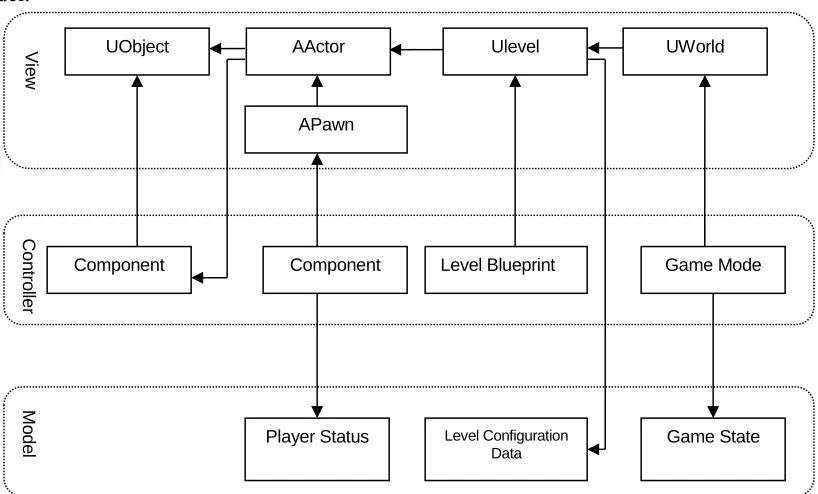
(1) The internal architecture of the game is designed according to UE4's Gameplay architecture. The entire framework is divided into three parts: View, Control and Model.
Data
Map Texture maps Music
Unreal Engine
Graphics Sound effect Physics
V
ie
w
Component Component Level Blueprint
C
o
n
tro
lle
r
Game Mode
UObject AActor Ulevel UWorld
APawn
Player Status Level Configuration
Data
M
o
d
e
[image:3.612.113.522.405.652.2]The upper layer is only responsible for external representations and does not process data. From the root, the UObject is the base of the object system. UObjcet derives the AActor, which is an object that can be placed or generated in the world. It inherits some of the features of UObject and it can hook components. APawn inherits from AActor, which can be controlled by the controller. Each character object in the game is an APawn, such as a player-controlled character in the game and various vehicles. ULevel is a space for AActor activities, equivalent to a game scene. And the combination of scenes is the World, which is the entire game world.
The middle layer is logically processed to formulate rules and patterns for the game. The AActor adds more functionality through the Component. The controller is used to control the APawn. The controller includes a HUD (Head Up Display) for displaying information on the screen, an Input, and a PlayerCameraManager that processes the camera view. The Level Blueprint serves as the logical carrier for this Level. Game mode is the definition of the game, including content like game rules.
The Level configuration data is processed in the lower layer, and the player state is created by the server. It is copied to all clients and contains online game information related to the player, such as game name, score, etc. The game state exists on the server and all clients and is free to copy to stay in sync. The purpose of separating them is for independent changes and synchronization between networks.
(2) The out-of-game part of the architecture is designed outside the game, mainly in the form of Model-View. View only handles the logic associated with the UI display. Data provisioning and logic processing are all done in the Model. In order to distinguish in the game, the control display logic will start with Page_, and the data processing will start with Model_. When creating a Page blueprint, you need to abstract the data processing logic related to the Page and put it under the Model blueprint corresponding to Page. For example, the blueprint Page_shop in the game is responsible for the shop display logic, and Model_Shop is responsible for processing the shop product data. In the Model, the stored content is resident memory, and it is forbidden to reference any UMG object.
4.2 The Design of Game Interactive Process
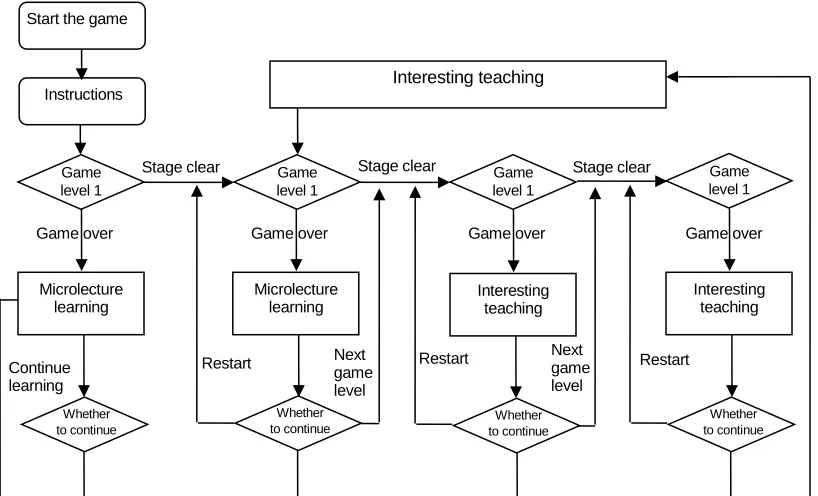
Figure 3. Interaction flowchart in the proposed game.
5. THE REALIZATION OF EDUCATIONAL GAMES
5.1 Implementation of the Scene Module
There are three issues to be aware of before importing the model into UE4. First, before the model is imported, it is necessary to determine the world position of the object, and there is no need to move and change the scene. Second, the issue of the proportion of model imports. Ensure that the ratio is consistent after import. Third, since there are many objects in the game scene, and the distance between the objects is very close, the original collision body must not be imported together to the UE4. Otherwise, some colliding bodies that are not closely attached may collide or cross with adjacent objects.
5.2 The Implementation of the Interaction Module
UI is an abbreviation of UserInterface, and UE4 adopts UMG UserInterface system. Take the example of making a player's blood volume bar. Right-click on the blank space in the ContentBrowser, find and click the WidgetBlueprint under the UserInterface option menu, open the UI editing interface, find the ProgressBar control from the Common of the Palette panel , click and drag to the CanvasPanel under the Hierarchy panel as the child node. Click ProgressBar, change its value to 100 in
Game level 1
Game level 1
Game level 1
Game level 1
Stage clear Stage clear Stage clear
Microlecture learning
Microlecture learning
Interesting teaching
Interesting teaching
Whether to continue
Whether to continue
Whether to continue
Whether to continue
Game over Game over Game over Game over
Interesting teaching Start the game
Instructions
Continue learning
Restart Next
game level
Restart Next
game level
side to bind the percentage display of the blood volume bar under the MotionCotrollerActor. HPpercent. This is a self-built function, and the value of the player's blood volume bar will change according to the change of the function value, and the player will observe his remaining blood volume.
6. CONCLUSIONS
Computer technology and computer graphics have developed rapidly in recent years. It is expected to be applied to more and more VR in our daily life and work. With the increase of application rate, VR will be more perfect and more humanized. Educational games have also received widespread attention from the public in the current development of computer technology. Compared with traditional education, in the use of educational games products by students, we find that they can receive knowledge more happily and profoundly. In the future, practitioners in this industry should continue to explore the current advanced and practical computer technology, and apply these technologies to education, so that the education of our country can be better developed in the future.
REFERENCES
1. Foreman N, Korallo L. 2014. “Past and Future Applications of 3-D (Virtual Reality) Technology,” Scientific and Technical Journal of Information Technologies, Mechanics and Optics, 2014, 94(6): 1-8.
2. Salamin P, Tadi T, Blanke O, et al. 2010. “Quantifying Effects of Exposure to the Third and First-Person Perspectives in Virtual-Reality-Based Training,” IEEE Transactions on Learning Technologies, 2010, 3(3): 272-276.
3. Pflesser B, Petersik A, Pommert A, et al. 2001. “Exploring the visible human's inner organs with the VOXEL-MAN 3D navigator,” Studies in Health Technology & Informatics, 2001, 81: 379-385. 4. Menshikova G Y, Kovalev A I, Klimova O A, et al. 2017. “The application of virtual reality
technology to testing resistance to motion sickness,” Psychology in Russia State of the Art, 2017, 10(3): 151-164.
5. Smith S, Ericson E. 2009. “Using immersive game-based virtual reality to teach fire-safety skills to children,” Virtual Reality, 2009, 13(2): 87-99.
6. Barnett M, Barab S A, Hay K E. 2001. “The Virtual Solar System Project,” Journal of College Science Teaching, 2001, 30(5): 300-304.
7. Tzovaras D, Nikolakis G, Fergadis G, et al. 2004. “Design and Implementation of Haptic Virtual Environments for the Training of the Visually Impaired,” IEEE Transactions on Neural Systems & Rehabilitation Engineering, 2004, 12(2): 266-278.
8. Kumar D, González A, Das A, et al. 2018. “Virtual Reality-Based Center of Mass-Assisted Personalized Balance Training System,” Frontiers in Bioengineering and Biotechnology, 2018, 5(1): 1-14.
9. Lam C K, Sundaraj K, Sulaiman M N. 2014. “Computer-based virtual reality simulator for phacoemulsification cataract surgery training,” Virtual Reality, 2014, 18(4):281-293.
10. Watanuki K, Hou L. 2010. “Augmented reality-based training system for metal casting,” Journal of Mechanical Science & Technology, 2010, 24(1): 237-240.
11. Kristian Kiili. 2005. “Digital Game-Based Learning: Towards an Experiential Gaming Model,”
Internet and Higher Education, 2005(8): 13–24.