2019 International Conference on Computation and Information Science (ICCIS 2019) ISBN: 978-1-60595-644-2
Design and Implementation of Indoor
Positioning System Based on Bluetooth
in Computer Room
Xiaoxu Cui, Liping Liu, Zhi Tian, Mingliang Wang
and Zuowen Wang
ABSTRACT
The amount of indoor material management is huge and widely distributed. This paper designs and implements the indoor positioning system of the computer room by using Bluetooth technology for the problems of traditional manual management, large management, difficult management and low efficiency. The Bluetooth positioning beacon is accepted by the material positioning tag card through the periodic broadcast signal, and the distance between the two is calculated according to the distance-RSSI loss model, and then the material coordinate is calculated by the three-side positioning algorithm, and the coordinate data is uploaded to the server through the Bluetooth gateway, and the user can Remotely view the material of the equipment room in real time on the client. The experimental data shows that the maximum error of indoor positioning is within 35cm and the positioning is accurate.
1.INTRODUCTION
2.SYSTEM DESIGN
2.1Overall System Design
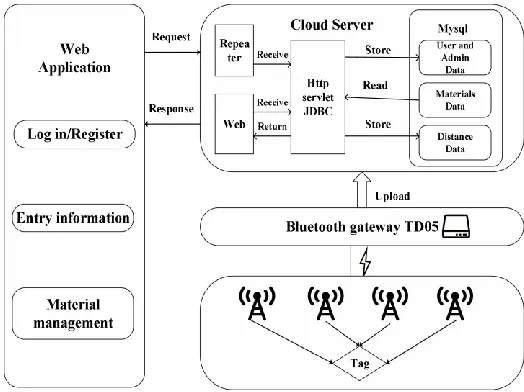
The overall structure of the system is shown in Figure 1. The indoor positioning design of the equipment room is divided into three modules: 1) Data acquisition module: collect data through the positioning beacon with Bluetooth Beacon and Bluetooth gateway, and then transfer to the server through the Bluetooth gateway [1];
2) Data receiving module: the server receives the RSSI data and performs calculation and storage into the MySQL database [2], and sends the processed data to the front-end web page through the indoor positioning algorithm;
[image:2.596.168.430.320.516.2]3) Client: The client is divided into two main functions: information entry and item management.
Figure 1. Overall structure of the system
2.2Hardware Design
algorithm. The coordinates of the material, coordinate data is uploaded to the server [5] through the Bluetooth gateway TD05.
2.3Software Design
Information entry is to enter the information about the item to which the tag belongs into the corresponding UUID (Bluetooth Unique Identification Number), and the entered information is sent to the server and stored in the MySQL database. The front end sends an http request request to the server, and after receiving the response response, the user is displayed to the user, and the user can view the specific location of the label and the specific information of the attached item through the management interface.
3.KEY MODELS AND ALGORITHMS
3.1Signal strength-distance loss model
To use Bluetooth for indoor positioning, you need to establish the distance-RSSI loss model [6-9].
Firstly, the RSSI value acquisition preprocessing is performed. The Bluetooth positioning beacon should be deployed to select the position of the surrounding unobstructed object to reduce the signal loss. After the signal is stable, the RRSI value is collected to prevent other signal interference and reduce the environmental error. Multiple RSSI values are collected at the same place. Mean filtering preprocessing is used to reduce measurement error, as in equation (1):
Secondly, the distance-RSSI loss model is established. The experimental data shows that there is a logarithmic relationship between the wireless signal strength and the distance, as in equation (2). Among them, PL(d) and PL(d0) respectively represent the signal strength loss of the wireless signal at d and d0 meters, and n is the environment. The variable factor, Xσ, is a normal random distribution with a variance of σ in dB. Let d0=1m, and (2) be changed to formula (3):
1
1 n
i
RSSI RSSI
n
(1)
0
0
( ) ( ) 10 lg(d )
PL d PL d n X
d
(2)
Bluetooth Beacon beacon is at a distance of 1 m from the positioning tag card. The distance d and the signal strength RSSI(d) are obtained from actual measurements, and n and R1 are the pending parameters of the model.
Finally, the optimal estimates of the parameters R1 and n. The least square method is used to find the optimal matching value by minimizing the sum of the squares of the errors to determine the optimal parameter value. The error function is given by equation (4):
RSSI d( ) R1 10 lg( )n d X (3)
2 1 1 ( , ) ( ( )) 2 m i i
J R n r RSSI d
m
(4) R1 and n are continuously cycle-optimized according to the initial value, as in equation (5):
1 1 1 1 ( ( )) 1
( ( ))10 lg( )
m i i i m i i
R R r RSSI d
m
n n r RSSI d d
m
(5) Where α is the gradient factor and α =0.02, so that J (R1, n) is minimized to obtain the desired R1 and n. The distance-RSSI loss model established according to the optimal parameters is as shown in equation (6):1
( ) 10 10
RSSI d R m
d
(6)
3.2Trilateral Centroid Localization Algorithm
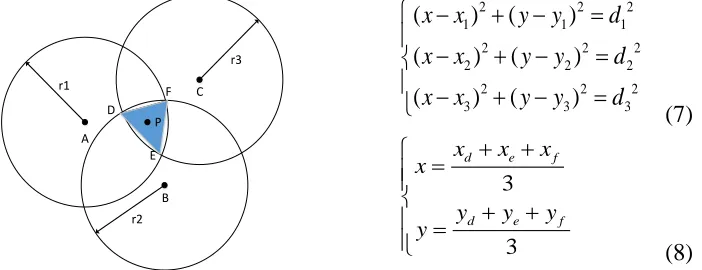
The coordinates of the material can be calculated by deploying the coordinates of the Bluetooth positioning beacon and the distance between the signal strength and the distance model [10].
A B C D E F P r1 r3 r2
2 2 2
1 1 1
2 2 2
2 2 2
2 2 2
3 3 3
( ) ( )
( ) ( )
( ) ( )
x x y y d
x x y y d
x x y y d
(7)
3
3
d e f
d e f
x x x
x
y y y
y
[image:5.596.134.485.105.240.2] (8)
Figure 2. Intersection region model under noise interference.
r1, r2, r3 represent the distance d between the material and the three nearest Bluetooth positioning beacon devices that are closest to it by the equation (6). The
three vertex coordinates of the shaded triangle that have been obtained by equation (6) are D (xd, yd), E (xe, ye), F (xf, yf), respectively, and the centroid coordinate P (x, y) of the triangle is to determine the position coordinates of the material, as in equation (8).
4. EXPERIMENT AND RESULT ANALYSIS
4.1 Distance-RSSI loss model parameter selection experiment
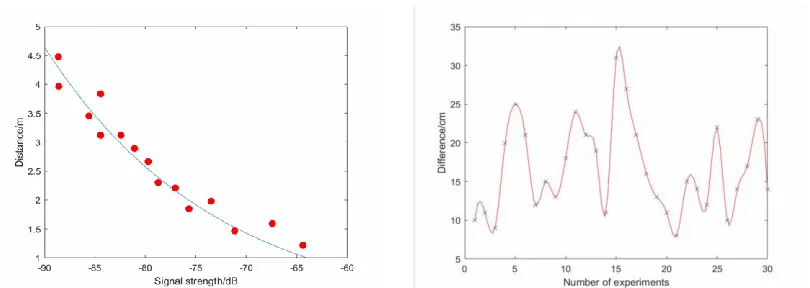
In order to determine the undetermined parameters n and R1 of the model, 15 points are selected at the indoor distance device 0.1m, 0.4m, 0.7m, 1.0m..., and the RSSI values collected by the pairing algorithm are averaged according to the positioning algorithm step, and then according to the steps. Second, use the least squares method to select the optimal parameters, and get R1=-68.451, n=2.556.
4.2 Material Positioning Experiment
In order to measure the error of the positioning algorithm, three Bluetooth positioning beacon devices are deployed in the 5.4m*16.2m indoor, and the two-dimensional coordinates are A (0,7.2), B (2.7,0), C (2.3,16.2), respectively. Is m. Randomly select 30 sampling points, substitute the collected data into the distance-RSSI loss model, and then calculate the material position coordinates according to the positioning step 3. Compare with the actual measured coordinate data to obtain the positioning error value as shown in Figure 7. It can be seen that the positioning error is always less than 35cm, and most of the errors are less
than 25cm, and the positioning accuracy is good.
Figure 6. Model curve and actual data Figure 7. Material positioning. error map.
5. CONCLUSIONS
[image:6.596.97.502.261.405.2]REFERENCES
1. Martin Woolley. 2019. Bluetooth Finder Technology Overview. Microcontroller and
Embedded System Applications, 2019, 19 (07): 90.
2. Zhenyuan Liu. 2018.Study on indoor positioning method based on low power Bluetooth beacon.Journal of China Academy of Electronics and Information Technology, 2018, 13(05):618-624.
3. Tao Wu. 2019. Research on indoor positioning algorithm based on WiFi and Bluetooth fusion. Anhui University of Engineering.
4. Bao Yang. 2019. A Bluetooth-based indoor positioning and navigation technology.Science
of Surveying and Mapping, 2019, 44(06):89-95.
5. Wenbin Xue, Hao Cui. 2019. Indoor Positioning System Based on iBeacon Bluetooth and MEMS Sensors. Computer Products and Circulation, 2019(03): 103.
6. Le Wang, Wanqing Liu. 2019. Application of RSSI Ranging in Bluetooth Indoor Positioning Robust Algorithm. Navigation and Timing, 2019, 6(03):82-87.
7. Jin Qian, Shurong Chen. 2019. Design and Implementation of Indoor Positioning and Navigation System Based on iBeacon. Microcomputer Applications, 2019, 35(01):76-79. 8. Chao Niu, Hui Wang. 2019. Design of fixed asset location and anti-lost anti-theft system
based on iBeacon. Internet of Things Technology, 2019, 9(01): 78-79.
9. Liping Song. 2019.Research on Indoor Positioning Algorithm Based on RSSI.Journal of
Taiyuan Normal University (Natural Science Edition), 2019, 18(02):49-52.