2018 International Conference on Physics, Computing and Mathematical Modeling (PCMM 2018) ISBN: 978-1-60595-549-0
Game Based Multi-Agent Equilibrium in Intelligent
City Transportation System Design
Jin LIU
1, Hong-jie ZHAO
2,*and Yoshito OGATA
11
Kyushu University, Fukuoka, Japan
2University of Electronic Science and Technology, Chengdu, China
*Corresponding author
Keywords: Intelligent city, Transportation system, Multi-agent, Game theory.
Abstract. Aiming at the complex, changing and distributed transport characteristics of future intelligent city, this paper applies multi-agent and game theory into urban intelligent transportation system design. A multi-agent architecture is built for the intelligent transport control system, then the game equilibrium mechanism and algorithm are developed. Finally, a simulation test is carried out to verify the effectiveness of the algorithm. The results show that the game equilibrium algorithm designed for multi-agent intelligent transport control system can effectively achieve the urban traffic coordination, which is beneficial to reduce traffic jams and has good theoretical value and guiding significance for the construction of intelligent city.
Introduction
Due to the considerable efficiency loss, energy loss and loss of life caused by traffic accidents and congestion, the traditional simple traffic control technology has already failed to meet the demand. Therefore, it is urgent to improve the urban traffic modernization, actively adopt modern high-tech methods and means, strengthen the urban road network capacity, and enhance the urban traffic conditions.
In the long-term practice, people gradually realize that the increasing traffic pressure cannot be met just by simply building and expanding roads. It is impossible to conduct large-scale road expansion construction because of fixed building structure, especially in the cities with serious traffic problems. To effectively solve traffic problem, it is advisable to turn to the ideas and methods of system engineering, as well as scientific and systematic comprehensive control. When speeding up the construction of transport infrastructure, people should strengthen traffic management, give full play to the potential of the existing traffic facilities (including roads) through the scientific and rational organization and control of traffic flow, and ensure the traffic flow safe, rapid, smooth and orderly to the maximum extent.
Urban intelligent traffic control system, as a huge complex network system, is complex, random, real-time, and nonlinear. Its analysis and design requires the application of theory and knowledge of large scale system. The application of multi-agent system (MAS) and game theory provide us with a good research direction[1]. We fully apply the idea and method of MAS and game theory to reasonably distribute road network traffic flow from the space and time, and achieve good effect of traffic management.
Multi-Agent Architecture of Intelligent Transport Control System
improve the control ability of the traffic control system by enhancing autonomous ability of the subsystem.
Urban traffic control induction system belongs to a complex large system, so hierarchical network intelligent mode is considered when building the system framework model, which includes organization level, coordination level, control level and execution level, and forms a network. Intelligent network model can achieve real-time control schemes with fewer computing resources, make quick response to traffic incidents, helps traffic participants (vehicle agent) achieve optimal travel or nearly optimal state, and realize the coordination of optimal system and user equilibrium.
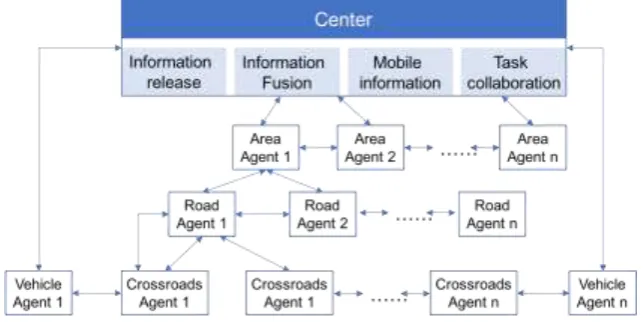
[image:2.595.137.459.245.406.2]By combining multi-agent technology with a hierarchical network structure, the multi-agent model [2] of intelligent urban traffic control system was established, which set up vehicles, intersection, road section, area, center, task coordination, movement information, information fusion and information release, with the structure shown in Figure 1.
Figure 1. Multi-agent based intelligent city transport control system model.
All kinds of agents have their different functions in multi-agent coordination model of urban traffic control induction system, so as to finish their tasks accordingly.
Vehicle agent has environmental perception, and changes their driving behavior in real-time way according to the surrounding actual situation.
Road sections agent is responsible for the fusion of the data collected by the sensor, and provides intersection agent with accurate traffic basic parameters, being the basis of a single intersection traffic distribution.
Intersection agent is responsible for the control of intersection traffic flow, realizes the integrated processing of the related four sections of information, predicts traffic information, and gives a single intersection traffic timing plan proposal, which feasibility is decided by the area agent.
Area agent is responsible for the statistical analysis of all the traffic within the jurisdiction, and achieves the overall coordination control decisions of the area by combining with the timing plan provided by traffic intersection, and using the information in the knowledge base.
By combining movement information agent, information fusion agent and collaborative task agent, center agent is responsible for analyzing the decision-making of all the area agents, coordinates the traffic of the whole city, works out solutions for traffic emergency, guides traffic jam in a timely manner, and makes the whole decision of traffic management with the consideration of comprehensive factors such as weather, major events, and the decision-making of reference areas. When necessary, it directly passes the decisions to intersection agent, enforces the decisions, and releases all kinds of traffic information through the information release agent at the same time. In multi-agent coordination model of urban traffic control induction system, various agents communicate information through dialogue communication mechanism.
Game Equilibrium in Multi-Agent Intelligent Transport Control System
is analyzed using the relevant knowledge and methods of game theory. The mechanism of equilibrium between intersection agents is emphatically explored. One game model is established to balance their relationship. According to the actual traffic flow, complementary advantages between intersections are maximized, and the game equilibrium is realized so as to improve the traffic capacity of the system[3].
Multi-Agent Game Equilibrium Mechanism
In the intelligent traffic control system based on multi-agent, all intersections have the common global goal of overall smooth traffic flow. Besides, each intersection agent has its own local goals of smooth traffic flow of the intersection[4]. Intersection agents and intersection agents between area agents, and area agents mutually influence, and interact. Therefore, each agent decision is necessarily affected by other decision-making choice, and the agents will inevitably face a certain degree of conflict. Here, the method of game theory is used to analyze the mechanism of cooperation and conflict between the agents; the game model is established to balance the relationship, and the game equilibrium is realized to ensure smooth traffic flow.
One game for the coordination model of urban traffic control induction system can be defined as follows:
{A, S, I, U}
G (1)
A denotes game behavior and the decision-making subject in the game coordination. It aims to maximize own benefit by choosing action strategies, and it is a collection of all agents, namely,
1 2 n
A {Agent , Agent , , Agent }
I denotes each agent’s information, including other agents’ characteristics and action strategy information.
S is the collection of all possible strategies or actions of agents; all feasible strategy for one agent is called its strategy room. Each agent has a limited set of pure strategy; S = {direct movement in east-west direction/direct movement in south-north direction, left-handed rotation in east-west direction and left-handed rotation in south-north direction}.
U is the profit function U ti( ), and it refers to the agent gain and loss under the condition of
established strategy combination.
Game equilibrium mechanism: each agent chooses the appropriate strategies in S based on their information I, and makes their interests reach Nash equilibrium through continuous coordination:
,
,
,i i i i i i i i
U s s U s s s S
(2)
i
s
denotes the strategy selected by the ith agent; s i
is the vector of all the agents’ strategy
except i. Ui denotes the benefit of the ith agent; Si denotes the strategy space of the ith agent. In
the multi-agent intelligent traffic control system model, the bottom is game between vehicle agents and crossing Agent and adjacent intersections Agent, the game between the middle is when the agent and intersection agent, area agent and road section agent, road agent and intersection agent, and area agents; the top is the game between the area agent and center agent.
Game Equilibrium Algorithm Design
Step 1: Center agent sends a signal control strategy to intersections agent through area agent, and sends induction strategy to vehicle agent broadcast via the information release agent;
Step 2: Intersections agent and vehicle agent response to strategy action, and look for Nash equilibrium;
Step 3: If there is Nash equilibrium, intersections agent and vehicle agent feedback to area agent and center agent, and then return to Step 1 for the next control cycle;
Step 4: If Nash equilibrium does not exist, intersections agent request for area agent; the area agent responds to the request, revises related strategies, conducts game coordination once again, and looks for Nash equilibrium;
Step 5: If the Nash equilibrium can not be reached after the area agent conducts the agreed number of game coordination, then it sends out to the coordination request to the center agent; the center agent responds to the request, revises related strategies and coordinates game once again, and looks for Nash equilibrium;
Step 6: If the Nash equilibrium can not be reached after the center agent had conducted the agreed number of game coordination, the automatic coordination fails, and it requests for manual intervention.
Simulation Test
The traffic entropy theory is applied[5], and macroscopic traffic entropy is introduced as a quantitative parameter of the traffic flow disorder. The more orderly internal traffic is, the smaller system energy is, and the smaller the traffic entropy is; and vice versa. The expression of macroscopic traffic entropy is as follows:
1
ln ( ) ( ) ln ( )
n
i i i
i
H E p t p t p t
(3)H denotes the macroscopic traffic entropy measurement in the area; p ti( ) is the congestion
[image:4.595.146.449.476.659.2]probability of the ith road traffic flow at time t relative to traffic capacity; n denotes total number of roads in the area.
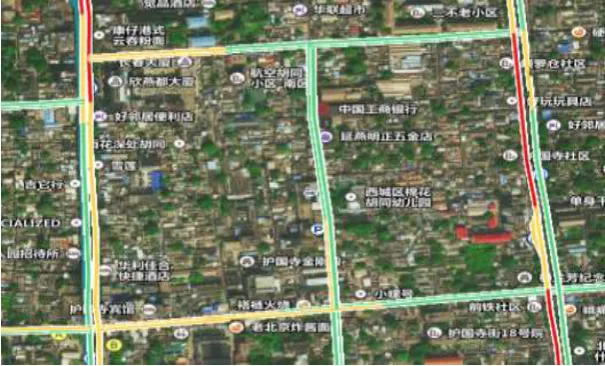
Figure 2. Selected simulation test area from Xinjiekou district in Beijing.
0 0.2 0.4 0.6 0.8 1 1.2 1.4
18:0 0
18:0 3
18:0 6
18:0 9
18:1 2
18:1 5
18:1 8
18:2 1
18:2 4
18:2 7
18:3 0
Traditional method
[image:5.595.168.439.87.201.2]Game Equilibrium
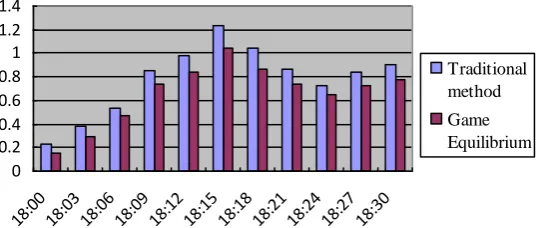
Figure 3. Comparative chart of between game equilibrium and traditional method.
As seen from Figure 3, within the period when the traffic flow increases constantly, the game equilibrium method has lower traffic entropy in the area, and better traffic order and flow control effect than traditional control method. Simulation test results show that the game equilibrium mechanism of intelligent traffic control system based on multi-agent can effectively control and guide the urban traffic flow, and improve the urban road network traffic capacity[6].
Summary
The new ways to solve the problem of the intelligent urban traffic using system theory and method are explored in the paper. Combining with multi-agent and game theory technology advantages, new thought and method are provided for the optimal design of the intelligent transportation system. It helps to realize traffic flow control and induce real coordination, as well as the effective balance of optimal system and user equilibrium, effectively improves the efficiency and actual capacity of urban road network, and provides important theoretical value and guiding significance for the intelligent urban construction in China.
References
[1]A. Stefano, S. Peter. Multi-agent Learning: Foundations and Recent Trends. Tutorial, IJCAI-17 conference. (2017)
[2]N. Muaz, H. Amir. Agent-based Computing from Multi-agent Systems to Agent-Based Models: A Visual Survey, Scientometrics. Springer. 89 (2): 479-499. (2011)
[3]J. N. Webb, Game Theory: Decisions, Interaction and Evolution, Springer. (2007)
[4]M. Ishii, P. T.-W. Lee, K. Tezuka, Y.-T Chang, A game theoretical analysis of port competition, Transportation Research Part E: Logistics and Transportation Review, 49(1), 92-106. (2013)
[5]H. Wang, X.N. Zhang, Game theoretical transportation network design among multiple regions, Annals of Operations Research, 249(1–2): 97-117. (2017)