© 2016, IRJET | Impact Factor value: 4.45 | ISO 9001:2008 Certified Journal | Page 2498
A Review on Route Adjustment for VGDRA in WSN
Insha Ashraf
1, Manish Kansal
21
M.Tech (ECE), Panchkula Engineering College, Haryana, India
2
A.P. (ECE), Panchkula Engineering College, Haryana, India
---***---
Abstract -
Wireless Sensor Networks (WSNs) consist of an
extensive number of small and low cost sensor nodes powered by small non rechargeable batteries and outfitted with different detecting devices. As a rule, for some applications, once a WSN is conveyed, probably in an in- friendly landscape, it is relied upon that all of a sudden dynamic to accumulate the required information for some times when something is distinguished, and after that remaining generally latent for drawn out stretches of time. Thus, efficient power saving schemes and corresponding algorithms must be created and planned keeping in mind the end goal to give reasonable energy consumption and to enhance the network lifetime for WSNs. The group based strategy is one of the great ways to deal with energy consumption in wireless sensor networks. The lifetime of wireless sensor networks is stretched out by proposed an virtual grid based dynamic routes adjustment (VGDRA) scheme for WSN in which some nodes are generally put to sleep to conserve energy, and this helps to enhance the network lifetime.Key Words
:
Wireless Sensor Network (WSN), WSN
Protocol, Virtual Grid based Dynamic Routes Adjustment (VGDRA).
1. INTRODUCTION
Wireless or Remote Sensor Network (WSN) – a self-organized network of minor processing and communication devices (nodes or hubs) has been widely used in several un-attended and dangerous environments. In a typical deployment of WSN, hubs are battery worked where they helpfully screen and report some wonder important to a
© 2016, IRJET | Impact Factor value: 4.45 | ISO 9001:2008 Certified Journal | Page 2499
uncommon essentialness resource of center points,progressive multiplication of sink's flexibility overhauls should be avoided as it phenomenally undermines the imperativeness insurance objective. In this appreciation, to enable sensor centers to keep up fresh courses towards the adaptable sink while obtaining immaterial correspondence cost, overlaying based virtual base over the physical framework is considered as a capable technique [6]. In the virtual system based data disseminating plans, only a game plan of appointed center points scattered in the sensor field are careful to screen sink's territory. Such doled out center points collect the watched data from the center points in their area in the midst of the nonappearance of the sink and after that proactively or responsively report data to the flexible sink.
[image:2.595.42.282.520.706.2]
2. WIRELESS SENSOR ROUTING PROTOCOLS
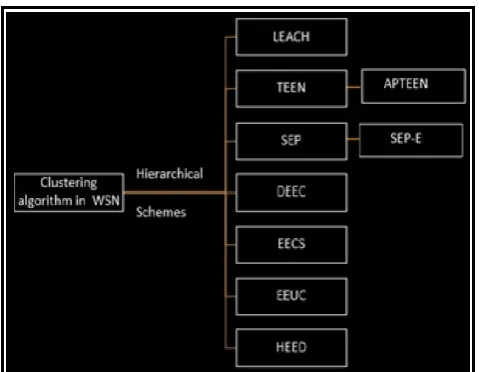
Recent advances in wireless sensor networks have lead to numerous new conventions particularly intended for sensor systems where vitality mindfulness is a fundamental thought. In any case, approaches like Direct Communication and Minimum Transmission Energy don't promise adjusted vitality dissemination among the sensor hubs.Figure 1: Classification of Clustering Schemes in WSN.
In Direct Communication Protocol every sensor hub transmits data specifically to the base station, paying little
respect to separate. Therefore, the hubs uttermosts from the BS are the ones to kick the bucket first. Then again, if there should arise an occurrence of Minimum Transmission Energy directing convention information is transmitted through middle of the road hubs. In this way every hub goes about as a switch for different hubs information notwithstanding detecting the earth. Hubs nearest to the BS are the first amazing MTE directing. In this way, bunch based system is one of the methodology which effectively expands the lifetime and soundness of entire sensor systems. we characterized most imperative vitality productive steering systems in light of different bunching characteristics like group development and information gathering process. Figure 1 is a various leveled outline of various directing conventions which are generally utilized as a part of WSN. A few virtual base based information spread conventions have been proposed for versatile sink based WSN in the most recent decade. In view of the portability design displayed by the sink in the sensor field, the information gathering or dispersal plans can be characterized into controlled and uncontrolled sink versatility plans. In controlled sink versatility plans [7] [10], the portability (speed and/or bearing) of the sink is controlled and controlled either by an outer onlooker or as per the system progression. The uncontrolled sink portability based plans are described by the way that the sink makes its best course of action self-rulingly as far as velocity and heading. This paper considers the uncontrolled sink portability situations and in the accompanying lines, we quickly depict the related works in this setting including their procedure and the relative qualities and shortcomings.
3. LITERATURE REVIEW
© 2016, IRJET | Impact Factor value: 4.45 | ISO 9001:2008 Certified Journal | Page 2500
virtual spine system. VCCSR plan diminishes the coursesremaking cost in coordinating the sink versatility on account of its arrangement of correspondence tenets, at the same time, the bunch head as an inside piece in courses re-change process diminish its vitality much prior. Further plan called Hexagonal cell-based Data Dissemination (HexDD) was recommended in [12] that manufactures a hexagonal framework structure for continuous information conveyance. The dynamic circumstances of different versatile sinks are considered in this. It results in high vitality utilization for the most part at higher sink's rates however it makes early problem area issue. Gracious et al. proposed a plan taking into account information spread known as Backbone-based Virtual Infrastructure (BVI) in [13], which makes utilization of single-level multi-jump bunching and indicates lessen the aggregate number of groups. It utilizes HEED [14] for grouping in which fundamental concern is given to lingering vitality level of hubs for choosing the CH hubs. The multi-bounce grouping is a fine way to deal with diminish the quantity of bunches, then again, the root hub which is the center in courses changes produces early vitality exhaustion which lessens the lifetime of system. Multiple Enhanced Specified-Deployed Subsinks (MESS) in [15], makes a virtual strip in the focal point of sensor field along these lines putting upgraded remote hubs (sub-sinks) having more stockpiling limit at equivalent separations. The same methodology has been proposed in Line-Based Data Dissemination (LBDD) [16] that makes a vertical line by partitioning the sensor field into two equivalent estimated pieces. Alongside this, another comparative methodology was found in, which focuses a virtual rail (RailRoad) amidst the sensor field. The principle downside of MESS, LBDD, and RailRoad is the early vitality consumption of hubs near the virtual structure. Quadtree-based Data Dissemination (QDD) plan was proposed by Mir and Ko in, it likewise brings about early vitality exhaustion of hubs, same as in the above plans. This strategy likewise lessens the general system lifetime. A further approach called Virtual Grid based Two-Tier Data Dissemination
(TTDD) in [19] dedicatedly shapes a uniform for each source hub virtual framework structure drawing nearer the complete sensor field. TTDD keeps the flooding of the sink's topological overhauls however the per source virtual matrix development diminishes the system lifetime.
Geographical Cellular-like Architecture (GCA) in [20] makes a cell like various leveled hexagonal virtual structure for taking care of sink portability. GCA however avoids flooding of area data of sink, however there is expansion in dormancy and parcel misfortune proportion due to non-perfect information conveyance ways. Hierarchical Cluster based Data Dissemination (HCDD) in [21] approaches a progressive bunch design in which the second level group leaders of the portable sink are chosen as steering operators which are in charge of keeping up the track on latest area of versatile sink. In high sink versatility, hubs that are utilizing HCDD encounters high vitality utilization. In this approach, the information conveyance ways are not ideal which results in high inactivity.
4. VIRTUAL GRID BASED DYNAMIC ROUTES
ADJUSTMENT
[image:3.595.314.552.542.701.2]Virtual Grid based Dynamic Routes Adjustment (VGDRA) is proposed for periodic data collection from WSN.
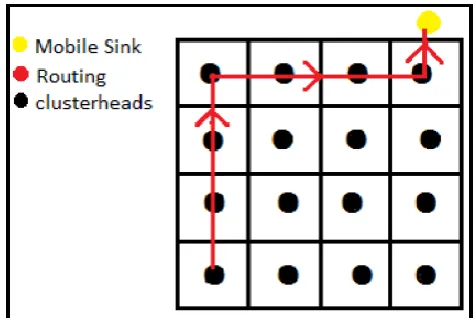
Figure 2: Straight line communication in VGRDA.
© 2016, IRJET | Impact Factor value: 4.45 | ISO 9001:2008 Certified Journal | Page 2501
utilization and information conveyance execution utilizing a [image:4.595.45.280.486.667.2]solitary versatile sink while sticking to the minimal effort subject of WSN. The proposed plan empowers sensor hubs to keep up about ideal courses to the most recent area of a portable sink with negligible system overhead. It segments the sensor field into a virtual lattice of K equivalent estimated cells and develops a virtual spine system involved all the cell-headers furthermore, VGDRA additionally sets up correspondence courses such that the end-to-end postponement and vitality expense is minimized in the information conveyance stage to the versatile sink. The mobile sink moves along the periphery of the sensor field and speaks with the fringe cell-headers for information accumulation. The courses rearrangement procedure is represented by an arrangement of tenets to progressively adapt to the sink versatility. Utilizing VGDRA, just a subset of the cell-headers needs to join in re-conforming their courses to the most recent area of the versatile sink there by lessening the correspondence cost. Recreation results uncover diminished vitality utilization and speedier merging of VGDRA contrasted with other cutting edge.
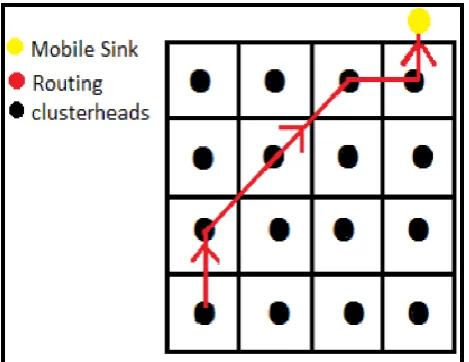
Figure 3: Shortest distance in grid routing approach.
Virtual Grid based Dynamic Routes Adjustment (virtual framework directing) in [22], assembles a virtual spine system and uses straight line correspondence however in this methodology, separation need correspondence is utilized, which will diminish the vitality utilization and
enhances the system lifetime. Figure 2 shows the straight line correspondence which is utilized as a part of VGRDA. Figure 3 shows the communication based on distance priority which is used in our distance enhancing grid routing approach.
5. CONCLUSION
According to review of previous approach firstly studied a virtual grid routing design, which acquires smallest correspondence cost while keeping up almost ideal courses to the most recent range of the portable sink. VGDRA arrangement distributes the sensor field into a virtual grid and builds up an virtual spine structure included the cell header nodes. The energy sort is considered to decrease energy dissipation which will improve the energy consumption and data delivery execution. Lifetime of the system will likewise be moved forward. The group based strategy is one of the great ways to deal with energy consumption in wireless sensor networks. The lifetime of wireless or remote sensor networks is stretched out by proposed an virtual grid based dynamic routes adjustment (VGDRA) scheme for WSN in which some nodes are generally put to sleep to conserve energy, and this helps to enhance the network lifetime. For further extent of the work, improve the network lifetime using various optimization algorithms can also be used for improving the performance of distance enhancing grid routing scheme.
REFERENCES
1) R. C. Shah, S. Roy, S. Jain, and W. Brunette, “Data MULEs: Modeling and analysis of a three-tier architecture for sparse sensor networks,” in Ad Hoc Network, vol. 1. 2003, pp. 215–233.
© 2016, IRJET | Impact Factor value: 4.45 | ISO 9001:2008 Certified Journal | Page 2502
3) W. Khan, A. H. Abdullah, M. H. Anisi, and J. I. Bangash, “Acomprehensive study of data collection schemes using mobile sinks in wireless sensor networks,” Sensors, vol. 14, no. 2, pp. 2510–2548, 2014.
4) M. Di Francesco, S. K. Das, and G. Anastasi, “Data collection in wireless sensor networks with mobile elements,” ACM Transaction Sensor Network, vol. 8, no. 1, pp. 1–31, Aug. 2011.
5) Chalermek, R. Govindan, and D. Estrin, “Directed diffusion: A scalable and robust communication paradigm for sensor networks,” in Proc. ACM SIGMOBILE International Conference Mobile Computer Network (MOBICOM), 2000, pp. 56–67.
6) E. B. Hamida and G. Chelius, “Strategies for data dissemination to mobile sinks in wireless sensor networks,” IEEE Wireless Commuunication, vol. 15, no. 6, pp. 31–37, Dec. 2008.
7) Kinalis, S. Nikoletseas, D. Patroumpa, and J. Rolim, “Biased sink mobility with adaptive stop times for low latency data collection in sensor networks,” Inf. Fusion, vol. 15, pp. 56–63, Jan. 2014.
8) W. M. Aioffi, C. A. Valle, G. R. Mateus, and A. S. da Cunha, “Balancing message delivery latency and network lifetime through an integrated model for clustering and routing in wireless sensor networks,” Computer Network, vol. 55, no. 13, pp. 2803–2820, Sep. 2011.
9) Nazir and H. Hasbullah, “Mobile sink based routing protocol (MSRP) for prolonging network lifetime in clustered wireless sensor network,” International Conference Computer Applied Industry (ICCAIE), Dec. 2010, pp. 624–629.
10) T. Banerjee, B. Xie, J. H. Jun, and D. P. Agrawal, “Increasing lifetime of wireless sensor networks using controllable mobile cluster heads,” Wireless Communication Mobile Computer, vol. 10, no. 3, pp. 313–336, Mar. 2010.
11) T.-S. Chen, H.-W. Tsai, Y.-H. Chang, and T.-C. Chen, “Geographic convergecast using mobile sink in wireless sensor networks,” Computer Communication, vol. 36, no. 4, pp. 445–458, Feb. 2013.
12) Erman, A. Dilo, and P. Havinga, “A virtual infrastructure based on honeycomb tessellation for data dissemination in multi-sink mobile wireless sensor networks,” EURASIP Journal Wireless Communication Network, vol. 2012, no. 17, pp. 1–54, 2012.
13) S. Oh, E. Lee, S. Park, J. Jung, and S.-H. Kim, “Communication scheme to support sink mobility in multi-hop clustered wireless sensor networks,” 24th IEEE International Conference Advance. Inf. Network Applied, Apr. 2010, pp. 866–872.
14) O. Younis and S. Fahmy, “HEED: A hybrid, energy-efficient, distributed clustering approach for ad hoc sensor networks,” IEEE Transaction Mobile Computer, vol. 3, no. 4, pp. 366–379, Oct. 2004.
15) Tang, J. Wang, X. Geng, Y. Zheng, and J.-U. Kim, “A novel data retrieving mechanism in wireless sensor networks with path-limited mobile sink,” International Journal Grid Distribution Computer, vol. 5, no. 3, pp. 133–140, 2012.