Georgia State University
ScholarWorks @ Georgia State University
Educational Psychology, Special Education, and Communication Disorders Dissertations
Department of Educational Psychology, Special Education, and Communication Disorders
7-3-2007
Using Speech Recognition Software to Increase
Writing Fluency for Individuals with Physical
Disabilities
Jennifer Tumlin Garrett
Follow this and additional works at:https://scholarworks.gsu.edu/epse_diss
Part of theEducational Psychology Commons, and theSpecial Education and Teaching Commons
This Dissertation is brought to you for free and open access by the Department of Educational Psychology, Special Education, and Communication Disorders at ScholarWorks @ Georgia State University. It has been accepted for inclusion in Educational Psychology, Special Education, and Communication Disorders Dissertations by an authorized administrator of ScholarWorks @ Georgia State University. For more information, please
Recommended Citation
Garrett, Jennifer Tumlin, "Using Speech Recognition Software to Increase Writing Fluency for Individuals with Physical Disabilities." Dissertation, Georgia State University, 2007.
This dissertation, USING SPEECH RECOGNITION SOFTWARE TO INCREASE WRITING FLUENCY FOR INDIVIDUALS WITH PHYSICAL DISABILITIES by JENNIFER TUMLIN GARRETT, was prepared under the direction of the candidate’s Dissertation Advisory Committee. It is accepted by the committee members in partial fulfillment of the requirements for the degree Doctor of Philosophy in the College of Education, Georgia State University.
The Dissertation Advisory Committee and the student’s Department Chair, as representatives of the faculty, certify that this dissertation has met all standards of excellence and scholarship as determined by the faculty. The Dean of the College of Education concurs.
____________________________ ____________________________ Kathryn Wolff. Heller, Ph.D. Paul A. Alberto, Ph.D.
Committee Chair Committee Member
____________________________ ____________________________ Linda Fowler, Ph.D Laura D. Fredrick, Ph.D.
Committee Member Committee Member
____________________________ Colleen M. O’Rourke, Ph.D. Committee Member
____________________________ Date
____________________________ Peggy L. Gallagher, Ph.D.
Chair, Department of Educational Psychology and Special Education
____________________________ Ronald P. Colarusso, Ed.D.
AUTHOR’S STATEMENT
By presenting this dissertation as a partial fulfillment of the requirements for the
advanced degree from Georgia State University, I agree that the library of Georgia State University shall make it available for inspection and circulation in accordance with its regulations governing materials of this type. I agree that permission to quote, to copy from, or to publish this dissertation may be granted by the professor under whose direction it was written, by the College of Education's director of graduate studies and research, or by me. Such quoting, copying, or publishing must be solely for scholarly purposes and will not involve potential financial gain. It is understood that any copying from or publication of this dissertation which involves potential financial gain will not be allowed without my written permission
All dissertations deposited in the Georgia State University library must be used in
accordance with the stipulations prescribed by the author in the preceding statement. The author of this dissertation is:
Jennifer Tumlin Garrett 609 N 6th Street Rochelle, IL 61068
The director of this dissertation is:
Dr. Kathryn Wolff Heller
Department of Educational Psychology and Special Education College of Education
VITA
Jennifer Tumlin Garrett
ADDRESS: 609 N. 6th Street
Rochelle, IL 61068
815-562-2524
Email: [email protected]
EDUCATION:
Ph.D. 2007 Georgia State University
Education of Students with Exceptionalities M.Ed. 1998 Georgia State University
Multiple and Severe Disabilities
BSEd. 1994 University of Georgia
Mental Retardation Education
PROFESSIONAL EXPERIENCE:
2006 to present Learning and Behavioral Specialist Teacher, Middle School and High School, Math, Social Science, and Technology
Rochelle Township High School, Rochelle, IL 2004 – 2005 Instructional Lead Teacher
Cobb County Schools, Wheeler High School 2001 - 2006 Graduate Research Assistant
Georgia State University
1998 – 2004 Orthopedic Impairments Teacher, Grades 9-12 Cobb County Schools, Wheeler High School 1996 – 1998 Special Education Department Chair
Gwinnett County Schools, Dyer Elementary 1994 – 1998 Intellectual Disabilities Teacher, Grades K-1 Gwinnett County Schools, Dyer Elementary
PROFESSIONAL SOCIETIES AND ORGANIZATIONS:
1993 - present Council for Exceptional Children
PRESENTATIONS AND PUBLICATIONS:
Heller, K.W., Coleman-Martin, M.B., & Tumlin Garrett, J. (2007). Adapting
environments and using technology. In R.P. Colarusso & C.M. O’Rourke (Eds.), Special education for all teachers (4th ed.). Dubuque, IA: Kendall Hunt.
Heller, K.W. & Tumlin Garrett, J. (2006). Cerebral palsy. In K.W. Heller, P.A. Alberto, P. Forney, S. Best, & M. Schwartzman (Eds.), Understanding Physical health and multiple disabilities. (2nd ed.). Manuscript submitted for publication.
Tumlin, J., & Mezei, P. (2005, April). Using word prediction to increase typing fluency and decrease spelling errors. Poster session presented at the Council for
Exceptional Children National Conference, Baltimore, MD.
Tumlin, J., Heller, K. W. (2004). Using word prediction software to increase typing fluency with students with physical disabilities. Journal of Special Education Technology, 19 (3), 5-14.
Heller, K. W., & Tumlin, J. (2004). Using expanded individualized healthcare plans to assist teachers of students with complex healthcare needs. Journal of School Nursing, 20, 150-160.
Heller K. W., Coleman-Martin, M. B., & Tumlin, J. J. (2003). Adapting environments and using technology. In R. P. Colarusso & C.M. O’Rourke (Eds.), Special education for all teachers. (3rd ed), (402-437). Dubuque, IA: Kendall Hunt.
Tumlin, J. (2003). Making inclusion work essay. In R. M. Gargiulo (Ed.), Special education in a contemporary society: An introduction to exceptionality (pp. 574-575). Belmont, CA: Wadsworth/Thomson Learning.
Heller, K.W., Swinehart-Jones, D., Coleman-Martin, M., & Tumlin, J. (2002). Overview of the Bureau for Students with Physical and Health Impairments. Poster session presented at Georgia Legislators' Event, Atlanta, GA.
Heller, K. W., Fredrick, L. D., Tumlin, J., & Brineman, D. G. (2002). Teaching decoding for generalization using the nonverbal reading approach. Journal of Physical and Developmental Disabilities, 14, 19-35.
Heller, K.W., & Tumlin, J. (2002, April). Teaching decoding for generalization using the Nonverbal Reading Approach. Paper presented at the Council for Exceptional Children National Conference. New York, NY.
ABSTRACT
USING SPEECH RECOGNITION SOFTWARE TO INCREASE WRITING FLUENCY FOR INDIVIDUALS WITH PHYSICAL DISABILITIES
by
Jennifer Tumlin Garrett
Writing is an important skill that is necessary throughout school and life. Many
students with physical disabilities, however, have difficulty with writing skills due to
disability-specific factors, such as motor coordination problems. Due to the difficulties
these individuals have with writing, assistive technology is often utilized. One piece of
assistive technology, speech recognition software, may help remove the motor demand of
writing and help students become more fluent writers. Past research on the use of speech
recognition software, however, reveals little information regarding its impact on
individuals with physical disabilities. Therefore, this study involved students of high
school age with physical disabilities that affected hand use. Using an alternating
treatments design to compare the use of word processing with the use of speech
recognition software, this study analyzed first-draft writing samples in the areas of
fluency, accuracy, type of word errors, recall of intended meaning, and length. Data on
fluency, calculated in words correct per minute (wcpm) indicated that all participants
wrote much faster with speech recognition compared to word processing. However,
accuracy, calculated as percent correct, was much lower when participants used speech
recognition compared to word processing. Word errors and recall of intended meaning
participants wrote longer drafts when using speech recognition software, primarily
because their fluency was higher, and they were able, therefore, to write more words.
Although the results of this study indicated that participants wrote more fluently
with speech recognition, because their accuracy was low, it is difficult to determine
whether or not speech recognition is a viable solution for all individuals with physical
disabilities. Therefore, additional research is needed that takes into consideration the
USING SPEECH RECOGNITION SOFTWARE TO INCREASE WRITING FLUENCY FOR INDIVIDUALS WITH PHYSICAL DISABILITIES
by
Jennifer Tumlin Garrett
A Dissertation
Presented in Partial Fulfillment of Requirements for the Degree of
Doctor of Philosophy in
Education of Students with Exceptionalities in
the Department of Educational Psychology and Special Education in
the College of Education Georgia State University
Copyright by Jennifer Tumlin Garrett
ACKNOWLEDGEMENTS
I cannot imagine that I would have been able to achieve my goal of obtaining my Ph.D. without the help and support of a number of people over the last several years. Dr. Kathy Heller was not only an outstanding professor, advisor, and dissertation committee chair, but also an incredible mentor. Her professionalism, work ethic, and knowledge inspire me, and I have grown so much by merely being associated with her. Thank you, Dr. Heller. I also would not have been able to complete my dissertation without the help and support of my other committee members, Drs. Paul Alberto, Laura Fredrick, Colleen O’Rourke, and Linda Fowler. The amount of feedback and input that you all gave me was much-needed and resulted in a project that was both exciting and worthwhile. Thank you all.
In addition to my committee, a number of fellow students were extremely helpful to and supportive of me thorough this process. First, if it was not for Doug McJannet, I never would have entered the Master’s program at Georgia State. He stated what now seems to be the obvious, that the orthopedic impairments program would be a good fit for me, and he certainly was correct. Thanks, Doug, for your life-changing idea. I don’t know where I would be if not for your suggestion. Peter Mezei was also instrumental in helping me complete the program. He was my go-to person in Atlanta once I moved away and helped with logistics and made sure I reached all of my deadlines. In addition to that, Peter was a great person to collaborate with, because he thinks with such clarity and depth. Thanks for all of your help, Peter. So many other fellow students helped me along the way, including Mari Beth Coleman-Martin, Dawn Swinehart-Jones, David Cihak, and many others. I also need to extend appreciation to Cobb County Schools for allowing me to grow as a teacher in the district and to return to collect data.
Finally, I would like to thank my close friends and family who supported me throughout the program. I am grateful for the encouragement of people like my friend Sharon Hunt; my parents, Beth and Bill; my sister, Tracy; and my husband, Mike. I never would have made it without you all. Thank you, Mike for supporting me during my year off and for being patient as I extended my graduation date more than once. And to my sister Natalie, you were the biggest inspiration in my life. The 30 years I had with you made me who I am today, and there’s not a day that goes by that I do not think of the influence that you have had on me. And finally, to Julianne, although I’ll never be able to tell you, had it not been for your existence, I probably still would be trying to finish school. Your short presence within me helped me to set my goals, meet my deadlines, and become Dr. Jennifer Tumlin Garrett. Thank you, and I love you. I truly have been blessed with wonderful people in my life.
TABLE OF CONTENTS
Page
List of Tables ... iv
List of Figures ... v
Abbreviations... vi
Chapter 1 WRITING FLUENCY FOR INDIVIDUALS WITH PHYSICAL DISABILITIES: A REVIEW OF THE LITERATURE... 1
Introduction and Purpose ... 1
Review of the Literature ... 2
Conclusions... 46
References... 48
2 USING SPEECH RECOGNITION SOFTWARE TO INCREASE WRITING FLUENCY FOR INDIVIDUALS WITH PHYSICAL DISABILITIES ... 57
Statement of the Problem ... 57
Purpose... 65
Research Questions... 66
Methodology ... 66
Results... 92
Discussion ...118
Conclusions...132
References...134
Appendixes ...139
LIST OF TABLES
Table Page
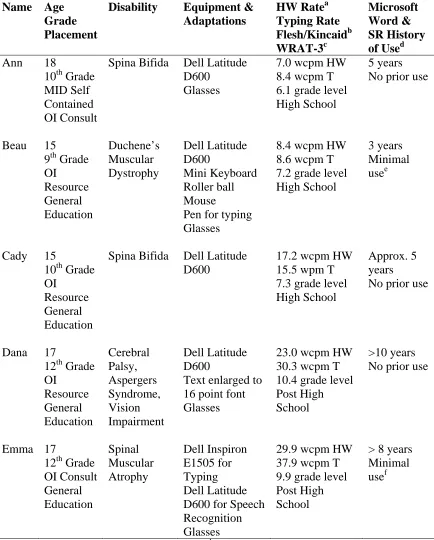
1 Student information ...68
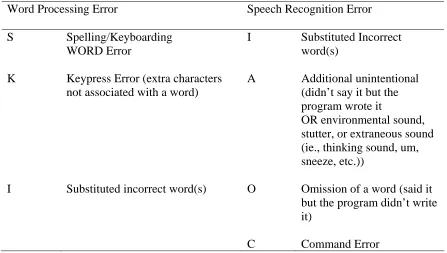
2 Coding for word errors across word processing and speech recognition ...89
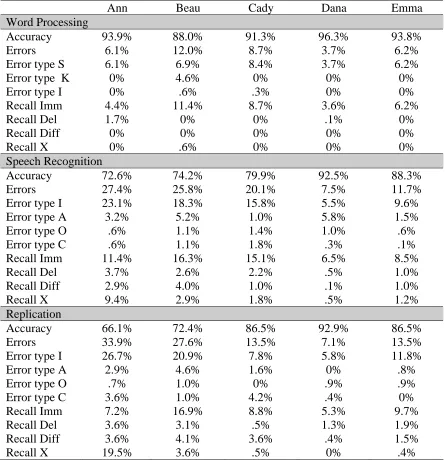
3 Percent of word errors across all words...98
4 Social validity questionnaire...115
LIST OF FIGURES
Figure Page
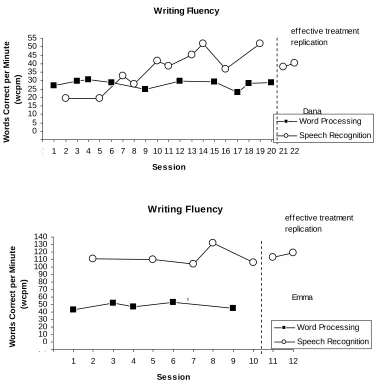
1 Writing fluency across participants ... 93
2 Accuracy across participants... 95
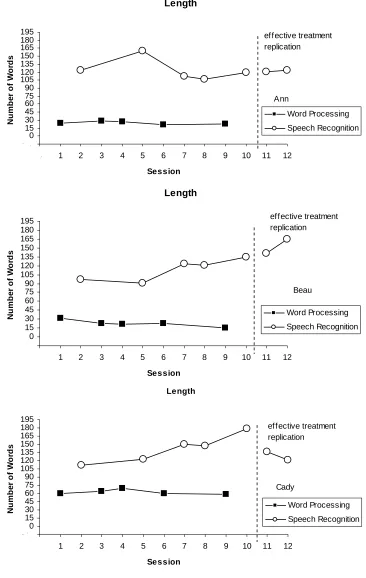
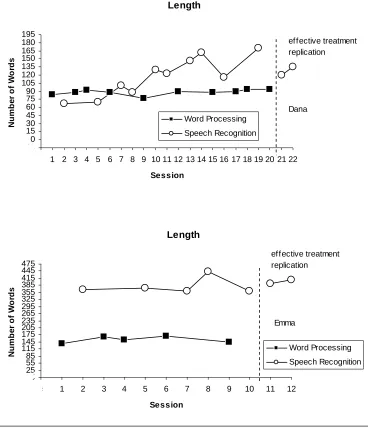
3 Length across participants...100
ABBREVIATIONS
AT Assistive Technology
CP Cerebral Palsy
LD Learning Disabilities
MD Muscular Dystrophy
MID
OI
Mild Intellectual Disabilities
Orthopedic Impairments
SMA Spinal Muscular Atrophy
wcpm Words Correct per Minute
MDVP Multi-Dimensional Voice Program (Kay Elemetrics, 1993)
CHAPTER 1
WRITING FLUENCY FOR INDIVIDUALS WITH PHYSICAL DISABILITIES: A
REVIEW OF THE LITERATURE
Introduction and Purpose
Writing is an important skill to acquire not only in school but also in life. It
allows individuals to communicate their thoughts in a nonvocal format. For individuals
who are nonverbal, it allows them to demonstrate understanding and intelligence. Writing
is also an important skill in the school environment, in the community, and in the
workplace. However, individuals with physical disabilities often have problems in
academic areas, such as writing, due to a number of interactional factors.
Students with physical disabilities have difficulties writing efficiently due to
decreased motor control in their hands. Handwriting is often not an option, and typing
rate can be extremely slow. Writing accuracy also can be affected due to poor spelling
performance (Sandberg, 2001) and extraneous motor movements, which can cause
unintended keystrokes (Best, Heller, & Bigge, 2005). Because individuals with physical
disabilities often are unable to write by hand, their only option for written output may be
using a word processor. There are many ways that word processors can provide better
access for individuals with physical disabilities. However, despite having the word
processor set up for modified access, motor problems that affect the typing speed of
individuals with physical disabilities may make word processing an inefficient option for
producing written output. The use of different types of assistive technology, such as
speech recognition software, may increase speed because it is activated by voice and is
therefore hands-free. Because users do not have to concern themselves with spelling
using speech recognition, accuracy also may improve. However, due to the high level of
recognition accuracy needed to effectively use speech recognition, more errors may be
produced.
The purpose of the review of the literature, therefore, is to examine the impact of
physical disabilities on writing and the applicability of using speech recognition software
as a possible intervention and strategy to improve writing output for this population.
Issues of speed of entry, accuracy rates, and production of errors will be discussed.
Because the research base that includes individuals with physical disabilities is limited,
research from the learning disabilities field will be discussed due to the fact that
individuals with physical disabilities and learning disabilities can experience similar
barriers to writing.
Review of the Literature
Types of Physical Disabilities that Affect Writing
Several types of physical disabilities exist that may have a negative impact on
writing. Therefore, this paper will refer to any orthopedic impairment, as defined below,
as a physical disability or physical impairment. In Georgia, the term orthopedic
impairment:
Refers to students whose severe orthopedic impairments affect their educational performance to the degree that the student requires special education. This term may include:
(1) Impairment caused by congenital anomalies, e.g., deformity or absence of some member.
Secondary disabilities may be present, including, but not limited to, visual impairment, hearing impairment, communication impairment and/or intellectual
disability.(http://public.doe.k12.ga.us/DMGetDocument.aspx/exceptional_ eligibility_oi.pdf?p=4BE1EECF99CD364EA5554055463F1FBBF5D074 D5FB1F2CAEB3B63B3ECB220CDD26C2114F3C57D8D25C69F04B76 A08C8D&Type=D)
This term includes such common conditions as cerebral palsy, spina bifida, muscular
dystrophy, and spinal muscular atrophy.
One of the most common physical disabilities is cerebral palsy. Cerebral palsy
refers to “a nonprogressive disorder of voluntary movement caused by damage to the
motor centers of the brain before or during birth or within the first few years of life”
(Heller, Alberto, Forney, & Schwartzman, 1996, p. 390). Specific motor issues such as
movement patterns, tone, and muscle control are commonly abnormal. In addition to the
motor problems that cerebral palsy can cause, there are often associated conditions, such
as difficulties in the area of cognition and learning, speech and communication, and
vision. All of these factors can have a tremendous impact on the functioning of the
individual and must be considered when assessing and providing writing activities for
individuals with cerebral palsy.
Problems with fine motor coordination are common with cerebral palsy. Often,
these motor patterns can lead to contractures, or shortening of the muscles (ligaments)
(Best et al., 2005). Spastic cerebral palsy often results in fingers, wrists, and elbows being
in flexion (Heller et al., 1996) and abnormal muscle tightness in the arms, hands, and
fingers (Best et al.). This can adversely affect fine motor coordination. Handwriting and
keyboarding can be difficult for individuals whose fine motor control is affected due to
Lack of coordination and range of motion may cause an individual with athetoid
cerebral palsy to have difficulty writing due to uncontrolled, nonpurposeful movements
with variable tone (Best et al., 2005). Also, these individuals often have a limited range
of motion and cannot access the same range of their environment as those with typical
motor patterns (Best et al.). Posture is often affected, so proper positioning of materials
can be important. Due to these abnormal motor patterns, fine motor work can be more
difficult. Reaching the desired target, whether it is for handwriting or keyboarding, can be
a challenging and inefficient task for individuals with cerebral palsy and can negatively
affect writing.
Cognitive and learning issues also can affect individuals with cerebral palsy (Best
et al., 2005; Heller et al., 1996). Individuals with cerebral palsy can have a range of
cognitive levels, from gifted to severe or profound mental retardation. However, there is a
higher incidence of mental retardation with more severe forms of cerebral palsy.
Learning also can be affected, and individuals with cerebral palsy often can have visual
or auditory processing difficulties. Cognitive and learning issues related to cerebral palsy
can affect an individual’s writing. Whether it is collecting and organizing thoughts or the
processing time it takes, or just getting words down on paper or on the computer screen,
individuals with cognitive or leaning problems in addition to cerebral palsy can
experience difficulty writing.
Speech impairments also are common with all types of cerebral palsy (Kotler &
Thomas-Stonell, 1997) and can impact writing. Speech is often affected due to motor
coordination issues. If the individual cannot physically write due to cerebral palsy, then
speech and communication issues can get in the way of the individual expressing what he
wants to say, thus affecting the individual’s ability to produce written work.
There are also a number of additional impairments that must be considered when
working with individuals with cerebral palsy. For example, the impact of having visual
impairments in addition to cerebral palsy can have an impact on the individual’s
functioning in his environment. Vision issues secondary to cerebral palsy may affect an
individual’s ability to write. If the individual has difficulty seeing the output, he might
need writing accommodations.
Another common physical disability is spina bifida. Spina bifida is characterized
by an outpouching of the spine and subsequent lack of normal nerve functioning, which
affects muscles, skin sensation, and body systems, including hand functioning (Shaer,
1997). Learning problems often accompany spina bifida and can include problems in the
areas of visual-perceptual skills, organization, attention, and memory (Shaer). Often,
language also is impaired and is characterized by cocktail speech, excessive speech, and
use of jargon clichés (Heller et al., 1996). Despite the complications from spina bifida,
two-thirds of individuals with spina bifida have normal intelligence. The other portion of
the population often has varying levels of cognitive ability, often falling in the range of
mild mental retardation (Heller et al.). Consequently, unrealistic demands are placed on
the individual because of apparent normal language abilities (Heller et al.).
Due to paralysis and decreased hand functioning, adaptations for writing are often
necessary. These can include reducing the length of the assignment, choosing alternative
assignments, and choosing a different mode of output of the assignment, such as
spina bifida may complete work more slowly despite accommodations. Barnes, Dennis,
and Hetherington (2004) noted that “even [individuals with spina bifida] with average
intellectual skills, are slow writers” and that “the brain anomalies associated with [spina
bifida] affect finger function as well as motor planning…, and persistent deficits in these
domains could disrupt writing skills in both childhood and adulthood” (p. 656).
Additional writing adaptations may be needed when perceptual issues accompany spina
bifida.
Another type of physical disability that may impact writing is degenerative
diseases. Diseases such as muscular dystrophy (MD) and spinal muscular atrophy (SMA)
gradually get worse over time and can result in more complex physical needs in the
educational environment as time progresses. Due to limitations in muscle functioning
caused by MD, contractures occur, limiting motor movement and range of motion. Along
with the weakness in muscles comes issues of coordination as well. As the disease
progresses, motor functions such as writing, positioning, and fine motor movement often
become difficult. In addition to the motor issues, individuals with muscular dystrophy
frequently deal with fatigue. Medical issues also can limit an individual’s participation in
academic activities. However cognition is not affected (Heller et al., 1996).
Spinal Muscular Atrophy (SMA) is another degenerative disease that, like
muscular dystrophy, is characterized by progressive weakness. However the root of SMA
begins in the nerves (anterior horn cells in the spinal cord) and ends up affecting muscle
strength (Heller et al., 1996). The muscles deteriorate because they are not being used.
When the nerves are not transmitting messages to the muscles, they atrophy because they
SMA have decreased muscle tone (Heller et al.). As with MD, as the disability
progresses, so does the loss of muscular function. Again, communication and cognition
are not affected, but often individuals have trouble physically accessing the environment.
Because of loss of muscular functioning, writing can be difficult and often, assistive
technology is necessary.
Specific Characteristics Affecting Writing Process
Despite the differences of these various physical disabilities, most individuals
with physical disabilities share several common characteristics that can impact writing.
According to Heller and Swinehart-Jones (2003), if a student has an orthopedic
impairment, he may have difficulty with physical access. However, if the disability is
health-related, problems related to fatigue and endurance may be present. Individuals
with more severe degrees of disability typically will have more complex issues than those
with less severe forms of the same disability. Common functional limitations associated
with physical disabilities that affect academic performance and writing can include motor
limitations, restricted communication, fatigue and endurance limitations, health factors,
experiential and conceptual development deficits, neurocognitive impairments, and
interactional effects of additional disabilities (Heller & Swinehart-Jones).
Individuals with physical disabilities obviously have difficulty with movement,
which can impact their ability to interact with and manipulate school materials. Motor
issues may affect the writing of individuals by decreasing speed due to decreased or
uncontrolled movements. Motor movements also can affect accuracy of handwriting or
typing. An individual with cerebral palsy, for example, may try to type a desired key and
individuals with physical disabilities to use standard classroom equipment (Heller &
Swinehart-Jones, 2003), and assistive devices are necessary. Because of these motor
limitations, individuals with physical disabilities often need modifications to their
materials and school environment in order to ensure their participation in school and their
environment. Without modifications, students can become passive or non-participants in
their environment and can be deprived of important learning activities and opportunities
(Heller, 2003).
Restricted communication can be a negative factor when writing. Dysarthria is
common with individuals with cerebral palsy and can create issues with writing. Many
individuals with dysarthria have restricted vocabulary due to inability to interact in
conversations effectively (Heller & Swinehart-Jones, 2003). Individuals with spina bifida
often have cocktail speech, where they repeat commonly used phrases that do not always
fit the context of the conversation. They may therefore lack the ability to write on an
expanded topic. Individuals with MD may experience decreased muscle control in the
mouth as well as enlarging of the tongue, which can impact speaking.
Other functional effects that a physical disability may have on an individual that
impact writing include fatigue, endurance, and pain (Heller, 2003). Because it takes some
individuals extra effort to move and plan movements, they often fatigue or tire easily or
quickly. They may not be able to sustain long periods of activity without a break and
therefore may not be able to produce large quantities of writing due to the amount of
effort it takes. Because they often focus so much on the physical act, concentrating on
what they are writing can be affected. Also, because they often use alternative ways of
Individuals with physical disabilities also can experience visual fatigue. Many times,
individuals with physical disabilities are not touch typists and must oscillate from looking
at the keyboard to looking at the screen. Having to visually track what they are writing
can cause visual and physical fatigue. The size of the font for the output must be
considered to reduce visual fatigue as much as possible (Heller & Swinehart-Jones,
2003).
Pain often accompanies physical disabilities, which again, can impact
concentration and interaction in the environment. Because of the physical impact of
physical disabilities, students may miss portions of classes or the school day or multiple
school days due to their disabilities. Absenteeism can be due to many factors, including
seizures, fatigue, pain, illness, or having to perform physical procedures. Missing class or
portions of a lesson can have a negative impact, and students fall farther behind. It is
difficult to catch up because these individuals frequently need extended time to complete
the same task as their non-disabled classmates, and this includes make-up work as well
(Heller, 2003).
Another factor in academic performance is that of experience. Experience can
affect the writing of individuals with physical disabilities in two ways. First, lack of
conceptual experiences due to limited motor responses and limited ability to explore the
environment can limit one’s understanding and conceptualization of the surrounding
world. Because in many cases the individuals have not been able to interact with their
environment physically, they often lack experiences or concepts that are introduced in
school. This can result in misconceptions and misinterpretations and can have an effect
negatively affect individuals with physical disabilities can be in their school experience.
Often, students with physical disabilities are not educated in the same way as their
non-disabled peers. This can be due to a number of factors, including teacher training,
reduced expectations, fatigue, absenteeism, medical factors, lack of creativity and
ingenuity of educators, motivation, and behavior. These students may not have had
sufficient writing instruction and therefore may struggle when attempting writing
assignments. The environment in which the student is educated is therefore important,
and effective modifications should be made (Heller, 2003). All of these factors can lead
to an ineffective educational experience for individuals with physical disabilities (Heller).
Cognitive demands of writing can also impact individuals with physical
disabilities. With individuals with physical disabilities, just the physical planning of
writing or typing (motor planning) can cause an unbalanced cognitive load. Transcribing
each letter into a physical format can be cognitively taxing. Having to think about
spelling, mechanics, and syntax also can be a barrier (Bereiter & Scardamalia, 1987;
MacArthur, 1999a; Sandberg, 2001). The amount of attention and concentration it takes
to find or type a key may interfere with the rehearsal needed to keep the content in
working memory (Baddeley & Wilson, 1985). Due to working memory issues, thoughts
can be easily lost, and the individual can have difficulty remembering sentences, words,
phrases, and spelling of what he wants to write. All of these cognitive factors can have a
negative impact on the writing of individuals with physical disabilities (Bereiter &
Scardamalia; Heller & Swinehart-Jones, 2003; Sandberg).
Individuals with physical disabilities often have additional impairments. In terms
with physical disabilities. Mental retardation, developmental delays, and learning
disabilities can accompany various physical disabilities. These learning issues obviously
affect students’ participation and success in school. Because of these learning issues,
specialized instructional strategies as well as an adapted or enhanced curriculum are
sometimes necessary to effectively teach individuals with physical disabilities. Vision
impairments as a secondary impairment also can have a tremendous impact on
individuals’ writing and participation in academic activities. For example, an individual
with physical disabilities and vision loss might not be able to read a standard textbook or
be able to see what the teacher is writing on the board. This can have a negative impact
on not only how the individual learns but also what the individual learns.
Psychosocial and environmental factors, such as motivation, self-concept and
self-esteem, and behavioral and emotional functioning also must be considered. Some
individuals may have limited social interaction or distorted social interaction. How a
student feels about himself also can impact his education. Low self-esteem can be
common. For example, an individual with muscular dystrophy or spinal muscular atrophy
may feel depressed about the loss of physical function. This depression may affect
motivation to engage in academic activities such as writing.
All of these functional, psychosocial, and environmental factors can have a
tremendous impact on the education of individuals with physical disabilities. Depending
on the type and the extent of the physical disability, writing ability may be affected.
Writing
Writing processes. Flower and Hayes (1981) formulated the cognitive processes
thoughts as they construct their composition. They suggested that writers utilize the
following processes when writing: planning, sentence generation, and revision. They
noted that during the revising process, planning and generation also occur (Flower &
Hayes; Hayes & Flower, 1987). Flower and Hayes described prewriting as the time the
writer spends before putting words on paper. Writing includes producing a product, and
rewriting is rewording the composition. They stated that writers pan and revise constantly
as they write and that the stages of writing overlap (Flower & Hayes). Male (2003)
described the process approach to writing in a similar manner, adding a
sharing/publication stage. In alignment with Flower and Hayes, Male (2003) agreed that
these processes are not linear; rather they are cyclical and interactive.
Planning involves idea generation and organization (Hayes & Flower, 1987) and
is viewed as the most important process of writing (Reece & Cumming, 1996). Planning
involves retrieval and shaping of knowledge (Hayes & Flower). Pre-writing, which
includes brainstorming and planning, is a time in which the student may generate ideas
about which to write. In this stage, the student may think of ideas, discuss ideas with a
teacher or peer, write down thoughts, utilize a graphic organizer, or create an outline. For
individuals with physical disabilities, motoric difficulties can be seen in the pre-writing
process. Therefore it is important that they have an effective means of physically
organizing information, such as writing notes, creating outlines, or rehearsing what they
plan to compose. Otherwise, thoughts and ideas can be lost in the planning stage.
In the next stage, the student writes a first draft. During the writing stage, not only
do individuals have to determine how the text should be organized and structured, they
accurately communicate what they are trying to convey (Dale, 1999). During draft
writing, sentence generation occurs, and the writer forms the plans into formal sentences.
As multiple sentences are generated, the writer is producing a draft (Hayes & Flower,
1987). Even when writing a first draft, the writer is always evaluating while generating
based on his goal for writing and may revise his plan, affecting word choice, sentence
order, or many other aspects of the composition. Strum and Koppenhaver (2000)
discussed that because of the cognitive demands on writing, it is important for writers to
compose multiple drafts.
Finally, the process of reviewing involves evaluating and revising what has been
written. In this stage, the student usually expands upon the draft, corrects errors,
reorganizes thoughts, and adds or removes segments of what was written in the draft.
Writing strategies. One of the strategies to promote composition of a written
product is to concentrate first on getting the desired content on paper in a draft format and
then on revising the draft, making necessary corrections. For example, Kellogg (1996)
described a writing strategy in which the writer would plan and generate text without
monitoring it for errors or reformatting. After the initial draft was completed, the writer
would read the draft and begin the editing process. However, other writing strategies
exist in which writers devote much attention to editing as they write their draft and
therefore produce a polished and complete document (Kellogg). Rhodes,
Dudley-Marling, and Mowder (1986) described a strategy for increasing writing fluency using a
draft format that they called free writing. In free writing, which also can be combined
simply wrote about anything that occurred to them and did not stop to edit or make any
corrections.
Effects of working memory. Due to the complexity of writing, working memory is
involved heavily in all stages of writing. In order to understand better the impact that
memory processes have on writing, a review of the Information Processing Theory
(Atkinson & Shiffrin, 1968) is necessary. In Atkinson and Shiffrin’s dual store model of
memory, the central executive system regulates the flow of information through different
phases of information processing. Information is sent first to the sensory register, where it
spends only a few seconds. The information in the sensory register is either lost or is
transferred to short-term memory, otherwise known as working memory. In working
memory, information is held for under one minute and either needs to be used or moved
to term memory. Information that does not transfer from working memory to
term memory is forgotten. In order to move information from working memory to
long-term memory, the individual must attend to the information in order to sufficiently
process it.
Working memory can hold five to nine units of information at one time, although
the amount of information in each unit can vary and affects the storage capacity.
Consequently, some of the capacity of working memory may be devoted to cognitive
processing, therefore leaving less room for information storage. Working memory
consists of a visuospatial sketchpad, which is for retention of visual material. Working
memory also consists of the phonological loop where auditory information is stored
through constant repetition (Baddeley & Wilson, 1985). Repeating information, known as
through subvocal rehearsal. Information disappears once the rehearsal stops. Decay and
interference also can cause information in working memory to disappear or to be replaced
by other information. Organizational processes that can help working memory include
chunking, or placing like information together (Atkinson & Shiffrin, 1968). Planning
prior to writing may help individuals chunk and organize their information better
(Bereiter & Scardamalia, 1987; Honeycutt, 2003; Reece & Cumming, 1996).
Working memory has implications in the transcription process, the act of
generating text (Barnes et al., 2004; Berninger, 1999), and editing (Kellogg, 1996). The
concept of cognitive load on working memory is related to activity interference, with
low-level activities interfering with higher-level activities (Bourdin & Fayol, 2000). For
example, if handwriting and spelling, which should be low-level activities, interfere with
the production of cohesive text, which is a higher-level activity, interference is occurring
in working memory, causing additional strain to the central executive system. As Bourdin
and Fayol stated, “the graphomotor component interferes with textual production” (p.
185). Writing utilizes resources and therefore increases the load on working memory.
Therefore, individuals do not have as many working memory resources for planning and
writing (Bourdin & Fayol).
Kellogg (1996) suggested that typing and handwriting are not as taxing on the
central executive system when the skills are well-practiced. In their experiment, Bourdin
and Fayol (2000) tested the hypothesis that working memory load is increased when
primary tasks, such as recall, are paired with secondary tasks, such as drawing, tapping,
or sorting. They found this to be true for younger children as opposed to older children
& Fayol, p. 192). Graham and Harris (2000) indicated that if writers are not fluent or
efficient with transcription, it can be taxing on attention. Additionally, having to attend to
transcription, considered a lower level of skill, can interfere with content generation
(Graham, 1990). Moreover, Flower and Hayes (1981) indicated that the process of
translating or transcribing ideas into written words can be a burden that may overwhelm
working memory. They stated, “if the writer must devote conscious attention to demands
such as spelling and grammar, the task of translating can interfere with the more global
processes of planning what one wants to say” (Flower & Hayes, p. 373).
The implications of working memory concerns for individuals with physical
disabilities are that they often do not have automated graphic transcription (Bourdin &
Fayol, 2000) due to their motor limitations, and because of this, there may be additional
strain on working memory. Handwriting, typing, or spelling is not necessarily a low-level
task due to the motor and learning issues that these individuals often experience.
Therefore, the physical act of transcribing their thoughts could have a tremendous impact
on the working memory load. Because individuals with physical disabilities have to
devote so much physical energy and attention to the motor act of typing or handwriting,
the central executive system is highly taxed.
Finally, the most significant demand on working memory, Kellogg (1996)
described, is when editing, not when reading the writing. Therefore, it is more taxing on
working memory for writers to edit as they compose as opposed to editing and then
revising later. Editing while composing adds just one more layer to burdens on working
Bourdin and Fayol (2000) discussed that children from ages six to nine produced
more coherent and elaborate texts orally as opposed to in written format. However, they
reported that once individuals reached the age of 9 or 10, the opposite was true, with
written texts becoming more coherent and elaborate than oral ones. Often, younger
children’s texts are choppier because they go from idea to idea and compose without
planning the entire text. Bourdin and Fayol hypothesized:
that the greater or lesser degree of efficiency of certain low-level
operations (orthography, graphic activity, etc.) modulates the quantity of resources available and thus has an indirect impact on the quantity and quality of the written compositions. We postulate that the children allocate less attention to conceptual planning because they have to devote
attentional resources to the management of certain low-level activities specific to writing (e.g., spelling, handwriting). This conception is consistent with a capacity theory of writing. (p. 184)
Reece and Cumming (1996) found that higher quality work was produced when the
writers planned prior to writing. Because writers did not have to pay attention to spelling,
punctuation, handwriting, and other distracters when dictating, there were more cognitive
resources that they could allocate to the other processes of writing, such as planning,
composing, and revising. Reece and Cumming also found quality increased when
planning involved using an outline prior to composing. Finally, Graham and Harris
(2000) stated that when writers dictated their work, they did not have to deal with the
transcription process, which removed the mechanical demands of writing. Consequently,
their quantity, in terms of length, and quality improved.
Speed and accuracy issues. Due to interference of motor planning issues with
working memory and the writing process, it is important that students with physical
disabilities use the most efficient method for text input. Efficiency can be measured by
of writing. Lewis, Graves, Ashton, and Kieley (1998) analyzed three minute writing
samples for speed and accuracy for students without disabilities and students with
learning disabilities. The researchers analyzed first drafts of writing samples for writing
speed and accuracy. First drafts were selected for analysis because the focus of the study
was text input, not the revising and editing stages of writing. Students were given a
prompt based on the classroom writing program. Speed was reported in number of
characters per minute. Errors were analyzed in terms of mechanics, spelling, and syntax.
The number of errors per 100 words was reported. The pre-test consisted of both groups
using handwriting only. The post-test consisted of five out of the six groups using
different treatments on the computer (e.g., systematic keyboarding instruction, alternative
keyboard, word processing alone, word prediction, and word prediction with speech).
The results indicated that speed was faster during the pre-test for students with learning
disabilities, with all students using handwriting. The word prediction with speech group
had the largest decrease in speed between pre-test and post-test, and the word prediction
alone group had the least amount of decrease in speed compared to handwriting. The
traditional handwriting group’s speed was virtually unchanged from pre-test to post-test.
When compared to students without disabilities, students with learning disabilities had a
slower speed at both pre-test and post-test. The writing accuracy of the students with
learning disabilities, however, improved from pre-test to post-test. The authors speculated
that the students with learning disabilities were able to identify their errors better on the
computer screen as opposed to their handwriting. Other authors have noted that the neat
copy that the computer produces can be advantageous for individuals with learning
The standard writing process may be difficult for students with physical
disabilities when there are speed and access issues. A slower speed may result in less
written material and less revising that is needed. DuBois, Klemm, Murchland, and Ozols
(2004) utilized parent and teacher surveys to discuss and analyze the handwriting of
students with hemiplegia cerebral palsy. They noted that students with physical
disabilities are typically expected to keep up with the general curriculum and with their
peers; however, their handwriting speed often holds them back and causes them to fall
behind when completing written activities. The motor dysfunction typical for individuals
with hemiplegia often causes abnormal muscle tone, spasticity, an increase in fatigue, and
slower movement, thus making handwriting difficult. Based on 72 questionnaires from
parents and teachers about the handwriting of children with hemiplegia cerebral palsy
ages 8 – 13, DuBois et al. found that 75% of the parents indicated handwriting problems
in their children and 69% of the teachers indicated handwriting difficulties. The surveys
assessed areas of functional writing, organization of writing, speed, and neatness. In the
area of speed, parents indicated that 52% of their children had difficulties with speed;
teachers indicated 42%. It was noted that some students experienced frustration due to
the time it took them to write and because they fatigued while handwriting. Other
findings of interest indicated that one-third of the students experienced pain when
writing, posture was an issue during the handwriting task, children often engaged in
atypical pencil grasps, and fatigue and tiring occurred frequently during longer writing
sessions. Almost two-thirds of the children were said to have difficulties with neatness.
Because of difficulty with handwriting for students with physical disabilities and
Other modifications may include giving extended time to complete assignments and
reducing the length of the assignment (Heller, 2003). This could lead to students
completing tests or assignments over two days, writing fewer or shorter assignments, or
using a laptop computer or assistive technology in class (Heller). Additional types of
modifications and assistive technology are available.
Modifications and Assistive Technology
Fortunately, many assistive technology adaptations exist that can assist in
circumventing writing problems (Bruce, Edmundson, & Coleman, 2003). Making
accommodations for writing is important, because long papers are difficult to produce.
These assistive technology solutions range from no-tech to high-tech. Low-tech
adaptations are often necessary to help the individual compensate for the physical
disability in the educational environment. Some adaptations can be as simple as
modifying writing or simply changing how individuals hold their pencils. Different types
of writing instruments, such as markers or felt-tipped pens can be used in order to change
the amount of resistance the writer experiences on the paper. For others, building up
writing instruments to provide a better grasp can help. Sometimes, it is necessary to use a
different body part, such as toes, to hold writing instruments and to write.
Modifications to paper also can be made. Paper guides, such as typoscopes also
can be used to define writing boundaries. Dark or raised lines on the paper can provide
the writer with clearly defined boundaries. Positioning of the paper is also important.
Sometimes, simply altering the angle or placement of the paper can help, and slant boards
are often used. Stabilization of the paper is sometimes necessary and can be
Finally, the size of the paper is important and should be within the writer’s range of
motion.
Some writers may need to use the computer due to illegible handwriting or lack of
ability to write. Most individuals without disabilities utilize the direct select method of
keyboarding (i.e., they make contact with the keys on the keyboard, typically using all ten
fingers). However, individuals with physical disabilities may need modifications for
direct select, such as using a mouth stick on a standard keyboard. If direct select is not
possible, alternate methods of selection, such as scanning, are available. For students with
motor problems who cannot use the standard keyboard, adapted computer keyboards can
be used. Alternate keyboards are available, such as IntelliKeys, mini keyboards, and
on-screen keyboards. Other adaptations may be necessary such as enlarging keyboard letters,
using keyguards, using a TouchWindow, and using specialized software to enhance rate,
such as word or letter prediction. Accessibility options also can be changed easily,
making changes to the repeat rate or using sticky keys for users who cannot use two
hands simultaneously. Solutions as simple as changing keyboard layout (such as
DVORAK), using one-handed keyboards, using switches, or using different pointer
devices (such as a mouth stick) are available. Audio taping responses instead of inputting
directly (Best et al., 2005) or utilizing spell check and grammar check for editing may be
helpful. Finally, word processing, word prediction, dictation, and speech recognition may
provide better writing access for some individuals with physical disabilities.
Word processing.Word processing is of little value without specific instruction
(MacArthur, Schwartz, & Graham, 1991). Male (2003) suggested the following writing
writing tasks (e.g., narratives, journaling, problem solving, compare/contrast); create an
environment of writing; integrate writing activities across all academic subjects; provide
opportunities to practice keyboarding and basic writing tasks (e.g., paragraph
construction); and do not over-emphasize errors. Instead, offer suggestions for
improvements in just a few areas.
When trying to determine useful features of word processing, it is necessary to
determine the size of the print and whether or not certain features will be enabled or
disabled (e.g., speech synthesis, grammar check, spell check). Teacher prompts are
important because they initiate the process of writing. How the student will access the
computer is also important. Will he or she utilize the standard keyboard or need an
adapted keyboard? Can the individual utilize the standard mouse or will he or she need to
utilize switches or a touch screen? Male (1997) reported that at times, it is useful to have
the teacher type for a student when the student is
unable to type fast enough to get his or her ideas down or when the student is stuck. Teachers can type short phrases on the computer, based on what the child says aloud, which the student can then expand into complete sentences. (p. 94)
A review of the research on word processing yielded mixed results
(Bangert-Drowns, 1993; Male, 1997). MacArthur and Shneiderman (1986) indicated that word
processing has three benefits that can potentially affect the way individuals write. The
benefits include the ability to produce a neat copy of their work, which in turn, elicits
perceptions of quality. They stated that the neat output can increase motivation. Second,
word processing allows for easy editing and revision. Finally, it takes away the physical
aspect of handwriting, which can reduce the physical demand and aid in the transcription
Graham, 1987). However, MacArthur and Shneiderman cautioned that students must
have some keyboarding skills and knowledge of basic functions, such as editing and
commands, of the word processor in order to utilize it successfully.
MacArthur, Schwartz, and Graham (1991) discussed advantages to typing, in that
it is easier and neater than handwriting for students with fine motor problems. They
recommend that students should be able use correct fingering while looking at the
keyboard (MacArthur et al.). Students should also be able to type as fast or faster as they
write by hand (Best et al., 2005; MacArthur et al.). After one school year of participating
in the Computers and Writing Instructive Project (CWIP), which consisted of a process
approach to writing, word processing instruction, and strategy instruction, 180 students
with learning disabilities, in comparison to the control group, improved on quality of
narrative and informative writing, increased the number of words, and decreased the
percentage of spelling errors (MacArthur et al.).
Lifshitz (1999) taught 25 individuals with mild mental retardation word
processing skills using two different instructional techniques: task analysis and cognitive
processes. Word processing skills taught included basic functions, including letter and
punctuation keys, use of action keys, including spacebar, enter, delete, backspace and
error keys, and use of commands, such as moving and copying text and saving and
printing. Participants were taught the letter keys by copying familiar texts. They began
typing only two-letter words and slowly increased word length, then moved to typing
sentences, and finally, moved to typing paragraphs. While typing the texts, the
participants were taught to use the spacebar accurately. The commands of moving text
taught through task analysis or cognitive processes, they were able to type simple text.
However, when learning to use the enter and spacebar keys, the use of cognitive
processes to teach the skills was more effective. Only a few participants were able to
successfully use the move commands. This study demonstrated that individuals with
mental retardation can learn basic word processing skills effectively but may be limited
in their understanding of higher-level functions and commands (Lifshitz).
Langone and Willis (1994-1995) found that when comparing word processing
with paper and pencil for teaching writing skills to children with learning disabilities in
elementary school, individual differences accounted for the effectiveness of both
strategies. As cited in Hetzroni and Shrieber, (2004) Margalit and Roth (1989) found that
word processing could help improve the writing of children with learning disabilities and
mild intellectual disabilities in elementary school once they learned keyboarding skills.
MacArthur and Graham (1987) and MacArthur and Shneiderman (1986) indicated
that through the use of word processing, problems associated with handwriting and
spelling were no longer present, and this, in turn, could lead to motivation for writing.
The word processor allowed students to edit and spell-check the product and to present a
legible document.
Hetzroni and Shrieber (2004) investigated the effects of word processing on the
writing of students with writing difficulties. All participants had learning disabilities and
had difficulty with spelling, legibility, and copying text. The authors reported that the
participants had basic knowledge of typing and were able to perform basic word
processing tasks. Percentage of spelling errors (number of errors divided by total number
spelling errors were of interest. All three participants made fewer spelling mistakes using
word processing, and two out of three participants consistently wrote a higher total
number of words when using word processing. Participants were able to use the
spell-check feature on the word processor. Because the product on word processing was more
legible, students were able to read their own writing better when using the word
processing product as opposed to the handwritten product. The authors noted that the red
line under the spelling errors helped students become aware of spelling mistakes. When
they returned to handwriting, they initially searched the document more thoroughly for
spelling mistakes, but because there was no visual reminder, they soon stopped searching
as the session progressed. It was found that word processing increased the readability of
the product and might, therefore, lead to greater motivation and confidence when writing.
Englert, Wu, and Zhao (2005) noted the advantage of technology, stating that
“technology can be used to offload some of the cognitive work from the inexperienced
writer onto the computer, just as a calculator might be used to offload some of the
cognitive demands on students in mathematics” (p. 185). Another advantage of the use of
technology is the accessibility of spelling assistance. Many word processors provide
spell-checking assistance, which can have a positive impact on the output of the user’s
writing. In their study, Englert et al. taught students to utilize a web-based program to
write detailed narratives. In one condition, the researchers scaffolded the assignment
based on topic and structure. The program also offered a text-to-speech function, which
was utilized. Another condition, the unscaffolded condition, did not allow students free
access to prompts and help during their writing. Finally, there was a paper and pencil
productivity (word counts and line counts). The results indicated that the scaffolding
helped with text structure, but the length did not vary much among conditions.
Outhred (1989) assessed the creative writing of children with learning disabilities.
She compared the stories written by hand with stories written using the word processor in
the areas of story length and misspellings. Over time, the length of the stories increased
in both the handwriting condition and the word processing condition. However, the
students who had the shorter handwritten stories wrote more when using the word
processor. In the area of spelling, students with low rates of spelling errors on
handwritten stories made approximately the same number of spelling errors when using
the word processor. Again, however, students who had severe spelling problems in the
handwriting condition (60% errors) made fewer errors when using the word processor
(30% errors). The results indicated that the word processor could be a positive choice for
students who have severe spelling problems or who are concerned with the mechanics of
writing and therefore produce less handwritten output.
Word prediction. Another solution that may help students circumvent spelling
problems and slow rate of production using a standard or alternate keyboard is word
prediction software. Word prediction software was developed to help reduce the number
of keystrokes it takes to type a word and works in the following way. When the student
types the first letter of a word, a list of numbered words appears in a separate window on
the screen. If the word the student is trying to type is on the list, the student can select the
word by typing the corresponding number or by clicking on the word with the mouse. If
the word is not on the list, the student continues to type, and the list of potential words
the word prediction screen transfer to the selected word processor. Options such as
predict ahead and flexible spelling are features that also are available. Predict ahead
works when the user selects a word from the list or types a word and enters a space.
Before typing the first letter of the next word, a list of predicted next words appears.
Newer versions of word prediction software have flexible spelling, so if the student types
a letter that the word does not begin with, but that has a similar sound, the word may
appear in the list (e.g., student types f-o- and the word “phone” appears on the list). Some
word prediction programs can learn new words that the user inputs (Lewis et al., 1998).
Because of the many features of word prediction software, it could be a helpful tool for
writing for some individuals.
There are potential benefits and limitations to using word prediction software.
MacArthur (1999a) stated that “word prediction software was originally developed for
individuals with physical disabilities to reduce the number of keystrokes required to type
words” (p. 178). Because the user theoretically can press fewer keys to type a word,
students who have motor problems or who are slow typists potentially can increase their
typing rate. It also has the potential to help students with spelling because they do not
have to type or spell the entire word (MacArthur, 1998b, 1999b; Merbler, Hadadian, &
Ulman, 1999; Mezei, & Heller, 2004). Additionally, MacArthur (2000) suggested that
word prediction software could be beneficial for students who had poor handwriting or
whose spelling was so poor that they could not read their work. Other benefits include
expanding vocabulary (MacArthur, 1999a, 1999b). There are limitations, however,
including difficulty of use (MacArthur, 1999b), the amount of time it takes to scan the list
the whole word because it does not appear in the list, taxing both the physical component
of writing as well as spelling. Consequently, it could take effort for some students to type
using word prediction software. The possibility also exists that the students might choose
the wrong word simply because it is available in the list.
A number of researchers have performed studies on the use of word prediction
software. Many of these studies have included participants with learning disabilities.
Lewis et al. (1998) assessed the writing of students with learning disabilities and found
that they could handwrite the fastest and use word prediction the second fastest. They
were slowest using word processing. Lewis et al. reported that teachers believed that
word prediction actually slowed down the typing rate for more advanced typists.
However, Lewis et al. also discussed that students may have had slower typing rates
using word processing and word prediction because of lack of practice and keyboard
familiarity. They recommended more typing practice for the students with learning
disabilities. However, for students with physical disabilities, more typing practice may
not help because these students may never be able to increase their typing rate due to
motor issues.
In another study with students with learning disabilities, the typing rate of the
student who had the highest words per minute rate and good knowledge of the keyboard
and keyboarding skills decreased when using word prediction software (Golden, 2001).
Golden discussed that the time to search the word prediction list could have impeded the
student’s ability to type faster, thus decreasing typing speed.
In relationship to spelling, MacArthur (1999b) found that only one out of three
given a more advanced writing task that called for the use of more complex words, two
out of three students improved their spelling using word prediction. MacArthur (1999b)
noted, however, that the word prediction software was difficult to use and required
significant demands on attention. In another study, however, all four participants with
learning disabilities significantly increased their correctly spelled words (MacArthur,
1998b).
Finally, Tumlin and Heller (2004) conducted a study with individuals with
physical disabilities using word prediction software. Tumlin and Heller found that the
two students with the most severe physical disabilities showed improvement in rate
(words per minute) when using word prediction software compared to word processing
alone. One student showed no difference in rate, and the fourth student decreased in rate
when using word prediction software. The student who decreased in rate had the fastest
baseline typing rate. However, Mezei and Heller (2004) found that for individuals with
physical disabilities, typing rate increased from word processing to word prediction for
three students with physical disabilities, and all of the participants decreased their
spelling errors.
The mixed results of the use of word prediction software indicate that individual
characteristics can influence the success of the use of assistive technology. As these
studies suggest, word prediction performance can rely on several factors. Student
characteristics such as the amount of time it takes to press a key (keypress time) and the
amount of time it takes for a student to search the word prediction list can influence
writing rate (Koester & Levine, 1997, 1998). For students with physical disabilities, the
disabilities. Because word prediction has yielded mixed results, especially for individuals
with higher initial typing rates, other solutions must be considered.
Dictation. Some students have such severe physical disabilities that their
production rate is very slow when using word processing, even with enhancements.
When individuals have difficulty with writing due to access issues, dictation is an option
(MacArthur, 1999a, 2000). Reece and Cumming (1996) offered an increase in speed of
production as an advantage to any form of dictation. De La Paz (1999) noted that
dictating is faster than writing or typing because people speak at a rate of 125 to 160
words per minute, write 15 to 25 words per minute, and depending on typing abilities,
typically type at a rate somewhat faster than writing. Therefore, dictation can be quite
efficient. De La Paz and Graham (1997) indicated that dictation can not only affect the
speed of writing but also the amount of work produced and the quality of the dictated
product. In their study, they found that advanced organization training paired with
dictation had a positive effect on the quality of the writing. De La Paz and Graham found
when comparing dictation to handwriting, dictation had a higher entry rate and the
students produced longer, more complete, more cohesive, and quantitatively better
essays. They also found that dictation was 250% faster than handwriting. Graham (1990)
and MacArthur and Graham (1987) found that students with learning disabilities were
able to compose longer, higher quality papers when using dictation instead of
handwriting or word processing. MacArthur and Graham found that dictation was nine
times faster than handwriting and twice as fast as word processing when assessing the
writing of fifth and sixth grade students with learning disabilities. Finally, Bereiter and