SRJIS/BIMONTHLY/DR. JAGDEEP KAUR & RAMAN (5649-5656)
JUNE-JULY, 2017, VOL. 4/22 www.srjis.com Page 5649 EFFECT OF CONSTRUCTIVIST APPROACH ON ACHIEVEMENT IN
MATHEMATICS OF ELEMENTARY SCHOOL STUDENTS
Jagdeep Kaur1, Ph. D. & Raman2 1
Principal, Ryat College of Education.
2
Research Scholar, Panjab University, Chandigarh.
The present study was conducted to study the effect of constructivist approach on achievement in mathematics of elementary school students. The sample comprised of 128 students from four schools affiliated with P.S.E.B Mohali. The data was analyzed with the help of mean, standard deviation and t-test. The major findings of the study were in favor of constructivist approach of teaching.
Keywords: Constructivist approach
INTRODUCTION
The world of today which depends more and more heavily on science and technology
demands more and more mathematical knowledge. Mathematics plays a big role in
developing human thoughts, bringing strategic, systematic reasoning processes used in
problem analysis and solving. It helps people to be able to anticipate, plan, decide, and
properly solve each problem in daily life. Thus mathematics is useful to our living, helping to
improve the quality of life (The Basic Education Core Curriculum, 2008). Mathematics has
the ability to confuse, frighten and frustrate learners of all ages. If a child has negative
experience in mathematics, that experience would affect his/her achievement as well as
attitude towards mathematics during adulthood. The obvious question is whether students’
failure to learn mathematics can be ascribed to problems of curriculum, problem of teaching,
or the student ,or perhaps the combination of these (Carnine,1997).There are many possible
reasons as to why students fail in mathematics. But most of the reasons are related to
curriculum and methods of teaching rather than the students’ lack of capacity to learn
(Carnine, 1991, Jones, Wilson, and Bhaswani, 1997).Airasian and Walsh (1997) argue that
the existing mode of teaching of mathematics in schools has not fulfilled the needs of the vast Scholarly Research Journal's is licensed Based on a work at www.srjis.com
SRJIS/BIMONTHLY/DR. JAGDEEP KAUR & RAMAN (5649-5656)
JUNE-JULY, 2017, VOL. 4/22 www.srjis.com Page 5650
majority of our students, and that not nearly enough instructional stress is put on the higher
order skills. Traditional method of teaching makes the learner to memorize information,
conduct well organized experiments and perform mathematical calculations using a specific
algorithm and makes them submissive and rule-bound. The traditional teacher as information
giver and the textbook guided classroom have failed to bring about the desired outcomes of
producing thinking students (Young and Collin, 2003).
Classroom teaching practice becomes more effective, when it is well informed by an
understanding of how students’ learn and learning will be more successful if students are
given the opportunity to explain or clarify their ideas. So in terms of pedagogy ,the
development of education now requires teaching strategies that emphasize student
involvement in their learning, where focus is on knowledge construction rather knowledge
transformation. Researchers have shown that learning strategy in classroom can be very
effective in encouraging student interaction and consequently enhanced students’
achievement. It is therefore essential that the major implication of learning theory should be
reflected in classroom practices in a more child focused manner (Nayak,
2007).Constructivism is an emerging pedagogy among the teaching community across the
world and National Curriculum Framework (NCF 2005) developed by National Council of
Education Research and confirmed the direction to it in Indian classroom situation. However,
the question is how to implement classroom teaching that is consistent with a constructivist
view of learning is still remains a major concern, particularly its feasibility at elementary
classroom.
A much heralded alternative is to change the focus of the classroom from teacher dominated
to student-centered using a constructivist approach
It is important to realize that the constructivist approach borrows from many other
practices in the pursuit of its primary goal: helping students learn how to learn. The benefits
of constructivism can be described as:
Students learn more enjoyably and are more likely to retain learning.
Students learn how to think and understand.
It is transferable skill to other settings.
Students have ownership of their own learning.
It applies natural curiosity to real world situations.
SRJIS/BIMONTHLY/DR. JAGDEEP KAUR & RAMAN (5649-5656)
JUNE-JULY, 2017, VOL. 4/22 www.srjis.com Page 5651 CONSTRUCTIVISM: Constructivism is an approach to teaching that acknowledges that
information can be conveyed but understanding is dependent upon the learner.
Constructivism is child-centered; it proposes that learning environment should support
multiple perspectives or interpretations of reality, knowledge construction, context-rich,
experience-based activities. Constructivism focuses on knowledge construction, not
knowledge reproduction. The mind is instrumental and essential in interpreting events, object
and perspectives on the base that is personal and individualistic. Our view of the external
world differs from others because of our unique set of experiences. Constructivism is
basically a theory based on observation and scientific study about how people learn. By
experiencing different things and reflecting o those experiences, people construct their own
knowledge and understanding of the world. When we encounter something new, we have to
reconcile it with our previous ideas and experience, maybe changing what we believe, or
maybe discarding the new information as irrelevant. In any case, we are active creators of our
own knowledge. To do this, we must ask questions, explore and assess what we know.
REVIEW OF RELATED STUDIES
. Kesal (2003) found that learning activities, evaluation strategies, student learning
experiences and instructors’ roles in the classroom should be reconsidered and improve in
order to make it more constructivist in nature. Karaduman (2007) found that constructivist
learning principles based learning materials increase students academic stress and retention in
social studies but don’t increase attitudes. Hussain (2012) revealed that students enjoyed
working on collaborative and cooperative projects. Ramon & Oluyemi (2013) found that
constructivist method pedagogy was more effective in improving classroom practices of
pre-service teachers and it is strategy that supports such outcomes which are clearly and vital
importance to mathematics. Tugba (2013) found that constructivist teaching practice levels of
pre-service mathematics Teachers was statistically significantly correlated with problem
solving in negative way and creative ability in positive way. Tuncel (2015) found that a
learning environment that includes active learning, reflecting learning, associating with life
and assessing simultaneously with teaching were created in teaching-learning process in
content knowledge courses. Chowdhary (2016) showed that there exists significant
difference on the achievement of the students taught through constructivist approach sand
conventional method of teaching. These studies consists the idea of constructivist approach
SRJIS/BIMONTHLY/DR. JAGDEEP KAUR & RAMAN (5649-5656)
JUNE-JULY, 2017, VOL. 4/22 www.srjis.com Page 5652 RATIONALE OF THE STUDY
In order to strengthen the mathematical programme with recent trends of the scientific
thinking, it demands strong foundation in the knowledge of the mathematics at the school
level. The present day teaching of mathematics in India is not satisfactory. It is believed the
entire world of phenomena can be interpreted mathematically. The new scientific, industrial
and computer revolution in our country makes it all the more imperative to denote special
attention to the study of mathematics as it plays an important part in technical professions.
Mathematics is one of those human activities that man has created to gratify certain human
needs and desires. It is believed that study of mathematics requires special mental ability and
requires great efforts. It is not everybody’s cup of tea. As far as the special ability for
mathematics is concerned, it has been proved that it requires a lot of practices. Mathematics
develops the power of thinking and reasoning. It gives mental exercise best fitted for
strengthening the faculties of the brain. It is the only subject that encourages and develops
logical thinking. It enables the students to discriminate between essential and non essential
things. It helps them to shift facts, to draw conclusions without ambiguity and that it is a
subject by which they may learn what is meant by rigid reasoning. Study of mathematics has
various objectives at the various stages of school education which can be described as it aims
at to enable the students to understand mathematical principles, concepts, processes, to
develop the technique of problem solving among them, so that they may able to express their
thoughts clearly and accurately. It also aims to develop critical attitude among the students to
solve the problems of mathematics. But these objectives of teaching mathematics are not
generally achieved, due to various reasons like traditional approach of teaching mathematics
has been used by teachers in the class rooms. The teachers presume that children do not know
anything. Hence the classroom remains dominated by teachers thus resulting in teacher
centeredness. Though we speak of child centered learning we have never tried to create an
environment in the classroom. The teachers use traditional methods of teaching and learning,
based on Objectivist view of knowledge. Objectivism is based on the assumption that
knowledge is objective, universal and complete and it can be imparted by those who have it,
to those who do not have it. Constructivism on the other hand is based on the assumption that
knowledge is subjective, Contextual and inherently partial. It is necessary to see that what
child already knows links with the present knowledge; how it is related and how he learns a
particular concept. The mathematics teaching should involve a scientific method that will
SRJIS/BIMONTHLY/DR. JAGDEEP KAUR & RAMAN (5649-5656)
JUNE-JULY, 2017, VOL. 4/22 www.srjis.com Page 5653
methods used by the teachers do not cater to those objectives. Usually in classroom,
mathematics teaching takes place through conventional methods without hands on
experience. Such a mathematics instruction does not develop cognitive abilities among
students but focuses only on the information of facts and preparing students for examination.
Hence there is need to try those methods, which help in sharpening the cognitive abilities of
the students.
The present study has been undertaken with an objective to study the effect of constructivist
approach on the achievement of the students in mathematics
OBJECTIVES OF THE STUDY
(i) To develop lesson plans based on constructivist approach for selected units of
mathematics.
(ii) To develop and standardize achievement test for selected units of mathematics.
(iii) To compare the achievement in mathematics of students taught with constructivist
approach (experimental group) and conventional method of teaching (control group).
HYPOTHESES OF THE STUDY
The present study was designed to test the following hypotheses:
H1: There is no significant difference in the achievement in mathematics of students taught
with constructivist approach (experimental group) and conventional method of teaching
(control group).
H1.1: There is no significant difference on knowledge in Mathematics of elementary school
children.
H1.2: There is no significant difference on understanding in Mathematics of elementary school
children
H1.3: There is no significant difference on application in Mathematics of elementary school
children
DELIMITATIONS OF THE STUDY
The present study was delimited in the following aspects.
The study is limited to four schools of Amritsar.
The study is limited to Class VIII students only
VARIABLES OF THE STUDY
There were two types of variables.
i) The independent variables
SRJIS/BIMONTHLY/DR. JAGDEEP KAUR & RAMAN (5649-5656)
JUNE-JULY, 2017, VOL. 4/22 www.srjis.com Page 5654
b) Conventional method of teaching
ii) The dependent variable
a) Achievement in mathematics
RESEARCH DESIGN
SAMPLE
In the present study random sample of 128 students (64 for Experimental group and 64 for
control group) of VIII grade from
(i) Jagat Jyoti Senior Secondary School, Amritsar. .
(ii) Khalsa College Senior Secondary School,Amritsar. .
(iii Khalsa Girls Senior Secondary School, Amritsar.
(iv) P.N.B Senior Secondary School, Amritsar affiliated to P.S.E.B was taken
RESEARCH TOOL
The following tools were used for collecting data:
1. An Achievement Test in mathematics was developed and standardized by the
investigator herself to measure the achievement of students before and after the
treatment.
2. 30 lesson plans based on constructivist approach from selected topics of mathematics
was prepared.
STATISTICAL TECHNIQUES: Mean, Standard deviation and t-test was calculated to find
out the results.
MAJOR FINDINGS
Findings are the precise effect of the research process by testing hypothesis through some
useful statistics (suresh,2014).It is highlights of the research where the researcher or the
investigator focused before investigtation. The following are the findings:
Teaching strategies
Experimental group (64)
SRJIS/BIMONTHLY/DR. JAGDEEP KAUR & RAMAN (5649-5656)
[image:7.595.142.455.262.433.2]JUNE-JULY, 2017, VOL. 4/22 www.srjis.com Page 5655 Table 1 t-ratio of mean gain score of experimental and control group:-
Variable
Experimental Group
N Mean SD
Control Group N Mean SD
SED t-ratio
Gain Scores
64 18.78 4.58
64 12.75
4.52 0.80 7.48
**
**Significant at 0.01 level
(Critical Value 1.66 at 0.05 level and 2.62 at 0.01 level, df 126)
A bar diagram has been drawn to depict the mean gain scores on achievement in Mathematics
and has been presented in fig1.
Fig 1 Bar diagram showing comparison of mean gain scores of treatment and control
group
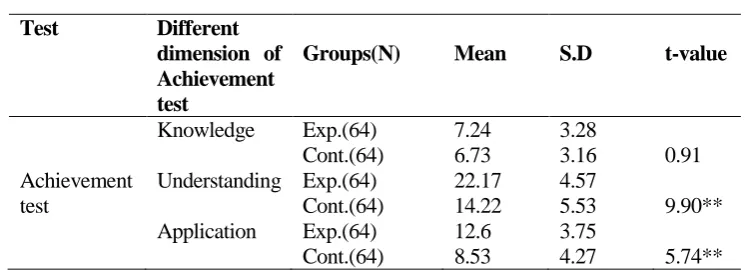
As achievement of an individual refers to higher mental acquisition which includes
the ability of Knowledge, Understanding and Application.In order to confirm which
dimension of achievement test really differ between two groups after given the treatment, the
mean, SD, and t-value applied as shown in table
Table 2 Post-test mean, SD and t-value for different dimension of Achievement for two
groups.
Test Different
dimension of Achievement test
Groups(N) Mean S.D t-value
Achievement test Knowledge Understanding Application Exp.(64) Cont.(64) Exp.(64) Cont.(64) Exp.(64) Cont.(64) 7.24 6.73 22.17 14.22 12.6 8.53 3.28 3.16 4.57 5.53 3.75 4.27 0.91 9.90** 5.74** **Significant at 0.01 level
0 2 4 6 8 10 12 14 16 18 20
Experimental Group Control Group
Control group
Experimental group
Mean Gain Scores
[image:7.595.110.483.601.736.2]SRJIS/BIMONTHLY/DR. JAGDEEP KAUR & RAMAN (5649-5656)
JUNE-JULY, 2017, VOL. 4/22 www.srjis.com Page 5656 (Critical Value 2.00 at 0.05 level and 2.66 at 0.01 level, df 62)
RESULTS OF THE STUDY
i) Students of experimental group exhibited better mean gains than students of
control group when taught by constructivist approach.
ii) Students of experimental group exhibit better mean scores on different dimensions
of achievement test than conventional method of teaching.
SUGGESTIONS FOR FURTHER STUDY
1) The research may be conducted at higher classes.
2) Achievement Test must contain more questions.
3) The opinion of good number of experts may be taken.
4) A sample containing more students may also be taken.
REFERENCES:
Airasian, P. & Walsh, M. (1997) Constructivist cautions. Phi Delta Kappan, 78(6), 444-449.
Carnine, D. (1997). Instructional design in mathematics for students with learning disabilities. Journal of learning disabilities, 30(2), 130-141.
Chowdhury, S.R. (2016). A study on the effect of constructivist approach on the achievement in mathematics of IX standard students. Journal of Humanities and Social Sciences, 21(2), 35-40.
Hussain, I. (2012). Use of constructivist approach in higher education: an instructors’ observation. Creative Education, 3(2), 179-184.Retrieved 13 June 2014 from http://www.SciRP.org/journal/ce.
Karaduman, H. & Gultekin. M. (2007) The effect of constructivist learning principles based learning materials to students’ attitudes, success and retention in social studies. The Turkish Online Journal of Educational Technology, 6(3). Retrieved 08 March 2014 from www.tojet.net. Kesal, F. (2003).An investigation on constructivist classroom characteristics in elt methodology ii
course. Ph.D Thesis, Department of Education Sciences, Middle East Technical University. Pagan, B. (2006).Positive contributions of constructivism to educational design. Retrieved April
20,2017from http://ejop.psychopen.eu/article/view/318/html
Ramon, O.G. & Oluyemi, A.S. (2013). Impact of constructivist model-based training programmes on pre-service teachers’ knowledge, creativity, classroom practice and junior secondary schools learning outcomes in mathematics. Journal of Education andPractice, 4(23), 48-55.
Tugba, T. (2013). Problem solving, creativity and constructivist-based teaching practice of pre-service mathematics teachers. Journal of Educational and Instructional Studies in the World, 3(1).
Tuncel, I. & Bahtiyar, A. (2015).A case study on constructivist learning environment in content knowledge courses in science teaching. Procedia-Social and Behavioral Sciences, 174, 3178-3185.
Yager, R. (1991). The constructivist learning model, towards real reform in science education. The Science Teacher, 58(6), 52-57.