Fast and Efficient Hashing for Sequence Similarity Search
using Substring Extraction in DNA Sequence Databases
Robinson Silvester .A
National Bureau of Agriculturally Important Insects, Bangalore,
Karnataka, India.
J. Cruz Antony
National Bureau of Agriculturally Important Insects, Bangalore,
Karnataka, India.
M. Pratheepa, PhD
National Bureau of Agriculturally Important Insects, Bangalore,
Karnataka, India.
ABSTRACT
Emergent interest in genomic research has resulted in the creation of huge biological sequence databases, however search and retrieval of relevant information from these databases takes a lot of processing time, when performed conventionally as size of databases containing DNA sequences is huge. Hence, providing an efficient searching mechanism is mandatory. In this paper we present an efficient search mechanism using Hashing techniques. Initially, the data is hashed and indexed according to different window sizes. During this process, we eliminate redundancies and only record patterns with distinct elements and provide them with corresponding hash values. During the search phase, the search string is checked for the size of the window and if it exceeds the maximum limit of 4, then it is divided. The first part is considered as the search string and the search is made. After the confirmation of the index, the strings that follow the current indexed string are matched with the search string and finally the confirmation is made. The simulation results show that the current methodology provides faster results, while occupying lesser memory.
Keywords
Hashing; Sequence Similarity by Hashing; Substring Extraction; DNA Sequence
1.
INTRODUCTION
Deoxyribonucleic Acid (DNA) contains genetic information specifying the biological development of all cellular forms of life. This information is encoded in sequences of nucleotides within the DNA molecules. DNA contains four types of nucleobases, viz., Adenine (A), Cytosine (C), Guanine (G) and Thymine (T) [1]. Each of DNA sequence in organisms is formed by thousands or millions of these bases arranged in random order. In recent years, the importance of storing this information has been realized and currently there are two standard formats for storing these information into database, which includes the FASTA and GenBank flat file format. Conventional search and retrieval of data from these databases takes a lot of time as the size of these databases are huge. Sometimes, a similarity search may require several hours or days to complete. Hence, it is very important to develop an efficient search mechanism.
Many algorithms have been developed for sequence matching, the most fundamental one being Naïve String Matching algorithm [2], which is the simplest and least efficient way of searching a string inside another string. Another string matching algorithm is the Boyer-Moore algorithm, like the string matching with finite automation [2] which does preprocessing of
the pattern to allow the faster searching. Based on these, Kalsi et al. [3] performed an experimental comparison of the most efficient algorithms for searching biological sequences. In addition in [4], [5] Faro and Lecroq presented an extensive evaluation of (almost) all existing exact string matching algorithms under various conditions, including alphabet of four characters and DNA sequences. Navarro and Raffinot presented a comparison [6] of all matching algorithms on biological sequences, including multiple pattern matching algorithms. More recently, Faro and Lecroq conducted another experiment on fast searching in biological sequences using multiple hash functions [7] and also D.Nassimi and M.Joshi developed a hash based scalable technique for parallel bidirectional search [8] taking into account the most recent solutions. Though both the algorithms provides an efficient way of hashing, the drawback is that the time taken for indexing and searching when the strings of longer sequences are used.
Basically a string matching algorithm uses a window to scan the text [9]. The size of this window is equal to the minimal length of a pattern in the set of patterns. It first aligns the left end of the window and the text, thereafter it checks if any pattern in the set occurs in the window (this specific work is called an attempt) and then shifts the window to the right [10]. It repeats the same procedure until the right end of the window goes beyond the right end of the text. The best algorithms for searching DNA sequences are based on filtering methods. Specifically, instead of checking at each position [10] of the text if each pattern in the set occurs, it seems to be more efficient to filter text positions and check only if the contents of the window looks like any pattern in the set.
When a resemblance has been detected a naive check [11] of the occurrence is performed. In order to detect the resemblance between the pattern and the text window, efficient algorithms use bit-parallelism or character comparisons [12]. Both techniques can be improved by using condensed alphabets and hashing.
2.
METHODOLOGY
2.1
System Architecture
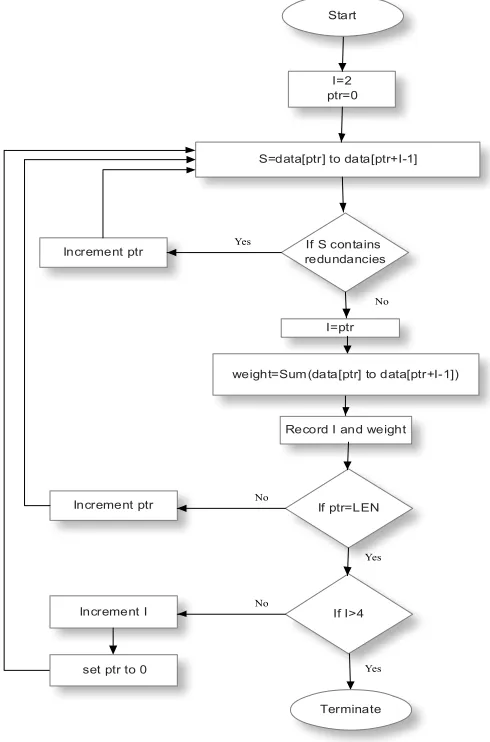
The technique of substring extraction is subdivided into two phases. The first phase deals with reading the actual data D and preparing the indices I. The index table helps in finding the substring [7] for the user. The indexing mechanism is carried out in three parts using different window sizes each time. For each window size w, the substring S from D is considered. S is eliminated of all redundancies and the value [13] of the final pattern is recorded.
[image:2.612.326.571.83.454.2]
Figure 1: System Architecture for Indexing and Searching of DNA sequences
The second phase deals with searching for a given string (Sub) in the data. The length of Sub is checked and if it is found to be greater than 4, then the string is divided into pre and post. These represent the initial and the final portions of Sub. Pre and post values are used as the search strings to find the index value of Sub. Figure 1 represents the entire system architecture of the indexing and searching mechanism.
2.2
Fast and Efficient Hashing for
Sequence Similarity Search using Substring
Extraction in DNA sequence databases
[image:2.612.58.291.243.410.2]As described earlier, DNA sequences are formed of four nucleobases, A, C, G and T. Hence, our database is restricted to these four characters, which occur repeatedly and in random orders. Indexing of these data is performed prior to the extraction process. The indexed table serves as the base for the second phase, i.e. the substring extraction phase.
Figure 2: Indexing of DNA Patterns
Each base in the DNA sequence is assigned a numerical value, which helps to recognize the pattern. Here, we assign the values 0, 1, 2 and 3 to A, C, G and T respectively.
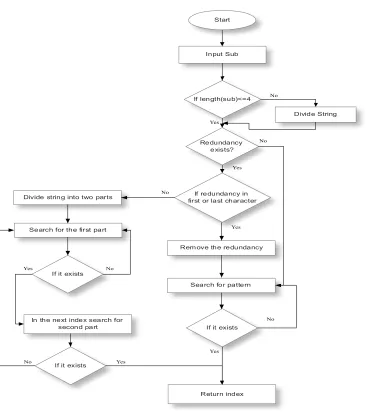
Figure 3: Substring Division and Search
The search phase can further be sub divided into two phases, namely, searching and division. The length of the substring (sub) is examined. If it is found to be greater than 4, then the division phase is initiated. Else sub passes through the usual search process. In the division phase, sub is divided into two parts. The initial part called the pre contains the first 4 characters of the substring. The remaining string is divided into string of 4 characters and is stored in the post array [8]. Pre is then passed to the search process for further processing. In the search phase, the presented string is checked for redundancies. If the redundancies occur at the beginning or at the end of the string, then it is removed and the new string without redundancies is obtained. The location of redundancies and the character that is redundant is recorded. The non-redundant string is searched for, in its corresponding window depending on the current length. If the pattern is found, redundancies are verified by checking the previous and the next index values in the same window and the resultant index (RI) value is returned. If sub has
been divided into pre and post, then the post values are verified by checking the preceding index values of RI in the current window. A special case occurrence is the redundancy of all the characters in sub (Eg. AAAA, CCCC). This usually returns only one character after the redundancy check. This search is performed in the window of the actual size of sub. RI is found by examining the consecutive records that have an index gap equal to the length of the string – 1, i.e.(length(sub)-1) prior to the removal of redundancies. Figure 3 shows a flowchart representation of substring division and search.
3.
RESULTS AND DISCUSSION
indexing process helps is lesser memory consumption. This leads to lesser number of entries in the indexing table, which in turn helps in faster processing.
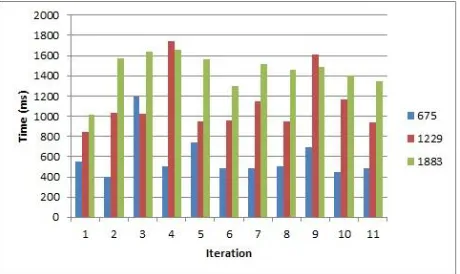
Figure 4: Time taken for indexing
Figure 4 shows the time taken for indexing when strings of various sizes are used. The legends show the number of database entries created. Here we can see that the average time taken for creating a database of size 675 rows is 589.4545ms, 1229 rows are 1123.2727ms and 1883 rows are 1451.09091ms.
During the process of searching, we can see some unusual high and low times, this is due to the usage of CPU by other services in the system. These spikes and lows are considered as noise and are leveled, and the average time taken is considered for analysis.
Figure 5: Time taken for search with a substring of 2 characters
[image:4.612.55.285.125.262.2]Figure 5 shows the time taken for searching in databases of various sizes when considering a search string of 2 characters. The average time taken for searching a string of two characters in a database of 675 rows is 9.375ms, 1229 rows is 25.5ms and 1883 rows is 37.81818ms.
Figure 6: Time taken for search with a substring of 3 characters
[image:4.612.324.556.336.492.2]Figure 6 shows the time taken for searching in databases of various sizes when considering a search string of 3 characters. The average time taken for searching a string of two characters in a database of 675 rows is 3.125ms, 1229 rows is 8.2ms and 1883 rows is 17.3333ms.
Figure 7: Time taken for search with a substring of 4 characters
Figure 7 shows the time taken for searching in databases of various sizes when considering a search string of 4 characters. The average time taken for searching a string of two characters in a database of 675 rows is 6.2ms, 1229 rows is 2ms and 1883 rows is 3.6ms.
[image:4.612.55.287.434.569.2]4.
CONCLUSION
Searching for substrings in a DNA sequence is a tedious job, where the system searches in a large number of entries for the current sequence. This consumes a lot of time and CPU cycles. Reduction of this search even to a small extent will yield faster results when implemented in a large-scale environment. In our process, we can see that even though the search time increases with the size of the database, the relative increase is considerable. I.e. The order of increase is low when compared to the increase in size of the database. From the Figure 5, 6 and 7 we can see that the time taken for searching reduces as the size of the search string increases. As the size of the search string increases, the search time in all the three databases comes to an almost constant state. Eliminating the spikes and lows (caused due to the intermission of other services) as noise, we can show that the current process provides faster searching capabilities.
5.
ACKNOWLEDGEMENT
We express sincere thanks to The Director, NBAII and Dr.S.K.Jalali, CCPI, (NABG) and all members of NAIP-NABG project for their reviews on early drafts of this manuscript. Deepest gratitude to Madhusmita Panda and Sharath Pattar for their knowledgeable assistance and the greatest support. Special thanks to Malathy V.M who was abundantly helpful and offered invaluable assistance and guidance towards development of this work. The work has been initiated and supported by World bank funded National Agricultural Innovative Project on National Agricultural Bioinformatics Grid-Insect Domain is gratefully acknowledged.
6.
REFERENCES
[1] Peter Snustard, Michael J. Simmons. GENETICS, Wiley 6th edition, www.wiley.com/go/global/snustad.
[2] Jones, Neil C. and Pevzner, Pavel A. (2004) “An Introduction to Bioinformatics Algorithms.” Cambridge: The MIT Press. 148-226 and 311-337.
[3] Petri Kalsi, Hannu Peltola, and Jorma Tarhio, “Comparison of exact string matching algorithms for biological sequences”, BIRD, 417–426, 2008.
[4] Simone Faro and Thierry Lecroq, “The exact string matching problem: a comprehensive experimental evaluation”, CoRR, abs/1012.2547, 2010.
[5] Simone Faro and Thierry Lecroq “The exact online string matching problem: a review of the most recent results”, ACM Computing Surveys, 45(2): to appear, 2013.
[6] Gonzalo Navarro and Mathieu Raffinot, “Flexible pattern matching in strings - practical on-line search algorithms for texts and biological sequences”, Cambridge University Press, 2002.
[7] Simone Faro, Thierry Lecroq, “Fast Searching in Biological Sequences Using Multiple Hash Functions”, Proceedings of the 2012 IEEE 12th International Conference on Bioinformatics & Bioengineering (BIBE), Larnaca, Cyprus, 11-13 November 2012
[8] David Nassimi, Milind Joshi, Andrew Sohn,”H-PBS: A Hash-Based Scalable Technique for Parallel Bidirectional Search”, 1063-6374/95 1995 IEEE
[9] Zhou Bai Stefan C. Kremer, “Sequence Learning: Analysis and Solutions for Sparse Data in High Dimensional Spaces”, 978-1-4673-1191-5/12/$31.00 ©2012 IEEE
[10] David Dittman, Taghi Khoshgoftaar, Randall Wald, and Amri Napolitano, “Similarity Analysis of Feature Ranking Techniques on Imbalanced DNA Microarray Datasets”, 2012 IEEE International Conference on Bioinformatics and Biomedicine
[11] V.Hari Prasad, Dr.P.Y.Kumar, Dr. D. Vasumathi, “Adaptive segmentation of DNA sequences using SBC Tehcnique:A novel Algorithm”, ICCCNT'12, July 2012, Coimbatore, India
[12] Gonzalo Navarro , Mathieu Raffinot , “Practical and flexible pattern matching over Ziv–Lempel compressed text”, Journal of Discrete Algorithms 2 (2004) 347–371
[13] Nur’Aini Binti Abdul Rashid, Rana Ghadban, Hazrina Yusof Hamdani,Atheer A-Abdulrazaq, “Enhanced CAFÉ Indexing Algorithm Using Hashing Function”, 978-1-4244-6716-7/10/$26.00, 2010 IEEE