http://dx.doi.org/10.4236/msa.2015.612108
Study and Characterization of Soft Magnetic
Properties of Fe
73.5
Cu
1
Nb
3
Si
13.5
B
9
Magnetic
Ribbon Prepared by Rapid Quenching
Method
Md. Khalid Hossain1*, Jannatul Ferdous2, Md. Manjurul Haque2,A. K. M. Abdul Hakim3 1Institute of Electronics, Atomic Energy Research Establishment, Savar, Dhaka, Bangladesh
2Department of Applied Physics, Electronics & Communication Engineering, Islamic University,
Kushtia, Bangladesh
3Department of Glass and Ceramic Engineering, Bangladesh University of Engineering and Technology, Dhaka,
Bangladesh
Received 15 August 2015; accepted 20 November 2015; published 1 December 2015
Copyright © 2015 by authors and Scientific Research Publishing Inc.
This work is licensed under the Creative Commons Attribution International License (CC BY).
http://creativecommons.org/licenses/by/4.0/
Abstract
Nanocrystalline Fe-based alloys offer a new opportunity for tailoring soft magnetic materials. Na-nocrystalline alloy in the form of ribbon with the composition of Fe73.5Cu1Nb3Si13.5B9 was prepared
by rapid quenching method for soft magnetic properties analysis. The rapidly quenched alloy has been annealed in a controlled way in the temperature range 490˚C to 680˚C and annealing time 1 min to 60 min. The study of the structural parameters has been investigated by means of XRD analysis. Magnetic properties were analyzed by measuring B-H loop and frequency dependence of initial permeability. Enhanced value of initial permeability by two orders of magnitude and very low value of relative loss factor of the order of 10−3 has been observed with the variation of
an-nealing temperature and time. The initial permeability for the optimum annealed sample has been found 23,064 as compared with 360 for its amorphous counterpart. The initial permeability spec-tra show dispersion around 100 kHz. Magnetic hysteresis has been investigated by measuring B-H loops at various magnetic fields for different annealing temperature and time. The coercivity and remanence has been found to decrease significantly for optimized annealed condition compared to as-cast state. The core loss of the samples decreases with the annealing time which indicates the good magnetic property of soft magnetic materials.
Keywords
Nanocrystalline Alloy, Magnetic Property, Hysteresis Loop, Permeability, Coercivity, Remanence
1. Introduction
In 1988, a new class of superior soft magnetic iron based alloys was introduced by Yoshizawa, Oguma and Ya-mauchi [1]. Those alloys have low losses, high permeability and near zero magnetostriction which indicate the soft magnetic materials. Later soft magnetic properties have been successfully addressed by Herzer [2] with the help of random anisotropy model. Because of the ultrafine microstructure of bcc Fe-Si with grain sizes of 10 - 15 nm, the Fe73.5Cu1Nb3Si13.5B9 alloys are known as nanocrystalline. The soft magnetic properties of Fe73.5Cu1
Nb3Si13.5B9 and related alloys were reported by many publications [3]-[8].
Based on random anisotropy model, by taking into account the nanocrystalline materials as a single phase magnetic system, Herzer explained the grain size dependence of the coercivity. By considering two phase mate-rials, Hernando et al.[9] extended this model and were able to explain the thermal dependence of the coercivity
[10]-[12]. Also based on the random anisotropy model, Herzer established the early explanation of the soft magnetic properties of these nanocrystalline alloys which were related to the ratio of the domain wall thickness to the mean crystallite size [5]. This model explained the main feature of the dependence of coercivity on the grain size [13][14]. Some previous researches showed that at the very beginning of nanocrystallization, mag-netic hardening took place [15]-[18]. Stoner and Wohlfarth [19] theoretically proposed single domain permanent magnets. From the single domain permanent magnets, high coercivity is obtained by mechanically locking the magnetized single domain particles. However, we can produce soft magnetic materials by reducing the size of the magnetic particle much below the critical size, which is normally of nanometer order.
If Fe-Si-B based amorphous ferromagnetic materials heated below their crystallization temperature, then good soft magnetic properties were observed. After partial crystallization of Fe73.5Cu1Nb3Si13.5B9, subjected to heat
treatment just above the crystallization temperature for a specific time, an extraordinary high permeability i.e.
two order of magnitude was developed which was higher than their conventional Fe-Si-B based alloys. The an-nealed nanometric grain size of 4 - 30 nm is developed for the heat treatment of the alloy. If the grain size is 10 - 12 nm then good magnetic properties are obtained. If DLex, where Lex is the ferromagnetic exchange length [6][8] and D is the average grain size, then best magnetic properties are obtained. According to calculation, for Fe(Si) alloy, Lex 35 nm [20].
The aim of the present research work is to synthesize Fe-based alloys of Fe73.5Cu1Nb3Si13.5B9 composition in
the amorphous state by using rapid solidification technique and study their magnetic properties with the evolu-tion of different phases by varying annealing condievolu-tion. Annealing of Fe-based soft nanocomposite magnetic materials has been performed in air. Then, the Curie temperature, initial permeability, hysteresisgraph (BH- loop), temperature dependence relative quality factor and loss factor of the composition Fe73.5Cu1Nb3Si13.5B9 are
determined. X-ray diffraction technique has been used for the characterization of nanostructured phases. The purpose is to correlate the evolution of nanograins, their volume fraction and size with the magnetic properties of the composition.
2. Experimental
The ribbons with composition Fe73.5Cu1Nb3Si13.5B9 has been prepared by rapid solidification technique. The
amorphous ribbons are prepared at a temperature 1500˚C in an argon atmosphere (0.2 to 0.3 atoms). The dimen-sion of the ribbon was 10 mm width and 25 mm thickness. The purity of the material is Fe (99.98%), Cu (99%), Nb (99.8%), Si (99.9%) and B (99.5%) as obtained from Johnson Mathey (Alfa Aesar Inc.).
A PHILIPS PW3040 X' Pert PRO X-ray diffractometer was used to study the crystalline phases of the pre-pared samples in the Materials Science division, Atomic Energy Centre, Dhaka. The powder specimens were exposed to CuKα radiation with a primary beam of 40 kV and 30 mA with a sampling pitch of 0.02˚ and time for
each step data collection was 1.0 sec. A 2θ scan was taken from 10˚ to 90˚ to set possible fundamental peaks where Ni filter was used to reduce CuKα radiation. All the data of the samples were analyzed using computer software “X’PERT HIGHSCORE”. X-ray diffraction patterns were carried out to confirm the crystal structure. Instrumental broadening of the system was determined from θ - 2θ scan of standard Si. The average grain size of the crystallites α-Fe(Si) were determined by Scherrer’s method [21] after correction for instrumental boarding.
As a function of frequency, dynamic magnetic properties of the nanocrystalline magnetic ribbon with compo-sition Fe73.5Cu1Nb3Si13.5B9 have been measured. By using a laboratory built furnace and Wayne Kerr 3255B
from room temperature to above 600˚C with continuous heating rate of ~5˚C/min. With the equation of µ' = L/L0, the permeability µ' was calculated, where L is the measured sample inductance and L0 is the inductance of
the coil of same geometric shape of vacuum. With the equation of μ" = µ' D, the imaginary permeability μ" was determined, where D = tanδ, the loss tangent of the sample. On piece of each ribbon has been measured at room temperature after subsequent annealing treatments in order to avoid the experimental error due to fluctuation in ribbon thickness and thermal treatments. From the temperature dependence of permeability measurements, the Curie temperature was determined. The permeability shows an abrupt drop to a very low value at Curie temper-ature. B-H loops were measured by using a B-H loop tracer.
3. Results
Figure 1represents the X-ray diffraction spectra of quenched alloy and the alloy annealed at different tempera-tures for 30 min. In the figures, the parenthesis represents the indices of the reflecting planes of the phases. bcc
α-Fe(Si) phases are found, identified by using standard software. From the X-ray fundamental line (110), the mean grain size of the nanograins was determined by using the Scherrer’s formula.
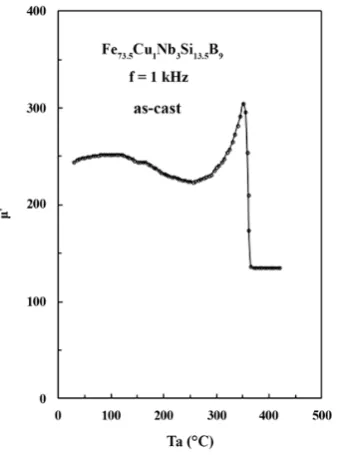
In order to determine the Curie temperature of amorphous sample, the real part of the complex initial permea-bility µ' vs. temperature T curves has been presented in Figure 2 for as-cast sample. The Curie temperature has been estimated to be 355˚C for this alloy composition in the as-cast condition. It has been found from Figure 2
that µ' decreases gradually and then there is a sharp increase of µ' near the Curie temperature which is a charac-teristic feature of the Hopkinson effect.
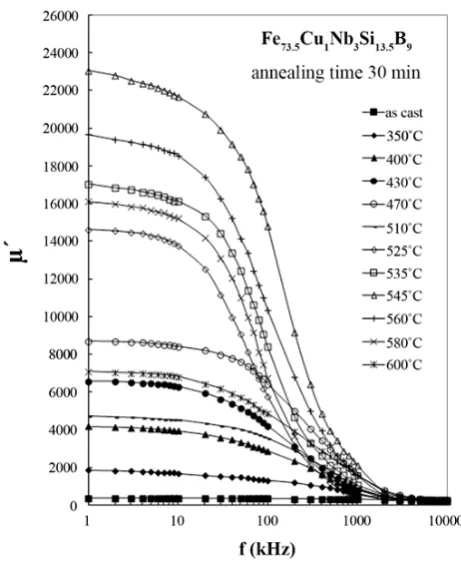
In Figure 4, for as-cast and annealed samples, the real part of the complex initial permeability µ' up to f = 10,000 kHz has been measured and presented. The results refer to isothermal annealing time of 30 min. It can be noted that µ' increase with the increase of annealing temperature and it drops at critical frequencies rapidly.
In Figure 6, the annealing temperature dependence of relative quality factor µ'/D of the samples at different frequency and a fixed 30 minute annealing time are presented. The relative quality factor increases with in-creasing annealing temperature up to 560˚C when the applied frequency is 1 kHz, 2 kHz and 3 kHz. Then, a rapid decrease of relative quality factor with increasing annealing temperature is above 560˚C. In the similar manner, the relative quality factor increases with increasing annealing temperature up to 545˚C when the applied frequency was 5 kHz and 10 kHz. A rapid decrease of µ'/D with increasing annealing temperature above 545˚C
was noticed when the applied frequency was 5 kHz and 10 kHz. For the sample annealed at 545˚C for 30 minute give the maximum quality factor if the applied frequency is lowers i.e. 10 kHz. This gives a choice of optimal annealing temperature for attaining best magnetic properties.
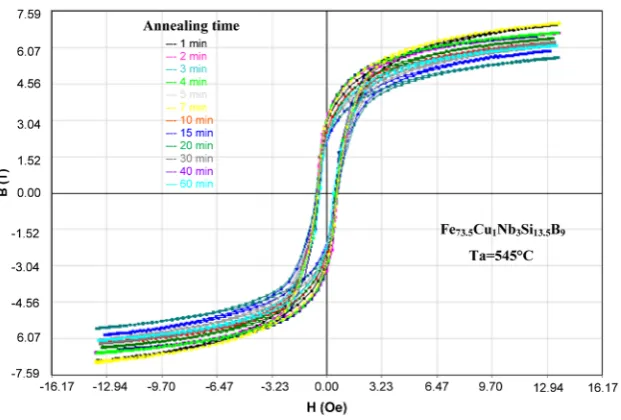
In Figure 7, the annealing temperature dependence of loss factor of the samples measured at different fre-quency have been presented. Loss factor rapidly decreases with increasing annealing temperature for all applied frequencies i.e. 2 kHz, 3 kHz, 4 kHz, 5 kHz and 50 kHz. Loss factor has high value at 50 KHz and decreases with the decrease of frequency. In Figure 8, the B-H loops at room temperature and at a constant frequency 1 kHz of the alloy were presented. Figures 9(a)-(d) represent the annealing time (ta) dependence of magnetic flux density (Bv), remanence (Br), coercivity (Hc) and loss (W/kG) of the sample annealed at temperature Ta = 545˚C respectively.
4. Discussion
ones achieved by conventional annealing [2][5][25].
The temperature at which the ferromagnetic material becomes paramagnetic is known as Curie temperature. From the initial permeability µ' versus annealing temperature T curves, the Curie temperature (Tc) of the Nano-crystalline ribbons of the sample Fe73.5Cu1Nb3Si13.5B9 has been determined. At fixed frequency (1 kHz), from
the as-cast condition of Fe73.5Cu1Nb3Si13.5B9 alloy, the temperature dependence of real part of the initial
permea-bility has been presented in Figure 2in order to determine the Curie temperature of the sample. The ferromag-netic to paramagferromag-netic transition of the amorphous phase can be characterized by Hopkinson effect and can be determined from the as-cast sample if the initial permeability passes through a maximum just before a sharp fall. Due to irreversible components of the structural relaxation like chemical short-range order, topological and long-range internal stress of the materials, it is very much difficult to determine the accurate Curie temperature, Tc of the amorphous materials. Curie temperature Tc may influence with this structural relaxation without de-stroying the amorphous state. So, the heating rate should be adjusted in such a way during the measurement of Tc that, no substantial relaxation takes place. Figure 2 shows that, with increasing the annealing temperature the initial permeability of the nanocrystalline sample also increase. The maximum initial permeability µ׳ found at
350˚C and above the 350˚C annealing temperature, the permeability decrease rapidly. Thus Curie temperature has been estimated as 355˚C from the sharp fall of the initial permeability after 355˚C [26]. In the similar way, the various curie temperature of residual amorphous matrix are determined like 350˚C, 367˚C, 350˚C and 310˚C from the variation of µ׳ with temperature for the toroidal samples annealed at 400˚C, 450˚C, 490˚C and 525˚C
respectively have been presented in Figure 3.
For as cast and annealed samples, real part of the complex initial permeability µ' has been presented in Figure 4 up to f = 10,000 kHz. Magnetic initial permeability are measured in very low field of the toroidal shaped sam-ples annealed at different temperatures, in order to correlate the soft magnetic properties of the alloys with mi-crostructural features. From the domain wall mobility especially in the range of reversible magnetization, the magnetic properties of the soft magnetic materials are determined. Figure 4 shows that the real part of initial permeability µ' decreases when the frequency increases and µ' becomes almost zero at very high frequency. This is because the very high frequency indicates the AC field and magnetization is opposed by AC field. As a result, at higher frequencies damping of the domain walls occurs and for this permeability drops to a very low value. This phenomenon defines the best frequency range at which a particular magnetic material can be used for prac-tical application.
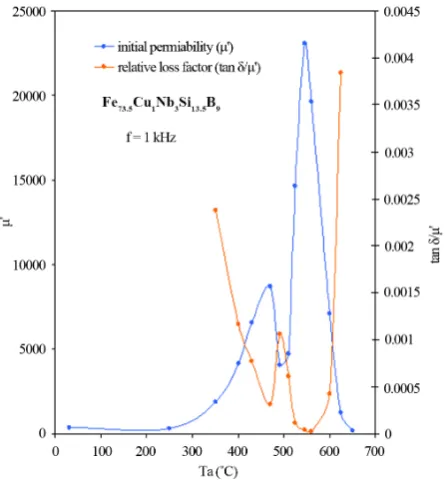
[image:5.595.231.400.468.696.2]From the annealing temperature dependence of initial permeability and relative loss factor curve (Figure 5), the role of amorphous phase in intergrain coupling can be easily realize. The curve express itself strong depen-
Figure 3. Variation of initial permeability µ' with samples annealed at different temperature for Fe73.5Cu1Nb3Si13.5B9 alloy at fixed frequency (1 kHz).
[image:6.595.198.431.83.357.2] [image:6.595.197.428.402.684.2]Figure 5. Variation of initial permeability μ' and of relative loss factor tanδ/μ' for Fe73.5Cu1Nb3Si13.5B9 alloy at fixed frequency f =
1 kHz with various annealing temperature Ta.
dence of initial permeability on annealing temperature. Due to irreversible structural relaxation of the amorph-ous matrix, an increase of initial permeability with annealing temperature was observed when the sample an-nealed at temperature below the crystallization, i.e. up to 470˚C. Permeability decrease with the increase of
an-nealing temperature up to 490˚C and beyond 490˚C anan-nealing temperature i.e. from 510˚C to 545˚C a sharp
in-crease of permeability was observed due to crystallization of α-Fe(Si) phase. For the annealing temperature of 545˚C, an enhancement of initial permeability by two orders of magnitude was observed (μ' = 23,065). From the other part of Figure 5 it was observed that, the relative loss factor drops sharply as the annealing temperature increased and at annealing temperature 545˚C a minimum value relative loss factor (=4.002 × 10⁻⁵) was found.
Beyond this temperature μ' drops to lower value drastically and again increases very rapidly, as a result of mag-netic hardening takes place [16].
At different frequency, the annealing temperature dependence of relative quality factor μ'/D and loss factor D of the samples are presented in Figure 6 and Figure 7 respectively. From the application point of view, for the soft magnetic materials both loss factor tanδ or D and relative quality factors are the important parameters. Soft magnetic materials must have minimum loss factor and maximum relative quality factors. It is well-established that, minimum loss and very high relative quality factor with the order of magnitude 105 - 106 observed upon timal annealing nanocrystalline alloys. By the successive annealing of the alloys from 350˚C to 600˚C, the op-timal annealing temperature is determined. At high frequency the flux penetration becomes low, as a result the loss is mainly controlled by interaction between the grains of the alloy but at very low frequency the loss is con-trolled by hysteresis losses.
Measurement of a hysteresis loop is a very simple and fast method to characterize magnetic materials. The hysteresis curves and their properties such as the remanence (Br), coercivity (Hc), and hysteresis loss (W/kG) are very useful information from the application point of view. The B-H loops at room temperature of the inves-tigated alloy Fe73.5Cu1Nb3Si13.5B9 were measured at a constant frequency (f = 1 kHz), and the results are
pre-sented in Figure 8. From these loops, Br, W/kG, and Hc were determined. In Figures 9(a)-(d), it can be ob-served that the magnetic flux density (Bv), remanence, coercivity and also hysteresis loss decrease with increase in annealing time, which implies good soft magnetic property of the alloy of Fe73.5Cu1Nb3Si13.5B9 (Table 1).
5. Conclusion
Figure 6. Temperature dependence of relative quality factor of Fe73.5Cu1Nb3Si13.5B9 alloy with various frequencies.
[image:8.595.195.435.82.253.2]Figure 7. Temperature dependence of loss factor of Fe73.5Cu1Nb3Si13.5B9 alloy with various frequencies.
[image:8.595.194.437.291.450.2] [image:8.595.159.470.486.696.2](a) (b)
[image:9.595.82.540.80.447.2](c) (d)
Figure 9. Annealing time (ta) dependence of (a) magnetic flux density (Bv) (b) remanence (Br) (c) coercivity (Hc) (d) loss (W/kG) of the sample annealed at temperature Ta = 545˚C.
Table 1. Annealing time dependence of magnetic flux density, remanence, coercivity and hysteresis loss for the samples annealed at temperature 545˚C at a fixed frequency 1 kHz.
Annealing Time (Ta) Magnetic Flux Density (Bv) Remanence (Br) Coercivity (Hc) Hysteresis Loss (W/kG)
2 6.674 3.224 0.616 26.234
4 6.683 3.021 0.509 22.832
30 6.291 2.184 0.513 20.378
60 6.150 2.183 0.406 17.752
to a maximum value of initial permeability (μ') which is 23,065 while the corresponding value of relative loss factor is 4.002 × 10⁻⁵ at a low frequency f = 1 kHz. At 545˚C, from magnetic hysterisisgraph we observe low core loss (26.234 - 17.752) W/kG, low remanence (3.224 - 2.183) kG and low coercivity (0.616 - 0.406).
Acknowledgements
The authors are thankful to Materials Science Division, Atomic Energy Centre, Dhaka-1000, Bangladesh for providing the amorphous Fe73.5Cu1Nb3Si13.5B9 ribbon materials and for extending experimental facilities. We
[image:9.595.85.539.514.593.2]References
[1] Yoshizawa, Y., Oguma, S. and Yamauchi, K. (1988) New Fe-Based Soft Magnetic Alloys Composed Of Ultrafine Grain Structure. Journal of Applied Physics, 64, 6044. http://dx.doi.org/10.1063/1.342149
[2] Herzer, G. (1990) Grain Size Dependence of Coercivity and Permeability in Nanocrystalline Ferromagnets. Magnetics,
IEEE Transactions, 26, 1397. http://dx.doi.org/10.1109/20.104389
[3] Yoshizawa, Y., Yamauchi, K., Yamane, T. and Sugihar, H. (1988) Common Mode Choke Cores Using the New Fe- Based Alloys Composed of Ultrafine Grain Structure. Journal of Applied Physics, 64, 6047.
http://dx.doi.org/10.1063/1.342150
[4] Yoshizawa, Y. and Yamauchi, K. (1989) Effects of Magnetic Field Annealing on Magnetic Properties in Ultrafine Crystalline Fe-Cu-Nb-Si-B Alloys. Magnetics, IEEE Transaction, 25, 3324-3326. http://dx.doi.org/10.1109/20.42291
[5] Herzer, G. (1989) Grain Structure and Magnetism of Nanocrystalline Ferromagnets. Magnetics, IEEE Transaction, 25, 3327-3329. http://dx.doi.org/10.1109/20.42292
[6] Yoshizawa, Y. and Yamauchi, K. (1990) Fe-Based Soft Magnetic Alloys Composed of Ultrafine Grain Structure. Ma-terials Transactions, JIM, 31, 307. https://www.jim.or.jp/journal/e/31/04/307.html
[7] Hilzinger, H.R. (1990) Recent Advances in Rapidly Solidified Soft Magnetic Materials. Journal of Magnetism and Magnetic Materials, 83, 370-374. http://dx.doi.org/10.1016/0304-8853%2890%2990552-2
[8] Köster, U., Schünemann, U., Blank-Bewersdorff, M., Brauer, S., Sutton, M. and Stephenson, G.B. (1991) Nanocrystal-line Materials by Crystallization of Metal-Metalloid Glasses. Materials Science and Engineering: A, 133, 611-615.
http://dx.doi.org/10.1016/0921-5093%2891%2990146-E
[9] Hernoado, A., Vazquez, M., Kulik, T. and Prados, C. (1995) Analysis of the Dependence of Spin-Spin Correlations on the Thermal Treatment of Nanocrystalline Materials. Physical Review B, 51, 3581.
http://dx.doi.org/10.1103/PhysRevB.51.3581
[10] Hernando, A. and Kulik, T. (1994) Exchange Interactions through Amorphous Paramagnetic Layers in Ferromagnetic Nanocrystals. Physical Review B, 49, 7064. http://dx.doi.org/10.1103/PhysRevB.49.7064
[11] Grossinger, R., Holzer, D., Ksshach, C., Sassik, H., Sato Turtelli, R., Sinnecker, J.P. and Witting, E. (1995) High Temperature Behaviour of FINEMET Ribbons in the Amorphous and in the Nanocrystalline State. IEEE Transactions on Magnetics, 31, 3883-3885. http://dx.doi.org/10.1109/20.489804
[12] Gomez-pole, C., Holzer, D., Multigner, M., Navarro, E., Agudo, P., Hemando, A., Vazquez, M., Sassik, H. and Gros-singer, R. (1996) Giant Magnetic Hardening of a Fe-Zr-B-Cu Amorphous Alloy during the First Stages of Nanocrys-tallization. Physical Review B, 53, 3392-3397. http://dx.doi.org/10.1103/PhysRevB.53.3392
[13] Noh, T.H., Lee, M.B., Kim, H.J. and Kang, I.K. (1990) Relationship between Crystallization Process and Magnetic Properties of Fe-(Cu-Nb)-Si-B Amorphous Alloys. Journal of Applied Physics, 67, 5568.
http://dx.doi.org/10.1063/1.345887
[14] Herzer, G. and Warlimont, H. (1992) Nanocrystalline Soft Magnetic Materials by Partial Crystallization of Amorphous Alloys. Nanostructured Materials, 1, 263-268. http://dx.doi.org/10.1016/0965-9773(92)90106-8
[15] Vazquez, M., Marin, P., Olofinjana, A.O. and Davies, H.A. (1995) The Magnetic Properties of FeSiBCuNb Wires during the First Stages to the Nanocrystallization Process. Materials Science Forum, 179-181, 521-526.
http://dx.doi.org/10.4028/www.scientific.net/MSF.179-181.521
[16] Kollar, P., Fuzer, J., Maa, P., Svec, T. and Konc, M. (1996) Magnetic Properties of Fe73.5Cu1Nb3−xUxSi13.5B9 (x = 1, 2, 3) Nanocrystalline Alloys. Journal of Magnetism and Magnetic Materials, 157-158, 213-214.
http://dx.doi.org/10.1016/0304-8853(95)01195-1
[17] Kulik, T. and Hernando, A. (1996) Magnetic Properties of Fe76.5−xCu1NbxSi13.5B9 Alloys Nanocrystallized from Amorphous State. Journal of Magnetism and Magnetic Materials, 160, 269-270.
http://dx.doi.org/10.1016/0304-8853(96)00193-X
[18] Conde, C.F., Franco, V. and Conde, A. (1997) Magnetic Properties and Structural Evolution of Fe73.5Cu1Nb3Si22.5-xBx Alloys. In: Duhaj, P., Mratko, P. and Svec, P., Eds., Rapidly Quenched and Metastable Materials Supplement, Elsevier, Holanda, 254-257.
[19] Stoner, E.C. and Wohlfarth, E.P. (1948) A Mechanism of Magnetic Hysteresis in Heterogeneous Alloys. Philosophical Transactions A, 240, 599. http://dx.doi.org/10.1098/rsta.1948.0007
[20] Duhaj, P., Svec, P., Jamoclpvic, D., Mako, I. and Hlasnik, M. (1992) Structure and Magnetic Properties of the Finemet Alloy Fe73Cu1Nb3Si13.5B9.5. Materials Science and Engineering: B, 14, 357-364.
http://dx.doi.org/10.1016/0921-5107(92)90075-K
[21] Cullity, B.D. (1959) Elements of X-Ray Diffraction. Addition Wesley, London, 262.
Fe73.5Cu1Nb3Si13.5B9 Alloy from Amorphous State on Heat Treatment. World Journal of Nano Science and
Engineer-ing, 5, 107-114. http://dx.doi.org/10.4236/wjnse.2015.54013
[23] Herzer, G. (1997) Nanocrystalline Soft Magnetic Alloys. In: Buchow, K.H.J., Ed., Handbook of Magnetic Material, Vol. 10, Elsevier B.V., Amsterdam, 415-462.
[24] Allia, P., Baricco, M., Knobel, M., Tiherto, P. and vanai, F. (1994) Soft Nanocrystalline Ferromagnetic Alloys with Improved Ductility Obtained through Dc Joule Heating of Amorphous Ribbons. Journal of Magnetism and Magnetic Materials, 133, 243-247. http://dx.doi.org/10.1016/0304-8853(94)90536-3
[25] Dahlgren, M., Grössingera, R., Hernandob, A., Holzera, D., Knobelc, M. and Tibertod, P. (1996) Magnetic Properties of Fe86Zr7Cu1B6 at Elevated Temperatures. Journal of Magnetism and Magnetic Materials, 160, 247-248.
http://dx.doi.org/10.1016/0304-8853(96)00180-1
![Figure 1. XRD patterns of Fe73.5Cu1Nb3Si13.5B9 ribbon sample (a) as-cast and annealed samples at (b) 490˚C (c) 510˚C (d) 525˚C (e) 545˚C (f) 560˚C (g) 600˚C and (h) 680˚C for 30 min [22]](https://thumb-us.123doks.com/thumbv2/123dok_us/8039728.771104/4.595.122.511.75.690/figure-xrd-patterns-ribbon-sample-cast-annealed-samples.webp)