Munich Personal RePEc Archive
The Demand for Money in Greece 1962
to 1998
Loizos, Konstantinos and Thompson, John
SOAS, University of London, Liverpool Business School
January 2001
THE DEMAND FOR MONEY IN GREECE 1962 TO 1998
by
Konstantinos Loizos (SOAS, University of London)
and
John Thompson
(Liverpool Business School)
The authors wish to thank Professor K Holden, Liverpool Business School, for his helpful comments and suggestions in the preparation of this paper but we would like to emphasise that any errors remaining the paper are entirely our responsibility.
January 2001
ABSTRACT
The paper examines the demand for narrow money in Greece over the period 1962 to 1998. The data is tested to examine the order of integration. Estimation of the demand function follows the two step methodology. The first step entails the specification of the long run equilibrium relationship between real narrow money, the index for industrial production (a proxy for real income), an interest rate and the rate of inflation through the estimation of the cointegrating vector by the Johansen technique. The second step involves an Error Correction Equation being estimated to provide the short-run dynamics. Finally the model is simulated to see how well it tracks the actual values of the dependent variable.
1
IntroductionThe demand for money assumes an important component of
theoretical models of any economy and as such has been the subject
of many studies for a wide variety of countries. In section 1 of this
paper we start by providing a brief review of the financial history of
Greece and a summary of what we consider to be key studies of the
demand for money in Greece. A discussion of the nature of the data is
presented in section 2. The empirical results are discussed in sections
3 and 4. The model is tested for its simulation properties in section 5
and our conclusions in section 6.
The Greek financial system was heavily regulated during the post-war
period until the mid-eighties. Major characteristics of this system are
the administratively set interest rates, the compulsory channeling of a
proportion of bank reserves into various uses and sectors indicated by
the authorities, the financial support of the government at
below-market rates and the control of foreign exchange transactions. Given
that banks were the dominant financial intermediaries while capital
market was underdeveloped, investment opportunities were heavily
dependent to the government priorities.
However, this picture altered, during the late eighties and nineties,
through a process of financial liberalization that aimed to restore
market conditions throughout the system. Important steps included
the gradual deregulation of bank lending and borrowing rates, the
removal of credit restrictions imposed on commercial banks, the
resumption of Treasury Bills sales directly to the public in 1985 and
the abolition of controls in capital movements in 1994. In 1994, the
government also lost its privileged access to the Central Bank while its
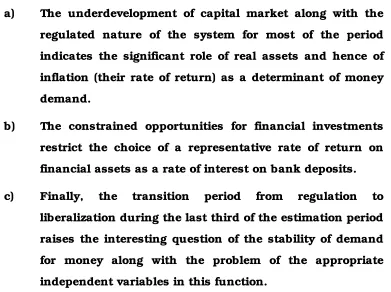
With respect to the formulation of the demand for money function the
following points are important:
a) The underdevelopment of capital market along with the
regulated nature of the system for most of the period
indicates the significant role of real assets and hence of
inflation (their rate of return) as a determinant of money
demand.
b) The constrained opportunities for financial investments
restrict the choice of a representative rate of return on
financial assets as a rate of interest on bank deposits.
c) Finally, the transition period from regulation to
liberalization during the last third of the estimation period
raises the interesting question of the stability of demand
for money along with the problem of the appropriate
[image:4.595.122.513.115.407.2]independent variables in this function.
Figure 1 shows the growth of M1 during this period and, whilst the
financial liberalisation discussed above must have affected the
behaviour of the money supply, the pattern in Chart 1 shows no
sudden changes or jumps in the time pattern of the growth of nominal
narrow money supply. We have therefore not included any dummy
variables to represent any of the measures discussed above1. In
general our approach will be a compromise between the various
traditions in the theoretical development of the demand for money and
will include as explanatory variables the rate of inflation, the level of
real GDP (y) and a representative rate of interest (r). Consequently we
include both the return on financial assets (i.e. the representative rate
of interest) and also the return on real assets {represented by the
expected rate of inflation (infl)} as well as the demand for transaction
purposes. This formulation is summarised below:
1
M/P = F(y, r, infl) with F1 > 0, F2 and F3 < 0 (1)
We now review briefly the existing literature on the demand for money
in Greece. These include Apostolou and Varelas [1987], Alexakis
[1980], Brissimis and Leventakis [1981,1983 and 1985], Ericsson and
Sharma [1998], Himarios [1983, 1986 and 1987], Palaiologos [1982],
Panayotopoulos [1983 and 1984], Prodromidis [1984] and Tavlas
[1987]. In order to simplify the discussion, we focus on just four
studies, which indicate the flavour of the existing literature. These
studies can usefully be categorised into those, which use annual data
e.g. Himarios [1986], Apostolou and Varelas [1987], and those, which
use quarterly data such as Psaradakis [1993], Ericsson and Sharma
[1998]. Himarios [1986] employs the partial adjustment hypothesis to
explain the demand for M1 and M2. According to Himarios’ results,
the demand for m12 is better explained by current income and a
short-term interest rate. The coefficient for inflation is insignificant at the
5% level. Despite the administrative nature of interest rates,
substitution between demand for m1 and financial assets is indicated
by the significance of the interest rate coefficient at the 5% level.
Demand for m2 is best explained by permanent income and expected
inflation with strongly significant coefficients whilst interest rates
coefficients are insignificant at the 5% level in most equations. Finally,
autocorrelation is removed when the lagged dependent variable enters
the functions, which may indicate the existence of adjustment costs. A
similar approach (i.e. the Partial Adjustment Hypothesis) was followed
by Apostolou and Varelas [1987], who also incorporate the level of
current income as an explanatory variable in their equation. Their
results suggest that the three variables (i.e. income, interest rate and
inflation) are all relevant to the explanation of the demand for money
in Greece. These results were troubled by the presence of
significance bounds were approached. In the case of the squares the lower boundary was approached only for the period 1979 to 1983.
2
autocorrelation, which was removed by the Cochrane-Orcutt method
of estimation.
The second two studies using quarterly data also use more
sophisticated techniques. Psaradakis [1993]3 estimates a vector
autoregression model (VAR) for the period 1960 quarter1 to 1989
quarter 1. The estimated model found a role for interest rates,
inflation and income in the determination of the demand for money.
Whereas the previous studies mentioned all concentrated on M1 or
M2, Ericcson and Sharma [1998] examined the stability of broad
money M3 over the period 1975 to 1994. They found a role for income,
various interest rates and inflation.
As noted earlier, we estimate an equation of the following form to
represent the demand for M1:
(M/P)D = fN(y, r, infl) (1)
where M = M1 (i.e. narrow money), P = the price level, y real income, r
a representative rate of interest and infl the actual rate of inflation
used as a proxy for the expected rate o inflation. All the variables will
be specified in logarithmic form. The exact definition of the variables is
discussed in the following section.
2
The DataQuarterly data on Gross Domestic Product for Greece are not available
before 1975 so it is necessary to use some proxy for income in the
demand for money function. As noted earlier Psaradakis [1993] used a
univariate time series model to construct a synthetic series of national
income on a quarterly basis. We have adopted a different approach by
using the index of industrial production as a surrogate for national
income. We acknowledge that use of the index of industrial production
3
represents just one sector (but a major one)4 of an economy but its
value as a proxy is essentially an empirical matter. The correlation
coefficient for the natural logarithm values of annual data for GDP
deflated by the consumer price index and the index of industrial
production is 0.9653 for 1962 to 1997. We would therefore contend
that the index of industrial production is a good proxy for real GDP.
The specification of the other variables is less contentious. The rate of
interest adopted for the study is the 3 – 6 months’ time deposit rate
with commercial banks (lrs) and as such represents the return on the
closest substitute financial asset. The consumer price index (lp) is
used to denote the price level since this is the most widely published
index in Greece. In a similar manner the rate of inflation (infl) is the
first difference of the logarithm of the consumer price index. The
statistics were obtained from International Financial Statistics as
recorded by Datastream. Full details are shown in the appendix.
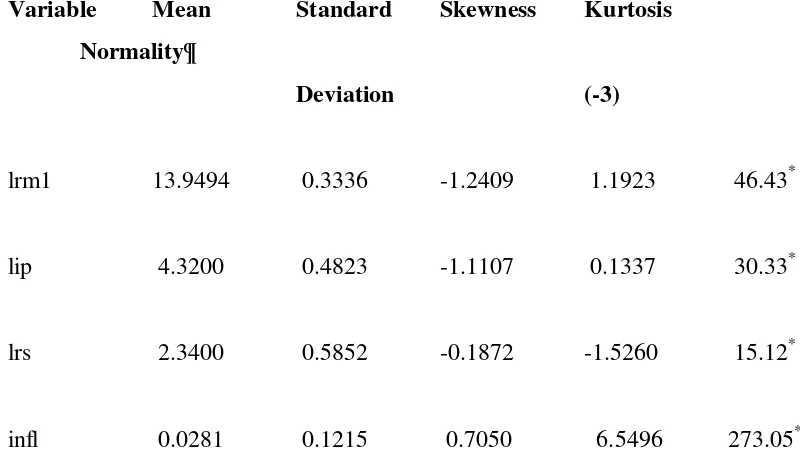
Descriptive statistics of the four variables of interest are shown in
Table 1. The first three variables show evidence of negative skewness
so that the distribution shows a longer tail to the left. As far as
kurtosis is concerned three variables (lrm1, lip and infl) show evidence
of positive kurtosis (i.e. leptokurtic) as compared with the normal
distribution i.e. the tails of the distribution are slimmer/longer than
that predicted by the normal curve. In the case of lrs, there is evidence
of fat or short tails (i.e. platykurtic). It would appear that none of the
variables are normally distributed and this is confirmed by the results
of the Bera-Jacques tests shown in the table.
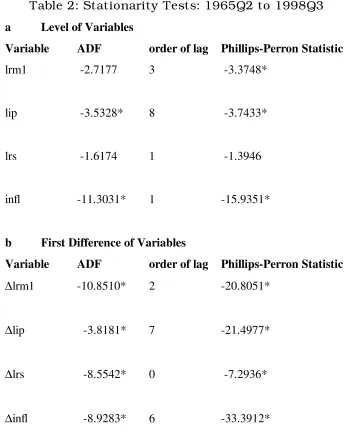
We now consider the order of integration of the variables5. Stationarity
tests were carried out the variables (all in logarithmic form) real m1
(lrm1), the industrial production index (lip), the rate of interest (lrs)
4
However it is a fact that the empirical elasticities of the demand for money with respect to this index are not strictly comparable to those for GDP.
5
and inflation (infl) using Dickey-Fuller6 and Phillips-Perron7 unit root
tests. Augmented Dickey-Fuller (ADF) statistics were calculated with
lags up to 12 periods thus compressing the data into the period 1965
quarter 2 to 1998 quarter 3. Selection of the appropriate lag was
based on the information criteria provided by the Akaike (AIC),
Schwarz-Bayesian (SBC) and the Hannan-Quinn (HQC) statistics. In
the case of different recommendations provided by the criteria, greater
weight was afforded to the SBC and HQ statistics in view of the
tendency of the AIC statistic to overestimate the lag8. The equation
implied by the selected lag was then tested for autocorrelation in the
residuals and in no case was the hypothesis of non-autocorrelated
residuals rejected. Tests were also carried out to ascertain if it was
appropriate to include a time trend in the ADF equation. In general
the hypothesis that the time trend was zero was not rejected9,10. The
results are shown in Table 2.
The degree of integration is clear-cut in the case of lrs. The hypothesis
that the variable is stationary (i.e. I(1)) is rejected for levels but
accepted for first differences, suggesting that lrs is I(1). There is some
ambiguity concerning the results of the test for lrm1. The hypothesis
of stationarity is rejected by the ADF test but accepted by the
Phillips-Perron test. The hypothesis of stationarity is accepted for the first
differences of the variable. In contrast both lip and infl seem to be I(0)
with both the ADF and Phillips-Perron statistics indicating
stationarity. Both Psaradakis (1993) and Ericsson and Sharma (1998)
indicate the existence of unit Root for infl. Therefore, we propose
initially to consider both lip and infl as I(1). If the cointegrating vector
obtained under this assumption is statistically and theoretically
acceptable then it can be assumed that the results of the ADF tests for
6
See Dickey and Fuller [1981] 7
See Phillips and Peron [1988] 8
See Basçi and Zaman [1998] 9
The relevant critical values were obtained from Dickey and Fuller [1981]. 10
lip and infl are misleading. We discuss the estimation of equation (1)
in the following section.
3
EstimationThe methodology adopted by us is a two step method using the
Johansen method (see for example Johansen [1988]) for estimation of
the long run, i.e. cointegrating, relationship between the variables. The
second step estimates the dynamic or short-run adjustment through
an error correction model (ECM)11.
It is first of all necessary to examine whether the specific function
should include either (or both) a time trend and a constant. We tested
for the omission of the two variables individually and collectively. The
hypothesis that the coefficient on the time trend was zero was not
rejected at the 5% level. In contrast the hypothesis that the constant
was zero was rejected at the 5% level. Not unnaturally the joint
hypothesis that the coefficient on the time trend and the constant
were zero was rejected at the 5% level. These tests left the proposed
cointegrating equation including a constant but excluding a time
trend.
It was then necessary to decide on the order of the VAR. In line with
our earlier comments on the bias of the Akaike criterion we relied on
the Schwarz Bayesian criterion which suggested the order to be 4. We
then tested for the number of cointegrating vectors within the model.
The results of the tests are, to say the least, inconclusive. At the 5%
level of significance, the tests based on the maximal eigenvalue and
the trace both indicated 2 cointegrating vectors. In contrast to these
results, tests based on model selection criteria were contradictory with
the Akaike Information, the Schwarz Bayesian and the Hannan-Quinn
11
criteria suggesting the number of cointegrating vectors as 4, 3 and 3
respectively. We selected three as the number of cointegrating vectors
and their respective values are shown in Table 3.
Interpretation of estimated cointegrating vectors can be difficult but
the first two vectors appear to be defective since either the magnitude
or the sign of some of the coefficients do not accord with economic
theory. On the other hand, for the third vector, the signs of the
estimated coefficients are consistent with theory as indicated with
reference to equation 1. The selected cointegrating vector is therefore:
lrm1 = 11.072 + 0.814*lip – 0.272*lrs – 0.189*infl (2)
The long-run elasticities indicated in equation 2 seem quite sensible.
Both the interest and inflation elasticities are negative and less than 1
suggesting that the demand for real M1 is inelastic with respect to
these two variables. Little can be said about the elasticity with respect
to the index of industrial production because this variable is a proxy
for real GDP. It is instructive to compare elasticities with those
obtained in other studies. Examples are shown below:
rs infl
Present study -0.27 -0.19
Himarios [1986] -0.30 -0.11
Apostolu & Varleas [1987]
1960 – 1982 -0.16 -0.87
1969 – 1982 -0.26 -0.48
Psaradakis [1993] n/a -8.93
With the exception of the inflation elasticity obtained by Psaradakis,
our estimates are within the same broad range obtained by the other
studies.
In the next section we turn to discuss the dynamic structure of the
4
The Dynamic Structure of the ModelWe use the general-to-specific approach starting off with the following
model12 of the ECM:
∆lrm1 = α0 + Σβi∆lipt-i + Σγ∆lrst-i + Σδ∆inflt-i + λrest-I + α1SR1
+ α2SR2 + α3SR3 + εt (3)
where res refers to the residuals from the cointegrating equation, SR1,
SR2 and SR3 are seasonal dummy variables and ε is the error term.
The ECM was then simplified by a process of sequential elimination of
variables for which the coefficients were not statistically different from
zero at the 5% level of significance; i.e. we used the general to the
specific approach. The preferred ECM is:
∆lrm1 = 0.058 + 0.185*∆lipt-2 –0.146*∆rlst-3 – 0.749*∆infl – 0.450*∆inflt-1
-0.135*∆inflt-2 –0.249*rest-3 – 0.197*S1 (4)
Full details of the estimated equation are shown in Table 4. It is
worth noting at this stage that:
a) The ‘t’ values of the estimated coefficients indicate coefficients
which are significantly different from zero in six cases out of eight;
one further case is significant at the 10% level and the remaining
coefficient verges on significance at this latter level.
b) Lagging the residual variable 3 periods produced the coefficient
with the highest ‘t’ value for this variable,
c) Although three seasonal dummy variables were tried only one
proved significantly different from zero at the 5% level. The ‘F’ test
failed to reject the hypothesis that the coefficients on the variables
12
S2 and S3 were jointly zero. Consequently only S1 appears in the
preferred ECM.
d) The significance of the coefficient for the lagged residuals from the
cointegrating equation implies that the explanatory variables in the
long-run equation are, in fact, cointegrated.
The diagnostics reported in Table 4 suggest that equation (4) passed
the autocorrelation and heteroscedascity tests satisfactorily but failed
the normality test for the residuals. The most important consequence
of this failure is probably to render invalid significance tests in the
case of small samples. Given the number of observations in our
sample (142) we suggest that our significance tests are valid but we
note this defect in the preferred ECM.
Combination of equation (4) and equation (2) produces the final
equation (5) explaining the demand for M1 in Greece:
lrm1 = lrm1(-1) + 0.058 + 0.185*∆lipt-2 – 0.146*∆rlst-3 – 0.749*∆infl –
0.450*∆inflt-1 - 0.135*∆inflt-2 – 0.249*{lrm1t-3 –(11.072
+0.814*lipt-3 – 0.272lrst-3 – 0.189*infl)
–0.197*S1 (5)
We now move on to see how well the predictions from equation (5)
track the actual values of rm1.
5
Model SimulationWe report the results of ex-post static and also dynamic simulation of
equation 5 over the period 1963 quarter 2 to 1993 quarter; i.e.
including four periods outside the estimation period13. The results are
depicted in figures 2 and 3 with the area to the right of the dotted line
13
indicating post estimation-period simulations. The relevant diagnostic
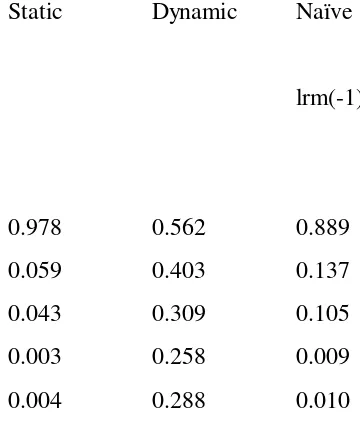
statistics for the within estimation-period simulations are shown in
table 5.
A cursory glance at figure 2 suggests that the model tracks the
behaviour of LRM1 quite well. There appear to be no significant
departures from the observed behaviour of LRM1. This tends to
confirm our view that the model did not require the introduction of
dummy variables to allow for the various changes in the financial
environment.
As far as the static simulation results are concerned, the satisfactory
quality of the model as far as tracking actual values of the log of the
real money supply is confirmed by the statistics shown in table 5. The
correlation coefficient between the simulated and actual values is
quite high and the various error statistics quite low. As a yardstick we
also obtained the same statistics for the naïve ‘no-change model’.
These are also shown in table 5 and, in every case are inferior to those
relevant to model predictions. The mean error for the model
simulation is also not significantly different from zero. This suggests
that the model is providing unbiased biased ‘in sample’ forecasts14.
Dynamic simulations provide a much more (?excessively) rigorous test
of the model. Examination of chart 3 shows that the demand for
money was significantly under predicted for the period 1969 to 1986.
Outside this period however, the actual behaviour of lrm1 was well
tracked. These conclusions are reinforced by examination of the
statistics contained in Table 5. In every case, as would be expected,
the diagnostic statistics for the dynamic simulations are inferior to
both the ex-post static simulations and the naïve forecasts.
Furthermore the hypothesis that the mean error is zero is rejected at
the 5% level of significance. This is no doubt to the under prediction
which occurred in the period 1969 to 1986.
14
6 Conclusions
This paper raised the issue of the long-run equilibrium relationship of
demand for money and its short run dynamics, in the context of the
Greek economy during a period experiencing conflicting developments
in its real and financial sector. The function was estimated using a
method based on the Granger-Engle two step method. The Johansen
procedure that was implemented to obtain the long-run (equilibrium)
relationship while the short-run dynamics were obtained through
estimation of an ECM which gave significant and correctly signed error
correction terms. These results should confirm the existence of
long-run stable relationship between M1 and a three other variables, i.e. the
index of industrial production (lip, a proxy for national income), a
short rate of interest (lrs) and the rate of inflation (infl). Apart from the
failure of the normality test for the residuals, the preferred ECM was
satisfactorily estimated. Furthermore, the estimated elasticities
indicated the dependence of money demand on inflation both in the
long run and short run. Hence, the inclusion of inflation in the
function seems justified denoting that real assets were an important
alternative to money during that period.
Finally the model tested by simulated the final equation within the
sample period. Ex Post Static simulations provided evidence that the
final equation tracked the actual variables in a satisfactory manner.
The Ex Post Dynamic simulations, whilst providing inferior results to
the static simulations, were also reasonably satisfactory given the
Table 1: Descriptive Statistics: 1962Q1 to 1998Q3
Variable Mean Standard Skewness Kurtosis
Normality
Deviation (-3)
lrm1 13.9494 0.3336 -1.2409 1.1923 46.43*
lip 4.3200 0.4823 -1.1107 0.1337 30.33*
lrs 2.3400 0.5852 -0.1872 -1.5260 15.12*
infl 0.0281 0.1215 0.7050 6.5496 273.05*
Table 2: Stationarity Tests: 1965Q2 to 1998Q3
a Level of Variables
Variable ADF order of lag Phillips-Perron Statistic
lrm1 -2.7177 3 -3.3748*
lip -3.5328* 8 -3.7433*
lrs -1.6174 1 -1.3946
infl -11.3031* 1 -15.9351*
b First Difference of Variables
Variable ADF order of lag Phillips-Perron Statistic
∆lrm1 -10.8510* 2 -20.8051*
∆lip -3.8181* 7 -21.4977*
∆lrs -8.5542* 0 -7.2936*
∆infl -8.9283* 6 -33.3912*
Table 3 Cointegrating Vectors
(Coefficients normalised on lrm1)
Vector 1 Vector 2 Vector 3
lrm1 -1.0000 -1.0000 -1.0000
lip 1.4943 1.2162 0.81406
lrs -1.6568 -13.1022 -0.27244
infl -47.3101 167.3539 -0.18893
Table 4: Error Correction Model
Dependent Variable Dlrm1. Number of Observations 133
Regressor Coefficient T-Ratio[Prob]
Constant 0.058331 9.6
∆lipt-2 0.18457 1.9
∆lrst-3 -0.14609 1.6
∆infl -0.74858 20.4
∆inflt-1 -0.44988 10.8
∆inflt-2 -0.13453 3.1
rest-3 -0.24934 5.5
sr1 -0.19661 13.9
Diagnostic Statistics
R-Squared 0.8137 R-Bar-Squared 0.8039 DW-statistic 2.0541
P value LM test for serial correlation 3.5488 0.47 Test for Heteroscedascity 0.23792 0.63 Bera Jarque test for normality of residuals 21.4205 0.00
Table 5: Simulation Accuracy
Static Dynamic Naïve Forecast
lrm(-1)
References
Alexakis, P. D. [1980] ‘I zitisi chrimatos stin Ellada, 1960-1975’(The Demand for Money in Greece, 1960-1975), Spoudai, Λ, 151-166.
Apostolou, N. and Varelas, E. [1987] ‘I zitisi chrimatos stin Ellini Oikonomia : Merikes diapistosis’ (Demand for Money in the Greek Economy: Some Findings), Spoudai, Vol. 37, No 3, (July-September), 434 – 447.
Basçi, S. and Zaman, A. [1998] ‘Effects of Skewness and Kurtosis on Model Selection Criteria, Economic Letters, 59, 17 – 22.
Brissimis, S. N. and Leventakis, J. A. [1981] ‘Inflationary Expectations and the Demand for Money: The Greek Experience’, Kredit und Kapital, Heft 4, 561-573.
Brissimis, S. N. and Leventakis, J. A. [1983] ‘Inflationary Expectations and the Demand for Money: The Greek Experience. A comment and Some Different Results. A Reply’, Kredit und Kapital, Heft 2, 265-266.
Brissimis, S. N. and Leventakis, J. A. [1985] ‘Specification Tests of the Money Demand Function in an Open Economy’, Review of Economics and Statistics, 67, 482-489.
Dickey, D. A. and Fuller, W. A. [1981] ‘Likelihood Ratio Statistics for Autoregressive Time Series with a Unit Root’, Econometrica, 49, 1057 – 1072.
Durbin, J. [1970] ‘Testing for Serial Correlation in Least Squares Regression when Some of the Regressors are Lagged dependent Variables’, Econometrica, 38, 410 – 421.
Engle, R.F. and Granger, C.W.J. [1987] ‘Co-integration and Error Correction: Representation, Estimation and Testing’, Econometrica, Vol. 55, No 2 (March), 251-276.
Ericsson, N. R. and Sharma, S. [1998] ‘Broad Money Demand and
Financial Liberalization in Greece’, Empirical Economics, 23, 417- 436.
Himarios, D. [1983] ‘Inflationary Expectations and the Demand for Money: The Greek Experience. A Comment and Some Different Results’, Kredit und Kapital, Heft 2, 253-263.
Himarios, D. [1987] ‘Has There Been a Shift in the Greek Money Demand Function?’, Kredit und Kapital, Heft 1, 106-115.
Holden, K and Peel, D. A. [1990] ‘On Testing for Unbiasedness and Efficiency of Forecasts’ Manchester School of Economic and Social Studies, 58, 120 – 127.
Johansen, S. [1988] ‘Statistical Analysis of Cointegrating Vectors’,
Journal of Economic Dynamics and Control, 12, 111 – 120.
Palaiologos, J. [1982] ‘I sinartisis protimiseos refstotitos is tin Ellinikin Ikonomian 1954-1978’ (The liquidity preference function in the Greek Economy 1954-1978), Spoudai, ΛΒ, 802-820.
Panayotopoulos, D. [1983] ‘I zitisi chrimatos stin Ellada. Ikonometriki dierevnisi me triminiea stichia 1962-81’ (Demand for Money in Greece. Econometric Estimation Using Quarterly Observations 1962-81),
Spoudai, ΛΓ, 76-106 and 251-292.
Panayotopoulos, D. [1984] ‘Inflationary Expectations and the Demand for Money: The Greek Experience. A Comment and Some Different Results- A Rejointer’ Kredit und Kapital, Heft 2, 272-280.
Phillips, P. C. B and Perron [1988] ‘Testing for a Unit Root in Time Series Regression’, Biometrica, 75, 335 – 346.
Prodromidis, K. P. [1984] ‘Determinants of Money Demand in Greece, 1966I-1977IV’, Kredit und Kapital, Heft 3, 352-367.
Psaradakis, Z. [1993] ‘The Demand for Money in Greece : An Exercise In Econometric Modelling with Cointegrated Variables’, Oxford Bulletin of Economics and Statistics, 55, 2, 215-236.
Tavlas, G. S. [1987] ‘Inflationary Finance and the Demand for Money in Greece’, Kredit und Kapital, Heft 2, 245-257.
Appendix 1: Data Sources
The data resource is IMF International Financial Statistics
obtained through Datastream and are described below:
1. Narrow money (M1) is the sum of currency outside deposit money
banks and demand deposits other than those of the central
government. In IMF statistics this is reported as GR MONEY
SUPPLY: M1 CURN, code: GRM1…A. M1 is expressed in end of
period billions of Drachmas.
2. Quarterly data on Gross Domestic Product for Greece are not
available before 1975. Hence, we have used as a proxy for real GDP
the Industrial Production Index (IP). This is reported in quarterly
basis in IMF statistics under the heading GR INDUSTRIAL
PRODUCTION VOLN and the code: GRINPRODH. The index has a
base 1980=100.
3. The Consumer Price Index is used to denote the price level. This is
reported in IMF statistics as GR CONSUMER PRICES NADJ, code:
GRI64…F, with a base 1990=100.
4. Interest rates on 3 to 6 months time deposits with commercial
banks (RS) were used as an indication of the short-term interest
rate. The series are reported as GR COMM BKS 3-6 MO DEPOSITS,
code: GRI60L and they are expressed as percent per annum.