International Research Journal of Engineering and Technology (IRJET)
e-ISSN: 2395-0056 Volume: 04 Issue: 11 | Nov -2017 www.irjet.net p-ISSN: 2395-0072© 2017, IRJET | Impact Factor value: 6.171 | ISO 9001:2008 Certified Journal | Page 1946
INTRODUCTION TO PALMPRINT RECOGNITION
Kanchana .A
1, Stanly Jayaprakash .J
21
Assistant Professor, Head of the deprament of CSE,
Mahendra Engineering College for Women, Namakkal Dt
2
Assistant Professor, Head of the deprament of CSE,
Mahendra Institute of Technology, Namakkal Dt
---***---Abstract -
Biometrics refers to human characteristicsand behavior. Biometric authentication is used for identification and access control that are used to identify individuals in groups under observation. Biometric identifier is frequently classified as physiological versus behavioral characteristics, for examples, fingerprint, palm veins, face recognition and palmprint. Existing works have used multiple correlation filters per class for performing palmprint classification algorithm. It produces sharp peak for known class and noisy output for unknown sample class using images from the PolyU database.
1.
INTRODUCTION TO BIOMETRICS
Biometrics refers to metrics related to human a characteristic which is used to identify individuals in groups. Biometric systems resolve or verify a person’s uniqueness without human intervention. It is based on anatomical and behavioral traits such as fingerprint, palmprint, vein pattern, finger knuckles, face, Iris, voice, and gait. Biometric characteristics, also called as
templates, indicate a robust and constant
communication between a person and his identity and these characteristics cannot be easily misplaced or forgotten or distributed or forged. A biometric characteristic called the feature set is exceptional for each and every individual. The feature set obtained during employment is stored in the system database as a template.
2.INTRODUCTION TO PALMPRINT RECOGNITION
In recent years, a range of automated biometric based recognition methods has been developed such as fingerprint, palmprint, iris pattern, voice, etc. In these biometric features, palmprint has a superior similarity over the fingerprint. Palmprint is an image obtained from the palm region of the hand. Palmprint based systems have become fresh research areas in recent years. The main benefit of palmprint is the accessibility of large space for extracting biometric features. In general, palmprint images should be standardized and oriented before feature extraction. Palmprint devices are less expensive than the other devices like iris. Palmprints hold extra distinctive features such as wrinkles and principle lines that can extract from low-resolution images. By joining all features of palm and
fingerprint such as ridge and valley features, principle lines and wrinkles, it is possible to provide a highly accurate biometric system. Palm and finger biometrics denoted by the information is presented in a friction ridge impression. This information uses ridge flow, ridge traits, and ridge structure of the raised segment of the epidermis.
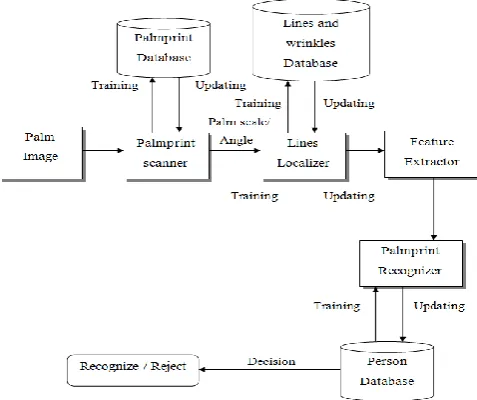
[image:1.595.321.560.372.572.2]Palmprints and Fingerprints have both individuality and stability. They have been used over a century as trusted forms of identification. The general framework of palmprints recognition system is depicted in figure 1.
Figure – 1: A framework for Palmprint recognition
Note that there is an extra point localizer of wrinkles and principle lines in palmprint recognition system. To Identify the accurate position of the lines for palmprint recognition, the developer usually exploits the locations of both lines and marks for help. In this system, functional modules such as palm scanner, line localizer, and identifier track the feature extractor as well as pattern recognizer schematics.
2.1 Human Identification using Palm Vein Images
International Research Journal of Engineering and Technology (IRJET)
e-ISSN: 2395-0056 Volume: 04 Issue: 11 | Nov -2017 www.irjet.net p-ISSN: 2395-0072© 2017, IRJET | Impact Factor value: 6.171 | ISO 9001:2008 Certified Journal | Page 1947
vein-based identification systems. The palm vein-basedidentification approach contains the possible
deformations, revolving, and translational variations by training the orientation maintaining features and utilizing a novel region-based matching scheme. There are two types of approaches in evaluating of palm vein that are obtained with the contactless and touch-based imaging system. Palm vein images in contactless imaging provide many translational and rotational changes. Hence, more severe preprocessing steps are needed and remove a constant and aligned ROI. This ROI reduces the rotational, translational and scale variations. The preprocessing steps fundamentally improve a fixed-size ROI from the obtained images. This is pursued by the nonlinear enhancement with the intention that the vein patterns from ROI images are examined more obviously. The identification process is more useful and efficient and it is necessary to build a coordinate system. It is sensible to link the coordinate system with the palm itself. Two links are utilized as the orientation points/lines to construct the coordinate system, i.e. the link between the index finger and middle finger together with the links between the ring finger and little finger.
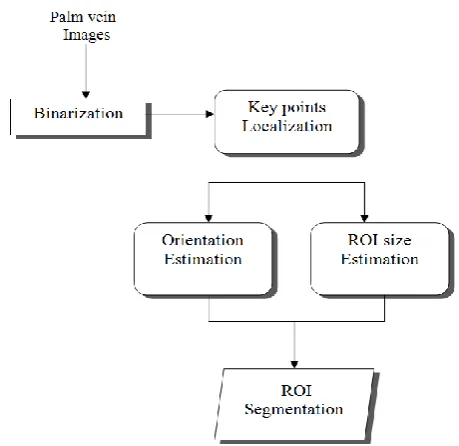
Figure - 2: Block diagram for personal identification using palm vein images
Figure 2 depicts personal identification using palm vein images. The palm images are binarized and it extracts the region of palm from the background region. Next, the calculation of the distance from the center position of the binarized palm to the boundary of the palm is done. The system places the two links by observing the corresponding local minima from the forecast distance.
The possible scale variations in the contactless environment can be quite huge. It selects the location and size of the ROI consistent with certain image-specific calculations from the palm. But the method is more
computationally well-organized as no extra
sampling/computations are needed. After segmentation,
the ROI images are scaled to produce a constant size region and the process is illustrated in Figure 3.
Figure - 3: Major steps in segmenting ROI images from contactless palm vein images
The palm vein images employed in identification using palm vein obtained under near-infrared illumination (NIR) and the images normally emerge darker with low contrast. So, image development more evidently demonstrates the vein and texture patterns. First, approximate the condition intensity profiles by segmenting the image into a little overlapping. In 32 X 32 blocks, three pixels are overlapped between two blocks to address the blocky effect. The average gray-level pixels in each block are forecasted. Consequently, the estimated background intensity profile is reduced to the same size as the unique image using bicubic interruption and the resulting image is subtracted from the original ROI image. Finally, histogram equalization is adapted to obtain the normalized and improved palm vein image. The improvement has been moderately successful in enhancing the information and contrast of the ROI images.
The standardized and improved palm vein images represent curved vascular network/patterns which can be approximated by small line segments that are quite
curved. Consequently, in this work, a recognition
[image:2.595.323.553.123.346.2] [image:2.595.41.271.371.558.2]International Research Journal of Engineering and Technology (IRJET)
e-ISSN: 2395-0056 Volume: 04 Issue: 11 | Nov -2017 www.irjet.net p-ISSN: 2395-0072© 2017, IRJET | Impact Factor value: 6.171 | ISO 9001:2008 Certified Journal | Page 1948
2.2 Palmprint Authentication using Fast ComplexGabor Wavelet
Palmprint biometric is acquired for personal authentication as it is distinctive and moderately low-resolution images of less than 100 dpi are adequate to remove the unique features. Palmprint features include line, geometry, point, texture, and statistical features. Jyoti Malik et al. (2011) observed that line features are extracted by using complex Gabor wavelet transform method. The line features extracted by complex Gabor wavelet and the values of theta are loaded in the feature vector. The feature vector is matched by hamming distance similarity measurement using sliding window method. In general, the palmprint authentication system is divided into two subsystems:
(i) The pre- authentication system and
(ii) Authentication system
In the pre-authentication system, a database of Gabor palmprint features is maintained. Reference threshold values are also identified and stored in the database.
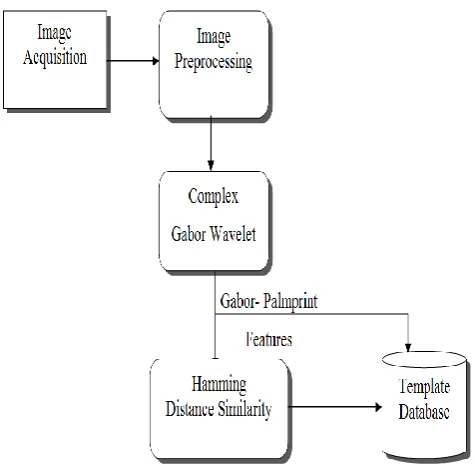
Figure – 4: Palmprint Pre-Authentication system
The above figure4 shows palm pre-authentication systems. In this system, the accuracy of a person being real or an imposter is identified with the aid of reference threshold values stored in a pre-authentication system database.
Figure – 5: Palmprint Authentication Systems
Figure 5 illustrated palmprint authentication system that plays a significant function in making the real-time authentication system. The reduction in matching time is done in a proposed fast palmprint authentication system using sliding window methods.
The desired line features are extracted from the palmprint using complex Gabor wavelet method that extracts line features from the input palmprint image. The Gabor wavelet is basically a Gaussian modulated by a complex sinusoid. The value of hamming distance is forecast scaling value by using sliding window method. In sliding window method, the ROI is minimized by the window size (WS) and the window of ((60–WS)×(60– WS)) slides over the rows and columns. The minimum value of the Hamming distance values is considered if the Hamming distance value is lower than the reference threshold value.
The sliding window method, the vital approach of feature matching, is an efficient method but it is very slow due to the window size. The window size is selected in such a way to negotiate association problem in the palmprint images. Here, two sliding window approaches are developed. Sliding window method 1 (SWM1) and Sliding window method 2 (SWM2) are about using palmprint segment in such a way to minimize the matching operation time. Finally, the SWM1 and SWM2 reduce the complexity of the algorithm of SWM.
3. PALMPRINT TEXTURE VERIFICATION
[image:3.595.319.569.82.232.2] [image:3.595.39.277.372.608.2]International Research Journal of Engineering and Technology (IRJET)
e-ISSN: 2395-0056 Volume: 04 Issue: 11 | Nov -2017 www.irjet.net p-ISSN: 2395-0072© 2017, IRJET | Impact Factor value: 6.171 | ISO 9001:2008 Certified Journal | Page 1949
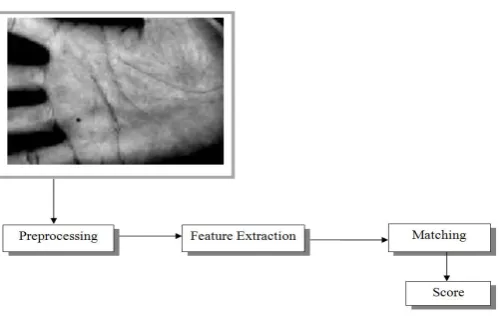
The main parts of palmprint verification system aredepicted in Figure. 6.
Figure – 6: Main modules of a Palmprint Verification
The main modules of a palmprint verification system as depicted in Figure 6 are:
a) Palmprint senses the palmprint of a human
obtained by a palmprint scanner.
b) Preprocessing in which the input palmprint is
improved and adapted to shorten the process of feature extraction;
c) Feature extraction in which the palmprint is
further processed to produce discriminative features also called feature vectors
d) Matching in which the feature vector of the
input palmprint compared against with one or
more existing templates.
The templates of supported clients of the biometric system also called users are regularly registered in a large database. Users can emphasize an identity and their palmprints can be checked against stored palmprints. Texture information is detected using Haralick’s features on principle line boundaries. Texture related palmprint recognition approach is used in a large range of problems, such as cancer characterization in medical imaging or segmentation of urban areas in satellite and aerial images. Therefore, as per recent studies, Haralick’s features are performed in higher numbers for palmprint recognition.
In a training stage, paradigm textures are recognized in a set of images representative of different classes. These paradigm textures form a thesaurus of textons. A palmprint is indicated by a histogram of the frequencies of each text on. This idea must be used for other features rather than texture, and the dictionaries are called collections of visual words. Further, detailed texture
based palmprint recognition is explained in the sub-sections below.
3.1 Reliable Contactless Palmprint Authentication
Aythami Morales et al. (2010) discussed the method for automatic hand recognition. The work proposed a new method for contactless hand authentication in complex images. Contactless hand authentication system uses skin color and hand shape information for hand detection process. Next, the palm is extracted and characterized by circular Gabor filter. Finally, the palm features are matched by a new normalized approximated string matching.
Typically the skin color is modeled by Bayes classifiers or Gaussian mixture models. As an alternative to Bayes classifiers and Gaussian mixture methods, the skin color based model is designed for machine learning. For an optimal compromise between the execution time and the precision of detection, the system uses a neural network (NN). And the NN entries are compiled by three neurons. One is for the color component of pixels in RGB domain. The NN output is the chance that a pixel is a skin pixel. The learning phase allows modeling the skin tone in RGB domain. Similarly, a Principal Components Analysis on a skin pixels database identifies an exact color space named skin space. After the learning, the NN can notice the pixels looking like skin. For each pixel of an image, the NN forecasts the chance that each pixel is a skin pixel. This process constructs the probabilities map.
The segmentation by skin color cannot perform the process of hand detection in a strong manner. Therefore, a precise active shape model is defined to cancel this problem and to address the two major complexities of active shape model. These problems are the contour initialization in the detection phase. After hand detection, it is efficient to describe the palm separately of the distance between the hand and the capture device. The extraction is based on hand dimensions and the palm extraction method.
The Gabor filter is implemented in texture analysis by using Gaussian modulated by a wave. In oriented Gabor filters, wave is an oriented complex sinusoidal signal. This forceful circular Gabor filter is convoluted with the palm image to artifact the palmprint features. In contrast, the features are not binarized, so all the information is maintained properly. With all information, the changes between two data’s are conserved.
[image:4.595.37.287.124.284.2]International Research Journal of Engineering and Technology (IRJET)
e-ISSN: 2395-0056 Volume: 04 Issue: 11 | Nov -2017 www.irjet.net p-ISSN: 2395-0072© 2017, IRJET | Impact Factor value: 6.171 | ISO 9001:2008 Certified Journal | Page 1950
high in the scoring matrix. This scoring matrix containshigh matching score. Finally, the AMSA is strong to translation, deletion, substitution or addition of elements in the vectors.
3.2 Palmprint Biometric Template Security
(i) Koen Simoens et al. (2012) presented a system
model in which each center entity or grouping of entities is a feasible attacker. Also, the image is moldered by the differential morphological pyramid, causing a separate scale-space representation.
Major reasons for the necessity of Renewable Biometrics: Firstly, biometric properties are subject to biological and mechanical changes such as aging, and injuries; hence the accuracy of the biometric authentication may decrease over time. More specifically, for behavioral biometrics such as speech or handwriting, it is relatively understandable that aging collides with the way that people talk.
From the point of biometric systems, this observation results in the inclination of a possible increase of false non-matches, i.e. legitimate users of biometric systems are more often rejected that the effect has been addressed. Secondly, cooperation or stolen biometric data are complex for biometric systems. Once any unique biometric raw data has been compromised, it may be efficiently used for replay attacks. For instance, it has been shown that sticky palmprints can be generated from digital palmprint images and used for illegal gain authentication by palmprint systems. For both the reasons, it may be attractive to restore biometric reference data: one objective is to preserve the identification performance for individual subjects over time of the process of biometric systems, by often updating reference data.
4. PALMPRINT PATTERN MATCHING
The palmprint pattern mainly comprises of ridges and minutiae, similar to a fingerprint pattern. Though, the creases and ridges in palmprint regularly overlap each other.
Therefore, reports have the extraction of local palmprint features. But, most of the existing work is limited only to the extraction of ridges.
Nevertheless, a few works attempted to estimate palmprint crease points by generating a local gray level directional map. These crease points are linked together to separate the crease in the form of line segments, which are used in the matching task. No features are offered to recommend the strength of these partly extracted creases for the matching of palmprints. Some
related works on palmprint verification are listed in the sub-sections.
4.1 Palmprint Recognition using Image Patterns using Correlation Filters
Vishnu Naresh Boddeti and BVK Vijaya Kumar., (2013) presented a template-based framework to bind class-specific information to a set of image patterns. It recovers that information by matching the template, and a query pattern of the same class must describe. This is performed by mapping the class-specific information to a group of spatial.
The information is retrieved during matching with a genuine query by forecasting the spatial translations applied to the images that were used to plan the template.
The main concentration made on the problem of binding information to biometric marks as an application of the framework. The main concept behind the approach is to exploit Correlation Filters (CFs) for the dual reason of pattern matching and binding specific class information to the template.
During authentication, the bound information is released automatically if the query pattern is authentic. The enrollment and authentication stages of the CF related framework are described in Figure 7.
Figure – 7: Enrollment and Authentication Stages of CF related Framework
In this stage, the following points are required.
Training images representative of the
authentic class. These could be biometric
[image:5.595.320.553.457.647.2]International Research Journal of Engineering and Technology (IRJET)
e-ISSN: 2395-0056 Volume: 04 Issue: 11 | Nov -2017 www.irjet.net p-ISSN: 2395-0072© 2017, IRJET | Impact Factor value: 6.171 | ISO 9001:2008 Certified Journal | Page 1951
(eg. face images with different lighting,expressions etc.) expected during testing.
Information or key to bound to the template
A secondary input (e.g., password or pin)
may be required for additional protection
The sequence should be mapped into places in the correlation plane, by segmenting the key into smaller segments of suitable size. Perfectly, the multi-peak CF should generate correlation peaks at those places in reaction to a centered valid image. For an un-centered query pattern, the peaks transfer internationally depending on the unidentified qualified shift between the query and the training images. Consequently during training, the system forecasts the centroid of the specified peak places that are stored in the database.
[image:6.595.313.556.81.334.2]During authentication, once the peaks should identify, they shift the centroid of the detected peaks to the region stored in the database. Additionally, as the key is mapped only to regions in the correlation plane, it can be recovered only up to a variation if the order of the key segments is not encoded. While other patterns are possible, the work resolves this issue by encoding the ordering along with the key in the filter itself by augmenting the key with the order of that segment. Figure 8 shows an example of mapping the binary key to peak location.
Figure – 8: Example showing mapping from binary key to peak location
The multipeak CF is designed with the training images, and the constraints are obtained from the key as inputs. This template is stored in the database along with the hash value of the key (this is optional) computed using a one-way hash function. Further, the work also does not allow the regions of the constraints to be within 3 pixels from the boundary of the image.
In an authentication stage, the query pattern is offered along with secondary input and a claimed identity in a verification scenario. Figure 9 shows a block diagram of the authentication process.
Figure -9: Block diagram of the testing stage in authentication
The query is then cross-correlated using the CF matching to the claimed identity. If the query is genuine, the resulting correlation should have peaks at the right places except for a possible global shift. The detected peaks in the center portion of the palmprint are to be stored in the database. From the new peak locations, the information bound to the template is reconstructed. The correctness of the retrieved key can be confirmed by comparing the stored hash value with the hash value of the recovered information. For a fake query image, key recovery would be unsuccessful due to the lack of sharp peaks in the resulting correlation plane when either the secondary input is incorrect, or the query does not belong to the claimed class or when both are incorrect. Thus, the framework to bind information to image patterns and to retrieve this information during authentication by embedding the information in the template is designed to discriminate that pattern class from the other pattern classes.
4.2 Multi feature Based Palmprint Recognition
Jing Claim & Jie Zhou (2011) observed that multi feature based high resolution palmprint recognition improves the matching performance with dissimilar resolution that exists in the contactless database. Quality-based and adaptive orientation field estimation algorithm with Neyman-Pearson rule could achieve the good performance, yet non-linear deformation and matching efficiency are not up to the grade.
The main contributions of the multi feature based high resolution palmprint recognition include the following:
Prob
e
Hash key Retrieve
Key Correlation
Autho r Release
Key
Hash key
Key Image
Transform ation Secondary
[image:6.595.39.278.457.581.2]International Research Journal of Engineering and Technology (IRJET)
e-ISSN: 2395-0056 Volume: 04 Issue: 11 | Nov -2017 www.irjet.net p-ISSN: 2395-0072© 2017, IRJET | Impact Factor value: 6.171 | ISO 9001:2008 Certified Journal | Page 1952
1) Utilize multiple features, namely minu tiae,
solidity, orientation and principle lines for palmprint recognition to considerable progress the matching performance of the conventional algorithm.
2) Propose quality-based and adaptive
orientation field evaluation algorithm that executes better than the existing algorithm in case of regions with a large number of creases.
3) Exploit fresh fusion scheme for a
recognition application that performs better than predictable fusion methods, e.g. weighted sum rule, SVMs or Neyman-Pearson rule.
The work evaluates the discriminative energy of different feature fusions and finds concreteness is very useful for palmprint recognition. An analysis of the database containing 14,576 full palmprints proved that the proposed algorithm achieved optimal results. In the verification process, False Rejection Rate (FRR) is 16% and 17% lower than the existing algorithm. It is at a False
Acceptance Rate (FAR) of 10%. In identification process,
the rank-1 live-scan partial palmprint recognition rate is improved from 82 % to 91.7 %.
Line feature matching is reported to be dominant and provides high accuracy in palmprint verification. On the other hand, it is very complex to describe these palm lines, i.e. their magnitude and direction, in noisy images precisely.
With the motivations of these existing works in palmprint texture recognition, palmprint pattern matching, and palmprint template recognition, the proposed work is designed in an efficient way. And also by considering the limitation faced in the existing work, the proposed work is designed to overcome those difficulties.
5. CONCLUSION
Palmprint is the accessibility of large space for extracting biometric features. In general, palmprint images should be standardized and oriented before feature extraction. Palmprints hold extra distinctive features such as wrinkles and principle lines that can extract from low-resolution images. By joining all features of palm and fingerprint such as ridge and valley features, principle lines and wrinkles, it is possible to provide a highly accurate biometric system. Palm and finger biometrics denoted by the information is presented in a friction ridge impression.
REFERENCES
[1] Adams Kong., David Zhang & Mohamed Kamel
2009, ‘A Survey on Palmprint Recognition’, Pattern
Recognition Letters, ELSEVIER, and vol. 42, no. 7, pp. 1408-1418.
[2] Adebayo Daramola, S, Olujimi Ajayi & Tiwalade Od
2014, ‘Robust Palm-Print Feature for Human Identification’, International Journal of Engineering and Advanced Technology (IJEAT), vol. 3, no. 4, pp. 152-155.
[3] Ajay Kumar & David Zhang 2006, ‘Personal
Recognition Using Hand Shape and Texture,” IEEE Transactions on Image Processing, vol. 15, no: 8, pp. 2454-2461.
[4] Ajay Kumar, David Wong, CM, Helen Shen, C & Anil
Jain, K 2003, ‘Personal Verification using Palmprint and Hand Geometry Biometric’, Audio and video based biometric person authentication, Springer, vol. 2688, pp.no:668-678.
[5] Anu Nair, SH & Aruna, P 2014, ‘Image Fusion
Techniques for Iris and Palmprint Biometric System’, Journal of Theoretical and Applied Information Technology, vol. 61, no. 3, pp. 476-485.
[6] Arie Nakhmani & Allen Tannenbaum 2012,
‘Self-Crossing Detection and Location for Parametric Active Contours’, IEEE Transactions on Image Processing, vol. 21, no. 7, pp. 3150-3156.
[7] Ashutosh Kumar & Ranjan Parekh 2012, ‘Palmprint
Recognition in Eigen-space’, International Journal on Computer Science and Engineering (IJCSE).
[8] Aythami Morales, Miguel FEERer, A & Ajay Kumar
2010, ‘Improved Palmprint Authentication using Contactless Imaging’, IEEE Transactions on Information Forensics and Security.
[9] Benjamin Snyder & Regina Barzilay 2008,
‘Unsupervised Multilingual Learning for
Morphological Segmentation’, Proceedings of ACL-08: HLT, pp. 737–745.
[10]Cappelli, R, FEERara, M & Maio, D 2012, ‘A Fast and
Accurate Palmprint Recognition System Based on
Minutiae’,IEEE Transactions on Systems, Man, and
Cybernetics, vol. 42, no. 3, pp. 956-962.
[11]Cuong Vu, T, Thien Phan, D & Damon Chandler, M
2012, ‘S3: A Spectral and Spatial Measure of Local Perceived Sharpness in Natural Images’, IEEE Transactions on Image Processing, vol. 21, no. 3, pp 1-13.
[12]Dewi Yanti Liliana & Eries Tri Utaminingsih 2012,