© 2017, IRJET | Impact Factor value: 5.181 | ISO 9001:2008 Certified Journal | Page 123
AN EMPIRICAL STUDY ON KEY DETERMINANTS OF CONSTRUCTION
DELAY
E.Abinayasri
1, Dr.S.Anandakumar
2, Dr.V.Krishnamoorthy
31
Final year M.E., Department of Civil Engineering, Kongu Engineering College,Perundurai, India
2Professor and Head ,
Department of Civil Engineering, Kongu Engineering College, Perundurai, India
3
Assistant Professor ,School of management Studies, Kongu Engineering College, Perundurai, India
---***---Abstract
-
The purpose of this study is to investigate the causes of construction delay and its impact on client dissatisfaction. The factors are identified from literature and using these factors questionnaire is prepared and it consists of total of 40 factors causing delay. In order to collect data from the respondents, questionnaire method is used. The structured questionnaire form is send to various construction companies through email. This study has been conducted in and around Erode district for a period of seven months from July 2016 to January 2017. The study identified nine dimensions of construction delay.Key Words
: design, equipment, personal,
manpower, experience, government, material,
finance, owner.
1.INTRODUCTION
Delay factors are considered to be significant role in the delivery of a construction project on time, within budget and at the required quality [26]. The success of the construction project requires sound strategies, good practices and careful judgement for completion of project on schedule and with estimates cost [1].Delays are the most common and costly problem encountered on construction projects. Construction delays are significant part of the project’s construction life. Even with present advanced technology, and management understanding of project management techniques, construction delay projects continue to suffer incase of delays and project completion dates. The major reasons for delay includes strikes, rework, deficit organization, shortage of materials, machinery failure, change orders. Delays are costly to all parties involving in the construction industry and often result in litigation. The time and expense incurred to produce a claims document in itself is substantial. There is room for improvement in present practices for keeping track of delays. Therefore, introducing a exible and more accurate delay analysis technique can be valuable [23].
2.
REVIEW OF LITERATURE
The following are the overview of literatures collected from past research and studies. The most noteworthy of them are relevant to the current study are being
reviewed.
Adnan Enshassi et al (2016) assess the factors leading to time and cost overruns in construction projects, Gaza Strip. The survey included 110 delay factors, 42 cost overrun factors. This study concluded that the major causes could be removed by better management practices.
Remon F. Aziz et al (2016) lists the construction delay causes. The questionnaire was prepared and distributed to 500 construction from the identified 293 delay causes. Relative Importance Index (RII). The most contributing causes and groups to delays were identified, and some future suggestions were proposed.
Majed Alzara et al (2016) identifies the major causes of project delays in northern Saudi Arabia The delay factors were collected from the University Projects Director were then compared to Saudi construction projects. It gives a solution to minimize delay factors and improve its performance using Performance Information Procurement System.
Samer Alsharif and Aslihan Karatas (2016) analyzed a framework for identifying causal factors of delay for operable nuclear power plants projects.
Greeshma b Suresh and Dr.S.Kanchana (2015) had done a study on quantification of delay factors in construction industry in Kerala region. Top 10 major causes of construction delays in construction industry are identified.
Prakash Rao and Joseph Camron Culas (2015) outlines the major causes of construction delays, the effects of delays, and methods of minimizing construction delays. Site management and supervision, effective strategic planning, and clear information and communication channel are the methods to minimize delays.
© 2017, IRJET | Impact Factor value: 5.181 | ISO 9001:2008 Certified Journal | Page 124
client’s perspective. A factor analysis was allow tointerpret the dependencies between them.
K.L.Ravisankar et al (2014) conducted a study on the quantification of delay factors in construction industry. The questionnaire is formed consisting of total 50 delay factors and is sent to various construction companies by email and in by personal.
3. RESEARCH GAP
Although several studies have been conducted with regard to study on key determinants of construction delay, most of the studies have been conducted in western perspective. Only few studies have been conducted in Indian context. Therefore the researcher would like to fill the gap by way of studying the engineers, supervisor’s views on construction delays.
With this background, the researcheres intend to identify the various dimensions of construction delay.
4. RESEARCH METHODOLOGY
4.1 Scope
The scope of the study is confined only to the engineer’s, supervisor’s views on construction delays in Erode district.
4.2 Period of study
The period of study is conducted during the period of September 2016 to January 2017.
4.3 Data collection methods
Primary data collection was done through questionnaire method. The first part of the questionnaire consists of the demographic profile of the respondents. The second part of the questionnaire was relating to factors that causes delay in construction sites.
4.4 Sampling method
The researchers adopted convenience sampling method for collecting data from the respondents.
Table-1: Number of questionnaire’s distributed and received
S.No. Taluks in
erode
Distributed questionnaire’s
Received response
Response rate
1 Erode 45 30 66%
2 Perundurai 45 30 67%
3 Modakkurichi 40 20 50%
4 Kodumudi 35 20 57%
5 Sathy 20 10 50%
6 Bhavani 20 15 75%
7 Anthiyur 15 12 67%
8 Gobi 40 35 78%
9 Thalavadi 10 6 60%
10 Total 250 178 65%
4.5 Construct development
The variables relating to the present study is drawn from the previous work done by-(Shebob et al, 2007), (Adnan Enshassi et al, 2016), (Sabah Alkass et al, 1996), (Arshi Shakeel Faridi et al, 2006), (Sadi A. Assaf and Sadiq Al-Hejji, 2006),(Remon F. Aziz et al 2016),(Greeshma b Suresh and Dr.S.Kanchana 2015).Suitable modification was made in the existing questionnaire to suit the requirements of the current study.
4.6 Descriptive statistics
The demographic profile in the questionnaire features the experience level of the respondent, their salary level, their level of designation in the department they are working in. The total survey was conducted in 250 out of whom only 178 questionnaires could be collected. The response rate of the survey was 65 percent. The survey were conducted among deputy managers, structural engineers, quantified engineers, safety officers, design engineers, site engineers, supervisors, assistant engineers.
5. ANALYSIS AND DISCUSSIONS
5.1 Reliability statistics
.
There is a number of diverse methods towards evaluating reliability of a scale. In this study the method hired is cronbach‟s reliability.
© 2017, IRJET | Impact Factor value: 5.181 | ISO 9001:2008 Certified Journal | Page 125
scale. Hence cronbach‟s α was obtained and found to be of [image:3.595.347.535.122.168.2]adequate magnitude[16]. Table-2: Reliability Statistics
Cronbach's Alpha N of Items
.901 40
Table-3: Reliabilities of various dimensions of construction delay
S.No. Dimensions Reliability statistics
1
Design 0.89
2
Equipment 0.86
3 Personal 0.85
4 Manpower 0.852
5 Experience 0.845
6 Government 0.862
7 Material 0.898
8 Finance 0.875
9 Owner 0.862
5.2 Exploratory factor analysis
The researcher studied the measured delay items by using exploratory factor analysis via principal component analysis in order to examine whether the items in fact measure the pre-specified constructs.
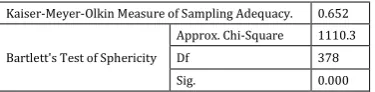
Prior to conducting the factor analysis, the two tests were achieved in order to check the possible existence of multi-collinearity or correlation among the items and the appropriateness of factor analysis. Initially, inspection of the correlation matrix exposed the presence of many coefficients of 0.3 and above, which supports the factorability of the correlation matrix .Then, to verify if the dataset was appropriate for factor analysis, the Kaiser-Meyer-Olkin (KMO) measure of sampling adequacy value has to be equal to, or greater than, 0.6 and that the Barlett’s test of sphericity value is important, where the significant value should be 0.05 or smaller. However, for this study, the KMO value is 0.652 and Bartlett’s test is significant therefore, it is appropriate to conduct the factor analysis.
Table -4: KMO and Bartlett's Test
Kaiser-Meyer-Olkin Measure of Sampling Adequacy. 0.652
Bartlett's Test of Sphericity
Approx. Chi-Square 1110.3
Df 378
Sig. 0.000
The next stage of analysis was to evaluate the delay elements. In order to examine whether the items of a construct shared a single underlying factor and to establish the discriminant validity of the constructs under investigation, an exploratory factor analysis (EFA) was achieved.
Exploratory factor analysis using a principal component analysis (PCA). Varimax with Kaiser normalisation was applied prior to factor rotation, thus keeping factors with an eigenvalue of 1 or greater.
The 40 items measured the key determinants of construction delay in and around Erode district. The research model is subjected to the PCA using SPSS Version 16. The exploratory factor analysis of delay reveals the presence of 9 components with eigenvalues exceeding 1; these 9 components accounted for 69.657 per cent of the total variance.
The underlying factors were labelled as follows: Factor 1: Design – This encompasses 6 items that represent 27.940 percent of the variance. The items are all related to delay in construction industry.
Factor 2: Equipment – This includes 6 items that account for 7.454 per cent of the variance. This item deals with the importance of support from the top management for reducing delay in construction industry and to enhance quality practices and for achieving company excellence. Factor 3: Personal – This consists of 6 items. This construct focuses on the construction quality information that influences company performance. This factor signifies 6.633 per cent of the variance.
Factor 4: Manpower – This comprises 4 items that deal with the importance of management of materials. It accounts for 5.928 per cent of the variance.
Factor 5: Experience– This includes 4 items that are associated key determinants of delay in construction industry. This factor explains 5.4 percent of the variance. Factor 6: Government – This includes 2 items that are related to the practice of delay as a means of attaining high standards of organisational performance. This factor explains 4.903 per cent of the variance.
Factor 7: Material –This component accounts for 4.409 per cent of the variance with 4 items.
Factor 8: Finance– Only 1 item are included in this component.This component is significant with factor explains 3.817 per cent of the variance.
Factor 9: Owner– Here 7 items are included. This component is significant with factor explains 3.173 per cent of the variance [8].
© 2017, IRJET | Impact Factor value: 5.181 | ISO 9001:2008 Certified Journal | Page 126
Table -5: Total Variance explainedS.No.
Factors Initial Eigen
Values
Variance
Explained Cumulative Percent
1 Design 10.33 27.940 27.940
2 Equipment 2.758 7.454 39.394
3 Personal 2.454 6.633 42.028
4 Manpower 2.193 5.928 47.956
5 Experience 1.998 5.400 53.356
6 Government 1.814 4.903 58.258
7 Material 1.631 4.409 62.667
8 Finance 1.412 3.817 66.484
9 Owner 1.174 3.173 69.657
Initially, all the 40 variables were used. After rejecting those items that have inadequate loadings, we reduced to nine factors. The identified factors explain percent of total variance. The factors are named as follows:
Design related factors
Equipment related factors
Personal related factors
Manpower related factors
Experience related factors
Government related factors
Material related factors
Finance related factors
Owner related factors
6. CONCLUSIONS
The purpose of this study was to identify the important dimensions of construction delay. For this, the researchers employed exploratory factor analysis. This study identified nine dimensions. These are design, equipment, personal, manpower, experience, government, material, finance, owner. These study findings would help the policy makers to identify the important dimensions of construction delay. Eventhough the study has achieved its objectives, it has certain limitations (i.e) the researchers adopted convenient sampling method. In future, similar study could be conducted by adopting some other sampling methods. This study adopted only exploratory factor analysis for identifying important dimensions of construction delay and in future confirmatory factor analysis could be used.
REFERENCES
[1] Adan Enshassi (2009), ‘Delays and cost overruns in the construction projects in the Gaza Strip’, Journal of Financial Management of property and Construction, Vol.14 No.02, pp. 126-151.
[2] Arshi Shakeel Faridi and Sameh Monir El-Sayegh (2006), ‘Significant factors causing delaying the UAE construction industry’, Journal of Construction Management and Economics, Vol.24, pp. 1167-1176.
[3] Arshi Shakeel Faridi and Sameh Monir El‐Sayegh (2006), ‘Significant factors causing delay in the UAE construction industry’, Construction Management and Economics, Vol. 24, pp. 1167-1176.
[4] Ayman H and Al-Momani (2000), ‘Construction delay: a quantitative analysis’, International Journal of Project Management, Vol. 18, pp. 51-59.
[5] Charles Teye Amoatey, Yaa Asabea Ameyaw, Ebenezer Adaku and Samuel Famiyeh (2015), ‘Analysing delay causes and effects in Ghanaian state housing construction projects’, International Journal of Managing Projects in Business, Vol. 8, pp.198-214.
[6] David Cooke Thomas Rohleder Paul Rogers, (2010), ‘A dynamic model of the systemic causes for patient treatment delays in emergency departments’, Journal of Modelling in Management, Vol.5, pp. 287 -301.
[7] Greeshma B Suresh and Dr. S. Kanchana (2015) ‘A study on quantification of delay factors in construction industry (Kerala region)’ International journal on engineering technology and sciences, vol. 2, pp. 96-103.
[8] Hayati Habibah Abdul Talib Khairul Anuar Mohd Ali Fazli Idris (2014),’Critical success factors of quality management practices among SMEs in the food processing industry in Malaysia’, Journal of Small Business and Enterprise Development, Vol. 21, pp. 152 – 176.
[9] Ibrahim Mahamid (2011), ‘Risk matrix for factors affecting time delay in road construction projects: owners' perspective’, Engineering Construction and Architectural Management, Vol. 18, pp. 609 – 617.
[10] Kikwasi, G.J (2012), ‘Causes and effects of delays and disruptions in construction projects in Tanzania’, Australasian Journal of Construction Economics and Building, Conference Series, Vol.1, pp. 52-59.
© 2017, IRJET | Impact Factor value: 5.181 | ISO 9001:2008 Certified Journal | Page 127
[12]Michal Gluzak and Agnieszka Lesniak (2015),‘Construction delays in clients opinion –multivariate statistical analysis’ Creative Construction Conference, Vol.123, pp. 182 – 189.
[13] Mohamed M. Marzouk and Tarek I. El-Rasas (2014), ‘Analyzing delay causes in Egyptian construction projects’. Journal of Advancer Research, Vol. 5, pp. 49-55.
[14] Murali Sambasivan and Yau Wen Soon (2006), ‘Causes and effects of delays in Malaysian construction industry’, Graduate School of Management, Vol.25, pp. 517-526.
[15] N. Hamzaha, M.A. Khoirya, I. Arshada, N. M. Tawilb and A. I. Che Anib (2011), ‘Cause of Construction Delay – Theoretical Framework’, The 2nd International Building Control Conference, Vol. 20, pp. 490-495.
[16]Nunnally J.C. (1978),Psychometric Theory,McGraw-Hill, New York, NY.
[17] Pablo Gonzalez, Vicente González, Keith Molenaar and Francisco Orozco(2013), ‘Analysis of Causes of Delay and Time Performance in Construction Projects’, Journal of Construction Engineering Management, Vol. 140, pp.1-9.
[18] Prakash Rao and Joseph Camron Culas (2014), ‘Causes of delay in construction projects- review article’ International journal of current research, Vol. 6, pp.7219-7222.
[19] Ravisankar, K.L, S. Ananda Kumar and V. Krishnamoorthy (2014), ‘Study on the quantification of delay factors in construction industry’ International journal of emerging technology and advanced engineering, Vol.4, pp.105-113.
[20] Remon F. Aziz and Asmaa A. Abdel-Hakam (2016), ‘Exploring delay causes of road construction projects in Egypt’, Alexandria Engineering Journal, pp. 4-25.
[21] Remon Fayek Aziz (2013), ‘Ranking of delay factors in construction projects after Egyptian revolution’, Alexandria Engineering Journal, Vol. 52, pp. 387-406.
[22]Sabah Alkass, Mark Mazerolle and Frank Harris (1996), ‘Construction delay analysis techniques’, Construction Management and Economics, Vol. 14, pp. 375- 394.
[23] Sadi A. Assaf and Mohammed Al-Khalil (1995), ‘Causes of delay in large building construction
projects’, Journal of Management in Engineering, Vol.11 No.2, pp. 45-50.
[24] Sadi A. Assaf, Mohammed AI-Khalil and Muhammad AI-Hazmi (2006), ‘Causes of delay in large construction projects’, International Journal of Project Management, Vol. 24, pp. 349-357.
[25] Samer Alsharif and Aslihan Karatas (2016), ‘A Framework for Identifying Causal Factors of Delay in Nuclear Power Plant Projects’ International Conference on Sustainable Design, Engineering and Construction, pp. 1486 – 1492.