http://dx.doi.org/10.4236/mme.2013.34019
Experimental Study of Soot Volume Fraction Applied in
Laminar Diffusion Flames
N. R. Caetano, F. M. Pereira, H. A. Vielmo, F. T. van der Lann Federal University of Rio Grande do Sul, DEMEC-UFRGS, Porto Alegre, Brazil
Email: [email protected]
Received August 8,2013; revised September 17, 2013; accepted September 30, 2013
Copyright © 2013 N. R. Caetano et al. This is an open access article distributed under the Creative Commons Attribution License, which permits unrestricted use, distribution, and reproduction in any medium, provided the original work is properly cited.
ABSTRACT
The soot emission has been the focus of many studies due to applications in industry and the prejudicial effects caused to the environment. The presence of soot is important to the heat transfer in boilers and combustion chambers, contrib- uting significantly to efficiency increases. In controversy, the inhaled soot may cause respiratory system damage and even cancer. Another important point is the contribution to the greenhouse effect. Therefore, the aim of this work is to analyse the soot emission in laminar diffusion flames produced from commercial fuels stabilized on a burner represen- tative of industrial applications. Methane, vehicular natural gas and liquid petroleum gas are considered as fuels. An experimental setup was constructed to implement the technique of laser light extinction and laser-induced incandes- cence. These non-intrusive techniques provide instant information, in real time, about soot volume fraction. The meas- urements were calibrated and validated using methods and results of studies available in the literature, and also the un- certainty is analysed and suitably minimized. The results will contribute to the database for projects of combustion sys- tems optimization, aiming to increase the efficiency and soot emissions control.
Keywords: Soot Emissions; Laminar Diffusion Flames; Commercial Fuels
1. Introduction
The aim of this work is the soot and radiation emission analysis in laminar diffusion flames produced by com- mercial gases distributed in Brazil to cook, Liquefied Petroleum Gas (LPG) and to automobile industry, Natu- ral Gas Vehicle (NGV). Laminar diffusion flames of 80 mm visible height stabilized on a Burke-Schumann bur- ner are considered, including using CH4 in order to vali-
date the measurements.
The soot is an important participate media in the ther- mal radiation exhibiting a fundamental role in the heat transfer within combustion systems. Thus, the interest of measuring the soot emissions is given by the importance of the process of soot production in flames, which en- ables controlling the basic elements of hydrocarbon com- bustion [1].
The soot emission has been the focus of many studies due to applications in industry and also the prejudicial effects caused to the environment [2]. The presence of soot is of fundamental importance to the heat transfer in boilers and combustion chambers, contributing signifi- cantly to increased efficiency of these systems. In con-
troversy, the inhaled soot may cause respiratory system damage and even cancer. Moreover, another important aspect is the contribution to the greenhouse effect. The atmospheric pollution is strongly associated with the in- dustry and automotive soot emissions, contributing to considerable global warming [3]. In this way, many studies are being done in order to investigate the soot formation [4,5].
There are several techniques being able to measure the soot properties, each having specifics skills and limita- tions. In this work an experimental setup is built to im- plement the techniques, which use laser light extinction (EXT) to calibrating the results achieved and laser in- duced incandescence (LII) [6,7]. The LII technique mea- surements are desired because they provide high spatial resolution. These non-intrusive techniques provide in- stantaneous information in real time of local soot vol- ume fraction and soot particle size employed in combus- tion [8,9]. The measurements are calibrated and validated by using methods and results available in the literature [10,11].
order to increase the energy efficiency and soot emissions control.
2. Experimental Approach
2.1. Burner Configuration
The study is performed in laminar diffusion flames using a burner of configuration proposed by Burke-Schumann [12], in which two concentric tubes are used, the internal one with 4.7 mm and the external with 45.0 mm of dia- meter, in order to guaranty an axisymmetric laminar flame. The internal tube is responsible to the fuel stream and the external by the air stream in coflow. Figure 1
shows the burner setup with components dimensions. The volumetric flows are measured using a flowmeter to air (AppliTech), scaled of 15 - 160 slpm, 2% of uncer- tainty, and also a flowmeter to fuel (ASA), ranging from 0.15 to 1.4 slpm, 5% of uncertainty. The approximated flows and velocities yielded to the flames are shown in the Table 1.
2.2. Flames Aboard
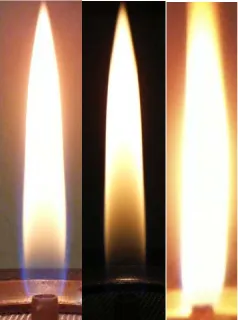
The subject of this work is flames of 50 mm of visible height, as can seem in the Figure 2, considering CH4 or
NGV or LPG as fuels. The volumetric flow of the fuels Measurement Area
Air Fuel
4.7 mm
[image:2.595.364.483.403.563.2]45.0 mm Air
Figure 1. Burner schematic representation.
Table 1. Volumetric flows and flowfield velocities to the flames.
h (mm) Vfuel (l/min) Vair (l/min) Ufuel (m/s) Uair (m/s)
80 0.15 12.00 0.14 0.10
and air are monitored, also the velocities of these flow- fields, for each flame.
2.3. Experimental Approach
2.3.1. Laser Light Extinction Technique
The approach used for calibration is shown in the Figure 3. This setup is applied to perform the laser light extinct- tion technique, which consists to focus the laser beam in the flame and capture the light transmitted.
The extinction of the light, i.e., the difference between the intensity after and before the laser beam passes through the flame is proportional to the mean soot volu- me fraction in the line of sight. As proposed by the Beer- Lambert law applied to soot analysis [10]. The flame thickness is measured performing a digital image proc- essing, counting pixels with calibrated dimensions at different flames heights. The extinction coefficient, 7.8, was taken from the literature [13] and compensated to the laser wavelength used in this work.
[image:2.595.68.278.403.500.2]The results obtained from this application are mean and global, nevertheless, are usefulness to calibrate the qualitative results achieved by LII [10,11], which provide spatial resolution. The illumination in the extinction tech- nique system consists of a wave continuum Argon ion laser of 514.5 nm of wavelength and light power of 2 W.
Figure 2. Flames visible height of 50 mm, considering the fuels CH4, NGV and LPG, from left to right.
Amplifier (High Voltage)
514.5 nm
Laser Ar+
Air Burner
Fuel PMT
Data Logger Computer
[image:2.595.57.472.553.719.2]The detection system is a photomultiplier tube (PMT), Hamamatsu, 931A. The measurements are taken spaced 10 mm in the longitudinal direction each other with ca- dence of 10 Hz during 60 seconds totalizing 600 samples in order to get statistical confidence.
2.3.2. Laser Induced Incandescence Technique
The results of soot volume fraction, fv, obtained by LII measurements were taken using the assemblage shown in the Figure 4, as proposed by [6,7].
The produced information by this system is local, i.e., provide results about soot concentration of the flame presenting high spatial resolution, circa 0.5 mm in this work. For this measurements is require a pulsed laser Nd: YAG, New Wave, with 532 nm of wavelength and 33 mJ per pulse in a cadence of 30 Hz in order to induce the incandescence of soot when the beam is focus on a small volume in the flame, transmitting an energy of about 0.7 J/cm2. This signal of incandescence is captured by the PMT aided by a band-pass filter, which is centered in 650 nm, used to avoid the noise of the flame and back- ground. The incandescence signal intensity is measured using an oscilloscope Tektronics, TDS 210, coupled in a computer.
2.4. Measurements Uncertainty
In the development of the experiments were found many difficulties that could yield low accuracy to the measure- ments. However, possible solutions were proposed to each problem. The flame instability causes by the flow controller absence affected on the signal detected. The light emitted by the flame alters the intensity of light ca- ptured by the sensors and also the flame oscillations at the top position changes the LII measurements results. Thus, was used a band-pass filter for increasing the sig- nal to noise ratio. Nevertheless, the signal intensity be- long small become difficult the measurements of low values in regions where small fv are present, as found in the flame basis.
The laser power supply varies producing intensity variations. In order to avoid this problem a largeinte- gration time was used to take the signals. Also, the pres-
Amplifier
Osciloscope
LASER 532 nm
Lenses PMT
LII Signal
[image:3.595.311.535.534.697.2]Burner
Figure 4. Scheme of laser induced incandescence setup.
ence of dust in the laboratory and the soot accumulation in the room along the experimental time are important factors to increase the uncertainty.
The uncertainty in soot volume fraction measurements involves the following components as source to the laser light extinction technique, 1) laser light intensity, ± 6%; 2) soot extinction coefficient, ± 8%; 3) laser light wave- length, ± 2%; 4) flame thickness, ± 1.5%. Thus, the total uncertainty in light extinction measurements is obtained by the propagation yielding circa ± 10.5%.
The measurement uncertainty in LII is estimated using the relative deviation from the results achieved by laser light extinction, which provide quantitative global values of fv. Toward determine this uncertainty was considered the methane flame, taken in account the discrepancy, which was estimated as roughly ± 6%.
3. Results and Discussion
3.1. Measurements Validation
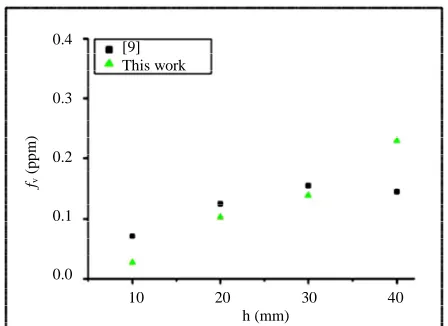
The results achieved to the methane flames are compared with the literature [9], in order to validate the measure- ments for different fuels, NGV and LPG, are shown in the following graph. The results present the soot volume fraction, fv, on each 10 mm height, h, at the longitudinal direction of the flame.
The results of this work have shown in agreement with the literature, circa ± 20% of maximum discrepancy, as illustrate in the Figure 5.
3.2. Experimental Results
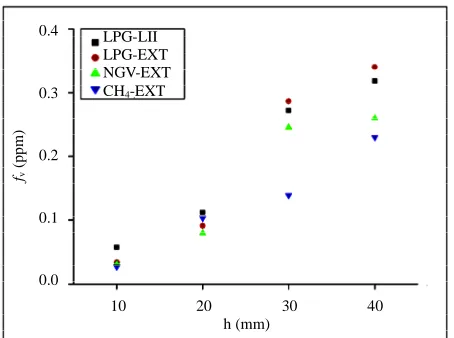
The mean results obtained using light extinction (EXT) and LII for different fuels are shown in the Figure 6. The values of fv for LPG are higher for both cases and the CH4 are generally 50% smaller. The NGV exhibits
roughly 20% less soot compared with LPG.
10 20 30 40 h (mm)
0.4
0.3
0.2
0.1
0.0 fv
(pp
m)
[image:3.595.60.288.606.720.2][9] This work
LPG-LII LPG-EXT NGV-EXT CH4-EXT
10 20 30 40 h (mm)
0.4
0.3
0.2
0.1
0.0 fv
(pp
m
[image:4.595.60.287.83.252.2])
Figure 6. Results of fv to the laminar flames produced by
LPG, NGV and CH4.
In the Figure 6 the black squares presents the fv values to LGP fuel flame, captured by LII technique, along the longitudinal direction upward the burner surface. The red circles indicate the fv results to LGP from light extinction measures, which were taken in order to calibrate the LII results. The green and blue triangles are the fv values achieved from light extinction technique to CH4 and
NGV fuels, respectively.
To measure in the extremities of the flame was found some difficulties, both top and bottom, due the instability at the top region of the flame and, also, the low values of soot volume fraction in the bottom region. The behaviour of the values agrees with published by [11]. The precur- sor of the soot is formed in the flame base by the excess of fuel and reaches the maximum concentration at the medium where the high temperature starts the oxidation the aggregates and the soot concentration decreases.
The results of fv just above the burner, around 10 mm, where the precursors of soot are formed, exhibits very low values, around 0.01 ppm or 10 ppb, so that it is diffi- cult to measure accurately. In the other hand, the maxi- mum values of fv are found in the range from 30 to 40 mm in the longitudinal positions, presenting values about 0.3 ppm. Whereas, downstream this region is noted a smooth decrease of the fv values, between 40 and 50 mm, circa 0.2. This behaviour is due the oxidation of the ag-glomerates, as described by literature [11].
The behaviour of the results obtained using LII in the LGP flame measurements agree with those from light extinction, including to the all of fuels studied in this work. However, the LPG fuel shown higher values of fv, followed by NGV and CH4. It was expected, considering
the carbon number in the chemical structure, that the sequence LPG, NGV and CH4, respectively, presents the
higher to low soot emissions due the same combustion conditions, i.e., in a laminar diffusion flame, in which the carbon content into the fuel requires to diffuse an oxygen
from the surrounding air to reaction occurs. This happens because the LPG is formed by propene and butane (C3H8,
C4H10), while NGV is composed by approximately 80%
of CH4 and 20% of other hydrocarbons like ethane
(C2H6), propane and butane.
3.3. Signal Processing
Furthermore, the LII technique was used to take local measures with enough spatial resolution in order to cre- ate transversal profiles at each longitudinal measurement height. Thus, the fit between fv values measured by both techniques are in agreement, 5% maximum discrepancy, regarding the measurement uncertainty attributed to this technique and the level of correlation. Thus, these results corroborates to the validity of the behaviour achieved globally by the light extinction and, locally, with LII measurements.
4. Conclusions
Techniques used to determine the soot volume fraction presented coherent results compared with the literature, values and relation.
Thus, the total uncertainty in light extinction measure- ments is obtained yielding circa ± 10.5%. The measure- ment uncertainty in LII is estimated as roughly ± 6%. The difficulties and uncertainty sources can be mini- mized by using optical filters, stable supplies and flow controllers.
The behaviour of the LII data related to fv as function of the flame height fitted with results of extinction results. The compatibility between these methods was observed, allowing performing global measurements with light ex- tinction, leading to use LII to obtain spatial resolution and particle diameter results, from other fuels, in future works.
Experimental results showed, as expected considering the number of carbon in the chemical structure, that the LPG has the higher fv values, followed by NGV and CH4,
respectively, i.e., the higher to smaller soot emissions produced by the commercial fuels. The values of fv for LPG are higher because both cases and the CH4 are
gen-erally 50% smaller. The NGV exhibits roughly 20% less soot compared with LPG. The behaviour of the results obtained by using LII flame measurements agrees with light extinction.
5. Acknowledgements
Authors want to thank the financial support of CNPq Brazilian agency fostering research.
REFERENCES
using LII in Flames and Exhaust Flows,” American Insti- tute of Aeronautics and Astronautics, 1999.
[2] P. O. Witze, S. A. Shimpi, R. P. Durrett and L. A. Farrell, “Time-Resolved Laser-Induced Incandescence Measure- ments for the EPA Heavy-Duty Federal Test Procedure,”
JSME International Journal, Series B: Fluids and Ther- mal Engineering, Vol. 48, No. 4, 2005, pp. 632-638.
[3] E. Geraque, “Fuligem Corresponde Por Terco do Aque- cimento Global,” Folha de São Paulo, 2009.
[4] A. Boiarciuc, F. Foucher, B. Moreau, O. Pajot and C. Mounaïm-Rousselle, “Simultaneous Spatial and Tempo- ral Resolved Laser-Induced Incandescence to Study the Soot Particles Formation,” Ph.D. Thesis, University of Orléans, Orléans, 2004.
[5] L. G. Barreta and M. E. Sbampato, “Imaging of Laser-In- duced Fluorescence in an Ethanol Atmospheric Flame,”
30th Encontro Nacional de Física da Matéria Conden- sada, 2007.
[6] A. C. Eckbreth, “Effects of Laser-Modulated Particulate Incandescence on Raman Scattering Diagnostics,” Jour-nal of Applied Physics, Vol. 48, No. 11, 1977 pp. 4473- 4483.http://dx.doi.org/10.1063/1.323458
[7] L. A. Melton, “Soot Diagnostics Based on Laser Heat- ing,” Applied Optics, Vol. 23, No. 13, 1984, p. 2201.
http://dx.doi.org/10.1364/AO.23.002201
[8] R. L. Vander Wal and K. J. Weiland, “Laser-Induced Incandescence: Development and Characterization to-
wards a Measurement of Soot-Volume Fraction,” Applied Physics, Vol. 59, No. 4, 1994, pp. 445-452.
[9] R. L. Vander Wal, T. M. Ticich and B. Stephens, “Can Soot Primary Particle Size Be Determined Using Laser- Induced Incandescence?” Combustion and Flame, Vol. 116, No. 1-2, 1999, pp. 291-296.
http://dx.doi.org/10.1016/S0010-2180(98)00040-6
[10] M. Y. Choi, G. W. Mulholland, A. Hamins and T. Ka- shiwagi, “Comparison of the Soot Volume Fraction using Gravimetric and Light Extinction Techniques,” Combus- tion and Flame, Vol. 102, No. 1-2, 1995, pp. 161-169.
http://dx.doi.org/10.1016/0010-2180(94)00282-W
[11] C. Shaddix, “Laser-Induced Incandescence Measurements of Soot Production in Steady and Flickering Methane, Propane, and Ethylene Diffusion Flames,” Combustion and Flame, Vol. 107, No. 4, 1996, pp. 418-452.
http://dx.doi.org/10.1016/S0010-2180(96)00107-1
[12] S. P. Burke and T. E. W. Schumann, “Diffusion Flames,”
Combustion Symposium, Vol. 20, 1928, pp. 998-1004.
[13] T. C. Willians, C. R. Shaddix, K. A. Jensen and J. M. SuoAnttila, “Measurement of the Dimensionless Extinc- tion Coefficient of Soot within Laminar Diffusion Flames,”
International Journal of Heat and Mass Transfer, Vol. 50, No. 7-8, 2007, pp. 1616-1630.