Energy-Efficient Cross-Layer Optimization for Wireless
Sensor Networks
Yongqiang Fei, Peng Zhang, Yuping Zhao
School of Electronics Engineering and Computer Science, Peking University, Beijing, China Email: [email protected], [email protected], [email protected]
Received May 2013
ABSTRACT
In this paper, we propose a cross-layer design combining adaptive modulation coding (AMC) and automatic repeat re-quest (ARQ) to minimize the bit energy consumption under both packet loss rate and retransmission delay constraints. We analyze the best constellation size of M-ary square quadrature amplitude modulation (MQAM) in different distance, and give advice on retransmission limits under different packet loss rates. The impacts of path loss fading and additive white Gaussian noise (AWGN) are taken into consideration. The computation of energy consumption includes the cir-cuit, transmission and retransmission energies at both transmitter and receiver sides. Numerical results are obtained to verify the validity of our design. We also show that the retransmission benefit varies with the packet loss rate constraint.
Keywords: Cross-Layer Design; Energy Consumption; Green Modulation; AMC; ARQ
1. Introduction
Along with the increasing demand for green communica-tion, researches on energy efficiency have been pros-pered in recent decades, especially in wireless commu-nication networks. Take sensor network for example, a single chip integrating baseband and radio frequency (RF) circuits may have to work with a small battery for years, whose battery replacement or charging, if possible, is dif-ficult and expensive. Such scenarios bring high require-ment of minimizing the energy consumption.
Among them, to find the energy efficient modulation type and constellation size is the central problem [1-4]. It is widely accepted that when transmission distance is far, transmission energy is dominant in total energy consump-tion, and small constellation size is more energy efficient. When transmission distance is short, circuit energy be-comes comparable to transmission energy, resulting in an advantage of large constellation size.
At the same time, great interests are attracted by cross- layer design. By employing adaptive modulation coding (AMC) at physical layer and automatic repeat request (ARQ) or Hybrid ARQ (HARQ) at data link layer, the system could achieve a considerable gain in spectral effi-ciency or reduce the packet loss rate [5-8]. This is due to the fact that by adopting retransmission protocol to guar-antee the information transmission, cross-layer design could allow for higher and more efficient transmission mode.
So far, few researches have discussed the cross-layer
optimization on energy consumption. In [1], Cui et al. presented the RF transceiver circuit structure, discussed energy efficiency of coded M-ary square quadrature am-plitude modulation (MQAM) and Multiple Frequency Shift Keying (MFSK), and made optimization under transmis-sion time and energy constraint. Cui also considered
un-coded MQAM and MFSK in [2]. Abouei etal. analyzed
On Off Keying (OOK) besides MQAM and MFSK, demonstrated the simulation distance-based results in [4]. Yet both Cui and Abouei ignored the impact of data link layer, drawing conclusions only at physical layer. In [3], Chen and Gursoy adopted retransmissions in their system and analyzed the energy efficiency of a linear network besides single-hop transmissions, but the retransmission time was unlimited, which is impossible in a practical system. On the other hand, unlimited retransmission time highly restricted the data link layer optimization, and only physical layer optimization was included. In [9], joint routing, media access control (MAC) and data link layer optimization was discussed in sensor networks. However, in their system, retransmission protocol was still not ap-plied.
The rest of this paper is organized as follows. We in-troduce the system model in Section 2. The analysis of cross-layer design aiming at minimizing the bit energy consumption is presented in Section 3. Section 4 pro-vides several numerical results to confirm the validity of our design. Finally, conclusions are drawn in Section 5.
2. System Model and Assumptions
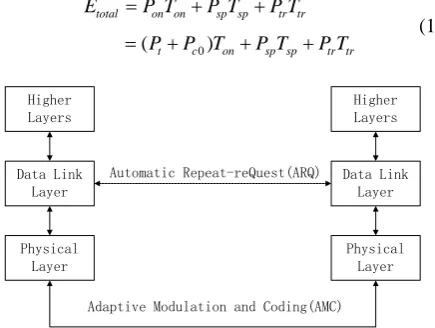
A cross-layer communication system between two wire-less nodes is considered, as shown in Figure 1. Data bits from higher layers are processed as packets and stored in a buffer at the transmitter. After modulation, data bits in the packets are mapped into constellation symbols and transmitted from the transmitter to the receiver.
At data link layer, ARQ protocol is employed. When an error occurs in a packet, the ARQ generator at the receiver sends a retransmission request to the ARQ con-troller via a feedback channel. The packet stored in the buffer will be retransmitted.
At physical layer, MQAM are supported. The modula-tion mode is chosen by the receiver based on the channel state information (CSI), which is sent back to the trans-mitter via a feedback channel.
We employed the energy consumption model from [1, 2,9]. Since there are no complicated blocks such as itera-tive decoding in the single-antenna system, the power consumed in baseband circuit is much smaller than that in RF circuits, and, for simplifying the model, can be neglected. The system works in three different modes: active mode, transient mode and sleep mode. When trans-mitting a signal, the system works in active mode. When there is no transmitting, the system works in sleep mode, and the power consumption is much smaller than that in active mode. The system works in transient mode when switching from sleep mode to active mode, whose dura-tion is quite short compared to those of other two modes. Thus, the total energy consumption can be divided into three parts:
0
( )
total on on sp sp tr tr t c on sp sp tr tr
E P T P T P T
P P T P T P T
= + +
[image:2.595.66.284.550.714.2]= + + + (1)
Figure 1. Cross-layer structure.
where Pon, Psp and Ptr are the power consumption of
ac-tive mode, sleep mode and transient mode, while Ton, Tsp
and Ttr are the duration of these three modes, respectively.
Base on the discussion above, we have Psp ≈0 and 0
tr
T ≈ . Pon consists of Pt and Pc0, denoting the power
consumption of transmitting signal and circuit, respec-tively. Pc0 is the sum of power consumption of circuits at
both transmitter and receiver, including the power am-plifier (PA) power consumption Pamp, which can be
cal-culated as Pamp =αPt, where α ξ η= / −1 with ξ the
peak-to-average ratio(PAR) and η the drain efficiency [10]. ξ =3( M −1) / ( M +1) is a function of MnQAM constellation size.
In this case, Etotal can be approximated as
( ) ((1 ) )
total t amp c on t c on
E ≈ P+P +P T = +α P+P T (2)
where Pc=Pc0−Pamp is the power consumption of all
RF circuit blocks except PA. Above, Pc is independent of
SNR request and transmission distance. On the contrary,
Pt must guarantee the SNR request for a certain packet
loss rate at the receiver after path loss fading.
It is assumed that the transmitted signal is received with additive white Gaussian noise (AWGN) after path loss fading, while perfect CSI is available. Additionally, feedback information is always transmitted correctly and without latency. At the receiver, packet error is detected perfectly, which can be ensured by high reliable cyclic redundancy check (CRC) codes.
3. Energy Efficiency Analysis
3.1. Transmission Power
Consider the path loss model, the signal power at the receiver, Pr, is given by
10 0 ( ) ( ) 10 log ( )
r t dB
d
P dB P dB K
d κ
= + − (3)
where κ is the path loss exponent, and d0 is the reference
distance for the antenna far-field. KdB is calculated as
10 0
20 log ( / 4π)
dB
K = λ d , where λ is the carrier
wave-length. At the receiver, the SNR, denoted as γs, can be
written as
0 r s
P N B
γ = (4)
where N0 is the noise power spectrum density and B is
the system bandwidth. Take account of AWGN, the
MnQAM symbol error rate, marked as n
SE
P , can be
de-rived as
2
6 log ( )
1
2(1 ) ( )
1
n n
SE s
n n
M
P Q
M M γ
= −
− (5)
where ( ) π1 / 2exp( / 2) 2 x
Q x =
∫
∞ −t dt and Mn =2n. nData Link Layer
Physical Layer
Data Link Layer
Physical Layer Higher
Layers
Higher Layers
is the number of data bits in one MnQAM symbol. Since
n SE
P for every symbol in a packet is independent, the
packet error rate, marked as n PE
P , is given by
1 (1 )Lp
n n
PE SE
P = − −P (6)
where Lp denotes the number of symbols in one packet.
With ARQ protocol, when a transmission error occurs in a packet, corresponding retransmission happens. The max-imum allowable retransmission time is denoted as Nmax,
which is determined by the maximum allowable trans-mission delay. In a realistic system, the maximum re-transmission time is finite, which suggested that if a pack-et is not delivered correctly after Nmax retransmissions, it
will be dropped. With n PE
P and Nmax, the packet loss rate,
n E
P , can be calculated as
1 max N
n n
E PE
P =P + . (7)
Equations (3)-(7) show the relationship between Pt and
n E
P . Assume that the max allowable packet loss rate is
PEmax, Pt should be as small as possible while subjected
to
n E Emax
P ≤P . (8)
3.2. Average Transmitting Time
With n and Lp, we can see that each packet contains n
p
L data bits. Assume that there are L data bits need to be transmitted, the total number of successfully transmitted MnQAM packets can be expressed as
/ ( p r)
L n L L
−
, where Lr is the number of redundant
symbols in one packet and x represents the largest integer less than x.
In this case, the average transmission time per packet is
1
1
1
(1 ) ( 1)
1 1 max max t PE max PE PE N N
n n n k n
PE PE max
k N n
n
N k P P N P
P P − = + = − + + − = −
∑
. (9)
Clearly, n
t
N is a function of n
PE
P and Nmax.
Com-bing Ntn and L n L/ ( p−Lr), the average number of
total transmitting packets can be obtained as
1
1
( ) ( ) 1
max PE total t PE N n n n n
p r p r
P
L L
N N
n L L n L L P
+
−
= =
− − −
. (10)
The transmitting time, Tonn, is linear with n total
N and
is given by
n n
on total p s
T =N L T (11)
where Ts is the symbol period. Base on Equations (8)-
(11), Tonn can be calculated as total active mode time in
the cross-layer system.
3.3. Energy Efficiency
According to the discussion above, Etotaln can be
calcu-lated based on Equations (2), (3), and (11). Thus the energy consumption of each successfully delivered data bits, also regarded as energy efficiency, is derived as
(1 ) n n total b n E E E P L =
− . (12)
Therefore, energy efficiency of different constellation sizes can be obtained while the performance and delay requirement are satisfied. By employing AMC at physi-cal layer and ARQ at link layer, energy consumption can be minimized in all distance.
4. Numerical Results
To verify the advantage of cross-layer optimization, nu-merical results are presented in this section. We adopt the circuit energy consumption values in [2]. The bit energy, as shown in Section 3, consists of transmission, retrans-mission and circuit energy at both transmitter and re-ceiver side under the constraints of PEmax and Nmax.
Pa-rameter settings used in simulations are listed in Table 1.
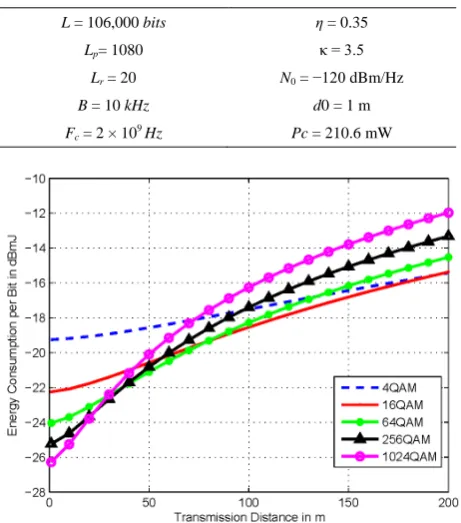
Figure 2 shows the bit energy consumption of differ-ent constellation sizes in a distance ranges from 1m to 200 m. In addition, PEmax is set to be 10−3 and Nmax is 4. It
[image:3.595.309.540.447.709.2]can be seen that larger constellation sizes cost less energy when d = 1 m. This saving gets smaller when d becomes
Table 1. System parameters.
L = 106,000 bits η = 0.35
Lp= 1080 κ = 3.5
Lr = 20 N0 = −120 dBm/Hz
B = 10 kHz d0 = 1 m
Fc= 2 × 10⁹ Hz Pc = 210.6 mW
larger. And finally, smaller constellation sizes turn out to be more energy efficient when d = 200 m. Generally, larger constellation sizes require higher Pt to satisfy the
PEmax constraint. However, Pt is small in short distance,
in other words, Pc dominates the total power
consump-tion. In this case, larger constellation sizes significantly shorten transmission time and reduce the bit energy con-sumption. On the contrary, Pt rises and dominates the
total power consumption as d increases, leading to the result that smaller constellation sizes perform better than larger ones. This is similar to former research results de-rived in no-retransmission cases.
By appropriately designing the AMC, the low-bond bit energy consumption of all constellation sizes, marked as
Ebmin, can be reached. For instance, we choose 1024QAM
when d is smaller than 20 m, while 16QAM is applied when d ranges from 80 m to 180 m.
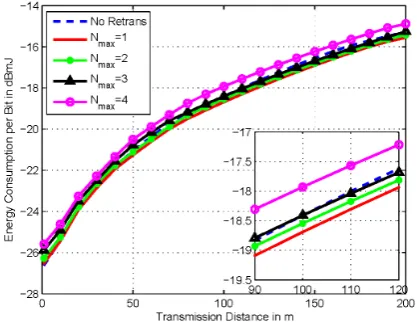
Figures 3 and 4 illustrate the impact of ARQ em-ployment. In Figure 3, the most energy efficient Nmax is 1
when PEmax is 10−3. However, with a stricter PEmax
con-straint, 10−7, larger Nmax leads to smaller Ebmin, as shown
in Figure 4. This is due to the fact that larger Nmax
re-duces Pt requirement, but inevitably increases
n on T at the same time. Under a looser constraint PEmax, the impact of
n on
T dominates and smaller Nmax makes better trade-off.
When PEmax constraint becomes stronger, the impact of Pt
is dominant, and larger Nmax performs better.
The largest energy saving achieved by ARQ changes from about 0.5 dBmJ to 0.8 dBmJ when PEmax varies from
10−3 to 10−7. We can also observe that Ebmin of Nmax = 4 is
larger than that of no-retransmission with PEmax = 10−3, which emphasizes the importance of ARQ design. With proper Nmax setting we can acquire energy saving, while
improper Nmax may cause lower energy efficiency.
5. Conclusion
In this paper, a cross-layer scheme combining AMC and
Figure 3. Energy Consumption per Bit under Different Re-transmission Time with PEmax = 10−
[image:4.595.69.279.547.708.2]3 .
Figure 4. Energy Consumption per Bit under Different Re-transmission Time with PEmax = 10−7.
ARQ is proposed in order to minimize the bit energy consumption under certain delay and performance con-straints. We analyzed the energy efficiency of the system, considering dynamic transmission power and duration. Numerical results are presented to verify the validity of the cross-layer design, which brings a significant energy consumption improvement. More channel model and other retransmission protocol will be included in future work.
6. Acknowledgements
This work is supported by 863 National Science and Technology Project of the Ministry of Science and Tech-nology of China, Number: SS2012AA011701.
REFERENCES
[1] S. Cui, A. J. Goldsmith and A. Bahai, “Energy-Con- strained Modulation Optimization for Coded Systems,” IEEE Global Telecommunications Conference, Vol. 1. 2003, pp. 372-376.
[2] S. G. Cui, “Energy-Constrained Modulation Optimiza-tion,” IEEE Transactionson Wireless Communications, Vol. 4, No. 5, 2005, pp. 2349-2360.
[3] Q. Chen and M. C. Gursoy, “Energy-Efficient Modula-tion Design for Reliable CommunicaModula-tion in Wireless Networks,” IEEE 43rd Annual Conference on Informa- tionSciencesandSystems, 2009, pp. 811-816.
[4] J. Abouei, K. N. Plataniotis and S. Pasupathy, “Green Modulations in Energy-Constrained Wireless Sensor Networks,” IETCommunications, Vol. 5, No. 2, 2011, pp. 240-251.
[5] Q. Liu, S. Zhou and G. B. Giannakis, “Cross-Layer Com- bining of Adaptive Modulation and Coding with Trun- cated Arq over Wireless Links,” IEEE Transactionson WirelessCommunications, Vol. 3, No. 5, 2004, pp. 1746- 1755
Coding Over Wireless Links: Cross-Layer Analysis and Design," IEEE Transactions on Wireless Communica-tions, Vol. 4, No. 3, 2005, pp. 1142-1153.
[7] J. Ramis and G. Femenias, “Cross-Layer Design of Adap- tive Multirate Wireless Networks Using Truncated HARQ,” IEEETransactionson VehicularTechnology, Vol. 60, No. 3, 2011, pp. 944-954.
[8] P. Zhang, Y. Miao and Y. Zhao, “Cross-Layer Design of Amc and Truncated Harq Using Dynamic Switching
Thresholds,” 2013 IEEE Wireless Communications and NetworkingConference (WCNC), 2013.
[9] S. Cui, R. Madan, A. Goldsmith and S. Lall, “Joint Routing, Mac, and Link Layer Optimization in Sensor Networks with Energy Constraints,” 2005 IEEE Inter- national Conference on Communications, Vol. 2, 2005, pp. 725-729.