Journal of Chemical and Pharmaceutical Research
__________________________________________________
ISSN No: 0975-7384 CODEN(USA): JCPRC5
J. Chem. Pharm. Res., 2011, 3(1):297-303
297
Removal of Tar-Chrome Red-B dye by Adsorption onto Natural Diatomite
Menderes Koyuncu*
and A. Rıza Kul**
Yuzuncu Yıl University, Van Vocational School of Higher Education, Department of Textile, Van, Turkey Yuzuncu Yıl University, Faculty of Science and Arts, Department of Chemistry, Van, Turkey
______________________________________________________________________________
ABSTRACT
In this study; the textile industry from using chromium dyes was removed from wastewater by low- cost diatomite in batch. In batch system, same particle size of diatomite (230-mesh size and surface area 49.0408 m2/g) and kept at pH5.10 and five different amounts of sorbent were used. The effect of the temperature on adsorption was evaluated with using three different temperatures. As result of the experiment, 81.072% of the chrom dyes was removed from the wastewater in conditions of using 230 mesh sieve, at 30 oC temperature for 8h in batch system but chrom dyes was removal for different min in batch system,61.992 %, 61.502 %, 63.926 %, 61.174 % and 61.895 % (15min, 30min, 60min, 180min and 300) respectively. Also, the equilibrium adsorption isotherms have been analyzed by Langmuir and Freundlich models.The adsorption values were fitted langmuir and Freundlich adsorption models. Langmuir adsorption capacity were found to be 25.04, 20.08 and 14.68mg/g at 25, 30 and 35 oC respectively. In addition, the filtrates were subjected to a comprehensive colorimetric appraisal using the CIE L∗ a ∗b∗ colour space system.
Keywords : Chromium dyes; Diatomite; Environmental pollution; Adsorption; Isotherms;
Colour space.
_____________________________________________________________________________________________
INTRODUCTION
298
Nowadays, the contamination of water by toxic heavy metals through the discharge of industrial wastewater is a world wide enviromental problem. Among these toxic metals chromium has major impact on environment and it has both beneficial and detrimental properties. In aqueous phase chromium mostly exists in two oxidation states such as trivalent chromium (i.e., Cr,3+ Cr(OH)2+or Cr (OH)2+ etc.) and hexavalent chromium (i.e., HCrO4-, CrO42- or Cr2O7, etc.) Most
of the hexavalent compounds are toxic, carcinogenic, and mutagenic and even they can cause lung cancer also. Chromium and its compounds are widely used in many industrial areas, such as painting, plating, alloys in the construction, steel production, brick, food and leather . These industries produce large quantities of toxic metal wastewater effluents. But the maximum exit Cr(VI) concentration based on USEPA guidelines for potable water is 0.05mg/l and the United Nations Food and Agricultural
Organization recommended maximum level for irrigation water is 0.1mg/l [2]. By this purpose, some typical treatment methods have been developed for removing chromium from water by using various methods: biosorption [3].coaqulation [4]. electrocoagulation [5] and adsorption [6], [7], [8] [9], [10], [11] and [12]. The aim of this study was to investigate the effects of parameters on the dyes solutions removal efficiency from wastewater using diatomite. The adsorption properties and adsorption isotherms of natural diatomite for Tar-chrome Red –B dyes solution were investigated.
EXPERIMENTAL SECTİON
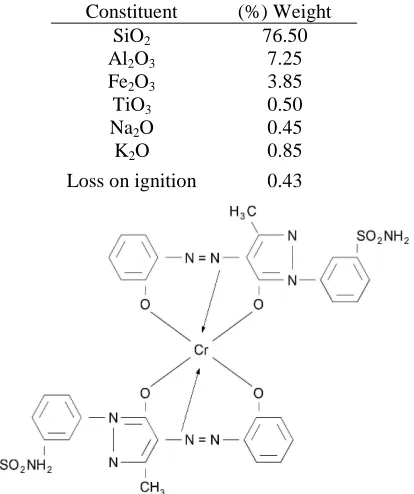
[image:2.595.204.411.482.729.2]100.0 ppm stock solution of chrome Red-B was prepared. In all experiments, 5.0 ppm Tar-chrome-red-B solution was used. İt was prepared from stock dye solution and kept at PH 5.10 Diatomite was used in sieve of 230 mesh particle size from Van -Çaldıran region of Turkey. All the chemicals used were of analytical reagent grade. Chemical composition of diatomite determined by XRD instrument was given in Table 1
Table 1. Chemical composition of diatomite used
Constituent (%) Weight
SiO2 76.50
Al2O3 7.25
Fe2O3 3.85
TiO3 0.50
Na2O 0.45
K2O 0.85
Loss on ignition 0.43
299
2.1.Adsorption procedure
Each of 50ml 5.0 ppm dye solution was put in the six 100 ml bottles. Then diatomite sorbent was added to each of five bottles in different amounts. Experiments were carried out in water- bath at 30 0C, pH 5.10, 195 rpm for 8 h. It was chosen 30 0C as working temperature ( Gürü et all.,2008). The samples were centrifuged at 20.000 rpm for 20min, and clarified supernatant solutions were carefully filtrated and analyzed by Solaar AA. Series spectrometer. In all calculations, chromium holding on the bottle was substracted from initial concentration of chromium in dye solution and it was calculated by holding on diatomite. This value was 4.0536 for 5.0 ppm dye solution. In these conditions, chromium holding amount onto diatomite was 81.0% according to 5.0 ppm initial concentration of the dye solution and chromium holding amount in bottles was 18.928% according to 5.0 ppm initial concentration of the dye solution. These experimental conditions were also used for at 25 0C, 35 0C and for different time 15, 30, 60, 180 and 300 min. At the end of the each experiment, all samples were centrifuged at 20.000 rpm for 20min, and clarified supernatant solutions were analyzed by atomic absorption spectrophotometer. Thus, optimum effect of time was determined. It was also studied the effect of temperature on adsorption at the recorded experimental conditions. In these experiments, the samples were investigated at 25 and 35 0C for different time and then clarified supernatant solutions were analyzed by atomic absoprtion spectrometer and optimum tempareture was determined.
2.2.Colorimetric studies
After optimum conditions were determined in batch experiments, the colorimetric data of the samples before and after adsorption were measured by using an instrumented colorimeter spectrophotometer, Konica minolta 3600d. The instrument was installed the colour in the terms of the CIE L∗ a∗ b∗ colour space system. In this colour space L∗ represented the lightness or brightness, a∗and b∗ colorimetric data, where + a∗ was the red and - a∗ was the green direction, + b∗ was the yellow and -b∗ was the blue direction [13].
RESULTS AND DISCUSSION
In this study, optimum conditions were determined for the removal of chrome dyes from wastewater. For this purpose, same particle size and amount of sorbent, contact time, and temperature effects on chrome dyes removal were investigated.
3.1.Adsorption procedure
300
decreases with increasing temperature.[14], [15], [16]. So it can be recommended as being up to 30 0C.
[image:4.595.83.532.104.433.2]81.0 percent adsorption was found for 50 ml 5.0 ppm chrome dye Red-B at constant 30 0C temperature and 60 min time and 195rpm with 5.0g of sorbent amount. Similar percent adsorptions were reported as 85% holding efficiency was obtained for 50ml 5.0ppm Cr3+ solution at constant 30 0C temperature and 60min. In the previous study (Gürü et al., 2008)
Fig. 2. Chrome Red-B dye of adsorption by different amount of diatomite (30 0C, 195 rpm, 8h.)
Fig.3. Chrome Red-B dye of adsorption on diatomite for different times (3 g diatomite, 30 0C, 195 rpm)
3.2. Colorimetric studies
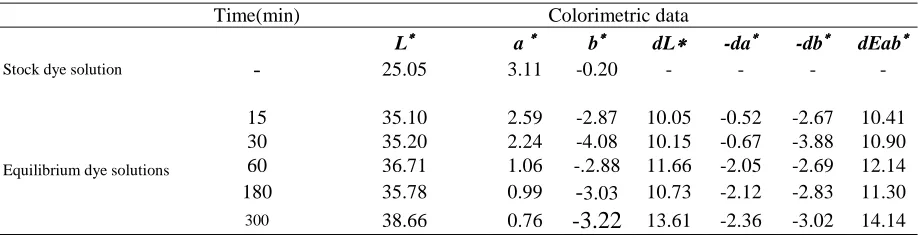
Colorimetric studies, performed in the CIE L∗ a∗ b∗ colour space system, permitted to obtain value on changes in input of individual colours following adsorption of Tar chrome Red –B on diatomite (Table 2.). As can be seen in Table 2, in the equilibrium of dye solution, an evidently increased parameter of Lightnees (L∗) was noted. Increasing amounts of the adsorbed dye on
diatomite were paralleled also by an evident change in colour dEab. Studies on sorption of Tar chrome Red-B on diatomite were paralleled by an evident change in participation decreased value of red (+a∗∗∗∗) and yellow (+b∗∗∗∗) colours. This can be explained by holding efficiency of the Tar chrome Red -B on diatomite.
Table. 2. Colorimetric values for adsorption of chrome Red -B onto diatomite
Time(min) Colorimetric data
L∗∗∗∗ a ∗∗∗∗ b∗∗∗∗ dL∗∗∗∗ -da∗∗∗∗ -db∗∗∗∗ dEab∗∗∗∗
Stock dye solution - 25.05 3.11 -0.20 - - - -
Equilibrium dye solutions
15 35.10 2.59 -2.87 10.05 -0.52 -2.67 10.41 30 35.20 2.24 -4.08 10.15 -0.67 -3.88 10.90 60 36.71 1.06 -.2.88 11.66 -2.05 -2.69 12.14 180 35.78 0.99 -3.03 10.73 -2.12 -2.83 11.30
[image:4.595.74.533.621.740.2]301 3.3. Adsorption isotherms
The two well-known expression of the Langmuir and Freundlich isotherm models were studied. The experimental results have been fitted to the Langmuir model and to the Freundlich model. These isotherms models are represented by the following equation [17], [18]. All isotherms equations were linearized, where Eqs. 3 and 4 become;
Langmuir isotherm : qe =
e e m
bC bC q
+
1
1
Freundlich isotherm: qe = Kf C1/n 2
) 1 )( 1 ( 1 1
e m m
e q bq C
q = + 3
lnqe = lnKf + (
n
1
)ln Ce 4
[image:5.595.174.431.391.496.2]
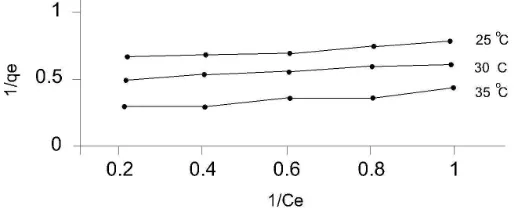
Isotherms at there different temperatures of dye solutions are show in Figs. 4 and 5, the Langmuir and Freundlich isotherm models, respectively. In the range 25-30 0C, an increase in temperature does not affect adsorption of Tar-Chrome Red-B on to diatomite significantly. This can be explained by physical adsorption decreases with increasing temperature [17].
Fig. 4. Langmuir plots for the adsorption of chrom Red –B onto diatomite
Fig. 5. Freundlich plots for the adsorption of chrom Red-B onto diatomite
Isotherm parameters are summarized in Table 3. For three different temperatures. The data of qm
maximum adsorption capacity was obtanied at 25 0C.
On the other hand, the value of correlation coefficients (R2
>
0.9905) indicates that there is a302
The equilibrium adsorption data at different temperatures fitted well to the monolayer Langmuir model and Freundlich model according to regression coefficient
Table. 3. Langmuir and Freundlich parameters of the sortion of chore Red –B onto diatomite
Langmuir constants Freundlich constants Tempareture qm (mg/g) b(l/g) R2 Kf (mg/g) n R2
25 0C 25.04 3.24 0.999 3.56 0.39 0.998 30 0C 20.08 1.70 0.998 2.34 0.70 0.998 35 0C 14.68 1.29 0.994 1.83 0.85 0.996
3.4.Thermodynamic study
The apparent enthalpy (∆H, kJ/mol), apparent free energy (∆G,kJ/mol) and apparent entropy (∆S, J/mol K) of Tar-Chrome Red-B were calculated by based on the following equations and the calculated values were given in Table 4.
Ln b = -
∆
RT H
+ constant 5
∆G = -RT ln b 6
∆S =
T G H −∆
∆
7
[image:6.595.129.485.129.200.2]Negative values of ∆H shows an exothermic physical adsorption. The negative values of ∆G affirm that the Tar-Chrom Red-B adsorption onto diatomite is a spontaneous process. This result was demonstrated by other experimental resultsn [16], [17]
Table.4. Thermodynamic parameters for the adsorption of Tar-Chrome Red - B on diatomite
T (K) ∆H (kJ/mol) ∆G (kJ/mol) ∆S (J/mol K) 298 -2.725 -2.912 0.627 303 -1.257 -1.346 0.293 308 -0.550 -0.654 0.337
CONCLUSİON
This study shows that diatomite is potential sorbent for removal of Tar chrome Red-B. It was obtanied 81.072% adsorption in batch system and optimum conditions were 30 0C temperature, 8h time and 195rpm shaking rate with 230-mesh particle size and 5.0g sorbent amount. The adsorption experiments were conducted isothermally at three different temperatures (25, 30 and 35 0C). For the adsorption equilibrium, it was found that the adsorption isotherm of Tar chrome Red-B on diatomite well fitted by both of the Langmuir model and Freundlich model.
Different thermodynamic parameters, ∆H, ∆S and ∆G have also beeen evaluated and it has been found that the adsorption was feasible, spontaneous and exothermic process.
303
REFERENCES
[1]. Anonymous, DPT pres, Ankara, Turkey, 2001; 1-30. Eighth Five-year Development plan for mining private specialization working committee report
[2] J Anandkumar ; B Mandal. 2009, Jhazmat., (168), 633-640. [3] R Attia; SA Khedr. Dyes Pigments., 2006, (69), 128-136.
[4] TC Chandra; MM Mirna; Y Sudaryanto; S Ismadji. Chem. Eng. J., 2007, (127), 121-129. [5] K Marungrueng; P Pavasant. 2007, Bioresour.Technol., (98), 1567-1572.
[6] WV Narayana; G Mahesh. 2009, Jhazmat., (161), 575-580. [7] R Naseem; SS Tahir. 2001, Water Res., (35), 3982 -3986. [8] MM Nassar; YH Magdy. 1997, Chem. Eng. J., (66): 223-226.
[9] J. Acharya; J.N Sahu; B.K. Sahoo; Mohanty, C.R.Meikap; 2009, Chem.Eng.J., (150), 25-39. [10] N Kanan; MM Sundaram. Dyes Pigments., 2001, (51), 25 – 40.
[11] MN Ahmed; RN Ram. 1992, Environ. Pollut., (77): 76 - 86.
[12] ID Mall; VC Srivastava; NK Agarwal. 2006, Dyes Pigments., (69), 210 - 223 [13] T Jesionowski. Dyes Pigments., 2005, (67): 81-92.
[14] E Malkoç; Y Nuhoglu, M Dundar; 2006, Jhazmat., (B138), 142-151.
[15] M Doğan; M Alkan; Ö Demirtaş; Y Özdemir; C Özmetin. Chem. Eng.J., 2006, (124), 89-101.