Logical ontology for mediating between
nursing intervention terminology systems
Hardiker, NR
Title
Logical ontology for mediating between nursing intervention terminology
systems
Authors
Hardiker, NR
Type
Article
URL
This version is available at: http://usir.salford.ac.uk/42/
Published Date
2003
USIR is a digital collection of the research output of the University of Salford. Where copyright
permits, full text material held in the repository is made freely available online and can be read,
downloaded and copied for noncommercial private study or research purposes. Please check the
manuscript for any further copyright restrictions.
er, the author believes it reflects funda-mental limitations with the underlying ap-proach - until relatively recently the only available ‘technologies’ for structuring ter-minology systems were simple enumerative or combinatorial approaches. Practical ex-perience shows that both enumerative systems and combinatorial systems must be tuned to particular purposes if they are to be useful [11, 12].
Of course there may be overlap con-cerning scope and coverage, but even where terminology systems intersect there may be a number of lexical and ontological differences e.g.different word derivations and different levels of granularity. These differences prevent us from ‘seeing’ over-lap without human intervention i.e.we are not able directly to make use of the similar-ities and resolve the differences between diverse nursing terminology systems. Thus some form of mediation is required in or-der to facilitate the comparison and inter-change of heterogeneous patient care data.
1.2 The GALEN Approach
The GALEN approach to mediation as used within this study was borne out of a programme of research and development into enabling technologies that could form the basis for the next generation of clinical information systems [13]. In common with other formal compositional approaches, at the heart of GALEN is a semantically valid model of clinical terminology (i.e.an ontol-ogy). The ontology is represented in the GALEN Representation and Integration Language (GRAIL) [14]. The ontology consists of entities that are related to one another by attributes to form composite entities. For example, the entity ‘Treatments and Procedures’ might be related to
‘Sub-Logical Ontology for Mediating between Nursing
Intervention Terminology Systems
N. R. Hardiker
Salford Health Informatics Research Environment, University of Salford, Greater Manchester, UK
1. Introduction
A number of researchers have proposed the use of logical ontologies, symbolic systems for representing concepts and their interrelationships, as mechanisms for medi-ating between health care terminology systems [1, 2].Terminology system develop-ers, standards organisations, and health in-formatics researchers have argued the need for such tools in the quest to support com-parability and interchange of data and interoperability between health care appli-cations [3, 4]. Substantial progress has been made. However, within nursing in particu-lar certain important fundamental issues around development and evaluation have yet to be resolved. In order to inform the ongoing debate, the remainder of this ar-ticle describes the development of an experimental ontology for nursing inter-ventions. It describes some of the key mod-elling decisions taken and it presents and interprets the results of evaluation.
1.1 The Proliferation of Nursing
Terminology Systems
In 1994, through the Nursing Information and Data Set Evaluation Center (NID-SECSM) the American Nurses Association
(ANA) had recognised 4 terminology systems [5]: the North American Nursing Diagnosis Association classification of nursing diagnoses (NANDA) [6]; the Nurs-ing Interventions Classification (NIC) [7]; the Omaha System (OMAHA) [8]; and the Home Health Care Classification system (HHCC) [9]. Since that time, the number of specialised nursing terminology systems has increased [10]. This proliferation is not necessarily an indication of the inadequacy of any particular terminology system.
Rath-Summary
Objectives:Several researchers have proposed the use of logical ontologies as ‘reference terminologies’. However, there are a number of unresolved issues. This article describes the development of a logical ontology for nursing interventions and presents the results of evaluation.
Methods: Initially this study involved the development in GRAIL of two separate experimental ontologies: an ontology based on the textual content of informal definitions for nursing interventions drawn from the Nursing Interventions Classification; and an ontology based on labels for the same nursing interventions. Following initial bench-testing, the ontology based on labels was selected for extension (to accommodate also nursing intervention components of the Home Health Care Classification System and the Omaha System), for further testing and for external evalua-tion.
Results: A hierarchy of nursing interventions gener-ated automatically from the experimental ontology based on informal definitions contained only 3 hier-archical relationships, compared to 214 for the initial ontology based on labels. For the final extended on-tology based on labels, the generated hierarchy con-tained the three source terminology systems in entire-ty - there were a total of 2861 hierarchical relation-ships. While the results of comparative bench testing of the final ontology were favourable, the results of external evaluation were mixed and showed little agreement between reviewers.
Conclusion: This study suggests that while a logical ontology based on labels might be a useful tool for mediating between nursing intervention terminology systems, a formative consensus type development methodology might improve the approach by helping to harmonise ideological differences that may exist across the nursing profession.
Keywords
Nursing, terminology, classification
Methods Inf Med 2003; 42: 265–70
stance Use’ by an ‘involves’ attribute to form a composite entity to represent ‘Sub-stance Use Treatment’. Within GRAIL there are mechanisms for imposing compo-sitional constraints, for recognising and removing redundancy and for classifying automatically composite entities potential-ly along multiple axes. For example, as we know that ‘Overdose’ is a specialisation of the more general ‘Substance use’ we can use this information to classify automatical-ly the concept ‘Substance Use Treatment: Overdose’ as a ‘Substance Use Treatment’. As part of the ontology development process the GALEN approach advocates use of a language for developing simpler intermediate representations, thereby by-passing any need for training in the GRAIL formalism [15]. The intermediate represen-tation language consists of a set of descrip-tors (corresponding to entities) and a set of semantic links (corresponding to attrib-utes) which define the content of the repre-sentation, and a small set of simple con-straints to determine the syntax for the intermediate representations. For example the NIC concept ‘Behavior Modification’ might be represented as:
Modification INVOLVES behavior.
Intermediate representations are expanded automatically or semi-automatically into more complex GRAIL expressions using the GALEN mapping tool (Tigger). These expressions are then presented to a software system, the Terminology Server [16], for automatic classification within the ontology.
2. Method
Initially this study involved the develop-ment and validation of two separate ex-perimental ontologies to determine which approach would be most useful:
● an ontology based on the textual
con-tent of informal definitions for nursing interventions drawn from the second edition of NIC [17]; and
● an ontology based on labels or rubrics
for the same nursing interventions [2].
2.1 The Nursing Interventions
Classification
NIC is a terminology system for describing exclusively the treatments that nurses perform. It is intended for use in all settings and in all specialties. The second edition of NIC contains 433 nursing interventions, each with a label or rubric e.g.‘Analgesic Administration’, an informal definition e.g.
‘Use of pharmacological agents to reduce or eliminate pain’, a list of activities that a nurse does to carry out the intervention e.g.
‘Check history for drug allergies’, a non-hierarchical code e.g.‘2210’ and a short list of background readings. Although no hier-archical relationships exist between nursing interventions themselves, each intervention is located within a simple taxonomic struc-ture consisting of 30 classes and 7 domains (47 interventions belong to more than one class). NIC was selected as the initial focus for this study as, of the commonly reported nursing intervention terminology systems, it contains the greatest number of pre co-ordinated nursing interventions and thus would provide greater scale.
2.2 Development of
the Experimental Ontologies
The focus of the first experiment was on in-formal definitions for nursing interventions drawn from NIC. As shown in the example in Section 2.1 informal definitions within NIC are written in a discursive style, and use a comparatively rich vocabulary. The development of intermediate representa-tions within this first experiment had three phases:
1. An initial modelling activity to develop rapidly a preliminary set of intermediate representations using a relatively literal manual translation process. In order to sustain progress, no attempts were made initially to represent unusual structures. Intermediate representations were not coerced to fit any particular patterns and new descriptors and links were added as necessary.
2. A comparative analysis of word sets derived both from the sources and from
the set of initial intermediate represen-tations to determine any omissions and transformations that had been made in the translation from sources to interme-diate representations. These included, but were not limited to, transformations concerning word derivations, spelling and prepositions.
3. A more formal process of normalisation to apply consistently to the intermediate representations the transformations identified in the previous phase in an attempt to resolve inconsistencies.
Within the second experiment the focus was on nursing intervention labels, again drawn from NIC. Labels within NIC contrast with informal definitions in that they are written in a semi-formal and rela-tively consistent style. For example, they are made up of 500 individual words (as compared to 1388 in informal definitions), with no prepositions, no possessives and no relative pronouns. Within this second experiment, the development of intermedi-ate representations for labels also had three phases: modelling, analysis and nor-malisation. However, no formal process of post hoc normalisation was needed as consistency between intermediate repre-sentations was much higher.
In transforming intermediate represen-tations into GRAIL in both experiments: there was a one-to-one mapping between descriptors and entities and between links and attributes; similar techniques were used to derive the initial hierarchies of elementary GRAIL entities; and composi-tional constraints were derived and imple-mented in the same way i.e.from the inter-mediate representations themselves. How-ever for the ontology based on labels, the proposed hierarchy of elementary entities was manually validated prior to implemen-tation and attributes at different levels of abstraction were arranged hierarchically rather than as siblings.
For each experiment the result was a multi-axial subsumption hierarchy, con-tained within and generated according to the respective underlying ontology, of source nursing interventions drawn from NIC.
Hardiker
2.3 Initial Bench Testing
Initial bench testing consisted of a compar-ison of the two generated hierarchies. The key criterion for comparison was whether and to what extent they captured hierarchi-cal relationships in the source terminology system. There are no explicit hierarchical relationships between nursing interven-tions within NIC. Therefore a test set of 73 implicit hierarchical relationships was identified manually. For example the NIC nursing intervention ‘Bleeding Reduction: Antepartum Uterus’ was considered to be a child of ‘Bleeding Reduction’. Each of the two generated hierarchies was examined to see how many of the test set of implicit hierarchical relationships were captured.
2.4 Extending the Ontology Based
on Labels
The results of this initial bench testing (pre-sented in Section 3) were used as the basis for rejection of the ontology based on in-formal definitions and for selection of the ontology based on labels for extension, further comparative bench testing and external evaluation. The ontology based on labels drawn from NIC was extended to include also nursing intervention compo-nents of two additional terminology systems, HHCC and OMAHA, using the same methodology as for the second ex-periment. In contrast to NIC these termi-nology systems are combinatorial in nature
e.g.using OMAHA the notion of adminis-tering a medicine would be captured by combining the category ‘Treatments and Procedures’ with the target ‘Medication administration’.
2.5 Comparative Bench Testing
of the Final Ontology
Comparative bench testing took a random-ly selected set of 30 terms drawn from the three source terminology systems, exam-ined mappings within the UMLS Metathe-saurus [18] to terms drawn from other systems, and compared these to mappings within the final extended ontology.
2.6 External Evaluation of the Final
Ontology
External evaluation provided an opportu-nity to assess the acceptability to 4 expert reviewers of the ontology and of its ability to mediate between diverse terminology systems. The generated hierarchy was used to identify:
● Hierarchical relationships within
indi-vidual terminology systems i.e. from subsumee to nearest subsumer within the same terminology system
● Synonyms within individual
terminolo-gy systems i.e.equivalent concepts with-in the same termwith-inology system
● Mappings between terminology systems i.e.from subsumee to nearest subsumer in another terminological system
● Existing transformations between
ter-minology systems i.e. equivalent con-cepts from different terminology sys-tems
● Potential transformations between
ter-minology systems i.e.close siblings from different terminology systems
For each set of relationships, pairs of related terms drawn from the generated hierarchy were presented in tabular form to the reviewers who were asked to indicate whether they deemed the relationships acceptable or not.
3. Results
3.1 Content and Structure of
the Initial Experimental Ontologies
For the initial experimental ontology based on labels, the simplicity of the labels (in contrast to the relative complexity of infor-mal definitions) was reflected in the result-ing ontology; it consisted of 476 entities (compared to 992 in the ontology based on informal definitions) and 11 attributes (compared to 47). There were 131 composi-tional constraints (compared to 1766).
3.2 Results of Initial Bench Testing
For the experimental ontology based on informal definitions, none of the hierarchi-cal relationships within the test set were present within the generated hierarchy of nursing interventions (the total number of hierarchical relationships within the gener-ated hierarchy was only 3). Analysis of the intermediate representations for the nurs-ing interventions contained within the test set revealed several factors that prevented the formation of hierarchical relationships: a) structural differences between potential children and potential parents; b) different levels of specificity between potential par-ents and potential children; c) the absence of hierarchical relationships in the hierar-chy of elementary GRAIL entities - unlike in the other cases this reflected on the de-velopment methodology rather than differ-ences embodied within informal definitions. Considerable work would be needed to overcome these factors e.g.a further round of normalisation to increase consistency, re-finement of intermediate representations to loosen formal definitions for potential parents or to tighten formal definitions for potential children, and enforcement of appropriate classifications within the hier-archy of elementary GRAIL entities.In contrast, for the initial experimental ontology based on labels there were 214 hierarchical relationships between nursing interventions. In many cases there was a richer structure within the generated hier-archy than within the test set, with several additional hierarchical relationships. As in-dicated previously the results of this initial bench testing were used as the basis for selection of the ontology based on labels for further development and evaluation.
3.3 Content and Structure of
the Final Extended Ontology
hierarchy. In terms of effort, there was a rapid tail-off when incorporating each of the two additional source terminology systems.
3.4 Results of Comparative Bench
Testing of the Final Ontology
Comparative bench testing demonstrated that in terms of numbersof mappings the final ontology proved to be more effective than the UMLS Metathesaurus - the final ontology suggested 45 mappings while the UMLS Metathesaurus suggested only 11. However, no assessment was made within this analysis of the acceptability of these mappings - the motivation behind external evaluation.
3.5 Results of External Evaluation
of the Final Ontology
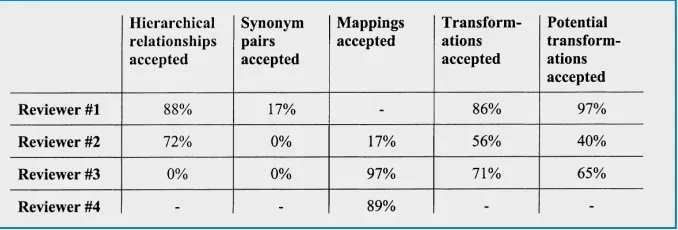
The results of external evaluation, as sum-marised in Table 1, were mixed. For two of the reviewers involved in the external eval-uation, the majority of hierarchical rela-tionships within individual terminology systems derived from the final ontology were seen as acceptable. A third reviewer rejected the notion outright. In contrast, synonyms within individual terminology systems were rejected in the vast majority of cases by all three reviewers. Mappings and transformations between terminology systems were in the majority of cases seen as acceptable although one reviewer had significantly higher rates of rejection.
A major limitation in the interpretation of certain of the results was the lack of measure of agreement between different reviewers. While most of the analyses involved only one reviewer, the analysis of transformations did allow a limited but highly significant assessment, using Cohen’s Kappa Coefficient, of inter-reviewer agreement. This showed that there was effectively no agreement between reviewers. While the broad range of analyses served to verify certain of the findings, they brought into question others by exposing inconsistencies on the part of individual reviewers and between review-ers.
4. Discussion
The use of informal definitions for nursing interventions resulted in highly complex intermediate representations. The hope for the ontology based on informal definitions was that the comparative richness of the informal definitions would be reflected within the ontology as a comprehensive set of hierarchical relationships; and that the rich generated hierarchy would facilitate the process of mapping between individual nursing interventions. This hope was dashed. In the first experiment the relative-ly rich representation embodied within the informal definitions required interpreta-tion and allowed great freedom of expres-sion. The need for systematic normalisation on initial intermediate representations demonstrated the difficulties associated with authoring consistently highly discur-sive definitional statements. The
normalisa-tion techniques used went some way in re-solving unintentional differences between intermediate representations. However this largely manual process was arduous with little support provided by external re-sources.
The first experiment demonstrated that although it is indeed possible to derive an ontology from informal definitions for nursing interventions, the utility of such an ontology as a vehicle for mediation is highly questionable. To derive under this methodology an ontology with a richer hierarchy would require simpler sources with limited discursive content and a higher degree of consistency. The results of the second experiment provided evidence to support these claims. There was evidence that certain transformations had been car-ried out in the development of intermedi-ate representations: the replacement of synonyms, the omission of certain con-structs in the source labels, the expansion of relational adjectives and other ‘packed’ concepts and the use of ‘role’-like con-structs. However, there was no need, as in the first experiment, for harmonising spelling and word form nor for transform-ing prepositions into links; the labels had already been normalised extensively dur-ing their development.
For the ontology based on labels the initial fear was that the simplicity and ab-stract nature of labels would result in fewer hierarchical relationships within the ontol-ogy. This fear was unfounded. The use of simpler sources had resulted in a more robust ‘style guide’ and greater coherence in the set of intermediate representations. The hierarchical organisation of attributes had further increased opportunities for subsumption and the manual validation of the entity hierarchy had contributed to the validity of subsumption. For these reasons, the initial ontology based on labels was subjected to a further round of develop-ment (i.e.the inclusion of nursing interven-tion components of HHCC and OMAHA), to further comparative bench testing and to external evaluation.
The final extended ontology covered all three source terminology systems in entire-ty i.e.every potential pre and post co-ordi-nated element was represented. The rapid Hardiker
[image:5.595.40.379.632.747.2]Methods Inf Med 3/2003
tail off in terms of effort required to extend the ontology is perhaps indicative of a degree of commonality between the three terminology systems.
Nursing interventions were organised within the final ontology in a rich multi-axial hierarchy. The results of comparative bench testing demonstrated that the final extended ontology based on labels might overcome the limitations of other ap-proaches to mediation. However, the re-sults of more extensive external evaluation highlighted certain deficiencies in the development and evaluation methods em-ployed.
The vast majority of mappings and transformations embodied within the final ontology were considered acceptable to reviewers. This is some indication of the usefulness of a logical ontology approach in exploiting similarities and resolving un-motivated differences between nursing intervention terminology systems. Howev-er a great many hiHowev-erarchical relationships and synonyms, and several mappings and transformations were rejected on account of their informal definitions i.e. source labels were incomplete in terms of the meaning behind the nursing interventions they purported to represent. The heavy reliance on labels as the sole source for the final ontology resulted in errors. These errors could have been avoided to a large extent by paraphrasing labels (and validat-ing the paraphrases) prior to more formal modelling.
Within the external evaluation, the re-jection rate for synonymy within individual terminology systems (embodied within the final ontology) was high.This is particularly significant as certain sets of synonyms with-in the ontology had a profound impact on the acceptability of mappings and transfor-mations between terminology systems. An analysis of the rejected mappings and transformations revealed that certain syno-nym sets appeared consistently to have caused problems. The approach taken with-in this study was useful with-in isolatwith-ing these problem synonym sets.
Modelling activity within this study demonstrated that even relatively simple labels for nursing interventions can have complex hidden semantics, necessitating
substantial nesting of entities and a rela-tively large number of attributes. Within this study the use of relatively simple inter-mediate representations that could be ex-panded automatically or semi-automatical-ly into more complex GRAIL expressions greatly facilitated the manual modelling process.
The lack of agreement between review-ers provided some indication that there were significant ideological differences concerning both the nature of nursing interventions and the terminology systems that represent them. Such ideological dif-ferences certainly accounted for some of the difficulties in mapping. The range of analyses revealed a number of inconsisten-cies on the part of individual reviewers and between reviewers. In many cases these in-consistencies suggested that the ideological differences between the individual review-ers were not totally clear-cut; even firmly held beliefs could apparently change. One possible reason for this is simple reviewer error. However, many inconsistencies were not isolated cases; they occurred across individual analyses and between analyses. A second reason might be that many of the basic notions embodied within nursing ter-minology systems are inherently difficult to define - the study showed that compara-tively vague notions like ‘manage’ are a major source of disagreement. A final pos-sibility is that to accept similarities between terminology systems would in many re-spects be politically unacceptable. Each of the source terminology systems for this study has a large body of users and other stakeholders; the developers and users of each of the terminology systems have made large personal investments in their devel-opment and continued use; and the institu-tions built up around the terminology systems depend to a large extent on their individuality. Such political motivators re-quire political solutions; they are certainly beyond the capability of a logical ontology. One of the limitations of the approach to development and evaluation used within this study was that it did not seek to identify or promote consensus. This study has shown that the ontology is a suitable and useful vehicle for negotiation. A consensus type methodology e.g.some form of
mod-ified Delphi study, would facilitate evolu-tion of the ontology and would obtain a more reliable consensus of opinion. Other researchers have reached similar conclu-sions [19]. This study has highlighted the deficiencies of a more summative ap-proach.
As has already been suggested the source terminology systems for this study reflect the views of their respective devel-opers; it is likely that they also represent in certain respects significant ideological dif-ferences across the nursing profession that are unlikely to be bridged by purely logical means. Indeed it might be wrong to do so: “Thinking only in computational terms, we run the risk of becoming focused exclusive-ly on re-engineering all clinical work into formal behaviors that are suitable for com-putational treatment” [20]. If such ideolog-ical differences are indeed irreconcilable by any means, this raises real questions about the role of ‘classification’ in nursing in ag-gregating data from disparate sources [21]. However, there was no evidence within this study of such extreme differences. As such, a combination of a description logic-based approach and a consensus type develop-ment and evaluation methodology should over time lead to convergence.
5. Conclusion
Acknowledgments
This article represents a synthesis of work carried out as part of a Doctoral program conducted at the University of Manchester, UK under the supervision of Alan Rector. The author would like to thank Professor Rector for his guidance throughout the course of study. He would also like to thank Susan Grobe, Derek Hoy, Stephen Kay, Katja Markert, Karen Martin, Joanne McCloskey Dochterman, Virginia Saba and Bon-nie Webber for their support.
References
1. Spackman K, Campbell K, Cote R. SNOMED RT: A Reference Terminology for Health Care. In: Masys D, editor. AMIA 1997 Annual Sym-posium. Nashville: Hanley & Belfus, Inc.; 1997: 640-4.
2. Hardiker N, Rector A. Structural Validation of Nursing Terminologies. Journal of the Ameri-can Medical Informatics Association 2001; 8(3): 212-21.
3. Chute C. Standards Move to Center Stage. MD Computing 1999; 16(1): 29-32.
4. Masarie F, Miller R, Bouhaddou O, Giuse N, Warner H. An Interlingua for Electronic Inter-change of Medical Information: Using Frames to Map Between Clinical Vocabularies. Com-puters and Biomedical Research 1991; 24(4): 379-400.
5. McCormick K, Lang N, Zielstorff R, Mil-holland K, Saba V, Jacox A. Toward Standard Classification Schemes for Nursing Language: Recommendations of the American Nurses Association Steering Committee on Databases to Support Clinical Nursing Practice. Journal of the American Medical Informatics Association 1994; 1: 421-7.
6. Kim M, McFarland G, McLane A. Pocket Guide to Nursing Diagnoses. 5th ed. St. Louis: Mosby-Year Book Inc.; 1993.
7. McCloskey J, Bulechek G. Nursing Interven-tions Classification. 2nd ed. St. Louis: Mosby; 1996.
8. Martin K, Scheet N. The Omaha System: a pocket guide for Community Health Nursing. Philadelphia: W.B.Saunders Company; 1992. 9. Saba V. Home Health Care Classification of
Nursing Diagnoses and Interventions.Washing-ton D.C.: Georgetown University; 1994. 10. http://www.ana.org/nidsec/nilang.htm. 11. Ozbolt JG, Russo M, Stultz MP. Validity and
Reliability of Standard Terms and Codes for Patient Care Data. In: Gardner RM, editor. 19th Annual Symposium on Computer Appli-cations in Medical Care: Hanley & Belfus Inc.; 1995: 37-41.
12. Henry S, Holzemer W, Reilly C, Campbell K. Terms used by nurses to describe patient prob-lems: can SNOMED III represent nursing con-cepts in the patient record? Journal of the American Medical Informatics Association 1994; 1: 61-74.
13. Rector A, Rossi-Mori A, Consorti F, Zanstra P. Practical development of re-useable terminolo-gies: GALEN-IN-USE and the GALEN Or-ganisation. International Journal of Medical Informatics 1998; 48: 71-84.
14. Rector A, Bechofer S, Goble C, Horrocks I, Nowlan W, Solomon W. The GRAIL concept modelling language for medical terminology. Artificial Intelligence in Medicine 1997; 9: 139-71.
15. Rogers J, Solomon W, Rector A, Pole P, Zanstra P, van der Haring E. Rubrics to Dissections to GRAIL. In: Pappas C, Maglaveras N, Scherrer J-R, editors. Medical Informatics Europe (MIE 97). Thessaloniki, Greece: IOS Press; 1997: 241-5.
16. Rector A, Solomon W, Nowlan W, Rush T, Zanstra P, Claassen W. A Terminology Server for Medical Language and Medical Informa-tion Systems. Methods of InformaInforma-tion in Medi-cine 1995; 34: 147-57.
17. Hardiker N, Webber B, Markert K, Rauch B. Supporting the development of formal models of nursing terminology. In: Proceedings of Nursing Informatics; Aukland; 2000.
18. Campbell K, Oliver D, Shortliffe E.The Unified Medical Language System: toward a colla-borative approach for solving terminologic problems. Journal of the American Medical Informatics Association 1998; 5(1): 12-6. 19. Levy D, Dolin R, Mattison J, KA S, KE C.
Com-puter-facilitated collaboration: experiences building SNOMED-RT. In: Chute C, editor. A Paradigm Shift in Health Care Information Systems: Clinical Infrastructures for the 21st Century; 1998: 870-4.
20. Coiera E. When Conversation Is Better Than Computation. Journal of the American Medical Informatics Association 2000; 7(3): 277-86. 21. Zielstorff RD, Hudgings CI, Grobe SJ.
Next-Generation Nursing Information Systems: Essential Characteristics for Professional Prac-tice. Washington, DC: American Nurses Pub-lishing; 1993.
Correspondence to:
Nicholas R. Hardiker RN PhD Senior Research Fellow
Salford Health Informatics Research Environment Brian Blatchford Building
The University of Salford Greater Manchester, M6 6PU UK
Phone: +44 161 295 7013 E-mail: [email protected]
Hardiker