International Journal of Emerging Technology and Advanced Engineering
Website: www.ijetae.com (ISSN 2250-2459, Volume 2, Issue 6, June 2012)393
Data Encryption Using Square Grid Transposition
With Cryptography DSA Technique
Dhananjaya Singh
1, Parma Nand
21 Department of Computer Science & Engineering, M.I.E.T, Meerut-250004(U.P), India.
2Department of Computer Science & Engineering, M.I.E.T, Meerut-250004(U.P), India
.
1
[email protected] 2[email protected]
Abstract— Data encryption is the conversion of data into a form, called a ciphertext, that cannot be easily understood by unauthorized people. Decryption is the process of converting encrypted data back into its original form, so it is easily understood. In literature, different techniques are used for encryption and decryption of text, image, audio and video. RSA (Rivest, Shamir, Aldeman) encryption technique has been used for encryption of text using data encryption technique with square grid transposition with key wrapping[2,3]. In this paper work, a modified approach for the encryption of the text is used called the DSA (Digital Signature Algorithm) encryption algorithm. The binary data of file is divided into equal sized blocks called as grids.
Keywords—Cryptography, Encryption, Grid Transposition, Decryption, RSA, DSA.
I. I
NTRODUCTIONToday due to the prominence use of the internet all over the world required Network [1,2] Security.
Cryptography [2,6,7] is conversion of original data into some modified form of data called cipher so that it is communicated in more secure manner between the sender and the receiver. Encryption is a mechanism for hiding information by turning readable text into a stream of gibberish in such a way that someone with the proper key can make it readable again. Today encryption plays a crucial role in protecting our information and most notably in securing our online purchase from attack. Encryption is one of the most important and most affordable defences available to a small business. If a hacker manages to get past all our other security measures, good encryption used properly will stop him his malintention.
II. METHODOLOGY
Step 1:A square grid of required size constructed by taking binary data from source file.
Step 2:Now grid transposition applied by readingdata diagonally and writing it down on row basis from left to right.
Step 3:A secret key that varies with each sessionas combination of 0’s and 1’s is generated based on the grid size, say 160 – bit for 32– sized, 384 – bit for 64 – sized etc.
Step 4:A new grid generated after transposition.
Step 5:The new grid is converted into ASCII sequence and written to another file called encrypted file.
Step 6:Steps 1 to 5 are repeated until the total file is formed into grids and encrypted.Padding with 0’s is done in grid formation deficiency.
Step 7:Key generated for each file is encrypted with the public key of sender using DSA algorithm.
Step 8:The encrypted key is then divided into various blocks and appended to file.
The above steps can be shown as the operational structure of the technique which includes the source file and then the implementation of the technique.
International Journal of Emerging Technology and Advanced Engineering
Website: www.ijetae.com (ISSN 2250-2459, Volume 2, Issue 6, June 2012)394
.
Figure1: Structure of the technique
This technique forms the raw data from the file into various grids of sizes say 32, 64, 128… by reading the binary data as bytes. A grid is nothing but a 2 -dimensional array of equal size. We may also called the grid as a matrix.
The size of the grid is fixed for a file for each session. If the grid is not filled with the given data from the file then the grid can be padded by adding 0’s at the end. The grid thus formed is encrypted by reading the data diagonal wise and written in a new grid of equal size from left to right row by row. This process is done for all the grids formed. Now a sequence of bits that varies with grid size as a combination of 0’s and 1’s is generated.
The grid reading can be as shown below. That is the file can be read diagonally. Let us assume the size of the grid is 32. The grid reading is as follows:
Figure2: Grid Reading 16X16
The above grid 16X16 (but implemented on 32X32 grid size) represent .txt file in the form of ASCII values of every character from the source file, if grid is short (i.e. grid is not filled completely from the given source file), padding is done with 0’s so that grid is complete. The key generated at each session for a given file is different and size of key varies with the grid size. Longer the size of the grid, longer is the size of the key.
Now the data is read from diagonally as above format and is transposed by writing the data in an equal sized grid from left to right row by row. The main point is that we have implemented this technique on 32X32 grid size but it is shown here with grid size 16X16.
The grid writing can be written as shown below. After applying grid writing, all the binary values are shifted to some new locations.
Grid Writing can be applied only after grid reading has done properly. Grid Reading is applied on source file which has been given as plaintext (.txt file) and grid writing is applied on grid reading as shown below.
The grid size is always equal in grid reading and grid writing which are 32X32 grid.
International Journal of Emerging Technology and Advanced Engineering
Website: www.ijetae.com (ISSN 2250-2459, Volume 2, Issue 6, June 2012)395
A. Key generation in detail
Let us suppose if the grid size is equal to 32, then all the non negative sequencing of grid size 32 has to be generated.
Each index requires atmost 5 bits to represent. Now the size of the key should be 32X5= 160 bits such that by grouping any 5 bits we get the all the indexing and no indexing once occurred should not repeat in the key.
If we take the grid size equal to 64, then all the non negative sequencing of grid size 64 has to be generated. Each index requires at most 6 bits to represent. Now the size of the key should be 64X6= 384 bits such that by grouping any 6 bits we get the all the indexing and no indexing once occurred should not repeat in the key. Suppose if the grid size is equal to 128, then all the non negative sequencing of grid size 128 has to be generated. Each index requires atmost 7 bits to represent. Now the size of the key should be 128X7=896 bits such that by grouping any 7 bits the algorithm derive the indexing and no indexing once occurred should not repeat in the key. Here, we are considering grid size 32 then as discussed above the key must be of 160 bits because each index requires atmost 5 bits to represent, hence a total of 160 bits are required for the key. In the above figure (i.e. grid writing) the data are read from grid reading diagonally and written in a new grid of equal size from left to right row by row as the arrow indicates in the above figure. The same process is applied for all the grids. Hence the generation of cipher that is encryption of data of file is completed.
III. DSA ENCRYPTION OF KEY
In DSA, the sender encrypt the message using the private key and at the receiving end, the receiver decrypt the message using public key along with set of global public key communities.DSA is a public key algorithm in which encryption and decryption is done and key generated in each session varies automatically for each input given as plaintext.DSA has been used for the encryption and decryption of the text file which is small in size as we know digital signature is used for authentication and confidentiality.
B. DSA algorithm
Have shared global public key values (p,q,g):
choose a large prime p with 2L-1 < p < 2L where L= 512 to 1024 bits and is a multiple of 64
choose q with 2159 < q < 2160 such that q is a
160 bit prime divisor of (p-1)
choose g = h(p-1)/q where 1<h<p-1 and h(p-1)/q
mod p > 1
Users choose private & compute public key:
choose x<q
compute y = gx mod p
Signature creation:
r = (gk mod p)mod q
s = [k-1(H(M)+ xr)] mod q
Signature verification:
w = s-1 mod q
u1= [H(M)w ]mod q
u2= (rw)mod q
v = [(gu1 yu2)mod p ]mod q
C. Decryption:
International Journal of Emerging Technology and Advanced Engineering
Website: www.ijetae.com (ISSN 2250-2459, Volume 2, Issue 6, June 2012)396
IV. FLOWCHART
[image:4.612.102.251.175.484.2]The flowchart for our technique is shown below:
Figure 4: Flowchart of the technique
The flowchart shows the overall working of our technique. Plaintext (.txt file) has given as input i.e. the file to be encrypted. After that grid reading has been done by taking the ASCII code of each character in a grid size of 32X32.If the grid is not complete then padding with 0’s done to make the grid complete.
After grid reading has done, grid writing is done by reading the data diagonally and written in an equal sized grid i.e. 32X32 grid size from left to right. Then DSA algorithm is applied on it for encryption and decryption of the .txt file. If both the messages are equal then we can say that file is successfully encrypted and decrypted otherwise again perform encryption and decryption using the DSA algorithm.
Some modules and their objects are denoted for this technique in JAVA is as follows:
OBJECTS FOR GRID READING:
FileReader filename= new FileReader(A.txt);
Above object is used to define the module Grid Reading. OBJECTS FOR GRID WRITING:
FileWriter Store=new FileWriter(―Ar.txt‖, arg); Grid Writing is achieved by using above object. OBJECTS FOR ENCRYPTION:
FileInputStream mis=new FileInputStream(dsa.java.msg); Encryption is done with the use of above object defined. OBJECTS FOR DECRYPTION:
FileOutputStream
mos=new FileOutputStream(dsa.java.msg); Decryption is accomplished using the above object.
V. RESULT
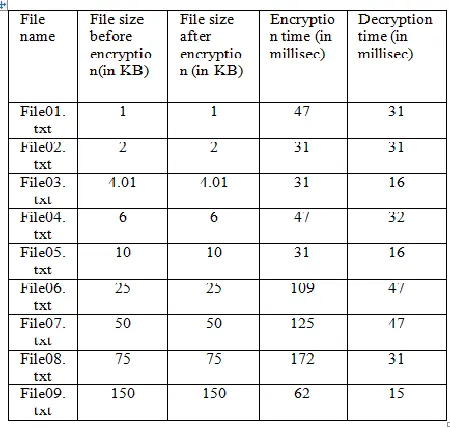
The above mentioned technique has been implemented successfully using JAVA programming language and various files have been experimented with varying file sizes and a grid size of 32.
This technique has been implemented on .txt files. The encryption and decryption times have been calculated from the experiment performed as the algorithm is reading the binary data from source file.
[image:4.612.331.556.493.707.2]The results are shown in the following table.
International Journal of Emerging Technology and Advanced Engineering
Website: www.ijetae.com (ISSN 2250-2459, Volume 2, Issue 6, June 2012)397
Now the graph for the encryption and decryption time for 32- grid size is shown below which are based on the results that are accomplished after implementing our technique on .txt file of various size.
[image:5.612.50.294.195.396.2]The encryption chart is:
Figure 5: Encryption chart v/s file size
The decryption chart is shown below:
Figure 6: Decryption chart v/s file size
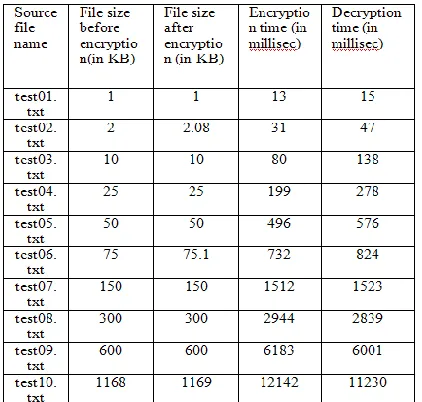
[image:5.612.328.539.218.419.2]Now let us compare the efficiency of our algorithm with RSA algorithm (existing work) having a grid size of 32. The various encryption and decryption times for the RSA algorithm are as follows:
Table II: File size v/s encryption and decryption time using RSA algorithm for .txt files with 32-size grid (existing work).
Thus from the above discussion we conclude that our algorithm is efficient in terms of time and security. Our proposed technique takes less time when it is compared to the existing algorithm. The time decreases monotonically with the increase in file size. Security is enhanced as it is encrypted twice folds.
VI. CONCLUSION
The above mentioned technique has been implemented for text files with variable grid sizes of length 32. It is being executed efficiently for 32 but when executed on grid length greater than does not work efficiently because there is a delay with grid size greater than 32.
As the key is generated randomly with varying size grid based on the grid size differently for different sessions therefore the complexity of the technique is enhanced. Due to encrypting the file twice folds; its security is enhanced to a great extent.
[image:5.612.74.287.532.696.2]International Journal of Emerging Technology and Advanced Engineering
Website: www.ijetae.com (ISSN 2250-2459, Volume 2, Issue 6, June 2012)398
REFERENCES
[1] Khaled A., Waiel F., Mohamed A., and Alaa A.,“Attack and Construction of Simulator for Some of Cipher Systems Using Neuro-Identifier,”International Arab Journal of Information Technology, vol. 7, no. 4, pp. 365-372, 2010.
[2] B. Schneier, Applied Cryptography: Protocols Algorithms, and Source Code in C, Wiley & Sons, Inc.1996.
[3] A.J. Menezes, P.C. Van Oorschot y S.A. Vanstone 1997.“Handbook of Applied Cryptography”, CRC Press. pp 15- 28 and. 283-291.
[4] J.A. Buchmann, ―Introduction to Cryptography. Marietta, GA: Springer-Verlag”, 2000, pp. 139-153.
[5] D.R. Stinson, “Cryptography: Theory and Practice Tercera edición”, CRC Press. 2005.
[6] A. Fuster, “Técnicas criptográficas de protección d datos,” Ed. Ra- Ma, 2001.
[7] Diffie, W., and Hellman, M. “New directions in cryptography” IEEE Trans.
[8] W. Stallings, “Cryptography and Network Security: Principles and Practice”,2da. Edición, Prentice-Hall, New Jersey, 1999.
[9] Stinson, D.R. : ―Cryptography Theory and Practice‖,CRC Press, London, 1995
[10] ―Cryptography and Network security‖, 2nd Edition by Atul Kahate. Tata Mc- Graw-Hill Publications, New Delhi.
[11] “Security Requirements for Cryptographic Modules, FIPS PUB 140-1, 1994 January 11
[12] Special Publication 800-12: “An Introduction to Computer Security”- The NIST Handbook
[13]
Josef P. and Jennifer S., ―Cryptography, an Introduction to Computer security,‖ Upper Saddle River NJ, Prentice Hall, 1989.
[14]