Journal of Chemical and Pharmaceutical Research, 2015, 7(4):1060-1068
Research Article
ISSN : 0975-7384
CODEN(USA) : JCPRC5
Simultaneous RP-HPLC estimation and validation of ramipril and
atorvastatin in bulk and combined tablet formulation
A. Ravi Varma
*, J. V. Shanmukha Kumar and S. Mutta Reddy
Department of Chemistry, K L University, Green Fields, Vaddeswaram, Guntur, Andhra Pradesh,, India
_____________________________________________________________________________________________ABSTRACT
A simple, precise, accurate and reproducible RP-HPLC method was developed and validated for simultaneous estimation of ramipril and atorvastatin in bulk and combined pharmaceutical formulations. Separation of ramipril and atorvastatin was successfully achieved on an Inertsil ODS C18 column (150mm x 4.6mm x 5 µm). The mobile phase consisted of 0.1% ortho phosphoric acid and methanol (60:40, v/v) at a flow rate of 1.2 ml/min. The detection was performed at 245 nm. The method was validated according to ICH guidelines for linearity, sensitivity, accuracy, precision and robustness. The response was found to be linear in the concentration range of 2.5 µg/ml to 7.5 µg/ml for ramipril and 10 µg/ml to 30 µg/ml for atorvastatin. The LOD and LOQ for ramipril were found to be 0.009 µ g/ml and 0.029 µg/ml, respectively. The LOD and LOQ for atorvastatin were 0.0269µg/ml and 0.0898 µ g/ml, respectively. The percentage recovery for ramipril and atorvastatin were found to be 100% and 101%, respectively. The excellent percentage recovery values indicate the high accuracy of the proposed method. The method specifically determines the analytes in the sample without interference from excipients of tablet dosage forms. The method was extensively validated according to ICH guidelines for linearity, range, accuracy, precision, specificity and robustness.
Key words: Ramipril, atorvastatin, analysis, RP-HPLC, combined dosage form
_____________________________________________________________________________________________
INTRODUCTION
NH
O O CH3
CH3
O N
O OH
[image:2.595.112.470.84.206.2]H H
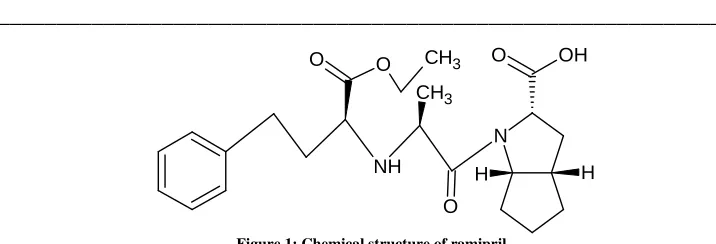
Figure 1: Chemical structure of ramipril
In the literature kinetic spectrophotometry [3], visible spectrophotometry [4,5,6], spectroflourimetry [5], atomic absorption spectrophotometry [6], liquid chromatography-mass spectrometry [7] and liquid chromatography with UV detection [8] techniques were reported for the quantification of ramipril alone in biological samples and pharmaceutical dosage forms.
Atorvastatin [9,10] is a member of the drug class known as statins. Chemically atorvastatin is called as [R-(R*, R*)]-2-(4-fluoro phenyl)-β, δ-dihydroxy-5-(1-methyl ethyl)-3-phenyl-4-[(phenyl amino) carbonyl]-1Hpyrrole-1-heptanoic acid and its chemical structure is given in Figure 2. Atorvastatin acts as an anticholesteremic agent or hydroxymethylglutaryl-CoA reductase inhibitor and is used for lowering plasma cholesterol. Atorvastatin is a competitive inhibitor of hydroxymethylglutaryl-coenzyme-A reductase, that catalyzes the conversion of HMG-CoA to mevalonate, an important step in the synthesis of cholesterol in liver. Decreased hepatic cholesterol levels increases hepatic uptake of cholesterol and reduces plasma cholesterol levels. The chief use of atorvastatin is in the treatment of dyslipidemia and the prevention of cardiovascular disease.
NH
N O
OH
OH OH O
F CH3
C H3
Figure 2: Chemical structure of atorvastatin
Literature survey reveals several methods for determination of atorvastatin individually in biological fluids and formulations like spectrophotometry [11], HPLC with UV detection [12,13], HPLC with fluorescence detection [14], TLC-densitometry [15], LC-MS/MS [16] and capillary electrophoresis [17] and microchip electrophoresis [17].
Atorvastatin and ramipril as a fixed dose combination are used in the treatment of patients with both essential hypertension and hypercholesterolemia. Spectroscopy [18], HPLC [18,19] and HPTLC [19] methods were reported in the literature for determination of atorvastatin and ramipril in combination. This paper describes a simple, rapid, accurate, reproducible and robust method for simultaneous determination of atorvastatin and ramipril in tablet formulation using RP-HPLC method.
EXPERIMENTAL SECTION
Apparatus:
[image:2.595.167.432.377.520.2]Empower II software. The analytical column used for the separation was 150 mm × 4.6 mm I.D., 5 µm particle size, Inertsil ODS C18 column.
Chemicals
All chemicals and solvents used were of analytical and HPLC grade quality, respectively. HPLC grade water was obtained from Milli Q water. Methanol of HPLC grade was purchased from Merck (India) and ortho phosphoric acid of analytical grade was obtained from Sd Fine Chemicals Ltd., Mumbai.
Mobile Phase
The mobile phase consisted of 0.1% ortho phosphoric acid and methanol (60:40, v/v).
Stock standard solution:
Accurately weighed quantity, 2.5 mg of ramipril and 10 mg of atorvastatin was transferred into 100 ml of volumetric flask and add 20 ml of mobile phase and sonicate for 15 min. Make up the volume with mobile phase.
Working standard solutions for calibration curve:
From the stock solutions, aliquot volumes containing ramipril and atorvastatin were quantitatively transferred into a series of 25 ml volumetric flasks, so that the final concentration were in the range of 2.5–7.5 µg/ml (i.e., 2.5, 3.75, 5.0, 6.25 and 7.5 µg/ml) for ramipril and 10–30 µg/ml (i.e., 10, 15, 20, 25 and 30 µg/ml) for atorvastatin. The solutions were completed to the volume with the mobile phase.
Preparation of sample solution:
Tablets containing ramipril and atorvastatin were weighed and their average weight was determined. The tablets were finely powdered into homogenous mixture. An accurately weighed 102.50 mg of tablet powder was transferred into a conical flask containing 30 ml of mobile and sonicated for 10 min with continuous shaking. The resulting solution was filtered through a 0.45 µm membrane filter into 100 ml volumetric flask and completed to volume with same solvent. This solution was appropriately diluted with the same solvent for the analysis by the proposed method.
Chromatographic conditions:
In the present study 0.1% ortho phosphoric acid and methanol in the ratio of 60:40 v/v is used as mobile phase. Before use the mobile phase was filtered through a 0.45 µ membrane filter and degassed for about 15 min. The mobile phase was pumped from the solvent reservoir to the column at a flow rate of 1.2 ml/min. the injection volume was 10 µl and the column temperature was maintained at 30±10C.The eluents were monitored at 245 nm.
Analysis of mixture of ramipril and atorvastatin:
Ten µl aliquot of each solution prepared in the section “working standard solutions for calibration curve” was injected automatically on to the column. The chromatograms were recorded. The calibration curve was constructed by plotting the peak area against the final concentration of the drug (µg/ml). The corresponding regression equations were derived.
RESULTS AND DISCUSSION
Development of the method:
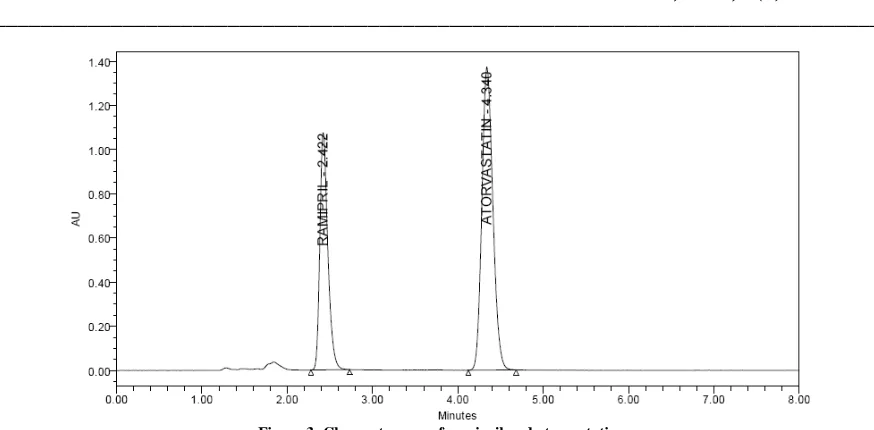
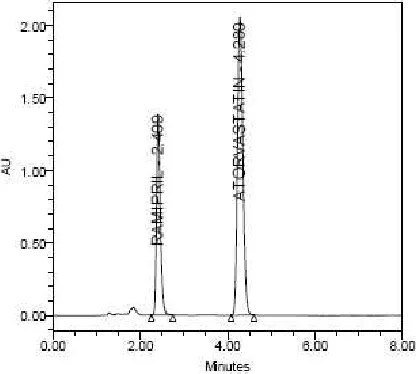
Figure 3: Chromatogram of ramipril and atorvastatin
System suitability:
[image:4.595.212.385.398.448.2]In order to assess the system suitability, five replicate injections of standard solutions of ramipril and atorvastatin were injected into the HPLC system. The suitability parameters like relative standard deviation of retention time, peak area, USP plate count and USP tailing were calculated. Results are shown in Table 1. The values are within the acceptable range and are enough for the analysis to be done.
Table 1: System suitability parameters
Parameters Ramipril Atorvastatin
Retention time (min) 2.416 4.339 Peak area 7300934 12254080 USP Plate Count 3365 5349 USP Tailing 1.33 1.13
Linearity:
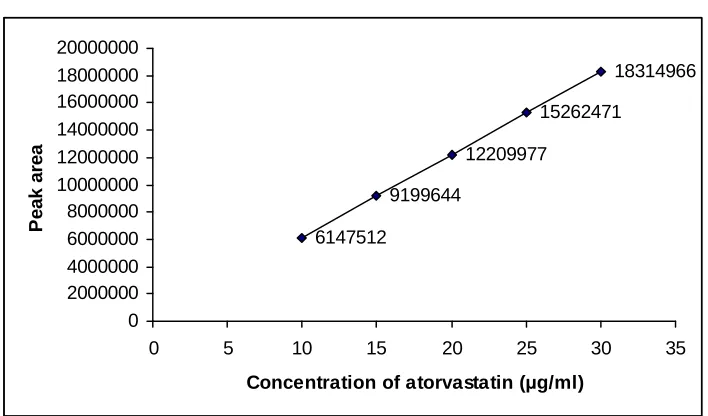
A linear relationship was established by plotting the peak area against the drug concentration. The relationship was found to be linear over the range 2.5–7.5 µg/ml and 10–30 µg/ml for ramipril and atorvastatin, respectively. The results are summarized in Table 2. The results show that good correlation existed between the peak area and concentration of the studied drugs.
Table 2: linearity of the method
Ramipril Atorvastatin
Area Amount of drug (ug/ml) Area Amount of drug (ug/ml)
3664650 2.5 6147512 10 5420897 3.75 9199644 15 7281773 5.00 12209977 20 9083229 6.25 15262471 25 10922660 7.5 18314966 30
Regression equation: y = 72743 x R2 = 0.9999
Regression equation: y = 122194 x
R2 = 1
[image:4.595.163.435.535.636.2]3664650 5420897 7281773 9083229 10922660 0 2000000 4000000 6000000 8000000 10000000 12000000
0 1 2 3 4 5 6 7 8
Concentration of ramipril (µg/ml)
[image:5.595.121.475.334.542.2]P e a k a re a
Figure 4: Linearity curve for ramipril
6147512 9199644 12209977 15262471 18314966 0 2000000 4000000 6000000 8000000 10000000 12000000 14000000 16000000 18000000 20000000
0 5 10 15 20 25 30 35
Concentration of atorvastatin (µg/ml)
P e a k a re a
Figure 5: Linearity curve for atorvastatin
Sensitivity:
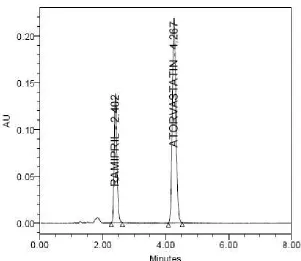
Figure 6: Chromatogram of ramipril and atorvastatin at LOD level
Figure 7: Chromatogram of ramipril and atorvastatin at LOQ level
Precision:
[image:6.595.146.447.386.647.2]shown in Table 3. The relative standard deviation was found to be <0.5, which proves that the method is adequately precise.
Table 3: Intra-day precision
Sample Weight (mg) Peak area of ramipril (5 µg/ml) Peak area of atorvastatin (20 µg/ml)
102.50 7237505 12171516
102.50 7280987 12200277
102.50 7228871 12204517
102.50 7203176 12203579
102.50 7257067 12228440
102.50 7292396 12210478
%RSD – 0.46 %RSD – 0.15
Accuracy:
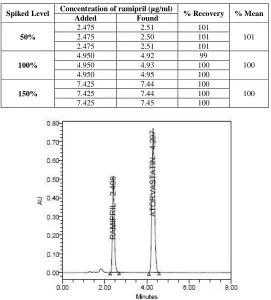
[image:7.595.163.434.344.644.2]Accuracy of the method was assessed by recovery studies through standard addition method. In the standard addition method known quantities of ramipril and atorvastatin at three different concentration levels (50, 100 and 150% of the labeled claim) were supplemented to the tablet sample solution previously analyzed. The solutions were once again analyzed by the proposed method. The percentage recoveries for ramipril and atorvastatin were calculated and are given in Table 4 & 5. Recovery studies showed the method to be adequately accurate and suitable for the simultaneous determination of ramipril and atorvastatin.
Table 4: Recovery studies for ramipril
Spiked Level Concentration of ramipril (µg/ml) % Recovery % Mean Added Found
50%
2.475 2.51 101
101 2.475 2.50 101
2.475 2.51 101
100%
4.950 4.92 99
100 4.950 4.93 100
4.950 4.95 100
150%
7.425 7.44 100
100 7.425 7.44 100
7.425 7.45 100
Figure 9: Chromatogram of ramipril and atorvastatin at 100% level
[image:8.595.158.438.538.645.2]Figure 10: Chromatogram of ramipril and atorvastatin at 150% level
Table 5: Recovery studies for atorvastatin
Spiked Level Concentration of atorvastatin (µg/ml) % Recovery % Mean Added Found
50%
9.900 10.01 101
101 9.900 10.04 101
9.900 9.98 101
100%
19.800 19.91 101
101 19.800 19.87 100
19.800 19.93 101
150%
29.700 30.01 101
101 29.700 30.02 101
29.700 30.06 101
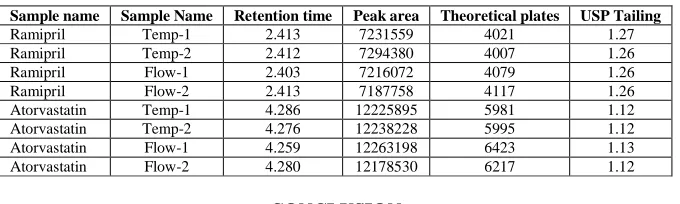
Robustness:
Table 6: Robustness of the method
Sample name Sample Name Retention time Peak area Theoretical plates USP Tailing
Ramipril Temp-1 2.413 7231559 4021 1.27 Ramipril Temp-2 2.412 7294380 4007 1.26 Ramipril Flow-1 2.403 7216072 4079 1.26 Ramipril Flow-2 2.413 7187758 4117 1.26 Atorvastatin Temp-1 4.286 12225895 5981 1.12 Atorvastatin Temp-2 4.276 12238228 5995 1.12 Atorvastatin Flow-1 4.259 12263198 6423 1.13 Atorvastatin Flow-2 4.280 12178530 6217 1.12
CONCLUSION
An isocratic HPLC with ultra violet detection method was successfully developed for the simultaneous analysis of ramipril and atorvastatin. The method validation results have proven that the method is adequately sensitive, precise, accurate, linear and robust. The method is selective for the ramipril and atorvastatin and free from the interference of the placebo and components of mobile phase. The short run time (8 min) enables rapid determination of the ramipril and atorvastatin. Further more, the method was suitable for the routine quality control of ramipril and atorvastatin in combined dosage forms.
Acknowledgements
The authors wish to thank the K L University, Green Fields, Vaddeswaram, Guntur, Andhra Pradesh for supporting this work.
REFERENCES
[1] JE Frampton; DH Peters. Drugs, 1995, 49(3), 440–466.
[2] R Thomsen; HB Rasmussen; K Linnet. Drug Metab. Dispos., 2014, 42(1), 126–133. [3] N Rahman; Y Ahmad; SN Azmi. AAPS Pharm. Sci. Tech., 2005, 6(3), E543-E551. [4] AA Al-Majed; F Belal; AA Al-Warthan. Spectrosc. Lett., 2001, 34(2), 211-220. [5] HE Abdellatef. Spectrochim. Acta. Part A, 2007, 66(3), 701-706.
[6] MM Ayad; A Shalaby; HE Abdellatef; MM Hosny. J. Pharm. Biomed. Anal., 2002, 28(2), 311-321.
[7] Z Zhu; A Vachareau; L Neirinck. J. Chromatogr. B Analyt. Technol. Biomed. Life Sci., 2002, 779(2), 297-306. [8] M De diego; G Godoy; S Mennickent; M Olivares; R Godoy. J. Chil. Chem. Soc., 2010; 55(4), 450-453. [9] AP Lea, D McTavish. Drugs, 1997, 53(5), 828-847.
[10] HS Malhotra, KL Goa. Drugs, 2001, 61(12), 1835-1881.
[11] SD Jadhav; MS Bhatia; SL Thamake; SA Pishawikar. Int. J. PharmTech Res., 2010, 2 (3), 1948-1953. [12] B Stanisz; L Kania. Acta Pol. Pharm., 2006, 63(6), 471-476.
[13] S Ertürk, E Sevinç Aktaş; L Ersoy; S Fiçicioğlu. J. Pharm. Biomed. Anal., 2003, 33(5), 1017-1023. [14] A Khedr. J. AOAC Int., 2007, 90(6), 1547-1553.
[15] AA Shirkhedkar; SJ Surana. J. AOAC Int., 2010, 93(3), 798-803.
[16] M Yacoub; AA Awwad; M Alawi; T Arafat. J. Chromatogr. B Analyt. Technol. Biomed. Life Sci., 2013, 917-918, 36-47.
[17] E Guihen; GD Sisk; NM Scully; JD Glennon. Electrophoresis, 2006, 27(12), 2338-2347. [18] L Joseph, M George, BVR Rao. Pak. J. Pharm. Sci., 2008, 21(3), 282-284.