E-LEARNING EVALUATION IN MALAYSIAN PUBLIC
SECTOR FROM THE PEDAGOGICAL PERSPECTIVE:
TOWARDS E-LEARNING EFFECTIVENESS
1YUSMINAR YUNUS, 2JUHANASALIM
1Dr., Malaysian Administrative Modernisation and Management Planning Unit (MAMPU), Prime
Minister’s Department, Malaysia
2Prof., Department of Information Science, Faculty of Information Science and Technology, Universiti
Kebangsaan Malaysia, Malaysia
E-mail: [email protected], [email protected]
ABSTRACT
E-learning has emerged as an attractive alternative for the delivery of teaching and learning/ training. Nevertheless, most e-learning focused more on technical issues whereby the pedagogical perspective is not given much emphasis. The lack of emphasis on pedagogical perspective will affect the quality and effectiveness of e-learning. The purpose of this paper is to evaluate the effectiveness of e-learning in the public sector from the pedagogical perspectives and to identify the evaluation criteria which contribute to the effectiveness of e-learning. This paper attempts to develop a model for evaluating e-learning in the public sector. Mixed methods was chosen as the data collection technique. Quantitative data was gathered from the questionnaires, whereas qualitative data was gathered from interviews and case study. The overall findings showed that e-Training is effective from pedagogical perspectives, whereas EPSA is moderately effective. The results also showed that eleven evaluation criteria contributes to e-learning effectiveness namely individual motivation & attitude, individual learning style, theory-objective-learning outcome & knowledge transfer, interactivity & content, structure design, interface design, multimedia design, instruction and help, learner-facilitator interaction, learner-learner interaction, and learner-content interaction. An ‘E-learning Evaluation Model’ was also developed which comprised of 4 dimensions namely individual, learning, content and interaction.
Keywords: E-Learning, E-Learning Evaluation, E-Learning Effectiveness, Pedagogical Perspective
1.
INTRODUCTIONRapid technological advancement especially in the field of Information and Communications Technology (ICT) has changed and affected the lives of people from all over the world and across all fields. The emergence of internet and multimedia technology had enabled the community to communicate at anyplace and anytime. Internet development not only brings changes in various fields, but it also dramatically revolutionizes education and training either in the public or private sector. Moreover, web development and globalization has transformed the delivery of learning and training from classroom to digital or electronic media. In addition, ICT's technological
development and internet innovation also contributed to a new form of learning which is known as e-learning [1].
Journal of Theoretical and Applied Information Technology 20th May 2013. Vol. 51 No.2
© 2005 - 2013 JATIT & LLS. All rights reserved.
ISSN: 1992-8645 www.jatit.org E-ISSN: 1817-3195
1.1 Problem and Issue
E-learning is an alternative to conventional learning that is able to provide benefit to learner, instructor and organisation either in the public or private sector [2]-[6]. Based on its potential, many organizations choose to use e-learning as a solution to training problem and to enrich their teaching and learning delivery.
Today, e-learning is gaining popularity with its utilization spawning worldwide. Usage of e-learning expanded globally to cover business, industry and educational institution [7] where distance education and training can be acquired by millions in the community at various age categories [8]. Although e-learning increasingly find its niche in a range of organizations and educational institution, research findings [9]-[13] still showed obvious weaknesses in e-learning where it is unable to attract the trainees’ or learners’ interest and this resulted in an adverse effect on the implementation of e-learning. The study undertaken by Sun Microsystems revealed that only 25% of the personnel completed their online course [13]. While findings from a research carried out in Europe in the year 2002 on the quality of e-learning showed that 61% of professionals from both the public and private sector rated the overall quality of e-learning as 'unsatisfactory/weak' or 'medium' [12]. Results from the study carried out on e-learning under the mega Leonardo da Vinci programme that involved 149 e-learning projects from 24 European countries showed that e-learning system still has weaknesses [10], [11]. In addition, American Society for Training and Development (ASTD) which is one of the prominent organizations specializing in learning, job training and professional achievement also found that only 45% of the organization involved in the study managed to attract the trainee’s interest [9]. Existing studies on e-learning in Malaysia are more focused on certain public or private organizations/institutions of higher learning. No comprehensive study has yet been found to evaluate e-learning in the Malaysian public sector.Thus, efforts should be made to evaluate e-learning in the Malaysian public sector in order to focus on how e-learning can attract learner interest and how learner engagement will affect the effectiveness of e-learning. Ensuring that e-learning is able to attract learner interest and effective is crucial and must be given the utmost priority.
Emphasis must be given to the quality, teaching and learning content, online learning material, pedagogy and technical assistance in e-learning [14]. According to [15], the success of web-based distance learning depends largely on how learner interest can be maintained. Moreover, most e-learning developer focus mainly on technical matters and subject identification on the whole whereas pedagogy and andragogy are disregarded [10], [11]. [10] and [11] suggested that more focus should be given to learner needs, using a learner-oriented approach and innovation from the aspect of pedagogy so that it can give added value to learners. [11] discovers that the success of e-learning does not rely solely on technology perfection.
[16] had stressed the importance of pedagogy as the major prcondition for the success of e-learning. [16] also stated that there is no proper guide on how to design, develop, deliver and manage e-learning from the perspectives of pedagogy. [15] had argued that pedagogy in an online learning environment is the key variable that contribute to the quality of learning. According to [15], LMS would only be effective if it supports pedagogical principles and provides motivation as required by the learners. In addition, successful online learning must be able to attract learners’ interest, deliver meaningful learning and able to motivate learners’ to learn.
The view that less attention and emphasis on pedagogical aspects in e-learning by scholars, practitioners and other researchers is strengthened by e-learning experts from four continents. Discussion involving thirty three e-learning experts in 2002 held in Netherlands found that most of the current e-learning are pedagogically poor in quality, less portable or has inadequate tools [17]. As a result from the discussion, they further agreed that pedagogical quality of e-learning is the key issue that requires attention [17]. [18] further emphasized that the key and real issue in e-learning is pedagogy. [19] and [20] also had the same view whereby pedagogy is the key issue in the effectiveness of learning regardless of the media or teaching & learning delivery used.
1.2 E-learning Evaluation Model from the perspective of pedagogy
E-learning evaluation model from pedagogical perspectives has been designed by [21], [22] and [23]. Based on the similarities between Pedagogy Model [22] and Pedagogy Framework [23], it can be concluded that pedagogy model/framework has to be grounded on sound learning theories. Apart from that, the present Pedagogy Model/Framework involve only general evaluation criteria and have no specific criterias to facilitate the evaluation of e-learning from the pedagogical perspective. Thus, this paper proposes an e-learning evaluation model from the perspective of pedagogy (see Figure 1). This model is adapted from Pedagogy Model [22] and Pedagogy Framework [23] with some modifications. The model is based on learning theories namely behaviorism, cognitivism and constructivism. Instructional design principle is also incorporated in the model.
This paper attempts to integrate several evaluation criteria from other e-learning evaluation model which is related to the perspective of pedagogy. Four dimensions namely individual, learning, content and relationship between instructor and learner has been identified as the main evaluation criteria to evaluate e-learning from the perspective of pedagogy. The individual dimension, learning, content and relationship between instructor and learner are the independent variable in this paper and the dependent variable is e-learning effectiveness. Furthermore, this paper attempts to confirm the association of the independent variables identified such as individual, learning, content, and relationship between instructor & learner with the dependent variable.
2.
METHODMixed methods was chosen as the research design for this paper based on its strength which will enable deep understanding of problems, the exploration of the respondents’ perception, better explaination, clarification, confirmation and verification of the relationship between variables. Mixed methods in this paper involved quantitative and qualitative data gathered from questionnaire survey, interview and case study through observation. The population framework consist of all civil servants who are involved in e-learning either at the ministry, department or government agency in the public sector of Malaysia. The sampling framework consist of civil servants who
have used e-learning either at the ministry, department or government agency in the public sector of Malaysia. The sampling method chosen for this paper is clustered sampling. Unit of analysis is individual who is the user of e-learning in the public sector of Malaysia. Two e-learning applications were evaluated namely Public Sector E-Learning (EPSA) and e-Training. EPSA was implemented in 2007 and used by all civil servants in the public sector of Malaysia. e-Training was implemented in 2000 and used by civil servants from Ministry of Human Resources Malaysia and students from few Training Institutes of the Manpower Department (ILJTM) under the Ministry of Human Resources such as Industrial Training Institute (ILP).
Questionnaires comprising of online questionnaire and manually distributed questionnaire form were sent to all EPSA users and e-Training users from 11 Industrial Training Institute (ILP). A total of 616 usable questionnaires were received. In addition, a total of 29 respondents from 4 different groups were face-to-face interviewed involving 6 pedagogy/e-learning experts, 4 subject matter experts, 4 developers and 15 learners. Case study through observation was also carried out by the researcher on two departments which conducted training via e-learning namely National Institute of Public Administration (INTAN) and Industrial Training Institute (ILP), Manpower Department, Ministry of Human Resources Malaysia.
2.1 Measurement
Journal of Theoretical and Applied Information Technology 20th May 2013. Vol. 51 No.2
© 2005 - 2013 JATIT & LLS. All rights reserved.
ISSN: 1992-8645 www.jatit.org E-ISSN: 1817-3195
synthesis of other researcher’s indicator. In stage 4, the indices for each construct was developed using 5-point Likert scales with 1=strongly disagree and 5=strongly agree. As a result, 12 items/variables were identified to measure the evaluation criteria of individual/learner dimension which was adapted from [25]-29]. On top of that, 16 items/variables were used to measure the evaluation criteria of learning dimension and 53 items/variables were used to measure the evaluation criteria of relationship between instructor and learner. These measurements were adapted from [30], [25], [28], [31] and [29]. However, the researcher did not find any indicator for the dependent variable e-learning effectiveness from the perspective of pedagogy. Thus the indicator for e-learning effectiveness was developed by the researcher based on the concept of pedagogy explained by [32], [34], [23] and [29]. Once all construct were measured, the questionnaire was designed and sent to 2 pedagogical experts for face and content validation.
2.2 Instruments
The instrument used to collect data involved structured schedule of interview and case study, online questionnaire and survey questionnaire forms which were manually administered and distributed to the respondents. Questionnaire survey was used to collect quantitative data, whereas structured schedule of interview and case study were used to collect qualitative data. The questions in the online questionnaire and survey questionnaire form are simillar.
Before the questionnaire is sent to the respondent, the researcher has conducted a pilot study in two phases. In the first phase, the researcher has interviewed ten respondents to know whether the questionnaire designed/contructed can be understood by the respondents. The questionnaire was modified based on the feedback obtained from the first phase pilot study. The second phase of the pilot study involved 80 respondents from several ministries, departments or agencies. 68 usable questionnaires were received. The purpose of the second phase of the pilot study is to test the reliability and validity of the research instrument. Data collected from the second phase of the pilot study were analysed using a statistical software known as Statistical Package for Social Science (SPSS) for Windows (version 16.0).
Data analysis for this paper comprises of quantitative and qualitative analysis. The
quantitative analysis involved few analyses such as factor analysis, reliability, demograpic, descriptive, correlation, hypothesis testing and regression analysis. The qualitative analysis also involved few analysis such as open-ended question analysis, interview analysis, observation analysis, evaluation criteria analysis and e-learning effectiveness analysis. A parallel triangulation approach was used to integrate the result of quantitative and qualitative analysis.
3.
RESULTSQuantitative data collected from the survey questionnaire and analyzed using the Statistical Package for Social Science (SPSS). Analysis includes an assessment of validity and reliability, analysis of demographic profile, descriptive, correlation, hypothesis testing and regression. Qualitative data gathered from interviews and case study were analyzed using content analysis.
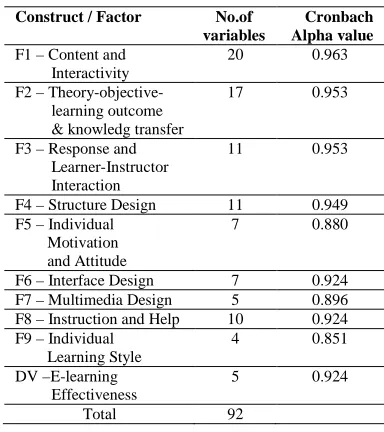
3.1 Reliability Analysis
Reliability analysis was carried out to test the reliability of all the construct/variables (see Table 1). Table 1 showed that all construct has cronbach alpha value above 0.8. Thus the result of reliability analysis showed that all constructs were accurate and consistent.
Table 1 Reliability test and construct
Construct / Factor No.of variables
Cronbach Alpha value
F1 – Content and Interactivity
20 0.963
F2 – Theory-objective- learning outcome & knowledg transfer
17 0.953
F3 – Response and Learner-Instructor Interaction
11 0.953
F4 – Structure Design 11 0.949
F5 – Individual Motivation and Attitude
7 0.880
F6 – Interface Design 7 0.924
F7 – Multimedia Design 5 0.896
F8 – Instruction and Help 10 0.924
F9 – Individual Learning Style
4 0.851
DV –E-learning Effectiveness
5 0.924
[image:4.612.339.531.482.698.2]Journal of Theoretical and Applied Information Technology 20th May 2013. Vol. 51 No.2
© 2005 - 2013 JATIT & LLS. All rights reserved.
ISSN: 1992-8645 www.jatit.org E-ISSN: 1817-3195
3.2 Demographic Analysis
Demographic profile is divided into three groups namely personal, professional and usage characteristics. Personal characteristics of respondents are gender, race, age and educational attainment. Whereas the professional characteristics of respondents include grade, service group, the scheme of service and years of service in the civil service. Besides that usage characteristic include e-learning usage and accessing e-e-learning.
Table 2a Respondents’ Demografic - Personal Characteristic
The respondents’ demographic characteristic (see Table 2a, 2b and 2c) showed that majority respondent are Malays, age ranged between 20 to 30 years old, had basic IT skills and working experience less than 5 years. Majority of EPSA respondents are in position grade of 41 to 47 which is in the ‘Management and Professional’ group and in the service scheme of ‘Administrative & Diplomatic’. These findings showed that most of EPSA respondents are professionals who need additional learning or training in order to improve their work performance. Most of e-Training
respondents are in grades 27 to 40 which is in the ‘Support’ group and in the service scheme of ‘Engineering’. Majority of EPSAs’ and e-Trainings’ respondent have been using e-learning for less than a year and access e-learning a few times in a year.
Table 2b Respondents’ Demografic – Professional Characteristic
Characteristic (n=350) EPSA e-Training(n=266) respondent No.of
freq % freq %
Gender Male Female 147 203 42.0 58.0 169 98 63.5 36.5 316 300 Race Malay Chinese Indian Others 317 10 12 11 90.6 2.9 3.4 3.1 229 5 10 22 86.1 1.9 3.8 8.3 546 15 22 33 Age (years) Below 20 20-30 31-40 41-50 50 above 1 197 99 35 18 0.3 56.3 28.3 10.0 5.1 99 118 39 10 0 37.2 44.4 14.7 3.8 0 100 315 138 45 18 Highest Level of Education MCE/SPM Certificate Diploma Bachelor Degree Masters PhD Professional qualification Others 55 12 48 189 34 7 2 2 15.8 3.4 13.8 54.2 9.7 2.0 0.6 0.6 73 101 69 16 6 0 0 2 27.3 37.8 25.8 6.0 2.2 0 0 0.7 128 113 117 205 40 7 2 4
Characteristic EPSA
(n=350)
e-Training (n=107)
No.of respondent
freq % freq %
[image:5.612.316.535.195.639.2] [image:5.612.88.299.262.582.2]Journal of Theoretical and Applied Information Technology 20th May 2013. Vol. 51 No.2
© 2005 - 2013 JATIT & LLS. All rights reserved.
ISSN: 1992-8645 www.jatit.org E-ISSN: 1817-3195
Table 2c Respondents’ Demografic – usage
Characteristic
3.3 Hypothesis testing
Nine hypotheses were formulated to determine the relationship between the identified evaluation criteria (independent variables) with e-learning effectiveness (dependent variable) as listed below:
H1a: There is significant relationship between Learners’ Motivation & Attitude with e-learning effectiveness.
H1b: There is significant relationship between Learners’ Learning Style with e-learning effectiveness.
H2: There is significant relationship between Theory-objective-learning outcome & knowledge transfer with e-learning effectiveness.
H3a: There is significant relationship between Content & Interactivity with e-learning effectiveness.
H3b: There is significant relationship between Structure Design with e-learning effectiveness.
H3c: There is significant relationship between Interface Design with e-learning effectiveness.
H3d: There is significant relationship between Multimedia Design with e-learning effectiveness.
H3e: There is significant relationship between Instruction and Help with e-learning effectiveness.
H4: There is significant relationship between Learner-Instructor Response & Interaction with e-learning effectiveness.
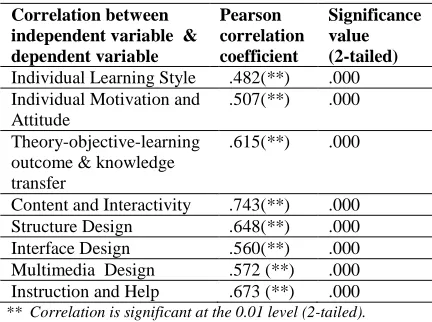
Pearson Correlation coefficient for the above evaluation criteria (see Table 3) were above 0.5 except for the Learners’ Learning Style which has Pearson Correlation coefficient of 0.482. Results of correlation showed that there were high correlation between evaluation criteria (independent variables) namely Learners’ Motivation & Attitude, Learners’ Learning Style, objective-learning Theory outcome & knowledge transfer, Content & Interactivity, Structure Design, Multimedia Design, Instruction and Help, and Learner-Instructor Response & Interaction with e-learning effectiveness (dependent variables). Besides that, there was moderate correlation between Learners’ Learning Style with e-learning effectiveness. Furthermore, signicant value for all independent variables were 0.000 which was smaller than p-value at significance level of 0.01 (two-sided). This showed that there were significant relationship between all evaluation criteria (independent variables) and e-learning effectiveness (dependent variables).
Table 3 Correlation Analisis between independent variable and dependent variable
** Correlation is significant at the 0.01 level (2-tailed).
Results of regression analysis showed that only four of the nine evaluation criteria were the best predictor for e-learning effectiveness namely Content & Interactivity, Learner-Instructor Response & Interaction, Theory-objective-learning outcome & knowledge transfer and Multimedia Design. The R Square value for regression model
Characteristic EPSA e-Training
(n=350) (n=266)
No.of respondent
freq % freq %
E-learning usage Less than 1 year 1-3 years More than 3 years
299 41 10
85.4 11.7 2.9
210 43 14
78.7 16.1 5.2
509 84 23
Accessing e-learning Never
Few times a year Few times a month Few times a week Everyday
0 228 104 16
2
0 65.1 29.7 4.6 0.6
0 161
61 40 5
0 60.5 22.6 15.0 1.9
0 389 164 56
7
Correlation between independent variable & dependent variable
Pearson correlation coefficient
Significance value (2-tailed)
Individual Learning Style .482(**) .000 Individual Motivation and
Attitude
.507(**) .000
Theory-objective-learning outcome & knowledge transfer
.615(**) .000
Content and Interactivity .743(**) .000
Structure Design .648(**) .000
Interface Design .560(**) .000
[image:6.612.314.530.477.638.2]which comprise of the four evaluation criteria was 61.6%. Thus 62% of e-learning effectiveness variance is explained by regression model which comprises of the above four evaluation criteria.
3.4 Public Sector e-learning effectiveness
Quantitative results from descriptive analysis showed that the percentage of e-learning effectiveness of EPSA and e-Training were 75%. Qualitative results from open-ended questions on questionnaire showed that the percentage of e-learning effectiveness of EPSA and e-Training were 80%. Qualitative results from observation analysis showed that the percentage of e-learning effectiveness of EPSA was 75% and e-Training was 90%. The qualitative results from evaluation criteria showed that the percentage of e-learning effectiveness of EPSA was 75% and e-Training was 100%.
An average percentage of e-learning effectiveness of EPSA and e-Training were calculated from the above analysis. As a result, the overall percentage of e-learning effectiveness of EPSA was 77% and e-Training was 87%.
3.5 Criteria which contributes to e-learning effectiveness
Quantitative results from hypothesis testing analysis showed that there were nine evaluation criteria which contributes to e-learning effectiveness namely Learners’ Motivation & Attitude (individual dimension), Learners’ Learning Style (individual dimension), Theory-objective-learning outcome & knowledge transfer (learning dimension), Content & Interactivity (content dimension), Structure Design (content dimension), Interface Design (content dimension), Multimedia Design (content dimension), Instruction and Help (content dimension), and Learner-Instructor Response & Interaction (content dimension). Qualitative results from the evaluation criteria analysis which integrates the findings from interview and observation also showed that majority of pedagogical/e-learning experts, subject matter experts, e-learning system developers, learner agree that all construct of the evaluation criteria for each dimension contributes to e-learning effectiveness.
3.6 Model for e-learning evaluation in the public sector
Result of quantitative data analysis showed that a model for evaluating e-learning effectiveness in the public sector from pedagogical perspectives comprise of nine criteria from four dimensions as listed below:
i. Individual dimension with two evaluation criteria namely Learners’ Motivation & Attitude, and Learners’ Learning Style, ii. Learning dimension with an evaluation
criteria of Theory-objective-learning outcome & knowledge transfer,
iii. Content dimension with five evaluation criteria namely Content & Interactivity, Structure Design, Interface Design, Multimedia Design, Instruction & Help, and
iv. Learner-Instructor dimension with an evaluation criteria of Response & Interaction.
Result of qualitative data analysis showed that a model for evaluating e-learning effectiveness in the public sector from pedagogical perspectives comprise of four dimensions and evaluation criteria as listed below:
i. Individual dimension with evaluation criteria namely motivation, attitude, previous knowledge and computer literacy,
ii. Learning dimension with evaluation criteria namely learning theory, learning objectives, learning outcome and transfer of knowledge,
iii. Content dimension with evaluation criteria namely interface design, structure design, instruction and help, interactivity, gaining learners’ interest, up-to-date, complete, useful, relevant, accurate, meet requirement, multi media, rlated to work and presentation, and
iv. Interaction dimension with evaluation criteria namely roles, cooperation, support, interaction and face-to-face discussion.
Journal of Theoretical and Applied Information Technology 20th May 2013. Vol. 51 No.2
© 2005 - 2013 JATIT & LLS. All rights reserved.
ISSN: 1992-8645 www.jatit.org E-ISSN: 1817-3195
public sector from pedagogical perspectives can be developed. The model comprise of eleven criteria from four dimension as listed below:
i. Individual dimension with two evaluation criteria namely Learners’ Motivation & Attitude, and Learners’ Learning Style, ii. Learning dimension with an evaluation
criteria of Theory-objective-learning outcome & knowledge transfer,
iii. Content dimension with five evaluation criteria namely Content & Interactivity, Structure Design, Interface Design, Multimedia Design, Instruction & Help, and
iv. Interaction dimension with three evaluation criteria namely interaction Learner-Instructor, Learner-Learner, and Learner-Content.
4.
DISCUSSION4.1 Public sector e-learning effectiveness
Findings from the integration or triangulation of quantitative and qualitative data analysis showed that EPSA is moderately effective and e-Training is effective from the perspective of pedagogy. As a summary, e-learning in the public sector is found to be effective from pedagogical perspective.
4.2 Criteria which contributes to e-learning effectiveness
Findings from the integration or triangulation of quantitative and qualitative data analysis showed that there were eleven evaluation criteria from four dimensions which contribute to e-learning effectiveness namely Learners’ Motivation & Attitude, Learners’ Learning Style, Theory-objective-learning outcome & knowledge transfer, Content & Interactivity, Structure Design, Interface Design, Multimedia Design, Instruction & Help, Learner-Instructor, Learner-Learner, and Learner-Content. These findings were in line with the findings of [7], [28], [31], [33], [29] and interaction concept by [35], [36], [37] and [23].
4.3 Model for e-learning evaluation in the public sector
The proposed model for e-learning evaluation from pedagogical perspectives introduces the evaluation criteria from four dimensions namely
individual/learner, learning, content and interaction. These evaluation criteria were found to be empirically significant which contributes to e-learning effectiveness. Furthermore, all the pedagogy/e-learning experts, subject matter experts and e-learning systems developers agreed that all the criteria contributed to e-learning effectiveness. The dimensions of the evaluation criteria were based on the model introduced by [23], [36] and [37].
5.
CONCLUSIONE-learning evaluation is important and need to be given emphasis. This paper attempts to evaluate e-learning in the public sector of Malaysia from pedagogical perspectives. Evaluation is carried out to see whether e-learning meets the learning objectives and the learning outcomes , and whether learning occurs in e-learning.
This paper also attempts to identify the evaluation criteria which contributes to e-learning effectiveness. The identified criteria has significant relationship with e-learning effectiveness. Previous research on e-learning effectiveness from pedagogical perspectives is found to be less comprehensive because the identified evaluation criteria do not contain construct or variable for each criteria. This paper attempts to introduce construct or variables for each criteria which was synthesize from other e-learning evaluation models which is related to pedagogical perspectives. The identified construct or variable was empirically tested and agreed by pedagogy/e-learning experts, subject matter experts and e-learning systems developers. This is the strength of the research. This research also contribute to theoretical and practical contribution. The key theoretical contribution is the development of e-learning evaluation model. This model complements the works of [22] who introduces Pedagogy Model and [23] who introduces Pedagogy Framework of e-learning. The key practical contribution is to provide the top and middle management of the public sector with the appropriate instrument to evaluate e-learning such as questionnaire survey, interview schedule and observation checklist.
effectiveness construct can be compared to see whether learners’ knowledge level increased after using e-learning. Furthermore, it is also suggested that structured equation modelling technique be used to validate the propose model.
REFRENCES:
[1] Rossett, A. (2002). The ASTD E-learning
Handbook. New York: McGraw-Hill.
[2] Ali A. (2005). Issues & Challenges in Implementing E-learning in Malaysia. Internet
:http://asiapacific-odl.oum.edu.my/ODL/html/odl/resourcedb/Ed ocs
_CSearchResults.asp?EDOCCODE=C33N40 [10 Januari 2007].
[3] Asgarkhani M.(2004). The Need for a Strategic Foundation for Digital Learning and Knowledge Management Solutions. Electronic Journal on e-Learning. http://www.ejel.org/
[10 Januari 2007].
[4] Singh, H. & Chris R. (2001). A White Paper: Achieving Success with Blended Learning, ASTD State of the Industry Report, American Society for Training & Development.
http://www.centra.com/download/whitepapers/ blendedlearning.pdf [10 Januari 2007].
[5] Singh, H. (2003). Building Effective Blended
Learning Program.
http://www.bookstoread.com/framework/blend ed-learning.pdf [10 Januari 2007]
[6] Voos R. (2003). Blended Learning - What is it and where might it take us?
http://www.aln.org/publications/view/v2n1/pdf /v2n1.pdf [10 Januari 2007].
[7] Mungania, P & Hatcher, T. (2004). A Systematic, Flexible, and Multidimensional Model for Evaluating E-Learning Programs.
Performance Improvement. 43(7): 33-39.
[8] Feldhaus, C.R. (1999). An exploratory study: Differences in the online learning experiences as perceived by participants of different background. Ph.D thesis.University of Louisville.
[9] Bassi, L.J. & Buren, M.E. (1999). 1999 ASTD state-of the industry report. Alexandria, VA: The American Society Training & Development.
[10] Dichanz, H. & Ernst, A. (2002). elearning – conceptual, psychological and didactic consideration. In. Scheffer, U. & Hesse,
F.W.(pnyt.). eLearning Successful
Appplication of the Revolution in Learning.
Stuttgart.
[11] Littig, P. (2006). New media-supported learning today and tomorrow: recommendations for the next generation of education and training concepts supported by new learning media. Industrial and Commercial Training. 38(2): 86-92.
[12] Massy, J. (2002). Quality and eLearning in Europe. Laporan Tinjauan 2002.
[13] Rossett, A. & Schafer, L. (2003). What to do about e-dropout: what if its not the e-learning but the e-learner? Training & Development. 57(6): 40-48.
[14] Schreurs, J. (2006). Total Quality Management (TQM) framework for e-learning based on EFQM and Kirkpatrick models. iJET International Journal of Emerging Technologies in Learning. 1-6.
[15] Abas, Z.W. (2003). E-learning: potential and challenges. Kertas Kerja International
Symposium on e-Learning. Anjuran
Universiti Malaysia Sabah. Kota Kinabalu, October.
[16] Govindasamy, T. (2002). Successful Implementation of e-learning pedagogical consideration. Internet and Higher Education. 4: 287-299.
[17] Kopper, R & Tatterall, K. (2005). Preface to Learning Design: A Handbook on Modelling and Delivering Networked Education & Training. Journal of Interactive Media in Education. 18: 1-7.
[18] Mishra, S. & Sharma, R.C. (2007). E-Learning Best Practices and Lessons Learned: A Summary. In. Mishra, S. & Sharma, R.C.(pnyt.). Cases on Global E-Learning
Practices: Successes and Pitfalls. Hershey:
Information Science Publishing.
[19] Joy, E.H. (2000). Measuring Learning Effectiveness: A New Look at No Significant Difference Findings in The Literature. Journal of Asynchronous Learning Networks. 4(1): 33-39.
[20] Zhang, D., Zhao, J.L. & Nunamaker, J.F. (2004). Can E-Learning Replace Classroom Learning? Communications of The ACM. 47(5): 75-79.
[21] Goodyear, P. (1999). Pedagogical frameworks and action research in open and distance learning. European Journal of open, distance & e-learning. 1-13.
Journal of Theoretical and Applied Information Technology 20th May 2013. Vol. 51 No.2
© 2005 - 2013 JATIT & LLS. All rights reserved.
ISSN: 1992-8645 www.jatit.org E-ISSN: 1817-3195
[23] Dalsgaard, C. (2005). Pedagogical quality in e-learning, Designing e-learning from a learning theoretical approach. Elearning & Education Journal. 1: 1-18.
[24] Lazarsfeld, P.F. 1955. Evidence and Inference in Social Research. In. Lazarsfeld, P.F & Rosenberg, M. (Eds.). Language of Social Research, pp. 99-128. Free Press.
[25] Horton, W. 2001. Evaluating E-learning. Alexandria: American Society for Training & Development.
[26] Chua, J. (2002). Quality Criteria for E-Learning Courseware.
http://www.ecc.org.sg/cocoon/ecc/website/qual itycriteria.pdf [3 Mac 2007].
[27] Reeves, T. C., Benson, L., Elliott, D., Grant, M., Holschuh, D., Kim, B., Kim, H., Lauber, E., and Loh, S. 2002. Usability and Instructional Design Heuristics for E Learning Evaluation. Proceedings of World Conference
on Educational Multimedia, Hypermedia and
Telecommunications, pp. 1615-1621.
[28] Zaharias, P. 2004. A Usability Evaluation Method for E-Learning Courses. Tesis Ph.D. Department of Management Science & Technology, Athens University of Economics and Business.
[29] Lim, H., Lee, S-G & Nam, K. 2007. Validating E-learning factors affecting training effectiveness. International Journal of
Information Managements 27(1): 22-35.
[30] Gillis, L. 2000. Quality Standards for Evaluating Multimedia and Online Training:
Evluation Booklet.Toronto: McGraw-Hill
Ryerson.
[31] Siragusa, L. (2005). Identification of effective instructional design principles and learning strategies for students studying in Web-based learning environments in higher education. Tesis Ph.D. Curtin University of Technology. [32] Vrasidas, C. 2004. Issues of Pedagogy and
Design in e-learning Systems. Kertas Kerja ACM Symposium on Applied Computing. Anjuran ACM, Nicosia, Cyprus, March 14-17. [33] Yildirim, Z. & Delialioglu, O. 2007. Students’
Perceptions on Effective Dimensions of Interactive Learning in a Blended Learning Environment. Educational Technology & Society 10(2): 133-146.
[34] Khan, B.H. (2005). Managing E-learning Strategies: Design, Delivery, Implementation
and Evaluation. Hershey: Information Science
Publishing.
[35] Moore, M. G. 1989. Three types of interaction. The American Journal of Distance Education. 3(2): 1-6.
[36] Ally, M. 2004. Foundations of Educational Theory for Online Learning. In. Anderson, T. & Elloumi, F. (Eds.). Theory and Practice of Online Learning, pp. 3-31. Athabasca: Athabasca University.
[37] Anderson, T. 2004. Toward a Theory of Online Learning. In. Anderson, T. & Elloumi,
F. (Eds.). Theory and Practice of Online
Learning, pp. 33-60. Athabasca: Athabasca