http://www.scirp.org/journal/me ISSN Online: 2152-7261
ISSN Print: 2152-7245
Population Age Structure, Urbanization and
Real Exchange Rate: An Empirical Study Based
on G20’s Panel Data
Jiaxing Lv
Regional Economics, Jinan University, Guangzhou, China
Abstract
This paper examines the internal transmission mechanisms of population age structure and urbanization to real exchange rate based on G20’s panel data over 1993-2016 periods. “Balassa-Samuelson effect” and “Factor endowment effect” are main channels that population age structure affect U.S dollar real exchange rate, and “demand structure effect” is not significant. The improve-ment of urbanization rate has significant positive effect on U.S dollar real ex-change rate through “Balassa-Samuelson effect” and “Factor endowment ef-fect” has significant negative effect on U.S dollar real exchange rate through “demand structure effect”. On the basis of theoretical and empirical analysis, we put forward suggestions to suppress the negative effects of aging on prod-uctivity.
Keywords
Population Age Structure, Urbanization, Real Exchange Rate, The Transmission Mechanism
1. Introduction and Literature Review
For a long time, many scholars have been studying the theory of real exchange rate decision all over the word. Economist Kassel put forward the theory of pur-chasing power parity, and Keynes published the theory of interest rate parity. In recent decades, foreign scholars began to focus on productivity, current account, government consumption and demand structure in order to study formation mechanism of the real exchange rate in the perspective of the concrete economic variables. And the influence of population age structure and urbanization on the real exchange rate is a relatively new direction in the last ten years.
How to cite this paper: Lv, J.X. (2018) Population Age Structure, Urbanization and Real Exchange Rate: An Empirical Study Based on G20’s Panel Data. Modern Economy, 9, 302-317.
https://doi.org/10.4236/me.2018.92020
Received: January 18, 2018 Accepted: February 10, 2018 Published: February 13, 2018
Copyright © 2018 by author and Scientific Research Publishing Inc. This work is licensed under the Creative Commons Attribution International License (CC BY 4.0).
http://creativecommons.org/licenses/by/4.0/ Open Access
1.1. Population Age Structure and Real Exchange Rate
Cantor and Driskill [1] firstly build the link between the population age struc-ture and the real exchange rate theoretically. Through establishing the model of inter-temporal alternation of generations, they derived the transmission me-chanism that population age structure affects savings, and leads to real exchange rate fluctuations. Braude [2] was the first scholar to test the above hypothesis from an empirical perspective. On the basis of the two goods-two periods model, he analyzed the mechanism that population age structure affects the real ex-change rate by “demand structure effect”. The increase of the children and the elderly population will cause the growing demand for the non-traded goods such as education, health care, which leads the rise of non-trade commodity prices and the real exchange rate appreciation. He empirically demonstrated this hy-pothesis using panel data from 98 countries in 1970-1990, and this result was different in different countries. There is less study on the relationship between population age structure and the real exchange rate. Changjiang Yang and Bingchao Huangpu [3] firstly analyzed this problem from the perspective of supply through introducing the earliest “b-s effect” and “factor endowment ef-fect”. At the same time, Yang and others thought that the effect of supply side- transmission mechanism was obvious in many developing countries, such as China, and they empirically confirmed this hypothesis. Mengquan Xu [4] em-pirically tested panel data from 37 countries, and came to the conclusion that the rising of the older people proportion could lead to the real exchange rate depre-ciation, which was the opposite of what Braude concluded.
1.2. Urbanization and Real Exchange Rate
There is very little literature on the relationship between urbanization and real exchange rates. Xiqun Zhu [5] had pointed out, changing the urban-rural dual economic structure, and accelerating the urbanization and urban-rural integra-tion were beneficial to improve the level of residents’ consumpintegra-tion, especially the rural residents’ consumption level. Wenjie Guo [6] had conducted empirical research on the economic growth of the service sector since the reform and opening up, and found that industrialization directed the production factors to accumulate in the city, thus speeding up the process of urbanization, raising the residents’ per capita income, and stimulating the development services in the city at the same time. Zetian Wang, Yang Yao [7] studied “b-s effect” in the structural transformation of developing economies and found that the rise of the rural population inhibited transmission mechanism between “b-s effect” and the real exchange rate. They also demonstrated that urbanization can have an im-pact on the transmission path of real exchange rates, resulting in fluctuations in real exchange rates. Xueke Wang [8] made an empirical test of panel data of 91 economies in 1980-2008, and found that in economies which were in a state of economic restructuring, limitation of labor mobility inhibited the real exchange rate appreciation. Mengquan Xu [4] systematically discussed the impact of
banization on the real exchange rate at the first time. Based on 37 national panel data, he found that the transmission mechanism of urbanization on real ex-change rate was different in different regions. In Europe and other developed re-gions, urbanization mainly affected the real exchange rate through the “demand structure effect”; while in developing countries such as Asia, urbanization main-ly affected the real exchange rate through “b-s effect” and “factor endowment effect”.
The structure of this paper is as follows: the second part is the theoretical ba-sis, and this part recombines the transmission mechanism of population age structure and urbanization to real exchange rate. The third part is model con-struction, variable selection and data description. The fourth part is the empiri-cal result and analysis. The fifth part is the conclusion and the policy meaning.
2. Theoretical Basis
2.1. Transmission Mechanism of the Population Age Structure to
the Real Exchange Rate
According to theoretical analysis of Mr. Cantor and Driskill [1], this paper ar-gues that the population age structure mainly influences the real exchange rate through three transmission mechanisms: “b-s effect”, “factor endowment effect” and “demand structure effect”.
First, the “b-s effect”, Changjiang Yang and Bingchao Huangfu [3] firstly put the point that increase in the proportion of the working population would cause real exchange rate appreciation from the perspective of supply. The increase in the proportion of the working population will boost the productivity of the two sectors of the country, while productivity improvement of the tradable sector will be greater than that of the non-tradable sector. Since the non-tradable sector is a labor-intensive industry, the increase in the wages of tradable sectors will lead to higher wages in the non-tradable sector, resulting in a relative rise in non-tradable prices. At the same time, the relative increase of domestic produc-tivity will lead to the relative improvement of the overall level of domestic prices, causing real exchange rate appreciation. This is the process by which the popula-tion age structure influences the real exchange rate through the “b-s effect” transmission mechanism.
Second, the “factor endowment effect”. Changjiang Yang and Bingchao Hua-ngfu [3] pointed out that increase in labor population and productivity of trada-ble sectors would promote the rise of the capital stock. Namely, as the labour force increased, the capital stock of the tradable sector was also rising, and the capital intensity of the tradable sector would rose as well. The marginal output of labour in the tradable sector was higher than that of the non-tradable sector, which would lead to an increase in the relative price of non-tradable goods and an appreciation of the real exchange rate In the case of the price of tradable goods being internationalized.
Third, the “demand structure effect”, in general, the consumption of children
and the elderly are more preference to services in non-tradable sectors. The in-crease in the proportion of children in the population will inin-crease the demand for non-tradable products such as education, and the increase in the proportion of elderly people will increase the demand for non-tradable products such as health care and nursing. In other words, the increase in the proportion of child-ren and elderly people will lead to the rise of non-tradable demand, which will lead to the real exchange rate appreciation.
2.2. Transmission Mechanism of Urbanization to Real Exchange
Rate
We assume that an economy is divided into tradable and non-tradable sectors, and the element compensation of the capital and labor of tradable sector is con-stant, namely the scale pay is concon-stant, In order to show that the tradable sector is a capital-intensive industry, and the non-tradable sector is a labor-intensive industry, we adopts Hoffmaister and Rold’os [9] to set the production function:
1
,
T T T T N N N
Y =A L Kα −α Y =A Lβ (1)
In which, 0<α β, <1, respectively represent the flexibility of labor output in
the tradable and non-tradable sectors; Y A L KT, T, T, T respectively represent the
output, technological progress, investment in labour and capital of tradable sec-tors; YN,AN,LN respectively represent output, technological progress and
la-bour input of non-tradable sector.
Assuming that labour can flow freely between different sectors, wages must be equal between different sectors, and the wages of the tradable sector (WT) are equal to the wages of the non-tradable sectors (WN). According to the principle of production optimization, there must be WT =MPLT*PT, WN =MPLN*PN.
In which, MPLT, PT represent the marginal output and price level of the tradable sector; MPLN, PN represent the marginal output and price level of labor in the non-tradable sector. That is:
1 1 1
T T T T T N N N N
W =αP A Lα−K−α =W =βP A Lβ− (2)
We assume that consumers have the following utility functions:
(
)
1,
T N N T
U C C =C Cφ −φ (3)
In which, CT, CN respectively represent the consumption of tradeable and non-tradable goods; φ φ=
( )
u is the monotonic increment function of urbani-zation rate, representing the proportion of non-tradable goods in total con-sumption.According to the maximization of consumer utility and the optimal produc-tion principle of producers, and combining (2) and (3), we can obtain consum-ers’ demand function for non-tradable products:
N N N
C =W φ P (4)
Assuming that the market is always clear, the demand for non-tradable goods is always equal to supply. From (1), (2), (4), we can get
1 1
N N T T T T N
A Lβ =αP A Lα−K−αφ P (5)
In order to simplify the model, we use relative price (pp=PN PT ) of the
tradable sector and the non-tradable sector to represent the real exchange rate. PT is decided by the international market, and the increase in the price of non-tradable sector (PN) means rise of relative price, that is, the real exchange rate appreciation. We can take the logarithm of (5) and we can get:
1 1 1
lnpp lnPN lnPT ln lnAT lnAN lnLN ln ln
r
α α
α β φ
α α
− −
= − = + − − + +
(6)
In which, r represents the cost of capital, r
(
1)
A L KT T Tα α
α
−= − . We can take
the derivative of (6) with respect to the urbanization rate and get:
ln ln ln
lnpp 1 AT AN LN ln
u u u u u
φ β ∂ ∂ ∂ ∂ = − − +∂
∂ ∂ ∂ ∂ ∂ ∂ (7)
We observe the right side of the Equation (7) and find that we can analyze the transmission mechanism of urbanization to real exchange rate from three as-pects:
First, the “b-s effect”, reflected in the first part of the Equation (7). In general, we assume that urbanization increases productivity through scale effects, know-ledge spillover effects, and so on, and this utility has a greater impact on the tradable sector. With the increase of urbanization rate, the productivity of the tradable sector is greater than that of the non-tradable sector, that is
ln ln 0 N T A A u u ∂ ∂ > >
∂ ∂ . According to the connotation of “b-s effect”, the relative
improvement of the productivity of tradable sector will inevitably raise the rela-tive price of non-tradable goods, thus causing real exchange rate appreciation. This is the effect of urbanization process on the real exchange rate through the “b-s effect”.
Second, the “factor endowment effect”, reflected in the second part of the Eq-uation (7). The urbanization process increases labor intensity (L/K) through the transfer of rural labor force to the city. The increase in labour intensity reduces the marginal cost of labor, and promotes marginal output of capital in non-tradable sectors relative to the tradable sector, thus leading to the rise in relative prices of tradable goods and depreciation of real exchange rates. In fact, it is the opposite of the classic study of Baghwati [10] that the rise of labor inten-sity causes real exchange rate depreciation.
Third, the “demand structure effect”, reflected in the third part of the equa-tion (7). The promoequa-tion of urbanizaequa-tion causes real exchange rate appreciaequa-tion ( ln 0
u
φ ∂
>
∂ ). Urbanization can influence the real exchange rate by increasing the
consumption capacity of residents and change the consumption preference of rural transfer population. The increasing urbanization rate increases the demand of non-tradable goods for rural transfer population, such as catering, entertain-ment, education, health care products, and then drives the relative rise in
non-tradable prices, resulting in a real exchange rate appreciation.
3. Model Construction and Variable Description
The influence of population age structure and urbanization on real exchange rate is research objective of this paper. Firstly, we need to judge the influence of population age structure and urbanization on the real exchange rate. In general, urbanization will speed up the ageing of the population by reducing fertility. Therefore, we introduce the cross-term of population age structure and urbani-zation into the model to reflect the depth effect of both. Moreover, based on pre-vious research, we know that many economic variables in the economy, such as interest rates, government spending, and current projects, can also affect the real exchange rate. To reflect the mechanisms that affect the real exchange rate com-prehensively and objectively, we select two macroeconomic variables-relative government consumption expenditure and relative trade dependence between two countries, as control variables. Secondly, based on the above theoretical analysis, this article assumes that the population age structure and urbanization influence the real exchange rate mainly through “B-s effect”, “factor endowment effect”, “demand structure effect” three mechanisms, and three mechanisms are independent. The “b-s effect” emphasizes that Population age structure and ur-banization affect productivity, and then change the real exchange rate; The “fac-tor endowment effect” emphasizes that the population age structure and urba-nization change the intensity of the factors, thus reducing the marginal cost to influence the real exchange rate; The “demand structure effect” emphasizes that the population age structure and urbanization influence the real exchange rate through the change of consumption structure. According to the regression de-composition method proposed by Blanchard, we decomposed the three me-chanisms that affect the real exchange rate and judge the extent and direction of the three mechanisms.
3.1. The Comprehensive Impact of Population Age Structure and
Urbanization on Real Exchange Rate
According to analysis and screening, the overall regression model is shown be-low:
(
)
1 2 3 4 5
it it it it it it it it
Lrer =αold +α urban +α old ×urban +α gov +α ddt +ε (8)
In which, Lrerit represents the real exchange rate; oldit represents the
rela-tive aging rate; urbanit represents the relative urbanization rate; oldit×urbanit
represents the intersecting effect of aging population and urbanization; govit
represents relative government consumption expenditure; ddtit represents
rel-ative trade dependence.
3.2. Transmission Mechanism of the Population Age Structure to
the Real Exchange Rate
According to the theoretical derivation of Yang Changjiang and Huangfu
chao [3], the transmission mechanism of the influence of population age struc-ture on real exchange rate is four. However, in the actual economic operation, the “frequent project effect” is more affected by the import and export trade, and according to the research of Dan Ma [11], the transmission mechanism that the population age structure affect the real exchange rate through the “current project effect” is not significant. Therefore, this paper assumes that the popula-tion age structure influences the real exchange rate mainly through “b-s effect”, “factor endowment effect” and “demand structure effect”. Because of other tors other than the population age structure will also affect productivity and fac-tor endowments, when we introduce productivity and facfac-tor endowments into the model, we also need to random introduce disturbance into the model to ac-curately depict the transmission effect of population age structure through three mechanisms. Therefore, we make linear regression of the productivity and factor endowment to the population age structure firstly and get the residual items of the regression equation pro
it
µ and fac it
µ . Then we construct the following four models to identify and characterize different transmission mechanisms:
11 12 13 14 15
pro fac
it it it it it it it
Lrer =β old +β u +β u +β gov +β ddt +ε (9)
21 22 23 24 25
pro
it it it it it it it
Lrer =β old +β u +β fac +β gov +β ddt +ε (10)
31 32 33 34 35
fac
it it it it it it it
Lrer =β old +β pro +β u +β gov +β ddt +ε (11)
41 42 43 44 45
it it it it it it it
Lrer =β old +β pro +β fac +β gov +β ddt +ε (12)
In model (9)-(12), Lrerit represents the real exchange rate; oldit represents
the age structure of the population; proit represents productivity, to measure
the “b-s effect”; facit represents the concentration of capital elements, to
measure the “factor endowment effect”; govit and ddtit respectively represent
the control variables of relative government consumption ratio and relative trade dependence; fac
it
u represents the residuals of regression; εit represents
ran-dom perturbation term. Since pro
it
u and uitfac exclude the influence of population age structure, the coefficient of the population age structure in (9) represents the comprehensive effect of the three mechanisms on the real exchange rate; The coefficient of (10)
21
β represents the effect of population age institutions on the real exchange rate
through the “demand structure effect” and the “b-s effect” mechanism; the coef-ficient of (11) represents β31 the population age structure influences the real
exchange rate through the “demand structure effect” and the “factor endowment effect” mechanism; the coefficient of (12) β41 represents the population age
structure influences the real exchange rate through the “demand structure ef-fect” mechanism. In addition, we can identify the “b-s efef-fect” and “factor en-dowment effect” on the actual exchange rate by Wald test. The following is the same.
3.3. Transmission Mechanism of Urbanization to Real
Exchange Rate
According to the method in (2), we make regression of the productivity and
tor endowment to urbanization respectively, obtaining the residuals of the re-gression equation pro
it
v and fac it
v . Then, we construct the following four models to identify and characterize different transmission mechanisms.
11 12 13 14 15
pro fac
it it it it it it it
Lrer =γ urban +γ v +γ v +γ gov +γ ddt +ε (13)
21 22 23 24 25
pro
it it it it it it it
Lrer =γ urban +γ v +γ fac +γ gov +γ ddt +ε (14)
31 32 33 34 35
fac
it it it it it it it
Lrer =γ urban +γ pro +γ v +γ gov +γ ddt +ε (15)
41 42 43
44 45
it it it it
it it it
Lrer urban pro fac
gov ddt
γ γ γ
γ γ ε
= + +
+ + + (16)
In model (13)-(16), Lrerit represents the real exchange rate; urbanit
represents urbanization; proit represents productivity, measuring the “b-s
ef-fect”; facit represents the concentration of capital elements, measuring the
“factor endowment effect”; govit and ddtit respectively represent the control
variables of relative government consumption ratio and relative trade depen-dence; pro
it
v represents the residuals that we make regression of productivity to urbanization; fac
it
v represents the residuals that we make regression of capital intensity to urbanization; εit represents a random disturbance term.
3.4. Variables Description
This paper studies the influence of population age structure and urbanization on real exchange rate. We use the annual panel data of 19 G20 countries in 1993-2016. The US dollar is the world’s currency, and the world’s exchange rates are pegged to the US dollar, so we choose the US dollar as the base currency. We choose the United States as the benchmark, and the explanatory variable is the bilateral real exchange rate between other countries’ currencies and the dollar. The exchange rate is a bilateral variable that is influenced not only by the eco-nomic variables of the country but also by American ecoeco-nomic variables, so In order to overcome the shortcomings of the unilateral influence, the variables se-lected in this paper are the relative quantities after treatment. The actual ex- change rate calculation formula is i *
i i e p rer
p
= (direct quotation). In which, ei
is the nominal exchange rate of the i state against the dollar; *
p represents the price level of the United States (in the us CPI); pi represents the price level of
the country of i (in the CPI of i). The price index and real exchange rate of each country are based on 2005. In this paper, Lreri represents the logarithm of the
real exchange rate, and Lreri rise represents the actual depreciation.
The original data of each variable is derived from the WDI database of the world bank and the IFS database of international monetary fund. According to the requirements of modeling, we have carried out relevant treatment of relevant variables. Limited to space, this article is no longer showing the results of de-scriptive statistics for variables, and readers who are interested can take it from the author.
4. Empirical Analysis
4.1. Regression Function among Population Age
Structure, Urbanization and Real Exchange Rate
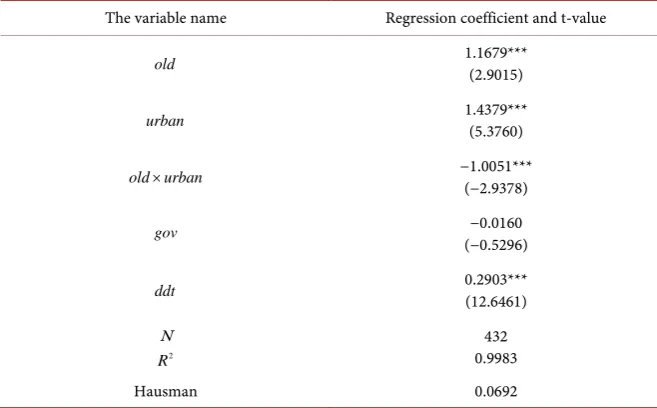
According to the Hausman test results, we adopt the fixed effect model to return the real exchange rate to the population aging and urbanization rate. The regres-sion results of the benchmark model are shown below.
[image:9.595.207.536.485.689.2]Table 1 shows that the coefficient of population age structure is 1.1679, and the coefficient is significant under 1% significance level. We can conclude that the population age structure has a significant effect on the real exchange rate, and with the increase of the ratio of the proportion of old people, the real change rate depreciates. The negative impact of population aging on real ex-change rate through “b-s effect” and “factor endowment effect” is greater than the positive influence of “demand structure effect”, which leads to the deprecia-tion of real exchange rate, and the final conclusion requires an in-depth analysis of different transmission mechanisms. The coefficient of the cross-effect of ur-banization and population aging (old×urban) is −1.0051, and the coefficient is significant at the level of 1%. The coefficient of urbanization is 1.4379, and the coefficient is significant at the level of 1%. The increase in urbanization leads to the depreciation of the real exchange rate, which is the opposite to the return result of the following (3). May be due to the interference of urbanization on the ageing population, the urbanization’s impact on the real exchange rate is re-flected on the cross effect of them. And the positive effect of “b-s effect” and “factor endowment effect” on the real exchange rate is offset by negative effect of population aging on the real exchange rate, which leading to a deviation in the coefficient of urbanization. In the following paper, we analyze the transmission
Table 1. Regression results of the benchmark model.
The variable name Regression coefficient and t-value
old 1.1679***
(2.9015)
urban 1.4379***
(5.3760)
old urban× −1.0051***
(−2.9378)
gov −0.0160
(−0.5296)
ddt 0.2903***
(12.6461) N
2
R
432 0.9983
Hausman 0.0692
Note: The statistical results are derived from the empirical analysis of stata software. The value of brackets in the table is standard error (t value); *, **, *** respectively represent the significance level of 1%, 5% and 10%. The following is the same.
mechanism of two factors separately and avoid the correlation between va-riables.
4.2. Regression Analysis of the Transmission Mechanism between
Real Exchange Rate and Population Age Structure
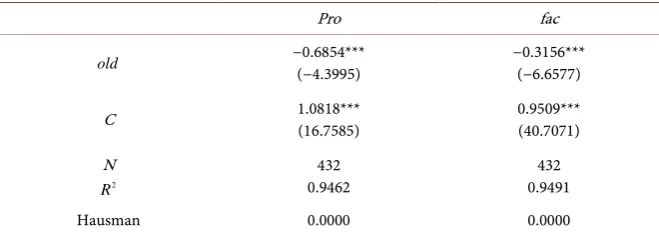
We firstly return the productivity and capital intensity respectively to the popu-lation age structure, and extract the residual term of the regression—the influ-ence of other factors(exclude the influinflu-ence of demographic age structure). The Hausman test results in Table 2 show that we both adopt fixed effect model to simulate the regression equation of productivity and capital intensity. From the results of the regression equation, we can get that the ageing population has a significantly influence on productivity and capital intensity, and the increase of the population old age inhibits the progress of productivity, reducing the inten-sity of capital elements, which is consistent with the hypothesis of this paper. Through the regression results of Table 2, we obtained residual items of produc-tivity and capital intensity— pro
u and fac
u .
We use the fixed effect panel data model to make a regression estimate of (9)-(12) after getting residual items of productivity and capital intensity— pro
u
and fac
u . In order to ensure the accuracy of the model, we deal with
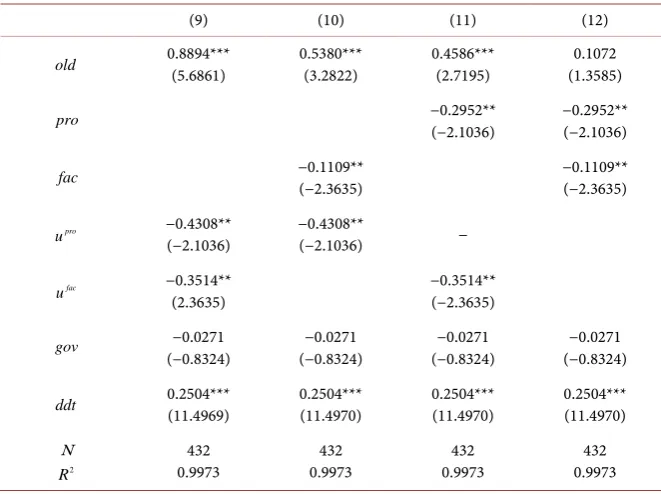
heterosce-dasticity, sequence correlation, cross-section heterosceheterosce-dasticity, etc., and the es-timation of the model is effective. The estimated results are shown in Table 3.
[image:10.595.208.538.593.710.2]As shown in Table 3, the coefficient of population age structure in the model (9) is 0.8894, and it is not zero at the significance level of 1%. We can get that the overall effect of population aging on the actual rate is negative, and with the ag-gravation of the aging population, the real exchange rate depreciates, which is contrary to the empirical conclusion of Braude [9]. The coefficient of population age structure in the model (12) is 0.1072, but the original hypothesis is accepted at the significance level of 10%, that is, the transmission mechanism of the pop-ulation aging through the “demand structure effect” to the real exchange rate is not significant. But considering the endogenous variable problem could lead to model estimation deviation, we need to further demonstrate the conclusion that population aging affects real exchange rates through the “demand structure ef-fect” not significantly. The coefficient of population age structure in the model
Table 2. Residual extraction of regression equation.
Pro fac
old −0.6854***
(−4.3995) −0.3156*** (−6.6577)
C 1.0818*** (16.7585) 0.9509*** (40.7071)
N
2
R
432
0.9462 0.9491 432
Hausman 0.0000 0.0000
Note: The statistical results are derived from the empirical analysis of stata software.
Table 3. Regression results of the transmission mechanism between the population age structure and the real exchange rate.
(9) (10) (11) (12)
old 0.8894***
(5.6861) 0.5380*** (3.2822) 0.4586*** (2.7195) (1.3585) 0.1072
pro −0.2952**
(−2.1036) −0.2952** (−2.1036)
fac −0.1109**
(−2.3635) −0.1109** (−2.3635)
pro
u −0.4308**
(−2.1036) −0.4308** (−2.1036) −
fac
u −0.3514** (2.3635) −0.3514** (−2.3635)
gov −0.0271
(−0.8324) (−0.8324) −0.0271 (−0.8324) −0.0271 (−0.8324) −0.0271
ddt 0.2504***
(11.4969) 0.2504*** (11.4970) 0.2504*** (11.4970) 0.2504*** (11.4970) N
2
R
432
0.9973 0.9973 432 0.9973 432 0.9973 432 Note: The statistical results are derived from the empirical analysis of stata software.
(10) is 0.5380, which is not zero at the significance level of 1%. That is, the effect of population aging on the real exchange rate is negative through “b-s effect” and “demand structure effect”. Comparing models (9) and (10), we can find that the coefficient of aging population has changed significantly. Combining Wald test, we can get that population aging through “factor endowment effect” has a significant impact on the real exchange rate, and this effect is negative effect, namely population aging leads to the real exchange rate depreciation. The coef-ficient of population age structure in model (11) is 0.4586, which is significant under 1% significance level, namely, population aging has a significant impact on the real exchange rate through “demand structure effect” and “factor en-dowment effect”. Comparing models (9) and (10), we can find that the coeffi-cient of aging population has changed significantly. Combining Wald test, we can get that population aging through “b-s effect” has a significant impact on the real exchange rate, and this effect is negative. The aging of the population re-duces the relative labor productivity of the tradable sector, making non-tradable prices relatively lower, the price level of the country fall, and the real exchange rate depreciate.
4.3. Regression Analysis of the Transmission Mechanism between
Urbanization and Real Exchange Rate
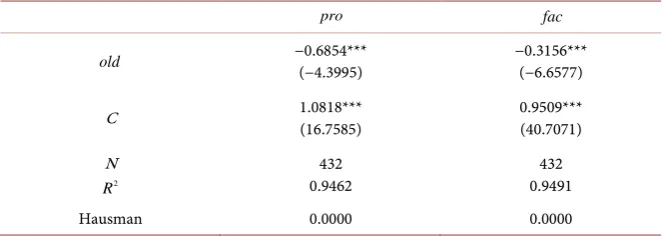
We firstly return the productivity and capital intensity respectively to the urba-nization, and extract the residual term of the regression—the influence of other factors (exclude the influence of urbanization). The Hausman test in Table 4
Table 4. Residual extraction of regression equation.
pro fac
old −0.6854***
(−4.3995) −0.3156*** (−6.6577)
C 1.0818*** (16.7585) 0.9509*** (40.7071)
N
2
R
432
0.9462 0.9491 432
Hausman 0.0000 0.0000
Note: The statistical results are derived from the empirical analysis of stata software.
shows that we should both adopt the stochastic effect model for the regression equation of productivity and capital intensity. According to the results of regres-sion equation, urbanization has a significant impact on productivity and capital intensity, and the increase of urbanization promotes the improvement of prod-uctivity. The increase of urbanization rate improves the intensity of capital ele-ments, which is contrary to the theoretical derivation of the foreword. It may be that the current urbanization promotes the economic growth and capital accu-mulation, and the capital accumulation is faster than the urbanization process. At the same time, the shift of rural population has also shifted agriculture from labor-intensive to capital-intensive. Through the regression results of Table 4, we get residual items of productivity and capital intensity— pro
v and vfac.
We use the fixed effect panel data model to make a regression estimate of (13)-(16) after getting residual items of productivity and capital intensity— pro
v
and fac
v , and the estimated results are shown in Table 5.
As shown in Table 5, the coefficient of urbanization in the model (13) is −7.4316 and is not zero at the significance level of 1%.The comprehensive effect of urbanization on the actual rate is positive, that is, with the increase of relative urbanization rate, the real exchange rate of the country appreciates. The coeffi-cient of urbanization rate in model (16) is 1.1371, but the original hypothesis is rejected at the significance level of 1%, that is, the transmission mechanism of urbanization through the “demand structure effect” is significant to the real ex-change rate. And this effect is negative, that is, the increase of urbanization rate reduces the real exchange rate, which is not consistent with the above assump-tion. May be in the context of economic globalization, international trade is more closely, the improvement of urbanization rate promoted the foreign im-ports and the demand for tradable goods, and the growth of tradable goods is greater than that of non-tradable goods, which leads to the negative effect of ur-banization on the real exchange rate through the “demand structure effect”. The coefficient of urbanization rate in the model (14) is −1.9056, which is signifi-cantly not zero at the significance level of 10%, that is, the effect of urbanization on the real exchange rate is positive through the “b-s effect” and the “demand structure effect”. Comparing model (13) and (14), the coefficient of the urbani-zation rate changes dramatically. According to Wald test results, urbaniurbani-zation
Table 5. Regression results of transmission mechanism between urbanization and real exchange rate.
(13) (14) (15) (16)
urban −7.4316***
(−3.8763) (−1.8139) −1.9056* −4.3888** (−2.3253) 1.1371*** (4.3431)
pro −0.3903***
(−3.4780) −0.3903*** (−3.4780)
fac −0.1593***
(−2.9110) −0.1593*** (−2.9110)
pro
v 3.0427***
(3.4780) 3.0427*** (3.4780) −
fac
v 5.5259*** (2.9110) 5.5259*** (2.9110)
gov −0.0299
(−0.9367) (−0.9367) −0.0299 (−0.9367) −0.0299 (−0.9367) −0.0299
ddt 0.2847***
(9.8008) 0.2847*** (9.8008) 0.2847*** (9.8008) 0.2847*** (9.8008) N
2
R
432
0.9983 0.9983 432 0.9983 432 0.9983 432 Note: The statistical results are derived from the empirical analysis of stata software.
has a significant effect on real exchange rate through “factor endowment effect”, and the effect is positive. The increase of urbanization leads to the appreciation of real exchange rate, which is contrary to the hypothesis of the previous article. The coefficient of the urbanization rate in Model (15) is 0.4586, which is signifi-cant under 5% significance level, namely, urbanization has a signifisignifi-cant impact on the real exchange rate through “factor endowment effect” and “demand structure effect”. Comparing models (13) and (15), the coefficient of urbaniza-tion has changed significantly. Combined with Wald test results, it can be seen that urbanization has a significant impact on the real exchange rate through the “b-s effect”, and the effect is positive, that is, the increase of urbanization leads to real exchange rate appreciation.
5. Conclusions
In this paper, we analyze the influence of population age structure and urbaniza-tion on the real exchange rate from the “Balassa-Samuelson effect” [12], “factor endowment effect” and “demand structure effect” transmission mechanism, and we adopt the fixed effect model to identify and analyze the transmission me-chanism of population age structure and urbanization, based on panel data from the G20 countries in 1993-2016. We can conclude that: at present, the popula-tion age structure mainly influences the real exchange rate through supply side mechanism, such as “b-s effect” and the “factor endowment effect”. The aging of the population increase, reduces the proportion of the workforce, and makes na-tional economy not promote the improvement of productivity through the
cialized production, knowledge spillover and economies of scale, thus hamper-ing the country’s relative productivity increase and leadhamper-ing to the country’s real exchange rate depreciation eventually. At the same time, the disappearance of demographic dividend and the slowdown in economic growth reduce the speed of capital accumulation, which leads to the relative rise in marginal output of labour in the non-tradable sector, the relative rise in the price of tradable goods, and real exchange rate depreciation eventually. However, the impact of popula-tion age structure on real exchange rate through “demand structure effect” is not significant. Maybe individual in the panel data includes China, India, South Africa, Brazil and other emerging economies, and these countries are still in the stage of development, with low per capita GDP, underdeveloped financial sys-tem and inadequate social security syssys-tem, so the transmission mechanism of “demand structure effect” to real exchange rate is not significant.
The effect of urbanization on the real exchange rate is significant through the “b-s effect”, “factor endowment effect” and “demand structure effect”. The ur-banization has a significant impact on the real exchange rate through “b-s ef-fect”, and this effect is positive. This indicates that with the increase of urbaniza-tion rate, the relative productivity of the country has been improved, resulting in the real exchange rate appreciation, which conforms to the theoretical expecta-tion of the b-s effect. However, the urbanizaexpecta-tion has a significant positive effect on the real exchange rate through the “factor endowment effect”, which is not in accordance with the theory expectation of “factor endowment effect”. The in-crease in urbanization rate improves the capital intensity and the marginal rela-tive output of labor in the tradable sector, which leads to the relarela-tive rise in the price of non-tradable goods and real exchange rate appreciation eventually. The G20 countries include fast developing economies such as China, India. The im-provement of urbanization rate improves the labor intensity in non-tradable sectors. On the other hand, the accumulation of capital from rapid economic growth offsets the increase in labor intensity in non-tradable sectors. Moreover, the increase in urbanization rate improves the capital intensity of tradable sector, leading to real exchange rate appreciation eventually. Urbanization has pro-duced a significant negative impact on the real exchange rate through the “de-mand structure effect”. That is, the increase of urbanization leads to the depreci-ation of the real exchange rate, which is not in accordance with the theoretical expectations. The G20 countries are the major open economies all over the word, and the big trading nations as well. That is, the trade between them is very frequent. In the context of economic globalization, it may not be practical that the increase in urbanization only improves the relative demand of non-tradable goods in our own country. Finally, standing in our own country (China) pers-pective, the population aging causes real exchange rate depreciation through “b-s effect”, however, this devaluation is at the expense of the relative productivity of the country, and is a sign of diminished economic competitiveness, which is clearly not desirable.
At present, the demographic dividend of China has gradually disappeared, and the pace of population aging has become an inevitable fact. Therefore, in order to curb the depreciation of the real exchange rate caused by the relative reduction of productivity, we must promote the improvement of productivity through other means. On the one hand, we need to speed up the transformation and upgrading of the manufacturing industry structure, and speed up the im-plementation innovation to drive the economic growth mode transformation; on the other hand, we must improve technology import, digestion, absorption and re-innovation ability through system innovation, break system and mechanism, and create a good external environment for enterprises. At the same time, we can promote productivity by speeding up urbanization. But to avoid the pro-found effect of urbanization on population aging, we should change people’s conception of fertility and delay the aging process of population. Moreover, with the improvement of economic development and social security system, the effect of population aging on the real exchange rate through the “demand structure ef-fect” will become more and more significant. Therefore, in order to suppress the effect, on the one hand, we can increase the supply of non-tradable goods by speeding up the transfer of the labor force to the non-tradable sector and break-ing down the barriers to entry of non-tradable sectors; on the other hand, in the process of promoting urbanization, we need to strengthen foreign trade, give full play to the comparative advantages of international trade, and guide the transfer of consumer preference to tradable goods.
References
[1] Cantor, R. and Driskill, R. (1999) Effects on the Real Exchange Rates of Demo-graphic and Fiscal-Policy Induced Changes in National Savings: Is the Conventional Academic Wisdom Always Right? Department of Economic of Loughborough Uni-versity Economic Research Paper.
[2] Braude, J. (2000) Age Structure and the Real Exchange Rate. Bank of Israel Discus-sion Paper Series, 10.
[3] Yang, C.J. and Huangpu, B.C. (2010) The Real Exchange Rate of RMB and Popula-tion Age Structure. Journal of Financial Research, 2, 52-67.
[4] Xu, M.Q. (2012) Research on the Impact of Urbanization and Population Structure on Real Exchange Rate. Doctoral Dissertation, Huazhong University of Science and Technology, Wuhan.
[5] Zhu, X.Q. and Zhao, K. (2013) The Urban-Rural Integration Development in the Accelerated Urbanization Period—Based on the Perspective of Expanding Con-sumer Demand. Journal of Suzhou University, 1, 54-59.
[6] Guo, W.J. (2006) Service Growth, Urbanization and Economic Development— Empirical Research on Data after China’s Reform and Opening up. Modern Eco-nomic Science, 5, 91-97.
[7] Tian, Z. and Wang, Y.Y. (2009) Structural Transformation and the Balassa Samuel-son Effect. The Journal of World Economy, 4, 38-49.
[8] Wang, X.K. (2013) The Relative Productivity of the Two Countries and the Balas-sa-Samuelson Effect—Based on an Empirical Test. The Journal of World Economy,
6, 18-35.
[9] Hoffmaister, A.W. and Roldós, J.E. (2001) The Sources of Macroeconomic Fluctua-tions in Developing Countries: Brazil and Korea. Journal of Macroeconomics, 23, 213-239. https://doi.org/10.1016/S0164-0704(01)00162-8
[10] Baghwati, J.N. (1984) Why Are Service Cheaper in the Poor Countries? The Eco-nomic Journal, 1984, 279-286.
[11] Balassa, B. (1964) The Purchasing Power Parity Doctrine: A Reappraisal. The Jour-nal of Political Economy, 6, 584-596. https://doi.org/10.1086/258965
[12] Ma, D. (2014) Identification of Mechanism between the Population Age Structure and Real Exchange Rate of RMB—Based on China’s Empirical Research on the World Panel Data. Journal of Financial Research, 5, 65-79.