A Personalized Markov Clustering and Deep Learning Approach for
Arabic Text Categorization
Vasu Jindal
University of Texas at Dallas Richardson, TX 75080 [email protected]
Abstract
Text categorization has become a key re-search field in the NLP community. How-ever, most works in this area are focused on Western languages ignoring other Semitic languages like Arabic. These lan-guages are of immense political and so-cial importance necessitating robust cate-gorization techniques. In this paper, we present a novel three-stage technique to efficiently classify Arabic documents into different categories based on the words they contain. We leverage the significance of root-words in Arabic and incorporate a combination of Markov clustering and Deep Belief Networks to classify Arabic words into separate groups (clusters). Our approach is tested on two public datasets giving a F-Measure of 91.02%.
1 Introduction
In the emerging era of big data technology, there has been a widespread increase in information ob-tained from text documents. Furthermore, with the rapid availability of machine-readable docu-ments, text classification techniques have gained tremendous interest during the recent years. Con-sequently, automatic categorization of numerous new documents to different categories has become critical for political, social and for news research purposes.
Text categorization techniques have been widely investigated by researchers around the world. However, most of the recent developments in this field are focused on popular Western guages, ignoring Semitic and Middle-Eastern lan-guages like Arabic, Hebrew, Urdu and Persian. As discussed further in related works in Section 2.1, most classification algorithms utilized English
and Chinese to validate their methods while works on Arabic are extremely rare. This is primarily due to significant dialect differences between these languages and their complex morphology. Ad-ditionally, the presence of various inflections in Arabic as opposed to English makes it difficult for the NLP community to validate techniques on the popular Middle Eastern languages. According to the US Department of Cultural Affairs, Arabic and Urdu are categorized as critical languages and United Nations heavily emphasizes on the social and political importance of these languages. Ara-bic is listed as one of the six official languages of the United Nations.
In this paper, we present a novel three stage approach to classify Arabic text documents into different categories combining Markov Cluster-ing, Fuzzy-C-means and Deep Learning. To the best of our knowledge, this is the first work that leverages the heavy influence of root-words in Arabic to extract features for both clustering and deep learning to perform classification of Ara-bic documents. First, we segment each document and extract root-word information. Then we per-form clustering with root-word based features us-ing Fuzzy-C-Means and Markov clusterus-ing. This allows us to separate documents into unsupervised groups (clusters). We then train a deep belief network (DBN) for each cluster using Restricted Boltzmann Machines. This personalization which is essentially training DBN for each cluster im-proves the classification accuracy and features ex-traction. Finally, we generate network graphs of these clusters which can be used for similarity re-latedness or summarization in future works. This is the first work to use a modified combination of Markov clustering and personalized deep learning to classify documents into different categories.
Ara-bic morphology. Section 3 focuses on methodol-ogy for Markov clustering and deep learning. Sec-tion 4 discusses our experimental results and fi-nally, Section 5 summarizes the paper and presents conclusions and future work.
2 Background
2.1 Related Works
As mentioned previously, even though numer-ous works in text categorization have been pro-posed for Western languages, works on categoriz-ing Semitic languages like Arabic are very rare in the NLP community.
Most previous works on Arabic text categoriza-tion treats documents as a bag-of-words where the text is represented as a vector of weighted fre-quencies for each of the distinct words or tokens. (Diederich et al. 2003; Sebastiani et al. 2002). We use a similar approach to extract features from documents based on root-word frequency. Early efforts to categorize Arabic documents were per-formed using Naive Bayes algorithm (El-Kourdi et al., 2004), maximum entropy (Sawaf et al., 2001) and support vector machines (Gharib et al., 2009). N-gram frequency statistics technique was used with Manhattan distance to categorize documents by Khreisat (Khreisat, 2006) El-Halees described a method based on association rules to classify Arabic documents (El-Halees, 2007). Hmeidi I. uses two machine learning methods for Arabic text categorization: K-Nearest Neighbor (KNN) and support vector machines (SVM) (Hmeidi et al., 2008). An approach for feature selection in Arabic text categorization was proposed using in-formation gain and Chi-square (Yang and Peder-sen, 1997). Abu-Errub A. proposed a new Arabic text classification algorithm using Tf-Idf and Chi square measurements (Abu-Errub, 2014). How-ever, all these methods were not very efficient for large datasets giving an accuracy of less than 70% and were unable to classify documents with dif-ferent diacritics. Diacritics are signs or accents whose pronunciation or presence in a word can re-sult in a different meaning.
Recently, a new technique using a combina-tion of kNN and Rocchio classifier for text cat-egorization was introduced (Mohammad et al., 2016). This approach specifically solves the Word Sense Disambiguation (WSD) problem in a su-pervised approach using lexical samples of five Arabic words. Although, this method achieved
higher accuracy than previous works, usage of only five Arabic words limits usage for larger datasets. Our proposed approach generates mul-tiple roots of each Arabic words addressing the is-sue of different diacritics in Arabic.
2.2 Arabic Morphology
Arabic belongs to the family of Semitic languages and has significant morphological, syntactical and semantical differences from other languages. It consists of 28 letters and can be extended to 90 by added shapes, marks, and vowels. Furthermore, Arabic is written from right to left and letters have different styles based on the position of its appear-ance in the word. The base words of Arabic inflect to express eight main features. Verbs inflect for aspect, mood, person and voice. Nouns and ad-jectives inflect for case and state. Verbs, nouns and adjectives inflect for both gender and num-ber. Arabic morphology consists from a bare root verb form that is trilateral, quadrilateral, or pental-iteral. The derivational morphology can be lexeme = Root + Pattern or inflection morphology (word = Lexeme + Features) where features are noun spe-cific, verb specific or single letter conjunctions. In contrast, in most European languages words are formed by concatenating morphemes. For exam-ple in German, ’Zeitgeit’(the spirit of the times) is simply ’Zeit’(time) + ’geist’(spirit) i.e the root and pattern are essentially interleaved.
”root-words” throughout this paper to represent the roots of an Arabic word.
[image:3.595.316.525.257.303.2]3 Methodology
Figure 1 presents an overview of our algorithm. In summary, our approach consists of a pre-processing stage, two stages of clustering and fi-nally a learning stage. In the pre-processing stage documents are tokenized and segmented into dif-ferent words and the Tf-Idf weighted root-word counts are extracted. Subsequently, we cluster the documents by a combination of Fuzzy C-means and Markov clustering in Step I and II. Finally, in Step III, we use deep learning models on each ob-tained cluster to personalize learning for each root word cluster. Personalization essentially means to train a separate deep belief network for each clus-ter. Each of these stages is discussed in subsequent sections.
3.1 Pre-Processing
In the pre-processing stage we first remove the punctuation marks, auxiliary verbs, pronouns, conjunctions etc. As we stated in section 2.2, it is very important for processing Arabic to properly use the semantic information provided by root-words (Kanaan et al., 2009). Therefore, repre-senting words presented in a document in the root pattern increases efficiency of classification. Root extraction or stemming for the Arabic dataset is performed using a letter weight and order scheme. For example, the root meaning ”write” has the form k-t-b. More words can be formed using vow-els and additional consonants in the root word. Some of the words that can be formed using k-t-b are kitab meaning ”book”, kutub meaning ”books”, katib meaning ”writer”, kuttab represent-ing ”writers”, kataba meanrepresent-ing ”he wrote”, yaktubu meaning ”he writes”, etc.
In our method we assign weights to letters of Arabic and subsequently rank them based on their frequency in the document. Root-words of the Arabic word are selected by recurring patterns with the maximum weight. Furthermore, we cal-culate the standard Tf-Idf frequency of each root word to use as features in clustering and deep learning. Tf-Idf (term frequency-inverse docu-ment frequency) is one of the widely used fea-ture selection techniques in information retrieval (Baeza-Yates et al., 1999). Tf measures the im-portance of a term in a given document while Idf
signifies the relative importance of a term in a col-lection of documents. In the next section, we will discuss the clustering step of our approach.
3.2 Estimation of Initial Number of Clusters
The words frequencies (Tf-Idf) and root-word fre-quencies are used from the pre-processing stage and grouped into clusters. Once the words are clustered, we consider each document and find which cluster of words it may belong. This is done by rank-matching based approach discussed later. The clustering step is described below.
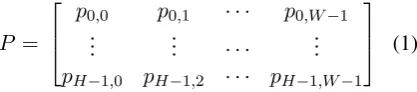
Consider each document to beP
P =
p0,0 p0,1 · · · p0,W−1
..
. ... · · · ...
pH−1,0 pH−1,2 · · · pH−1,W−1
(1)
where pi,0 indicate extracted words tokenized
from the documents. pi,j are the similar root-words ofpi,0.
We first estimate the initial number of cate-gories that may be present in a corpus of text doc-uments. The estimation of initial number of clus-ters is critical for text categorization as many Ara-bic documents may contain synonyms, different morphologies of Arabic and yet may have a close meaning. We perform estimation by computing the total number of modes found in all eigenvec-tors of the data. Modes in each eigenvector of the data are detected using kernel density estimation. Then, significance test of the gradient and second derivative of a kernel density estimation is com-puted. A similar approach was used for bioinfor-matics data (Pouyan et al., 2015). The number of modes is approximated using the number of times, the gradient changes from positive to negative for each projection of data on the eigenvectors.K rep-resents initial number of clusters approximated by summation of all the modes in eigenvectors.
3.3 Initial Clustering Using Fuzzy-C-Mean
Estimation of Number of Distinct
Root-words Estimation of Number of Distinct
Root-words
Modified Fuzzy
C-Means Clustering
Modified Fuzzy
C-Means Clustering
Modified Markov Clustering
Modified Markov Clustering
.
Step I Step II
Classification using Deep
Belief Networks Classification
using Deep Belief Networks TF-IDF of Arabic
Documents ميحرلا نمحرلا الله مسب 9
ابحرم 5
Network Graphs of Arabic words
[image:4.595.103.493.64.129.2]Step III
Figure 1: The general view of our proposed method
word. The clusters we obtain are intended to cor-respond to the different root-words in the docu-ment. Concisely,χ={α1, ..., αj, ..., αK}will be centers of K root-wordsC = {c1, ..., cj, ..., cK} which represents potential similarities of root-words. Words are assigned to different root word clusters by minimizing the following optimization model:
Jm= N
X
i=1 K
X
j=1
umijDm(xi, αj) (2)
where word xi belongs to root word cj with the membership probability ofuij. The fuzzification coefficient is selected asm = 2similar to set by James C. Bezdek. Dm(xi, αj)implies the
Maha-lanobis Distancebetween wordxi and root word
cj. Since membership probability depends on the dispersion of clustercj, we use Mahalanobis Dis-tance instead of Euclidean DisDis-tance as a disDis-tance metric betweenxi and population cj. The initial cluster setC will be available after applying the revised Fuzzy-C-Means and used in future steps.
3.4 Merging and Ranking Clusters Using Markov Clustering
Kernel density may result in duplicate clusters due to the similar diacritics or morphologies in Ara-bic. Furthermore, it is important to rank the clus-ters based on the similar root words. We use Markov clustering to address this issue, a fast, divisive and scalable clustering algorithm based on stochastic modelling of flow of networks (Van Dongen, 2001). Markov clustering (MCL) has re-cently emerged as a popular clustering technique for determining cluster networks. The algorithm computes the probability of random walks through a graph by applying two main methods: expansion and inflation. When MCL is applied on centers of initial clusters, the centers corresponding to ini-tial populations will be clustered in the same seg-ments. We extract the final categories of the text documents by merging these clusters. The
redun-dant clusters due to similar diacritics are merged in this stage.
Once the words are clustered, we consider each document and find the most similar cluster of words it may belong to using a rank-matching based approach. The ranking algorithm can be explain by considering a graph of the Arabic root words of interest. The frequency of a random walk visiting a particular root word in sufficiently large steps i.e. in a stationary distribution is the score of the root-word. Letaij represent the fraction of time root-wordj has higher rank over root-word i. Then weighted edges of graphAij = aija+ijaji. Recall that we denoted the document with matrix P in the previous step. Let pt(i) = P(Xt = i) denote the distribution of the random walk at time t. Then, the transition matrix can be formulated as:
pTt+1 =pTt ·P (3)
Iteratively, the random walk will converge to a unique stationary distribution and the score can be found using:
π(i) =X
j
π(j)·PAij+Aji
l(Ail+Ali)
(4)
We find the maximum match between the 40% most frequent words in the document and every cluster. Cluster of words consisting of the highest number of words from top 40% frequent words in the document is assigned to the document.
3.5 Deep Learning
di-h1
80 nodes 80 nodesh2 h3 40 nodes Input
Layer
Output Layer
Root Words
Classes of Classified
Root words
[image:5.595.73.290.69.180.2]Pre-trained hidden layers using RBM
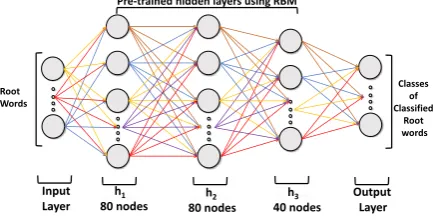
Figure 2: Deep Neural Network forC1
alects and diacritics. The classifiers get more fine-grained by training one classifier for every cluster. This personalization poses several advantages: the features learned using deep learning are per-sonalized for each root word. Consequently, the technique is robust against different dialects, scripts and way of writing. Secondly, personalized deep learning models extract features from diacrit-ics. As previously described in section 2.2, dia-critics makes Arabic word classification very chal-lenging. By extracting features from diacritics in the context of appeared root-words, our personal-ized deep learning approach efficiently solves this problem.
We separately train deep belief networks (DBN) on each cluster obtained from Stage II. For ex-ample the deep network contains one input layer, three hidden layers and one output layer for Clus-ter 1 with hidden layers consisting of 80, 80 and 40 nodes respectively. The input of these classi-fication models are words in each clusters. The activation function of hidden units is the sigmoid function which is traditionally used in nonlinear neural networks. Furthermore, higher number of parameters in neural networks generally makes pa-rameter estimation much more difficult. There-fore, it is inefficient to start training of deep neu-ral networks from random initial weight and bias values. We incorporate Restricted Boltzmann Ma-chines (RBM) to pre-train the network and find good initial weights for training deep belief net-works (Le Roux and Bengio, 2008).
Let Di be a DBN model for cluster Ci. The hidden layers of each Di are first trained as RBMs using unlabeled inputs. We use Contrastive Divergence-1 (CD-1) algorithm to obtain samples after 1-step Gibbs sampling (Hinton, 2002). CD-1 allows accurate estimation of gradient’s direc-tion and minimize reconstrucdirec-tion error. Due to this
pre-training, Di learns an identity function with same desired output as the original input. Further-more, it enhances the robustness ofDiby learning feature representations of the Arabic words before the final supervised learning stage.
Subsequently, the pre-trained DBN network is fine-tuned by vanilla back-propagation with la-beled segments as the input layer. Figure 2 gives the abstract structure of final resulting D1 after
tuning and is also used for identification for clus-terC1. If a new document is added for text
catego-rization then we find it’s nearest neighbor cluster and use the deep learning model specific to that cluster. Finally, we plot the network graphs of the extracted cluster words for visualization of the as-sociation of these words.
4 Experimental Results
We evaluate our three-stage technique using two popular datasets previously used in Arabic text categorization: 10,000 documents from Al-Jazeera news website (http://www.aljazeera.net) and 6,000 Saudi Press Agency (Al-Harbi et al., 2008) documents. The results are reported using 10-fold cross validation. Our proposed method achieves a precision of 91.2% and recall of 90.9% giving F-measure of 91.02%.
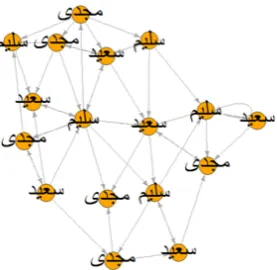
Clustering is performed on a set consisting of the total 12,000 documents, randomly sampled from separately from Al-Jazeera and Saudi Press Agency. We further ran deep learning on each of these clusters and extracted network graphs. Two example networks are presented in Figure 3 and 4. We compare our results with existing ap-proaches in Table 1. We can see that our tech-nique improves substantially on the previous pub-lished works. Furthermore, it is capable to catego-rize different diacritics by using clusters based on root-words. Most misclassified cases in our algo-rithm due to random outliers and/or mix categories in a document. An example of a random outlier are some recent words which are not influenced by root-words. This can be further improved by using a larger dataset and using new discrimina-tive features for clustering and deep learning.
5 Conclusion and Future Work
Table 1:Performance of our algorithm on Al-Jazeera Dataset
Technique Precision Recall Root-words based? Robust to Diacritcs?
Naive Bayes (El-Kourdi et al., 2004) 62.6% 57.4% No No
SVM (Hmeidi et al.,2008) 71.2% 66.7% No No
kNN (Mohammad AH et al., 2016) 83.0% 80.2% No No
Ours 91.2% 90.9% Yes Yes
[image:6.595.93.268.105.326.2]Figure 3: Network of a document’s words from Cluster 1
Figure 4: Network of a document’s words from Cluster 2
different diacritics and complex morphology of Semitic languages. Furthermore, this procedure can be extended to Persian and Semitic languages like Hebrew which heavily depend on root-words. Future work includes extracting more discrimina-tive features of root-words using deep learning and improving training of our models using larger datasets. We also plan to explore other Arabic morphologies like lemmas used in Arabic depen-dency parsing (Marton et al., 2003).
6 Acknowledgements
We acknowledge the support and guidance of Quality of Life Technology (QoLT) laboratory in the University of Texas at Dallas. We are thankful to Dr. Maziyar Baran Pouyan and Dr. Mehrdad Nourani for conceiving the original integration techniques for bioinformatics data using Gaussian Estimation and Fuzzy-c-means. We further like to thank University of Texas at Dallas and ACL Don and Betty Walker Scholarship program. We are specially thankful to Dr. Christoph Teichmann for his insightful comments as the mentor through ACL Student Mentorship Program.
7 References
Ahmed Abdelali. 2004. Localization in modern standard Arabic. Journal of the American Society for Information Science and technology, 55(1):23-28.
Aymen Abu-Errub. 2014. Arabic text classifi-cation algorithm using tf-idf and chi square mea-surements. International Journal of Computer Ap-plications, 93(6).
S Al-Harbi, A Almuhareb, A Al-Thubaity, MS Khorsheed, and A Al-Rajeh. 2008. Automatic Arabic text classification. Journes internationals, France, pp. 77–83.
Ricardo Baeza-Yates, Berthier Ribeiro-Neto, et al. 1999. Modern information retrieval, volume 463. ACM press New York.
Joachim Diederich, Jorg Kindermann, Edda Leopold,and Gerhard Paass. 2003. Authorship at-tribution with support vector machines. Applied intelligence, 19(1-2):109-123.
[image:6.595.113.252.406.541.2]Mohamed El Kourdi, Amine Bensaid, and Tajje-eddine Rachidi. 2004. Automatic arabic document categorization based on the Naive bayes algorithm. In Proceedings of the Workshop on Computational Approaches to Arabic Script-based Languages, pages 51-58. Association for Compu-tational Linguistics.
Tarek F Gharib, Mena B Habib, and Zaki T Fayed. 2009. Arabic text classification using support vector machines. International Journal of Computer Applications, 16(4):192-199.
Geoffrey E Hinton. 2002. Training products of experts by minimizing Contrastive Divergence. Neural computation, 14(8):1771-1800.
Ismail Hmeidi, Bilal Hawashin, and Eyas El-Qawasmeh. 2008. Performance of kNN and SVM classifiers on full word arabic articles. Advanced Engineering Informatics, 22(1):106–111.
Ghassan Kanaan, Riyad Al-Shalabi, Sameh Gh-wanmeh, and Hamda Al-Maadeed. 2009. A com-parison of text-classification techniques applied to arabic text. Journal of the American society for Information Science and Technology, 60(9):1836-1844.
Laila Khreisat. 2006. Arabic text classification using N-gram frequency statistics a comparative study. DMIN, 2006:78-82.
Nicolas Le Roux and Yoshua Bengio. 2008. Representational power of restricted boltzmann machines and deep belief networks. Neural com-putation, 20(6):1631-1649.
Yuval Marton, Nizar Habash, and Owen Ram-bow. 2013. Dependency parsing of modern stan-dard arabic with lexical and inflectional features. Computational Linguistics, 39(1):161-194.
Adel Hamdan Mohammad, Omar Al-Momani, and Tariq Alwadan. 2016. Arabic text catego-rization using k-nearest neighbour, decision trees (c4.5) and rocchio classifier: A comparative study.
M Baran Pouyan, V Jindal, J Birjandtalab, and M Nourani. 2015. A two-stage cluster-ing technique for automatic biaxial gatcluster-ing of flow cytometry data. In Proceedings of 2015 IEEE
International Conference on Bioinformatics and Biomedicine (BIBM), pages 511-516.
Hassan Sawaf, Jorg Zaplo, and Hermann Ney. 2001. Statistical classification methods for ara-bic news articles. Natural Language Processing in ACL’2001, Toulouse, France.
Fabrizio Sebastiani. 2002. Machine learning in automated text categorization. ACM computing surveys (CSUR), 34(1):1-47.
Stijn Marinus Van Dongen. 2001. Graph clus-tering by flow simulation.