Abstract— CAPTCHA (Completely Automated Public Turing Test to Tell Computers and Humans Apart) is a security mechanism designed to differentiate between humans from malicious bot program. Captcha's are the security checks which prevents spammers and hackers from getting the important data from the web pages through this malicious code or robotic software program. Text-based captcha's were most widely deployed across the web to secure against malicious bot programs. Numerous successful attacks on this single layer text-based attacks were deployed by Google, Microsoft, Yahoo, Amazon, and other Internet giants. These attacks on text-based captcha's achieved a success rate from 5% to 77 % in less than 10 seconds on a standard desktop computer (with 3.5 GHz Intel Core i5 CPU and 8 GB RAM). In 2015 Microsoft deployed a new two-layer Captcha scheme which was more difficult for bots to attack. But recent survey state that the two-layer Microsoft's Captcha can be attacked with an average speed of 9.05s on a standard desktop computer. In this paper, Microsoft two layer captcha is analysed studied and new multilayer captcha is being proposed which will make bots difficult to attack the Captcha and get the important data from web maliciously. The proposed Captcha will be composed multilayer text-based captcha combined with an image which can be solved using a checkbox. The proposed captcha can be solved by humans in less than two seconds but will be very difficult for bots to solve. The proposed captcha is also time- based which should be solved within 10 seconds which will make bots even more challenging to attack the captcha.
Index Terms— BOTS,
CAPTCHA, Image Captcha,
Microsoft two-layer Captcha, reCaptcha, Security, Text-based Captcha.I. INTRODUCTION
he Internet is becoming the town square for the global village of tomorrow
Bill Gates.
The internet has become the central information hub and a common meeting ground for all inhabitants from every corner of the world. The usage of the internet is growing exponentially day-to-day activities like online banking, online bill payment, online shopping, online Dr. Uma Pujeri is with Maharashtra Institute of Technology, Computer Engineering Department, Kothrud-, Pune, India. (mobile-7588839003; email: [email protected])
Pof Siddivinayak Kulkarni is with MIT World Peace University Kothrud, Pune, India. (mobile – 7720092181; email:
Dr. Ramachandra Pujeri is Director of MIT College of Engineering, Kothrud, Pune, India. (mobile 7028020515; email – [email protected])
train/bus/airplane tickets booking, important business transaction, and important bank transactions are done through internet. With these exponential growths of the internet, the web services attacks by the malicious automated program (bots) which silently steal important data from the web are also increasing. Hence there is a need to distinguish these bots and humans to protect private data. Captcha is a Turing test that distinguishes human from a computer. Captcha not only deals with security but also improves the performance of the internet. captcha should have the following three characteristics.
1.Human should easily solve captcha in a few seconds. 2.Captcha should be easily be generated by tester
machines
3.Captcha should be very difficult for bots to solve. The most used captcha are most secured one. The following are some captcha available in the market
reCaptcha [7] – This is the most popular captcha which was used by Google search engine. It is very simple captcha, it just asks the user to tick on the checkbox ‘I M NOT ROBOT' to confirm the user's presence and thus differentiate the user from the bot. Figure 1 shows reCAPTCHA
Figure 1 reCAPTCHA
Nucaptcha- The types of captcha keeps the track of human behaviour and identify the human from the bots.
Sweet Captcha and Play through – this captcha makes the user drag and drop the image and match the image with the captcha.
Biometric Security – This captcha runs with the fingerprint, eye scan, face-scan etc.
Text-based Captcha [4] – This type of captcha consisted of English alphabets, numerals and special characters and also uses sophisticated distortion rotation or noise interference to make it difficult for bots to pass the captcha. This captcha was most widely used.
Smart Captcha to Provide High Security against
Bots
Uma P, Member, IAENG, Siddivinayak K, Ramachandra P.
Figure 2 Text-based CAPTCHA [4]
Microsoft two layer captcha – Microsoft deployed the two-layer captcha in 2015. In this captcha all characters were connected to each other top-to-bottom, left-to-right which made it difficult for bots to identify each character and pass the captcha.
Figure 3 Microsoft two layer captcha
These captchas are mostly used for the security purpose and are widely used during
1. Form submission 2. Online Registration 3. Online Transaction
4. Online downloading of important materials from servers
5. Posting comments on social media Disadvantages of existing captcha.
Text-based captcha – Text-based captchas are usually based on English alphabets that use multiple fonts, different font size, sophisticated distortion, rotation, blurred letters and noise interference to prevents bots to recognize the text-based captcha, but sometimes it becomes even difficult for humans to crack the captcha. These text-based captchas can be easily identified by modern optical character recognition (OCR) algorithm. Current research states that there were 90% numerous successful attack of text-based captcha deployed by Google, Yahoo, and Amazon. Hence text-based captcha is not secured anymore.
Microsoft Two layer Captcha – In 2015 Microsoft deployed two layer captcha which connected the sides of each character across both top-to-bottom and right-to-left in order to detect the difficulty of detecting where each character is by the bots. Research states that even a two-layer Microsoft captcha can be attacked at the success rate of 44.6% with an average speed of 9.05 seconds on the standard desktop computer.
In this paper, several captchas are studies and analysed especially Text-based captcha and Microsoft two layer captcha. The paper also discusses how these captchas can be successfully cracked by bots. The paper also discusses our
proposed algorithm named Smart captcha which can be solved by the human is less than five seconds but will be difficult for the bots to pass. The proposed captcha will be text-based captcha combined with an image that can be mapped using a checkbox. The proposed captcha is also time-based which should be solved within 15 seconds which will make bots even more challenging to attack the captcha.
II. HISTORY OF CAPTCHA
A. M. Turing (1950) Computing Machinery and Intelligence [1] has done a survey on turning the machine to understand "Can Machine Think". In this Quarterly review article "MIND A QUARTERLY REVIEW OF PSYCHOLOGY AND PHILOSOPHY” author A. M Turing has written seven-session namely
1. The Imitation Game 2. Critique of New Problem
3. The Machine Concerned in the game 4. Digital Computers
5. Universality of Digital Computers 6. Contrary Views on the Main Questions 7. Learning Machines.
B. Moni Naor(September 1996) [2] A preliminary draft, Department of Applied Mathematics and Computer Science, Weizmann Institute of Science, wrote on "Turing Machine" In this article the author has proposed a Turing test which verifies that human is the one who is querying on web application and not the bot.
C. The most common Captchas were invented by groups of people working in parallel in 1997. The first group consisted of three Scientist Anderi Z. Border, Mark D. Lillibridge, Krishna Bharat, and Martin Abadi. The second group consisted of three scientist Gili Raanan, Eilon Solan and Eran Reshef. The two groups developed the initial version of Captcha which composed of letters, digits, distorted images etc.
D. In September 2000 Udi Manber of Yahoo [8] mentioned about the "chat room problem" to researchers at Carnegie Mellon University (CMU) where bots were joining the chat room and asking the user to click on the link of advertisement. A CMU professor Manuel Blum, Luis von A, John Langford developed GIMPY captcha which picked large English words randomly and displayed them as an image of the English words and asked the user to transcribe the words correctly.
test which humans can pass but computers were unable to solve the
F. In 2009 Google deployed new captcha technology named recaptcha[16] to prevent bots from accessing user’s private and privileged data.
G. In 2011 the Google used reCAPTCHA with CAPTCHA technology to digitize the archive of New York Times and Google Books[17][18].
H. In recent years Google used image-based captcha like identifying objects, Streets Marks, trees etc to improve its driverless car dataset.[18][19]
III. PROPOSEDSYSTEM
Our proposed captcha is a combination of characters, numbers, specials characters and different images. The character ranges is from "A, B, C, D, E, F, G, H, I, J, K, L, M, N, O, P, Q, S, T, U, V, W, X, Y, Z, a, b, c, d, e, f, g, h, i, j, k, l, m, n, o, p, q, r, s, t, u, v, w, x, y, z" and numbers ranges from "1, 2, 3, 4, 5, 6, 7, 8, 9," and special characters range from "@, #, $, &". These characters, numbers and special characters are selected randomly to generate a text-based captcha. A background is added to this captcha. Our system also has a database of more than 1000 images and these images are very common and can be easily recognized by a common man.
One of this image are selected from the database randomly and joined with the text-based captcha that is generated using random characters, numbers and special characters. Three checkboxes are generated and one among which composes of exact text for text-based captcha and text for the image. If the user ticks the right checkbox then the captcha is solved and if the user ticks on the wrong checkbox the error message is displayed "Wrong Captcha" and new captcha is reloaded. The proposed algorithm is times based, the user has to solve the captcha within 15 seconds else an error message is displayed "Time Out" and new captcha is reloaded. A. Algorithm for the proposed captcha
Step 1 – Initialize a character string to {‘A to Z’, ‘a to z’, ‘1 to 9’, ‘@’, ‘#’, ‘&’, ‘$’}
Step 2 – Set maximum length of text-based captcha to 5 Step 3 – Generate each character in the text-based captcha with different color
Step 4 – Add a background to the text-based captcha Step 5- Randomly choose any one image from the database
Step 6 – Combine it with text-based captcha and generate a new captcha named Smart Captcha which is a combination of text and image based captcha
Step 7 – Generate a three checkbox randomly which is composed of exact text for text-based captcha and text for the image.
Step 8 - Check whether the user ticks the right checkbox. If the user ticks the right checkbox then the captcha is solved and if the user ticks on the wrong checkbox the error message is displayed "Wrong Captcha" and new
captcha is reloaded.
Step 9 – Check whether the user solves the captcha within 15 seconds.
Step 10 if the user is unable to solve the captcha within 15-second display error message "Timeout" and reload B. Design Methodology
Our proposed algorithm is implemented using Java programing language as a front-end and My SQL server as a backend tool.
Why Java – One of the biggest reason that Java is popular and widely used programming language across the globe is that Java is a platform independent language and the program written in Java can run on different types machines. The Android application also uses Java. Since it is widely used and popular programming language in the world, many big and popular organization are built using Java. Many banks, schools, business, insurance companies, hospitals, retailers, manufacturers use Java because of its simplicity and security. Java is an evolving language which almost uniquely combines stability with innovation.
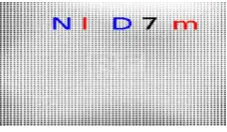
[image:3.595.375.489.401.467.2]Our proposed algorithm first generates the text-based captcha of three characters. Length of the text-based is kept only five because it can be solved at a faster rate. Following is the output for text-based captcha
Figure 4 – Text-based Captcha of our proposed algorithm Next, the algorithm selects any one image from the database randomly. In this case, the algorithm has selected the image of a fan.
Figure 5 – Random Image selected from the database
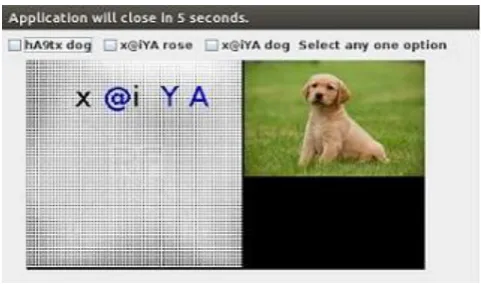
[image:3.595.372.490.679.767.2]Now algorithm combines this image and text-based captcha to form a Smart Captcha.
The final output of our proposed algorithm looks like this
Figure 7 Smart Captcha with a right ticked checkbox When the user ticks the wrong checkbox new captcha is reloaded displaying the error message as the wrong captcha.
IV. RESULTS
This captcha was tested with more than 1000 people and around 700 users gave positive feedback for the proposed captcha. Many users found it easy and were able to solve it in less than five seconds. Captcha was clear, understandable and easy to solve and hence many users rated it in between 100 to 90 points.
The feedback form was designed which composed of five points where first points ensure clarity of the captcha because nowadays there are many captchas which are complicated and unreadable for the humans too. The second point checks whether the user is understanding the captcha and can solve it. The third point checks the time required for the user to solve the captcha. Nowadays there are many captchas that are not solved even in 30 seconds and they simply go in infinite loop blocking our work. Fourth points in the feedback form check the likeliness of captcha by the user. The fifth point is designed to collect some additional information.
[image:4.595.56.297.83.225.2][image:4.595.54.302.567.699.2]
Figure 8 Feedback of Smart Captcha
Figure 8 illustrates the graph for feedback of smart captcha. The graph denotes that when tested more than 200 users rated it with 100 points and more than 450 users rated it within between 99 to 90 points. Around 150 users were neutral and around 100 users gave negative feedback for
this captcha
Figure 9 Comparison of different Captcha w.r.t. Time Figure 9 illustrates the graph of different captcha with respect to time. Smart captcha was solved by more than 500 people in less than five seconds. Similarly, Multilayer Captcha was solved by 500 people in less than 20 seconds, sweet captcha and play through was solved by 400 people is less than 20 seconds, biometric security captcha was solved by 500 people in less than 15 seconds and text-based captcha was solved by 500 people in less than 10 seconds.
V. CAPTCHATESTING
Captcha Testing – Our Smart captcha was tested on captcha solver tools like GSA captcha breaker,
Able2Extract Professional 12, and online OCR reader and convert it to text "www.newocr.com"
A. GSA captcha
GSA stands for German Software development and Analytics. This software will accept the captcha and solves any captcha. This software will accept user captcha and find the best algorithm to solve your captcha and display the text of your image captcha. Our captcha was tested with this software and following was the output of from this software.
Smart Captcha[owned by me] was tested in GSA
Captcha software
[https://www.gsa-online.de/product/captcha_breaker/] and figure 10 and 11 depicts the test results which was tested in October 2018.
[image:4.595.318.546.598.752.2]Figure 11 Output of Smart Captcha with 0 % success rate when tested in GSA CAPTCHA.
B. Able2 Extract Professional 12
This software converts any PDF, regardless of whether it is native or scanned, using the powerful OCR technology that is part of Able2Extract Professional. The latest version of the OCR engine has the ability to not only convert text but also certain types of images as well. Smart Captcha was tested in this software too and the output generated for captcha by Able2 Extract Professional 12 was scrabbled letter which were unable to read.
C. Online OCR reader
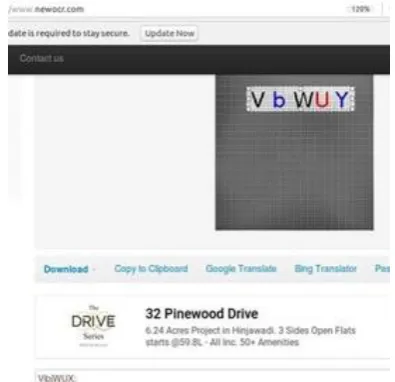
NewOCR.com is a free online OCR (Optical Character Recognition) service, can analyze the text in any image file that you upload and then convert the text from the image into text that you can easily edit on your computer. Our captcha was also tested with online OCR reader the text captcha up to three characters was easily deployed this online OCR reader but with the five characters, it never displayed any output. https://www.newocr.com/.
The software was able to detect text captcha for length in a few cases
Following output was generated for the text-based captcha by NewOCR API
Figure 12 Output of Online OCR Reader for VbWUY was VibjWUX.
VI. MATHEMATICAL PROOF TO PROVE DIFFICULT TO SOLVE Good Captcha is a Test T where most human have success rate probability as 1 and bots have a success rate for T which is nil or negligible.
Definition – A test T is said to be (α, β) human executable if at least α portion of the population has success greater than β over T.
Statement - Smart captcha are unsolvable by bots in time t.
Proof :
C1 ∈ {SC} SC is smart captcha, C1 is a text captcha C2 ∈ {SC} C2 is an image captcha
t1 is the time required to solve text captcha t2 is the time required to solve image captcha
t1 + t2 is the time required to solve smart captcha by bots t is the time required to solve the smart captcha within 15 seconds
On input x by bot run a captcha test T for C1 oIf captcha test passes that is T == x in time t1
then accept x and halt. Print success captcha solved in t1 seconds
oIf the captcha test does not passes that is T ≠ x in time t1 second then reject and load new captcha C1
On input x1 by bot run a captcha test T1 for C2 oIf captcha test passes that is T1 == x1 in time
t2 seconds then accept x1 and halt. Print success captcha solved in t2 seconds oIf the captcha test does not passes that is T1
≠ x1 in time t2 second then reject and load new captcha C2
Smart captcha are unsolvable
[image:5.595.53.251.562.753.2]text captcha and image captcha, the user should tick on right checkbox within 15 second which maps text for text-based captcha and text for image-based captcha. The proposed captcha was tested with 10000 users and it was more than 8000 user were able to solve the captcha in less than 15seconds.
Future Work
Text-based captcha can be made more complicated by using distortion, rotation and split algorithm which is still easy for a human to recognize in few second but difficult for bots or OCR algorithms to solve in a specified time. The image stored in the database has to be changed periodically because it should be difficult for the machine learning algorithm to learn about the image and map the correct text in the specified time. Images also can be displayed in a distorted form which can be recognized by human but difficult for bots to solve.
ACKNOWLEDGMENT
I wholeheartedly thank our Head of the Department, Computer Engineering, Maharashtra Institute of Technology, Kothrud, Pune, Prof Bharati Dixit for her support, guidance encouragement and motivation.
I thank Dr. Anil Hiwale, Principal MITCOE, Kothrud, Pune, for his support in carrying out this research.
REFERENCES
[1] Mind, Volume LIX, Issue 236, 1 October 1950, Pages 433–460, https://doi.org/10.1093/mind/LIX.236.433
[2] Moni Naor. Verification of a human in the loop or Identification via the Turing Test. Unpublished Manuscript,1997.Available electronically:
[3] Moni Naor, Verification of a human in the loop or Identification via the Turing Test, 1996
http://www.wisdom.weizmann.ac.il/~naor/PAPERS/human.pdf [4] By Luis von Ahn, Manuel Blum, John Langford
[5] Communications of the ACM, February 2004, Vol. 47 No. 2, Pages 56-60,
[6] Bursztein, Elie; Martin, Matthieu; Mitchell, John C. (2011). "Text-based CAPTCHA Strengths and Weaknesses". ACM Computer and Communication Security 2011 (ACM Conference CSS'2011). Stanford University. Available electronically:
[7] Elie Bursztein, Matthieu Martin, John C. Mitchell, "Text-based CAPTCHA Strengths and Weaknesses", ACM Computer and Communication security 2011
https://elie.net/static/files/text-based-captcha-strengths-and-weaknesses/text-based-captcha-strengths-and-weaknesses-paper.pdf [8] Von Ahn L., Blum M., Hopper N.J., Langford J. (2003) CAPTCHA:
Using Hard AI Problems for Security. In: Biham E. (eds) Advances in Cryptology — EUROCRYPT 2003. EUROCRYPT 2003. Lecture Notes in Computer Science, vol 2656. Springer, Berlin, Heidelberg Available electronically:
[9] Luis von Ahn, Manuel Blum1, Nicholas J. Hopper, and John Langford, "CAPTCHA: Using Hard AI Problems for Security" https://link.springer.com/content/pdf/10.1007%2F3-540-39200-9_18.pdf
[10] Luis von Ahn, Manuel Blum and John Langford. The Captcha Project homepage: http://www.captcha.net.
[11] Google, “Google ReCAPTCHA”, 2009, www.google.com/recaptcha/intro/index.html
[12] Marvin V. Zelkowitz.(2011) Advances In Computer, Academic Press, 07-Jun-2011, Volume 83.
[13] Palo Alto Research Center, “History of Captcha”, 2012, https://web.archive.org/web/20120205201803/http://www2.parc.com: 80/istl/projects/captcha/history.htm
[14] Allison L. Coates, Henry S. Baird, Richard J. Fateman. (2001) “Pessimal Print: A Reverse Turing Test “ In : Proceedings, IAPR 6th
International Conference on Document Analysis and Recognition , Seattle, WA, September 2001, pp. 1154–1158 Available electronically: http://www.cse.lehigh.edu/~baird/Pubs/icdar01.pdf [15] M. Merler, J. Jacob, Breaking an image-based CAPTCHA, COMS
6998, 2009. Available at
http://www.cs.columbia.edu/~mmerler/project/Final%20Report.pdf [16] Pope, C. & Kaur, K. (2005), "Is it human or computer? Defending
e-commerce with Captchas", IT Professional, vol. 7, no. 2, pp. 43-49. [17] Chow, R., Golle, P. Jakobsson, M., Wang .L.& Wang , X.(2208),
"Making CAPTCHAs clickable ", Conference HotMobile '08 Proceedings of the 9th workshop on Mobile computing systems and applications on. New York.2008, vol., no. pp.
[18] Shirali-shahreza, M. & Shirali-shahreza, S. (2007), "Question-Based CAPTCHA", Conference on Computational Intelligence and Multimedia Applications, 2007. International Conference on,Sivakasi, Tamil Nadu.2007, vol. 4, no. pp. 54-58.
[19] Elie Bursztein, Jonathan Aigrain, Angelika Moscicki, John C. Mitchell (2014) “The End is Nigh: Generic Solving of Text-based CAPTCHAs” Published at : WoOT (unisex workshop on offensive technology) Available at : https://elie.net/static/files/the-end-is-nigh- generic-solving-of-text-based-captchas/the-end-is-nigh-generic-solving-of-text-based-captchas-paper.pdf
[20] "Teaching computers to read: Google acquires reCAPTCHA". Google Official Blog.
[21] "Deciphering Old Texts, One Woozy, Curvy Word at a Time". The New York Times.
[22] CAPTCHA From Wikipedia https://en.wikipedia.org/wiki/CAPTCHA [23] "You are building a self -driving AI without even knowing about it".
Hacker Noon.
[24] Prof. Yogdhar Pandey, "Evaluating the Usability and Security of a Spelling Based Captcha System," International Journal of Computer Science and Information Technologies(IJCSIT), Vol. 5 (3), 2014, 4728-4731
![Figure 2 Text-based CAPTCHA [4]](https://thumb-us.123doks.com/thumbv2/123dok_us/394022.536947/2.595.77.260.61.189/figure-text-based-captcha.webp)