1468
Mem2Seq: Effectively Incorporating Knowledge Bases into End-to-End
Task-Oriented Dialog Systems
Andrea Madotto∗, Chien-Sheng Wu∗, Pascale Fung
Human Language Technology Center
Center for Artificial Intelligence Research (CAiRE) Department of Electronic and Computer Engineering
The Hong Kong University of Science and Technology, Clear Water Bay, Hong Kong
[eeandreamad,cwuak,pascale]@ust.hk
Abstract
End-to-end task-oriented dialog systems usually suffer from the challenge of in-corporating knowledge bases. In this pa-per, we propose a novel yet simple end-to-end differentiable model called memory-to-sequence (Mem2Seq) to address this is-sue. Mem2Seq is the first neural gen-erative model that combines the multi-hop attention over memories with the idea of pointer network. We empirically show how Mem2Seq controls each gener-ation step, and how its multi-hop attention mechanism helps in learning correlations between memories. In addition, our model is quite general without complicated task-specific designs. As a result, we show that Mem2Seq can be trained faster and attain the state-of-the-art performance on three different task-oriented dialog datasets.
1 Introduction
Task-oriented dialog systems help users to achieve specific goals with natural language such as restaurant reservation and schedule arrangement. Traditionally, they have been built with several pipelined modules: language understanding, dia-log management, knowledge query, and language generation (Williams and Young,2007;Hori et al., 2009;Lee et al.,2009;Levin et al.,2000;Young et al.,2013). Moreover, the ability to query exter-nal Knowledge Bases (KBs) is essential in task-oriented dialog systems, since the responses are guided not only by the dialog history but also by the query results (e.g. Table1). However, despite the stability of such pipelined systems via com-bining domain-specific knowledge and slot-filling
∗ ∗
These two authors contributed equally.
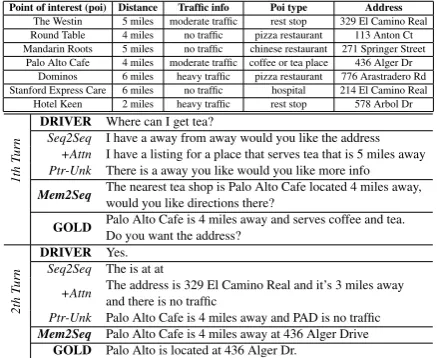
Point of interest (poi) Distance Traffic info Poi type Address The Westin 5 miles moderate traffic rest stop 329 El Camino Real Round Table 4 miles no traffic pizza restaurant 113 Anton Ct Mandarin Roots 5 miles no traffic chinese restaurant 271 Springer Street
Palo Alto Cafe 4 miles moderate traffic coffee or tea place 436 Alger Dr Dominos 6 miles heavy traffic pizza restaurant 776 Arastradero Rd Stanford Express Care 6 miles no traffic hospital 214 El Camino Real Hotel Keen 2 miles heavy traffic rest stop 578 Arbol Dr
1th
T
urn
DRIVER Where can I get tea?
Seq2Seq I have a away from away would you like the address +Attn I have a listing for a place that serves tea that is 5 miles away Ptr-Unk There is a away you like would you like more info
Mem2Seq The nearest tea shop is Palo Alto Cafe located 4 miles away, would you like directions there?
GOLD Palo Alto Cafe is 4 miles away and serves coffee and tea. Do you want the address?
2th
T
urn
DRIVER Yes. Seq2Seq The is at at
+Attn The address is 329 El Camino Real and it’s 3 miles away and there is no traffic
Ptr-Unk Palo Alto Cafe is 4 miles away and PAD is no traffic Mem2Seq Palo Alto Cafe is 4 miles away at 436 Alger Drive
[image:1.595.307.526.222.401.2]GOLD Palo Alto is located at 436 Alger Dr.
Table 1: Example of generated responses for the In-Car Assistant on the navigation domain.
techniques, modeling the dependencies between modules is complex and the KB interpretation re-quires human effort.
Recently, end-to-end approaches for dialog modeling, which use recurrent neural networks (RNN) encoder-decoder models, have shown promising results (Serban et al.,2016;Wen et al., 2017;Zhao et al., 2017). Since they can directly map plain text dialog history to the output re-sponses, and the dialog states are latent, there is no need for hand-crafted state labels. Moreover, attention-based copy mechanism (Gulcehre et al., 2016;Eric and Manning,2017) have been recently introduced to copy words directly from the input sources to the output responses. Using such mech-anism, even when unknown tokens appear in the dialog history, the models are still able to produce correct and relevant entities.
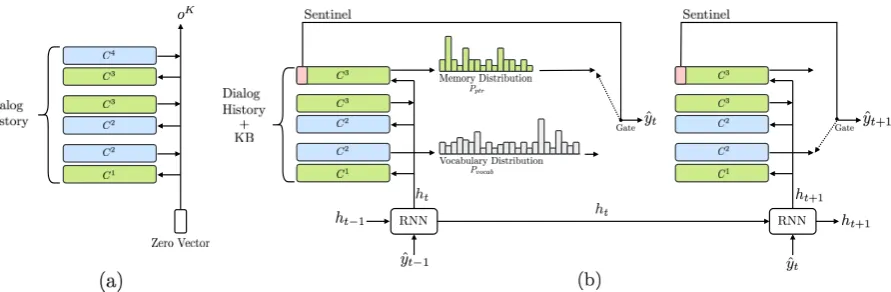
Figure 1: The proposed Mem2Seq architecture for task-oriented dialog systems. (a) Memory encoder with 3 hops; (b) Memory decoder over 2 step generation.
since RNNs are known to be unstable over long sequences. 2) Processing long sequences is very time-consuming, especially when using attention mechanisms.
On the other hand, end-to-end memory networks (MemNNs) are recurrent attention models over a possibly large external mem-ory (Sukhbaatar et al., 2015). They write exter-nal memories into several embedding matrices, and use query vectors to read memories repeat-edly. This approach can memorize external KB in-formation and rapidly encode long dialog history. Moreover, the multi-hop mechanism of MemNN has empirically shown to be essential in achiev-ing high performance on reasonachiev-ing tasks (Bordes and Weston, 2017). Nevertheless, MemNN sim-ply chooses its responses from a predefined candi-date pool rather than generating word-by-word. In addition, the memory queries need explicit design rather than being learned, and the copy mechanism is absent.
To address these problems, we present a novel architecture that we call Memory-to-Sequence (Mem2Seq) to learn task-oriented dialogs in an end-to-end manner. In short, our model augments the existing MemNN framework with a sequen-tial generative architecture, using global multi-hop attention mechanisms to copy words directly from dialog history or KBs. We summarize our main contributions as such: 1) Mem2Seq is the first model to combine multi-hop attention mech-anisms with the idea of pointer networks, which allows us to effectively incorporate KB informa-tion. 2) Mem2Seq learns how to generate dynamic queries to control the memory access. In addi-tion, we visualize and interpret the model dynam-ics among hops for both the memory controller
and the attention. 3) Mem2Seq can be trained faster and achieve state-of-the-art results in several task-oriented dialog datasets.
2 Model Description
Mem2Seq1is composed of two components: the MemNN encoder, and the memory decoder as shown in Figure 1. The MemNN encoder cre-ates a vector representation of the dialog history. Then the memory decoder reads and copies the memory to generate a response. We define all the words in the dialog history as a sequence of to-kens X = {x1, . . . , xn,$}, where $ is a special charter used as a sentinel, and the KB tuples as
B ={b1, . . . , bl}. We further defineU = [B;X] as the concatenation of the two setsXandB,Y =
{y1, . . . , ym}as the set of words in the expected system response, andP T R = {ptr1, . . . , ptrm} as the pointer index set:
ptri =
(
max(z) if∃zs.t.yi=uz
n+l+ 1 otherwise (1)
whereuz ∈U is the input sequence andn+l+ 1 is the sentinel position index.
2.1 Memory Encoder
Mem2Seq uses a standard MemNN with adjacent weighted tying (Sukhbaatar et al.,2015) as an en-coder. The input of the encoder is word-level in-formation in U. The memories of MemNN are represented by a set of trainable embedding matri-cesC = {C1, . . . , CK+1}, where eachCk maps tokens to vectors, and a query vectorqkis used as a reading head. The model loops overKhops and
1The code is available at https://github.com/
it computes the attention weights at hopkfor each memoryiusing:
pki =Softmax((qk)TCik), (2)
whereCik=Ck(xi)is the memory content in po-sition i, and Softmax(zi) = ezi/Σjezj. Here,pk is a soft memory selector that decides the mem-ory relevance with respect to the query vectorqk. Then, the model reads out the memoryok by the weighted sum overCk+12,
ok=X
i
pkiCik+1. (3)
Then, the query vector is updated for the next hop by using qk+1 = qk +ok. The result from the encoding step is the memory vectoroK, which will become the input for the decoding step.
2.2 Memory Decoder
The decoder uses RNN and MemNN. The MemNN is loaded with bothX andB, since we use both dialog history and KB information to generate a proper system response. A Gated Re-current Unit (GRU) (Chung et al.,2014), is used as a dynamic query generator for the MemNN. At each decoding stept, the GRU gets the previously generated word and the previous query as input, and it generates the new query vector. Formally:
ht=GRU(C1(ˆyt−1), ht−1); (4)
Then the queryhtis passed to the MemNN which will produce the token, where h0 is the encoder
vectoroK. At each time step, two distribution are generated: one over all the words in the vocabu-lary (Pvocab), and one over the memory contents (Pptr), which are the dialog history and KB inofr-mation. The first,Pvocab, is generated by concate-nating the first hop attention read out and the cur-rent query vector.
Pvocab( ˆyt) =Softmax(W1[ht;o1]) (5)
whereW1 is a trainable parameter. On the other
hand,Pptris generated using the attention weights at the last MemNN hop of the decoder: Pptr =
pKt . Our decoder generates tokens by pointing to the input words in the memory, which is a simi-lar mechanism to the attention used in pointer net-works (Vinyals et al.,2015).
2Here isCk+1since we use adjacent weighted tying.
We designed our architecture in this way be-cause we expect the attention weights in the first and the last hop to show a “looser” and “sharper” distribution, respectively. To elaborate, the first hop focuses more on retrieving mem-ory information and the last one tends to choose the exact token leveraging the pointer supervi-sion. Hence, during training all the parameters are jointly learned by minimizing the sum of two stan-dard cross-entropy losses: one betweenPvocab( ˆyt) and yt ∈ Y for the vocabulary distribution, and one between Pptr( ˆyt) and ptrt ∈ P T R for the memory distribution.
2.2.1 Sentinel
If the expected word is not appearing in the mem-ories, then thePptr is trained to produce the sen-tinel token$, as shown in Equation1. Once the sentinel is chosen, our model generates the token fromPvocab, otherwise, it takes the memory con-tent using thePptrdistribution. Basically, the sen-tinel token is used as a hard gate to control which distribution to use at each time step. A similar ap-proach has been used in (Merity et al., 2017) to control a soft gate in a language modeling task. With this method, the model does not need to learn a gating function separately as in Gulcehre et al. (2016), and is not constrained by a soft gate func-tion as inSee et al.(2017).
2.3 Memory Content
We store word-level content X in the memory module. Similar to Bordes and Weston(2017), we add temporal information and speaker information in each token ofXto capture the sequential depen-dencies. For example, “hellot1 $u” means “hello” at time step 1 spoken by a user.
Task 1 2 3 4 5 DSTC2 In-Car
Avg. User turns 4 6.5 6.4 3.5 12.9 6.7 2.6
Avg. Sys turns 6 9.5 9.9 3.5 18.4 9.3 2.6
Avg. KB results 0 0 24 7 23.7 39.5 66.1
Avg. Sys words 6.3 6.2 7.2 5.7 6.5 10.2 8.6
Max. Sys words 9 9 9 8 9 29 87
Pointer Ratio .23 .53 .46 .19 .60 .46 .42
Vocabulary 3747 1229 1601
Train dialogs 1000 1618 2425
Val dialogs 1000 500 302
[image:4.595.75.289.62.168.2]Test dialogs 1000 + 1000 OOV 1117 304
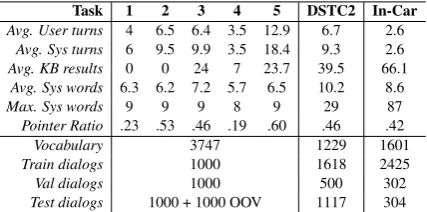
Table 2: Dataset statistics for 3 different datasets.
3 Experimental Setup
3.1 Dataset
We use three public multi-turn task-oriented log datasets to evaluate our model: the bAbI dia-log (Bordes and Weston,2017), DSTC2 ( Hender-son et al.,2014) and In-Car Assistant (Eric et al., 2017). The train/validation/test sets of these three datasets are split in advance by the providers. The dataset statistics are reported in Table2.
The bAbI dialog includes five end-to-end dia-log learning tasks in the restaurant domain, which are simulated dialog data. Task 1 to 4 are about API calls, refining API calls, recommending op-tions, and providing additional information, re-spectively. Task 5 is the union of tasks 1-4. There are two test sets for each task: one follows the same distribution as the training set and the other has out-of-vocabulary (OOV) entity values that does not exist in the training set.
We also used dialogs extracted from the Di-alog State Tracking Challenge 2 (DSTC2) with the refined version from Bordes and Weston (2017), which ignores the dialog state annotations. The main difference with bAbI dialog is that this dataset is extracted from real human-bot dialogs, which is noisier and harder since the bots made mistakes due to speech recognition errors or mis-interpretations.
Recently, In-Car Assistant dataset has been re-leased. which is a human-human, multi-domain dialog dataset collected from Amazon Mechan-ical Turk. It has three distinct domains: cal-endar scheduling, weather information retrieval, and point-of-interest navigation. This dataset has shorter conversation turns, but the user and system behaviors are more diverse. In addition, the sys-tem responses are variant and the KB information is much more complicated. Hence, this dataset re-quires stronger ability to interact with KBs, rather than dialog state tracking.
3.2 Training
We trained our model end-to-end using Adam op-timizer (Kingma and Ba, 2015), and chose learn-ing rate between [1e−3,1e−4]. The MemNNs, both encoder and decoder, have hopsK = 1,3,6
to show the performance difference. We use sim-ple greedy search and without any re-scoring tech-niques. The embedding size, which is also equiv-alent to the memory size and the RNN hidden size (i.e., including the baselines), has been selected between[64,512]. The dropout rate is set between
[0.1,0.4], and we also randomly mask some in-put words into unknown tokens to simulate OOV situation with the same dropout ratio. In all the datasets, we tuned the hyper-parameters with grid-search over the validation set, using as measure to the Per-response Accuracy for bAbI dialog and DSTC2, and BLEU score for the In-Car Assistant.
3.3 Evaluation Metrics
Per-response/dialog Accuracy: A generative
re-sponse is correct only if it is exactly the same as the gold response. A dialog is correct only if ev-ery generated responses of the dialog are correct, which can be considered as the task-completion rate. Note that Bordes and Weston (2017) tests their model by selecting the system response from predefined response candidates, that is, their sys-tem solves a multi-class classification task. Since Mem2Seq generates each token individually, eval-uating with this metric is much more challenging for our model.
BLEU: It is a measure commonly used for ma-chine translation systems (Papineni et al., 2002), but it has also been used in evaluating dialog sys-tems (Eric and Manning,2017;Zhao et al.,2017) and chat-bots (Ritter et al.,2011;Li et al.,2016). Moreover, BLEU score is a relevant measure in task-oriented dialog as there is not a large vari-ance between the generated answers, unlike open domain generation (Liu et al.,2016). Hence, we include BLEU score in our evaluation (i.e. using Mosesmulti-bleu.perlscript).
Entity F1: We micro-average over the entire set of
Assis-Task QRN MemNN GMemNN Seq2Seq Seq2Seq+Attn Ptr-Unk Mem2Seq H1 Mem2Seq H3 Mem2Seq H6
T1 99.4 (-) 99.9 (99.6) 100 (100) 100 (100) 100 (100) 100 (100) 100 (100) 100 (100) 100 (100)
T2 99.5 (-) 100 (100) 100 (100) 100 (100) 100 (100) 100 (100) 100 (100) 100 (100) 100 (100)
T3 74.8 (-) 74.9 (2.0) 74.9 (0) 74.8 (0) 74.8 (0) 85.1 (19.0) 87.0 (25.2) 94.5 (59.6) 94.7(62.1)
T4 57.2 (-) 59.5 (3.0) 57.2 (0) 57.2 (0) 57.2 (0) 100 (100) 97.6 (91.7) 100 (100) 100(100)
T5 99.6(-) 96.1 (49.4) 96.3 (52.5) 98.8 (81.5) 98.4 (87.3) 99.4 (91.5) 96.1 (45.3) 98.2 (72.9) 97.9 (69.6)
T1-OOV 83.1 (-) 72.3 (0) 82.4 (0) 79.9 (0) 81.7 (0) 92.5 (54.7) 93.4 (60.4) 91.3 (52.0) 94.0(62.2)
T2-OOV 78.9 (-) 78.9 (0) 78.9 (0) 78.9 (0) 78.9 (0) 83.2 (0) 81.7 (1.2) 84.7 (7.3) 86.5(12.4)
T3-OOV 75.2 (-) 74.4 (0) 75.3 (0) 74.3 (0) 75.3 (0) 82.9 (13.4) 86.6 (26.2) 93.2(53.3) 90.3 (38.7)
T4-OOV 56.9 (-) 57.6 (0) 57.0 (0) 57.0 (0) 57.0 (0) 100 (100) 97.3 (90.6) 100 (100) 100(100)
T5-OOV 67.8 (-) 65.5 (0) 66.7 (0) 67.4 (0) 65.7 (0) 73.6 (0) 67.6 (0) 78.1 (0.4) 84.5(2.3)
Table 3: Per-response and per-dialog (in the parentheses) accuracy on bAbI dialogs. Mem2Seq achieves the highest average per-response accuracy and has the least out-of-vocabulary performance drop.
Ent. F1 BLEU Per-Resp.
Per-Dial. Rule-Based - - 33.3
-QRN - - 43.8
-MemNN - - 41.1 0.0
GMemNN - - 47.4 1.4
Seq2Seq 69.7 55.0 46.4 1.5 +Attn 67.1 56.6 46.0 1.4
+Copy 71.6 55.4 47.3 1.3
Mem2Seq H1 72.9 53.7 41.7 0.0
Mem2Seq H3 75.3 55.3 45.0 0.5
Mem2Seq H6 72.8 53.6 42.8 0.7
Table 4: Evaluation on DSTC2.
Seq2Seq (+attn and +copy) is reported from Eric and Manning(2017).
BLEU Ent. F1 Sch. F1 Wea. F1 Nav. F1
Human* 13.5 60.7 64.3 61.6 55.2 Rule-Based* 6.6 43.8 61.3 39.5 40.4 KV Retrieval Net* 13.2 48.0 62.9 47.0 41.3 Seq2Seq 8.4 10.3 09.7 14.1 07.0 +Attn 9.3 19.9 23.4 25.6 10.8 Ptr-Unk 8.3 22.7 26.9 26.7 14.9
Mem2Seq H1 11.6 32.4 39.8 33.6 24.6
Mem2Seq H3 12.6 33.4 49.3 32.8 20.0
Mem2Seq H6 9.9 23.6 34.3 33.0 4.4
Table 5: Evaluation on In-Car Assistant. Human, rule-based and KV Retrieval Net evaluation (with *) are reported from (Eric et al.,2017), which are not directly comparable. Mem2Seq achieves highest BLEU and entity F1 score over baselines.
tant F1 scores reported in Eric et al. (2017) uses the entities in their canonicalized forms, which are not calculated based on real entity value. Since the datasets are not designed for slot-tracking, we report entity F1 rather than the slot-tracking accu-racy as in (Wen et al.,2017;Zhao et al.,2017).
4 Experimental Results
We mainly compare Mem2Seq with hop 1,3,6 with several existing models: query-reduction networks (QRN, Seo et al. (2017)), end-to-end memory networks (MemNN, Sukhbaatar et al.(2015)), and gated end-to-end memory net-works (GMemNN, Liu and Perez (2017)). We also implemented the following baseline models: standard sequence-to-sequence (Seq2Seq) models with and without attention (Luong et al., 2015), and pointer to unknown (Ptr-Unk, Gulcehre et al. (2016)). Note that the results we listed in Table3 and Table4for QRN are different from the origi-nal paper, because based on their released code,3 we discovered that the per-response accuracy was not correctly computed.
bAbI Dialog: In Table 3, we follow Bordes
3We simply modified the evaluation part and reported the results. (https://github.com/uwnlp/qrn)
DSTC2: In Table 4, the Seq2Seq models fromEric and Manning(2017) and the rule-based from Bordes and Weston (2017) are reported. Mem2Seq has the highest 75.3% entity F1 score and an high of 55.3 BLEU score. This further con-firms that Mem2Seq can perform well in retrieving the correct entity, using the multiple hop mecha-nism without losing language modeling. Here, we do not report the results using match type (Bordes and Weston,2017) or entity type (Eric and Man-ning, 2017) feature, since this meta-information are not commonly available and we want to have an evaluation on plain input output couples. One can also find out that, Mem2Seq comparable per-response accuracy (i.e. 2% margin) among other existing solution. Note that the per-response ac-curacy for every model is less than 50% since the dataset is quite noisy and it is hard to generate a response that is exactly the same as the gold one.
In-Car Assistant: In Table 5, our model can
achieve highest 12.6 BLEU score. In addition, Mem2Seq has shown promising results in terms of Entity F1 scores (33.4%), which are, in general, much higher than those of other baselines. Note that the numbers reported fromEric et al. (2017) are not directly comparable to ours as we mention below. The other baselines such as Seq2Seq or Ptr-Unk especially have worse performances in this dataset since it is very inefficient for RNN meth-ods to encode longer KB information, which is the advantage of Mem2Seq.
Furthermore, we observe an interesting phe-nomenon that humans can easily achieve a high entity F1 score with a low BLEU score. This im-plies that stronger reasoning ability over entities (hops) is crucial, but the results may not be similar to the golden answer. We believe humans can pro-duce good answers even with a low BLEU score, since there could be different ways to express the same concepts. Therefore, Mem2Seq shows the potential to successfully choose the correct enti-ties.
Note that the results of KV Retrieval Net base-line reported in Table5come from the original pa-per (Eric et al., 2017) of In-Car Assistant, where they simplified the task by mapping the expression of entities to a canonical form using named entity recognition (NER) and linking. Hence the eval-uation is not directly comparable to our system. For example, their model learned to generate re-sponses such as “You have a football game at
foot-70 T1 T4 124 T2
280 T3
403 T5
648 In-Car
1557 DSTC2
Maximum input lenght (# tokens)
0 5 10 15 20
Time
p
er
ep
o
ch
(minutes)
Mem2Seq H6
[image:6.595.310.523.64.210.2]Seq2Seq Seq2Seq+Attn Ptr-Unk
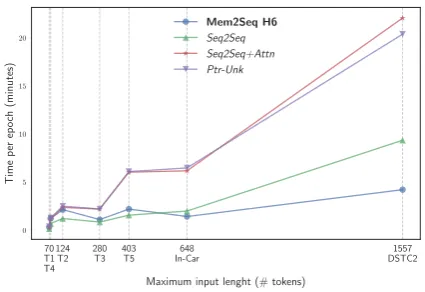
Figure 2: Training time per-epoch for different tasks (lower is better). The speed difference be-comes larger as the maximal input length in-creases.
ball time with football party,” instead of generat-ing a sentence such as “You have a football game at 7 pm with John.” Since there could be more than one football party or football time, their model does not learn how to access the KBs, but it rather learns the canonicalized language model.
Time Per-Epoch: We also compare the
train-ing time 4 in Figure2. The experiments are set with batch size 16, and we report each model with the hyper-parameter that can achieved the highest performance. One can observe that the training time is not that different for short in-put length (bAbI dialog tasks 1-4) and the gap becomes larger as the maximal input length in-creases. Mem2Seq is around 5 times faster in In-Car Assistant and DSTC2 compared to Seq2Seq with attention. This difference in training effi-ciency is mainly attributed to the fact that Seq2Seq models have input sequential dependencies which limit any parallelization. Moreover, it is unavoid-able for Seq2Seq models to encode KBs, instead Mem2Seq only encodes with dialog history.
5 Analysis and Discussion
Memory Attention: Analyzing the attention
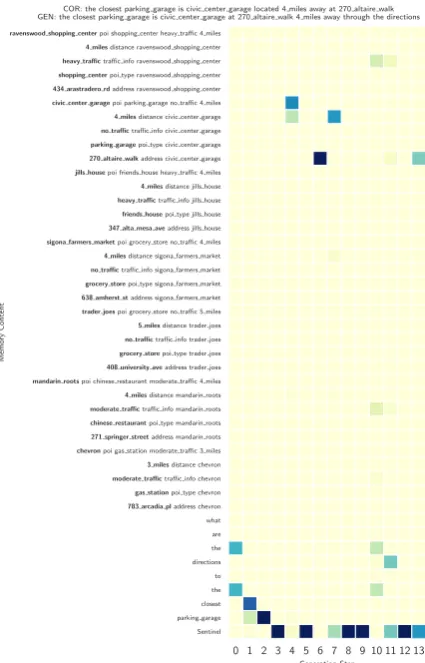
weights has been frequently used to show the memory read-out, since it is an intuitive way to un-derstand the model dynamics. Figure3shows the attention vector at the last hop for each generated token. Each column represents thePptr vector at the corresponding generation step. Our model has a sharp distribution over the memory, which
0 1 2 3 4 5 6 7 8 9 10 11 12 13
Generation Step Sentinel
parking garage closest the to directions the are what
783 arcadia pladdress chevron
gas stationpoi type chevron
moderate traffictraffic info chevron
3 milesdistance chevron
chevronpoi gas station moderate traffic 3 miles
271 springer streetaddress mandarin roots
chinese restaurantpoi type mandarin roots
moderate traffictraffic info mandarin roots
4 milesdistance mandarin roots
mandarin rootspoi chinese restaurant moderate traffic 4 miles
408 university aveaddress trader joes
grocery storepoi type trader joes
no traffictraffic info trader joes
5 milesdistance trader joes
trader joespoi grocery store no traffic 5 miles
638 amherst staddress sigona farmers market
grocery storepoi type sigona farmers market
no traffictraffic info sigona farmers market
4 milesdistance sigona farmers market
sigona farmers marketpoi grocery store no traffic 4 miles
347 alta mesa aveaddress jills house
friends housepoi type jills house
heavy traffictraffic info jills house
4 milesdistance jills house
jills housepoi friends house heavy traffic 4 miles
270 altaire walkaddress civic center garage
parking garagepoi type civic center garage
no traffictraffic info civic center garage
4 milesdistance civic center garage
civic center garagepoi parking garage no traffic 4 miles
434 arastradero rdaddress ravenswood shopping center
shopping centerpoi type ravenswood shopping center
heavy traffictraffic info ravenswood shopping center
4 milesdistance ravenswood shopping center
ravenswood shopping centerpoi shopping center heavy traffic 4 miles
Memo
ry
Content
COR: the closest parking garage is civic center garage located 4 miles away at 270 altaire walk GEN: the closest parking garage is civic center garage at 270 altaire walk 4 miles away through the directions
[image:7.595.306.526.61.235.2]0.0 0.2 0.4 0.6 0.8
Figure 3: Last hop memory attention visualization from the In-Car dataset. COR and GEN on the top are the correct response and our generated one.
plies that it is able to select the right token from the memory. For example, the KB information “270 altarie walk” was retrieved at the sixth step, which is an address for “civic center garage”. On the other hand, if the sentinel is triggered, then the generated word comes from vocabulary distribu-tionPvocab. For instance, the third generation step triggered the sentinel, and “is” is generated from the vocabulary as the word is not present in the dialog history.
Multiple Hops: Mem2Seq shows how multiple
hops improve the model performance in several datasets. Task 3 in the bAbI dialog dataset serves as an example, in which the systems need to rec-ommend restaurants to users based on restaurant ranking from highest to lowest. Users can reject the recommendation and the system has to rea-son over the next highest restaurant. We found out there are two common patterns between hops among different samples: 1) the first hop is usu-ally used to score all the relevant memories and
Figure 4: Principal component analysis of query vectors in hop (a) 1 and (b) 6 for bAbI dialog.
room time date party event
conference room 100 3pm Thursday sales team conference - 11am Tuesday - tennis activity - 7pm Wednesday - dentist appointment conference room 100 1pm Tuesday HR meeting
- 7pm Friday - doctor appointment - 11am Tuesday - lab appointment DRIVER When’s my tennis match?
Seq2seq Your lab appointment is on Monday at
+Att Your lab appointment is on Tuesday at 11am
Ptr-Unk Your tennis match is on PAD at 1pm
Mem2Seq H1 Your is very welcome
Mem2Seq H3 Your tennis is on Tuesday at 11am
Mem2Seq H6 Your tennis is Monday at 11am
[image:7.595.75.288.62.394.2]GOLD Your tennis match is Tuesday at 11am
Table 6: Example of generated responses for the In-Car Assistant on the scheduling domain.
retrieve information; 2) the last hop tends to focus on a specific token and makes mistakes when the attention is not sharp. Such mistakes can be at-tributed to lack of hops, for some samples. For more information, we report two figures in the supplementary material.
Query Vectors: In Figure 4, the principal
[image:7.595.307.525.284.430.2]Examples: Table1 and6show the generated re-sponses of different models in the two test set sam-ples from the In-Car Assistant dataset. We report examples from this dataset since their answers are more human-like and not as structured and repet-itive as others. Seq2Seq generally cannot pro-duce related information, and sometimes fail in language modeling. Instead, using attention helps with this issue, but it still rarely produces the cor-rect entities. For example, Seq2Seq with atten-tion generated 5 miles in Table 1 but the correct one is 4 miles. In addition, Ptr-Unk often cannot copy the correct token from the input, as shown by “PAD” in Table1. On the other hand, Mem2Seq is able to produce the correct responses in this two examples. In particular in the navigation domain, shown in Table1, Mem2Seq produces a different but still correct utterance. We report further ex-amples from all the domains in the supplementary material.
Discussions: Conventional task-oriented dialog
systems (Williams and Young, 2007), which are still widely used in commercial systems, require a multitude of human efforts in system designing and data collection. On the other hand, although end-to-end dialog systems are not perfect yet, they require much less human interference, especially in the dataset construction, as raw conversational text and KB information can be used directly with-out the need of heavy preprocessing (e.g. NER, dependency parsing). To this extent, Mem2Seq is a simple generative model that is able to in-corporate KB information with promising gener-alization ability. We also discovered that the en-tity F1 score may be a more comprehensive evalu-ation metric than per-response accuracy or BLEU score, as humans can normally choose the right entities but have very diversified responses. In-deed, we want to highlight that humans may have a low BLEU score despite their correctness because there may not be a large n-gram overlap between the given response and the expected one. How-ever, this does not imply that there is no correla-tion between BLEU score and human evaluacorrela-tion. In fact, unlike chat-bots and open domain dialogs where BLEU score does not correlate with hu-man evaluation (Liu et al.,2016), in task-oriented dialogs the answers are constrained to particular entities and recurrent patterns. Thus, we believe BLEU score still can be considered as a relevant measure. In future works, several methods could
be applied (e.g. Reinforcement Learning (Ranzato et al., 2016), Beam Search (Wiseman and Rush, 2016)) to improve both responses relevance and entity F1 score. However, we preferred to keep our model as simple as possible in order to show that it works well even without advanced training methods.
6 Related Works
End-to-end task-oriented dialog systems train a single model directly on text transcripts of di-alogs (Wen et al., 2017; Serban et al., 2016; Williams et al.,2017;Zhao et al.,2017;Seo et al., 2017;Serban et al., 2017). Here, RNNs play an important role due to their ability to create a la-tent representation, avoiding the need for artificial state labels. End-to-End Memory Networks ( Bor-des and Weston, 2017; Sukhbaatar et al., 2015), and its variants (Liu and Perez, 2017;Wu et al., 2017,2018) have also shown good results in such tasks. In each of these architectures, the output is produced by generating a sequence of tokens, or by selecting a set of predefined utterances.
multi-hop attention in combination with copy mecha-nism, whereas other models use a single matrix representation. 2) non-recurrent generative mod-els (Vaswani et al.,2017), which only rely on self-attention mechanism, are related to the multi-hop attention mechanism used in MemNN.
7 Conclusion
In this work, we present an end-to-end trainable Memory-to-Sequence model for task-oriented di-alog systems. Mem2Seq combines the multi-hop attention mechanism in end-to-end memory net-works with the idea of pointer netnet-works to incor-porate external information. We empirically show our model’s ability to produce relevant answers us-ing both the external KB information and the pre-defined vocabulary, and visualize how the multi-hop attention mechanisms help in learning corre-lations between memories. Mem2Seq is fast, gen-eral, and able to achieve state-of-the-art results in three different datasets.
Acknowledgments
This work is partially funded by ITS/319/16FP of Innovation Technology Commission, HKUST 16214415 & 16248016 of Hong Kong Re-search Grants Council, and RDC 1718050-0 of EMOS.AI.
References
Dzmitry Bahdanau, Kyunghyun Cho, and Yoshua Ben-gio. 2015. Neural machine translation by jointly learning to align and translate. International Con-ference on Learning Representations.
Antoine Bordes and Jason Weston. 2017. Learn-ing end-to-end goal-oriented dialog. Interna-tional Conference on Learning Representations, abs/1605.07683.
Junyoung Chung, Caglar Gulcehre, Kyunghyun Cho, and Yoshua Bengio. 2014. Empirical evaluation of gated recurrent neural networks on sequence mod-eling. NIPS Deep Learning and Representation Learning Workshop.
Mostafa Dehghani, Sascha Rothe, Enrique Alfonseca, and Pascal Fleury. 2017. Learning to attend, copy, and generate for session-based query suggestion. In Proceedings of the 2017 ACM on Conference on In-formation and Knowledge Management, CIKM ’17, pages 1747–1756, New York, NY, USA. ACM.
Mihail Eric, Lakshmi Krishnan, Francois Charette, and Christopher D. Manning. 2017. Key-value retrieval
networks for task-oriented dialogue. InProceedings of the 18th Annual SIGdial Meeting on Discourse and Dialogue, pages 37–49. Association for Com-putational Linguistics.
Mihail Eric and Christopher Manning. 2017. A copy-augmented sequence-to-sequence architecture gives good performance on task-oriented dialogue. In Proceedings of the 15th Conference of the European Chapter of the Association for Computational Lin-guistics: Volume 2, Short Papers, pages 468–473, Valencia, Spain. Association for Computational Lin-guistics.
Alex Graves, Greg Wayne, and Ivo Danihelka. 2014. Neural turing machines. CoRR.
Alex Graves, Greg Wayne, Malcolm Reynolds, Tim Harley, Ivo Danihelka, Agnieszka Grabska-Barwi´nska, Sergio G´omez Colmenarejo, Edward Grefenstette, Tiago Ramalho, John Agapiou, et al. 2016. Hybrid computing using a neural net-work with dynamic external memory. Nature, 538(7626):471–476.
Jiatao Gu, Zhengdong Lu, Hang Li, and Victor O.K. Li. 2016. Incorporating copying mechanism in sequence-to-sequence learning. In Proceedings of the 54th Annual Meeting of the Association for Com-putational Linguistics (Volume 1: Long Papers), pages 1631–1640, Berlin, Germany. Association for Computational Linguistics.
Caglar Gulcehre, Sungjin Ahn, Ramesh Nallapati, Bowen Zhou, and Yoshua Bengio. 2016. Pointing the unknown words. In Proceedings of the 54th Annual Meeting of the Association for Computa-tional Linguistics (Volume 1: Long Papers), pages 140–149, Berlin, Germany. Association for Compu-tational Linguistics.
Shizhu He, Cao Liu, Kang Liu, and Jun Zhao. 2017. Generating natural answers by incorporating copying and retrieving mechanisms in sequence-to-sequence learning. InProceedings of the 55th An-nual Meeting of the Association for Computational Linguistics (Volume 1: Long Papers), pages 199– 208, Vancouver, Canada. Association for Computa-tional Linguistics.
Matthew Henderson, Blaise Thomson, and Jason D Williams. 2014. The second dialog state tracking challenge. InProceedings of the 15th Annual Meet-ing of the Special Interest Group on Discourse and Dialogue (SIGDIAL), pages 263–272.
Chiori Hori, Kiyonori Ohtake, Teruhisa Misu, Hideki Kashioka, and Satoshi Nakamura. 2009. Statisti-cal dialog management applied to wfst-based di-alog systems. In IEEE International Conference on Acoustics, Speech and Signal Processing, 2009. ICASSP 2009., pages 4793–4796. IEEE.
International Conference on Learning Representa-tions.
Diederik P Kingma and Jimmy Ba. 2015. Adam: A method for stochastic optimization. International Conference on Learning Representations.
Cheongjae Lee, Sangkeun Jung, Seokhwan Kim, and Gary Geunbae Lee. 2009. Example-based dialog modeling for practical multi-domain dialog system. Speech Communication, 51(5):466–484.
Esther Levin, Roberto Pieraccini, and Wieland Eckert. 2000. A stochastic model of human-machine inter-action for learning dialog strategies. IEEE Transac-tions on speech and audio processing, 8(1):11–23.
Jiwei Li, Michel Galley, Chris Brockett, Jianfeng Gao, and Bill Dolan. 2016. A diversity-promoting ob-jective function for neural conversation models. In Proceedings of the 2016 Conference of the North American Chapter of the Association for Computa-tional Linguistics: Human Language Technologies, pages 110–119, San Diego, California. Association for Computational Linguistics.
Chia-Wei Liu, Ryan Lowe, Iulian Serban, Mike Nose-worthy, Laurent Charlin, and Joelle Pineau. 2016. How not to evaluate your dialogue system: An em-pirical study of unsupervised evaluation metrics for dialogue response generation. In Proceedings of the 2016 Conference on Empirical Methods in Natu-ral Language Processing, pages 2122–2132, Austin, Texas. Association for Computational Linguistics.
Fei Liu and Julien Perez. 2017. Gated end-to-end memory networks. InProceedings of the 15th Con-ference of the European Chapter of the Association for Computational Linguistics: Volume 1, Long Pa-pers, pages 1–10, Valencia, Spain. Association for Computational Linguistics.
Thang Luong, Hieu Pham, and Christopher D. Man-ning. 2015. Effective approaches to attention-based neural machine translation. InProceedings of the 2015 Conference on Empirical Methods in Natu-ral Language Processing, pages 1412–1421, Lis-bon, Portugal. Association for Computational Lin-guistics.
Stephen Merity, Caiming Xiong, James Bradbury, and Richard Socher. 2017. Pointer sentinel mixture models. International Conference on Learning Rep-resentations.
Alexander Miller, Adam Fisch, Jesse Dodge, Amir-Hossein Karimi, Antoine Bordes, and Jason We-ston. 2016. Key-value memory networks for directly reading documents. In Proceedings of the 2016 Conference on Empirical Methods in Natural Lan-guage Processing, pages 1400–1409, Austin, Texas. Association for Computational Linguistics.
Kishore Papineni, Salim Roukos, Todd Ward, and Wei-Jing Zhu. 2002. Bleu: a method for automatic eval-uation of machine translation. In Proceedings of
40th Annual Meeting of the Association for Com-putational Linguistics, pages 311–318, Philadelphia, Pennsylvania, USA. Association for Computational Linguistics.
Marc’Aurelio Ranzato, Sumit Chopra, Michael Auli, and Wojciech Zaremba. 2016. Sequence level train-ing with recurrent neural networks. International Conference on Learning Representations.
Alan Ritter, Colin Cherry, and William B. Dolan. 2011. Data-driven response generation in social media. In Proceedings of the 2011 Conference on Empirical Methods in Natural Language Processing, pages 583–593, Edinburgh, Scotland, UK. Association for Computational Linguistics.
Abigail See, Peter J. Liu, and Christopher D. Manning. 2017.Get to the point: Summarization with pointer-generator networks. InProceedings of the 55th An-nual Meeting of the Association for Computational Linguistics (Volume 1: Long Papers), pages 1073– 1083, Vancouver, Canada. Association for Compu-tational Linguistics.
Minjoon Seo, Sewon Min, Ali Farhadi, and Hannaneh Hajishirzi. 2017. Query-reduction networks for question answering. International Conference on Learning Representations.
Iulian Vlad Serban, Alessandro Sordoni, Yoshua Ben-gio, Aaron C Courville, and Joelle Pineau. 2016. Building end-to-end dialogue systems using gener-ative hierarchical neural network models. InAAAI, pages 3776–3784.
Iulian Vlad Serban, Alessandro Sordoni, Ryan Lowe, Laurent Charlin, Joelle Pineau, Aaron C Courville, and Yoshua Bengio. 2017. A hierarchical latent variable encoder-decoder model for generating di-alogues. InAAAI, pages 3295–3301.
Sainbayar Sukhbaatar, Jason Weston, Rob Fergus, et al. 2015. End-to-end memory networks. InAdvances in neural information processing systems, pages 2440–2448.
Ashish Vaswani, Noam Shazeer, Niki Parmar, Jakob Uszkoreit, Llion Jones, Aidan N Gomez, Łukasz Kaiser, and Illia Polosukhin. 2017. Attention is all you need. InAdvances in Neural Information Pro-cessing Systems, pages 6000–6010.
Oriol Vinyals, Meire Fortunato, and Navdeep Jaitly. 2015. Pointer networks. In C. Cortes, N. D. Lawrence, D. D. Lee, M. Sugiyama, and R. Garnett, editors,Advances in Neural Information Processing Systems 28, pages 2692–2700. Curran Associates, Inc.
Tsung-Hsien Wen, Milica Gasic, Nikola Mrksic, Lina Maria Rojas-Barahona, Pei hao Su, Stefan Ultes, David Vandyke, and Steve J. Young. 2017. A network-based end-to-end trainable task-oriented dialogue system. InEACL.
Jason D Williams, Kavosh Asadi, and Geoffrey Zweig. 2017. Hybrid code networks: practical and efficient end-to-end dialog control with supervised and rein-forcement learning. InProceedings of the 55th An-nual Meeting of the Association for Computational Linguistics (Volume 1: Long Papers), pages 665– 677, Vancouver, Canada. Association for Computa-tional Linguistics.
Jason D Williams and Steve Young. 2007. Partially observable markov decision processes for spoken dialog systems. Computer Speech & Language, 21(2):393–422.
Sam Wiseman and Alexander M. Rush. 2016. Sequence-to-sequence learning as beam-search opti-mization. InProceedings of the 2016 Conference on Empirical Methods in Natural Language Process-ing, pages 1296–1306, Austin, Texas. Association for Computational Linguistics.
Chien-Sheng Wu, Andrea Madotto, Genta Winata, and Pascale Fung. 2017. End-to-end recurrent entity net-work for entity-value independent goal-oriented di-alog learning. InDialog System Technology Chal-lenges Workshop, DSTC6.
Chien-Sheng Wu, Andrea Madotto, Genta Winata, and Pascale Fung. 2018. End-to-end dynamic query memory network for entity-value independent task-oriented dialog. In IEEE International Confer-ence on Acoustics, Speech and Signal Processing (ICASSP).
Steve Young, Milica Gaˇsi´c, Blaise Thomson, and Ja-son D Williams. 2013. Pomdp-based statistical spo-ken dialog systems: A review. Proceedings of the IEEE, 101(5):1160–1179.