
Hesitant probabilistic fuzzy linguistic
sets with applications in multi-criteria
group decision making problems
Joshi, Dheeraj K and Beg, Ismat and Kumar, Sanjay
Lahore School of Economics
5 September 2017
Online at
https://mpra.ub.uni-muenchen.de/95218/
Mathematics 2018, 6, 47; doi:10.3390/math6040047 www.mdpi.com/journal/mathematics
Article
Hesitant Probabilistic Fuzzy Linguistic Sets with
Applications in Multi-Criteria Group Decision
Making Problems
Dheeraj Kumar Joshi 1, Ismat Beg 2,* and Sanjay Kumar 1
1 Department of Mathematics, Statistics and Computer Science, G. B. Pant University of Agriculture and Technology, Pantnagar, Uttarakhand 263145, India; [email protected] (D.K.J.);
[email protected] (S.K.)
2 Centre for Mathematics and Statistical Sciences, Lahore School of Economics, Lahore 53200, Pakistan * Correspondence: [email protected]
Received: 3 February 2018; Accepted: 23 March 2018; Published: 26 March 2018
Abstract: Uncertainties due to randomness and fuzziness comprehensively exist in control and decision support systems. In the present study, we introduce notion of occurring probability of possible values into hesitant fuzzy linguistic element (HFLE) and define hesitant probabilistic fuzzy linguistic set (HPFLS) for ill structured and complex decision making problem. HPFLS provides a single framework where both stochastic and non-stochastic uncertainties can be efficiently handled along with hesitation. We have also proposed expected mean, variance, score and accuracy function and basic operations for HPFLS. Weighted and ordered weighted aggregation operators for HPFLS are also defined in the present study for its applications in multi-criteria group decision making (MCGDM) problems. We propose a MCGDM method with HPFL information which is illustrated by an example. A real case study is also taken in the present study to rank State Bank of India, InfoTech Enterprises, I.T.C., H.D.F.C. Bank, Tata Steel, Tata Motors and Bajaj Finance using real data. Proposed HPFLS-based MCGDM method is also compared with two HFL-based decision making methods.
Keywords: hesitant fuzzy set; hesitant probabilistic fuzzy linguistic set; score and accuracy function; multi-criteria group decision making; aggregation operator
1. Introduction
Uncertainties in decision making problems are due to either randomness or fuzziness, or by both and can be classified into stochastic and non-stochastic uncertainty [1]. Stochastic uncertainties in every system may be well captured by the probabilistic modeling [2,3]. Although several theories have been proposed in the literature to deal with non-stochastic uncertainties but among them fuzzy set theory [4,5] is extensively researched and successfully applied in decision making [6–10]. An extensive literature is due to Mardani et al. [11] on the various fuzzy aggregation operators proposed in last thirty years. Type-2 fuzzy sets [5], interval-valued fuzzy set (IVFS) [4], intuitionistic fuzzy sets (IFS) [12] and interval-valued intuitionistic fuzzy sets (IVIFS) [13], Pythagorean fuzzy set [14] and neutrosophic sets [15] are few other extensions of fuzzy sets practiced in MCGDM problems to include non-stochastic uncertainty and hesitation.
(HFS) and applied in MCGDM problems [18,19]. Various extensions of HFS e.g., triangular hesitant fuzzy set (THFS), generalized hesitant fuzzy set (GHFS), interval valued hesitant fuzzy set (IVHFS), dual hesitant fuzzy set (DHFS), interval valued intuitionistic hesitant fuzzy set (IVIHFS) and hesitant pythagorean fuzzy set were used in decision making problems [20–28] considering decision hesitancy and prioritization among decision criteria and developed a fuzzy group decision making method to evaluate complex emergency response in sustainable development. Recently, Garg and Arora [29] proposed distance and similarity measures-based MCDM method using dual hesitant fuzzy soft set.
Qualitative and quantitative analysis of decision criteria with hesitant and uncertain information has always been an important issue for researchers in MCGDM problems. Limited knowledge of decision makers (DMs), nature of considered alternatives and unpredictability of events are main constraints in getting sufficient and accurate information about the decision preferences and decision criteria. Many criteria which are difficult to be analyzed quantitatively can be analyzed using linguistic variables [5]. Linguistic variables improve consistency and flexibility of traditional decision making methods [30] and hence many researchers [31–45] have proposed use of linguistic variable in decision making problems. Kobina et al. [46] proposed few probabilistic linguistic aggregation operators for decision making problem. Garg and Kumar [47], Liu et al. [48] and Garg [49] proposed various aggregation operators, prioritized aggregation operators for linguistic IFS and linguistic neutrosophic set and applied them to MCGDM problems. Lin et al. [50] integrated linguistic sets with HFS to define hesitant fuzzy linguistic set (HFLS) to include hesitancy and inconsistencies among DMs in assessment of an alternative with respect to a certain criterion. Ren et al. [51] and Joshi & Kumar [52] proposed TOPSIS method MCGDM using hesitant fuzzy linguistic and IVIHFL information. Recently few researchers [53–55] have proposed generalized single-valued neutrosophic hesitant fuzzy prioritized aggregation operators and linguistic distribution-based decision making methods using hesitant fuzzy linguistic assessment for decision making methods.
Probabilistic and fuzzy approach-based MCGDM method process only either stochastic or non stochastic uncertainty. One of their major limitations is not to handle both types of uncertainties simultaneously. Comprehensive concurrence of stochastic and non stochastic uncertainty in real life problems attracted researchers to incorporate probability theory with fuzzy logic. Idea of integrating fuzzy set theory with probabilistic theory was initiated by Liang and Song [56] and Meghdadi and Akbarzadeh [1]. In 2005, Liu and Li [57] defined probabilistic fuzzy set (PFS) to handle both stochastic and non stochastic uncertainties in a single framework. To handle simultaneous occurrence of both stochastic and non stochastic uncertainties with hesitation, Xu and Zhou [58] introduced probabilistic hesitant fuzzy set (PHFS). PHFS permits more than one membership degree of an element with different probabilities. Recently many applications of PHFS are found in MCGDM problems [58–65].
Earlier in all HFL-based decision making methods, probabilities of occurrence of elements are assumed to be equal. Assumption of equal probabilities in HFL is too hard to be followed by DMs in real life problems of decision making due to their hesitation. For example, a decision maker provides hesitant fuzzy linguistic element (HFLE)
{
s
2,
0
.
4
,
0
.
5
,
0
.
6
}
to evaluate the safety level of a vehicle. He or she thinks that the safety level associated with 0.6 and 0.4 are the most and least suitable. However, he or she contradicts with own decision by associating equal probability to each 0.4, 0.5, 0.6. Hence, HFLE{
s
2,
0
.
4
,
0
.
5
,
0
.
6
}
with equal probabilities cannot represent DM’s
accurate assessment of decision criteria. With this limitation in present form of HFLS, we introduce notion of hesitant probabilistic fuzzy linguistic set (HPFLS). This new class of set undertakes both uncertainties caused by randomness and fuzziness in the environment of hesitation in a single framework.(HPFLOWA) and hesitant probabilistic fuzzy linguistic ordered weighted geometric (HPFLOWG) aggregation operators to aggregate the HPFL information. A MCGDM method with HPFL information is proposed. Methodology of proposed MCGDM method is illustrated by a numerical example and also applied on a real case study to rank the organizations.
2. Preliminaries
In this section, we briefly review fundamental concepts and definitions of hesitant fuzzy set, linguistic variables, hesitant fuzzy linguistic set and hesitant probabilistic fuzzy set.
Definition 1. ([16,17]) Let X be a reference set. An HFS A on X is defined using a function
I
A(
X
)
that returns a subset of [0, 1]. Mathematically, it is symbolized using following expression:}
|
)
(
,
{
x
I
x
x
X
A
A
(1)where
I
A(
X
)
is hesitant fuzzy element (HFE) having a set of different values lies between [0, 1].Definition 2. ([32]) Let
S
{
s
i|
i
1
,
2
,
....
t
}
be a finite discrete LTS. Heres
i represents a possible value for a linguistic variable and satisfies the following characteristics:1. The set is ordered:
s
i
s
j ifi
j
2. Max
{
s
i,
s
j}
s
i ifi
j
3. Min
{
s
i,
s
j}
s
j ifi
j
Xu [66] extended finite discrete LTS
S
{
s
i|
i
1
,
2
,
....
t
}
to continuous LTS to conserve all the provided information. An LTS is original ifs
S
, otherwise it is called virtual.Definition 3. ([50]) Let X be the reference set and
s
S
.A hesitant fuzzy linguistic set A in X is a mathematical object of following form:}
|
)
(
),
(
,
{
x
s
x
h
x
x
X
A
A
(2)Here
h
A(
x
)
is a set of possible finite number of values belonging to [0,1] and denotes the possible membership degrees that x belongs tos
(
x
)
.Definition 4. ([58]) Let X be the reference set. An HPFS HF on X is a mathematical object of following form:
(3)
Here
h
(
i|
p
i)
is set of elements
i|
p
iexpressing the hesitant fuzzy information with probabilities tothe set
H
P,
0
i
1
(
i
1
,
2
,
....#
h
)
(number of possible elements inh
(
i|
p
i)
,p
i
[
0
,
1
]
arecorresponding probabilities with condition
h
i i
p
#1
1
s.3. Hesitant Probabilistic Fuzzy Linguistic Set (HPFLS) and Hesitant Probabilistic Fuzzy Linguistic Element (HPFLE)
Qualitative and quantitative analysis of decision criteria with hesitant is always been an important issue for researchers in MCGDM problems. Earlier classification of fuzzy sets (hesitant fuzzy set [16,17], hesitant fuzzy linguistic set [50] and probabilistic hesitant fuzzy [58]) are not capable to deal with fuzziness, hesitancy and uncertainty both qualitatively and quantitatively. Keeping in mind the limitations of HFLEs and to fully describe precious information provided by DMs; our aim is to propose a new class of set called HPFLS. This set can easily describe stochastic
]}
,
0
[
,
|
{
s
s
0s
s
t
S
t
| | }
,
{ h p X
and non-stochastic uncertainties with hesitant information using both qualitative and quantitative terms. In this section, we also develop expected mean, variance, score and accuracy function of HPFLEs, along with a comparison method. Some basic operations of HPFLEs are also defined in this section.
Definition 5.LetXand S be the reference set and linguistic term set. An HPFLSHPL on
X
is a mathematicalobject of following form:
}
|
)
(
,
{
x
h
p
x
X
H
PL
PL x
(4)Here
h
PL(
p
x)
s
(
x
|
p
k),
h
i|
p
i
|
i,
p
i ,s
(
x
)
S
andh
PL(
p
x)
is set of some elementsx
denoting the hesitant fuzzy linguistic information with probabilities to the set HP L,
0
i
1
,
i = 1, 2, …, #hP L. Here #hP L is the number of possible elements in
h
PL(
p
x)
,p
i
[
0
,
1
]
is the hesitant probability of
i and. 1 #
1
PL h
i i
p We call
h
PL(
p
x)
HPFLE andH
PL is set of all HPLFEs.As an illustration of Definition 5, we assume two HPFLEs
}]
5
.
0
|
5
.
0
,
2
.
0
|
4
.
0
,
3
.
0
|
2
.
0
{
),
1
|
[(
)
(
p
s
1h
PL x
, hPL(py)[(s3|1),{0.4|0.2,0.5|0.4,0.2|0.4}] on reference setX{x,y}.An object
H
PL
[
x
,
(
s
1|
1
),
{
0
.
2
|
0
.
3
,
0
.
4
|
0
.
2
,
0
.
5
|
0
.
5
}
,
y
,
(
s
3|
1
),
{
0
.
4
|
0
.
2
,
0
.
5
|
0
.
4
,
0
.
2
|
0
.
4
}]
represents an HPFLS.
It is important to note that if the probabilities of the possible values in HPFLEs are equal, i.e.,
1
p
=p
2=…p
#h, then HPFLE reduced to HFLE.3.1. Some Basic Operations on Hesitant Probabilistic Fuzzy Linguistic Element (HPFLEs)
Based on operational rules of hesitant fuzzy linguistic set [50] and hesitant probabilistic set [61], we propose following operational laws for hPL(px) s ((x)|p),h
j|pj
| j,pj1
and
k k
k ky
PL p s y p h p p
h2 ( ) (( )| ),
| |
, then(1)
(
h
PL)
s
((
x
)
|
p
),
h
j|
p
j
|
j,
p
j1
for some 0(
2
)
(h1PL) s((x)|p ),h
1(1
j)|pj
|
j,pj for some 0(
3
) h1PLhPL2 s((x)(y))|p ),h((
j
k
j
k)|pjpk)(4) h1PLhPL2 s((x)(y))|p ),h((
j
k)|pjpk)(5) h1PLhPL2 s((x)(y))|p ),h((
j
k)|
pjpk
Max(pj,pk
(6) h1PLhPL2 s((x)(y))|p ),h((
j
k)|
pjpk
Min(pj,pk
Using definition of and , it can be easily proved that h1PLhPL2 and h1PLhPL2 are
commutative. In order to show that (h1PL), ( )
1
PL
h
, h1PLhPL2 , h1PLhPL2 , h1PLhPL2 and h1PLhPL2are again HPFLE, we assume that hPL1 (px)[(s2|1),{0.2|0.3,0.4|0.2,0.5|0.5}] and
}] 4 . 0 | 2 . 0 , 4 . 0 | 5 . 0 , 2 . 0 | 4 . 0 { ), 1 | [( )
( 3
2
s p
hPL y are two HPFLEs on reference set X{x,y} and perform
the operation laws as follows:
}]
5
.
0
|
25
.
0
,
2
.
0
|
16
.
0
,
3
.
0
|
04
.
0
{
),
1
|
[(
)
(
h
1s
4PL
}]
5
.
0
|
75
.
0
,
2
.
0
|
64
.
0
,
3
.
0
|
36
.
0
{
),
1
|
[(
)
(
h
1PL
s
4
}] 2 . 0 | 5 . 0 , 2 . 0 | 8 . 0 , 1 . 0 | 8 . 0 , 08 . 0 | 52 . 0 , 08 . 0 | 82 . 0 , 04 . 0 | 76 . 0 , 12 . 0 | 28 . 0 , 12 . 0 | 58 . 0 , 06 . 0 | 54 . 0 { ), 1 | [(5 2
1 h s
}] 2 . 0 | 1 . 0 , 2 . 0 | 25 . 0 , 1 . 0 | 2 . 0 , 08 . 0 | 08 . 0 , 08 . 0 | 2 . 0 , 04 . 0 | 16 . 0 , 12 . 0 | 04 . 0 , 12 . 0 | 1 . 0 , 06 . 0 | 08 . 0 { ), 1 | [(5 2
1 h s
hPL PL
}] 14 . 0 | 5 . 0 , 14 . 0 | 5 . 0 , 14 . 0 | 5 . 0 , 11 . 0 | 4 . 0 , 11 . 0 | 5 . 0 , 06 . 0 | 4 . 0 , 11 . 0 | 2 . 0 , 11 . 0 | 5 . 0 , 08 . 0 | 4 . 0 { ), 1 | [( 5 2
1 h s
hPL PL
}] 17 . 0 | 2 . 0 , 17 . 0 | 5 . 0 , 08 . 0 | 4 . 0 , 08 . 0 | 2 . 0 , 08 . 0 | 4 . 0 , 08 . 0 | 4 . 0 , 13 . 0 | 2 . 0 , 13 . 0 | 2 . 0 , 08 . 0 | 2 . 0 { ), 1 | [(5 2
1 h s
hPL PL
3.2. Score and Accuracy Function for Hesitant Probabilistic Fuzzy Linguistic Element (HPFLE)
Comparison is an indispensable and is required if we tend to apply HPFLE in decision making and optimization problems. Hence, we define expected mean, variance, score and accuracy function of HPFLE in this sub section as follows:
Definition 6. Expected mean
E
(
h
PL(
p
x))
and varianceV
(
h
PL(
p
x))
for a HPFLE
i i
i ik x
PL p s x p h p p
h ( ) (( )| ),
| |
, are defined as follows:
h p p h E h i i i x PL # )) ( ( # 1
(5) i x PL h i i xPL
p
E
h
p
p
h
V
2 # 1)))
(
(
(
))
(
(
(6)Definition 7. Score function
S
(
h
PL(
p
x))
and accuracy functionA
(
h
PL(
p
x))
fora HPFLE
i i
i i kx
PL p s x p h p p
h ( ) (( )| ),
| |
, are defined as follows:))
)(
(
(
))
(
(
))
(
(
h
PLp
xE
h
PLp
xs
x
p
kS
(7)))
(
(
))
(
(
h
PLp
xV
h
PLp
xA
(
s
(
x
)(
p
k))
(8)Using score and accuracy functions two HPFLEs hPL(px), hPL(py) can be compared as follows:
(1) If
S
(
h
PL(
p
x))
S
(
h
PL(
p
y)),
then
h
PL(
p
x)
h
PL(
p
y)
(2) If
S
(
h
PL(
p
x))
S
(
h
PL(
p
y)),
then
h
PL(
p
x)
h
PL(
p
y)
(3) If S(hPL(px))S(hPL(py)),(a) If
A
(
h
PL(
p
x))
A
(
h
PL(
p
y)),
then
h
PL(
p
x)
h
PL(
p
y)
(b) If
A
(
h
PL(
p
x))
A
(
h
PL(
p
y)),
then
h
PL(
p
x)
h
PL(
p
y)
(c) If
A
(
h
PL(
p
x))
A
(
h
PL(
p
y)),
then
h
PL(
p
x)
h
PL(
p
y)
As an illustration of Definitions 6 and 7, we compare two HPFLEs
}]
5
.
0
|
5
.
0
,
2
.
0
|
4
.
0
,
3
.
0
|
2
.
0
{
),
1
|
[(
)
(
p
s
2h
PL x
and hPL(py)[(s3|1),{0.4|0.2,0.5|0.4,0.2|0.4}] using score and accuracy functions as follows:
)) ( (hPL px
E (0.2*0.30.4*0.20.5*0.5)/3= 0.13
)) ( (hPL py
E
(
0
.
4
*
0
.
2
0
.
5
*
0
.
4
0
.
2
*
0
.
4
)
/
3
=
0.12
)) ( (hPL px V 0279 . 0 3 / )) 5 . 0 * ) ) 13 . 0 5 . 0 (( ) 2 . 0 * ) ) 13 . 0 4 . 0 (( 3 . 0 * ) ) 13 . 0 2 . 0
((( 2 2 2
)) ( (hPL py V 0252 . 0 3 / )) 4 . 0 * ) 12 . 0 2 . 0 ( ) 4 . 0 * ) ) 12 . 0 5 . 0 (( 2 . 0 * ) ) 12 . 0 4 . 0
((( 2 2 2
)) ( (hPL px
)) ( (hPL py
S s(3*1)(0.4*0.20.5*0.40.2*0.4)/3 s0.36
)) ( (hPL px
A s(2*1)((0.20.13)2)*0.3((0.40.13)2)*0.2)((0.50.13)2)*0.5)/3 s0.0558
)) ( (hPL py
A 0.0756
3 / ) 4 . 0 * ) 12 . 0 2 . 0 ( ) 4 . 0 * ) ) 12 . 0 5 . 0 (( 2 . 0 * ) ) 12 . 0 4 . 0 )(( 1 * 3
( 2 2 2 s
s
Since S(hPL(py))S(hPL(px)) therefore hPL(py)hPL(px).
Different HPFLEs may have different number of PFNs. To make them equal in numbers we extend HPFLEs until they have same number of PFNs. It can be extended according to DMs risk behavior.
4. Aggregation Operators for Hesitant Probabilistic Fuzzy Linguistic Set (HPFLS)
In group decision making problems, an imperative task is to aggregate the assessment information obtained from DMs about alternatives against each criterion. Various aggregation operators for HFLS [18,50] and HPFS [58–63,67] have been developed in the past few decades. As we propose HPFLS for MCGDM problems, we also develop few aggregations operators to aggregate information in the form of HPFLEs. In this section, we define HPFLW and HPFLOW operators.
4.1. Hesitant Probabilistic Linguistic Fuzzy Weighted Aggregation Operators
Let HPLi hPL(px) si((x)|p ),h
i|pi
|
i,pi,(i1,2,..,n) be collection of HPFLEs. Hesitant probabilistic fuzzy linguistic weighted averaging (HPFLWA) operator and hesitant probabilistic fuzzy linguistic weighted geometric (HPFLWG) operator are defined as follows:Definition 8. HPFLWA is a mapping PL
n
H H
PL such that
HPFLWA ( , ,..., ) ( )
1 2
1 i i
n i n H H H H
, ,.., , 1 2 11 1 1 2 2
... | ) 1 ( 1 , ) | ) (( n n i H H H n i n i n i i
is x p p p p
(9)Definition 9. HPFLWG operator is a mapping PL n
H H
PL such that
HPFLWG i
i n i n H H H
H, ,..., ) ( ) (
1 2
1
, ,.., , 1 2 11 1 1 2 2
... | ) ( , ) | ) (( n n i i H H H n i n i n i
i x p p p p
s
(10)where
(
1,
2,...,
n)
is weight vector ofH
i(
i
1
,
2
,...,
n
)
with
i
[
0
,
1
]
and1
,
1
n i i
p
n isthe probability of
i in the HPFLEsH
i(
i
1
,
2
,...,
n
).
In particular ifT
n n
n
1,1,...,1
then HPFLWAand HPFLWG operator are reduced to following hesitant probabilistic fuzzy linguistic averaging (HPFLA) operator and hesitant probabilistic fuzzy linguistic geometric (HPFLG) operator respectively:
HPFLA
i n i n H n H H
H , ,..., ) 1 (
1 2
, ,.., , 1 2 1 11 1 1 2 2
... | ) 1 ( 1 , ) | ) (( 1 n n H H H n i n n i n i
i x p pp p
s
n
HPFLG
i nn i n H H H H 1 1 2
1, ,..., )
(
, ,.., , 1 2 1 1 1 1 2 2 1 1 ... | ) ( , ) | ) (( n n H H H n i n n i n i in x p pp p
s
(12)Lemma 1. ([17] Let
i
0
,
i
0
,
i
1
,
2
,...,
n
and1
1
n i i
, then
n i i i n i i i 1 1
and equality holds ifand only if
1
2
...
n.Theorem 1. Let HihPL(px){si((x)|p ),h
i| pi
|
i,pi}(i1,2,..,n) be collection of HPFLEs. Let)
,...,
,
(
1
2
n
be weight vector ofH
i(
i
1
,
2
,...,
n
)
with
i
[
0
,
1
]
and1
,
1
n i i
thenHPFLWG
(
H
1,
H
2,...,
H
n)
HPFLWA
(
H
1,
H
2,...,
H
n)
HPFLG
(
H
1,
H
2,...,
H
n)
HPFLA
(
H
1,
H
2,...,
H
n)
Proof. Using Lemma l, we have following inequality for any
i
H
i(
i
1
,
2
,...,
n
),
n i i n i i i n i n i i ii i i
1 1 1 1
)
1
(
)
1
(
1
)
(
Thus, we can obtain the following inequality:
,
,.., ,
12 1 , ,.., , 1 2 1 2 2 1 1 2 2 1 1 ... | ) 1 ( 1 ... | ) ( n n i n n i H H H n i n i H H H n i n
i pp p pp p
,
,.., , 1 1 21 , ,.., , 1 2 1
1 1 12 2 1 12 2
... | ) 1 ( 1 , ) | ) (( ... | ) ( , ) | ) (( n n i n n i i H H H n i n i n i i i H H H n i n i n i
i x p pp p s x p pp p
s
Using definition of score function
)), )( ( ( # )) ( ( # 1 k h i i i xPL s x p
h p p h S
we have HPFLWG
.
)
,...,
,
(
HPFLWA
)
,...,
,
(
H
1H
2H
n
H
1H
2H
n Similarly, it can be proved that HPFLG.
)
,...,
,
(
HPFLA
)
,...,
,
(
H
1H
2H
n
H
1H
2H
n □4.2. Hesitant Probabilistic Fuzzy Linguistic Ordered Weighted Aggregation Operators
Let H hPL(px) {s i((x)|p ),h
i|pi
| i,pi }(i 1,2,..,n)i
PL be collection of HPFLEs,
)
,...,
,
(
1
2
n
is weight vector of with
i
[
0
,
1
]
and1
1
n i i
. Letp
i is the probability of
iin the HPFLEs
H
i(
i
1
,
2
,...,
n
),
(i) ith be the largest ofH
i, p(i) is the probability of
(i), and )(i
be the largest of
. We develop the following two ordered weighted aggregation operators:Definition 10. HPFLOWA operator is a mapping PL n
H H
PL such that
HPFLOWA ( , ,..., ) ( ())
1 2
1 i i
n
i
n H
H H
H
, ,.., , 1 ) ( ) 2 ( ) 1 ( ) ( 1 ) ( ) ( ) ( ) 2 ( ) 2 ( ) 1 ( 1 ) 1 ( ... | ) 1 ( 1 , ) | ) (( n n i H H H n i n i n i iis x p p p p
(13)
Definition 11. HPFLOWG operator is a mapping PL n
H H
PL such that
HPFLOWG i
i n i n H H H
H , ,..., ) ( )
( ()
1 2
1
, ,.., , 1 ) ( ) 2 ( ) 1 ( ) ( 1 ) ( ) ( ) ( ) 2 ( ) 2 ( ) 1 ( 1 ) 1 ( ... | ) ( , ) | ) (( n n i i H H H n i n i n ii x p p p p
s (14)
Similar to Theorem 1, the above ordered weighted operators have the relationship below:
HPFLOWG
(
H
1,
H
2,...,
H
n)
HPFLOWA
(
H
1,
H
2,...,
H
n)
4.3. Properties of Proposed Weighted and Ordered Weighted Aggregation Operators
Following are few properties of proposed weighted and ordered weighted aggregation operators that immediately follow from their definitions.
Property 1. (Monotonicity). Let
(
H
1,
H
2,...,
H
n)
and(
H
1
,
H
2
,...,
H
n
)
be two collections of HPFLNs, if ii
H
H
for all I = 1,2, …n, thenHPFLWA
(
H
1
,
H
2
,...,
H
n)
HPFLWA
(
H
1,
H
2,...,
H
n)
HPFLWG
(
H
1
,
H
2
,...,
H
n)
HPFLWG
(
H
1,
H
2,...,
H
n)
HPFLOWA
(
H
1
,
H
2
,...,
H
n
)
HPFLOWA
(
H
1,
H
2,...,
H
n)
HPFLOWG
(
H
1
,
H
2
,...,
H
n
)
HPFLOWG
(
H
1,
H
2,...,
H
n)
Property 2. (Idempotency). Let
H
i
H
i
,
(
i
1
,
2
,..,
n
)
, thenH H H H H H H H H H H H
H, ,..., n)HPFLWG( , ,..., n)HPFLOWA( , ,..., n)HPFLOWG( , ,..., n)
(
HPFLWA 1 2 1 2 1 2 1 2
Property 3. (Boundedness). All aggregation operators lie between the max and min operators:
)
,...,
,
(
max
)
,...,
,
(
HPFLWA
)
,...,
,
(
min
H
1H
2H
n
H
1H
2H
n
H
1H
2H
n)
,...,
,
(
max
)
,...,
,
(
HPFLWG
)
,...,
,
(
min
H
1H
2H
n
H
1H
2H
n
H
1H
2H
n)
,...,
,
(
max
)
,...,
,
(
HPFLOWA
)
,...,
,
(
min
H
1H
2H
n
H
1H
2H
n
H
1H
2H
n)
,...,
,
(
max
)
,...,
,
(
HPFLOWG
)
,...,
,
(
5. Application of Hesitant Probabilistic Fuzzy Linguistic Set to Multi-Criteria Group Decision Making (MCGDM)
In this section, we propose a MCGDM method with hesitant probabilistic fuzzy linguistic information. Let
{
A
1,
A
2,…,A
m} be set of alternatives to be ranked by a group of DMs{
D
1,
D
2,...,
D
k}
against criteria
{
C
1,
C
2,...,
C
n}
. w(w1,w2,...,wn)T is the weight vector of criteria with the condition1
0wj and
1
1
n
j j
w
.H
k
(
H
ijk)
mn ~is HPFL decision matrix where
|
| , }( 1,2,.., ) ),| ) ((
{s x p h p p t T
H t t t t
k
ij denotes HPFLE when alternative
A
i is evaluated bykthDM under the criteria Cj. If two or more decision makers provide the same value, then the value
comes only once in decision matrix. Algorithm of proposed HPFLS-based MCGDM method includes following steps:
Step 1: Construct HPFL decision matrices
(
)
(
i
=
1,2,....,
;
j
=
1,2,...
)
~
n
m
H
H
k
ijk mn ,according to the preferences information provided by the DMs about the alternative Ai under the
criteria Cj denoted by HPFLE HhPL(px){s((x)|p),h
t|pt
|
t,pt}(t1,2,..,T).Step 2: Use the proposed aggregation operators (HPFLWA and HPFLWG) given in Section 3, to aggregate individual hesitant probabilistic fuzzy linguistic decision matrix information provided by
each decision maker into a single HPFL decision matrix
).
1,2,...
=
j
;
1,2,....,
=
i
(
)
(
~
n
m
H
H
ij mnStep 3: Calculate the overall criteria value for each alternative
A
i(
i
1
,
2
,..
m
)
by applying the HPFLWA and HPFLWG aggregation operator as follows:)) C ,..., C , C ( ),...., C ,..., C , C ( ), C ,..., C , ((C HPFLWA
) C ,..., C , (C HPFLWA )
,..., 2 , 1 (
2 1 2
22 21 1 12 11
2 i1
mn m m n
n in i
i i m
H
)) C ,..., C , C ( ),...., C ,..., C , C ( ), C ,..., C , ((C HPFLWG
) C ,..., C , (C HPFLWG )
,..., 2 , 1 (
2 1 2
22 21 1 12 11
2 i1
mn m m n n
in i
i i m
H
Step 4: Use score or accuracy functions to calculate the score values
S
(
h
PL(
p
x))
and accuracyvalues
A
(
h
PL(
p
x))
of the aggregated hesitant probabilistic fuzzy linguistic preference values)
,..
2
,
1
(
i
m
H
i
.Step 5: Rank all the alternatives
A
i(
i
1
,
2
,..
m
)
in accordance with S(hiPL(px)) or ).,.. 2 , 1 ( )), (
(h p i m A iPL x
6. Illustrative Example
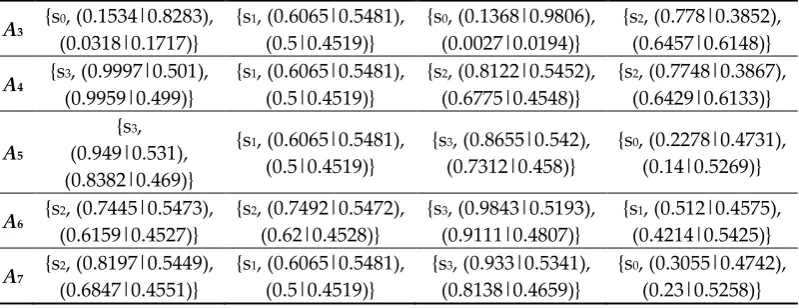
An example is undertaken in this section to understand the implementation methodology of proposed MCGDM method with HPFL information. Further, a real case study is done to rank organizations using proposed MCGDM method. We also compare proposed method with existing HPFL-based MCGDM methods proposed by Lin et al. [50] and Zhou et al. [68].
Example. Suppose that a group of three decision makers (D1, D2, D3)intend to rank four alternatives (A1, A2,
A3, A4)on the basis of three criteria (C1, C2, C3). All DMs are considered equally important and equal weights
are assigned to them. Each DM provides evaluation information of each alternative under each criterion in form of HPFLEs with following LTS:
poor,
extremely
=
s
{
S
0s
1=
very
poor,
s
2=
poor,
s
3=
fair,
s
4=
good,
good,
very
=
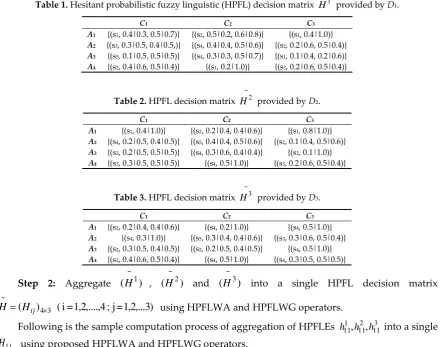
Step 1: HPFL decision matrices are constructed according to preferences information provided by DMsD1, D2 and D3 about the alternative Ai (i = 1, 2, 3, 4) under the criteria Cj (i = 1, 2, 3).
[image:11.595.80.522.138.485.2]Tables 1–3 represent HPFL evaluation matrices provided by DMsD1, D2 and D3.
Table 1. Hesitant probabilistic fuzzy linguistic (HPFL) decision matrix
~ 1
H provided by D1.
C1 C2 C3
A1 {(s1, 0.4|0.3, 0.5|0.7)} {(s2, 0.5|0.2, 0.6|0.8)} {(s1, 0.4|1.0)}
A2 {(s3, 0.3|0.5, 0.4|0.5,)} {(s4, 0.4|0.4, 0.5|0.6)} {(s2, 0.2|0.6, 0.5|0.4)}
A3 {(s5, 0.1|0.5, 0.5|0.5)} {(s4, 0.3|0.3, 0.5|0.7)} {(s1, 0.1|0.4, 0.2|0.6)}
A4 {(s2, 0.4|0.6, 0.5|0.4)} {(s1, 0.2|1.0)} {(s3, 0.2|0.6, 0.5|0.4)}
Table 2. HPFL decision matrix
~ 2
H provided by D2.
C1 C2 C3
A1 {(s1, 0.4|1.0)} {(s2, 0.2|0.4, 0.4|0.6)} {(s1, 0.8|1.0)}
A2 {(s4, 0.2|0.5, 0.4|0.5)} {(s5, 0.4|0.4, 0.5|0.6)} {(s2, 0.1|0.4, 0.5|0.6)}
A3 {(s2, 0.2|0.5, 0.5|0.5)} {(s4, 0.3|0.6, 0.4|0.4)} {(s2, 0.1|1.0)}
A4 {(s3, 0.3|0.5, 0.5|0.5)} {(s4, 0.5|1.0)} {(s3, 0.2|0.6, 0.5|0.4)}
Table 3. HPFL decision matrix
~ 3
H provided by D3.
C1 C2 C3
A1 {(s2, 0.2|0.4, 0.4|0.6)} {(s4, 0.2|1.0)} {(s4, 0.5|1.0)}
A2 {(s4, 0.3|1.0)} {(s5, 0.3|0.4, 0.4|0.6)} {(s3, 0.3|0.6, 0.5|0.4)}
A3 {(s2, 0.3|0.5, 0.4|0.5)} {(s2, 0.2|0.5, 0.4|0.5)} {(s4, 0.5|1.0)}
A4 {(s2, 0.4|0.6, 0.5|0.4)} {(s4, 0.5|1.0)} {(s4, 0.3|0.5, 0.5|0.5)}
Step 2: Aggregate
(
)
~1
H
,(
)
~ 2
H
and(
)
~ 3
H
into a single HPFL decision matrix1,2,...3)
=
j
;
1,2,....,4
=
i
(
)
(
43~
H
ijH
using HPFLWA and HPFLWG operators.Following is the sample computation process of aggregation of HPFLEs h111,h112,h113 into a single
11
H
using proposed HPFLWA and HPFLWG operators.0.6)}] | 0.4 0.4, | 0.2 , {(s 1.0)}, | 0.4 , {(s 0.7)}, | 0.5 0.3, | 0.4 , {(s [ ) , , (
H 111 112 113 1 1 2
11 PFLWA h h h
H 0.6)} * 1 * (0.7 | (1/3)))] 0.4)^ -((1 * (1/3)) 0.4)^ -((1 * (1/3)) 0.5)^ -(((1 -{[1 0.4)}, * 1 * (0.7 | (1/3)))] 0.2)^ -((1 * (1/3)) 0.4)^ -((1 * (1/3)) 0.5)^ -(((1 -{[1 0.6)}, * 1 * (0.7 | (1/3)))] 0.4)^ -((1 * (1/3)) 0.4)^ -((1 * (1/3)) 0.5)^ -(((1 -{[1 0.4)}, * 1 * (0.7 | (1/3)))] 0.2)^ -((1 * (1/3)) 0.4)^ -((1 * (1/3)) 0.5)^ -(((1 -{[1 0.6)}, * 1 * (0.3 | (1/3)))] 0.4)^ -((1 * (1/3)) 0.4)^ -((1 * (1/3)) 0.4)^ -(((1 -{[1 0.4)}, * 1 * (0.3 | (1/3)))] 0.4)^ -((1 * (1/3)) 0.4)^ -((1 * (1/3)) 0.4)^ -(((1 -{[1 0.4)}, * 1 * (0.3 | (1/3)))] 0.2)^ -((1 * (1/3)) 0.4)^ -((1 * (1/3)) 0.4)^ -(((1 -{[1 0.4)}, * 1 * (0.3 | (1/3)))] 0.2)^ -((1 * (1/3)) 0.4)^ -((1 * (1/3)) 0.4)^ -(((1 -{[1 , {(s(11 2)/3
0.42}]
|
0.44
0.28,
|
0.38
0.42,
|
,0.44
0.28
|
0.38
0.18,
|
0.4
0.18,
|
0.4
0.12,
|
0.34
0.12,
|
0.34
,
{(s
[
1.3
11H
[
{(s
1.3,
0.34
|
0.12,
0.4
|
0.18,
0.38
|
0.28
,0.44
|
0.42}]
0.6)}] | 0.4 0.4, | 0.2 , {(s 1.0)}, | 0.4 , {(s 0.7)}, | 0.5 0.3, | 0.4 , {(s [ ) , , (
H 111 112 113 1 1 2
11 PFLWG h h h
0.6)} * 1 * (0.7 | (1/3)))] ((0.4)^ * (1/3)) ((0.4)^ * (1/3)) {[(((0.5)^ 0.4)}, * 1 * (0.7 | (1/3)))] ((0.2)^ * (1/3)) ((0.4)^ * (1/3)) {[(((0.5)^ 0.6)}, * 1 * (0.7 | (1/3)))] ((0.4)^ * (1/3)) ((0.4)^ * (1/3)) {[(((0.5)^ 0.4)}, * 1 * (0.7 | (1/3)))] ((0.2)^ * (1/3)) ((0.4)^ * (1/3)) {[(((0.5)^ 0.6)}, * 1 * (0.3 | (1/3)))] ((0.4)^ * (1/3)) ((0.4)^ * (1/3)) {[(((0.4)^ 0.4)}, * 1 * (0.3 | (1/3)))] ((0.4)^ * (1/3)) ((0.4)^ * (1/3)) {[(((0.4)^ 0.4)}, * 1 * (0.3 | (1/3)))] ((0.2)^ * (1/3)) ((0.4)^ * (1/3)) {[(((0.4)^ 0.4)}, * 1 * (0.3 | (1/3)))] ((0.2)^ * (1/3)) ((0.4)^ * (1/3)) {[((0.4)^ ,
{(s(1^(1/3)1^(1/3)2^(1/3))
0.38}]
|
0.43
0.3,
|
0.34
0.38,
|
,0.43
0.3
|
0.34
0.2,
|
0.4
0.2,
|
0.4
0.12,
|
0.32
0.12,
|
0.32
,
{(s
[
3.3
11H
[
{(s
3.3,
0.32
|
0.12,
0.4
|
0.2,
0.3
|
0.3
,0.4
|
0.38}]
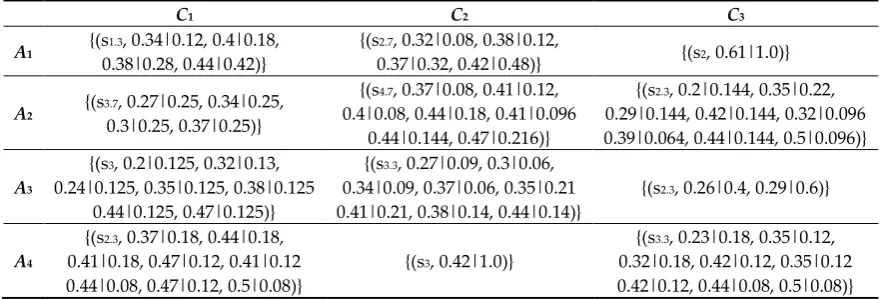
[image:12.595.77.519.325.475.2]Similarly other HPFLEs of HPFL decision matrices (Tables 1–3) are aggregated into the single HPFL decision matrix using HPFLWA and HPFLWG operators, and shown in Tables 4 and 5.
Table 4. Aggregated hesitant probabilistic fuzzy linguistic element (HPFLE) group decision matrix using hesitant probabilistic fuzzy linguistic weighted averaging (HPFLWA) operator.
C1 C2 C3
A1 {(s
1.3, 0.34|0.12, 0.4|0.18, 0.38|0.28, 0.44|0.42)}
{(s2.7, 0.32|0.08, 0.38|0.12,
0.37|0.32, 0.42|0.48)} {(s2, 0.61|1.0)}
A2 {(s
3.7, 0.27|0.25, 0.34|0.25, 0.3|0.25, 0.37|0.25)}
{(s4.7, 0.37|0.08, 0.41|0.12, 0.4|0.08, 0.44|0.18, 0.41|0.096
0.44|0.144, 0.47|0.216)}
{(s2.3, 0.2|0.144, 0.35|0.22, 0.29|0.144, 0.42|0.144, 0.32|0.096 0.39|0.064, 0.44|0.144, 0.5|0.096)}
A3
{(s3, 0.2|0.125, 0.32|0.13, 0.24|0.125, 0.35|0.125, 0.38|0.125
0.44|0.125, 0.47|0.125)}
{(s3.3, 0.27|0.09, 0.3|0.06, 0.34|0.09, 0.37|0.06, 0.35|0.21 0.41|0.21, 0.38|0.14, 0.44|0.14)}
{(s2.3, 0.26|0.4, 0.29|0.6)}
A4
{(s2.3, 0.37|0.18, 0.44|0.18, 0.41|0.18, 0.47|0.12, 0.41|0.12 0.44|0.08, 0.47|0.12, 0.5|0.08)}
{(s3, 0.42|1.0)}
{(s3.3, 0.23|0.18, 0.35|0.12, 0.32|0.18, 0.42|0.12, 0.35|0.12 0.42|0.12, 0.44|0.08, 0.5|0.08)}
Table 5. Aggregated HPFLE group decision matrix using hesitant probabilistic fuzzy linguistic weighted geometric (HPFLWG) operator.
C1 C2 C3
A1 {(s3.3, 0.32|0.12, 0.4|0.2,
0.3|0.3, 0.4|0.38)}
{(s4.1, 0.27|0.08, 0.3|0.1,
0.3|0.3, 0.36|0.5)} {(s3.6, 0.54|1.0)}
A2 {(s4.6, 0.26|0.25, 0.3|0.25,
0.3|0.3, 0.4|0.2)}
{(s5, 0.36|0.08, 0.4|0.12,
0.4|0.22, 0.4|0.14, 0.42|0.1 0.5|0.22)}
{(s4, 0.18|0.14, 0.3|0.22,
0.2|0.14, 0.4|0.1, 0.2|0.1 0.3|0.06)}
A3
{(s4.2, 0.18|0.13, 0.2|0.13,
0.3|0.15, 0.3|0.13 0.42|0.2, 0.5|0.23)}
{(s4.4, 0.26|0.09, 0.3|0.06,
0.34|0.09, 0.37|0.06, 0.35|0.21 0.41|0.21, 0.38|0.14, 0.44|0.14)}
{(s3.8, 0.17|0.4, 0.2|0.6)}
A4
{(s4, 0.36|0.18, 0.43|0.24,
0.39|0.18, 0.46|0.12, 0.42|0.08 0.46|0.12, 0.5|0.08)}
{(s4.2, 0.37|1.0)}
{(s4.5, 0.23|0.18, 0.31|0.16,
0.27|0.28, 0.42|0.18, 0.42|0.12, 0.5|0.08)}
Step 3: Aggregate assessment of each alternative
A
i(
i
1
,
2
,
3
,
4
)
against each criteria is calculated using the HPFLWA and HPFLWG aggregation operators with criteria weights4
.
0
,
3
.
0
,
4
.
0
2 31
w
w
w
as follows:) C , C , (C
HPFLWA 11 12 13
1 H 1.0)] | 0.61 , (s 0.48), | 0.42 0.32, | 0.37 0.12, | 0.38 0.08, | 0.32 , (s 0.42), | 0.44 0.28, | 0.38 0.18, | 0.4 0.12, | 0.34 , (s
[ 1.3 2.7 2
1 H 0.202) | 0.49 0.134, | 0.47 0.05, | 0.47 0.034, | 0.46 0.134, | 0.47 0.09, | 0.45 0.034, | 0.45 0.022, | 0.44 0.086, | 0.47 0.058, | 0.46 0.022, | 0.46 0.014, | 0.45 0.058, | 0.45 0.038, | 0.44 0.014, | 0.44 0.01, | 0.43 , (s1.93 1 H ) C , C , (C
HPFLWG 11 12 13
1
[image:12.595.111.484.518.651.2]1.0)] | 0.54 , (s 0.5), | 0.36 0.3, | 0.3 0.1, | 0.3 0.08, | 0.27 , (s 0.38), | 0.4 0.3, | 0.3 0.2, | 0.4 0.12, | 0.32 , (s
[ 3.3 4.1 3.6
1
H
0.202) | 0.48 0.134, | 0.46 0.05, | 0.46 0.034, | 0.44 0.134, | 0.45 0.09, | 0.43 0.034, | 0.44 0.022, | 0.41
0.086, | 0.46 0.058, | 0.44 0.022, | 0.45 0.014, | 0.42 0.058, | 0.43 0.038, | 0.41 0.014, | 0.42 0.01, | 0.4 , (s1.93
1 H
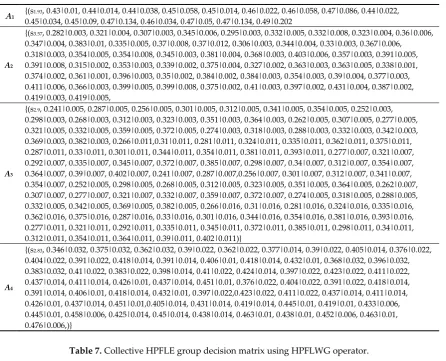
Similarly, other elements of HPFL decision matrices (Tables 4 and 5) are aggregated into the overall HPFL decision matrix using HPFLWA and HPFLWG operators and shown in Tables 6 and 7.
Table 6. Collective HPFLE group decision matrix using HPFLWA operator.
.A1 {(s
1.93, 0.43|0.01, 0.44|0.014, 0.44|0.038, 0.45|0.058, 0.45|0.014, 0.46|0.022, 0.46|0.058, 0.47|0.086, 0.44|0.022,
0.45|0.034, 0.45|0.09, 0.47|0.134, 0.46|0.034, 0.47|0.05, 0.47|0.134, 0.49|0.202
A2
{(s3.57, 0.282|0.003, 0.321|0.004, 0.307|0.003, 0.345|0.006, 0.295|0.003, 0.332|0.005, 0.332|0.008, 0.323|0.004, 0.36|0.006,
0.347|0.004, 0.383|0.01, 0.335|0.005, 0.37|0.008, 0.37|0.012, 0.306|0.003, 0.344|0.004, 0.33|0.003, 0.367|0.006, 0.318|0.003, 0.354|0.005, 0.354|0.008, 0.345|0.003, 0.381|0.004, 0.368|0.003, 0.403|0.006, 0.357|0.003, 0.391|0.005, 0.391|0.008, 0.315|0.002, 0.353|0.003, 0.339|0.002, 0.375|0.004, 0.327|0.002, 0.363|0.003, 0.363|0.005, 0.338|0.001, 0.374|0.002, 0.361|0.001, 0.396|0.003, 0.35|0.002, 0.384|0.002, 0.384|0.003, 0.354|0.003, 0.39|0.004, 0.377|0.003, 0.411|0.006, 0.366|0.003, 0.399|0.005, 0.399|0.008, 0.375|0.002, 0.41|0.003, 0.397|0.002, 0.431|0.004, 0.387|0.002, 0.419|0.003, 0.419|0.005,
A3
{(s2.9, 0.241|0.005, 0.287|0.005, 0.256|0.005, 0.301|0.005, 0.312|0.005, 0.341|0.005, 0.354|0.005, 0.252|0.003,
0.298|0.003, 0.268|0.003, 0.312|0.003, 0.323|0.003, 0.351|0.003, 0.364|0.003, 0.262|0.005, 0.307|0.005, 0.277|0.005, 0.321|0.005, 0.332|0.005, 0.359|0.005, 0.372|0.005, 0.274|0.003, 0.318|0.003, 0.288|0.003, 0.332|0.003, 0.342|0.003, 0.369|0.003, 0.382|0.003, 0.266|0.011,0.31|0.011, 0.281|0.011, 0.324|0.011, 0.335|0.011, 0.362|0.011, 0.375|0.011, 0.287|0.011, 0.33|0.011, 0.301|0.011, 0.344|0.011, 0.354|0.011, 0.381|0.011, 0.393|0.011, 0.277|0.007, 0.321|0.007, 0.292|0.007, 0.335|0.007, 0.345|0.007, 0.372|0.007, 0.385|0.007, 0.298|0.007, 0.34|0.007, 0.312|0.007, 0.354|0.007, 0.364|0.007, 0.39|0.007, 0.402|0.007, 0.241|0.007, 0.287|0.007,0.256|0.007, 0.301|0.007, 0.312|0.007, 0.341|0.007, 0.354|0.007, 0.252|0.005, 0.298|0.005, 0.268|0.005, 0.312|0.005, 0.323|0.005, 0.351|0.005, 0.364|0.005, 0.262|0.007, 0.307|0.007, 0.277|0.007, 0.321|0.007, 0.332|0.007, 0.359|0.007, 0.372|0.007, 0.274|0.005, 0.318|0.005, 0.288|0.005, 0.332|0.005, 0.342|0.005, 0.369|0.005, 0.382|0.005, 0.266|0.016, 0.31|0.016, 0.281|0.016, 0.324|0.016, 0.335|0.016, 0.362|0.016, 0.375|0.016, 0.287|0.016, 0.33|0.016, 0.301|0.016, 0.344|0.016, 0.354|0.016, 0.381|0.016, 0.393|0.016, 0.277|0.011, 0.321|0.011, 0.292|0.011, 0.335|0.011, 0.345|0.011, 0.372|0.011, 0.385|0.011, 0.298|0.011, 0.34|0.011, 0.312|0.011, 0.354|0.011, 0.364|0.011, 0.39|0.011, 0.402|0.011)}
A4
{(s2.83, 0.346|0.032, 0.375|0.032, 0.362|0.032, 0.39|0.022, 0.362|0.022, 0.377|0.014, 0.39|0.022, 0.405|0.014, 0.376|0.022,
[image:13.595.78.525.180.541.2]0.404|0.022, 0.391|0.022, 0.418|0.014, 0.391|0.014, 0.406|0.01, 0.418|0.014, 0.432|0.01, 0.368|0.032, 0.396|0.032, 0.383|0.032, 0.41|0.022, 0.383|0.022, 0.398|0.014, 0.41|0.022, 0.424|0.014, 0.397|0.022, 0.423|0.022, 0.411|0.022, 0.437|0.014, 0.411|0.014, 0.426|0.01, 0.437|0.014, 0.451|0.01, 0.376|0.022, 0.404|0.022, 0.391|0.022, 0.418|0.014, 0.391|0.014, 0.406|0.01, 0.418|0.014, 0.432|0.01, 0.397|0.022,0.423|0.022, 0.411|0.022, 0.437|0.014, 0.411|0.014, 0.426|0.01, 0.437|0.014, 0.451|0.01,0.405|0.014, 0.431|0.014, 0.419|0.014, 0.445|0.01, 0.419|0.01, 0.433|0.006, 0.445|0.01, 0.458|0.006, 0.425|0.014, 0.45|0.014, 0.438|0.014, 0.463|0.01, 0.438|0.01, 0.452|0.006, 0.463|0.01, 0.476|0.006,)}
Table 7. Collective HPFLE group decision matrix using HPFLWG operator.
A1 {(s1.93, 0.4|0.01, 0.42|0.014, 0.41|0.038, 0.43|0.058, 0.42|0.014, 0.45|0.022, 0.44|0.058, 0.46|0.086, 0.41|0.022, 0.44|0.034,
0.43|0.09, 0.45|0.134, 0.44|0.034, 0.46|0.05, 0.46|0.134, 0.48|0.202
A2
{(s3.57, 0.27|0.003, 0.31|0.004, 0.29|0.003, 0.32|0.006, 0.28|0.003, 0.31|0.005, 0.31|0.008, 0.32|0.004, 0.36|0.006,
0.34|0.004, 0.38|0.01, 0.33|0.005, 0.37|0.008, 0.36|0.012, 0.3|0.003, 0.34|0.004, 0.33|0.003, 0.36|0.006, 0.31|0.003, 0.35|0.005, 0.34|0.008, 0.34|0.003, 0.38|0.004, 0.36|0.003, 0.4|0.006, 0.35|0.003, 0.39|0.005, 0.38|0.008, 0.31|0.002, 0.35|0.003, 0.34|0.002, 0.37|0.004, 0.32|0.002, 0.36|0.003, 0.35|0.005, 0.33|0.001, 0.37|0.002, 0.36|0.001, 0.39|0.003, 0.34|0.002, 0.38|0.002, 0.37|0.003, 0.34|0.003, 0.39|0.004, 0.37|0.003, 0.41|0.006, 0.35|0.003, 0.39|0.005, 0.39|0.008, 0.36|0.002, 0.4|0.003, 0.38|0.002, 0.42|0.004, 0.37|0.002, 0.41|0.003, 0.4|0.005,
A3
{(s2.9, 0.24|0.005, 0.29|0.005, 0.26|0.005, 0.3|0.005, 0.31|0.005, 0.32|0.005, 0.33|0.005, 0.25|0.003, 0.3|0.003, 0.27|0.003,
0.31|0.003, 0.32|0.003, 0.34|0.003, 0.35|0.003, 0.25|0.005, 0.3|0.005, 0.27|0.005, 0.32|0.005, 0.33|0.005, 0.35|0.005, 0.36|0.005, 0.26|0.003, 0.31|0.003, 0.28|0.003, 0.33|0.003, 0.34|0.003, 0.36|0.003, 0.37|0.003, 0.26|0.011,0.31|0.011, 0.28|0.011, 0.32|0.011, 0.33|0.011, 0.35|0.011, 0.36|0.011, 0.27|0.011, 0.32|0.011, 0.29|0.011, 0.34|0.011, 0.35|0.011, 0.37|0.011, 0.38|0.011, 0.26|0.007, 0.32|0.007, 0.28|0.007, 0.33|0.007, 0.34|0.007, 0.36|0.007, 0.37|0.007, 0.28|0.007, 0.33|0.007, 0.3|0.007, 0.34|0.007, 0.35|0.007, 0.37|0.007, 0.38|0.007, 0.24|0.007, 0.29|0.007,0.26|0.007, 0.3|0.007, 0.31|0.007, 0.32|0.007, 0.33|0.007, 0.25|0.005, 0.3|0.005, 0.27|0.005, 0.31|0.005, 0.32|0.005, 0.34|0.005, 0.35|0.005, 0.25|0.007, 0.3|0.007, 0.27|0.007, 0.32|0.007, 0.33|0.007, 0.35|0.007, 0.36|0.007, 0.26|0.005, 0.31|0.005, 0.28|0.005, 0.33|0.005, 0.34|0.005, 0.36|0.005, 0.37|0.005, 0.26|0.016, 0.31|0.016, 0.28|0.016, 0.32|0.016, 0.33|0.016, 0.35|0.016, 0.36|0.016, 0.27|0.016, 0.32|0.016, 0.29|0.016, 0.34|0.016, 0.35|0.016, 0.37|0.016, 0.38|0.016, 0.26|0.011, 0.32|0.011, 0.28|0.011, 0.33|0.011, 0.34|0.011, 0.36|0.011, 0.37|0.011, 0.28|0.011, 0.33|0.011, 0.3|0.011, 0.34|0.011, 0.35|0.011, 0.37|0.011, 0.38|0.011)}
A4 {(s2.83, 0.33|0.032, 0.36|0.032, 0.35|0.032, 0.37|0.022, 0.35|0.022, 0.36|0.014, 0.37|0.022, 0.38|0.014, 0.37|0.022,
0.4|0.022, 0.38|0.022, 0.39|0.014, 0.4|0.022, 0.41|0.014, 0.4|0.022, 0.42|0.022, 0.41|0.022, 0.44|0.014, 0.41|0.014, 0.43|0.01, 0.44|0.014, 0.45|0.01, 0.37|0.022, 0.4|0.022, 0.39|0.022, 0.41|0.014, 0.39|0.014, 0.4|0.01, 0.41|0.014, 0.42|0.01, 0.4|0.022,0.42|0.022, 0.41|0.022, 0.44|0.014, 0.41|0.014, 0.43|0.01, 0.44|0.014, 0.45|0.01, 0.4|0.014, 0.43|0.014, 0.42|0.014, 0.44|0.01, 0.42|0.01, 0.43|0.006, 0.44|0.01, 0.46|0.006, 0.42|0.014, 0.45|0.014,0.43|0.014, 0.46|0.01, 0.43|0.01, 0.45|0.006, 0.46|0.01, 0.47|0.006,)}
Step 4: The score values S(hiPL(px))(i1,2,3,4) of the alternatives
A
i(
i
1
,
2
,
3
,
4
)
are calculated [image:14.595.218.378.214.297.2]and shown as follows (Table 8):
Table 8. Score values for the alternatives using HPFLWA and HPFLWG operators.
Score HPFLWA HPFLWG
)) ( (h1PL px
S S0.05652 S0.05409
)) ( (h2PL px
S S 0.00559 S0.00545
)) ( (h3PL px
S S0.00745 S0.00723
)) ( (h4PL px
S S0.01901 S0.01874
Step 5. Finally, alternatives Ai (i = 1, 2, 3, 4) are ranked in accordance with score values ))
( (hiPL px
[image:14.595.118.478.370.410.2]S and shown in Table 9.
Table 9. Ranking of alternatives using proposed HPFLWA and HPFLWG operators.
Method Ranking Best/Worst
Using HPFLWA operator A1> A4> A3> A2 A1/A2 Using HPFLWG operator A1> A4> A3> A2 A1/A2
Table 9 confirms that using both proposed HPFLWA and HPFLWG operators best and worst alternatives are A1 and A2 respectively.
6.1. A Real Case Study
A real case study is undertaken to rank seven organizations; State Bank of India (A1), InfoTech
Enterprises (A2), ITC (A3), H.D.F.C. Bank (A4), Tata Steel (A5), Tata Motors (A6) and Bajaj Finance (A7)
on the basis of their performance against following four criteria. 1. Earnings per share (EPS) of company (C1)
2. Face value (C2)
3. Book value (C3)
4. P/C ratio (Put-Call Ratio) of company (C4)
In this real case study, C1, C2, and C3 are benefit criteria while C4 is cost criterion. Real data for
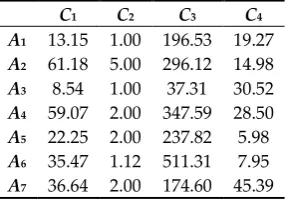
[image:14.595.227.372.652.752.2]each alternative against each criterion are retrieved from http://www.moneycontrol.com from date 20.7.2017 to 27.7.2017. Table 10 shows their average values.
Table 10. Average of actual numerical value of criteria. C1 C2 C3 C4
A1 13.15 1.00 196.53 19.27
A2 61.18 5.00 296.12 14.98
A3 8.54 1.00 37.31 30.52
A4 59.07 2.00 347.59 28.50
A5 22.25 2.00 237.82 5.98
A6 35.47 1.12 511.31 7.95
To construct hesitant fuzzy decision matrix (Table 11), we use the method proposed by Bisht and Kumar [69] and fuzzify Table 10 using triangular and Gaussian membership functions.
Table 11. Hesitant fuzzy decision matrix
C1 C2 C3 C4
A1 0.3784, 0.3029 0.6065, 0.50 0.7545, 0.6247 0.997, 0.9614
A2 0.9676, 0.8718 0.6065, 0.50 0.8964, 0.7662 0.696, 0.5743
A3 0.1534, 0.0318 0.6065, 0.50 0.1368, 0.0027 0.778, 0.6457
A4 0.9997, 0.9959 0.6065, 0.50 0.8122, 0.6775 0.7748, 0.6429
A5 0.949, 0.8382 0.6065, 0.50 0.8655, 0.7312 0.2278, 0.14
A6 0.7445, 0.6159 0.7491, 0.62 0.9843, 0.9111 0.512, 0.4214
A7 0.8197, 0.6847 0.6065, 0.50 0.933, 0.8138 0.3055, 0.23
Probabilities are associated with elements of hesitant fuzzy decision matrix (Table 11) to convert it into probabilistic hesitant fuzzy decision matrix
I
[
I
Pij
(
ij|
p
ij)])
mn .Probabilities which are associated with first row of hesitant fuzzy decision matrix (Table 11) are as follows:
5554
.
0
3029
.
0
3784
.
0
3784
.
0
)
(
111
p
,0
.
4446
3029
.
0
3784
.
0
3029
.
0
)
(
211
p
5481
.
0
5
.
0
6065
.
0
6065
.
0
)
(
112
p
,0
.
4519
5
.
0
6065
.
0
5
.
0
)
(
212
p
9285
.
0
9614
.
0
997
.
0
9614
.
0
)
(
114
p
,0
.
0715
997
.
0
9614
.
0
997
.
0
)
(
214
p
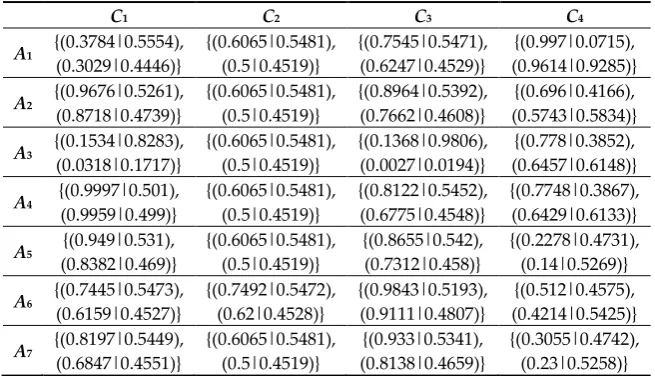
[image:15.595.134.462.465.653.2]Similarly all elements of hesitant fuzzy decision matrix are associated with probabilities and probabilistic hesitant fuzzy decision matrix (Table 12) is obtained.
Table 12. Probabilistic Hesitant fuzzy decision matrix.
C1 C2 C3 C4
A1 {(0.3784|0.5554),
(0.3029|0.4446)}
{(0.6065|0.5481), (0.5|0.4519)}
{(0.7545|0.5471), (0.6247|0.4529)}
{(0.997|0.0715), (0.9614|0.9285)} A2 {(0.9676|0.5261),
(0.8718|0.4739)}
{(0.6065|0.5481), (0.5|0.4519)}
{(0.8964|0.5392), (0.7662|0.4608)}
{(0.696|0.4166), (0.5743|0.5834)} A3 {(0.1534|0.8283),
(0.0318|0.1717)}
{(0.6065|0.5481), (0.5|0.4519)}
{(0.1368|0.9806), (0.0027|0.0194)}
{(0.778|0.3852), (0.6457|0.6148)} A4 {(0.9997|0.501),
(0.9959|0.499)}
{(0.6065|0.5481), (0.5|0.4519)}
{(0.8122|0.5452), (0.6775|0.4548)}
{(0.7748|0.3867), (0.6429|0.6133)} A5 {(0.949|0.531),
(0.8382|0.469)}
{(0.6065|0.5481),
![Table 15. Hesitant fuzzy linguistic decision matrix ([50]) .](https://thumb-us.123doks.com/thumbv2/123dok_us/194018.518341/17.595.153.442.657.735/table-hesitant-fuzzy-linguistic-decision-matrix.webp)

