Proceedings of the 57th Annual Meeting of the Association for Computational Linguistics, pages 4238–4248 4238
Learning to Ask Unanswerable Questions
for Machine Reading Comprehension
Haichao Zhu†∗, Li Dong‡, Furu Wei‡, Wenhui Wang‡, Bing Qin†\, Ting Liu†\ †Harbin Institute of Technology, Harbin, China
‡Microsoft Research, Beijing, China \Peng Cheng Laboratory, Shenzhen, China
{hczhu,qinb,tliu}@ir.hit.edu.cn
{lidong1,fuwei,wenwan}@microsoft.com
Abstract
Machine reading comprehension with unan-swerable questions is a challenging task. In this work, we propose a data augmentation technique by automatically generating relevant unanswerable questions according to an an-swerable question paired with its correspond-ing paragraph that contains the answer. We introduce a pair-to-sequence model for unan-swerable question generation, which effec-tively captures the interactions between the question and the paragraph. We also present a way to construct training data for our ques-tion generaques-tion models by leveraging the ex-isting reading comprehension dataset. Exper-imental results show that the pair-to-sequence model performs consistently better compared with the sequence-to-sequence baseline. We further use the automatically generated unan-swerable questions as a means of data aug-mentation on the SQuAD 2.0 dataset, yielding
1.9absolute F1 improvement with BERT-base model and1.7absolute F1 improvement with BERT-large model.
1 Introduction
Extractive reading comprehension (Hermann et al., 2015;Rajpurkar et al., 2016) obtains great attentions from both research and industry in recent years. End-to-end neural models (Seo et al., 2017; Wang et al., 2017; Yu et al., 2018) have achieved remarkable performance on the task if answers are assumed to be in the given paragraph. Nonetheless, the current systems are still not good at deciding whether no answer is presented in the context (Rajpurkar et al.,
2018). For unanswerable questions, the systems are supposed to abstain from answering rather than making unreliable guesses, which is an embodiment of language understanding ability.
∗
Contribution during internship at Microsoft Research Asia.
Title:Victoria (Australia)
Paragraph: . . . Public schools, also known as state or government schools, are funded and run directly by the
Victoria Department of Education. Students do not pay tuition fees, but some extra costs are levied. Private fee-paying schools include parish schools . . .
Ans. Question: What organization runs the public schoolsin Victoria?
UnAns. Question: What organization runsthe waste managementin Victoria?
(Plausible) Answer:Victoria Department of Education
Figure 1: An example taken from the SQuAD 2.0 dataset. The annotated (plausible) answer span in the paragraph is used as a pivot to align the pair of answer-able and unansweranswer-able questions.
To create training data for unanswerable ques-tion generaques-tion, we use (plausible) answer spans in paragraphs as pivots to align pairs of answer-able questions and unansweranswer-able questions. As shown in Figure1, the answerable and unanswer-able questions of a paragraph are aligned through the text span “Victoria Department of Education” for being both the answer and plausible answer. These two questions are lexically similar and both asked with the same answer type in mind. In this way, we obtain the data with which the models can learn to ask unanswerable questions by editing answerable ones with word exchanges, negations, etc. Consequently, we can generate a mass of unanswerable questions with existing large-scale machine reading comprehension datasets.
Inspired by the neural reading comprehension models (Xiong et al., 2017;Huang et al., 2018), we introduce a pair-to-sequence model to bet-ter capture the inbet-teractions between questions and paragraphs. The proposed model first encodes in-put question and paragraph separately, and then conducts attention-based matching to make them aware of each other. Finally, the context-aware representations are used to generate outputs. To facilitate the use of context words during the generation process, we also incorporate the copy mechanism (Gu et al.,2016;See et al.,2017).
Experimental results on the unanswerable ques-tion generaques-tion task shows that the pair-to-sequence model generates consistently better re-sults over the sequence-to-sequence baseline and performs better with long paragraphs than with short answer sentences. Further experimental re-sults show that the generated unanswerable ques-tions can improve multiple machine reading com-prehension models. Even using BERT fine-tuning as a strong reading comprehension model, we can still obtain a 1.9% absolute improvement of F1 score with BERT-base model and 1.7% absolute F1 improvement with BERT-large model.
2 Related Work
Machine Reading Comprehension (MRC) Var-ious large-scale datasets (Hermann et al., 2015;
Rajpurkar et al., 2016; Nguyen et al., 2016;
Joshi et al., 2017; Rajpurkar et al., 2018; Ko-cisky et al.,2018) have spurred rapid progress on machine reading comprehension in recent years. SQuAD (Rajpurkar et al., 2016) is an extractive benchmark whose questions and answers spans
are annotated by humans. Neural reading com-prehension systems (Wang and Jiang,2017;Seo et al., 2017; Wang et al., 2017; Hu et al., 2018;
Huang et al., 2018; Liu et al., 2018; Yu et al.,
2018;Wang et al., 2018) have outperformed hu-mans on this task in terms of automatic metrics. The SQuAD 2.0 dataset (Rajpurkar et al., 2018) extends SQuAD with more than 50,000 crowd-sourced unanswerable questions. So far, neural reading comprehension models still fall behind humans on SQuAD 2.0. Abstaining from answer-ing when no answer can be inferred from the given document does require more understanding than barely extracting an answer.
Question Generation for MRC In recent years, there has been an increasing interest in generating questions for reading comprehension.
Du et al. (2017) show that neural models based on the encoder-decoder framework can generate significantly better questions than rule-based sys-tems (Heilman and Smith, 2010). To generate answer-focused questions, one can simply indicate the answer positions in the context with extra fea-tures (Yuan et al., 2017; Zhou et al., 2018; Du and Cardie, 2018; Sun et al., 2018; Dong et al.,
2019). Song et al. (2018) and Kim et al. (2019) separate answer representations for further match-ing. Yao et al. (2018) introduce a latent variable for capturing variability and an observed variable for controlling question types. In summary, the above mentioned systems aim to generate answer-able questions with certain context. On the con-trary, our goal is to generate unanswerable ques-tions.
Adversarial Examples for MRC To evaluate the language understanding ability of pre-trained systems,Jia and Liang(2017) construct adversar-ial examples by adding distractor sentences that do not contradict question answering for humans to the paragraph. Clark and Gardner(2018) andTan et al. (2018) use questions to retrieve paragraphs that do not contain the answer as adversarial exam-ples. Rajpurkar et al.(2018) create unanswerable questions through rigid rules, which swap entities, numbers and antonyms of answerable questions. It has been shown that adversarial examples gen-erated by rule-based systems are much easier to detect than ones in the SQuAD 2.0 dataset.
catego-Decoder
Interac+on Output
Encoder
Interac+on
Encoder
P W C
P W C P W C A W C P W C
… …
Q W C Q W C
Q W C Q W C
…
Paragraph Ques+on Decoder
Encoder Output
P W C
Q W C P W C A W C Q W C
… …
Paragraph + Ques+on
SEQ2SEQ PAIR2SEQ Unanswerable Ques+on
[image:3.595.77.287.63.219.2]Unanswerable Ques+on
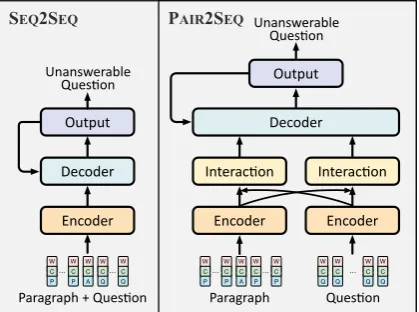
Figure 2: Diagram of the proposed pair-to-sequence model and sequence-to-sequence model. The input em-beddings is the sum of the word emem-beddings, the char-acter embeddings and the token type embeddings. The input questions are all answerable.
rize these work according to the type of the aug-mentation data: external data source, paragraphs or questions. Devlin et al.(2019) fine-tune BERT on the SQuAD dataset jointly with another dataset TriviaQA (Joshi et al., 2017). Yu et al. (2018) paraphrase paragraphs with backtranslation. An-other line of work adheres to generate answerable questions. Yang et al. (2017) propose to gener-ate questions based on the unlabeled text for semi-supervised question answering. Sun et al. (2019) propose a rule-based system to generate multiple-choice questions with candidate options upon the paragraphs. We aim at generating unanswerable questions as a means of data augmentation.
3 Problem Formulation
Given an answerable question q and its corre-sponding paragraphpthat contains the answera, we aim to generate unanswerable questionsq˜that fulfills certain requirements. First, it cannot be an-swered by paragraph p. Second, it must be rele-vant to both answerable questionq and paragraph p, which refrains from producing irrelevant ques-tions. Third, it should ask for something of the same type as answera.
As shown in Figure2, we investigate two simple neural models built upon encoder-decoder archi-tecture (Cho et al.,2014;Bahdanau et al.,2015) to generate unanswerable questions. A sequence-to-sequence model takes the concatenated paragraph and question as input, and encodes the input in a sequential manner. A pair-to-sequence model is further introduced to capture the interactions
be-tween inputs. The decoder of two models gener-ates unanswerable questions sequentially. We fac-torize the probability of generating the unanswer-able questionP(˜q|q, p, a)as:
P(˜q|q, p, a) =
|q˜|
Y
t=1
P(˜qt|q˜<t, q, p, a) (1)
whereq˜<t = ˜q1. . .q˜t−1.
3.1 Sequence-to-Sequence Model
In the sequence-to-sequence model, paragraph and question pairs are packed into an ordered sequence x with a special separator in between. To indi-cate answers in paragraphs, we introduce token type embeddings which can also be used to dis-tinguish questions from paragraphs in sequence-to-sequence model. As we can see in Figure 2, the token type can be answer (A), paragraph (P), or question (Q). For a given token, we construct the input representation ei by summing the cor-responding word embeddings, character embed-dings and token type embedembed-dings. Here characters are embedded by an embedding matrix followed by a max pooling layer.
We apply a single-layer bi-directional recur-rent neural networks with long short-term mem-ory units (LSTM; Hochreiter and Schmidhuber,
1997) to produce encoder hidden states hi =
fBiLSTM(hi−1,ei). On each decoding step t, the hidden states of decoder (a single-layer unidirec-tional LSTM network) are computed by st =
fLSTM(st−1,[yt−1;ct−1]), whereyt−1is the word embedding of previously predicted token andct−1 is the encoder context vector of previous step. Be-sides, we use an attention mechanism to summa-rize the encoder-side information into ct for cur-rent step. The attention distributionγtover source words is computed as inLuong et al.(2015):
score(hi,st) =hTi Wγst (2) γi,t = exp(score(hi,st))/Zt (3)
ct= |x|
X
i
γi,thi (4)
where Zt = P |x|
k exp(score(hk,st)), Wγ in score function is a learnable parameter.
Next,stis concatenated withctto produce the vocabulary distributionPv:
whereWvandbv are learnable parameters. Copy mechanism (See et al.,2017) is incorporated to di-rectly copy words from inputs, because words in paragraphs or source questions are of great value for unanswerable question generation. Specifi-cally, we usestandctto produce a gating proba-bilitygt:
gt= sigmoid(Wg[st;ct] +bg) (6)
whereWg andbg are learnable parameters. The gate gt determines whether generating a word from the vocabulary or copying a word from in-puts. Finally, we obtain the probability of generat-ingq˜tby:
P(˜qt|q˜<t, q, p, a) =gtPv(˜qt) + (1−gt) X
i∈ζ˜qt ˆ
γi,t
where ζq˜t denotes all the occurrence of q˜t in
in-puts, and the copying scoreγˆtis computed in the same way as attention scoresγt(see Equation (3)) while using different parameters.
3.2 Pair-to-Sequence Model
Paragraph and question interactions play a vitally important role in machine reading comprehension. The interactions make the paragraph and question aware of each other and help to predict the an-swer more precisely. Therefore we propose a pair-to-sequence model, conducting attention based in-teractions in encoder and subsequently decoding with two series of representations.
In pair-to-sequence model, the paragraph and question are embedded as in sequence-to-sequence model, but encoded separately by weight-shared bi-directional LSTM networks, yieldinghpi = fBiLSTM(hpi−1,e
p
i−1)as paragraph encodings andhqi = fBiLSTM(hqi−1,e
q
i−1)as ques-tion encodings. The same attenques-tion mechanism as in sequence-to-sequence model is used in the following interaction layer to produce question-aware paragraph representationsh˜pi:
αi,j = exp(score(hpi,h q
j))/Zi (7)
ˆ
hpi =
|q|
X
j=1
αi,jhqj (8)
˜
hpi = tanh(Wp[hpi; ˆh p
i] +bp) (9)
where Zi = P|k=1q| exp(score(hpi,hqk)) ,Wp and bp are learnable parameters. Similarly, the
paragraph-aware question representations h˜qi are produced by:
βi,j = exp(score(hpi,hqj))/Zj (10)
ˆ
hqi =
|p|
X
i=1
βi,jhpi (11)
˜
hqj = tanh(Wq[hqj; ˆh q
j] +bq) (12)
whereZj = P |p|
k=1exp(score(h p k,h
q
j)),Wq and bqare learnable parameters.
Accordingly, the decoder now takes paragraph context cpt−1 and question context cqt−1 as en-coder context, computed asct (see Equation (4)) in sequence-to-sequence model, to update decoder hidden statesst= fLSTM(st−1,[yt−1;cpt−1;c
q t−1]) and predict tokens. Copy mechanism is also adopted as described before, and copying words from both the paragraph and question is viable.
3.3 Training and Inference
The training objective is to minimize the negative likelihood of the aligned unanswerable question
˜
q given the answerable question q and its corre-sponding paragraphpthat contains the answera:
L=− X
(˜q,q,p,a)∈D
logP(˜q|q, p, a;θ) (13)
where Dis the training corpus and θdenotes all the parameters. Sequence-to-sequence and pair-to-sequence models are trained with the same ob-jective.
During inference, the unanswerable question for question answering pair (q, p, a) is obtained via argmaxq0P(q0|q, p, a), where q0 represents candidate outputs. Beam search is used to avoid iterating over all possible outputs.
4 Experiments
We conduct experiments on the SQuAD 2.0 dataset (Rajpurkar et al., 2018). The extrac-tive machine reading benchmark contains about
100,000 answerable questions and over 50,000
4.1 Unanswerable Question Generation
4.1.1 Training Data Construction
We use (plausible) answer spans in paragraphs as pivots to align pairs of answerable questions and unanswerable questions. An aligned pair is shown in Figure 1. As to the spans that correspond to multiple answerable and unanswerable questions, we sort the pairs by Levenshtein distance ( Leven-shtein,1966) and keep the pair with the minimum distance, and make sure that each question is only paired once.
We obtain 20,220 aligned pairs from the SQuAD 2.0 dataset in total. The Levenshtein dis-tance between the answerable and unanswerable questions in pairs is3.5on average. Specifically, the 17,475pairs extracted from the SQuAD 2.0 training set are used to train generation models. Since the SQuAD 2.0 test set is hidden, we ran-domly sample 46 articles from the SQuAD 2.0 training set with1,805(∼10%) pairs as holdout set and evaluate generation models with 2,745
pairs extracted the SQuAD 2.0 development set.
4.1.2 Settings
We implement generation models upon Open-NMT (Klein et al.,2017). We preprocess the cor-pus with the spaCy toolkit for tokenization and sentence segmentation. We lowercase tokens and build the vocabulary on SQuAD 2.0 training set with word frequency threshold of 9 to remove most noisy tokens introduced in data collection and tokenization. We set word, character and token type embeddings dimension to 300. We use theglove.840B.300dpre-trained embed-dings (Pennington et al.,2014) to initialize word embeddings, and do further updates during train-ing. Both encoder and decoder share the same vo-cabulary and word embeddings. The hidden state size of LSTM network is150. Dropout probabil-ity is set to0.2. The data are shuffled and split into mini-batches of size32for training. The model is optimized with Adagrad (Duchi et al.,2011) with an initial learning rate of0.15. During inference, the beam size is 5. We prohibit producing un-known words by setting the score of<unk>token to-inf. We filter the beam outputs that make no differences to the input question.
4.1.3 Evaluation Metrics
The generation quality is evaluated using three au-tomatic evaluation metrics: BLEU (Papineni et al.,
2002), ROUGE (Lin, 2004) and GLEU (Napoles
et al., 2015). BLEU1 is a commonly used metric in machine translation that computes n-gram precisions over references. Recall-oriented ROUGE2metric is widely adopted in summariza-tion, and ROUGE-L measures longest common subsequence between system outputs and refer-ences. GLEU3 is a variant of BLEU with the
modification that penalizes system output n-grams that present in input but absent from the reference. This makes GLEU a preferable metric for tasks with subtle but critical differences in a monolin-gual setting as in our unanswerable question gen-eration task.
We also conduct human evaluation on100 sam-ples in three criteria: (1) unanswerability, which indicates whether the question is unanswerable or not; (2) relatedness, which measures semantic re-latedness between the generated question and in-put question answering pair; (3) readability, which indicates the grammaticality and fluency. We ask three raters to score the generated questions in terms of relatedness and readability on a 1-3
scale (3 for the best) and determine the answer-ability in binary (1 for unanswerable). The raters are not aware of the question generation methods in advance.
4.1.4 Results
Results of the automatic evaluation are shown in Table 1. We find that the proposed pair-to-sequence model that captures interactions between paragraph and question performs consistently bet-ter than sequence-to-sequence model. Moreover, replacing the input paragraph with the answer sen-tence hurts model performance, which indicates that using the whole paragraph as context provides more helpful information to unanswerable ques-tion generaques-tion. We also try to generate unan-swerable questions by only relying on answer-able questions (see “-Paragraph”), or the para-graph (see “-Question”). Unsurprisingly, both ab-lation models obtain worse performance compared with the full model. These two ablation results also demonstrate that the input answerable ques-tion helps more to improve performance compared with the input paragraph. We argue that the orig-inal answerable question provides more direct in-formation due to the fact that the average edit dis-tance between the example pairs is 3.5. At last,
1github.com/moses-smt/mosesdecoder 2
Model GLEU-3 GLEU-4 BLEU-3 BLEU-4 ROUGE-2 ROUGE-3 ROUGE-L
SEQ2SEQ 33.13 27.39 36.80 27.84 46.54 32.98 64.28
PAIR2SEQ 35.06 29.43 37.67 29.17 47.46 34.18 65.24
- Paragraph (+AS) 34.42 28.43 37.35 28.44 47.13 33.29 65.02
- Paragraph 33.58 27.54 35.89 26.99 46.14 31.45 64.78
- Question 9.40 6.21 6.7 3.1 12.64 5.63 32.26
[image:6.595.79.527.64.163.2]- Copy 25.06 19.80 36.06 22.84 33.40 20.45 52.76
Table 1: Automatic evaluation results. Higher score is better and the best performance for each evaluation metric is highlighted inboldface. “- Paragraph (+AS)” represents replacing paragraphs with answer sentences.
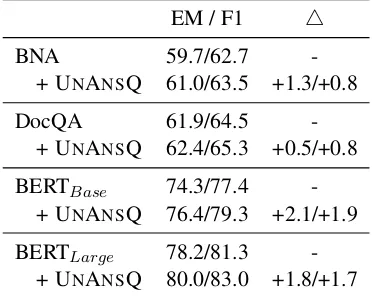
EM / F1 4
BNA 59.7/62.7
-+ UNANSQ 61.0/63.5 +1.3/+0.8
DocQA 61.9/64.5
-+ UNANSQ 62.4/65.3 +0.5/+0.8
BERTBase 74.3/77.4 -+ UNANSQ 76.4/79.3 +2.1/+1.9
BERTLarge 78.2/81.3 -+ UNANSQ 80.0/83.0 +1.8/+1.7
Table 2: Experimental results of applying data augmen-tation to reading comprehension models on the SQuAD 2.0 dataset. “4” indicates absolute improvement.
we remove the copy mechanism that restrains pre-diction tokens to the vocabulary. The results indi-cate the necessity of copying tokens from answer-able questions and paragraphs to outputs, which relieves the out-of-vocabulary problem.
Table 3shows the human evaluation results of generated unanswerable questions. We compare with the baseline method TFIDF, which uses the input answerable question to retrieve similar ques-tions towards other articles as outputs. The re-trieved questions are mostly unanswerable and readable, but they are not quite relevant to the question answering pair. Notice that being rele-vant is demonstrated to be important for data aug-mentation in further experiments on machine read-ing comprehension. Here pair-to-sequence model still outperforms sequence-to-sequence model in terms of all three metrics. But the differences in human evaluation are not as notable as in the au-tomatic metrics.
As shown in Table 4, we further randomly sample 100 system outputs to analyze the types of generated unanswerable questions. We bor-row the types defined in Rajpurkar et al. (2018)
UNANS RELA READ
TFIDF 0.96 1.52 2.98
SEQ2SEQ 0.62 2.88 2.39 PAIR2SEQ 0.65 2.95 2.61
[image:6.595.320.511.217.302.2]Human 0.95 2.96 3
Table 3: Human evaluation results. Unanswerability (UNANS): 1 for unanswerable, 0 otherwise. Related-ness (RELA): 3 for relevant to both answerable ques-tion and paragraph, 2 for relevant to only one, 1 for ir-relevant. Readability (READ): 3 for fluent, 2 for minor grammatical errors, 1 for incomprehensible.
Type S2S P2S Human
Negation 42% 54% 32%
Antonym 4% 5% 9%
Entity Swap 17% 20% 20%
Mutual Exclusion 2% 0% 12% Impossible Condition 8% 12% 25%
Other 27% 8% 2%
Table 4: Types of unanswerable questions generated by models and humans, we refer the reader to ( Ra-jpurkar et al.,2018) for detail definition of each type. “S2S” represents the sequence-to-sequence baseline and “P2S” is our proposed pair-to-sequence model.
[image:6.595.88.274.218.366.2]Title:Victoria (Australia)
Paragraph:Victorian schools are either publicly or privately funded. Public schools, also known asstate or government schools, are funded and run directly by theVictoria Department of Education. Students do not pay tuition fees, but some extra costsare levied. Private fee-paying schools include parish schools run by theRoman Catholic Churchand independent schools similar to British public schools. Independent schools are usually affiliated with Protestant churches. Victoria also has several private Jewish and Islamic primary and secondary schools. Private schools also receive some ...
Question:What organization runs the public schools in Victoria? Human:What organization runs the waste management in Victoria? SEQ2SEQ:what organization runs the public schools in texas ?
PAIR2SEQ:what organization never runs the public schools in victoria ? (Plausible) Answer:Victoria Department of Education
Question:What church runs some private schools in Victoria? Human:What church runs public schoolsin Victoria? SEQ2SEQ:what church runs some private schools ?
PAIR2SEQ:what church no longer runs some private schools in victoria ? (Plausible) Answer:Roman Catholic Church
Question:Since students do not pay tuition, what do they have to pay for schooling in Victoria? Human:What is covered by the state in addition to tuition?
SEQ2SEQ:since students do not pay to pay schooling in victoria ?
PAIR2SEQ:since students do n’t pay tuition , what do they have to pay for schooling in victoria ? (Plausible) Answer:some extra costs
Question:What are public schools in Victoria? Human:What are public banks in Victoria? SEQ2SEQ:what are n’t public schools in victoria ? PAIR2SEQ:what are public schools not in victoria ? (Plausible) Answer:state or government schools
Figure 3: Sample output generated by human, sequence-to-sequence model, and pair-to-sequence model. The (plausible) answer span of questions are marked in colors and main difference of model outputs are underlined.
be improved by incorporating external resources. In Figure3, we present a sample paragraph and its corresponding answerable questions and gen-erated unanswerable questions. In the first ex-ample, two models generate unanswerable ques-tions by swapping the location entity “Victoria” with “texas” and inserting negation word “never”, respectively. In the second example, sequence-to-sequence model omits the condition “in Victo-ria” and yields an answerable question. Pair-to-sequence model inserts the negation “no longer” properly, which is not mentioned in the para-graph. In the third example, grammatical errors are found in the output of SEQ2SEQ. The last ex-ample shows that inserting negation words in dif-ferent positions (“n’t public” versus “not in victo-ria”) can express different meanings. Such cases are critical for generated questions’ answerability, which is hard to handle in a rule-based system.
4.2 Data Augmentation for Machine Reading Comprehension
4.2.1 Question Answering Models
We apply our automatically generated unanswer-able questions as augmentation data to the
follow-ing readfollow-ing comprehension models:
BiDAF-No-Answer (BNA) BiDAF (Seo et al.,
2017) is a benchmark model on extractive ma-chine reading comprehension. Based on BiDAF,
Levy et al.(2017) propose the BiDAF-No-Answer model to predict the distribution of answer candi-dates and the probability of a question being unan-swerable at the same time.
DocQA Clark and Gardner (2018) propose the DocQA model to address document-level reading comprehension. The no-answer probability is also predicted jointly.
BERT Fine-Tuning It is the state-of-the-art model on unanswerable machine reading com-prehension. We adopt the uncased version of BERT (Devlin et al., 2019) for fine-tuning. The batch sizes of BERT-base and BERT-large are set to12and24 respectively. The rest hyperparame-ters are kept untouched as in the official instruc-tions of fine-tuning BERT-Large on SQuAD 2.0.
4.2.2 Data Augmentation Setup
EM / F1 4
BERTBase 74.3/77.4 -+ TFIDF 75.0/77.8 +0.7/+0.4 + RULE 75.6/78.5 +1.3/+1.1
[image:8.595.86.274.62.155.2]+ SEQ2SEQ 75.5/78.2 +1.2/+0.8 + PAIR2SEQ 76.4/79.3 +2.1/+1.9
Table 5: Results using different generation methods for data augmentation. “4” indicates absolute improve-ment.
the answerable questions in the SQuAD 2.0 train-ing set, besides ones aligned before, to generate unanswerable questions. Then we use the para-graph and answers of answerable questions along with the generated questions to construct training examples. At last, we have an augmentation data containing69,090unanswerable examples.
We train question answering models with aug-mentation data in two separate phases. In the first phase, we train the models by combining the aug-mentation data and all86,821SQuAD 2.0 answer-able examples. Subsequently, we use the original SQuAD 2.0 training data alone to further fine-tune model parameters.
4.2.3 Results
Exact Match (EM) and F1 are two metrics used to evaluate model performance. EM measures the percentage of predictions that match ground truth answers exactly. F1 measures the word overlap between the prediction and ground truth answers. We use pair-to-sequence model with answerable questions and paragraphs for data augmentation by default.
Table2shows the exact match and F1 scores of multiple reading comprehension models with and without data augmentation. We can see that the generated unanswerable questions can improve both specifically designed reading comprehen-sion models and strong BERT fine-tuning models, yielding1.9absolute F1 improvement with BERT-base model and1.7absolute F1 improvement with BERT-large model. Our submitted model obtains an EM score of80.75and an F1 score of83.85on the hidden test set.
As shown in Table 5, pair-to-sequence model proves to be a better option for generating aug-mentation data than other three methods. Besides the sequence-to-sequence model, we use answer-able questions to retrieve questions from other
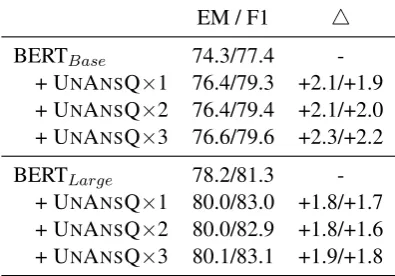
ar-EM / F1 4
BERTBase 74.3/77.4 -+ UNANSQ×1 76.4/79.3 +2.1/+1.9 + UNANSQ×2 76.4/79.4 +2.1/+2.0
+ UNANSQ×3 76.6/79.6 +2.3/+2.2
BERTLarge 78.2/81.3 -+ UNANSQ×1 80.0/83.0 +1.8/+1.7 + UNANSQ×2 80.0/82.9 +1.8/+1.6 + UNANSQ×3 80.1/83.1 +1.9/+1.8
Table 6: Ablation over the size of data augmentation. “×N” means the original size is enhanced N times. “4” indicates absolute improvement.
ticles with TFIDF. The retrieved questions are
of little help to improve the model, because they are less relevant to the paragraph as shown in Ta-ble 3. We refer to the rule-based method (Jia and Liang,2017) that swaps entities and replaces words with antonyms as RULE. In comparison to the above methods, pair-to-sequence model can yield the largest improvement.
Results in Table 6 show that enlarging the size of augmentation data can further improve model performance, especially with the BERT-base model. We conduct experiments using two and three times the size of the base augmentation data (i.e., 69,090 unanswerable questions). We generate multiple unanswerable questions for each answerable question by using beam search. Be-cause we only generate unanswerable questions, the data imbalance problem could mitigate the improvement of incorporating more augmentation data.
5 Conclusions
[image:8.595.317.515.64.202.2]unanswer-able questions can help to improve multiple read-ing comprehension models. As for future work, we would like to enhance the ability to utilize antonyms for unanswerable question generation by leveraging external resources.
Acknowledgments
We thank anonymous reviewers for their help-ful comments. Qin and Liu were supported by National Natural Science Foundation of China (NSFC) via grants 61632011 and 61772156.
References
Dzmitry Bahdanau, Kyunghyun Cho, and Yoshua Ben-gio. 2015. Neural machine translation by jointly learning to align and translate. In Proceedings of the 3rd International Conference on Learning Rep-resentations.
Kyunghyun Cho, Bart van Merrienboer, Caglar Gul-cehre, Dzmitry Bahdanau, Fethi Bougares, Holger Schwenk, and Yoshua Bengio. 2014. Learning phrase representations using RNN encoder–decoder for statistical machine translation. InProceedings of the 2014 Conference on Empirical Methods in Nat-ural Language Processing (EMNLP), pages 1724– 1734. Association for Computational Linguistics.
Christopher Clark and Matt Gardner. 2018. Simple and effective multi-paragraph reading comprehen-sion. InProceedings of the 56th Annual Meeting of the Association for Computational Linguistics (Vol-ume 1: Long Papers), pages 845–855. Association for Computational Linguistics.
Jacob Devlin, Ming-Wei Chang, Kenton Lee, and Kristina Toutanova. 2019. BERT: Pre-training of deep bidirectional transformers for language under-standing. InProceedings of the 2019 Conference of the North American Chapter of the Association for Computational Linguistics: Human Language Tech-nologies, Volume 1 (Long Papers). Association for Computational Linguistics.
Li Dong, Nan Yang, Wenhui Wang, Furu Wei, Xi-aodong Liu, Yu Wang, Jianfeng Gao, Ming Zhou, and Hsiao-Wuen Hon. 2019. Unified language model pre-training for natural language understand-ing and generation. Computing Research Reposi-tory, arXiv:1905.03197. Version 1.
Xinya Du and Claire Cardie. 2018. Harvest-ing paragraph-level question-answer pairs from wikipedia. InProceedings of the 56th Annual Meet-ing of the Association for Computational LMeet-inguistics (Volume 1: Long Papers), pages 1907–1917. Asso-ciation for Computational Linguistics.
Xinya Du, Junru Shao, and Claire Cardie. 2017. Learn-ing to ask: Neural question generation for readLearn-ing
comprehension. In Proceedings of the 55th
An-nual Meeting of the Association for Computational Linguistics (Volume 1: Long Papers), pages 1342– 1352. Association for Computational Linguistics.
John Duchi, Elad Hazan, and Yoram Singer. 2011. Adaptive subgradient methods for online learning and stochastic optimization. Journal of Machine Learning Research, 12(Jul):2121–2159.
Jiatao Gu, Zhengdong Lu, Hang Li, and Victor O.K. Li. 2016. Incorporating copying mechanism in sequence-to-sequence learning. In Proceedings of the 54th Annual Meeting of the Association for Com-putational Linguistics (Volume 1: Long Papers), pages 1631–1640. Association for Computational Linguistics.
Michael Heilman and Noah A. Smith. 2010. Good Question! Statistical ranking for question genera-tion. InHuman Language Technologies: The 2010 Annual Conference of the North American Chap-ter of the Association for Computational Linguistics, pages 609–617. Association for Computational Lin-guistics.
Karl Moritz Hermann, Tomas Kocisky, Edward Grefenstette, Lasse Espeholt, Will Kay, Mustafa Su-leyman, and Phil Blunsom. 2015. Teaching ma-chines to read and comprehend. In C. Cortes, N. D. Lawrence, D. D. Lee, M. Sugiyama, and R. Garnett, editors,Advances in Neural Information Processing Systems 28, pages 1693–1701. Curran Associates, Inc.
Sepp Hochreiter and J¨urgen Schmidhuber. 1997.
Long short-term memory. Neural Computation,
9(8):1735–1780.
Minghao Hu, Yuxing Peng, Zhen Huang, Xipeng Qiu, Furu Wei, and Ming Zhou. 2018. Reinforced mnemonic reader for machine reading comprehen-sion. In Proceedings of the Twenty-Seventh In-ternational Joint Conference on Artificial Intelli-gence, IJCAI-18, pages 4099–4106. International Joint Conferences on Artificial Intelligence Organi-zation.
Hsin-Yuan Huang, Chenguang Zhu, Yelong Shen, and Weizhu Chen. 2018. FusionNet: Fusing via fully-aware attention with application to machine compre-hension. In International Conference on Learning Representations.
Robin Jia and Percy Liang. 2017. Adversarial exam-ples for evaluating reading comprehension systems. In Proceedings of the 2017 Conference on Empiri-cal Methods in Natural Language Processing, pages 2021–2031. Association for Computational Linguis-tics.
Mandar Joshi, Eunsol Choi, Daniel Weld, and Luke Zettlemoyer. 2017. TriviaQA: A large scale dis-tantly supervised challenge dataset for reading
Meeting of the Association for Computational Lin-guistics (Volume 1: Long Papers), pages 1601– 1611. Association for Computational Linguistics.
Yanghoon Kim, Hwanhee Lee, Joongbo Shin, and Ky-omin Jung. 2019. Improving neural question gener-ation using answer separgener-ation. InAAAI Conference on Artificial Intelligence.
Guillaume Klein, Yoon Kim, Yuntian Deng, Jean Senellart, and Alexander Rush. 2017. OpenNMT: Open-source toolkit for neural machine translation. In Proceedings of ACL 2017, System Demonstra-tions, pages 67–72. Association for Computational Linguistics.
Tomas Kocisky, Jonathan Schwarz, Phil Blunsom, Chris Dyer, Karl Moritz Hermann, Gabor Melis, and Edward Grefenstette. 2018. The NarrativeQA read-ing comprehension challenge. Transactions of the Association for Computational Linguistics, 6:317– 328.
Vladimir I Levenshtein. 1966. Binary codes capable of correcting deletions, insertions, and reversals. So-viet Physics Doklady, 10(8):707–710.
Omer Levy, Minjoon Seo, Eunsol Choi, and Luke Zettlemoyer. 2017. Zero-shot relation extraction via reading comprehension. In Proceedings of the 21st Conference on Computational Natural Lan-guage Learning (CoNLL 2017), pages 333–342. As-sociation for Computational Linguistics.
Chin-Yew Lin. 2004. ROUGE: A package for auto-matic evaluation of summaries. InText Summariza-tion Branches Out.
Xiaodong Liu, Yelong Shen, Kevin Duh, and Jianfeng Gao. 2018. Stochastic answer networks for ma-chine reading comprehension. InProceedings of the 56th Annual Meeting of the Association for Compu-tational Linguistics (Volume 1: Long Papers), pages 1694–1704. Association for Computational Linguis-tics.
Thang Luong, Hieu Pham, and Christopher D. Man-ning. 2015. Effective approaches to attention-based neural machine translation. InProceedings of the 2015 Conference on Empirical Methods in Natural Language Processing, pages 1412–1421. Associa-tion for ComputaAssocia-tional Linguistics.
Courtney Napoles, Keisuke Sakaguchi, Matt Post, and Joel Tetreault. 2015. Ground truth for grammati-cal error correction metrics. InProceedings of the 53rd Annual Meeting of the Association for Compu-tational Linguistics and the 7th International Joint Conference on Natural Language Processing (Vol-ume 2: Short Papers), pages 588–593. Association for Computational Linguistics.
Tri Nguyen, Mir Rosenberg, Xia Song, Jianfeng Gao, Saurabh Tiwary, Rangan Majumder, and Li Deng. 2016. MS MARCO: A human generated machine
reading comprehension dataset. Computing
Re-search Repository, arXiv:1611.09268. Version 3.
Kishore Papineni, Salim Roukos, Todd Ward, and Wei-Jing Zhu. 2002. Bleu: a method for automatic eval-uation of machine translation. InProceedings of the 40th Annual Meeting of the Association for Compu-tational Linguistics.
Jeffrey Pennington, Richard Socher, and Christopher Manning. 2014. Glove: Global vectors for word representation. In Proceedings of the 2014 Con-ference on Empirical Methods in Natural Language Processing (EMNLP), pages 1532–1543. Associa-tion for ComputaAssocia-tional Linguistics.
Pranav Rajpurkar, Robin Jia, and Percy Liang. 2018.
Know what you don’t know: Unanswerable ques-tions for SQuAD. InProceedings of the 56th Annual Meeting of the Association for Computational Lin-guistics (Volume 2: Short Papers), pages 784–789. Association for Computational Linguistics.
Pranav Rajpurkar, Jian Zhang, Konstantin Lopyrev, and Percy Liang. 2016.SQuAD: 100,000+ questions for machine comprehension of text. InProceedings of the 2016 Conference on Empirical Methods in Nat-ural Language Processing, pages 2383–2392. Asso-ciation for Computational Linguistics.
Abigail See, Peter J. Liu, and Christopher D. Manning. 2017.Get to the point: Summarization with pointer-generator networks. InProceedings of the 55th An-nual Meeting of the Association for Computational Linguistics (Volume 1: Long Papers), pages 1073– 1083. Association for Computational Linguistics.
Minjoon Seo, Aniruddha Kembhavi, Ali Farhadi, and Hannaneh Hajishirzi. 2017. Bidirectional attention flow for machine comprehension. InInternational Conference on Learning Representations.
Linfeng Song, Zhiguo Wang, Wael Hamza, Yue Zhang, and Daniel Gildea. 2018. Leveraging context infor-mation for natural question generation. In Proceed-ings of the 2018 Conference of the North American Chapter of the Association for Computational Lin-guistics: Human Language Technologies, Volume 2 (Short Papers), pages 569–574. Association for Computational Linguistics.
Kai Sun, Dian Yu, Dong Yu, and Claire Cardie. 2019. Improving machine reading comprehension with general reading strategies. In Proceedings of the 2019 Conference of the North American Chapter of the Association for Computational Linguistics: Hu-man Language Technologies, Volume 1 (Long Pa-pers). Association for Computational Linguistics.
Xingwu Sun, Jing Liu, Yajuan Lyu, Wei He, Yan-jun Ma, and Shi Wang. 2018. Answer-focused and position-aware neural question generation. In Pro-ceedings of the 2018 Conference on Empirical Meth-ods in Natural Language Processing, pages 3930– 3939. Association for Computational Linguistics.
is no answer: Modeling answer validation for ma-chine reading comprehension. InNatural Language Processing and Chinese Computing, pages 85–97, Cham. Springer International Publishing.
Shuohang Wang and Jing Jiang. 2017. Machine com-prehension using Match-LSTM and answer pointer. InInternational Conference on Learning Represen-tations.
Wei Wang, Ming Yan, and Chen Wu. 2018. Multi-granularity hierarchical attention fusion networks for reading comprehension and question answering. In Proceedings of the 56th Annual Meeting of the Association for Computational Linguistics (Volume 1: Long Papers), pages 1705–1714. Association for Computational Linguistics.
Wenhui Wang, Nan Yang, Furu Wei, Baobao Chang, and Ming Zhou. 2017. Gated self-matching net-works for reading comprehension and question an-swering. InProceedings of the 55th Annual Meet-ing of the Association for Computational LMeet-inguistics (Volume 1: Long Papers), pages 189–198. Associa-tion for ComputaAssocia-tional Linguistics.
Caiming Xiong, Victor Zhong, and Richard Sochern. 2017. Dynamic coattention networks for question answering. InInternational Conference on Learn-ing Representations.
Zhilin Yang, Junjie Hu, Ruslan Salakhutdinov, and William Cohen. 2017. Semi-supervised QA with generative domain-adaptive nets. In Proceedings of the 55th Annual Meeting of the Association for Computational Linguistics (Volume 1: Long Pa-pers), pages 1040–1050. Association for Computa-tional Linguistics.
Kaichun Yao, Libo Zhang, Tiejian Luo, Lili Tao, and Yanjun Wu. 2018. Teaching machines to ask ques-tions. In Proceedings of the Twenty-Seventh In-ternational Joint Conference on Artificial Intelli-gence, IJCAI-18, pages 4546–4552. International Joint Conferences on Artificial Intelligence Organi-zation.
Wen-tau Yih, Ming-Wei Chang, Christopher Meek, and Andrzej Pastusiak. 2013. Question answering us-ing enhanced lexical semantic models. In Proceed-ings of the 51st Annual Meeting of the Association for Computational Linguistics (Volume 1: Long Pa-pers), pages 1744–1753. Association for Computa-tional Linguistics.
Adams Wei Yu, David Dohan, Quoc Le, Thang Luong, Rui Zhao, and Kai Chen. 2018. Fast and accurate reading comprehension by combining self-attention and convolution. In International Conference on Learning Representations.
Xingdi Yuan, Tong Wang, Caglar Gulcehre, Alessan-dro Sordoni, Philip Bachman, Saizheng Zhang, Sandeep Subramanian, and Adam Trischler. 2017.
Machine comprehension by text-to-text neural ques-tion generaques-tion. InProceedings of the 2nd Workshop
on Representation Learning for NLP, pages 15–25. Association for Computational Linguistics.
Qingyu Zhou, Nan Yang, Furu Wei, Chuanqi Tan, Hangbo Bao, and Ming Zhou. 2018. Neural ques-tion generaques-tion from text: A preliminary study. In