5101
Simple Unsupervised Summarization by Contextual Matching
Jiawei Zhou Harvard University
Alexander M. Rush Harvard University
Abstract
We propose an unsupervised method for sen-tence summarization using only language modeling. The approach employs two lan-guage models, one that is generic (i.e. pre-trained), and the other that is specific to the tar-get domain. We show that by using a product-of-experts criteria these are enough for main-taining continuous contextual matching while maintaining output fluency. Experiments on both abstractive and extractive sentence sum-marization data sets show promising results of our method without being exposed to any paired data.
1 Introduction
Automatic text summarization is the process of formulating a shorter output text than the origi-nal while capturing its core meaning. We study the problem of unsupervised sentence summa-rization with no paired examples. While data-driven approaches have achieved great success based on various powerful learning frameworks such as sequence-to-sequence models with atten-tion (Rush et al.,2015;Chopra et al.,2016; Nalla-pati et al.,2016), variational auto-encoders (Miao and Blunsom,2016), and reinforcement learning (Paulus et al., 2017), they usually require a large amount of parallel data for supervision to do well. In comparison, the unsupervised approach reduces the human effort for collecting and annotating large amount of paired training data.
Recently researchers have begun to study the unsupervised sentence summarization tasks. These methods all use parameterized unsuper-vised learning methods to induce a latent vari-able model: for example Schumann (2018) uses a length controlled variational autoencoder,Fevry and Phang(2018) use a denoising autoencoder but only for extractive summarization, andWang and
Lee (2018) apply a reinforcement learning pro-cedure combined with GANs, which takes a fur-ther step to the goal ofMiao and Blunsom(2016) using language as latent representations for semi-supervised learning.
This work instead proposes a simple approach to this task that does not require any joint training. We utilize a generic pretrained language model to enforce contextual matching between sentence prefixes. We then use a smoothed problem spe-cific target language model to guide the fluency of the generation process. We combine these two models in a product-of-experts objective. This ap-proach does not require any task-specific training, yet experiments show results on par with or better than the best unsupervised systems while produc-ing qualitatively fluent outputs. The key aspect of this technique is the use of a pretrained language model for unsupervised contextual matching, i.e. unsupervised paraphrasing.
2 Model Description
Intuitively, a sentence summary is a shorter sen-tence that covers the main point succinctly. It should satisfy the following two properties (simi-lar toPitler(2010)): (a) Faithfulness: the sequence is close to the original sentence in terms of mean-ing; (b) Fluency: the sequence is grammatical and sensible to the domain.
We propose to enforce the criteria using a product-of-experts model (Hinton,2002),
P(y|x)∝pcm(y|x)pfm(y|x)λ, |y| ≤ |x| (1)
useλas a hyper-parameter to balance the two ex-pert models.
We consider this distribution (1) being defined over all possibleywhose tokens are restricted to a candidate listC determined byx. For extractive summarization,Cis the set of word types inx. For abstractive summarization,C consists of relevant word types to x by taking K closest word types from a full vocabulary V for each source token measured by pretrained embeddings.
2.1 Contextual Matching Model
The first expert, pcm(y|x), tracks how close y is to the original input x in terms of a contex-tual ”trajectory”. We use a pretrained language model to define the left-contextual representations for both the source and target sequences. Define S(x1:m, y1:n) to be the contextual similarity be-tween a source and target sequence of length m andn respectively under this model. We imple-ment this as the cosine-similarity of a neural lan-guage model’s final states with inputs x1:m and y1:n. This approach relies heavily on the observed property that similar contextual sequences often correspond to paraphrases. If we can ensure close contextual matching, it will keep the output faith-ful to the original.
We use this similarity function to specify a gen-erative process over the token sequencey,
pcm(y|x) = N
Y
n=1
qcm(yn|y<n,x).
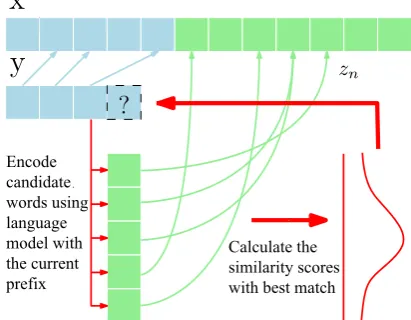
The generative process aligns each target word to a source prefix. At the first step,n = 1, we com-pute a greedy alignment score for each possible word w ∈ C, sw = maxj≥1S(x1:j, w) for all source prefixes up to length j. The probability qcm(y1 = w|x) is computed as softmax(s) over all target words. We also store the aligned context z1= arg maxj≥1S(x1:j, y1).
For future words, we ensure that the alignment is strictly monotonic increasing, such that zn < zn+1for alln. Monotonicity is a common assump-tion in summarizaassump-tion (Yu et al., 2016a,b;Raffel et al.,2017). For n > 1 we compute the align-ment scoresw = maxj>zn−1S(x1:j,[y1:n−1, w])
to only look at prefixes longer thanzn−1, the last greedy alignment. Since the distribution condi-tions on y the past alignments are deterministic to compute (and can be stored). The main com-putational cost is in extending the target language
?
zn
x
y
Encode candidate words using language model with the current prefix
[image:2.595.312.518.66.226.2]Calculate the similarity scores with best match
Figure 1: Generative process of the contextual match-ing model.
model context to computeS.
This process is terminated when a sampled to-ken in y is aligned to the end of the source se-quence x, and the strict monotonic increasing alignment constraint guarantees that the target quence will not be longer than the source se-quence. The generative process of the above model is illustrated in Fig.1.
2.2 Domain Fluency Model
The second expert,pfm(y|x), accounts for the flu-ency of y with respect to the target domain. It directly is based on a domain specific language model. Its role is to adapt the output to read closer shorter sentences common to the summarization domain. Note that unlike the contextual match-ing model where y explicitly depends on x in its generative process, in the domain fluency lan-guage model, the dependency ofyonxis implicit through the candidate setC that is determined by the specific source sequencex.
The main technical challenge is that the prob-abilities of a pretrained language model are not well-calibrated with the contextual matching model within the candidate setC, and so the lan-guage model tends to dominate the objective be-cause it has much higher variance (more peaky) in the output distribution than the contextual match-ing model. To manage this issue we apply ker-nel smoothing over the language model to adapt it from the full vocabV down to the candidate word listC.
Aurenham-mer,1991) over all the embeddings using the can-didate set C. That is, each word type w0 in the full vocabulary V is exactly assigned to one re-gion represented by a word typew in the candi-date set C, such that the distance from w0 to w is not greater than its distance to any other word types inC. As above, we use cosine similarity be-tween corresponding word embeddings to define the regions. This results in a partition of the full vocabulary space into|C|distinct regions, called Voronoi cells. For each word typew ∈C, we de-fineN(w) to be the Voronoi cell formed around it. We then use cluster smoothing to define a new probability distribution:
pfm(y|x) = N
Y
n=1
X
w0∈N(y
n)
lm(w0|y<n)
where lm is the conditional probability distribu-tion of the pretrained domain fluency language model. By our construction,pfmis a valid distribu-tion over the candidate listC. The main benefit is that it redistributes probability mass lost to terms in V to the active words in C. We find this ap-proach smoothing balances integration withpcm.
2.3 Summary Generation
To generate summaries we maximize the log prob-ability (1) to approximatey∗ using beam search. We begin with a special start token. A sequence is moved out of beam if it has aligned to the end token appended to the source sequence. To discourage extremely short sequences, we apply length normalization to re-rank the finished hy-potheses. We choose a simple length penalty as lp(y) =|y|+αwithαa tuning parameter.
3 Experimental Setup
For the contextual matching model’s similarity functionS, we adopt the forward language model of ELMo (Peters et al.,2018) to encode tokens to corresponding hidden states in the sequence, re-sulting in a three-layer representation each of di-mension 512. The bottom layer is a fixed char-acter embedding layer, and the above two layers are LSTMs associated with the generic unsuper-vised language model trained on a large amount of text data. We explicitly manage the ELMo hid-den states to allow our model to generate con-textual embeddings sequentially for efficient beam
search.1 The fluency language model component
lmis task specific, and pretrained on a corpus of summarizations. We use an LSTM model with 2 layers, both embedding size and hidden size set to 1024. It is trained using dropout rate 0.5 and SGD combined with gradient clipping.
We test our method on both abstractive and ex-tractive sentence summarization tasks. For ab-stractive summarization, we use the English Giga-word data set pre-processed byRush et al.(2015). We trainpfm using its 3.8 million headlines in the training set, and generate summaries for the in-put in test set. For extractive summarization, we use the Google data set from Filippova and Al-tun (2013). We train pfm on 200K compressed sentences in the training set and test on the first 1000 pairs of evaluation set consistent with pre-vious works. For generation, we set λ = 0.11
in (1) and beam size to 10. Each source sentence is tokenized and lowercased, with periods deleted and a special end of sentence token appended. In abstractive summarization, we useK = 6in the candidate list and use the fixed embeddings at the bottom layer of ELMo language model for simi-larity. LargerK has only small impact on perfor-mance but makes the generation more expensive. The hyper-parameterα for length penalty ranges from -0.1 to 0.1 for different tasks, mainly for de-sired output length as we find ROUGE scores are not sensitive to it. We use concatenation of all ELMo layers as default inpcm.
4 Results and Analysis
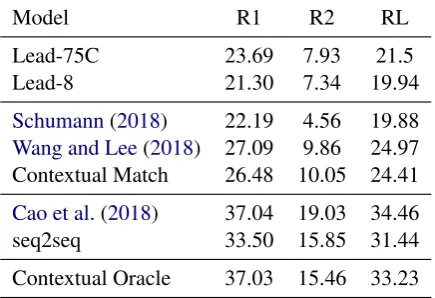
Quantitative Results. The automatic evaluation scores are presented in Table1 and Table2. For abstractive sentence summarization, we report the ROUGE F1 scores compared with baselines and previous unsupervised methods. Our method out-performs commonly used prefix baselines for this task which take the first 75 characters or 8 words of the source as a summary. Our system achieves comparable results toWang and Lee(2018) a sys-tem based on both GANs and reinforcement train-ing. Note that the GAN-based system needs both source and target sentences for training (they are unpaired), whereas our method only needs the target domain sentences for a simple language model. In Table1, we also list scores of the state-of-the-art supervised model, an attention based
1Code available at https://github.com/jzhou316/Unsuper
Model R1 R2 RL
Lead-75C 23.69 7.93 21.5
Lead-8 21.30 7.34 19.94
Schumann(2018) 22.19 4.56 19.88
Wang and Lee(2018) 27.09 9.86 24.97
Contextual Match 26.48 10.05 24.41
Cao et al.(2018) 37.04 19.03 34.46
seq2seq 33.50 15.85 31.44
[image:4.595.73.291.64.213.2]Contextual Oracle 37.03 15.46 33.23
Table 1: Experimental results of abstractive summa-rization on Gigaword test set with ROUGE metric. The top section is prefix baselines, the second section is re-cent unsupervised methods and ours, the third section is state-of-the-art supervised method along with our implementation of a seq-to-seq model with attention, and the bottom section is our model’s oracle perfor-mance. Wang and Lee(2018) is by author correspon-dence (scores differ because of evaluation setup). For another unsupervised work Fevry and Phang (2018), we attempted to replicate on our test set, but were un-able to obtain results better than the baselines.
Model F1 CR
F&A Unsupervised 52.3
-Contextual Match 60.90 0.38
Filippova et al.(2015) 82.0 0.38 Zhao et al.(2018) 85.1 0.39
Table 2: Experimental results of extractive summariza-tion on Google data set. F1 is the token overlapping score, and CR is the compression rate. F&A is an unsu-pervised baseline used inFilippova and Altun(2013), and the bottom section is supervised results.
seq-to-seq model of our own implementation, as well as the oracle scores of our method obtained by choosing the best summary among all finished hypothesis from beam search. The oracle scores are much higher, indicating that our unsupervised method does allow summaries of better quality, but with no supervision it is hard to pick them out with any unsupervised metric. For extractive sen-tence summarization, our method achieves good compression rate and significantly raises a previ-ous unsupervised baseline on token level F1 score.
Analysis. Table 3 considers analysis of differ-ent aspects of the model. First, we look at the fluency model and compare the cluster smoothing
abstractive extractive
Models R1 R2 RL F1 CR
CS + cat 26.48 10.05 24.41 60.90 0.38 CS + avg 26.34 9.79 24.23 60.09 0.38 CS + top 26.21 9.69 24.14 62.18 0.34 CS + mid 25.46 9.39 23.34 59.32 0.40 CS + bot 15.29 3.95 14.06 21.14 0.23
TEMP5 + cat 26.31 9.38 23.60 52.10 0.43 TEMP10 + cat 25.63 8.82 22.86 42.33 0.47 NA + cat 24.81 8.89 22.87 49.80 0.32
Table 3: Comparison of different model choices. The top section evaluates the effects of contextual represen-tation in the matching model, and the bottom section evaluates the effects of different smoothing methods in the fluency model.
(CS) approach with softmax temperature (TEMPx with x being the temperature) commonly used for generation in LM-integrated models (Chorowski and Jaitly,2016) as well as no adjustment (NA). Second, we vary the 3-layer representation out of ELMo forward language model to do contextual matching (bot/mid/top: bottom/middle/top layer only, avg: average of 3 layers, cat: concatenation of all layers).
Results show the effectiveness of our clus-ter smoothing method for the vocabulary adap-tive language model pfm, although temperature smoothing is an option for abstractive datasets. Additionally Contextual embeddings have a huge impact on performance. When using word em-beddings (bottom layer only from ELMo language model) in our contextual matching modelpcm, the summarization performance drops significantly to below simple baselines as demonstrated by score decrease. This is strong evidence that encoding in-dependent tokens in a sequence with generic lan-guage model hidden states helps maintain the con-textual flow. Experiments also show that even when only using pcm (by setting λ = 0), uti-lizing the ELMo language model states allows the generated sequence to follow the source x closely, whereas normal context-free word embed-dings would fail to do so.
[image:4.595.90.271.384.470.2]I: japan ’s nec corp. and UNK computer corp. of the united states said wednesday they had agreed to join forces in supercomputer sales
G: nec UNK in computer sales tie-up
s2s: nec UNK to join forces in supercomputer sales GAN: nec corp. to join forces in sales
CM (cat): nec agrees to join forces in supercomputer sales
CM (top): nec agrees to join forces in computer sales CM (bot): nec to join forces in supercomputer sales
I: turnout was heavy for parliamentary elections monday in trinidad and tobago after a month of intensive cam-paigning throughout the country , one of the most pros-perous in the caribbean
G: trinidad and tobago poll draws heavy turnout by john babb
s2s: turnout heavy for parliamentary elections in trinidad and tobago
GAN: heavy turnout for parliamentary elections in trinidad
CM (cat): parliamentary elections monday in trinidad and tobago
CM (top): turnout is hefty for parliamentary elections in trinidad and tobago
CM (bot): trinidad and tobago most prosperous in the caribbean
I: a consortium led by us investment bank goldman sachs thursday increased its takeover offer of associated british ports holdings , the biggest port operator in britain , after being threatened with a possible rival bid
G: goldman sachs increases bid for ab ports
s2s: goldman sachs ups takeover offer of british ports GAN: us investment bank increased takeover offer of british ports
CM (cat): us investment bank goldman sachs increases shareholdings
CM (top): investment bank goldman sachs increases in-vestment in britain
CM (bot): britain being threatened with a possible bid
Table 4: Abstractive sentence summary examples on Gigaword test set. I is the input, G is the reference, s2s is a supervised attention based seq-to-seq model, GAN is the unsupervised system fromWang and Lee(2018), and CM is our unsupervised model. The third example is a failure case we picked where the sentence is fluent and makes sense but misses the point as a summary.
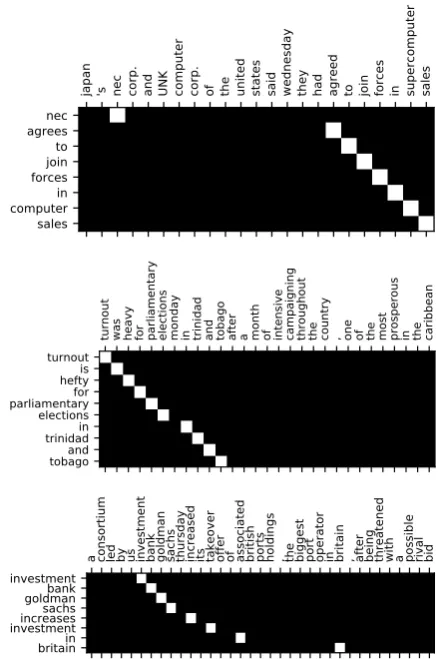
layer only. Our generation has fairly good quali-ties, and it can correct verb tenses and paraphrase automatically. Note that top representation actu-ally finds more abstractive summaries (such as in example 2), and the bottom representation fails to focus on the proper context. The failed exam-ples are mostly due to missing the main point, as in example 3, or the summary needs to re-order tokens in the source sequence. Moreover, as a byproduct, our unsupervised method naturally generates hard alignments between summary and source sentences in the contextual matching pro-cess. We show some examples in Figure2
corre-japan 's nec corp. and UNK computer corp. of the united states said wednesday they had agreed to join forces in supercomputer sales
nec agrees to join forces in computer sales
turnout was heavy for parliamentary elections monday in trinidad and tobago after a month of intensive campaigning throughout the country , one of the most prosperous in the caribbean
turnoutis hefty for parliamentary elections in trinidad and tobago
a consortium led by us investment bank goldman sachs thursday increased its takeover offer of associated british ports holdings , the biggest port operator in britain , after being threatened with a possible rival bid
[image:5.595.308.528.66.396.2]investmentbank goldmansachs increases investmentinbritain
Figure 2: Examples of alignment results generated by our unsupervised method between the abstractive sum-maries and corresponding source sentences in the Gi-gaword test set.
sponding to the sentences in Table4.
5 Conclusion
We propose a novel methodology for unsupervised sentence summarization using contextual match-ing. Previous neural unsupervised works mostly adopt complex encoder-decoder frameworks. We achieve good generation qualities and competitive evaluation scores. We also demonstrate a new way of utilizing pre-trained generic language models for contextual matching in untrained generation. Future work could be comparing language models of different types and scales in this direction.
Acknowledgements
References
Franz Aurenhammer. 1991. Voronoi diagramsa sur-vey of a fundamental geometric data structure. ACM Computing Surveys (CSUR), 23(3):345–405.
Ziqiang Cao, Wenjie Li, Sujian Li, and Furu Wei. 2018. Retrieve, rerank and rewrite: Soft template based neural summarization. In Proceedings of the 56th Annual Meeting of the Association for Computa-tional Linguistics (Volume 1: Long Papers), pages 152–161.
Sumit Chopra, Michael Auli, and Alexander M Rush. 2016. Abstractive sentence summarization with at-tentive recurrent neural networks. InProceedings of the 2016 Conference of the North American Chap-ter of the Association for Computational Linguistics: Human Language Technologies, pages 93–98.
Jan Chorowski and Navdeep Jaitly. 2016. Towards better decoding and language model integration in sequence to sequence models. arXiv preprint arXiv:1612.02695.
Thibault Fevry and Jason Phang. 2018. Unsuper-vised sentence compression using denoising auto-encoders. arXiv preprint arXiv:1809.02669.
Katja Filippova, Enrique Alfonseca, Carlos A Col-menares, Lukasz Kaiser, and Oriol Vinyals. 2015. Sentence compression by deletion with lstms. In
Proceedings of the 2015 Conference on Empirical Methods in Natural Language Processing, pages 360–368.
Katja Filippova and Yasemin Altun. 2013. Overcom-ing the lack of parallel data in sentence compression.
Geoffrey E Hinton. 2002. Training products of experts by minimizing contrastive divergence. Neural com-putation, 14(8):1771–1800.
Yishu Miao and Phil Blunsom. 2016. Language as a latent variable: Discrete generative mod-els for sentence compression. arXiv preprint arXiv:1609.07317.
Ramesh Nallapati, Bowen Zhou, Caglar Gulcehre, Bing Xiang, et al. 2016. Abstractive text summa-rization using sequence-to-sequence rnns and be-yond.arXiv preprint arXiv:1602.06023.
Romain Paulus, Caiming Xiong, and Richard Socher. 2017. A deep reinforced model for abstractive sum-marization.arXiv preprint arXiv:1705.04304.
Matthew E Peters, Mark Neumann, Mohit Iyyer, Matt Gardner, Christopher Clark, Kenton Lee, and Luke Zettlemoyer. 2018. Deep contextualized word rep-resentations. arXiv preprint arXiv:1802.05365.
Emily Pitler. 2010. Methods for sentence compression.
Colin Raffel, Minh-Thang Luong, Peter J Liu, Ron J Weiss, and Douglas Eck. 2017. Online and linear-time attention by enforcing monotonic alignments.
arXiv preprint arXiv:1704.00784.
Alexander M Rush, Sumit Chopra, and Jason We-ston. 2015. A neural attention model for ab-stractive sentence summarization. arXiv preprint arXiv:1509.00685.
Raphael Schumann. 2018. Unsupervised abstrac-tive sentence summarization using length con-trolled variational autoencoder. arXiv preprint arXiv:1809.05233.
Yau-Shian Wang and Hung-Yi Lee. 2018. Learning to encode text as human-readable summaries us-ing generative adversarial networks. arXiv preprint arXiv:1810.02851.
Lei Yu, Phil Blunsom, Chris Dyer, Edward Grefen-stette, and Tomas Kocisky. 2016a. The neural noisy channel. arXiv preprint arXiv:1611.02554.
Lei Yu, Jan Buys, and Phil Blunsom. 2016b. On-line segment to segment neural transduction. arXiv preprint arXiv:1609.08194.