288
Transfer Learning Based Free-Form Speech Command Classification for
Low-Resource Languages
Yohan Karunanayake
University of Moratuwa Sri Lanka
Uthayasanker Thayasivam
University of Moratuwa Sri Lanka
Surangika Ranathunga
University of Moratuwa Sri Lanka
Abstract
Current state-of-the-art speech-based user in-terfaces use data intense methodologies to rec-ognize free-form speech commands. However, this is not viable for low-resource languages, which lack speech data. This restricts the us-ability of such interfaces to a limited num-ber of languages. In this paper, we propose a methodology to develop a robust domain-specific speech command classification system for low-resource languages using speech data of a high-resource language. In this transfer learning-based approach, we used a Convolu-tion Neural Network (CNN) to identify a fixed set of intents using an ASR-based character probability map. We were able to achieve sig-nificant results for Sinhala and Tamil datasets using an English based ASR, which attests the robustness of the proposed approach.
.
1 Introduction
Speech command recognizable user interfaces are becoming popular since they are more natural for end-users to interact with. Google Assis-tant1, and Amazon Alexa2 can be highlighted as few such commercial services, which are rang-ing from smartphones to home automation. These are capable of identifying the intent of free-form speech commands given by the user. To enable this kind of service, Automatic Speech Recogni-tion (ASR) systems and Natural Language Under-standing (NLU) systems work together with a very high level of accuracy (Ram et al.,2018).
If ASR or NLU components have suboptimal results, it directly affects the final output (Yaman et al., 2008; Rao et al., 2018). Hence, to get good results in ASR systems, it is common to use
1
https://assistant.google.com
2https://developer.amazon.com/alexa
very large speech corpora (Hannun et al., 2014;
Amodei et al., 2016; Chiu et al., 2018). How-ever, low-resource languages (LRL) do not have this luxury. Here, languages that have a lim-ited presence on the Internet and those that lack electronic resources for speech and/or language processing are referred to as low-resource lan-guages (LRLs) (Besacier et al.,2014). Because of this reason despite the applicability, speech-based user interfaces are limited to common languages. For LRLs researchers have focused on narrower scopes such as recognition of digits or keywords (Manamperi et al.,2018;Chen et al.,2015). How-ever, free-form commands are difficult to manage in this way since there can be overlappings be-tween commands.
Buddhika et al.(2018);Chen et al.(2018) show some direct speech classification approaches to its intents. In particular, Buddhika et al.(2018) have given some attention for the low resource setting. Additionally, Transfer learning is used to exploit the issue of limited data in some of the ASR based research (Huang et al.,2013;Kunze et al.,2017). In this paper, we present an improved and effec-tive methodology to classify domain-specific free-form speech commands while utilizing this direct classification and transfer learning approaches. Here, we use a character probability map from an ASR model trained on English to identify intents. Performance of this methodology is evaluated us-ing Sinhala (Buddhika et al.,2018) and newly col-lected Tamil datasets. The proposed approach can reach to a reasonable accuracy using limited train-ing data.
Rest of the paper is organized as follows. Sec-tion 2 presents related work, section3 describes methodology used. Section4and5 provides de-tails of the datasets and experiments. Section 6
2 Related Work
Most of the previous research has used separate ASR and NLU components to classify speech in-tents. In this approach, transcripts generated from the ASR module are fed as input for a separate text classifier (Yaman et al.,2008;Rao et al.,2018). Here, an erroneous transcript from the ASR mod-ule can affect the final results of this cascaded sys-tem (Yaman et al.,2008;Rao et al.,2018). In this approach, two separately trained subsystems are connected to work jointly. As a solution for these issues, Yaman et al.(2008) proposed a joint opti-mization technique and use of the n-best list of the ASR output. LaterHe and Deng(2013) extended this work by developing a generalized framework. However, these systems require a large amount of speech data, corresponding transcript, and their class labels. Further, the ASR component used in these systems requires language models and phoneme dictionaries to function, which are dif-ficult to find for low-resource languages.
This cascading approach is effective when there is a highly accurate ASR in the target language.
Rao et al.(2018) present such a system to navigate in an entertainment platform for English. Here, they have used a separate ASR system to convert speech into text. More importantly, they highlight that a lower performance of ASR affects the entire system.
More recently, researchers have presented some approaches that aim to go beyond cascading ASR components. In this way, they have tried to elim-inate the use of intermediate text representations and have used automatically generated acoustic level features for classification. Liu et al.(2017) proposed topic identification in speech without the need for manual transcriptions and phoneme dictionaries. Here, the input features are bottle-neck features extracted from a conventional ASR system trained with transcribed multilingual data. Then these features are classified through CNN and SVM classifiers. Additionally Lee et al.
(2015) have highlighted that effectiveness of this kind of bottleneck features of speech when com-paring different speech queries.
Chen et al. (2018); Buddhika et al. (2018) present two different direct classification ap-proaches to determine the intent of a given spo-ken utterance. Chen et al. (2018) have used a neural network based acoustic model and a CNN based classifier. However, this requires transcripts
of the speech data to train the acoustic model, thus accuracy depends on the availability of a large amount of speech data. One advantage of this approach is that we can optimize the final model once we combined the two models. Bud-dhika et al. (2018) classified speech directly us-ing MFCC (Mel-frequency Cepstral Coefficients) of the speech signals as features. In this approach, they have used only 10 hours of speech data to achieve reasonable accuracy.
3 Methodology
In section2, we showed that research work ofLiu et al. (2017);Chen et al. (2018); Buddhika et al.
(2018) has benefited from direct speech classifica-tion approach. Addiclassifica-tionally, as shown in the work of Lee et al.(2015);Liu et al.(2017), it is bene-ficial to use automatically discovered acoustic re-lated features. Therefore our key idea is reusing a well trained ASR neural network on high re-source language as a feature transformation mod-ule. This is known as transfer learning (Pan and Yang, 2010). Here, we try to reuse the knowl-edge learned from one task to another associated task. Current well trained neural network based end-to-end ASR models are capable of convert-ing given spoken utterance into the correspondconvert-ing character sequence. Therefore these ASR models can convert speech into some character represen-tation. Our approach is to reuse this ability in low-resource speech classification.
We used DeepSpeech (DS) (Hannun et al.,
2014) model as the ASR model. DS model con-sists of 5 hidden layers including a bidirectional recurrent layer. Input for the model is a time-series of audio features for every timeslice. MFCC coefficients are used as features. Model converts this input sequence x(i) into a sequence of
char-acter probabilitiesy(i), withyˆt = P(ct|x), where
ct=∈ {a, b, c, .., z, space, apostrophe, blank}in English model. These probability values are cal-culated by a softmax layer. Finally, the corre-sponding transcript is generated using the proba-bilities via beam search decoding with or without combining a language model.
bi-directional recurrent layer, which is very critical for detecting sequence features in speech. With-out this layer, the model is useless (Hannun et al.,
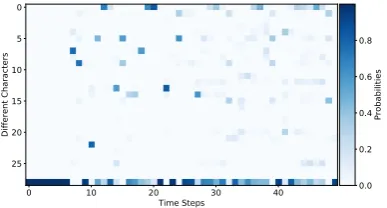
2014;Amodei et al.,2016). Hence, the only pos-sible way to extract features is after the softmax layer. Additionally, this layer provides normal-ized probability values for each time step. Figure
1shows a visualization of this intermediate char-acter probability map for a Sinhala speech query containing ‘ෙ ෂය යද - ´s¯es.aya k¯ıyada’.
0 10 20 30 40
Time Steps 0
5
10
15
20
25
Different Characters
0.0 0.2 0.4 0.6 0.8
[image:3.595.327.490.64.306.2]Probabilities
Figure 1: Visualization of probability output for Sin-hala utterance
In this considering scenario, we need to identify a fixed set of intents related to a specific domain. Instead of converting these probability values into a text representation, we classify these obtained features directly in to intents as in (Liu et al.,
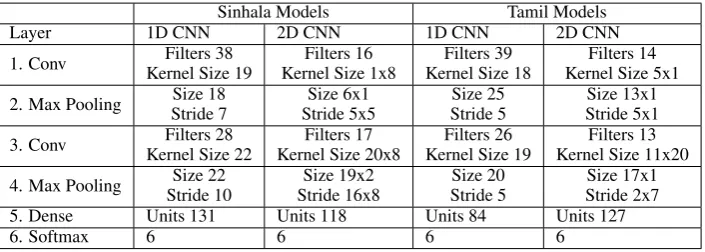
2017;Chen et al., 2018). We experimented with different classifier models such as Support Vector Machines (SVM), Feed Forward Networks (FFN), which used in previous works. Further, in the work of Liu et al.(2017);Chen et al.(2018), they have shown the effectiveness of Convolutional Neural Networks - CNN to classify intermediate features of the speech. Because of this, we evaluated the performance of CNN. Additionally, We exam-ined the effectiveness of 1-dimensional(1D) and 2-dimensional(2D) convolution for feature classifi-cation. Figure2shows the architecture of the final CNN based model. Please refer to ‘Supplementary Material’ for the detail of model parameters.
4 Datasets
We used two different free-form speech command datasets to measure the accuracy of the proposed methodology. The first one is a Sinhala dataset and contains audio clips in the banking domain ( Bud-dhika et al., 2018). Since it was difficult to find such other datasets for low-resource languages, we created another dataset in the Tamil language,
Frozen DeepSpeech
Layers Conv 1D/2D Max Pooling Conv 1D/2D Max Pooling Dense (d)
Intent
Intermediate Feature Map
MFCC Feature Vectors Low-resource Classifier
[image:3.595.85.279.221.325.2]Softmax (s)
Figure 2: Architecture of the final model
which contains the same intentions as Sinhala dataset. Both Sinhala and Tamil are morpholog-ically different languages. Table1summarizes the details.
Intent Sinhala Tamil
I S I S
1. Request Acc. balance 8 1712 7 101
2. Money deposit 7 1306 7 75
3. Money withdraw 8 1548 5 62
4. Bill payments 5 1004 4 46
5. Money transfer 7 1271 4 49
6. Credit card payments 4 795 4 67
Total 39 7624 31 400
Unique words 32 46
Table 1: Details of the data sets (I-Inflections, S-Number of samples)
Original Sinhala dataset contained 10 hours of speech data from 152 males and 63 females stu-dents in the age between 20 to 25 years. We had to revalidate the dataset since it included some miss-classified, too lengthy and erroneous speech queries. The final data set contained 7624 sam-ples totaling 7.5 hours. Tamil dataset contains 0.5 hours of speech data from 40 males and females students in the same age group. There were 400 samples in the Tamil dataset. The length of each audio clip is less than 7 seconds.
5 Experiments
[image:3.595.309.517.409.514.2]Benchmark Current
Approach SVM 6L FFN TL + SVM TL + FFN TL + 1D CNN TL + 2D CNN
Features MFCC DS Intermediate
Accuracy Sinhala 48.79% 63.23% 70.04% 74.67% 93.16% 92.09%
[image:4.595.97.490.60.117.2]Accuracy Tamil 29.25% 26.98% 23.77% 35.50% 37.57% 76.30%
Table 2: Summary of results with different approaches and overall accuracy values
This model and some other neural network based ASR modes provide a probability map for each character in each time step. Due to high compu-tational demand for training, we adopted an al-ready available pre-trained DS model by Mozilla3. This model uses the first 26 MFCC features as input. Model is trained on American English and achieves an 11% word error rate on the Lib-riSpeech clean test corpus.
Given the DS English model, we extract the in-termediate probability features for a given speech sample and then fed them into the classifier. Fur-ther, we employed a Bayesian optimization based algorithm for hyperparameter tuining (Bergstra et al., 2013). Since datasets are small we used 5 fold cross-validation to evaluate the accuracy.
We selected method presented in (Buddhika et al., 2018) as our benchmark. In their work, they have used the first 13 MFCC features as in-put for the SVM, FFN classifiers. Since we had to validate the Sinhala dataset, we reevaluate the accuracy values on the validated dataset using 5-fold cross-validation. Additionally, we performed the same experiments on newly collected Tamil dataset to examine the language independence of the proposing method. Table 2 summarizes the outcomes of these different approaches. In all ex-periments, class distribution among all data splits was nearly equal.
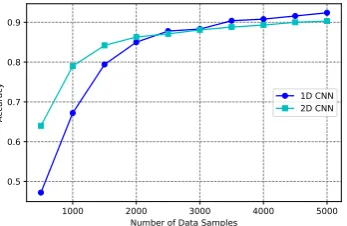
In this work, we are concerned about the amount of available data. Hence, we evaluated the accuracy change of the best performing ap-proaches with the size of training samples. We perform this on the Sinhala dataset since it has more than 4000 data samples. We drew multi-ple random sammulti-ples with a particular size and per-formed 5-fold cross-validation. Here, the number of random samples is 20. Table3summarizes the experiment results.
In another experiment, we examined the end-to-end text output of the DS English model for a given Sinhala speech query. Table4presents some of these outputs.
3https://github.com/mozilla/DeepSpeech
6 Result and Discussion
We were able to achieve 93.16% and 76.30% overall accuracy for Sinhala and Tamil datasets respectively using 5-fold cross-validation. Ta-ble2 provides a comparison of previous and our approaches. It shows clearly that the proposed method is more viable than the previous direct speech feature classification approach. One possi-ble reason can be the reduction of noise in speech signals. In this situation, the DS model is capable of removing these noises since it is already trained on noisy data. Another reason is that reduction of the feature space. Additionally, in this way, we can have more accurate results using small dataset.
Intent Sinhala Tamil
F1 P R F1 P R
1 0.96 0.94 0.99 0.87 0.89 0.87
2 0.93 0.97 0.89 0.80 0.78 0.84
3 0.91 0.87 0.95 0.75 0.89 0.66
4 0.89 0.93 0.87 0.64 0.75 0.63
5 0.96 0.97 0.95 0.60 0.76 0.51
6 0.92 0.95 0.89 0.79 0.74 0.89
[image:4.595.310.527.366.460.2]Average 0.93 0.93 0.93 0.76 0.81 0.76
Table 3: Classification results of best performing mod-els (F1- F1-Score, P- Precision, R- Recall)
Table 3 shows the averaged precision, recall and F1-score values for each intent class and two datasets. In the Sinhala dataset, all classes achieve more than 0.9 F1-score, except for type 4 intent. Type 1 intent shows the highest F1-score among all and, this must be because of the higher number of data samples available for this class. Despite that, type 6 intent also reports 0.93 f1-score even with a lower number of data samples. Tamil data shows a slightly different result. Intent types 4,5 report the lowest score in the Tamil dataset and the number of speech queries from these classes are comparatively low in the dataset. Further, we can observe that the Tamil classifier is incapable of accurately identifying positive intent classes 4 and 5 (since lower recall value).
codemixed speech quires since it is more natu-ral when in speaking. These words are in En-glish. Additionally, the feature generator model (DS model) is also trained in English data. This can result in more overall accuracy in Tamil data set. Additionally, type 6 intent commands contain English words in both datasets and this can result for higher precision value.
Further, sentences with more overlapping words with other sentences (different intent type) and with limited length tend to misclassify more. Hence classes, type 3,4 in Sinhala, type 2,4 in Tamil dataset show lower accuracy.
1000 2000 3000 4000 5000
Number of Data Samples 0.5
0.6 0.7 0.8 0.9
Accuracy
[image:5.595.308.532.62.117.2]1D CNN 2D CNN
Figure 3: CNN classifier accuracy variance with the number of samples (Sinhala dataset)
Figure3summarize the overall accuracy change of best performing classifiers with samples size. As it shows having 1000 samples is enough to achieve nearly 80% overall accuracy. After that, it reaches saturation. Furthermore, it reports 77% overall accuracy for Tamil dataset with 320 train-ing samples. This highlights the effectiveness of the proposed transfer learning approach in limited data situations.
Additionally, Figure 3shows the most effective CNN model type with the number of available data samples to classify sequential feature maps. As it shows, it is useful to use 2D CNN based classifiers when there is a very limited amount of data. How-ever, when there are relatively more data (More than 4000 samples in Sinhala dataset) 1D CNN based classifiers gives higher results. We can see this effect on Tamil dataset also. As table 2shows 1D CNN model accuracy is low compared to 2D CNN model with 400 data samples.
Further, we examined the speech decoding ca-pability of the English model. See Table4. Here ‘Utterance’ is the pronounced Sinhal sentence, ‘Eng. Transcript’ is the ideal English transcript. ‘DS output’ lists the generated transcripts from the
Utterance ෙ ෂය යද ඉ ය යද
Eng. Transcript ’sheshaya keeyada’ ’ithiriya keeyada’
DS Output
’she sreci ete’ ’itcillety edet’ ’sheis heki edit’ ’it tia gaviade’
’sheisae an’ ’itlid en’
Table 4: DS transcript for some Sinhala utterances
full model. In these generated outputs, the first few characters are decoded correctly. But, in the latter part, this decoding is compromised by the possible character sequences of the English language since it is trained in English. From this, we can infer that this character probability map is closer to text rep-resentation than the MFCC features. Hence, this can improve the classification accuracy.
7 Conclusion
In this study, we proposed a method to identify the intent of free-form commands in a low-resource language. We used an ASR model trained on the English language to classify the Sinhala and Tamil low-resource datasets. The proposed method out-performs previous work and, even with a limited number of samples, it can reach to a reasonable accuracy.
CNN base classifiers perform well in the clas-sification of character probability maps generated by ASRs. Further, 1D CNN models work better with a higher number of samples, while 2D CNN models work better with a small amount of data. In the future, we plan to extend this study by incor-porating more data from different languages and domains.
Acknowledgments
This research was funded by a Senate Research Committee (SRC) Grant of the University of Moratuwa. We thank for the support received from the LK Domain Registry. We thank Mr. P. Thananjay for assistance with data validation.
References
Dario Amodei, Sundaram Ananthanarayanan, Rishita Anubhai, Jingliang Bai, Eric Battenberg, Carl Case, Jared Casper, Bryan Catanzaro, Qiang Cheng, Guo-liang Chen, et al. 2016. Deep speech 2: End-to-end
speech recognition in english and mandarin. In
In-ternational Conference on Machine Learning, pages 173–182.
[image:5.595.96.270.258.371.2]hy-perparameters of machine learning algorithms. In
Proceedings of the 12th Python in science
confer-ence, pages 13–20. Citeseer.
Laurent Besacier, Etienne Barnard, Alexey Karpov, and Tanja Schultz. 2014. Automatic speech recog-nition for under-resourced languages: A survey.
Speech Communication, 56:85–100.
Darshana Buddhika, Ranula Liyadipita, Sudeepa
Nadeeshan, Hasini Witharana, Sanath Javasena, and Uthayasanker Thayasivam. 2018. Domain specific
intent classification of sinhala speech data. In2018
International Conference on Asian Language Pro-cessing (IALP), pages 197–202. IEEE.
Nancy F Chen, Chongjia Ni, I-Fan Chen, Sunil Sivadas, Haihua Xu, Xiong Xiao, Tze Siong Lau, Su Jun Leow, Boon Pang Lim, Cheung-Chi Leung, et al. 2015. Low-resource keyword search
strate-gies for tamil. In 2015 IEEE International
Con-ference on Acoustics, Speech and Signal Processing (ICASSP), pages 5366–5370. IEEE.
Yuan-Ping Chen, Ryan Price, and Srinivas Banga-lore. 2018. Spoken language understanding
with-out speech recognition. In2018 IEEE International
Conference on Acoustics, Speech and Signal Pro-cessing (ICASSP), pages 6189–6193. IEEE.
Chung-Cheng Chiu, Tara N Sainath, Yonghui Wu, Ro-hit Prabhavalkar, Patrick Nguyen, Zhifeng Chen, Anjuli Kannan, Ron J Weiss, Kanishka Rao, Eka-terina Gonina, et al. 2018. State-of-the-art speech recognition with sequence-to-sequence models. In
2018 IEEE International Conference on Acous-tics, Speech and Signal Processing (ICASSP), pages 4774–4778. IEEE.
Awni Hannun, Carl Case, Jared Casper, Bryan
Catanzaro, Greg Diamos, Erich Elsen, Ryan
Prenger, Sanjeev Satheesh, Shubho Sengupta, Adam
Coates, et al. 2014. Deep speech: Scaling up
end-to-end speech recognition. arXiv preprint
arXiv:1412.5567.
Xiaodong He and Li Deng. 2013.
Speech-centric information processing: An
optimization-oriented approach. Proceedings of the IEEE,
101(5):1116–1135.
Jui-Ting Huang, Jinyu Li, Dong Yu, Li Deng, and Yi-fan Gong. 2013. Cross-language knowledge transfer using multilingual deep neural network with shared
hidden layers. In2013 IEEE International
Confer-ence on Acoustics, Speech and Signal Processing, pages 7304–7308. IEEE.
Julius Kunze, Louis Kirsch, Ilia Kurenkov, Andreas Krug, Jens Johannsmeier, and Sebastian Stober. 2017. Transfer learning for speech recognition on
a budget. InProceedings of the 2nd Workshop on
Representation Learning for NLP, pages 168–177.
Lin-shan Lee, James Glass, Hung-yi Lee, and
Chun-an ChChun-an. 2015. Spoken content retrievalbeyond
cascading speech recognition with text retrieval.
IEEE/ACM Transactions on Audio, Speech, and Language Processing, 23(9):1389–1420.
Chunxi Liu, Jan Trmal, Matthew Wiesner, Craig Har-man, and Sanjeev Khudanpur. 2017. Topic
identifi-cation for speech without asr. InProc. Interspeech
2017, pages 2501–2505.
Wageesha Manamperi, Dinesha Karunathilake, Thilini Madhushani, Nimasha Galagedara, and Dileeka Dias. 2018. Sinhala speech recognition for interac-tive voice response systems accessed through mobile
phones. In 2018 Moratuwa Engineering Research
Conference (MERCon), pages 241–246. IEEE.
Sinno Jialin Pan and Qiang Yang. 2010. A survey on
transfer learning. IEEE Transactions on knowledge
and data engineering, 22(10):1345–1359.
Ashwin Ram, Rohit Prasad, Chandra Khatri, Anu Venkatesh, Raefer Gabriel, Qing Liu, Jeff Nunn, Behnam Hedayatnia, Ming Cheng, Ashish Nagar, et al. 2018. Conversational ai: The science behind
the alexa prize.arXiv preprint arXiv:1801.03604.
Jinfeng Rao, Ferhan Ture, and Jimmy Lin. 2018. Multi-task learning with neural networks for voice query understanding on an entertainment platform. InProceedings of the 24th ACM SIGKDD Interna-tional Conference on Knowledge Discovery & Data Mining, pages 636–645. ACM.
Sibel Yaman, Li Deng, Dong Yu, Ye-Yi Wang, and Alex Acero. 2008. An integrative and discriminative
technique for spoken utterance classification. IEEE
Transactions on Audio, Speech, and Language Pro-cessing, 16(6):1207–1214.
A Supplemental Material
Sinhala Models Tamil Models
Layer 1D CNN 2D CNN 1D CNN 2D CNN
1. Conv Filters 38
Kernel Size 19
Filters 16 Kernel Size 1x8
Filters 39 Kernel Size 18
Filters 14 Kernel Size 5x1
2. Max Pooling Size 18 Stride 7
Size 6x1 Stride 5x5
Size 25 Stride 5
Size 13x1 Stride 5x1
3. Conv Filters 28
Kernel Size 22
Filters 17 Kernel Size 20x8
Filters 26 Kernel Size 19
Filters 13 Kernel Size 11x20
4. Max Pooling Size 22 Stride 10
Size 19x2 Stride 16x8
Size 20 Stride 5
Size 17x1 Stride 2x7
5. Dense Units 131 Units 118 Units 84 Units 127
[image:7.595.118.471.339.465.2]6. Softmax 6 6 6 6