129
Preemptive Toxic Language Detection in Wikipedia Comments
Using Thread-Level Context
Mladen Karan and Jan ˇSnajder
Faculty of Electrical Engineering and Computing Unska 3, Zagreb
{mladen.karan, jan.snajder}@fer.hr
Abstract
We address the task of automatically detecting toxic content in user generated texts. We fo-cus on exploring the potential for preemptive moderation, i.e., predicting whether a particu-lar conversation thread will, in the future, incite a toxic comment. Moreover, we perform pre-liminary investigation of whether a model that jointly considers all comments in a conversa-tion thread outperforms a model that considers only individual comments. Using an existing dataset of conversations among Wikipedia con-tributors as a starting point, we compile a new large-scale dataset for this task consisting of labeled comments and comments from their conversation threads.
1 Introduction
Due to the ever-growing amount of user generated content online, manual moderation of such content is becoming increasingly difficult to scale up. On the other hand, the relative anonymity and lack of personal contact between participants of web conversations lowers inhibitions and increases the risk of toxic behavior, making adequate moderation increasingly important. Consequently, automated detection of toxic language in user generated con-tent is an increasingly important area of research. While automated classification models are unlikely to ever fully replace human moderators, they can make their task easier by suggesting which content to prioritize for moderation.
The typical way to approach this problem is via supervised machine learning, where an input to a model is a user-generated text, and the output is a classification decision (toxic or non-toxic) or a numerical toxicity score. In this paper, we explore two possible extensions of this approach: preemp-tive classificationandthread-level models.
While practically very useful, standard models are only applicable in a post-hoc scenario, i.e., to
detect a toxic comment after if has already been posted. An alternate approach would be to have models detect situations that are likely to lead to toxic comments. If successful, such models would enable moderators to preemptively focus on poten-tially problematic discussion threads and then ei-ther intervene and guide the discussion away from conflict or respond in near real-time after the toxic comment is posted. Large-scale implementation of such near real-time moderation might be unneces-sary and require too many moderators. However, for limited parts of discussions that are known to pertain to specially vulnerable social groups, this might be a feasible approach. Our first research question is whether such preemptive toxic com-ment detection is viable.
The second research question pertains to the ben-efits of including thread-level information when detecting toxic comments. Namely, most existing models consider every comment in isolation, there-fore ignoring the context provided by the other comments in the discussion. For post-hoc models, while useful, this additional information may not be crucial, as the main indicators of toxicity are most present in the text of the comment being clas-sified rather than in the rest of the thread. In the preemptive scenario, however, the model has ac-cess only to comments that appeared before a toxic one. We hypothesize that considering the entire thread of comments might be of greater importance in this case.
2 Related Work
Many varieties of toxic language have been con-sidered in NLP research, including sexism, racism (Waseem and Hovy,2016a;Waseem,2016), toxic-ity (Kolhatkar et al.,2018), hatefulness (Gao and Huang, 2017a), aggression (Kumar et al.,2018), attack (Wulczyn et al.,2017a), obscenity, threats, and insults.Waseem et al.(2017) proposed a sys-tematic typology of toxic language.
Post-hoc detection of toxic text has been tackled by traditional machine learning approaches, such as logistic regression (Waseem and Hovy,2016b; Davidson et al.,2017;Wulczyn et al.,2017b), and support vector machines (SVM) (Xu et al.,2012; Schofield and Davidson,2017). However, the best performance is most often attained by deep learning approaches, such as convolutional neural networks (CNN) (Gamb¨ack and Sikdar,2017;Potapova and Gordeev,2016;Pavlopoulos et al.,2017) and vari-ants of recurrent neural networks (RNN) (Pavlopou-los et al., 2017;Gao and Huang, 2017b;Pitsilis et al., 2018;Zhang et al.,2018b). In our exper-iments we focus mainly on deep learning-based models.
All the above-mentioned approaches deal with the post-hoc scenario. Other work we are aware of that explores the preemptive scenario is that of Zhang et al. (2018a). There, the task is to pre-dict – given an initial courteous exchange of two user comments – whether the third comment will be toxic. The authors create a manually labeled data set and perform an extensive study on which pragmatic and rhetorical devices are indicative of conversation toxicity. Moreover, there is the work of (Liu et al., 2018), where a logistic regression classifier with a rich feature set (including thread level features) is evaluated on a data set of manually labeled 30000 Instagram comments. In contrast, the data set produced in our work is much bigger, but has only silver labels.
In our work we consider the use of thread-level information for toxic comment detection. Within the scope of this work we limit ourselves to sim-ple mechanisms for including this information into deep learning models. Recently, deep learning models have been proposed that leverage graph structures, such as TreeLSTM (Tai et al.,2015) and GraphSAGE (Hamilton et al.,2017), which might be useful for modeling thread-level structure in our task. We leave the investigation of this possibility for future work.
3 Dataset
At the time of writing we were not aware of the data set from (Liu et al.,2018). At first we considered using the dataset from (Zhang et al., 2018a), but found it rather small (∼1200 examples) for deep learning approaches. Furthermore, this dataset was constructed using a very carefully designed methodology for a specific experiment – detecting whether a toxic comment will appear given a cour-teous initial exchange of two comments. We are interested in a more general case, where conversa-tion threads might be longer and not necessarily start in a courteous manner. Moreover, we aimed at a setting which would better reflect the realistic working conditions in which our models would be used and allow us to measure their practical impact. Consequently, we decided to create a new dataset from the data collected by Hua et al. (2018). It contains the entire conversational history of com-ments on Wikipedia modeled as a graph of actions. The possible actions areCreation,Addition, Modi-fication,Deletion, andRestoration. Automatically derived toxicity scores are also provided for each example.
We apply the following steps to this dataset:
Step 1. Filter the data to remove all threads with less than 2 different participants. This leaves
∼8.7M threads.
Step 2. Apply allModificationactions, to update the comments to their most recent version.
Step 3.Flag comments that were deleted. A com-ment is considered deleted if there is aDeletion
action on it, without a subsequentRestoration ac-tion that would undo the effect.
Step 4.Split the threads into the train (70%), dev (15%), and test (15%) sets. The split is done across time: the test set contains the most recent threads, while the train set contains the least recent.
Step 5. Semi-automatically label the examples for toxicity. An example is considered toxic if its toxicity or severe toxicity scores are above 0.64 or 0.92, respectively. 1 and it was deleted by a person who is not the comment author. This heuris-tic takes into account two signals: (1) the fact that a toxic classifier has high confidence for a com-ment and (2) the fact the comcom-ment was deleted.
1
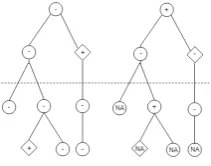
Figure 1: An illustration of examples generated for the post-hoc (left tree) and preemptive (right tree) case. Di-amond shaped nodes represent toxic comments while round nodes represent non-toxic comments. Positive examples for the classifier are denoted by + and negative ones by –. Examples denoted by NA are not considered by the classifier: these are the leaf nodes in the preemp-tive scenario. The filtering from Step 7 has the effect of ignoring all examples with an insufficient number of preceding comments, e.g., forLmin = 2all com-ments above the dotted line would be ignored in the
rich-contextsetting.
Considering only deleted examples as toxic would yield noisy labels, as comments are often deleted for reasons other than being toxic. Manual inspec-tion of the silver-labeled dataset reveals that the combination of the toxicity classifier and observed deletion is effective in identifying some of the toxic comments. However, this approach fails to identify those toxic comments which were not deleted or those for which the toxicity classifier failed. The former issue is not problematic, as it was shown by Hua et al.(2018) that toxic comments on Wikipedia get deleted by the community very quickly. Thus toxic comments that are not deleted are quite rare. The latter issue, however, represents a limitation of our work. Our results apply only to those types of toxic language that are detectable by current post-hoc models. Extending this data set to account for more complex types of toxic language would re-quire considerable annotation effort and we leave it as a possibility for future work.
Step 6.Generate examples from each thread in the train/dev/test set for the (1) preemptive scenario and (2) post-hoc scenario as shown in Figure 1. For the post-hoc scenario, examples are generated from all comments in the tree. Positive examples are those comments that are labeled as toxic, while all other comments are negative examples. In the preemptive scenario, examples are generated from all comments that are not leaves of the tree. Posi-tive examples are those comments that have a toxic child and no toxic ancestors, while all other com-ments are negative examples. The number of
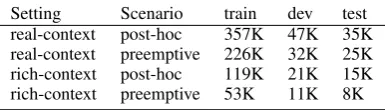
pre-Setting Scenario train dev test real-context post-hoc 357K 47K 35K real-context preemptive 226K 32K 25K rich-context post-hoc 119K 21K 15K rich-context preemptive 53K 11K 8K
Table 1: Statistics of the generated data set variants.
ceding comments available for each comment in this data can vary from 0 to over 100 (median is 2). Consequently, to differentiate from the setting in the next step, we will refer to this setting as the
real-context setting.
Step 7. While the previous setting is more real-istic, in order to better assess their full potential, we wished to evaluate the thread level models in a setting where the context provided by preceding comments is always available. To this end, we fil-ter the examples from the previous step such that only those are left that have at leastLmin = 2
com-ments on the path to the root.2 We will refer to the datasets obtained in this step as being in the
rich-context setting.
As the label distribution of the examples ob-tained in this way is extremely skewed (positive examples account for 0.5 to 1 percent of the data, depending on the setting and scenario), we under-sample the negative class. For completeness, we also retain the non-undersampled versions of the dev and test sets for some of the experiments.
Lastly, to additionally evaluate the quality of the silver labels we manually labeled 100 examples from the balanced version of the data set. We found that on these examples the silver labels have 0.51 precision and 1.00 recall. This yields 0.67 F1 mea-sure and is somewhat lower than the expected 0.85 obtained for this classifier in (Hua et al.,2018). The difference indicates that the thresholds from (Hua et al., 2018) obtained on non-deleted comments from Wikipedia may not perform equally well on deleted comments. To address this and increase the quality of the labels, more deleted comments should be manually labeled and thresholds retuned using, e.g., the same error rate method of (Wulczyn et al.,2017a).
Some statistics of the finally generated data set are given in Table1, and some examples in Table2. We make the dataset and the code for generating it available.3
2
Following the choice of (Zhang et al.,2018a).
[image:3.595.316.515.64.120.2]Text Toxic
Go fuck yourself. Anways. +
Lazy Bast*rd +
Superman is a total loser batman would win + Sick of this article and the shitty writing + When did it become an inherently evil thing to be concerned for human welfare?
–
[image:4.595.82.283.64.153.2]Please elaborate; this is fascinating. –
Table 2: Examples of comments from the dataset.
Setting Scenario train dev test real-context post-hoc 357K 47K 35K real-context preemptive 226K 32K 25K rich-context post-hoc 119K 21K 15K rich-context preemptive 53K 11K 8K
Table 3: Statistics of the generated data set variants.
4 Models
We implement several baseline models to get some preliminary results on this data.
Our simplest model is a linear support vector machine (SVM) on TF-IDF weighted unigrams and bigrams. We include the most frequent 10k n-grams into the model, and tune the C hyperpa-rameter on the dev data. This model ignores thread context, even when it is available.
For the deep learning models we use an neural network based encoder to derive a vector represen-tation for each comment in our data. We denote this encoder asenccom. For models that ignore
pre-ceding comments, the output of this encoder is fed directly to linear and softmax layers and produces a classification decision for each comment. Thus, the output of our model for a commentc, which is a sequence of word embeddings, could be written as:
yc=softmax(WTenccom(c))
For models that take preceding comments into account, the input is not a single comment but a sequence of comments,t = (c1, . . . ,cn), which
includes the comment to classify,cn, and all of its
ancestors,(c1, . . . ,cn−1). We first applyenccom
to each individual ci, obtaining comment
repre-sentations ri = enccom(ci). We then feed the
sequences= (r1, . . . ,rn)as features into another
encoder, which we denote byencthr. The output
of the model for the given input is similar as before:
yt=softmax(WTencthr(s))
For implementing the encoder, we performed
preliminary experiments with convolutional neural networks (CNN) (Krizhevsky et al., 2012), long short-term memory networks (LSTM) (Hochreiter and Schmidhuber,1997), and gated recurrent units (GRU) (Cho et al.,2014), tuning hyperparameters on the development data. We found that, on the development data for this task, GRU and LSTM perform similarly and slightly better than CNN. We also found that bidirectional recurrent mod-els perform slightly better than standard ones. To represent the words we use the freely available 50-dimensional GloVE embeddings (Pennington et al., 2014) trained on 6 billion tokens. Preliminary ex-periments also reveal models perform better when the embeddings are also updated during training. For our final experiments we use two BiLSTM models with a cell/hidden-state size of 50 to imple-mentenccomandencthr. We use Adam (Kingma
and Ba,2015) to train the models with a learning rate of 0.001, minibatch size of 128, and early stop-ping using the dev set. We denote the variants of the model that are thread-agnostic and thread-aware as BiLSTM and BiLSTM-context, respectively. All models are implemented in PyTorch (Paszke et al., 2017) and the code is available online.4
5 Results
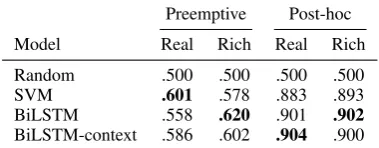
The results are given in Table4. Each column repre-sents one dataset variant. All differences within the same variant are statistically significant at p<0.05 (tested used bootstrap resampling).
While differences across different dataset vari-ants are not directly comparable, there is a tendency for models to perform much better in the post-hoc scenario than in the preemptive scenario, which is expected. Preemptive models are, however, able manually labeled to beat the random baseline and achieve scores that are numerically similar to those ofZhang et al.(2018a) on their data.
The BiLSTM-context model performs similarly or worse than the BiLSTM model in all cases ex-cept the preemptive real case where context does help, but both LSTM-based models are outper-formed by a simple SVM. This indicates that the additional information provided by the thread con-text is, in this case, not very useful for determining the correct class. Manual inspection of the data set confirms that humans could determine the toxicity of most comments without referring to the thread for additional context.This intuition is invalid in
[image:4.595.85.278.195.250.2]Preemptive Post-hoc
Model Real Rich Real Rich
Random .500 .500 .500 .500
SVM .601 .578 .883 .893
BiLSTM .558 .620 .901 .902
[image:5.595.86.276.64.138.2]BiLSTM-context .586 .602 .904 .900
Table 4: Results in various settings and scenarios. Ran-dom is the expected performance of choosing a ranRan-dom class with uniform probability across the classes. The numbers are F1-scores on perfectly balanced test data.
cases when the thread context for preemptive detec-tion already contains a toxic comment. A presence of a toxic comment in a thread is a good indicator of a situation where more toxicity will follow. Thus considering the entire thread leads to better perfor-mance in such cases. This, however, is not true
preemptivedetection, as toxicity already occurred earlier in thread. Consequently, we filtered out such cases from the data by requiring comments that are positive examples for the preemptive case to have no toxic ancestors (as described in Chapter 3). It is however worth mentioning that, for this reason, our preliminary experiments which omit this filter-ing step indeed showed more noticeable benefits of having the thread available in the preemptive case.
We also note that the unbalanced nature of this data has a very negative effect on performance in a practical setting. For example, even after tun-ing the classification threshold to maximize F1 on unbalanced dev data, the F1-score for the best post-hoc model on the unbalanced test is still below 0.5. Thus, more work is required to make models for this task that are applicable in a real-world setting.
6 Conclusion
We compiled a large semi-automatically labeled dataset for studying preemptive toxic language de-tection in Wikipedia conversations. We explored two types of deep learning models for this task: those that only consider a single comment and those that take into account the context by con-sidering preceding comments in a conversation. In our experiments, the context-sensitive models did not significantly outperform context-agnostic ones. While all preemptive models would beat a random baseline, their performance is still too low for prac-tical applications.
There are numerous possibilities for future work. One is to employ more sophisticated
graph-based deep learning methods such as GraphSAGE (Hamilton et al.,2017). Another direction would be exploring ways to better address the class unbal-ance typical for this task. Yet another possibility would be to enrich the input features with informa-tion available about the user who is commenting, e.g., whether they had toxic comments in the past, or their personality profile derived from text us-ing models such as that ofGjurkovi´c and ˇSnajder (2018). Finally, combining deep learning with dis-course and pragmatic features, such as those of Zhang et al.(2018a), might be a good next step to improve the models in the preemptive setting.
References
Kyunghyun Cho, Bart van Merrienboer, Caglar Gul-cehre, Dzmitry Bahdanau, Fethi Bougares, Holger Schwenk, and Yoshua Bengio. 2014. Learning phrase representations using rnn encoder–decoder for statistical machine translation. InProceedings of the 2014 Conference on Empirical Methods in Natural Language Processing (EMNLP), pages 1724–1734.
Thomas Davidson, Dana Warmsley, Michael Macy, and Ingmar Weber. 2017. Automated Hate Speech De-tection and the Problem of Offensive Language. In
Proceedings of ICWSM.
Bj¨orn Gamb¨ack and Utpal Kumar Sikdar. 2017. Us-ing Convolutional Neural Networks to Classify Hate-speech. In Proceedings of the First Workshop on Abusive Language Online, pages 85–90.
Lei Gao and Ruihong Huang. 2017a. Detecting online hate speech using context aware models. In Pro-ceedings of Recent Advances in Natural Language Processing (RANLP), pages 260–266, Varna, Bul-garia.
Lei Gao and Ruihong Huang. 2017b. Detecting on-line hate speech using context aware models. arXiv preprint arXiv:1710.07395.
Matej Gjurkovi´c and Jan ˇSnajder. 2018. Reddit: A gold mine for personality prediction. InProceedings of the Second Workshop on Computational Modeling of Peoples Opinions, Personality, and Emotions in Social Media, pages 87–97.
Will Hamilton, Zhitao Ying, and Jure Leskovec. 2017. Inductive representation learning on large graphs. In
Advances in Neural Information Processing Systems, pages 1024–1034.
Yiqing Hua, Cristian Danescu-Niculescu-Mizil, Dario Taraborelli, Nithum Thain, Jeffery Sorensen, and Lu-cas Dixon. 2018. Wikiconv: A corpus of the com-plete conversational history of a large online collabo-rative community. InProceedings of the 2018 Con-ference on Empirical Methods in Natural Language Processing, pages 2818–2823. Association for Com-putational Linguistics.
Diederik P Kingma and Jimmy Ba. 2015. Adam: A method for stochastic optimization. pages 1–13.
Varada Kolhatkar, Hanhan Wu, Luca Cavasso, Emilie Francis, Kavan Shukla, and Maite Taboada. 2018. The sfu opinion and comments corpus: A corpus for the analysis of online news comments.
Alex Krizhevsky, Ilya Sutskever, and Geoffrey E Hin-ton. 2012. Imagenet classification with deep con-volutional neural networks. InAdvances in neural information processing systems, pages 1097–1105.
Ritesh Kumar, Aishwarya N. Reganti, Akshit Bha-tia, and Tushar Maheshwari. 2018. Aggression-annotated Corpus of Hindi-English Code-mixed Data. InProceedings of the 11th Language Resources and Evaluation Conference (LREC), pages 1425–1431, Miyazaki, Japan.
Ping Liu, Joshua Guberman, Libby Hemphill, and Aron Culotta. 2018. Forecasting the presence and intensity of hostility on instagram using linguistic and social features. InTwelfth International AAAI Conference on Web and Social Media.
Adam Paszke, Sam Gross, Soumith Chintala, Gregory Chanan, Edward Yang, Zachary DeVito, Zeming Lin, Alban Desmaison, Luca Antiga, and Adam Lerer. 2017. Automatic differentiation in pytorch. In NIPS-W.
John Pavlopoulos, Prodromos Malakasiotis, and Ion Androutsopoulos. 2017. Deep learning for user com-ment moderation. InProceedings of the First Work-shop on Abusive Language Online, pages 25–35.
Jeffrey Pennington, Richard Socher, and Christopher D. Manning. 2014. Glove: Global vectors for word representation. In Empirical Methods in Natural Language Processing (EMNLP), pages 1532–1543.
Georgios K Pitsilis, Heri Ramampiaro, and Helge Langseth. 2018. Detecting offensive language in tweets using deep learning. arXiv preprint arXiv:1801.04433.
Rodmonga Potapova and Denis Gordeev. 2016. Detect-ing state of aggression in sentences usDetect-ing cnn. arXiv preprint arXiv:1604.06650.
Alexandra Schofield and Thomas Davidson. 2017. Iden-tifying Hate Speech in Social Media. XRDS: Cross-roads, The ACM Magazine for Students, 24(2):56–59.
Kai Sheng Tai, Richard Socher, and Christopher D Man-ning. 2015. Improved semantic representations from tree-structured long short-term memory networks. InProceedings of the 53rd Annual Meeting of the Association for Computational Linguistics and the 7th International Joint Conference on Natural Lan-guage Processing (Volume 1: Long Papers), vol-ume 1, pages 1556–1566.
Zeerak Waseem. 2016. Are you a racist or am i seeing things? annotator influence on hate speech detection on twitter. InProceedings of the first workshop on NLP and computational social science, pages 138– 142, Austin, Texas.
Zeerak Waseem, Thomas Davidson, Dana Warmsley, and Ingmar Weber. 2017. Understanding Abuse: A Typology of Abusive Language Detection Subtasks. In Proceedings of the First Workshop on Abusive Langauge Online.
Zeerak Waseem and Dirk Hovy. 2016a. Hateful sym-bols or hateful people? predictive features for hate speech detection on twitter. InProceedings of the NAACL student research workshop, pages 88–93, San Diego, California.
Zeerak Waseem and Dirk Hovy. 2016b. Hateful sym-bols or hateful people? predictive features for hate speech detection on twitter. InProceedings of the NAACL student research workshop, pages 88–93.
Ellery Wulczyn, Nithum Thain, and Lucas Dixon. 2017a. Ex machina: Personal attacks seen at scale. InProceedings of the 26th International Conference on World Wide Web, pages 1391–1399. International World Wide Web Conferences Steering Committee.
Ellery Wulczyn, Nithum Thain, and Lucas Dixon. 2017b. Ex machina: Personal attacks seen at scale. InProceedings of the 26th International Conference on World Wide Web, pages 1391–1399. International World Wide Web Conferences Steering Committee.
Jun-Ming Xu, Kwang-Sung Jun, Xiaojin Zhu, and Amy Bellmore. 2012. Learning from bullying traces in social media. InProceedings of the 2012 conference of the North American chapter of the association for computational linguistics: Human language tech-nologies, pages 656–666. Association for Computa-tional Linguistics.
Justine Zhang, Jonathan Chang, Cristian Danescu-Niculescu-Mizil, Lucas Dixon, Yiqing Hua, Dario Taraborelli, and Nithum Thain. 2018a. Conversations gone awry: Detecting early signs of conversational failure. InProceedings of the 56th Annual Meeting of the Association for Computational Linguistics (Vol-ume 1: Long Papers), volume 1, pages 1350–1361.
Ziqi Zhang, David Robinson, and Jonathan Tepper. 2018b. Detecting Hate Speech on Twitter Using a Convolution-GRU Based Deep Neural Network. In