Proceedings of NAACL-HLT 2018, pages 206–211
Lexical Substitution for Evaluating
Compositional Distributional Models
Maja Buljan∗ Sebastian Pad´o∗ Jan ˇSnajder† ∗ Institut f¨ur Maschinelle Sprachverarbeitung, University of Stuttgart
{maja.buljan,pado}@ims.uni-stuttgart.de
†TakeLab, Faculty of Electrical Engineering and Computing, University of Zagreb [email protected]
Abstract
Compositional Distributional Semantic Mod-els (CDSMs) model the meaning of phrases and sentences in vector space. They have been predominantly evaluated on limited, ar-tificial tasks such as semantic sentence simi-larity on hand-constructed datasets. This pa-per argues for lexical substitution as a means to evaluate CDSMs. Lexical substitution is a more natural task, enables us to evaluate meaning composition at the level of individ-ual words, and provides a common ground to compare CDSMs with dedicated lexical substi-tution models. We create a lexical substisubsti-tution dataset for CDSM evaluation from an English-language corpus with manual “all-words” lexi-cal substitution annotation. Our experiments indicate that the Practical Lexical Function CDSM outperforms simple component-wise CDSMs and performs on par with the con-text2vec lexical substitution model using the same context.
1 Introduction
Compositional Distributional Semantics Models (CDSMs) compute phrase meaning in semantic space as a function of the meanings of the phrase constituents (Baroni et al.,2014). The most basic CDSMs represent words as vectors and compose phrase vectors by component-wise operations of the constituent vectors (Mitchell and Lapata,2008). More complex models represent predicates with matrices and tensors (Baroni and Zamparelli,2010; Grefenstette,2013;Paperno et al.,2014).
Given the large number of different CDSMs pro-posed in the literature (Erk,2012), meaningful eval-uation becomes crucial. The dominant evaleval-uation method, adopted by the majority of CDSM studies, is pairwise phrase similarity (Mitchell and Lap-ata,2008;Guevara,2010;Grefenstette et al.,2012; Grefenstette,2013;Paperno et al.,2014). Only a
handful of studies pursued other evaluation tasks, such as textual entailment (Marelli et al.,2014a,b) or sentiment analysis (Socher et al.,2013).
Arguably, phrase similarity evaluation has three major problems. First, the task is affected by the general limitations of rating scales, such as incon-sistencies in annotations, scale region bias, and fixed granularity (Schuman and Presser, 1996). Phrase similarity datasets used for CDSM eval-uation demonstrate slight to fair inter-annotator agreement, as well as overlap between groups of items rated aslowandhighin similarity (Mitchell and Lapata,2008).
Secondly, phrase similarity is a task that is rather difficult to put down precisely, especially for long phrases. Generally, phrases can be (dis)similar in any number of ways. Annotators commonly agree that some sentence pairs are semantically highly similar (private company files annual accountand
private company registers annual account, Picker-ing and Frisson 2001), and others are semantically unrelated (man waves hand vs.employee leaves company). In contrast, their assessments become less confident for cases likedelegate buys landand
agent sells property(Kartsaklis et al.,2013), where there is a semantic relation other than synonymy. Similarity is also arguably not a useful measure when sentences are semantically deviant, as it is of-ten the case in the datasets: how similar areprivate company files annual accountandprivate company smooths annual account?
The third problem is that the most widely used phrase similarity datasets are constructed in a bal-anced fashion along psycholinguistic principles. For instance, the adjective-noun-verb-adjective-noun (“ANVAN”) dataset (Pickering and Frisson, 2001;Kartsaklis et al.,2013), from which the exam-ples above are drawn, was constructed from a set of particularly ambiguous verbs paired with strongly disambiguating contexts. Such setups often do not
correlate well with usefulness on more natural data. In a previous study on lexical substitution,Kremer et al.(2014) found that the advantage of machine learning-based models over simple baselines was much harder to show on a real-world corpus than on the previously used manually constructed bench-mark dataset (McCarthy and Navigli,2009).
In this paper, we pursue the idea that lexical sub-stitution (McCarthy and Navigli,2009) is a more suitable evaluation task for CDSMs. Lexical sub-stitution is the task of finding meaning-preserving substitutes for a target word in context: e.g., the wordsubmitsis a legitimate substitute forfilesin
private company files annual account, but not in
office clerk files old papers. Lexical substitution provides a frame for comparing synonyms in con-text, and disambiguating the context-appropriate sense of polysemous words. Since this is a prob-lem CDSMs can account for, lexical substitution seems a suitable task for testing and comparing dif-ferent CDSMs. Additionally, lexical substitution is a more natural task than similarity ratings, it makes it possible to evaluate meaning composition at the level of individual words, and provides a common ground to compare CDSMs with dedicated lexical substitution models.
2 The ANVAN-LS Dataset
To perform more realistic evaluations for CDSMs, we would like to test them on a sample of actual human utterances rather than hand-selected exam-ples. That being said, for the evaluation to be use-ful, the structures on which we evaluate should be relatively uniform and limited, at least initially while moving from artificial to natural datasets. We thus construct a dataset1for English that strikes a
balance between these factors: we maintain the adjective-noun-verb-adjective-noun (ANVAN) for-mat, but our phrases are based on corpus sentences, and some or all words in the ANVAN can form the targets of lexical substitution ranking tasks. Sampling ANVAN Queries. The starting point of our corpus construction is the English CoInCo corpus (Kremer et al., 2014), which consists of roughly 2,500 sentences taken from thenewsand
fictionsection of the MASC corpus and provides manually annotated lexical substitutes for all con-tent words (nouns, adjectives, verbs, and adverbs). 1The corpus is freely available at http://www.
ims.uni-stuttgart.de/forschung/ressourcen/ korpora/ANVAN-LS.html
We extracted all clauses from CoInCo that met the following requirements: (1) the dependency structure of the clause includes an ANVAN struc-ture; (2) at least one constituent word of the AN-VAN sub-clause has at least two human-provided single-word substitutes that exceeded a minimal frequency threshold (more than 5 occurrences in a large corpus, cf. Section 3); (3) the POS tags were correct. This resulted in 165 ANVAN phrases, which contained an average of 4.4 (out of 5) tar-get words with substitutes, for a total of 732 tartar-get words for lexical substitution.
An issue that required additional consideration was the adjective positions of the ANVANs. In the CoInCo, we found a substantial number of noun-noun compounds whose modifiers were tagged as adjectives. Conversely, many adjective modifiers in the corpus were substituted with nouns by hu-man annotators. To account for this variability, we extended the ANVAN schema conservatively by allowing nouns to fill the A position if it was ob-served in the large corpus robustly as a modifier (i.e., as part of at least 100 N-N bigram types, each of which occurred at least 300 times).
Building Lexical Substitution Tasks. For each of the 732 target words, we constructed a lexical substitution query by pairing the target with two correct substitutes and two confounders (see Ta-ble1). Since substitutes provided by more annota-tors in CoInCo tend to be more reliable, we picked the two most frequently given substitutes for each target. In the case of ties, we chose the lemma with the highest corpus frequency.
target construction arm build large airfield substitute1 construction branch build large airfield substitute2 construction part build large airfield confounder1 construction back build large airfield confounder2 construction hand build large airfield
Table 1: ANVAN-LS lexical substitution example
3 Experimental Setup
Task and Evaluation. We evaluate models on ANVAN-LS in the form of a ranking task for each
query: models are supposed to rank the correct sub-stitutes for each target higher than its confounders. Our evaluation measure is the mean average preci-sion (MAP) of all queries. In our case,
MAP = 1
N
N
X
i=1 4 X
k=1
Pli(k)∆rli(k)
where kis the rank in the 4-item listlof substi-tution candidates,Pl(k)is the precision at cut-off
pointkin listl, the∆rl(k)is the change in recall
from itemsk−1tokinl, andN is the total number of ANVAN queries. We calculate MAP both over-all, and by target positions in ANVAN, to obtain more detailed insights into performance depending on part of speech and word position.
Corpus and Semantic Space. FollowingBaroni and Zamparelli(2010) andPaperno et al.(2014), we use a concatenation of the ukWaC, BNC, and English Wikipedia corpora (around 2.8G words). We build a square co-occurrence matrix, using the complete vocabulary of our ANVAN sentence dataset, and a set of the most frequent content words in our corpus, for a total of 30K words. In addition, we built two co-occurrence matrices of bigrams, composed of all predicates (adjectives and verbs) in our vocabulary and their most frequent noun co-occurrents, as observed in the corpus, with a threshold of 300. The bigrams were observed in co-occurrence with the aforementioned 30K vocab-ulary and most frequent corpus terms, resulting in a 650K-by-30K matrix for A-N and N-N bigrams and a 620K-by-30K matrix for V-N bigrams.
For all three matrices, the 3-word-window co-occurrence counts were transformed with PPMI and reduced to 300 dimensions with SVD. All mod-els were built with DISSECT (Dinu et al.,2013). CDSMs. We consider two component-wise CDSMs: the simple additive and multiplicative models (Mitchell and Lapata, 2008), defined as
2S
catch×−→ear+
2O
catch×−−−→sound+−−−→catch
{ 2S
catch×−→ear+−−−→catch, catch2O }
−→
ear {−−−→catch, 2S
catch, catch2O }
−−−→ sound
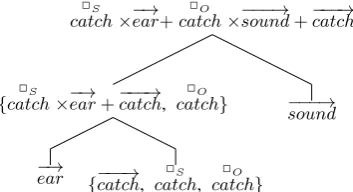
Figure 1: Example for Practical Lexical Function model composition forear catch sound
p=u⊕v, where⊕is either component-wise ad-dition or multiplication. We also work with two variants of the Practical Lexical Function model (PLF), which are derived from the Lexical Func-tion Model (LF, Baroni and Zamparelli (2010)), which represents predicates (verbs and adjectives in our case) as matrices to be multiplied with vector representations of their nominal arguments. More specifically, when applied to an ANVAN sentence (such aspointed ear catch sharp sound), the PLF model incorporates vector representations for each of the five constituent words, along with an ad-jective matrix forpointed and sharp, as well as verbsubjectand verbobjectmatrices for the verb and
its subject and object arguments. An example of composition for a verb with its subject and object arguments is given in Figure1.
Formally, the standard PLF (PLFPaperno) defines
the composition for ANVAN-style sentences as: V2
S ·−→S +VO2·−→O +−→V, where−→S and−→O are the
composed A-N bigrams, A2 ·−→N. The required
matrices are learned with ridge regression from unigram and bigram vectors.
Gupta et al.(2015) pointed out that the standard PLF “overcounts” the predicate by adding it explic-itly, and proposed a rectified variant which simply leaves out the function word vector−→V. We also experiment with this model, PLFGupta.
All CDSMs rank the four candidates for each target (cf. Table1) by comparing the vector for the original sentence against four sentences in which the target is replaced by the two correct and two incorrect substitutes. We use the raw dot product as similarity measure, following Roller and Erk (2016), to boost frequent candidates.
tasks, it is a suitable competitor model for CDSMs on a similar problem. Context2vec uses word em-beddings to compute a set of viable substitutes given a context, using a bidirectional LSTM recur-rent neural network to build a sentential context representation. We work with two instantiations: first, using only ANVAN as context (C2VANVAN),
and second, using the full CoInCo sentence from which the ANVAN was extracted (C2VSent). The
first model is directly comparable to the CDSMs in that it uses the same context information, while the second one enables us to gauge to what extent the models can benefit from a richer context. We let context2vec generate 1000 substitutions for each target word. If any substitution candidates were not included in this list, the missing items were defined to be tied at the last position, and the AP was defined as the MAP of all permutations of the missing items with respect to their ranking. Baselines. Two baselines are defined to compare our models against. The first is the random base-line (Random): the MAP of all possible rankings of two relevant and two irrelevant items, equal to
0.680. The second baseline (LemmaSim) ranks the
lemma-level similarities of the target word and its substitutes candidates without context.
4 Results
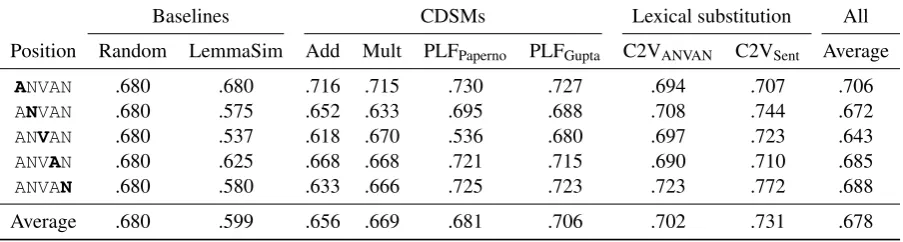
Table2lists the performance of our experiments on ANVAN-LS, first evaluated for each target word
position (top rows) and then averaged across all target positions (bottom row). The rightmost col-umn shows the average performance of all tested models. Even though there is some variance in the numbers between subject-position targets and object-position targets, we see consistent patterns by part of speech: adjectives are easiest to stitute, followed by nouns, while verbs are sub-stantially more difficult. The difficulty with verbs corresponds to the findings ofMedi´c et al.(2017) for Croatian, who proposed a correlation between the syntactic valence of words and their difficulty (but see below).
The worst model by far is LemmaSim. This is surprising, given thatKremer et al.(2014) found lemma-level similarity to be very competitive. Fur-ther analysis showed that its bad performance is due to our choice of confounders as highly similar lemmas (cf. Section2). An example where high similarity indicates syntagmatic rather than paradig-matic relatedness isohio democrat embark
over-landtrip/*itinerary/*sightseeing/journey/travel,2
where the two confounders can form noun com-pounds with the target, likesightseeing trip. The simple Add and Mult models also perform worse than random, in contrast to many other studies, un-derscoring the difficulty of performing well on our dataset. They do relatively well for adjectives, but worse on nouns, and Add struggles with verbs.
The PLFPapernomodel performs at baseline level
overall, but shows particularly clear differences among parts of speech. It does very well for all adjectives and nouns, but very poorly on verbs, where it is in fact the worst model overall, both measured absolutely, and relatively to the overall performance of the model. An analysis showed that this is indeed, as Gupta et al. (2015) claim, due to the overpowering effect of the predicate vector which is added in the final step of the com-position and thus tends to dominate the composed phrase. Consequently, PLFPapernoessentially falls
back to verb lemma similarity (cf. the example
russian teamwin/earn/*clinch/get/*succeed gold medal).
PLFGuptaperforms comparable to PLFPapernoin
all positions, but demonstrates a significant im-provement on verbs, for example russian team
win/earn/get/*clinch/*succeed gold medal. The PLFGupta model also outperforms the baselines,
overall and for all individual positions, it emerges as the best performing CDSM.
Finally, the two context2vec models beat the baseline both on all positions and overall. Interest-ingly, C2VANVAN, which uses the same information
provided to the CDSMs, performs roughly on par with PLFGupta, the best-scoring CDSM. Evidently,
Context2Vec (as a lexical substitution model) and PLF (as a CDSM) perform comparably – it is not the case that one of the two model families shows a clear advantage over the other, given the same con-text. C2VSent, which has access to richer context,
shows another substantial improvement. An inter-esting difference between PLF and Context2Vec is that the lexical substitution models – which do not take syntactic structure into account – show less variance among positions than the PLF, which does take syntactic structure into account.
In their analysis of CDSM performance on a Croatian language ANVAN dataset,Medi´c et al. (2017) found a superior performance of simple
Baselines CDSMs Lexical substitution All Position Random LemmaSim Add Mult PLFPaperno PLFGupta C2VANVAN C2VSent Average
ANVAN .680 .680 .716 .715 .730 .727 .694 .707 .706
ANVAN .680 .575 .652 .633 .695 .688 .708 .744 .672
ANVAN .680 .537 .618 .670 .536 .680 .697 .723 .643
ANVAN .680 .625 .668 .668 .721 .715 .690 .710 .685
ANVAN .680 .580 .633 .666 .725 .723 .723 .772 .688
[image:5.595.75.527.64.185.2]Average .680 .599 .656 .669 .681 .706 .702 .731 .678
Table 2: Evaluation results on ANVAN-LS (mean average precision)
CDSMs (such as addition) for nouns while the PLF performed better on verbs. They attributed this to the role of valence, arguing that the functional role of the verbs, and the disambiguation potential of its argument positions, is better captured by the PLF. In contrast, the variance in performance between word positions that we find for the different models on the ANVAN-LS dataset indicates that the
dif-ficulty of substituting verbs might not be due to the intrinsic factor of valence, but due to remain-ing shortcomremain-ings in all CDSM models to properly model predicate-argument combination.
5 Conclusion
This paper presented the case for using lexical sub-stitution as a better evaluation setup for compo-sitional distributional semantic models (CDSMs). We created a new corpus, ANVAN-LS, on the basis
of a corpus with manually annotated lexical substi-tution, and evaluated a battery of models. Our eval-uation on this corpus (1) uses a corpus-based, rather than manually constructed, dataset, and should be more indicative for the performance of models on “real-world data” than previous ANVAN-based
eval-uations; (2) is challenging, with a high baseline, which simple CDSMs like component-wise addi-tion and multiplicaaddi-tion were indeed not able to beat; (3) enables a detailed evaluation at a per-position level; (4) makes it possible, to our knowledge for the first time, to compare CDSMs with dedicated lexical substitution models on par, and shows that the two model families perform comparably when using the same context, but differ in their perfor-mance by position.
The last result in particular opens up a new line of research, namely an investigation of similari-ties and differences between the two model fam-ilies. The improvement we observe for C2VSent
over C2VANVANin particular calls for a move from
ANVAN-style sentences to more complex and var-ied sentence structures. It remains to be researched how capable CDSMs are to model meaning modu-lation that extends beyond the immediate predicate-argument structure (Kremer et al.,2014).
Acknowledgments. We acknowledge partial funding by Deutsche Forschungsgemeinschaft through SFB 732 (project D10) and by the Croatian Science Foundation under the project UIP-2014-09-7312. We would also like to thank Domagoj Alagi´c for his support.
References
Marco Baroni, Raffaela Bernardi, and Roberto Zampar-elli. 2014. Frege in space: A program of composi-tional distribucomposi-tional semantics. LiLT (Linguistic Is-sues in Language Technology)9.
Marco Baroni and Roberto Zamparelli. 2010. Nouns are vectors, adjectives are matrices: Representing adjective-noun constructions in semantic space. In Proceedings of EMNLP. Cambridge, MA, pages 1183–1193.
Georgiana Dinu, Nghia The Pham, and Marco Baroni. 2013. DISSECT – distributional semantics composi-tion toolkit. InProceedings of ACL. Sofia, Bulgaria, pages 31–36.
Katrin Erk. 2012. Vector Space Models of Word Mean-ing and Phrase MeanMean-ing: A Survey. Language and Linguistics Compass6(10):635–653.
Edward Grefenstette. 2013. Category-theoretic quantitative compositional distributional models of natural language semantics. arXiv preprint arXiv:1311.1539.
Emiliano Guevara. 2010. A regression model of adjective-noun compositionality in distributional se-mantics. In Proceedings of the 2010 Workshop on GEometrical Models of Natural Language Seman-tics. Uppsala, Sweden, pages 33–37.
Abhijeet Gupta, Jason Utt, and Sebastian Pad´o. 2015. Dissecting the practical lexical function model for compositional distributional semantics. In Proceed-ings of STARSEM. Denver, Colorado, pages 153– 158.
Dimitri Kartsaklis, Mehrnoosh Sadrzadeh, and Stephen Pulman. 2013. Separating disambiguation from composition in distributional semantics. In Proceed-ings of CoNLL. Sofia, Bulgaria, pages 114–123.
Gerhard Kremer, Katrin Erk, Sebastian Pad´o, and Ste-fan Thater. 2014. What substitutes tell us-analysis of an “all-words” lexical substitution corpus. In Pro-ceedings of EACL. Gothenburg, Sweden, pages 540– 549.
Marco Marelli, Luisa Bentivogli, Marco Baroni, Raf-faella Bernardi, Stefano Menini, and Roberto Zam-parelli. 2014a. SemEval-2014 Task 1: Evaluation of compositional distributional semantic models on full sentences through semantic relatedness and tex-tual entailment. InProceedings of SemEval. Dublin, Ireland, pages 1–8.
Marco Marelli, Stefano Menini, Marco Baroni, Luisa Bentivogli, Raffaella Bernardi, and Roberto Zampar-elli. 2014b. A SICK cure for the evaluation of com-positional distributional semantic models. In Pro-ceedings of LREC. Reykjav´ık, Iceland, pages 216– 223.
Diana McCarthy and Roberto Navigli. 2009. The En-glish lexical substitution task. Language Resources and Evaluation43(2):139–159.
Zoran Medi´c, Jan ˇSnajder, and Sebastian Pad´o. 2017. Does free word order hurt? Assessing the Practical Lexical Function model for Croatian. In Proceed-ings of STARSEM. Vancouver, BC, pages 115–120.
Oren Melamud, Jacob Goldberger, and Ido Dagan. 2016. context2vec: Learning generic context em-bedding with bidirectional LSTM. InProceedings of CONLL. Berlin, Germany, pages 51–61.
Jeff Mitchell and Mirella Lapata. 2008. Vector-based models of semantic composition. InProceedings of ACL. Columbus, OH, pages 236–244.
Denis Paperno, Nghia The Pham, and Marco Baroni. 2014. A practical and linguistically-motivated ap-proach to compositional distributional semantics. In Proceedings of ACL. Baltimore, MD, pages 90–99.
Martin Pickering and Steven Frisson. 2001. Process-ing ambiguous verbs: Evidence from eye move-ments. Journal of Experimental Psychology: Learn-ing, Memory, and Cognition27(2).
Stephen Roller and Katrin Erk. 2016. Pic a different word: A simple model for lexical substitution in con-text. In Proceedings of NAACL/HLT. San Diego, CA, pages 1121–1126.
Howard Schuman and Stanley Presser. 1996. Ques-tions and answers in attitude surveys: Experiments on question form, wording, and context. Sage.