Standardization efforts: The relationship between knowledge
dimensions, search processes and innovation outcomes
Zongjie Xie
a,n, Jeremy Hall
b, Ian P. McCarthy
c, Martin Skitmore
d, Liyin Shen
a aSchool of Construction Management and Real Estate, International Research Centre for Sustainable Built Environment, Chongqing University, 174 Shazhengjie, Chongqing, 400030 PR China
b
Nottingham University Business School, Jubilee Campus, University of Nottingham, Nottingham NG8 1BB, UK c
Beedie School of Business, Simon Fraser University, 8888 University Drive, Burnaby, BC, Canada V5A 1S6 d
Faculty of Science and Engineering, Queensland University of Technology, Queensland, Australia
a r t i c l e i n f o
Article history:
Received 30 September 2014 Received in revised form 2 December 2015 Accepted 16 December 2015 Available online 24 December 2015
Keywords:
Standardization effort Search process Innovation Knowledge Construction industry
a b s t r a c t
We explore how a standardization effort (i.e., when afirm pursues standards to further innovation) involves different search processes for knowledge and innovation outcomes. Using an inductive case study of Vanke, a leading Chinese property developer, we show how varying degrees of knowledge complexity and codification combine to produce a typology of four types of search process:active, in-tegrative,decentralizedandpassive, resulting in four types of innovation outcome:modular,radical, in-crementalandarchitectural. We argue that when the standardization effort in afirm involves highly codified knowledge, incremental and architectural innovation outcomes are fostered, while modular and radical innovations are hindered. We discuss how standardization efforts can result in a second-order innovation capability, and conclude by calling for comparative research in other settings to understand how standardization efforts can be suited to different types of search process in different industry contexts.
&2015 The Authors. Published by Elsevier Ltd. This is an open access article under the CC BY-NC-ND license (http://creativecommons.org/licenses/by-nc-nd/4.0/).
1. Introduction
This paper focuses on how afirm's standardization efforts im-pact its knowledge search processes, and the resulting innovation outcomes. Standardization is the process of developing and im-plementing specifications based on the consensus of the views of
firms, users, interest groups and governments (Sherif, 2006;
Saltzman et al., 2008). The resulting standards are intended to promote compatibility, interoperability and quality. An early ex-ample of standardization is the regulation of the sizes of the threads that we find on nuts, bolts and screws, which was achieved by the development of a screw-cutting lathe that could repeatedly produce these products to specific standards with universal applications.
Standards can be developed and governed by Standards De-velopment Organizations (SDO) or independently, for example, by
firms who have afirst mover or dominant position in the market (Utterback, 1996). When afirm pursues a standard to produce an
innovation outcome, this what we call a‘standardization effort'. More specifically, a standardization effort is when afirm pursues a leadership role in developing standards to further innovation. For example, Google followed a standardization effort when acquiring and developing the innovations for its mobile operating system, Android (Grøtnes, 2009).
Scholars have argued that standardization has a significant impact on the creation and diffusion of innovations (Dolfsma and Seo, 2013;Grøtnes, 2009;Lecocq and Demil, 2006;Tassey, 2000;
Wrighta et al., 2012). However, prior research on the relationship between standardization and innovation remains inconsistent. For example, some studies have proposed a positive relationship (Rysman and Simcoe, 2008), where standardization fosters the diffusion of innovation (Hashem and Tann, 2007) and changes industrial structures (Lecocq and Demil, 2006), whereas others have argued that it constrains innovation, by inhibiting creativity (Hamel, 2006) and postponing the gestation period between in-vention and successful commercialization (Hill and Rothaermel, 2003). A number of studies have noted this unclear relationship between innovation and standardization (Gilson et al., 2005;Kano, 2000; Wrighta et al., 2012; Yoo et al., 2005). In one case,
Damanpour (1991) argues that standardization can establish managerial control when implementing innovation in a Contents lists available atScienceDirect
journal homepage:www.elsevier.com/locate/technovation
Technovation
http://dx.doi.org/10.1016/j.technovation.2015.12.002
0166-4972/&2015 The Authors. Published by Elsevier Ltd. This is an open access article under the CC BY-NC-ND license (http://creativecommons.org/licenses/by-nc-nd/4.0/). nCorresponding author.
E-mail addresses:[email protected](Z. Xie),
manufacturing context, but it might also constrain the producer– client relationship in a service context. Given such inconsistencies, better understanding the inter-play and relationship between standardization and innovation is an important research opportunity.
In response, this study aims to improve our understanding of how the search for knowledge associated with afirm's standar-dization effort can result in more effective innovation manage-ment. According toNelson and Winter (1982), understanding how
firms search for knowledge helps to explain innovative behavior, a perspective that has since been widely applied within the in-novation discourse (Chiang and Hung, 2010; Cillo and Verona, 2008;Fabrizio, 2009;Laursen and Salter, 2004;Mahdi, 2003). For example, Rosenkopf and Nerkar (2001) explored how a local search for solutions, using current knowledge, contrasts with distant search, or what Rosenkopf and Almeida (2003) call ex-plorative learning. Katila and Ahuja (2002) focused on search depth (how deeply existing knowledge is reused) and search scope (how widely new knowledge is explored), while Greve (2003)
investigated problematic search caused by low performance and slack search caused by excess resources.
In addition to how variations in search scope can impact in-novation, studies have also highlighted the importance of different approaches to search. Broadcast search is suited to external solvers self-selecting themselves to create a solution (Jeppesen and
Lakhani, 2010). In contrast‘pyramiding’, a search process based upon the view that appropriate experts will know other appro-priate experts, is used for identifying individuals who have more of a given attribute by“moving up to the pyramid”(Hippel et al., 2009:1398). Furthermore, search processes can vary in terms of the extent to which alliance partners jointly search for new knowledge across different knowledge domains (Zack, 1999) or use search processes to selectively target knowledge sources from product market, science and suppliers (McCarthy et al., 2006;
Nicholson and Sahay, 2004).
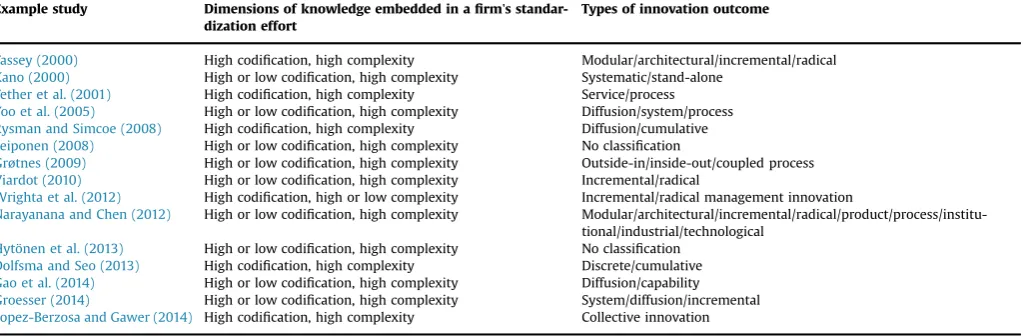
We present our arguments in four sections. First, we review the literature on standardization and innovation to identify how dif-ferent dimensions of knowledge, embedded in the standardization effort, can impact different types of innovation outcome (see
Fig. 1). We also examine and illustrate the potential relationships between the different dimensions of knowledge, search processes and innovation outcomes involved in a standardization effort. Second, to investigate and illustrate the relationships between these elements of a standardization effort, we present a case study on Vanke Co., Ltd. (Vanke), the largest residential property de-veloper in China. For almost 16 years, Vanke has undertaken a standardization effort in housing design and construction. This resulted in standards and innovations for mass off-site fabrication (referred to as‘housing industrialization’), which have since been adopted by the Chinese construction industry and influenced re-lated Chinese government policies. Third, we discuss the case
findings and present a typology of four types of search process: active, integrative, decentralized and passive, along with four dif-ferent types of innovation outcome: modular, radical, incremental and architectural. Finally, we conclude the paper by discussing theoretical and practical implications of our research.
2. Standardization and innovation in management research
[image:2.595.42.555.84.252.2]Looking across the literature that explores the relationship between standardization and innovation, we identify two recur-ring main themes–knowledge embedded in standardization and types of innovation outcome (see Table 1). In this section we specifically discuss knowledge in the context of afirm's standar-dization effort. In addition, we discuss innovation from the per-spective of searching for knowledge during a standardization ef-fort. Although widely acknowledged as a key to understanding innovative behavior, search is only alluded to in the standardiza-tion discourse. The dearth of research in this area is reflected in its absence from our literature summary table (Table 1).
Fig. 1.Standardization efforts and the relationship between knowledge
dimen-sions, search processes and innovation outcomes. Table 1
Standardization and innovation in management research.
Example study Dimensions of knowledge embedded in afirm's
standar-dization effort
Types of innovation outcome
Tassey (2000) High codification, high complexity Modular/architectural/incremental/radical Kano (2000) High or low codification, high complexity Systematic/stand-alone
Tether et al. (2001) High codification, high complexity Service/process Yoo et al. (2005) High or low codification, high complexity Diffusion/system/process Rysman and Simcoe (2008) High codification, high complexity Diffusion/cumulative Leiponen (2008) High or low codification, high complexity No classification
Grøtnes (2009) High or low codification, high complexity Outside-in/inside-out/coupled process Viardot (2010) High or low codification, high complexity Incremental/radical
Wrighta et al. (2012) High codification, high or low complexity Incremental/radical management innovation
Narayanana and Chen (2012) High or low codification, high complexity Modular/architectural/incremental/radical/product/process/institu-tional/industrial/technological
[image:2.595.34.283.544.720.2]2.1. Knowledge embedded in afirm's standardization effort
Standardization is a deliberate attempt by an organization to develop, ratify and implement standards among stakeholders (Gao et al., 2014). Standardization can be led by a Standards Develop-ment Organization (SDO), such as the American Society of Me-chanical Engineers (ASME) that oversees standards for meMe-chanical components and devices. It can also be led by individual firms pursuing a standard for their products or processes and related innovations. This is called a‘standardization effort’. For example, Google developed the Android operating system for mobile tele-communication devices (Grøtnes, 2009), and management and accounting consultancies have, over time, developed standardized agendas and methods used within their industry (Wrighta et al., 2012).
Table 1presents that research on standardization and innova-tion has employed two dimensions of knowledge to characterize the processes: codification and complexity. Codification refers to the extent to which knowledge can be documented, transferred or shared (Zack, 1999). The life cycles of standardization (Tether et al., 2001) and technological change (Anderson and Tushman, 1990) help explain how the level of knowledge codification can vary in standardization. Non-codified knowledge usually emerges at ear-lier stages of standardization when technological uncertainties, trials, and competition among various competing technologies are common. The early stage of a standardization effort can end with the emergence of, for example, a dominant design (Anderson and Tushman, 1990) and the non-codified knowledge partially trans-forms to codified knowledge when the industry standard becomes established.
Although studies define standardization and standards differ-ently, they rarely emphasize this distinction, while some studies treat the two terms synonymously. For example, Tassey (2000:588) explains that “standardization represents a codifi ca-tion of an element of an industry's technology or simply some information relevant to the conduct of economic activity”, while standards are “a set of specifications to which all elements of products, processes, formats, or procedures under its jurisdiction must conform”. These definitions assume that standardization is a knowledge codification process, to assist understanding of the innovations and promote the efficiency of economic activity, especially in highly skilled settings (Bénézech et al., 2001).
We argue that merely focusing on codified knowledge under-estimates the role of the capabilities and learning mechanisms accumulated from non-codified knowledge embedded in stan-dardization. Such mechanisms can be developed as part of the process of developing and implementing a standard (Zollo and Winter, 2002), but tend to be neglected in the knowledge codifi -cation process of standardization. In technology industries, for example, the processes of standardization include providing compatible technology, creating a supportive network, developing a dominant brand name, going global, minimizing production cost and investing more than the competitors (Viardot, 2010). In our view, studies have tended to focus merely on the codified knowledge i.e., the process outcome, at the expense of
non-codi-fied knowledge that is embedded in the process of standardiza-tion. By‘embedded’we mean that the knowledge resides in the “organizing principles, routines and standard operating proce-dures” (Nicholson and Sahay, 2004:337) necessary for the stan-dardization effort.
The second dimension of knowledge listed in Table 1 is knowledge complexity, which is the extent to which knowledge canflow and be used independently between people or subunits offirms (Teece, 1986;Winter, 1987). To be understood and used, knowledge with high complexity requires some other knowledge or additional processing. Knowledge with low complexity is
stand-alone and can be more easily transferred and used. The literature emphasizes the importance of knowledge complexity in afirm's standardization effort, but fails to delineate how it impacts the type of innovation outcome that is produced.
Some studies suggest that high knowledge complexity is cen-tral to standardization (Rysman and Simcoe, 2008;Tassey, 2000;
Tether et al., 2001). For example,Yoo et al. (2005)argue that the standardization and innovation in broadband mobile services is driven by the need to integrate complex and diverse technological knowledge. The literature moreover suggests that knowledge embedded in standardization may be composed of different de-grees of complexity. For example, knowledge will likely be less complex when fewer stakeholders are involved, such as a‘bespoke (one-off, custom-made) service' (Tether et al., 2001), and more complex when the stakeholders involved have different techno-logical, social and economic backgrounds or interests (Yoo et al., 2005). Knowledge complexity is likely to be exacerbated when sustainable development issues are driving innovation (Matos and Hall, 2007; Zollo and Winter, 2002) as is the case in the con-struction industry (discussed below).
Narayanana and Chen (2012)reveal, implicitly, that knowledge complexity in standardization has the potential to influence ar-chitectural innovation at the community level (i.e., competing
firms and their technological platforms) and modular innovation within the product offerings. These types of innovation come from a classification (modular, radical, incremental and architectural) based on the extent to which the innovation involves new inter-faces between components and or involves new components alone (Henderson and Clark, 1990). These types of innovation are re-levant to the issue of knowledge complexity in standardization which usually determines the interfaces that links components in a product. For example, Kleinsmann et al. (2010)identified dif-ferent collaborative mechanisms within four types of interface from company, project and actor levels in the context of knowl-edge complexity. Standards provide opportunities for changes in the way in which the component knowledge are linked together, while leaving the core component knowledge untouched ( Hen-derson and Clark, 1990).
2.2. Standardization efforts from a search perspective
As discussed above, the standardization studies listed inTable 1
have placed little emphasis on search processes. This is somewhat surprising given that a key aspect of innovation is that it involves the search for and transfer of new knowledge (Rogers, 2003), or recombining existing ideas or technologies (Schumpeter, 1934). Understanding the search for knowledge and how it is conducted has been recognized as crucial for understanding the innovation process (Miller et al., 2007; Rogers, 2003;Tsai, 2001), as knowl-edge provides the foundation for learning (Cohen and Lenvinth, 1990;Shenkar and Li, 1999). Search is central to innovation and standardization efforts. Drawing on the work ofNelson and Winter (1982), we define search in these contexts as an organization's problem-solving activities that involve the creation and re-combination of technological knowledge.
We propose that a search perspective linked to the dimensions of technological knowledge can help reconcile the inconsistencies in the literature focused on standardization and innovation. Dif-ferent types of search activity have been found to influence whether afirm innovates incrementally or radically. For example,
and Hung, 2010), leading to varying innovation performances.
3. Methods
A case study of a firm that was highly successfully in using standards to innovate effort can advance our understanding of standardization efforts and the role of search processes. Conse-quently, we now describe our methodology and explain why and how we conducted the case study of Vanke. We also explain our approach to data collection and we identified, synthesized and illustrates the different knowledge dimensions, search processes and innovation outcomes in Vanke's standardization effort.
3.1. Case context and selection
We selected the Chinese building sector because it has under-gone a substantial transition, with new approaches to improving energy efficiency and the adoption of information and commu-nication technologies. Although traditionally the building sector has not been considered innovation-intensive, there have been recent measures adopted to improve innovative practices through standards (Saltzman et al., 2008).
The Chinese building sector is an interesting and important industry in terms of the need to innovate, as it accounts for almost a third of China's total energy consumption. Such demands are exacerbated by the sheer scale of China's economy and its rapid urbanization. The percentage of the population living in urban areas is expected to increase from 36% in 2000 to an estimated 50% by 2020 (Chen and Shu, 2012). Indeed, an additional 2 billion square meters of newly constructed buildings have been added yearly in China over the last 10 years. Existing buildings currently account for around 40 billion square meters in area, around 95% of them failing to meet the existing requirements for energy-efficient buildings (Kleinsmann et al., 2010).
The Chinese government has developed and announced sets of standards to help increase innovative construction. For example, it has encouraged the implementation of Building Information Model (BIM) technology in the life cycle of buildings, which in-cludes design, construction and operations standards. Local gov-ernments have also prepared their own standards for im-plementing BIM. The Chinese government also announced the standard for energy efficient building assessment (GB/T 50668-2011) in 2011, for building an energy-efficient community. Com-panies that meet the standard can gain tax reductions and ex-emptions from the government. The standard outlines basic as-sessment requirements and different classification levels for building systems including architectural planning, building en-velope, HVAC (Heating, Ventilating and Air Condition), water supply and drainage, power supply and lighting, indoor environ-ment and operation and the manageenviron-ment of buildings both re-sidential and public. To keep pace with and satisfy the changing requirements in these areas of building design and construction,
firms in the Chinese building sector have had to deliver innovative responses of the right type and at the appropriate speed. However, while most innovation in this sector has been driven by standar-dization efforts, little is known about the efficacy of such innovations.
FollowingSiggelkow (2007), we chose Vanke, one of China's largest property developers, as our case for three reasons. First, Vanke is the leading Chinese company for‘housing tion', their long-term strategy since 1999. Housing industrializa-tion promotes mass off-site prefabricaindustrializa-tion instead of convenindustrializa-tional on-site construction methods. Standardization is a basic premise of housing industrialization. For example, building components have to be standardized to facilitate design, mass off-site
prefabrication and assembly on the construction site. Housing industrialization thus not only changes the way to build, it also requires a standardization effort that changes the relationship between the stakeholders involved in the building sector supply chain. These changes may have a substantial impact on other sectors because the building industry has close relationships with for example, the steel industry, forestry, electrical appliance in-dustry, water treatment and even the medical industry.
Second, to foster housing industrialization, Vanke has had to initially overcome many disadvantages. These included the high costs of housing industrialization building methods compared with those of conventional building methods, outdated construc-tion technologies and lack of capital, supportive government po-licies and skilled labor in the building sector. Currently, housing industrialization has been accepted by the Chinese government and welcomed by industry. Over the past 16 years, Vanke has thus been at the forefront of developing standards for housing in-dustrialization, providing us with a useful opportunity to explore this phenomenon in the Chinese building sector.
Third, the large scale and established industry presence of Vanke is important as it represents a large part of the sector's standardization effort. Vanke is one of the largest real estate de-velopers in China. In 2012, it had approximately 22 billion US dollars of sales revenue (gross) and 31,019 employees, and had developed 14.33 million square meters of building work. The large scale of Vanke helps buffer the company from external contingent factors such as fiscal policies and economic changes to firms, which can disrupt smaller developers. In addition, Vanke has a relatively long history in the Chinese building sector, having launched its business in 1984. Its 30 years of constant operation thus allows us to investigate the formation and dynamics of the capabilities developed by the company.
3.2. Data categories and collection
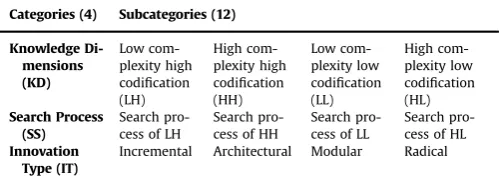
To develop a framework to understand afirm's standardization effort, we sought data regarding the relationship between knowledge dimensions, search processes and innovation out-comes. Following guidelines for collecting case data byEisenhardt (1989) and Yin (2003), we categorised these elements. For ex-ample, in terms of knowledge dimensions the degree of codifi ca-tion and complexity (low versus high in each case), while relative, can be substantiated. We followed a similar approach for collect-ing data on different search processes and types of innovation. The
final four categories and twelve sub-categories of data are pre-sented inTable 2.
[image:4.595.303.553.652.744.2]We collected data for this study from both archival sources and interviews. The archives included annual company reports, cor-porate social responsibility reports, scholarly journals, internal company documents (reports and presentations), national stan-dards, news papers and the autobiographies and other writings of Shi Wang, the founder and current chairman of Vanke. Scholarly journal articles focused on Vanke were obtained from sources such
Table 2
Categories and sub-categories of data coding.
Categories (4) Subcategories (12)
Knowledge Di-mensions (KD)
Low com-plexity high codification (LH)
High com-plexity high codification (HH)
Low com-plexity low codification (LL)
High com-plexity low codification (HL) Search Process
(SS)
Search pro-cess of LH
Search pro-cess of HH
Search pro-cess of LL
Search pro-cess of HL Innovation
Type (IT)
as the China National Knowledge Index (CNKI). Autobiographies of the current chairman of Vanke included Wang (2012a, 2012b,
2013,2014a,2014b).
We conducted 28 interviews (telephone and face-to-face) with project and procurement managers, customer service and R&D staff, accounting department representatives and administrators working nationwide at Vanke. We also interviewed government officials and researchers. The interviews lasted between twenty minutes and one and a half hours. We also used additional open-ended questionnaires after the first round of interviews. All in-terviews were conducted between April 2014 and March 2015.
3.3. Data coding and analysis
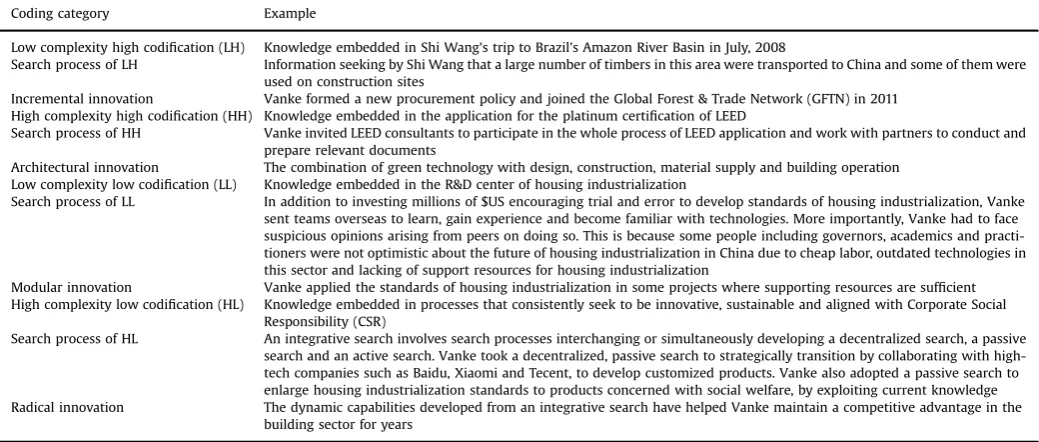
[image:5.595.43.563.524.745.2]The collected data were coded following guidelines for quali-tative content analysis (Eisenhardt, 1989; Kohlbacher, 2006). De-tailed write-ups of the archival and interview data were produced to ensure intimate familiarity with the case. The data were then sorted into the 4 categories and 12 sub-categories of the dimen-sions of knowledge, search process and innovation outcome, in effect making them variables in our study. This allowed us to make inferences, verifications and a theory guided analysis of the data.
Table 3provides examples of the data coding.
Further tables were used to help analyse cross-sectional data and to sequence and organize longitudinal data. The longitudinal data were collected to increase the internal validity of the case study. The data were also divided by source and the patterns that emerged were analysed and compared with those from the in-terviews. When both were consistent, the findings were con-sidered to be stronger and better grounded. When evidence from the two sources conflicted, the evidence was reconciled by either probing the difference or by collecting additional data. For ex-ample, archival data indicated that Vanke planned to apply housing industrialization to all of its projects by 2014. However, interview data from Chongqing indicated that only one project used the technologies of housing industrialization. Further data verified that Vanke had applied different levels of standardization and innovation in different districts, depending on the availability of supporting resources.
4. Findings and typology
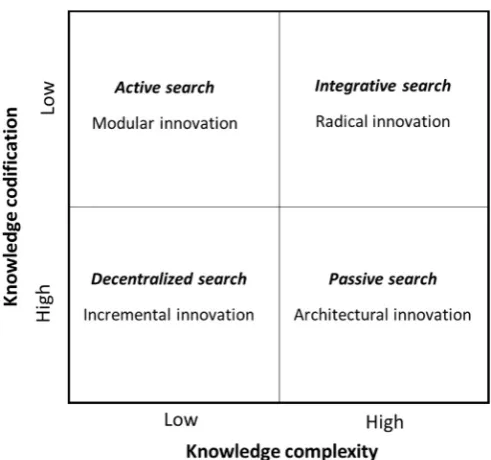
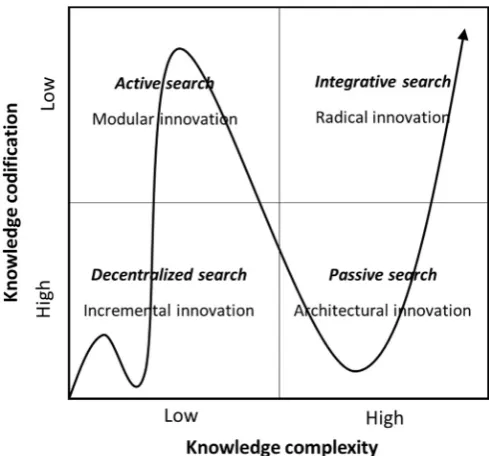
Thefindings in this study suggest that a standardization effort is a complex phenomenon shaped by multiple search processes for different dimensions of knowledge and innovation outcomes. This is depicted in a theoretical framework (seeFig. 2) that shows how the two proposed dimensions of knowledge (codification and complexity) combine to produce a typology of four types of search (active, integrative, decentralized and passive) and four types of innovation outcome (modular, radical, incremental and archi-tectural). We now validate and illustrate the typology using the casefindings and drawing upon previous research on innovation and standardization.
4.1. Decentralized search and incremental innovations
The first type of search and related innovation outcome we discuss occurs when the knowledge in a standardization effort is of low complexity and is highly codified. This creates what we refer to asdecentralizedsearch and results inincremental innova-tion outcomes. Decentralized search means that the search is not centrally coordinated by a unit in the organization. The search is autonomously led by different individuals and units, each of which may be tracking a specific aspect of the environment, such as market demand, competitor actions, product and technological innovation, and regulatory updates (McCarthy et al., 2010; Daft and Weick, 1984). Decentralized search is suitable for low com-plexity knowledge especially as the search is typically conducted and controlled by individuals, especially at the executive level (Daft et al., 1988). These individuals serve as the strategic scanning interface between the organization and the external environment. The trip to Brazil's Amazon River Basin in 2008 made by Van-ke's CEO (Shi Wang) is an example decentralized search. The search was not undertaken by a team of analysts. Only Shi Wang was involved as the knowledge complexity was low. The knowl-edge that was acquired was also highly codified in that it could be seen, documented and presented by an individual–it is not rou-tinized and does not involve many interactions within afirm. The resulting innovations are typically incremental and are supposed to provide developmental plasticity or flexibility to the internal and external environments, improving the ability to value external
Table 3
Examples of data coding.
Coding category Example
Low complexity high codification (LH) Knowledge embedded in Shi Wang's trip to Brazil's Amazon River Basin in July, 2008
Search process of LH Information seeking by Shi Wang that a large number of timbers in this area were transported to China and some of them were used on construction sites
Incremental innovation Vanke formed a new procurement policy and joined the Global Forest & Trade Network (GFTN) in 2011 High complexity high codification (HH) Knowledge embedded in the application for the platinum certification of LEED
Search process of HH Vanke invited LEED consultants to participate in the whole process of LEED application and work with partners to conduct and prepare relevant documents
Architectural innovation The combination of green technology with design, construction, material supply and building operation Low complexity low codification (LL) Knowledge embedded in the R&D center of housing industrialization
Search process of LL In addition to investing millions of $US encouraging trial and error to develop standards of housing industrialization, Vanke sent teams overseas to learn, gain experience and become familiar with technologies. More importantly, Vanke had to face suspicious opinions arising from peers on doing so. This is because some people including governors, academics and practi-tioners were not optimistic about the future of housing industrialization in China due to cheap labor, outdated technologies in this sector and lacking of support resources for housing industrialization
Modular innovation Vanke applied the standards of housing industrialization in some projects where supporting resources are sufficient High complexity low codification (HL) Knowledge embedded in processes that consistently seek to be innovative, sustainable and aligned with Corporate Social
Responsibility (CSR)
Search process of HL An integrative search involves search processes interchanging or simultaneously developing a decentralized search, a passive search and an active search. Vanke took a decentralized, passive search to strategically transition by collaborating with high-tech companies such as Baidu, Xiaomi and Tecent, to develop customized products. Vanke also adopted a passive search to enlarge housing industrialization standards to products concerned with social welfare, by exploiting current knowledge Radical innovation The dynamic capabilities developed from an integrative search have helped Vanke maintain a competitive advantage in the
knowledge. These incremental innovations are minor improve-ments that build on incumbent knowledge (Dewar and Dutton, 1986).
In the case of Shi Wang's trip to the Amazon River Basin, the search and knowledge resulted in Vanke becoming a member of the Global Forest & Trade Network (GFTN) whose aims are to eliminate illegal logging and improve forest management. This helped Vanke identify societal concerns about its practices and pioneer its culture of Corporate Social Responsibility (CSR). For example, a new procurement policy was adopted to restrict use of non-renewable forest resources for Vanke's operations. The adoption of the procurement policy was relatively straightforward (i.e., an incremental innovation) as it did not require major chan-ges to operational units. The process of forming and applying the procurement policy and joining GFTN diversified Vanke's goal of improving CSR and the sustainability of their operations, while also building the company's flexibility to adapt to the external environment.
4.2. Passive search and architectural innovations
The second type of search and innovation outcome we discuss occurs when the knowledge in a standardization effort is highly complex and highly codified. This creates what we refer to as
passivesearch and results inarchitecturalinnovation outcomes. By passive we mean a situation where a firm takes whatever in-formation comes its way, which can result in knowledge discovery and transfer efficiencies. However, the potential to receive novel ideas that underlie major solutions tends to be reduced by simply waiting for knowledge to arrive. This is because passive search has inertia and is satisficing in nature i.e., once an organization has received information to meet its requirements, waiting for further and better alternatives is considered time-consuming (March, 1991).
Highly complex knowledge in a standardization effort will likely require other complementary knowledge and additional processing to be understood. Therefore, the standardization effort also has to acquire and assimilate this additional knowledge often drawing upon different organizational subunits and external partners. To help mitigate the risk and costs of this complexity,
codifying that knowledge is a common approach. Together these factors support a standardization effort suited to producing ar-chitectural innovations. This is because an arar-chitectural innovation changes the way in which the components of knowledge are linked together, while leaving the core knowledge untouched (Henderson and Clark, 1990). The capabilities for an architectural innovation include the ability to reconfigure the current structure of a system or to enlarge the current system by taking in new subsystems (Yoo et al., 2005).
An example of a passive search and architectural innovation outcome by Vanke is their adoption of Leadership in Energy and Environmental Design (LEED), a third-party certification scheme for assessing green building. LEED measures the environmental performance of various aspects of construction, such as the de-velopment of sustainable architectural designs, water efficiency, energy, materials and resource use, emissions and indoor en-vironmental quality. Adopting LEED certification is an architectural innovation as it requires the use of complex interrelated knowl-edge and coordination of capabilities with suppliers to attain. According to the U.S. Green Building Council (USGBC), this typi-cally involves a specified application procedure, and can be com-municated through documentation (high codification). Vanke in-vited LEED consultants to participate during the application pro-cedure and cooperated with partners such as designers and con-structionfirms, preparing relevant documents on certification of qualification, construction methods, energy saving, recyclable material, etc.
4.3. Active search and modular innovations
The third type of search and innovation outcome in our ty-pology is when the knowledge dimensions have low complexity and low codification. This results in anactivesearch andmodular
innovation. In contrast to passive search, active search involves allocating resources to vigorously explore, test and shape the en-vironment (Daft et al., 1988). An active search includes sending agents to places and events in the environment (Smith et al., 2010) and engaging in trial and error learning (Daft and Weick, 1984). This type of search suits low complexity knowledge as it is exists independently outside a firm's boundary and requires little in-tegration thefirm's existing knowledge (Beckert, 1999). Also, low codified knowledge is suited to experiential learning methods that involve interacting with the environment (Kamp et al., 2004). This is essential for acquiring, forming and applying such knowledge.
An example of active search by Vanke is when it established an R&D center in 1999 to develop standards for building components in China. To accumulate knowledge and technologies for housing industrialization, Vanke sent teams of researchers overseas (especially to Japan) tofind and internalize the acquired knowl-edge by working with researchers at partner organizations. Vanke has invested millions of U.S. dollars annually in these learning secondments and the R&D center.
Active search was an important mechanism for Vanke in overcoming skepticism to its housing industrialization strategy. There was skepticism from the Chinese government and from Vanke's peers in the building sector that this approach might not be suitable for China due to availability of inexpensive, low skilled labor suitable for its outdated construction technologies. Vanke's active search sought innovations and standards that would de-monstrate the viability of the strategy and overcome the skepti-cism. In this respect, an active search tends to be an action or-iented and self-regulating process that helps ensure the firm's standardization effort suits external conditions.
[image:6.595.35.281.54.284.2]The learning from active search typically remains in the teams or sub-units of thefirm that undertake the search. Consequently, at the product level this learning promotes modular innovations
Fig. 2.Standardization efforts and embedded knowledge dimensions: a typology of
by changing component knowledge while leaving the product's structural knowledge unchallenged (Henderson and Clark, 1990). At the organizational level, active search and modular innovation has limited impact on routines and systems.
Vanke has residential projects nationwide, but the rollout of housing industrialization was initially limited to just Shenzhen and Beijing. It was several years later that this strategy and stan-dardization effort was applied elsewhere, for example in the southwestern city of Chongqing. This restricted rollout of housing industrialization was partly because of the delays in routinizing, institutionalized and standardizing the implementation of the innovations. Also, Vanke applied different levels of housing in-dustrialization in different districts, depending on the availability of supporting resources in the districts. In addition, the Chinese government had not until recently enacted any legislation re-quiring the use of housing industrialization methods in the con-struction industry. The legitimacy of housing industrialization was cemented as Vanke used active search to aggressively develop nine major standards and innovations, which were eventually approved by the Chinese government in March, 2015. Since then all construction projects in China are required to meet the national standards on housing industrialization pioneered by Vanke.
4.4. Integrative search and radical innovations
Thefinal search type and innovation outcome in our typology isintegrative search and radicalinnovations, involves embedded knowledge with high complexity and low codification. The search is integrative because it employs and builds on the decentralized, passive and active search types. Integrative search toggles be-tween these different search processes to produce both ex-plorative and exploitative learning (McCarthy and Gordon, 2011). It is suited to environments where the regulations, demand, in-novation and competitive actions in the industry are all changing at different rates and in different directions. This is considered to be a‘conflicted’industry dynamic that is unlikely to suit just one type of search process (McCarthy et al., 2010).
The embedded knowledge in this case is linked to learning by repetitive operation, as suggested byNelson and Winter (1982). Hierarchical learning may also be assimilated and gradually ac-cumulated within an organization's memory, becoming a specific part of routines that support dynamic capabilities and the pro-duction of radical innovations (Tushman and O’Reilly, 1996). Dy-namic capabilities are cultivated through the recombination of previous knowledge, and the amalgamation of new and different knowledge vectors. These conditions promote radical innovations that are clear departures from existing knowledge and practices (Dewar and Dutton, 1986).
Central to the success of Vanke standardization effort was the company's use of an integrative search. It initially adopted passive search to apply for LEED and develop and standardize green technologies for housing industrialization. Vanke gradually en-larged the implementation of its housing industrialization in-novations to its commercial products, as well as to its social wel-fare projects such as indemnificatory apartments including low-rent, affordable, price-fixed and public rental housing. A plan of quality management, the Panshi Plan, was developed by refining and documenting Vanke's best practice experience from these projects into a set of standards for the whole company.
Vanke also conducted decentralized and active searches. It re-cognized the possibility of being overthrown by emerging com-panies in other sectors, such as manufacturing, information and communication technology, and this resulted in the proposed strategic transition of the company from developer to city service provider. In 2014 Vanke organized in-company teams to learn from companies such as Haier (household appliances
manufacturer), Alibaba (e-commerce), Tencent (internet service provider), Xiaomi (smartphone manufacturer) and Baidu (internet search engine). The decentralized and active searches opened the potential for Vanke to collaborate with these firms to provide novel products in the Chinese market. For example, Vanke now provides value-added services to customers using the data ser-vices of Baidu. Vanke also collaborated with partners to develop standards and innovations for universal serial bus (USB) plugs, sanitary appliances, airfilters and door opening technology using cell phones. The integrative search, dynamic capabilities and ra-dical innovations also led Vanke to restructure the relationships betweenfirms in its supply chain. Vanke initiated a supply chain alliance that included manufacturers, designers, developers, con-struction and home decoration companies as well as research in-stitutions such as Tsinghua University, Tongji University and Tianjin University.
5. Discussion
While standardization efforts have been recognized as playing a crucial role in howfirms create and profit from innovation, we found that existing empirical research offers inconsistentfindings on the relationship between standardization and innovation. To help resolve these inconsistencies and further our understanding of standardization, we examined how degrees of knowledge complexity and codification impact the type of search required and the resulting innovation outcome. We explained how these two dimensions of knowledge combine to produce a typology of four types of search process and four types of associated innova-tion outcome. Using a detailed case study, we illustrated and verified each dimension of our typology. Together the typology and the case study help us to better understand how search im-pacts the inter-play and relationship between standardization and innovation outcomes.
5.1. Implications for the theory and practice
We now discuss four major implications of this, which we be-lieve are of relevance to both management practice and future empirical research.
First, this study demonstrates that search processes are im-portant to major standardization efforts. In our case study it is clear that multiple types of search were employed to acquire and assimilate different dimensions of knowledge. The processes for gaining this knowledge are at the heart of a standardization effort and the associated innovation outcomes. Our typology and case study show that there is a contingency relationship between standardization, search and innovation outcomes, where one size doesnotfit all. The quest for different types of knowledge, involves different search approaches that in turn underlie the type of in-novation outcome produced.
A second implication of our research is that the case study provides provisional evidence for understanding how standardi-zation efforts can be suited to different types of search process. For example, wefind that standardization efforts that employ decen-tralized and passive search processes are positively linked to in-cremental and architectural innovation outcomes. This is due to the knowledge embedded in the standardization effort, which is highly codified and complex. It promotes consensus and re-combination among stakeholders, explaining why a standardiza-tion effort strongly diffuses within the industry (Hashem and Tann, 2007) and in turn shapes the industry structure (Lecocq and Demil, 2006) and its value chain (Yoo et al., 2005).
standards and innovations (Unruh, 2000), resulting in strong technological trajectories (Dosi, 1982;Smith et al., 2010). In con-trast, when the knowledge in a standardization effort is char-acterized as having low complexity and low codification it suits an active search for modular innovations that involve designing ‘open’ component systems (Tassey, 2000), using trial and error search activities (Daft and Weick, 1984) and conductingfield stu-dies (Smith et al., 2010). When the knowledge is characterized as high complexity and low codification it suits integrative search and radical innovation outcomes. As shown in our case study, in-tegrative search involves recombining current relationships be-tween stakeholders and encouraging novel solutions resulting in component systems that disrupt existing product standards and offerings.
A third implication is that a single standardization effort can shift between different search processes over time. This is because standardization efforts are complex activities that can take many years to complete; the type of knowledge required during the course of a standardization effort can vary and change. Conse-quently, as found in our case study, there will likely be a pathway of different search processes involved in a major standardization effort.
In Fig. 3 we show the search pathway observed in our case study. It begins with decentralized search, followed by active search, passive and then integrative search. The knowledge char-acteristics for decentralized search provide the starting point in this pathway. The standardization effort begins with the search for simple codifiable knowledge that often focuses on identifying obvious gaps and needs to be addressed by the standardization effort. An active search follows, as any lack of knowledge codifi -cation requires a more skilled and costly search process to identify, understand, assimilate and exploit the knowledge. Next is passive search, as the efficiency of the investments in search become more important and firms seek more explicit standards and complex solutions to suit market needs. Thefinal search in the pathway is integrative. It is the most sophisticated, impactful, but difficult form of search. The pathway of search types reflects the learning and capabilities that preparefirms to undertake integrative search and pursue radical innovation outcomes. This concept of a learning pathway is whatMcCarthy et al. (2006: 440) refer to as“a ladder of abstraction”for interpreting and managing different and higher
order types of search for different types of innovation outcome. We thus suggest that a more strategic orientation towards stan-dards can prevent inhibiting creativity and unnecessary delays as identified byHamel (2006)andHill and Rothaermel (2003).
A fourth implication concerns managerial efforts in practice. If management's goal is primarily incremental and/or architectural innovation, it should be expected that the knowledge will be standardized, and that decentralized and passive search processes can be used. If the managerial objective is concerned with modular and/or radical innovations, the knowledge will not likely be standardized, and as a result active and integrative search pro-cesses are appropriate. For company and government policies, if decentralized and passive searches in the standardization efforts are performed, incremental and architectural innovation are ex-pected. To foster radical and modular innovations, it is necessary to enable active and integrative search processes.
5.2. Imitations of this study
Some limitations of this study and related opportunities for future research are worth noting.
While our case study allowed us to explore deeply the activ-ities, events and interactions of a major standardization effort, like all case studies, the generalizability of our finding maybe re-stricted. For example, as the search pathway inFig. 3is based on the standardization effort of just one case (Vanke), it is likely there could be alternative viable pathways. These would involve some or all of the search processes but in different orders, and thus the different pathways will suit different standardization efforts. The matching of a standardization effort with a given pathway will likely be determined by the knowledge complexity and codifi ca-tion as well as the innovaca-tion context in terms of factors such as time scales, complexity, regulations and costs. For example, the rapid development of code division multiple access (CDMA) standards for radio communication technologies in Korea would have a known innovation outcome that could involve a different search pathway. The importance of the pace of innovation to a search pathway is supported byHill and Rothaermel (2003)who claim that standardization efforts postpone the gestation period between invention and successful commercialization.
While it can be argued that ourfindings may be less applicable tofirms in other industries, the value of the typology andfindings are grounded in prior theories and research. Furthermore, as this particular industry setting has traditionally not been considered innovation-intensive, we speculate that our typology is likely to have even greater relevance for settings where innovation is fast changing and core to sustained competitive advantage. This should help motivate and make it easier for scholars to apply the typology and ideas to other industry contexts.
Another limitation of this research is that our case was focused on a successful case of a standardization effort that resulted in industry leadership. We recognize that not all standardization ef-forts will result in similar competitive advantages. Indeed, it would be fruitful to explore cases where such efforts resulted in a downward competitive trajectory, for example by creating bu-reaucratic inefficiencies or commoditizing of the industry, as was the case for nuts, bolts and screws.
6. Conclusion
[image:8.595.35.280.503.731.2]The benefits and challenges of standardization have captured the attention of managers and scholars, yet the empiricalfindings on the impact of standardization on innovation are inconsistent. Focusing on a standardization effort (i.e., when a firm pursues standards to further innovation), our work draws upon on
research on the importance of search processes for innovation and adopts a contingency approach to standardization effort, search process and innovation outcome relationships. To examine these relationships we developed a typology that provides a descriptive, explanatory and predictive framework for researchers to examine the diversity and impact of different standardization efforts. An important implication is that standardization efforts need to be seen as a long-term strategic initiatives that drive the creation and adoption of standards and innovations. If the search processes and resulting standards are not coordinated in pursuit of an innovation goal, then the risk is the effort will be a collection of disconnected standardization exercises that result in bureaucratic inefficiencies, commoditization or the stifling of creativity.
Acknowledgments
This research was partly supported by the Humanity and Social Science Youth foundation of Chinese Ministry Education (13YJC630189) and the Fundamental Research Funds for the Cen-tral Universities (2015CDJXY). The authors are grateful to people who helped in undertaking the research and making improve-ments to this article. We would also like to thank the editors and reviewers of Technovation for their insightful comments and feedback on this research.
Reference
Anderson, P., Tushman, M.L., 1990. Technological discontinuities and dominant designs: a cyclical model of technological change. Adm. Sci. Q. 35, 604–633. Bénézech, D., Lambert, G., Lanoux, B., Lerch, C., Loos-Baroin, J., 2001. Completion of
knowledge codification: an illustration through the ISO 9000 standards im-plementation process. Res. Policy 30, 1395–1407.
Beckert, J., 1999. Agency, entrepreneurs, and institutional change. The role of strategic choice and institutionalized practices in organizations. Organ. Stud. (Walter De. Gruyter GmbH Co. KG.) 20, 777–799.
Chen, L., Shu, Q., 2012. Platform design on building energy-saving monitoring and management system. Autom. Instrum. 10, 42–44.
Chiang, Y.-H., Hung, K.-P., 2010. Exploring open search strategies and perceived innovation performance from the perspective of inter-organizational knowl-edgeflows. R&D Manag. 40, 292–299.
Cillo, P., Verona, G., 2008. Search styles in style searching: exploring innovation strategies in fashionfirms. Long Range Plan. 41, 650–671.
Cohen, M.W., Lenvinth, A.D., 1990. Absorptive capacity: a new perspective on learning and innovation. Adm. Sci. Q. 35, 128–152.
Daft, R.L., Weick, K.E., 1984. Toward a model of organizations as interpretation systems. Acad. Manag. Rev. 9, 284–295.
Daft, R.L., Sormunen, J., Don, P., 1988. Chief executive scanning, environmental characteristics, and company performance: an empirical study. Strateg. Manag. J. 9, 123–139.
Damanpour, F., 1991. Organizational innovation: a meta-analysis of effects of de-terminants and moderators. Acad. Manag. J. 34, 555–590.
Dewar, R.D., Dutton, J.E., 1986. The adoption of radical and incremental innova-tions: an empirical analysis. Manag. Sci. 32, 1422–1433.
Dolfsma, W., Seo, D., 2013. Government policy and technological innovation–a suggested typology. Technovation 33, 173–179.
Dosi, G., 1982. Technological paradigms and technological trajectories: a suggested interpretation of the determinants and directions of technical change. Res. Policy 11, 147–162.
Eisenhardt, K.M., 1989. Building theories from case study research. Acad. Manag. Rev. 14, 532–550.
Fabrizio, K.R., 2009. Absorptive capacity and the search for innovation. Res. Policy 38, 255–267.
Gao, P., Yu, J., Lyytinen, K., 2014. Government in standardization in the catching-up context: case of China’s mobile system. Telecommun. Policy 38, 200–209. Gilson, L.L., Mathieu, J.E., Shalley, C.E., Ruddy, T.M., 2005. Creativity and
standar-dization: complementary or conflicting drivers of team effectiveness? Acad. Manag. J. 48, 521–531.
Grøtnes, E., 2009. Standardization as open innovation: two cases from the mobile industry. Info. Technol. People 22, 367–381.
Greve, H.R., 2003. A behavioral theory of R&D expenditures and innovations: evi-dence from shipbuilding. Acad. Manag. J. 46, 685–702.
Groesser, S.N., 2014. Co-evolution of legal and voluntary standards: development of energy efficiency in Swiss residential building codes. Technol. Forecast. Soc. Change 87, 1–16.
Hamel, G., 2006. The why, what, and how of management innovation. Harv. Bus.
Rev. 84, 72–84.
Hashem, G., Tann, J., 2007. The adoption of ISO 9000 standards within the Egyptian context: a diffusion of innovation approach. Total Qual. Manag. 18, 631–652. Henderson, R.M., Clark, K.B., 1990. Architectural innovation: the reconfiguration of
existing product technologies and the failure of establishedfirms. Adm. Sci. Q. 35, 9–30.
Hill, C.W.L., Rothaermel, F.T., 2003. The performance of incumbentfirms in the face of radical technological innovation. Acad. Manag. Rev. 28, 257–274.
Hippel, E.v., Franke, N., Prügl, R., 2009. Pyramiding: efficient search for rare sub-jects. Research Policy 38, 1397–1406.
Hytönen, H., Jarimo, T., Salo, A., Yli-Juuti, E., 2013. Markets for standardized tech-nologies:patent licensing with principle of proportionality. Technovation 32, 523–535.
Jeppesen, L.B., Lakhani, K.R., 2010. Marginality and problem-solving effectiveness in broadcast search. Organ. Sci. 21 (5), 1016–1033.http://dx.doi.org/10.1287/ orsc.1090.0491.
Kamp, L.M., Smits, R.E.H.M., Andriesse, C.D., 2004. Notions on learning applied to wind turbine development in the Netherlands and Denmark. Energy Policy 32, 1625–1637.
Kano, S., 2000. Technical innovations, standardization and regional comparison–a case study in mobile communications. Telecommun. Policy 24, 305–321. Katila, R., Ahuja, G., 2002. Something old, something new: a longitudinal study of
search behavior and new product introduction. Acad. Manag. J. 45, 1183–1194. Kleinsmann, M., Buijs, J., Valkenburg, R., 2010. Understanding the complexity of
knowledge integration in collaborative new product development teams: a case study. J. Eng. Technol. Manag. 27, 20–32.
Laursen, K., Salter, A., 2004. Searching high and low: what types offirms use universities as a source of innovation? Res. Policy 33, 1201–1215.
Lecocq, X., Demil, B., 2006. Strategizing industry structure: the case of open systems in a low-tech industry. Strateg. Manag. J. 27, 891–898.
Leiponen, A.E., 2008. Competing through cooperation: the organization of standard setting in wireless telecommunications. Manag. Sci. 54, 1904–1919.
Lopez-Berzosa, D., Gawer, A., 2014. Innovation policy within private collectives: evidence on 3GPP’s regulation mechanisms to facilitate collective innovation. Technovation 34, 734–745.
Mahdi, S., 2003. Search strategy in product innovation process: theory and evi-dence from the evolution of agrochemical lead discovery process. Ind. Corp. Change 12, 235–270.
March, J.G., 1991. Exploration and exploitation in organizational learning. Organ. Sci. 2, 71–87.
Matos, S., Hall, J., 2007. Integrating sustainable development in the supply chain: the case of life cycle assessment in oil and gas and agricultural biotechnology. J. Oper. Manag. 25, 1083–1102.
McCarthy, I.P., Gordon, B.R., 2011. Achieving contextual ambidexterity in R&D or-ganizations: a management control system approach. R&D Manag. 41, 240–258. McCarthy, I.P., Tsinopoulos, C., Allen, P., Anderssen, C.R., 2006. New product
de-velopment as a complex adaptive system of decisions. J. Prod. Innov. Manag. 23, 437–456.
McCarthy, I.P., Lawrence, T.B., Wixted, B., Gordon, B.R., 2010. A multidimensional conceptualization of environmental velocity. Acad. Manag. Rev. 35, 604–626. Miller, D.J., Fern, M.J., Cardinal, L.B., 2007. The use of knowledge for technilogical
innovation within diversifiedfirms. Acad. Manag. J. 50, 307–326.
Narayanana, V.K., Chen, T., 2012. Research on technology standards: accomplish-ment and challenges. Res. Policy 41, 1375–1406.
Nelson, R.R., Winter, S.G., 1982. An Evolutionary Theory of Economic Change. Press of Harvard University Press, The Belknap, United Kingdom.
Nicholson, B., Sahay, S., 2004. Embedded knowledge and offshore software devel-opment. Info. Organ. 14, 329–365.
Rogers, E., 2003. The Diffusion of Innovation. Free Press, New York.
Rosenkopf, L., Nerkar, A., 2001. Beyond local search: boundary-spanning, explora-tion, and impact in the optical disk industry. Strateg. Manag. J. 22, 287. Rosenkopf, L., Almeida, P., 2003. Overcoming local search through alliances and
mobility. Manag. Sci. 49, 751–766.
Rysman, M., Simcoe, T., 2008. Patents and the performance of voluntary standard-setting organizations. Manag. Sci. 54, 1920–1934.
Saltzman, J., Chatterjee, S., Raman, M., 2008. A framework for ICT standards crea-tion: the case of ITU-T standard H.350. Info. Syst. 33, 285–299.
Schumpeter, J.A., 1934. The Theory of Economic Development. Harvard University Press, United States.
Shenkar, O., Li, J., 1999. Knowledge search in international cooperative ventures. Organ. Sci. 10, 134–143.
Sherif, M.H., 2006. Standards for telecommunications services. In: Jakobs, K. (Ed.), Advanced Topics in Information Technology Standards and Standardization Research.. Idea Group Publishing, Hershey, PA, pp. 183–205.
Siggelkow, N., 2007. Persuasion with case studies. Acad. Manag. J. 50, 20–24. Smith, A., Voß, J.-P., Grin, J., 2010. Innovation studies and sustainability transitions:
the allure of the multi-level perspective and its challenges. Res. Policy 39, 435–448.
Tassey, G., 2000. Standardization in technology-based markets. Res. Policy 29, 587–602.
Teece, D.J., 1986. Profiting from technological innovation: implications for in-tegration, collaboration, licensing and public policy. Res. Policy 15, 285–305. Tether, B.S., Hipp, C., Miles, I., 2001. Standardisation and particularisation in
ser-vices: evidence from Germany. Res. Policy, 1115–1138.
performance. Acad. Manag. J. 44, 996–1004.
Tushman, M.L., O’Reilly, C.A., 1996. Ambidextrous organizations: managing evolu-tionary and revoluevolu-tionary change. Calif. Manag. Rev. 38, 8–30.
Unruh, G.C., 2000. Understanding carbon lock-in. Energy Policy 28, 817–830. Utterback, J.M., 1996. Mastering the Dynamics of Innovation. Harvard Business
School Press, United States.
Viardot, E., 2010. Achieving market leadership: the next challenge for technology firms from growing countries. J. Technol. Manag. Grow. Econ. 1, 9–28. Wang, S., 2012a. Process and Retreat Which Influenced My Life. Zhengjiang
Uni-versity Press, China.
Wang, S., 2012b. Success is Challenging Yourself. Lianhe Press, Beijing. Wang, S., 2013. My Success Comes When People Don’t Need Me Anymore.
Zhengjiang University Press, China.
Wang, S., 2014a. Da Dao Dang Ran, Vanke and Me (2000–2013). CITIC Press, China.
Wang, S., 2014b. Road and Dream, Vanke and Me (1983–1999). CITIC Press, China. Winter, S.G., 1987. Knowledge and competence as strategic assets. In: Teece, D.J.
(Ed.), The Competitive Challenge. Ballinger, MA, Cambridge, pp. 159–184. Wrighta, C., Sturdyb, A., Wyliec, N., 2012. Management innovation through
stan-dardization: consultants as standardizers of organizational practice. Res. Policy 41, 652–662.
Yin, R.K., 2003. Case Study Research: Design and Methods. SAGE, United Kingdom. Yoo, Y., Lyytinen, K., Yang, H., 2005. The role of standards in innovation and
dif-fusion of broadband mobile services: the case of South Korea. J. Strateg. Info. Syst. 25, 323–353.
Zack, M.H., 1999. Managing codified knowledge. Sloan Manag. Rev. 40, 45–58. Zollo, M., Winter, S.G., 2002. Deliberate learning and the evolution of dynamic