1 Carbon-bridged (p-phenylenevinylene) polymer for high-performance solution-processed distributed feedback lasers
Marta Morales-Vidal, José A. Quintana, José M. Villalvilla, Pedro G. Boj, Hiroki Nishioka, Hayato Tsuji*, Eiichi Nakamura*, Guy L. Whitworth, Graham A. Turnbull, Ifor D. W. Samuel and María A. Díaz-García*
Dr. M. Morales-Vidal,[+] Dr. J. M. Villalvilla, Prof. M. A. Díaz-García
Dpto. Física Aplicada, Instituto Universitario de Materiales de Alicante (IUMA) and Unidad Asociada UA-CSIC
Universidad de Alicante Alicante 03080, Spain E-mail: [email protected]
Dr. J. A. Quintana, Dr. P. G. Boj
Dpto. Óptica, IUMA and Unidad Asociada UA-CSIC Universidad de Alicante
Alicante 03080, Spain
H. Nishioka, Prof. H. Tsuji,[++] Prof. E. Nakamura Department of Chemistry, School of Science The University of Tokyo
Hongo, Bunkyo-ku, Tokyo 113-0033, Japan
E-mail: [email protected]; [email protected]
Dr. G. L. Whitworth, Prof. G. A. Turnbull, Prof. I. D. W. Samuel
Organic Semiconductor Centre, SUPA, School of Physics and Astronomy University of St Andrews
St Andrews, KY16 9SS, United Kingdom
[+] Present address: Grupo de Investigación en Aplicaciones del Láser y Fotónica, Dpto. Física Aplicada, University of Salamanca, Salamanca, E-37008, Spain
[++] Present address: Department of Chemistry, Faculty of Science, Kanagawa University, 2946 Tsuchiya, Hiratsuka 259-1293, Japan
Keywords: organic semiconductors, conjugated polymers, oligomer, distributed feedback lasers
Abstract
Thin film organic lasers are attractive light sources for a variety of applications. Recently, we reported that carbon-bridged oligo(p-phenylenevinylene)s (COPVn with repeating unit n = 1 to 6) function as unique laser dyes which combine high
2 properties. Here we report high performance lasers with a novel active polymer poly-COPV1, based on the basic unit of poly-COPV1, prepared as a high quality neat film that overcome the trade-off between the device performance and durability. The prepared lasers show thresholds 30 times lower and operational lifetimes 300 times longer than devices based on COPV1 dispersed in polystyrene. The low threshold operation allowed the poly-COPV1 lasers to be pumped by a nitride diode laser.
1. Introduction
Distributed feedback (DFB) lasers with both the active material and the
resonator made of solution-processable materials have recently attracted great attention for their potential as inexpensive and high-throughput lasers.[1,2] Their interest lies in the prospect to obtain low cost, mechanically flexible, wavelength tunable, compact lasers with easy integration to other devices. Great progress has been made in improving both the active laser material and the DFB resonator, including aspects such as efficiency, stability, easy processing and integrability.[1,2] There have also been advances on the application of these devices to different areas, including optical communications,[3] spectroscopy[4] and sensing.[5-7]
The choice of active organic material is crucial to obtaining high laser performance. It should simultaneously achieve various characteristics such as: high quality films with strong photo absorption (and hence high gain), high
photoluminescence quantum yield (PLQY), low waveguide loss and high photostability. In previous work, it was demonstrated that carbon-bridged oligo(p-phenylenevinylene) dyes (COPVn , with n = 1 to 6), dispersed in polystyrene (PS), are among the best dyes to be used for DFB lasers emitting at wavelengths that cover a wide range of the visible spectrum (380-600 nm).[8-10] Films doped with COPVn, with between 3 and 6 repeat units (n), emitted within the 515-585 nm spectral range, exhibited very low amplified spontaneous emission (ASE) and DFB pump intensity thresholds (down to 0.7 kWcm-2) and very long operational lifetimes (up to 106 pump pulses (pp)).
A drawback of COPVn compounds is that in order to obtain good quality films with high performance they require blending with another material (i.e. a thermoplastic polymer such as PS), thus leading to limited absorption and charge-transporting
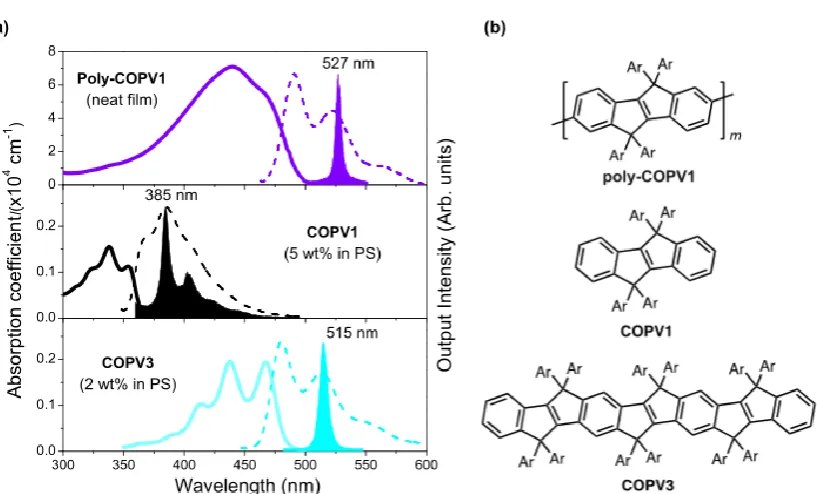
3 Here, we report a COPV-based polymer (i.e. poly-COPV1, see chemical
structure in Scheme 1) which shows an excellent laser performance when prepared as a uniform neat film. To develop a suitable COPV-polymer, one needs to consider both the structural rigidity of the chromophore and the solubility of the polymer. The latter requires some flexibility of the chain. For this reason, and also to benefit from its easier synthesis, we selected COPV1 for polymerization, from the previously reported COPVn compounds.
Now, while the longer chain oligomers achieved excellent laser performance, COPV1 showed weaker ASE performance, with a rather high threshold of 90 kWcm-2 and a lifetime of only 1.8 102 pp. The instability problems were attributed to the reactive terminal sites of the photoexcited states.[11] In this work our hypothesis is that through polymerization, the terminal sites of COPV1 would be protected (in a similar way to the longer COPV homologues which have a smaller distribution of terminal sites and thus higher photostability) so its photostability would improve. Moreover, the resulting polymer is expected to benefit from the improvement of the tradeoff between absorbance and PLQY of the active layer upon increasing concentration, firstly because the long alkyl chains would keep the active units separated from each other to prevent intermolecular photoluminescence (PL) quenching; secondly, because the rigidity and well-defined structure of the COPV unit would prevent the existence of non-radiative decay by intra-chain energy transfer, unlike traditional phenylenevinylenes which may be randomly segmented.
4 and deposited on top of an active film of uniform thickness. Another remarkable
milestone in resonator design was the fabrication of DFB lasers using substructured gratings, achieving much lower thresholds (i.e. < 0.1 kW cm-2). [21] The key advantage of substructured gratings, which consist of gratings with an additional ridge in the unit cell, is that they allow separate optimisation of feedback along the waveguide and output coupling in a direction perpendicular to the film plane, thus lowering the lasing threshold.
In this paper, we report organic thin film lasers using a novel COPV-based polymer, poly-COPV1, prepared as a neat film without any matrix. The performance of the devices is much better than that of lasers based on monomeric COPV1 dispersed in thermoplastic polymers. The ASE threshold is 30 times lower and the ASE lifetime 300 times longer than for the monomer COPV1, reaching values similar to those obtained with COPV3. Efficient and high performance DFB lasers, with both active material and resonator made of polymeric material, have been prepared by following recently
reported successful strategies, such as the use of a top-layer polymeric resonator architecture or the employment of a substructured grating.
2. Results
2.1. Synthesis of poly-COPV1
The synthesis of poly-COPV1 is shown in Scheme 1. COPV1-Br2 was
synthesized by a procedure previously reported,[22] and was subjected to borylation to obtain COPV1-(Bpin)2. The Suzuki-Miyaura coupling polymerization of COPV1-Br2 and COPV1-(Bpin)2 proceeded smoothly to give poly-COPV1 in 80% yield. Poly-COPV1 was freely soluble in common organic solvents, such as toluene,
tetrahydrofuran (THF), and chloroform.
INSERT SCHEME 1
2.2 Poly-COPV1 neat films: absorbance, PL and ASE properties
5 than those of previously reported for COPV-dispersed PS films. Poly-COPV1 showed efficient PL with spectral peaks at 490 nm and 525 nm, and a high PLQY of 68%, even in a neat film. Both the high absorbance and high PLQY offer a significant
improvement on the monomeric COPVs dispersed in PS in previous work.[8]
It should be noted about the significant red-shift of the absorption and PL spectra of the poly-COPV1 film with respect to those of COPV1 dispersed in PS. This shift is due to
the electronic interaction between the COPV1 units in the polymer chain (dihedral angle
between the monomers: ~37º, according to calculations).The existence in the
poly-COPV1 film of self-absorption (“inner filter effect”) does not seem to be significant
according to the small difference between the spectra of poly-COPV1 as a neat film and
as a highly diluted liquid solution (see Figure S1 in Supporting information). As a
consequence, the PLQY of the neat film remains as high as that of the dilute solution
(68 % and 79 %, for film and solution respectively). The refractive index (nf) and the
extinction coefficient (k) as a function of wavelength for the poly-COPV1 film were determined by ellipsometry (see supporting information, Figure S2). The specific nf value at the wavelength at which ASE emission appears (ASE) is included in Table 1.
INSERT FIGURE 1 INSERT TABLE 1
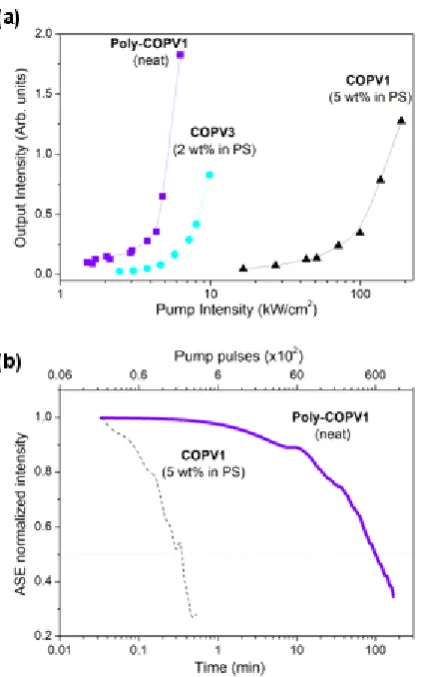
Under optical excitation at pump = 450 nm, the poly-COPV1 shows ASE at ASE = 527 nm (see Figure 1), which corresponds to the wavelength of the first vibronic PL peak, as generally occurs for very planar compounds with high PLQY and small Stokes shifts. Its ASE threshold (Ith-ASE) is very low (3 kW cm-2, see Figure 2a and Table 1), being this value 30-fold lower than that obtained with a COPV1-doped PS film, and similar to that obtained with a COPV3-doped PS film.[8] Note that some of the
measurements performed on the poly-COPV1 film (i.e. those of sample labelled as S2 in Table 1) were performed under the same experimental conditions used to characterize COPV3 (excitation at pump = 436 nm), to enable proper comparison of both materials.
INSERT FIGURE 2
6 protected). From plots of the ASE intensity versus time (see Figure 2b) we find 1/2-ASE = 6 104 pp. This value is more than 300 times larger than that obtained from a 5 wt%-COPV1-doped PS film under an excitation of two times threshold (Ipump = 180 kW cm-2) (see Figure 2b).[8] Importantly, the photostability of poly-COPV1, which is prepared as a neat film, is outstanding, not just in comparison to the monomer COPV1, but also in comparison to other COPVs. For example, COPV3 dispersed at 2 wt% in PS showed a 1/2-ASE value of 8.4 104 pp, similar to that obtained with the poly-COPV1 film, but with softer pumping conditions (Ipump= 8 kW cm-2, two times above threshold) and with a very low doping level. Note that the longest ASE lifetime reported for COPVs was for COPV6 (1/2-ASE = 1 106 pp), when the dye doping concentration was 2 wt%, however the stability decreased considerably for higher concentrations (1/2-ASE = 3 104 pp for 20 wt%).[8]
The high photostability shown by the poly-COPV1 neat film indicates that our polymerization strategy has been successful in protecting the COPV1 terminal sites from chemical reactions. From the viewpoint of steric effect, the central moiety of the COPV1 molecule is sterically protected by the aromatic substituents with long alkyl chains (Ar) on the bridging carbon atoms, whereas the terminal benzene rings are not. From the viewpoint of molecular orbitals (see Supporting information, Figure S3), both HOMO () and LUMO (*) are delocalized over the whole molecule, and its
photoexcited * state has a greater contribution of quinoidal resonance structure than the ground state, resulting in unprotected dangling bonds at their terminal sites that are liable to react with other species (e.g. molecular oxygen or neighboring COPV
molecules). Like longer COPV homologues that have smaller distribution on the terminal sites and thus higher photostability, polymeric COPV1 excludes this terminal effect to give much higher photostability, in accordance with the initial hypothesis.
Net gain coefficients (g) of 60 and 33 cm-1, at Ipump of 34.8 and 18.2 kW cm-2, respectively, were determined for the poly-COPV1 film by means of a Variable Stripe Length study (see supporting information, Figure S4).[23] These g values are superior to those reported for a 8 wt% COPV6 doped PS film (60 and 6.3 cm-1, at Ipump of 43.3 and 11.5 kW/cm2, respectively,[8] and only about twice lower than state-of-the-art organic semiconductors.[24,25]
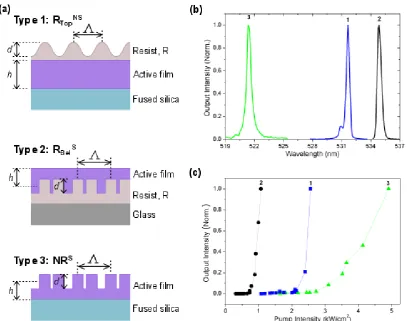
7 DFB lasers based on poly-COPV1 neat active films and different types of device architectures were subsequently fabricated. All the resonators consisted on 1D relief gratings (with single period or substructured) imprinted in a polymeric layer. Three types of architecture were studied: with a resist resonator located either below or on top of the active film, which we denote as RBel and RTop architectures, respectively; and a device with no resist layer (denoted as NR) and with the grating (substructured)
imprinted directly on the active film was also prepared. According to this, the prepared lasers are classified in three categories, (see Figure 3a):
Type 1: RTopNS (not substructured top-layer resist resonator). Laser with a single period (i.e. not substructured) DFB grating engraved by HL on a photoresist (dichromated gelatine, DCG) layer deposited on top of the active film.
Type 2: RBelS(substructured resist resonator below the active film). Laser with a substructured grating, fabricated via UV-NIL on a mr-XNIL26 UV-NIL resist layer located below the active film.
Type 3: NRS(substructured resonator on active film, no resist). Laser with no resist and a substructured grating directly imprinted in the active film surface by means of solvent immersion imprint lithography (SIIL).
INSERT FIGURE 3 INSERT TABLE 2
Figure 3b shows spectra from a selection of lasers (one for each resonator type) whose emissions appear at wavelengths in the spectral range between 521 and 535 nm. Single mode emission was obtained in all cases, with linewidths of around 0.5 nm or below. The geometries of these DFB laser structures are listed in Table 2, along with their lasing characteristics.
In order to compare the laser threshold performance to that of previously reported devices based on molecular COPV compounds (all with single period
gratings), we first focus on device RTopNS (1). Its emission (DFB = 531.9 nm) is close to ASE, with a laser threshold of 1.9 kW cm-2. This value is significantly lower than that of previously reported devices based on COPV1 dispersed in PS with gratings engraved on inorganic substrates.[8] Importantly, the threshold obtained for device RTopNS (1) is around the same than that obtained with the best lasers with a top-layer resonator architecture based on COPV3, emitting in similar spectral region.[9]
8 kW cm-2; see Figure 3c and Table 2). This device, which was optically pumped by a nitride diode laser, emitted at 534.9 nm, relatively close to the wavelength at which the gain is maximum (ASE = 527 nm). We prepared other RBelS type lasers (see Table S5 in Supporting information) emitting at wavelengths further away (by around 15 nm) from ASE, but they still show low thresholds (between 1 and 2 kWcm-2).
Finally, device NRS (3), with the grating directly imprinted on the active film and no resist layer, was observed to emit at DFB = 521.3 nm, approximately 6 nm shorter in wavelength than ASE. The threshold of this laser (2.8 kW cm-2) was slightly higher than those of the other devices. Nevertheless, it can be considered low, taking into account that losses due to self-absorption are higher in the blue side of ASE, thus DFB lasers emitting in those regions have generally higher thresholds.
With regards to the operational lifetime of the lasers, in accordance with the ASE photostability results described in the previous section, very long DFB half-life values were obtained, i.e. 1/2-DFB ~ 1 106 pp for device R
BelS (2) under an excitation density of two times threshold, and slightly larger for the other devices.
4. Conclusions
We have reported the synthesis of a COPV-based polymer, poly-COPV1, and demonstrated its great potential as the active material for thin film organic lasers. The material can be prepared as a high quality neat waveguide film with a relatively high refractive index (n = 1.68, at λ = 527 nm) without any host matrix. This has the
advantages of higher pump absorption and simpler processing compared to previously described oligomeric COPV derivatives, which require mixing with another material such as a thermoplastic polymer to obtain a good quality film with good laser
performance. The fact that the shortest COPV unit (COPV1), among the ones reported to date (COPVn with n = 1 to 6), has been used for polymerization, is a remarkable aspect because its synthesis is much simpler. The ASE properties of the poly-COPV1 film have been investigated and compared to those of COPV1 dispersed in polystyrene. Results have shown a much better performance for the poly-COPV1: an ASE threshold 30-times lower and an ASE lifetime 300-times longer. The significant enhanced
9 material were made with either a top-layer polymeric resonator architecture, or with a substructured grating imprinted on a resist layer located below the active film or directly on the active film. Thresholds as low as 0.7 kWcm-2, under pumping with an
inexpensive GaN laser diode, and operational lifetimes of 1 106 pump pulses were obtained for a device with a substructured grating imprinted in a resist layer, with a poly-COPV1 film deposited on top. Lasers with a top-layer resonator architecture also demonstrated low thresholds around 2 kWcm-2 with single period gratings. Overall, this study demonstrates the great potential of COPV-based polymers for laser applications. Further work will focus on device architectures combining both strategies, i.e.
substructured gratings with top-layer resonator architecture to obtain even lower thresholds, improved efficiencies and the possibility to fabricate wavelength tunable devices within a single chip.[9] From the materials point of view, further work will focus on the development of other polymers, based on other COPV compounds, for example to expand the emission of the devices to wavelength ranges further away to those accessible for poly-COPV1.
5. Experimental section
Synthesis
COPV1-(Bpin)2: A mixture of COPV1-Br2 (887 mg, 0.80 mmol), bis(pinacolato)diboron (1.03 g,
4.1 mmol), dichloro[1,1'-bis(diphenylphosphino)ferrocene]palladium(II) dichloromethane adduct (72.3 mg, 0.089 mmol), potassium acetate (813 mg, 8.3 mmol) in 1,4-dioxane (16 mL) were stirred at 80 ºC for 22 hours. Water was added to the mixture, which was then extracted with dichloromethane. The organic layer was dried with MgSO4 and concentrated in vacuo. Silica gel
column chromatography (eluent: hexane/dichloromethane = 9/1, 4/1 then 2/1) and the reprecipitation from dichloromethane and methanol afforded the title compound as a white solid
(650 mg, 67%). 1H NMR (500 MHz, CDCl
3): 0.87 (t, J = 7.2 Hz, 12H), 1.26–1.29 (m, 64H),
1.53–1.58 (m, 8H), 2.52 (t, J = 7.7 Hz, 8H), 7.01 (d, J = 8.0 Hz, 8H), 7.14 (d, J = 7.4 Hz, 2H),
7.20 (d, J = 8.6 Hz, 8H), 7.60 (d, J = 7.4 Hz, 2H), 7.83 (s, 2H); 13C NMR (125 MHz, CDCl 3):
10
Poly-COPV1: A mixture of COPV1-Br2 (133 mg, 0.12 mmol), COPV1-(Bpin)2 (144 mg, 0.12
mmol), tetrakis(triphenylphosphine)palladium(0) (26.0 mg, 0.022 mmol) and Aliquat 336 (5 drops) in toluene (6.0 mL) and 2M K2CO3 aqueous solution (4.0 mL) was stirred at 110 ºC for 44
hours. Bromobenzene (0.05 mL) was then added to reaction mixture and stirred at 110 ºC for 8 hours. 4,4,5,5-Tetramethyl-2- phenyl-1,3,2-dioxaborolane (0.05 mL) was added to reaction and mixture and stirred at 110 ºC for another 10 hours. The reaction mixture was diluted with dichloromethane, and passed through a silica gel short column. The solvent was removed in vacuo. The crude mixture was purified by gel permeation chromatography (GPC; eluent: chloroform) to remove smaller molecules. Reprecipitation from dichloromethane and methanol, and washing the obtained solid with acetone gave the title compound as a yellow solid (184 mg, 80% based on COPV1 monomer). HPLC (GPC): Mn = 5792, Mw = 8098, PDI = 1.40.
Thin film preparation and thickness characterization. Neat films of poly-COPV1 (refractive index n = 1.68, at λ = 527 nm) were prepared by spin coating over appropriate substrates using toluene as a solvent. Particularly, 250 nm-thick films (s1) were deposited on glass BK7 substrates with dimensions (2.5 2.5) cm2, while 600 nm-thick films (s2) were deposited on (2.5 2.5) cm2 fused silica to measure absorbance, PL, PLQY, ASE and gain. Film thickness was determined by a Veeco Dektak 150 profilometer on the center of the samples (measurements on other parts of the sample were carried out to account for the error, see Table 1).
DFB fabrication. Type 1: RTopNS lasers were fabricated by recording a second-order relief grating in a DCG layer deposited on the top of the active film following the procedure described in reference 9. First a poly-COPV1 thin film was coated onto a fused silica substrate from a toluene solution followed by deposition of a DCG photoresist layer. The active film surface was treated in an oxygen plasma for a few seconds to improve photoresist adherence. The thickness after the treatment was h = 405 nm. Then, a 1D grating with a period Λ = 331 nm was recorded in the DCG layer by HL, desensitized in a cool water bath and dry developedin an oxygen stream-plasma for selective etching.
11 onto the UV-NIL gratings and then encapsulated with a layer of the fluorinated polymer CYTOP (n = 1.34). The grating structure consists of two ridges of width w, displaced by a distance x, within each second order unit cell, and with a periodicity Λ = 350 nm. For
device RBelS (2), w = 95 nm and x = 75 nm. The other RBelS type devices were prepared using different stamps (see Figure S4, supporting information) as to obtain gratings with different w and x values (see Table S1, Supporting information). These parameters determine the relative amount of first-order and second-order character of the grating.
The SIIL technique was used to fabricate Type 3: NRs devices. A substructured grating was directly imprinted on the active film, as described by Vasdeskis et al,[27, 28] using acetone as the imprinting solvent. The same perfluoropolyether stamp used to prepare device RBelS (2) was employed in this case.
Optical characterization. Absorption measurements were carried out in a Varian Cary 300 Bio UV-Vis spectrophotometer. PL and PLQY measurements were performed with a Hamamatsu integrating sphere. The excitation source for most of the ASE and DFB experiments was an optical parametric oscillator (OPO) (pumped with a pulsed Nd:YAG laser) operating at the 450 nm wavelength (4 ns pulse width; 20 Hz repetition rate). Some ASE measurements (sample S2) were performed at the 436 nm wavelength provided by a Raman cell pumped with the 532 nm line of a Nd:YAG laser (10 nm pulse width, 10 Hz repetition rate). Device RBelS (2), showing the lowest threshold, was pumped with a 445 nm diode laser (20 ns, 20 Hz). The diode laser setup was an assembled in-house consisting of a laser head from Roither LaserTechnick (LD-445-1000MG) which was attached to a PicoLAS driver board (LDP-V 50-100).
ASE characterization was performed by focusing the pump beam to a stripe (dimensions of 2.9 mm 0.3 mm or 3.5 mm 0.5 mm, for excitation at 450 nm or 436 nm, respectively) using a cylindrical lens onto the surface of an un-patterned (with no DFB grating) active film. Light emission was collected from the edge of the film at a high pump power density, using an Andor fiber coupled grating spectrograph. The energy of the pump pulses was controlled by using a polarizing filters system. The ASE photostability was studied by recording the ASE intensity as a function of time and quantified by means of the half-life parameter.
12 films). For the experiments using the laser diode as excitation source, the pump beam was shaped to a stripe of dimensions 2 mm 0.6 mm. In all cases the emitted laser light was collected in a direction perpendicular to the film surface using the spectrograph.
References
[1] C. Grivas, Prog. Quantum Electron. 2016, 3, 45.
[2] A. Kuehne, M.C. Gather, Chem. Rev. 2016, 116, 12823. [3] J. Clark, G. Lanzani, Nat. Photon. 2010, 4, 438.
[4] C. Vannahme, S. Klinkhammer, U. Lemmer, T. Mappes, Opt. Express 2011, 19, 8179. [5] E. Heydari, J. Buller, E. Wischerchoff, A. Laschewsky, S. Döring, J. Stumpe, Adv.
Opt. Mater. 2014, 2, 137.
[6] Y. Wang, P. O. Morawska, A. L. Kanibolotsky, P. J. Skabara, G. A. Turnbull, I. D. W. Samuel, Laser Photonics Rev. 2013, 7, L71.
[7] M. Morales-Vidal, P. G. Boj, J. A. Quintana, J. M. Villalvilla, A. Retolaza, S. Merino, M. A. Díaz-García, Sens. Actuators B 2015, 220, 1368.
[8] M. Morales-Vidal, P. G. Boj, J. M. Villavilla, J. A. Quintana, Q. Yan, N.-T. Lin, X. Zhu, N. Ruangsupapichat, J. Casado, H. Tsuji, E. Nakamura, M. A. Díaz-García, Nat. Commun. 2015, 6, 8458.
[9] J. A. Quintana, J. M. Villalvilla, M. Morales-Vidal, P. G. Boj, X. Zhu, N. Ruangsupapichat, H. Tsuji, E. Nakamura, M. A. Díaz-García, Adv. Opt. Mater. 2017, 1700238.
[10] E. Nakamura, H. Tsuji, M. A. Díaz-García, M. Morales, P. G. Boj, J. M. Villalvilla, J.A. Quintana, Patent no. ES2547630, April 13, 2016.
13 J. T. López Navarrete, H. Tsuji, E. Nakamura, J. Casado J. Am. Chem. Soc. 2015, 137, 3834.
[12] M. Gaal, C. Gadermaier, H. Plank, E. Moderegger, A. Pogantsch, G. Leising, E. J. W. List, Adv. Mater. 2003, 15, 1165.
[13] E. Mele, A. Camposeo, R. Stabile, P. Del Carro, F. Di Benedetto, L. Persano, R. Cingolani, D. Pisignano, Appl. Phys. Lett. 2006, 89, 131109.
[14] M. B. Christiansen, M. Schøler, A. Kristensen, Opt. Express, 2007, 15, 3931. [15] M. G. Ramírez, P. G. Boj, V. Navarro-Fuster, I. Vragovic, J. M. Villalvilla, I. Alonso,
V. Trabadelo, S. Merino, M. A. Díaz-García, Opt. Express 2011, 19, 22443.
[16] G. Tsiminis, Y. Wang, A. L. Kanibolotsky, A. R. Inigo, P. J. Skabara, I. D. W. Samuel, G. A. Turnbull, Adv. Mater. 2013, 25, 2826.
[17] M. G. Ramírez, J. M. Villalvilla, J. A. Quintana, P. G. Boj, M. A. Díaz-García, Opt. Mater. Express 2014, 4, 733.
[18] J. R. C. Smirnov, Q. Zhang, R. Wannemacher, L. Wu, S. Casado, R. Xia, I. Rodríguez, J. Cabanillas-González, Sci. Rep. 2016, 6, 34565.
[19] N. Tsutsumi, S. Nagi, K. Kinashi, W. Sakai, Sci. Rep. 2016, 6,34741. [20] T. Zhai, X. Zhang, Z. Pang, Opt. Express 2011, 19, 6487.
[21] E. R. Martins, Y. Wang, A. L. Kanibolotsky, P. J. Skabara, G. A. Turnbull, I. D. W. Samuel, Adv. Opt. Mater. 2013, 1, 563.
[22] X. Zhu, H. Tsuji, J.T. López-Navarrete, J. Casado, E. Nakamura, J. Am. Chem. Soc. 2012, 134, 19254.
[23] M. D. McGehee, R. Gupta, S. Veenstra, E. K. Miller, M. A. Díaz-García and A. J. Heeger, Phys. Rev. B 1998, 58, 7035.
14 [26] Y. Wang, G. Tsiminis, A. L. Kanibolotsky, P. J. Skabara, I. D. W. Samuel, G. A. Turnbull, Opt. Express 2013, 21, 14362.
[27] A. E. Vasdekis, M. J. Wilkins, J. W. Grate, R. T. Kelly, A. E. Konopka, S. S. Xantheas, T.-M. Chang, Lab Chip 2014, 14, 2072.
[28] G. L. Whitworth, S. Zhang, J. R. Y. Stevenson, B. Ebenhoch, I. D. W. Samuel, G. A. Turnbull, Appl. Phys. Lett. 2015, 107, 163301.
Acknowledgements
We are grateful to Dr Tom Wood for performing the spectroscopic ellipsometry
15 Schemes and Figures
i)
ii)
18 Figure 3. DFB lasers based on poly-COPV1. (a) Schemes of DFB laser types
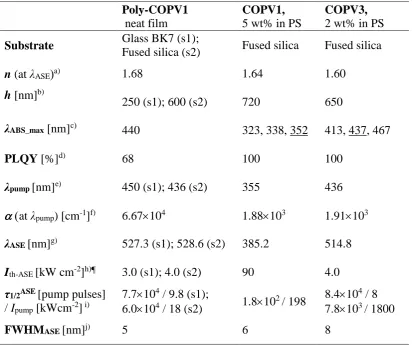
19 Table 1. Optical and ASE properties of films without gratings (data for COPV1 and COPV3 extracted from ref. [8].
Poly-COPV1 neat film
COPV1, 5 wt% in PS
COPV3, 2 wt% in PS
Substrate Glass BK7 (s1);
Fused silica (s2) Fused silica Fused silica
n (at λASEa) 1.68 1.64 1.60
h [nm]b)
250 (s1); 600 (s2) 720 650
λABS_max[nm]c) 440 323, 338, 352 413, 437, 467
PLQY [%]d) 68 100 100
λpump [nm]e) 450 (s1); 436 (s2) 355 436 at λpump) [cm-1]f) 6.67104 1.88103 1.91103
λASE [nm]g) 527.3 (s1); 528.6 (s2) 385.2 514.8
Ith-ASE [kW cm-2]h)¶ 3.0 (s1); 4.0 (s2) 90 4.0 τ1/2ASE [pump pulses]
/ Ipump [kWcm-2] i)
7.7104 / 9.8 (s1);
6.0104 / 18 (s2) 1.8102 / 198
8.4104 / 8 7.8103 / 1800
FWHMASE [nm]j) 5 6 8
20 Table 2. Geometrical and performance parameters of selected poly-COPV1 DFB lasers
Device
Typea) Substrate
Resonator material
Device Labelb)
h c) (nm)
d) (nm)
W e) (nm)
X f) (nm)
λpumpg) (nm)
λDFBh) (nm)
Ith-DFBi) (kW/cm2)
FWHMj) (nm)
RTopNS Fused
silica DCG
k) 1 405 331 450 531.9 1.9 < 0.5
RBelS Glass mr-XNIL26 UV-NILl) 2 ≈140 350 95 75 445 534.9 0.7 < 0.5
NRS Fused
silica Active film 3 100 350 95 75 450 521.3 2.8 < 0.5
a)Device types as defined in Figure 3a: Type 1: R
21 Table of contents entry
High-performance solution-processed distributed feedback lasers based on a Carbon-bridged (p-phenylenevinylene) polymer are reported. The lasers, with neat films of a novel active polymer poly-COPV1, based on the basic unit of COPV1, show thresholds 30 times lower and operational lifetimes 300 times longer than devices based on COPV1 dispersed in polystyrene.
Keywords: organic semiconductors, conjugated polymers, oligomer, distributed feedback lasers
Marta Morales-Vidal, José A. Quintana, José M. Villalvilla, Pedro G. Boj, Hiroki Nishioka, Hayato Tsuji, Eiichi Nakamura, Guy L. Whitworth, Graham A. Turnbull, Ifor D. W. Samuel and María A. Díaz-García*
Title
Carbon-bridged (p-phenylenevinylene) polymer for high-performance solution-processed distributed feedback lasers