
[1]
CANNABINOIDS IN EXPERIMENTAL STROKE: A SYSTEMATIC REVIEW
AND META-ANALYSIS
Authors: Timothy J England (PhD), William H Hind (PhD), Nadiah A Rasid
(BMedSci), Saoirse E O’Sullivan (PhD)
Affiliations: Division of Medical Sciences & Graduate Entry Medicine, School
of Medicine, University of Nottingham
Running title: Cannabinoids and stroke: a systematic review
Corresponding author: Timothy J England
Division of Medical Sciences & Graduate Entry Medicine
School of Medicine
Faculty of Medicine & Health Sciences
University of Nottingham
Royal Derby Hospital Centre
Uttoxeter Road, Derby DE22 3DT
Tel: +44 1332 724668, Fax +44 1332 724697
Email: [email protected]
Word Count (title page, abstract, main text, excluding references): 3957
Tables: 2
[2]
Abstract
Cannabinoids (CB) show promise as neuroprotectants with some agents
already licensed in humans for other conditions. We systematically reviewed
CBs in pre-clinical stroke to guide further experimental protocols. We selected
controlled studies assessing acute administration of CBs for experiment
stroke, identified through systematic searches. Data were extracted on lesion
volume, outcome and quality; analysed using random effects models; results
are expressed as standardised mean difference (SMD) with 95% confidence
intervals [CI]. 144 experiments (34 publications) assessed CBs on infarct
volume in 1473 animals. CBs reduced infarct volume in transient (SMD -1.41,
[95% CI -1.71,-1.11], p<0.00001) and permanent (-1.67 [-2.08,-1.27],
p<0.00001) ischaemia and in all subclasses: endocannabinoids (-1.72
[-2.62,-0.82], p=0.0002), CB1/CB2 ligands (-1.75 [-2.19,-1.31], p<0.00001), CB2
ligands (-1.65 [-2.09,-1.22], p<0.00001), cannabidiol (-1.20 [-1.63,-0.77],
p<0.00001), Δ9-tetrahydrocannabinol (-1.43 [-2.01,-0.86], p<0.00001) and
HU-211 (-2.90 [-4.24,-1.56], p<0.0001). Early and late neuroscores significantly
improved with cannabinoid use (-1.27 [-1.58,-0.95], p<0.00001; -1.63
[-2.64,-0.62], p<0.002 respectively) and there was no effect on survival. Statistical
heterogeneity and publication bias was present, median study quality was 4
(range 1-6/8). Overall, CBs significantly reduced infarct volume and improve
functional outcome in experimental stroke. Further studies in aged, female
and larger animals, with other co-morbidities are required.
[3]
Introduction
Components of the endocannabinoid system (ECS) are altered following
ischaemic stroke. The expression of CB1 and CB2 receptors are upregulated
in the rat brain following cerebral ischaemia,1, 2 indicating that the ECS may
play an important role in the endogenous response to stroke, though the
relevance of these changes are not known. Human and animal in vivo data
have shown increases in neurological levels of anandamide (AEA),
oleoylethanolamide (OEA) and palmitoylethanolamide (PEA), with
2-arachidonoylglycerol (2-AG) levels either unchanged or increased.3-8
Pre-clinical stroke studies have derived neuroprotective qualities from a range of
approaches to manipulating the ECS. For example, CB2 ligands can modify
the post-stroke inflammatory response, and CB1 activation can initiate a
chemical hypothermia, with both processes resulting in a decrease in stroke
infarct volume. 9, 10 Activation of CB2 receptors has only demonstrated
protective effects and the role of CB1 activation is less clear with studies
demonstrating efficacy of both CB1 agonists and antagonists.11, 12
Cannabinoids can be divided into three categories: endocannabinoids,
phytocannabinoids and synthetic cannabinoids. AEA and 2-AG (both CB1/2
agonists) are the best studied endocannabinoids, but other chemically similar
compounds have been suggested as endocannabinoids or
endocannabinoid-like compounds, including OEA, PEA, lauroylethanolamide and
linoleoylethanolamide. Endocannabinoids also display activity at non-CB1/2
receptor sites, including TRPV1, PPARα/γ, 5HT1A and GPR55.13
Phytocannabinoids are derived from the cannabis plant, a unique source of
[4]
cannabidiol (CBD) already in clinical use to treat spasticity in multiple
sclerosis (Sativex). THC is a partial agonist for CB1 and CB2 receptors, whilst
CBD displays low affinity for CB receptors.14 Synthetic cannabinoid
compounds have been developed, some of which exhibit high potency at CB1
(arachidonyl-2’-chloroethylamide) or CB2 (JWH-133, O-1966 and O-3853)
receptors, activate both CB1/2 (CP 55,940, HU-210, TAK-937 and WIN
55,212-2), or activate non-CB receptors (e.g. HU-211, a proposed NMDA
antagonist).
Given the accumulating preclinical evidence for the use of cannabinoids in
stroke, as well as the expansion in the use of cannabinoid-based medicines in
other disorders, a systematic review of the currently available preclinical
literature is warranted. Whilst it is clear there are many studies describing the
benefit of administering cannabinoids for experimental stroke, a number of
unanswered questions remain before the transition is made into ‘bedside’
testing. It is unclear as to whether the optimal time of administration and dose
of the various cannabinoid classes have been established, and whether the
body of evidence is reliable and consistent. The aim of this study, therefore, is
to systematically review and meta-analyse the effects of exogenous
cannabinoid administration on infarct volume, functional outcome and survival
[5]
Methods
Search Criteria
Experimental (non-human) studies in evaluating the effect of cannabinoids on
focal acute stroke were searched up to December 2013 in PubMed, Medline,
Embase, ScienceDirect, and Web Of Science. Search keywords included
were ‘stroke,’ ‘ischaemia,’ ‘cannabinoid,’ ‘cannabidiol,’
‘delta-9-tetrahydrocannabinoid,’ ‘WIN 55,212-2,’ ‘2-Arachidonoy glycerol,’
‘endocannabinoids,’ ‘CB1 receptors,’ and ‘CB2 receptors.’ References from
included studies and conference proceedings were also searched. There was
no protocol per se, although pre-specified exclusion criteria were used to
prevent bias and studies were included if the following were met: (i) a focal
ischaemic stroke model, not global; (ii) treatment was given for an acute
model (within 48 hours), not chronic; (iii) only cannabinoid ligands were given;
(iv) there was a control group; (v) there were measures of infarct size,
functional outcome or survival; and (vi) data was from an original article, not a
review article. If an article was only available as an abstract it was not
included.
Data acquisition
Data on total infarct size, measured in percentage (%) or volume (mm3) were
extracted from included papers. Volumes corrected for oedema were chosen
instead of uncorrected data. When all data was not available, authors were
[6]
experiment. If authors were unable to provide necessary information, the
lowest number of animals within the range given was used. The Grab
application (version 1.5) was used to obtain values from figures given in
published articles if no values were stated within the text. Similarly,
information on vital status, weight (grams), Rotarod test (time spent on
Rotarod expressed in seconds or percentage compared to baseline) and
neurological score were collected. If published articles used multiple groups
(e.g., to assess time response relationships) with one control group, then the
number of animals per control group was divided into the number of
comparison groups. Since different procedures were used in different
experiments, the total dose of drug given throughout a complete experiment
was taken instead of a single dose. When drugs were given at more than one
point of time, the earliest time of administration was used.
Quality
Methodological quality was assessed using an eight-point criteria derived from
STAIR 15, as used previously, 16, 17 with 1 point given to evidence of the
following: presence of randomisation, monitoring temperature throughout the
experiment, masked outcome measurement, assessment of outcome at days
1-3, assessment of outcome at days 7-30, assessment of outcome other than
just infarct size, dose-response relationship conducted, and therapeutic time
[7]
Data analysis
Data were grouped before analysis by (i) model type (permanent or transient
ischaemia); (ii) species; (iii) time to treatment; (iv) total dose and (v)
cannabinoid type. Data from each of these groups were analysed as forest
plots using the Cochrane Review Manager software (version 5.2) and Stata
(version 11), as used in previous animal meta-analyses.17 Since
heterogeneity was expected between study protocols (different species,
stroke models, dose, time), random effect models were used. The results of
continuous data are expressed as standardised mean difference (SMD), with
95% confidence intervals (CI), which allows data measured on different scales
and in different species to be merged. The results of binary data (survival) are
expressed as odds ratios (OR) with 95% CI. Studies were weighted by
sample size and statistical significance was set at p<0.05. PRISM 6
(GraphPad) was used to compare the dose- and time-response relationship
between drug classes. Infarct volume data acquired can be accessed at
[8]
Results
Design of the studies
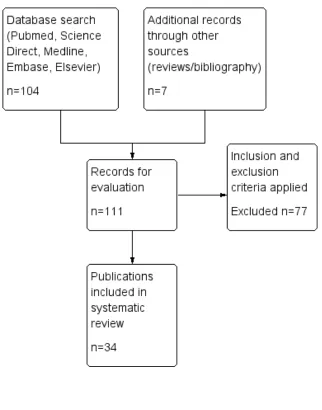
The initial search for studies identified 101 relevant publications. Once the
pre-specified inclusion criteria were applied, a total of 34 publications were
chosen for analysis (Figure 1, Table 1). These came from 18 laboratories in 9
countries (USA, Israel, Italy, Japan, Spain, Denmark, Germany, UK and
China). Studies were excluded if they examined global ischaemia, neonatal
animals, did not measure infarct volume or functional outcome, did not
administer a cannabinoid receptor ligand, were review articles (not original
articles), where induction of injury was by methods other than
ischaemia/reperfusion or if the data was unobtainable.
19 of 34 publications studied 786 rats 5, 10, 18-34 and 14 studied 673 mice;3, 9, 11,
12, 35-44 1 article studied rats and primates.45 24 articles examined greater than
1 experimental paradigm (total number of experiments 144). Transient
ischaemic models were used in 21 publications, vessel occlusion time ranging
between 30 minutes to 4 hours. Permanent models of ischaemia were used in
13 articles (photothrombotic n=2). Drugs were administered intravenously
(n=17) or via the peritoneum (n=16), and one study used the oral route.44
Time of administration ranged from pre-ischaemia up to 5 days post middle
cerebral artery occlusion (MCAo). Median study quality was 4 (range 1-6).
[9]
Overall, administration of cannabinoid receptor ligands reduced infarct volume
in comparison to vehicle; standardised mean difference, SMD, -1.49, 95%
confidence interval CI, -1.73 to -1.25, p < 0.00001 (Figure 2, Table 2). If we
only include the 18 publications (75 experiments, 767 animals) reporting
absolute lesion volume in the analysis, the weighted mean difference (WMD)
between groups was -28.3 mm3 (95% CI -32.4, -24.2, p<0.00001) in favour of
cannabinoids; equivalent to a SMD of -1.27 (95% CI -1.58, -0.97, p<0.00001).
Infarct volume was significantly reduced in rats and mice, SMD -1.75, (95% CI
-2.15 to -1.35, p < 0.00001) and -1.34 (95% CI -1.61 to -1.06, p < 0.00001)
respectively. The only study involving primates revealed non-significant infarct
volume reduction upon administration of TAK-937, a CB1/CB2 receptor ligand
(SMD -0.55, 95% CI -1.62 to 0.53, p = 0.32).45
When grouped by drug class, synthetic agonists (mixed CB1/CB2 ligands
(p<0.00001), CB2 ligands (p<0.00001), HU-211 (p<0.0001)),
phytocannabinoids (THC and CBD (both p<0.00001)) and endocannabinoids
(p=0.002) all reduced infarct volume significantly (see Table 2). The
breakdown by individual compound can be seen in Figure 2; the most
profound infarct volume reduction is seen with HU-210, a synthetic CB1/CB2
ligand (n=8 experiments, 80 animals 10) (SMD -3.52, 95% CI –5.34 to -1.71).
Methanandamide, lauroylethanolamide and linoleoylethanolamide were all
neutral in their effect, whereas AEA (n=3, 28 animals) showed borderline
significant infarct volume reduction (SMD -0.78, 95% CI –1.64 to 0.08,
[10]
Individual studies of the CB1 antagonist SR141716 had a neutral effect on
lesion volume except when used at a very high dose (20 mg/kg 11) leading to
a significant reduction in lesion size (SMD -5.59 [95% CI -9.69, -1.49],
p=0.008). Trends to harm were seen using the CB2 antagonist SR144528
(SMD 0.96, 95% CI -0.32 to 2.24 p=0.14).
There was significant statistical heterogeneity (I2 56%, p<0.00001, Figure 2)
in the all studies analysis.
Drug dose
The effect of drug class dose on infarct volume was analysed to help establish
whether there was a dose-response relationship with infarct volume reduction
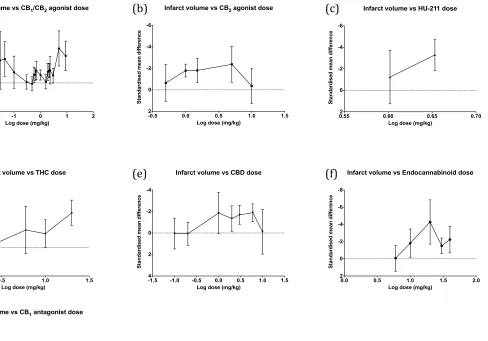
for each class of cannabinoid (Figure 3).
CB1/CB2 agonists were significantly effective at numerous doses and showed
a bimodal distribution of maximum effect with peaks at 45 mcg/kg (HU-210,
SMD -4.16, 95%CI -7.17 to -1.16, p=0.007, n=5 experiments, 50 animals) 10
and 5 mg/kg (WIN 55,212-2, SMD -6.0, 95%CI -9.04 to -2.95, p=0.0001, n=1,
13 animals,25 Figure 3a). Significant statistical heterogeneity was present (I2
63%, p<0.00001).
CB2 ligands were tested between total doses 0.5 mg/kg and 10 mg/kg with
peak effect at 5 mg/kg (JWH133 and O1966, SMD 2.38, 95%CI 4.06 to
-0.71, p=0.005, n=5, 37 animals,41, 42 Figure 3b). There was no significant
[11]
THC significantly reduced infarct volume at two doses, 10 and 20 mg/kg
(SMD -0.95, 95%CI -1.92 to -0.02, p=0.05, n=3, 27 animals; and SMD -2.41,
95%CI -3.29 to -1.53, p<0.00001, n=6, 59 animals, respectively; Figure 3d). A
dose-response relationship was observed with CBD, the greatest lesion
volume reduction using 6 mg/kg (SMD -1.89, 95%CI -2.7 to -1.07, p<0.00001,
n=6, 57 animals 36, 38, 39). No effect was seen at the greater dose of 10 mg/kg
(n=1, 9 animals),3 Figure 3e.
Peak effect with administration of endocannabinoids was seen at 20 mg/kg
(SMD -4.28, 95%CI -6.85 to -1.71, p=0.001, n=2, 16 animals 24, 44) with
significant but less potent effects seen with 30 and 40 mg/kg (Figure 3f).
Statistical heterogeneity was evident in the endocannabinoid analysis (I2 78%,
p<0.00001) but not for THC and CBD.
Time of administration
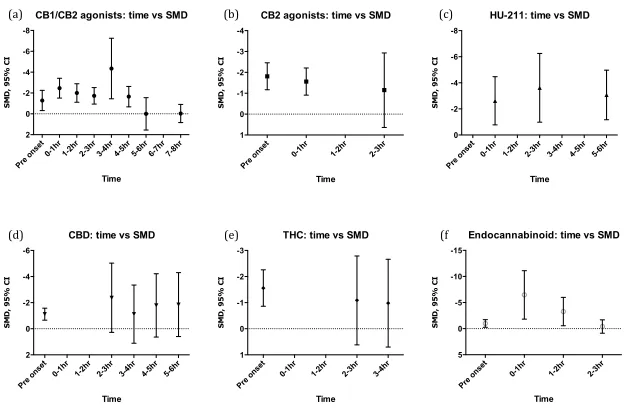
CB1/CB2 agonists, assessed up to 8 hours post stroke, revealed a gradual
decline in effect size over time, with significant effects seen up to 4-5 hours
after insult (Figure 4a). A similar pattern was seen for endocannbinoids but
with loss of significant effect as soon as 2-3 hours post stroke (Figure 4f).
HU-211 produced significant infarct volume reduction as late as 6 hours post ictus
(Figure 4c). Both CBD (up to 6 hours) and THC (up to 4 hours) demonstrated
trends to infarct reduction with later administration but there were too few
studies to produce significant values at these later time points (Figures 4d and
4e); 17 of 23 experiments using CBD (and 11 of 13 for THC) administered the
[12]
Functional outcome and survival
Early neurological outcome improved significantly when evaluated in 55
experiments (590 animals), SMD -1.27 95% CI -1.58 to -0.95, p<0.00001.
Late neurological impairment was only assessed in 8 experiments (126
animals) but this still resulted in a significantly improved outcome (p=0.002,
Table 2). No effect was seen on survival in 7 experiments (154 animals).
Quality
10 of 34 publications utilised randomisation in their design, 4 reported blinding
of outcome assessments, 21 monitored temperature during surgery, 33
measured outcome at 1-3 days and 4 at 7-30 days, 28 measured outcomes
other than lesion size, 12 assessed a time window for administration and 16
established dose response effects.
There was no relationship between quality score and lesion volume effect size,
Spearman’s rho co-efficient -0.113, p=0.18. Likewise, there were no
significant differences in effect size when comparing individual components of
the scale such as randomisation and blinding of outcome assessment.
Publication bias
Begg’s funnel plots were visually analysed to determine the presence or
[13]
(Egger’s statistic p<0.001, Figure 5H46). Significant bias was present in the
subgroups CB1/2 agonists (p<0.001, Figure 5A), CB2 agonists (p=0.023,
Figure 5B), HU-211 (p<0.001, Figure 5C), and endocannabinoids (p=0.038,
[14]
Discussion
This extensive meta-analysis has determined that cannabinoids significantly
reduce infarct volume in both transient and permanent models of ischaemia,
and improve both early and late functional outcome. Almost twice as many
animals were studied in transient (n=945) than permanent (n=519) models
and greater infarct volume reductions were seen in permanent models (SMD
-1.67 versus -1.41). HU-210, a CB1/CB2 agonist, demonstrated the greatest
infarct volume reduction and the CB1/CB2 agonist group were effective when
administered as late as 5 hours post stroke onset. HU-211, a proposed NMDA
antagonist and enantiomer of HU-210, was effective up to 6 hours after onset.
The mechanisms of action responsible for the effects of cannabinoids in the
pre-clinical setting are multiple but not well understood or always explored
within these studies. CB1 receptors are primarily located in the central
nervous system, with activation known to decrease excessive glutamate
release, 38 allied excitotoxicity 47 and enhance cerebral blood flow.48 THC,36
TAK-937,33 WIN 55212-2 19 and HU-210 10 are protective through CB1
mediated hypothermia, an effect abolished by warming. CB2 receptors are
expressed predominantly by cells of the immune system but they also display
CNS presence, in particular, microglial cells activated during the course of
inflammation express CB2 receptors.49 Activation of CB2 receptors results in a
decrease in the release of pro-inflammatory cytokines, neutrophil recruitment
9, 41 and leukocyte adhesion to cerebral vessels.43
Cannabinoid induced neuroprotection is also likely to be mediated through
[15]
41 and 5HT
1A.3, 39 For example, the effects of CBD are not inhibited by CB1,
CB2 or TRPV1 (transient receptor potential cation channel subfamily V1, or
capsaicin receptor) antagonism, but its ability to decrease infarct volume and
enhance cerebral blood flow appear to be mediated, at least in part, through
5HT1A.3, 39 Other mechanisms, such as anti-inflammatory effects, are yet to be
linked to a particular target site, and other known cannabinoid target sites of
action such as TRPs and PPARs (peroxisome proliferator-activated receptors)
require further exploration. The endocannabinoid PEA is associated with
reduced cell death, oedema and inflammation,18 and OEA is thought to
mediate its infarct-reducing effects through PPARα,as the protective effects
of OEA were absent in PPARα-/- mice 40 and inhibited by a PPARα
antagonist.44
Our systematic review has highlighted many deficiencies in the existing
literature that warrant further investigation. It is not apparent that CB2
antagonists have been tested against mixed CB1/CB2 ligands, which is
important considering that CB2 activation is a potential therapeutic target.
Furthermore, expression of CB2 receptors decreases in the first 3 hours after
MCAo and then gradually increases by 24 hours.11 It may, therefore, be of
benefit to stimulate CB2 at later time points; our time-to-treatment analysis
only showed a trend to infarct volume reduction at 2-3 hours with CB2
agonists and there were no experiments extending drug delivery beyond 3
hours. In this review, other cannabinoids show promise with later
administration causing significant infarct volume reduction, including CB1/CB2
receptor agonists (up to 5 hours) and HU-211 (up to 6 hours). CBD may also
[16]
as 6 hours but there were too few studies to demonstrate a significant effect;
in one study, animal survival was significantly increased even when CBD was
administered 3 days following stroke.35
The optimal dose of administration for each drug class also remains unclear.
It was generally seen that higher doses resulted in a greater degree of infarct
volume reduction. Furthermore, questions are raised with regards to the role
of CB1 antagonism; CB1 agonists mediate their positive effects through the
various mechanisms described but CB1 antagonism with SR141716 used at a
high dose (20 mg) also appeared to be beneficial (it was neutral at lower
doses). The mechanisms of such an effect are not understood. If CB1
agonism were detrimental in stroke, the effects of the mixed CB1/CB2 agonists
should be less than that of the CB2 specific drugs, although this was not
observed. It is more likely that beneficial effects of the CB1 antagonist at high
doses are off-target effects, non-CB1 mediated responses, as previously
suggested for SR141716A.50
Further data is also required exploring the effects of cannabinoids in stroke in
animals with other co-morbidities, as would occur in humans. For example,
only one group have also observed the effects of cannabinoids (TAK-937) in
aged and female rats and larger species.28, 45 Moreover, TAK-937 is the only
compound that has examined co-administration with thrombolysis,28 essential
with regards to safety since some neuroprotectants can enhance the risks of
rtPA associated haemorrhage.51 Hypertensive rats have been studied using
HU-211 only, 26, 27, 34 but largely data is absent on the effects of cannabinoids
in animals with co-morbidities relevant to stroke.52 It is also clear that
[17]
lacking with only 8 of 144 experiments (HU-211, CBD, TAK-937) measuring
late neuroscores.26, 35, 45 This is important considering the outcomes in future
clinical trials will be related to functional outcome and safety.
There are limited data regarding the safety of cannabinoids in humans and
none in the stroke population. Sativex, licenced for use in treating spasticity
secondary to Multiple Sclerosis, containing THC and CBD in a 1:1 ratio
(2.7mg:2.5mg per 100µl), can commonly cause dizziness, depression,
euphoria, gastro-intestinal upset and altered appetite; uncommonly it causes
palpitations, tachycardia, hallucinations and suicidal ideation.53 In a 14-week
open label study of 339 patients, 5% discontinued Sativex secondary to
treatment related side effects.54 The psychotropic side effects appear to be
mediated through THC CB1 stimulation and studies using CBD alone,
however, indicate that it is very well tolerated; in 3 small studies CBD did not
affect heart rate and blood pressure using a single 600mg dose,55-57 and in
regular use for epilepsy (200-300mg), no specific adverse events were
reported (4 randomised studies of poor quality, total n=48).58
Our paper has a number of limitations affecting interpretation of results,
issues that confound many meta-analyses. First, significant heterogeneity is
present secondary to the variability in design of individual studies. This is
accounted for, in part, by using a random effects model of analysis. Moreover,
further heterogeneity is introduced by organising compounds into subgroups;
although we have classed the drugs by mechanisms of action, it is likely that
many will act on other target sites not identified and therefore statements on
efficacy could be an under- or over-estimate. Second, caution must also be
[18]
may have missed publications in less well known journals; the non-inclusion
of some studies means that the estimated treatment effects could be
inaccurate. Third, the results also depend on study quality which can also
impact report precision; 10 of 34 publications utilised randomisation in their
design and only 4 reported blinding of outcome assessments. The impact of
various quality items on reported efficacy has been previously assessed;60 the
presence or absence of randomisation to a treatment group, blinding of drug
allocation and blinding of outcome assessments were the most powerful
determinants of outcome. In contrast, this review did not find any relationship
between study quality and efficacy, even when individual components of
quality were analysed. However, the absence of some of the parameters in
our ‘quality’ score does not necessarily mean that the experiment was carried
out to a poor standard; for example, evaluating timing of outcome
assessments is simply expanding the cohort of evidence rather than
improving the study quality. Second, it may be that some studies did not
report specific components such as randomisation, which may explain why we
found no relationship between quality and efficacy. Fourth, many publications
would often use an inadequate number of animals in the control arms of the
experiments involving multiple comparisons (e.g. comparing several
dose-arms to one control group) resulting in smaller control groups in the
meta-analysis (it is important not to count the control animals more than once).
Moreover, the small group sizes produce imprecise estimates of the variance
and, therefore, the SMD. SMD, and not weighted mean difference (WMD),
was used in order to merge different scales measuring the same parameter;
[19]
absolute volume (mm3). Interpretation of SMD is less intuitive but it has
allowed us to include significantly more studies within the analysis.
The failure of multiple neuroprotective agents to be translated into the clinical
setting has been extensively highlighted in the literature, 15, 61 hence,
evaluating pre-clinical data thoroughly and systematically before progressing
to designing human clinical trials is of great importance. Indeed, before
moving novel experimental ideas into clinical trials, it is proposed that
multi-centre phase III-type preclinical studies are performed
(www.dcn.ed.ac.uk/multipart). There are no previous clinical trials using
cannabinoids in stroke but positive data from trials using cannabinoids in
other neurological diseases already exist.62 The pleiotropic effects of
cannabinoids on the ischaemic penumbra and cerebral vasculature following
stroke, combined with their excellent tolerability, make them promising
candidates for future treatment.
Conflicts of interest
[20]
References
1. Jin KL, Mao XO, Goldsmith PC, Greenberg DA. CB1 cannabinoid receptor induction in experimental stroke. Ann Neurol 2000; 48(2): 257-61.
2. Ashton JC, Rahman RM, Nair SM, Sutherland BA, Glass M, Appleton I. Cerebral hypoxia-ischemia and middle cerebral artery occlusion induce expression of the cannabinoid CB2 receptor in the brain. Neurosci Lett 2007; 412(2): 114-7.
3. Mishima K, Hayakawa K, Abe K, Ikeda T, Egashira N, Iwasaki K et al. Cannabidiol prevents cerebral infarction via a serotonergic 5-hydroxytryptamine1A receptor-dependent mechanism. Stroke 2005; 36(5): 1077-82.
4. Schabitz WR, Giuffrida A, Berger C, Aschoff A, Schwaninger M, Schwab S et al.
Release of fatty acid amides in a patient with hemispheric stroke: a microdialysis study. Stroke 2002; 33(8): 2112-4.
5. Muthian S, Rademacher DJ, Roelke CT, Gross GJ, Hillard CJ. Anandamide content is increased and CB1 cannabinoid receptor blockade is protective during transient, focal cerebral ischemia. Neuroscience 2004; 129(3): 743-50.
6. Franklin A, Parmentier-Batteur S, Walter L, Greenberg DA, Stella N.
Palmitoylethanolamide increases after focal cerebral ischemia and potentiates microglial cell motility. The Journal of neuroscience : the official journal of the Society for Neuroscience 2003; 23(21): 7767-75.
7. Degn M, Lambertsen KL, Petersen G, Meldgaard M, Artmann A, Clausen BH et al.
Changes in brain levels of N-acylethanolamines and 2-arachidonoylglycerol in focal cerebral ischemia in mice. J Neurochem 2007; 103(5): 1907-16.
8. Naccarato M, Pizzuti D, Petrosino S, Simonetto M, Ferigo L, Grandi FC et al.
Possible Anandamide and Palmitoylethanolamide involvement in human stroke.
Lipids in health and disease 2010; 9: 47.
9. Murikinati S, Juttler E, Keinert T, Ridder DA, Muhammad S, Waibler Z et al.
Activation of cannabinoid 2 receptors protects against cerebral ischemia by inhibiting neutrophil recruitment. FASEB journal : official publication of the Federation of American Societies for Experimental Biology 2010; 24(3): 788-98.
10. Leker RR, Gai N, Mechoulam R, Ovadia H. Drug-induced hypothermia reduces ischemic damage: effects of the cannabinoid HU-210. Stroke 2003; 34(8): 2000-6. 11. Zhang M, Martin BR, Adler MW, Razdan RK, Ganea D, Tuma RF. Modulation of the
balance between cannabinoid CB(1) and CB(2) receptor activation during cerebral ischemic/reperfusion injury. Neuroscience 2008; 152(3): 753-60.
12. Hayakawa K, Mishima K, Nozako M, Hazekawa M, Ogata A, Fujioka M et al. Delta9-tetrahydrocannabinol (Delta9-THC) prevents cerebral infarction via hypothalamic-independent hypothermia. Life sciences 2007; 80(16): 1466-71.
13. Pertwee RG, Howlett AC, Abood ME, Alexander SP, Di Marzo V, Elphick MR et al.
International Union of Basic and Clinical Pharmacology. LXXIX. Cannabinoid receptors and their ligands: beyond CB(1) and CB(2). Pharmacol Rev 2010; 62(4):
588-631.
14. Pertwee RG. The diverse CB1 and CB2 receptor pharmacology of three plant cannabinoids: tetrahydrocannabinol, cannabidiol and
Delta(9)-tetrahydrocannabivarin. British journal of pharmacology 2008; 153(2): 199-215. 15. STAIR. Recommendations for standards regarding preclinical neuroprotective and
restorative drug development. Stroke 1999; 30(12): 2752-8.
16. Gibson CL, Gray LJ, Bath PM, Murphy SP. Progesterone for the treatment of experimental brain injury; a systematic review. Brain 2008; 131(Pt 2): 318-28. 17. England TJ, Gibson CL, Bath PM. Granulocyte-colony stimulating factor in
experimental stroke and its effects on infarct size and functional outcome: A systematic review. Brain Res Rev 2009; 62(1): 71-82.
18. Ahmad A, Genovese T, Impellizzeri D, Crupi R, Velardi E, Marino A et al. Reduction of ischemic brain injury by administration of palmitoylethanolamide after transient middle cerebral artery occlusion in rats. Brain Res 2012; 1477: 45-58.
19. Bonfils PK, Reith J, Hasseldam H, Johansen FF. Estimation of the hypothermic component in neuroprotection provided by cannabinoids following cerebral ischemia.
[21] 20. Berger C, Schmid PC, Schabitz WR, Wolf M, Schwab S, Schmid HH. Massive
accumulation of N-acylethanolamines after stroke. Cell signalling in acute cerebral ischemia? J Neurochem 2004; 88(5): 1159-67.
21. Belayev L, Busto R, Zhao W, Ginsberg MD. HU-211, a novel noncompetitive N-methyl-D-aspartate antagonist, improves neurological deficit and reduces infarct volume after reversible focal cerebral ischemia in the rat. Stroke 1995; 26(12): 2313-9; discussion 2319-20.
22. Belayev L, Busto R, Watson BD, Ginsberg MD. Post-ischemic administration of HU-211, a novel non-competitive NMDA antagonist, protects against blood-brain barrier disruption in photochemical cortical infarction in rats: a quantitative study. Brain Res
1995; 702(1-2): 266-70.
23. Garg P, Duncan RS, Kaja S, Koulen P. Intracellular mechanisms of
N-acylethanolamine-mediated neuroprotection in a rat model of stroke. Neuroscience
2010; 166(1): 252-62.
24. Garg P, Duncan RS, Kaja S, Zabaneh A, Chapman KD, Koulen P.
Lauroylethanolamide and linoleoylethanolamide improve functional outcome in a rodent model for stroke. Neurosci Lett 2011; 492(3): 134-8.
25. Hu B, Wang Q, Chen Y, Du J, Zhu X, Lu Y et al. Neuroprotective effect of WIN 55,212-2 pretreatment against focal cerebral ischemia through activation of
extracellular signal-regulated kinases in rats. Eur J Pharmacol 2010; 645(1-3): 102-7. 26. Lavie G, Teichner A, Shohami E, Ovadia H, Leker RR. Long term cerebroprotective
effects of dexanabinol in a model of focal cerebral ischemia. Brain Res 2001; 901(1-2): 195-201.
27. Leker RR, Shohami E, Abramsky O, Ovadia H. Dexanabinol; a novel neuroprotective drug in experimental focal cerebral ischemia. J Neurol Sci 1999; 162(2): 114-9. 28. Murakami K, Suzuki M, Suzuki N, Hamajo K, Tsukamoto T, Shimojo M.
Cerebroprotective effects of TAK-937, a novel cannabinoid receptor agonist, in permanent and thrombotic focal cerebral ischemia in rats: therapeutic time window, combination with t-PA and efficacy in aged rats. Brain Res 2013; 1526: 84-93. 29. Nagayama T, Sinor AD, Simon RP, Chen J, Graham SH, Jin K et al. Cannabinoids
and neuroprotection in global and focal cerebral ischemia and in neuronal cultures.
The Journal of neuroscience : the official journal of the Society for Neuroscience
1999; 19(8): 2987-95.
30. Schomacher M, Muller HD, Sommer C, Schwab S, Schabitz WR. Endocannabinoids mediate neuroprotection after transient focal cerebral ischemia. Brain Res 2008; 1240: 213-20.
31. Sun J, Fang Y, Chen T, Guo J, Yan J, Song S et al. WIN55, 212-2 promotes differentiation of oligodendrocyte precursor cells and improve remyelination through regulation of the phosphorylation level of the ERK 1/2 via cannabinoid receptor 1 after stroke-induced demyelination. Brain Res 2013; 1491: 225-35.
32. Sun J, Fang YQ, Ren H, Chen T, Guo JJ, Yan J et al. WIN55,212-2 protects oligodendrocyte precursor cells in stroke penumbra following permanent focal cerebral ischemia in rats. Acta pharmacologica Sinica 2013; 34(1): 119-28.
33. Suzuki N, Suzuki M, Hamajo K, Murakami K, Tsukamoto T, Shimojo M. Contribution of hypothermia and CB1 receptor activation to protective effects of TAK-937, a cannabinoid receptor agonist, in rat transient MCAO model. PLoS One 2012; 7(7):
e40889.
34. Teichner A, Ovadia H, Lavie G, Leker RR. Combination of dexanabinol and tempol in focal cerebral ischemia: is there a ceiling effect? Exp Neurol 2003; 182(2): 353-60. 35. Hayakawa K, Irie K, Sano K, Watanabe T, Higuchi S, Enoki M et al. Therapeutic time
window of cannabidiol treatment on delayed ischemic damage via high-mobility group box1-inhibiting mechanism. Biological & pharmaceutical bulletin 2009; 32(9): 1538-44. 36. Hayakawa K, Mishima K, Abe K, Hasebe N, Takamatsu F, Yasuda H et al.
Cannabidiol prevents infarction via the non-CB1 cannabinoid receptor mechanism.
Neuroreport 2004; 15(15): 2381-5.
37. Hayakawa K, Mishima K, Irie K, Hazekawa M, Mishima S, Fujioka M et al.
Cannabidiol prevents a post-ischemic injury progressively induced by cerebral ischemia via a high-mobility group box1-inhibiting mechanism. Neuropharmacology
[22] 38. Hayakawa K, Mishima K, Nozako M, Hazekawa M, Irie K, Fujioka M et al. Delayed
treatment with cannabidiol has a cerebroprotective action via a cannabinoid receptor-independent myeloperoxidase-inhibiting mechanism. J Neurochem 2007; 102(5):
1488-96.
39. Hayakawa K, Mishima K, Nozako M, Ogata A, Hazekawa M, Liu AX et al. Repeated treatment with cannabidiol but not Delta9-tetrahydrocannabinol has a neuroprotective effect without the development of tolerance. Neuropharmacology 2007; 52(4): 1079-87.
40. Sun Y, Alexander SP, Garle MJ, Gibson CL, Hewitt K, Murphy SP et al. Cannabinoid activation of PPAR alpha; a novel neuroprotective mechanism. British journal of pharmacology 2007; 152(5): 734-43.
41. Zarruk JG, Fernandez-Lopez D, Garcia-Yebenes I, Garcia-Gutierrez MS, Vivancos J, Nombela F et al. Cannabinoid type 2 receptor activation downregulates stroke-induced classic and alternative brain macrophage/microglial activation concomitant to neuroprotection. Stroke 2012; 43(1): 211-9.
42. Zhang M, Adler MW, Abood ME, Ganea D, Jallo J, Tuma RF. CB2 receptor activation attenuates microcirculatory dysfunction during cerebral ischemic/reperfusion injury.
Microvascular research 2009; 78(1): 86-94.
43. Zhang M, Martin BR, Adler MW, Razdan RK, Jallo JI, Tuma RF. Cannabinoid CB(2) receptor activation decreases cerebral infarction in a mouse focal
ischemia/reperfusion model. J Cereb Blood Flow Metab 2007; 27(7): 1387-96. 44. Zhou Y, Yang L, Ma A, Zhang X, Li W, Yang W et al. Orally administered
oleoylethanolamide protects mice from focal cerebral ischemic injury by activating peroxisome proliferator-activated receptor alpha. Neuropharmacology 2012; 63(2):
242-9.
45. Suzuki N, Suzuki M, Murakami K, Hamajo K, Tsukamoto T, Shimojo M.
Cerebroprotective effects of TAK-937, a cannabinoid receptor agonist, on ischemic brain damage in middle cerebral artery occluded rats and non-human primates. Brain Res 2012; 1430: 93-100.
46. Egger M, Davey Smith G, Schneider M, Minder C. Bias in meta-analysis detected by a simple, graphical test. BMJ 1997; 315: 629-634.
47. Shen M, Piser TM, Seybold VS, Thayer SA. Cannabinoid receptor agonists inhibit glutamatergic synaptic transmission in rat hippocampal cultures. The Journal of neuroscience : the official journal of the Society for Neuroscience 1996; 16(14): 4322-34.
48. Parmentier-Batteur S, Jin K, Mao XO, Xie L, Greenberg DA. Increased severity of stroke in CB1 cannabinoid receptor knock-out mice. The Journal of neuroscience : the official journal of the Society for Neuroscience 2002; 22(22): 9771-5.
49. Howlett AC, Barth F, Bonner TI, Cabral G, Casellas P, Devane WA et al. International Union of Pharmacology. XXVII. Classification of cannabinoid receptors. Pharmacol Rev 2002; 54(2): 161-202.
50. Raffa RB, Ward SJ. CB(1)-independent mechanisms of Delta(9)-THCV, AM251 and SR141716 (rimonabant). Journal of clinical pharmacy and therapeutics 2012; 37(3):
260-5.
51. Zechariah A, ElAli A, Hermann DM. Combination of tissue-plasminogen activator with erythropoietin induces blood-brain barrier permeability, extracellular matrix
disaggregation, and DNA fragmentation after focal cerebral ischemia in mice. Stroke
2010; 41(5): 1008-12.
52. Fisher M, Feuerstein G, Howells DW, Hurn PD, Kent TA, Savitz SI et al. Update of the stroke therapy academic industry roundtable preclinical recommendations. Stroke
2009; 40(6): 2244-50.
53. Electronic Medicines Compendium. Sativex: summary of product charactreristics. http://www.medicines.org.uk/emc/medicine/23262.
54. Langford RM, Mares J, Novotna A, Vachova M, Novakova I, Notcutt W et al. A double-blind, randomized, placebo-controlled, parallel-group study of THC/CBD oromucosal spray in combination with the existing treatment regimen, in the relief of central neuropathic pain in patients with multiple sclerosis. J Neurol 2013; 260(4):
984-97.
55. Fusar-Poli P, Allen P, Bhattacharyya S, Crippa JA, Mechelli A, Borgwardt S et al.
9-[23] tetrahydrocannabinol and cannabidiol. The international journal of
neuropsychopharmacology / official scientific journal of the Collegium Internationale Neuropsychopharmacologicum (CINP) 2010; 13(4): 421-32.
56. Borgwardt SJ, Allen P, Bhattacharyya S, Fusar-Poli P, Crippa JA, Seal ML et al.
Neural basis of Delta-9-tetrahydrocannabinol and cannabidiol: effects during response inhibition. Biological psychiatry 2008; 64(11): 966-73.
57. Bergamaschi MM, Queiroz RH, Chagas MH, de Oliveira DC, De Martinis BS, Kapczinski F et al. Cannabidiol reduces the anxiety induced by simulated public speaking in treatment-naive social phobia patients. Neuropsychopharmacology : official publication of the American College of Neuropsychopharmacology 2011; 36(6): 1219-26.
58. Gloss D, Vickrey B. Cannabinoids for epilepsy. Cochrane Database Syst Rev 2014; 3: Cd009270.
59. Sena ES, van der Worp HB, Bath PM, Howells DW, Macleod MR. Publication bias in reports of animal stroke studies leads to major overstatement of efficacy. PLoS biology 2010; 8(3): e1000344.
60. Crossley NA, Sena E, Goehler J, Horn J, van der Worp B, Bath PM et al. Empirical evidence of bias in the design of experimental stroke studies: a metaepidemiologic approach. Stroke 2008; 39(3): 929-34.
61. O'Collins VE, Macleod MR, Donnan GA, Horky LL, van der Worp BH, Howells DW. 1,026 experimental treatments in acute stroke. Annals of Neurology 2006: 467-477. 62. Collin C, Ehler E, Waberzinek G, Alsindi Z, Davies P, Powell K et al. A double-blind,
[24]
Titles and Legends to Figures
Figure 1: Record identification process.
Figure 2: Forest plot of the effects of cannabinoids on experimental infarct
volume subdivided by drug treatment. Each subgroup is ordered by increasing
dose. Time of administration is given where ‘pre’ represents administration
before stroke onset and ‘h’ the number of hours after.
Figure 3: The effect of cannabinoid drug dose on experimental infarct volume
subdivided by drug class. The standardised mean difference (SMD) in infarct
volume is plotted against log [dose] for each drug subgroup (a-g). Error bars
represent 95% confidence intervals (CI) and values are not significant where
they cross zero.
Figure 4: The effect of time of administration on experimental infarct volume
subdivided by drug class. The standardised mean difference (SMD) in infarct
volume is plotted against time of administration for each drug subgroup (a-f).
Error bars represent 95% confidence intervals (CI) and values are not
significant where they cross zero.
Figure 5: Funnel plots for all studies (a) and each cannabinoid subgroup (b-h)
evaluating publication bias. Standard error of the standardised mean
difference (SE (SMD), y-axes) for each study is plotted against its effect size
[25]
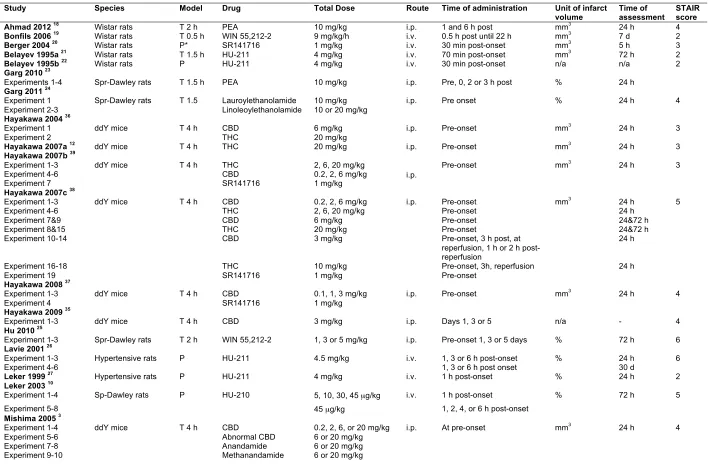
Table 1. Description of included studies
Study Species Model Drug Total Dose Route Time of administration Unit of infarct
volume
Time of assessment
STAIR score
Ahmad 2012 18 Wistar rats T 2 h PEA 10 mg/kg i.p. 1 and 6 h post mm3 24 h 4
Bonfils 2006 19 Wistar rats T 0.5 h WIN 55,212-2 9 mg/kg/h i.v. 0.5 h post until 22 h mm3 7 d 2
Berger 2004 20 Wistar rats P* SR141716 1 mg/kg i.v. 30 min post-onset mm3 5 h 3
Belayev 1995a 21 Wistar rats T 1.5 h HU-211 4 mg/kg i.v. 70 min post-onset mm3 72 h 2
Belayev 1995b 22 Wistar rats P HU-211 4 mg/kg i.v. 30 min post-onset n/a n/a 2
Garg 2010 23
Experiments 1-4 Spr-Dawley rats T 1.5 h PEA 10 mg/kg i.p. Pre, 0, 2 or 3 h post % 24 h Garg 2011 24
Experiment 1 Experiment 2-3
Spr-Dawley rats T 1.5 Lauroylethanolamide Linoleoylethanolamide
10 mg/kg 10 or 20 mg/kg
i.p. Pre onset % 24 h 4
Hayakawa 2004 36 Experiment 1 Experiment 2
ddY mice T 4 h CBD THC
6 mg/kg 20 mg/kg
i.p. Pre-onset mm3 24 h 3
Hayakawa 2007a 12 ddY mice T 4 h THC 20 mg/kg i.p. Pre-onset mm3 24 h 3
Hayakawa 2007b 39 Experiment 1-3 Experiment 4-6 Experiment 7
ddY mice T 4 h THC
CBD SR141716
2, 6, 20 mg/kg 0.2, 2, 6 mg/kg
1 mg/kg i.p.
Pre-onset mm3 24 h 3
Hayakawa 2007c 38
Experiment 1-3 ddY mice T 4 h CBD 0.2, 2, 6 mg/kg i.p. Pre-onset mm3 24 h 5
Experiment 4-6 THC 2, 6, 20 mg/kg Pre-onset 24 h
Experiment 7&9 CBD 6 mg/kg Pre-onset 24&72 h
Experiment 8&15 THC 20 mg/kg Pre-onset 24&72 h
Experiment 10-14 CBD 3 mg/kg Pre-onset, 3 h post, at
reperfusion, 1 h or 2 h post-reperfusion
24 h
Experiment 16-18 Experiment 19
THC SR141716
10 mg/kg 1 mg/kg
Pre-onset, 3h, reperfusion Pre-onset
24 h Hayakawa 2008 37
Experiment 1-3 ddY mice T 4 h CBD 0.1, 1, 3 mg/kg i.p. Pre-onset mm3 24 h 4
Experiment 4 SR141716 1 mg/kg
Hayakawa 2009 35
Experiment 1-3 ddY mice T 4 h CBD 3 mg/kg i.p. Days 1, 3 or 5 n/a - 4
Hu 2010 25
Experiment 1-3 Spr-Dawley rats T 2 h WIN 55,212-2 1, 3 or 5 mg/kg i.p. Pre-onset 1, 3 or 5 days % 72 h 6 Lavie 2001 26
Experiment 1-3 Hypertensive rats P HU-211 4.5 mg/kg i.v. 1, 3 or 6 h post-onset % 24 h 6
Experiment 4-6 1, 3 or 6 h post onset 30 d
Leker 1999 27 Hypertensive rats P HU-211 4 mg/kg i.v. 1 h post-onset % 24 h 2
Leker 2003 10
Experiment 1-4 Sp-Dawley rats P HU-210 5, 10, 30, 45 µg/kg i.v. 1 h post-onset % 72 h 5
Experiment 5-8 45 µg/kg 1, 2, 4, or 6 h post-onset
Mishima 2005 3
Experiment 1-4 ddY mice T 4 h CBD 0.2, 2, 6, or 20 mg/kg i.p. At pre-onset mm3 24 h 4
Experiment 5-6 Abnormal CBD 6 or 20 mg/kg
Experiment 7-8 Anandamide 6 or 20 mg/kg
[26]
Muthian 2004 5
Experiment 1-3 Wistar rats T 2.5 h WIN 55,212-2 0.1, 0.3, or 1 mg/kg i.v. 5 min pre-onset mm3 24 h 5
Experiment 4-6 SR141716 0.1, 0.3, or 1 mg/kg
Experiment 7 LY320153 6 mg/kg
Murakami 2013 28 Experiment 1-6 Experiment 7-8 Experiment 9
Rats
Aged rats
P P* P*
TAK-937 30, 100 mcg/kg/h
100 mcg/kg/hr
i.v. 3, 5 or 8 h post, until 24 h 1 h post until 24 h 1 h post until 24 h
% 48 h 4
Murikinati 2010 9 C57BL/6 mice P JWH-133 1 mg/kg/day i.v. 4 hours pre-onset mm3 3 d 2
Nagayama 1999 29 Experiment 1-4 Experiment 5
Spr-Dawley rats P WIN 55,212-2 SR141716
1 mg/kg 1 mg/kg
i.p. 30 min pre-, 30, 60, or 120 min post-
mm3 24 h 4
Schomacher 2008 30
Experiment 1-2 Wistar rats T 1.5 h PEA 30 or 10 mg/kg i.p. 30 min post-onset mm3 24 h 5
Experiment 3 Anandamide 10 mg/kg
Sun 2007 40 C57BL/6 Mice T 2 h OEA 10mg/kg/day i.p. -3,-2 & -1 days pre-onset mm3 48 h 1
Sun 2013a 31
Experiment 1-2 Spr-Dawley rats P WIN 55,212-2 1 or 9 mg/kg i.v. 2 h post-onset % 24 h 5
Sun 2013b 32 Experiment 1-5
Experiment 6-7 Spr-Dawley rats P WIN 55,212-2 SR141716 1, 3 or 9 mg/kg 1 or 2 mg i.v. 2 h % 24 h 4
Suzuki 2012a 45
Experiment 1-4 Spr-Dawley rats T 2 h TAK-937 3, 10, 30 or 100 µg/kg i.v. At reperfusion % 24 h 4
Experiment 5 Cynomolgus
monkeys
T 0.5 h 2 µg/kg 30 min post-reperfusion
Suzuki 2012b 33 Spr-Dawley rats T 2 h TAK-937 100 mcg/kg/h i.v. 2 h (on reperfusion) for 24 h mm3 24 h 2
Teichner 2003 34
Experiment 1-2 Hypertensive rats P HU-211 4.5 mg/kg i.v. 1 h % 1 and 30
days
4
Zarruk 2012 41
Experiment 1-3 Mice P JWH-133 0.5, 1.5 or 5 mg/kg i.p. 10 min post-onset % 48 h 6
Experiment 4-5 1.5 mg/kg 10 min or 3 h post-onset
Zhang 2007 43
Experiment 1 and 3 Mice T 1 h O-3853 1 mg/kg i.v. 1 h pre- or 10 min post- mm3 24 h 3
Experiment 2 and 4 O-1966 1 mg/kg 1 h pre- or 10 min post-
Zhang 2008 11 Experiment 1-2 Experiment 3-4 Experiment 5-6
Mice T 1 h O-1966
SR141716 SR144528
1 mg/kg 5, 20 mg/kg
5, 20 mg/kg i.v.
1 h pre-onset % 24 h 2
Zhang 2009 42
Experiment 1-3 Mice T 1 h O-1966 1, 5, or 10 mg/kg i.p. 1 h pre-onset % 24 h 5
Experiment 4-6 5 mg/kg 1 h pre-onset, 1 h or 3 h
post-reperfusion Zhou 2012 44
Experiement 1-9 Kunming mice T 1.5 h OEA 10, 20, 40 mg/kg oral
3 d pre-onset or 30, 60, 90,
150 min post onset mm3 24 h 5
*photothrombotic model; T, transient MCAO; P, permanent MCAO; PEA, palmitoylethanolamide; THC, Δ9-tetrahydrocannabinol; CBD, cannabidiol; OEA, oleoylethanolamide; i.p., intra-peritoneal;
[27]
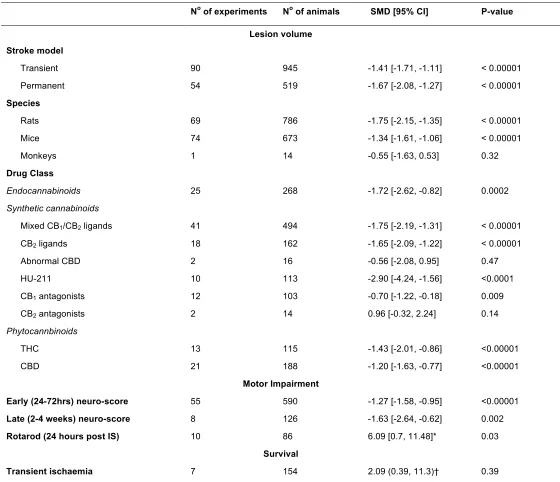
Table 2. Change in infarct volume (according to stroke model, species and drug class), motor impairment and survival following administration of any
cannabinoid in experimental stroke.
No of experiments No of animals SMD [95% CI] P-value
Lesion volume Stroke model
Transient 90 945 -1.41 [-1.71, -1.11] < 0.00001
Permanent 54 519 -1.67 [-2.08, -1.27] < 0.00001
Species
Rats 69 786 -1.75 [-2.15, -1.35] < 0.00001
Mice 74 673 -1.34 [-1.61, -1.06] < 0.00001
Monkeys 1 14 -0.55 [-1.63, 0.53] 0.32
Drug Class
Endocannabinoids 25 268 -1.72 [-2.62, -0.82] 0.0002
Synthetic cannabinoids
Mixed CB1/CB2 ligands 41 494 -1.75 [-2.19, -1.31] < 0.00001
CB2 ligands 18 162 -1.65 [-2.09, -1.22] < 0.00001
Abnormal CBD 2 16 -0.56 [-2.08, 0.95] 0.47
HU-211 10 113 -2.90 [-4.24, -1.56] <0.0001
CB1 antagonists 12 103 -0.70 [-1.22, -0.18] 0.009
CB2 antagonists 2 14 0.96 [-0.32, 2.24] 0.14
Phytocannbinoids
THC 13 115 -1.43 [-2.01, -0.86] <0.00001
CBD 21 188 -1.20 [-1.63, -0.77] <0.00001
Motor Impairment
Early (24-72hrs) neuro-score 55 590 -1.27 [-1.58, -0.95] <0.00001
Late (2-4 weeks) neuro-score 8 126 -1.63 [-2.64, -0.62] 0.002
Rotarod (24 hours post IS) 10 86 6.09 [0.7, 11.48]* 0.03
Survival
Transient ischaemia 7 154 2.09 (0.39, 11.3)† 0.39
[28]
[29] Figure 2
Study or Subgroup 1.1.1 HU-210 (CB1/CB2 ligand)
Leker E1 2003 5mcg 1hr Leker E2 2003 10mcg 1hr Leker E3 2003 30mcg 1hr Leker E4 2003 45mcg 1hr Leker E5 2003 45mcg 1hr Leker E6 2003 45mcg 2hr Leker E7 2003 45mcg 4hr Leker E8 2003 45mcg 6hr
Subtotal (95% CI)
Heterogeneity: Tau² = 4.70; Chi² = 27.87, df = 7 (P = 0.0002); I² = 75% Test for overall effect: Z = 3.81 (P = 0.0001)
1.1.2 WIN 55,212-2 (CB1/CB2 ligand)
Bonfils 2006 9mg 0.5h Hu 2010 1mg pre Hu 2010 3mg pre Hu 2010 5mg pre Muthian E1 2004 0.1mg pre Muthian E2 2004 0.3mg pre Muthian E3 2004 1mg pre Nagayama 1999 E1 1mg pre Nagayama 1999 E2 1mg .5hr Nagayama 1999 E3 1mg 1hr Nagayama 1999 E4 1mg 2hr Sun 2013a 1mg 2hr Sun 2013a 9mg 2hr Sun E1 2013 1mg 2h Sun E2 2013 3mg 2h Sun E3 2013 9mg 2h Sun E4 2013 1mg 2h Sun E5 2013 9mg 2h
Subtotal (95% CI)
Heterogeneity: Tau² = 1.48; Chi² = 41.67, df = 17 (P = 0.0007); I² = 59% Test for overall effect: Z = 4.49 (P < 0.00001)
1.1.3 TAK-937 (CB1/CB2 ligand)
Murakami E1 2013 30µg 3h Murakami E2 2013 100µg 3h Murakami E3 2013 30µg 5h Murakami E4 2013 100µg 5h Murakami E5 2013 30µg 8h Murakami E6 2013 100µg 8h Murakami E7 2013 30µg 1h Murakami E8 2013 100µg 1h Murakami E9 2013 100µg 1h Suzuki 2012 100µg 2hr Suzuki 2012 10µg 2hr Suzuki 2012 2µg 1hr Suzuki 2012 30µg 2hr Suzuki 2012 3µg 2hr Suzuki 2012b 100µg 2h
Subtotal (95% CI)
Heterogeneity: Tau² = 0.57; Chi² = 35.06, df = 14 (P = 0.001); I² = 60% Test for overall effect: Z = 5.40 (P < 0.00001)
1.1.4 JWH-133 (CB2 ligand)
Murikinati 2010 1mg pre Zarruk E1 2012 0.5mg 10m Zarruk E2 2012 1.5mg 10m Zarruk E3 2012 5mg 10m Zarruk E4 2012 1.5mg 10m Zarruk E5 2012 1.5mg 3hr
Subtotal (95% CI)
Heterogeneity: Tau² = 0.00; Chi² = 2.06, df = 4 (P = 0.72); I² = 0% Test for overall effect: Z = 3.51 (P = 0.0005)
1.1.5 O-3853 (CB2 ligand)
Zhang E1 2007 1mg pre Zhang E3 2007 1mg 10m
Subtotal (95% CI)
Heterogeneity: Tau² = 0.00; Chi² = 0.04, df = 1 (P = 0.85); I² = 0% Test for overall effect: Z = 3.22 (P = 0.001)
1.1.6 O-1966 (CB2 ligand)
Zhang E1 2008 1mg pre Zhang E1 2009 1mg pre Zhang E2 2007 1mg pre Zhang E2 2008 1mg pre Zhang E2 2009 5mg pre Zhang E3 2009 10mg pre Zhang E4 2007 1mg 10m Zhang E4 2009 5mg pre Zhang E5 2009 5mg 1hr Zhang E6 2009 5mg 3hr
Subtotal (95% CI)
Heterogeneity: Tau² = 0.10; Chi² = 9.92, df = 9 (P = 0.36); I² = 9% Test for overall effect: Z = 5.59 (P < 0.00001)
1.1.7 Abnormal CBD
Mishima 2005 E5 6mg pre Mishima 2005 E6 20mg pre
Subtotal (95% CI)
Heterogeneity: Tau² = 0.00; Chi² = 0.20, df = 1 (P = 0.66); I² = 0% Test for overall effect: Z = 0.73 (P = 0.47)
1.1.8 THC
Hayakawa 2004 E2 20mg pre Hayakawa 2007a 20mg pre Hayakawa 2007b E1 2mg pre Hayakawa 2007b E2 6mg pre Hayakawa 2007bE3 20mg pre Hayakawa 2007c E4 2mg pre Hayakawa 2007c E5 6mg pre Hayakawa 2007cE15 20mg pr Hayakawa 2007cE16 10mg pr Hayakawa 2007cE17 10mg 3h Hayakawa 2007cE18 10mg 4h Hayakawa 2007cE6 20mg pre Hayakawa 2007cE8 20mg pre
Subtotal (95% CI)
Heterogeneity: Tau² = 0.04; Chi² = 12.40, df = 12 (P = 0.41); I² = 3% Test for overall effect: Z = 4.91 (P < 0.00001)
1.1.9 CBD
Hayakawa 2004 E1 6mg pre Hayakawa 2007b E4 0.2mg Hayakawa 2007b E5 2mg pre Hayakawa 2007b E6 6mg pre Hayakawa 2007c E1 0.2mg Hayakawa 2007c E11 3mg 3h Hayakawa 2007c E12 3mg 4h Hayakawa 2007c E13 3mg 5h Hayakawa 2007c E14 3mg 6h Hayakawa 2007c E2 2mg pre Hayakawa 2007c E3 6mg pre Hayakawa 2007c E7 6mg pre Hayakawa 2007c E9 6mg pre Hayakawa 2007cE10 3mg pre Hayakawa 2008 0.1mg pre Hayakawa 2008 1mg pre Hayakawa 2008 3mg pre Mishima 2005 E1 0.2mg pre Mishima 2005 E2 2mg pre Mishima 2005 E3 6mg pre Mishima 2005 E4 10mg pre
Subtotal (95% CI)
Heterogeneity: Tau² = 0.00; Chi² = 15.81, df = 20 (P = 0.73); I² = 0% Test for overall effect: Z = 5.44 (P < 0.00001)
1.1.10 Anandamide
Mishima 2005 E7 6mg pre Mishima 2005 E8 10mg pre Schomacher 2008 E3 10mg
Subtotal (95% CI)
Heterogeneity: Tau² = 0.00; Chi² = 0.93, df = 2 (P = 0.63); I² = 0% Test for overall effect: Z = 1.78 (P = 0.07)
1.1.11 Methanandamide
Mishima 2005 E10 10mg pre Mishima 2005 E9 6mg pre
Subtotal (95% CI)
Heterogeneity: Tau² = 0.00; Chi² = 0.00, df = 1 (P = 0.96); I² = 0% Test for overall effect: Z = 0.16 (P = 0.87)
1.1.12 Palmitoylethanolamide
Ahmad 2012 10mg 1h Garg 2010 10mg 0h Garg 2010 10mg 2h Garg 2010 10mg 3h Garg 2010 10mg pre Schomacher 2008 10mg 30m Schomacher 2008 30mg 30m
Subtotal (95% CI)
Heterogeneity: Tau² = 13.36; Chi² = 70.45, df = 6 (P < 0.00001); I² = 91% Test for overall effect: Z = 2.64 (P = 0.008)
1.1.13 Oleoylethanolamine
Sun 2007 10mg pre Zhou 2012 E1 10mg pre Zhou 2012 E2 20mg pre Zhou 2012 E3 40mg pre Zhou 2012 E4 40mg 0.5h Zhou 2012 E5 40mg 1.5h Zhou 2012 E6 40mg 1h Zhou 2012 E7 40mg 2.5h Zhou 2012 E8 10mg 1.5h Zhou 2012 E9 40mg 1.5h
Subtotal (95% CI)
Heterogeneity: Tau² = 2.04; Chi² = 28.65, df = 9 (P = 0.0007); I² = 69% Test for overall effect: Z = 4.10 (P < 0.0001)
1.1.14 Lauroylethanolamide
Garg E1 2011 10mg pre
Subtotal (95% CI)
Heterogeneity: Not applicable Test for overall effect: Z = 0.16 (P = 0.87)
1.1.15 Linoleoylethanolamide
Garg E2 2011 10mg pre Garg E3 2011 20mg pre
Subtotal (95% CI)
Heterogeneity: Tau² = 0.00; Chi² = 0.14, df = 1 (P = 0.71); I² = 0% Test for overall effect: Z = 0.07 (P = 0.95)
1.1.16 HU-211
Belayev 1995a 4mg 70min Lavie 2001 E1 4.5mg 1hr Lavie 2001 E2 4.5mg 3hr Lavie 2001 E3 4.5mg 6hr Lavie 2001 E4 4.5mg 1hr Lavie 2001 E5 4.5mg 3hr Lavie 2001 E6 4.5mg 6hr Leker 1999 4mg 1hr Teichner E1 2003 4.5mg 1h Teichner E2 2003 4.5mg 1h
Subtotal (95% CI)
Heterogeneity: Tau² = 2.30; Chi² = 28.13, df = 9 (P = 0.0009); I² = 68% Test for overall effect: Z = 4.23 (P < 0.0001)
1.1.17 SR141716 (CB1 antagonist)
Berger 2004 1mg 30min Hayakawa 2007b E7 1mg pre Hayakawa 2007cE19 1mg pre Muthian E4 2004 0.3mg pre Muthian E5 2004 1mg pre Muthian E6 2004 3mg pre Nagayama 1999 E5 1mg pre Sun E6 2013 1mg 2h Sun E7 2013 2mg 2h Zhang E3 2008 5mg pre Zhang E4 2008 20mg pre
Subtotal (95% CI)
Heterogeneity: Tau² = 0.18; Chi² = 12.20, df = 10 (P = 0.27); I² = 18% Test for overall effect: Z = 2.33 (P = 0.02)
1.1.18 LY320153 (CB1 antagonist)
Muthian E7 2004 6mg pre
Subtotal (95% CI)
Heterogeneity: Not applicable Test for overall effect: Z = 1.03 (P = 0.30)
1.1.19 SR144528 (CB2 antagonist)
Zhang E5 2008 5mg pre Zhang E6 2008 20mg pre
Subtotal (95% CI)
Heterogeneity: Tau² = 0.00; Chi² = 0.03, df = 1 (P = 0.87); I² = 0% Test for overall effect: Z = 1.47 (P = 0.14)
Total (95% CI)
Heterogeneity: Tau² = 1.03; Chi² = 324.21, df = 142 (P < 0.00001); I² = 56% Test for overall effect: Z = 12.24 (P < 0.00001)
Test for subgroup differences: Chi² = 48.72, df = 18 (P = 0.0001), I² = 63.1%
Mean 34.22 20.02 11.2 9.44 9.28 13.26 13.83 39.77 2.84 41.61 38.64 28.84 214.68 248.7 223.05 149.4 144.3 192.5 222.5 23.86 12.5 28.9 23.8 12.3 24.1 12.5 81.2 58.3 79.1 75.4 102.8 95.1 76.8 59.8 81.7 13.3 29.2 5.5 19.2 36.7 105.7 9.95 16.42 8.08 15.11 8.83 10.94 68.2 71.9 15.6 14.3 65.6 14.4 5.4 21.4 71.3 5.38 13.58 16.03 58.2 84.8 47.49 46.7 93.9 53.3 46.7 93.9 53.5 49 67 80 82.2 46.7 52.2 52.21 94.3 49.2 51.4 92.3 65.7 58.9 64.2 53 49.2 51.4 40.4 53 60.8 92.3 49.2 51.4 94.3 49.2 51.4 87 89.6 85.7 40.43 87.3 90.9 15.2 10.2 12.9 38.4 11.2 198.29 153.79 18 134.7 59.3 43.1 132.5 112.1 42 139 71.8 14.1 39.6 52.5 7.3 66.6 11.5 12 14.4 8.1 11.1 13.8 15.8 9.7 10 99 91.9 91.1 248.5 256 128.5 204.2 29.1 30.2 14.93 12.3 215 29.45 31.1 SD 4.32 9.17 3.62 4.5 4.92 3.98 5.49 10.04 2.59 5.65 8.92 2.69 95.9 47.2 100.33 20 9.2 10.8 10.8 2.58 2.3 3.04 4.29 2.14 2.5 2.3 10.6 21.9 14.2 11.7 19.3 25.4 10.5 11 17 7.2 13.2 3.4 11.2 10.3 64.8 3.82 2.61 4.43 5.86 4.35 3.26 14.1 17.3 3.73 4.41 11.3 3.69 3.67 9.55 15.6 2.35 2.2 6.79 32.3 28.04 15.39 13.4 18.6 23.3 17.7 26.3 29.4 16.7 31.2 11.4 10.5 16.7 22.8 15.39 36.3 30.9 20.6 23.5 10.6 27.8 14.8 19.6 25.3 19.3 34.1 18.8 20.6 21.5 23 21.9 34.2 29.2 20.6 35.4 26.4 22.8 13.36 37.6 20.4 0.62 0.9 3.5 5.4 2.3 54.75 53.13 2 74.4 24.8 30.1 87.3 69 35.6 52.8 15.4 19.2 4.16 36.9 11.8 51.5 0.02 3.2 2.4 0.6 2.3 2.5 1.7 4.7 6 41.6 4.75 8.2 40.2 98.4 100.6 32.6 5.6 3.1 3.35 1.93 44.7 5.88 5.48 Total 8 8 8 8 8 8 8 8 64 5 10 10 10 7 7 7 6 6 6 6 6 6 4 4 4 6 6 116 10 9 10 9 7 7 8 8 8 18 16 7 20 17 10 164 5 5 5 4 10 0 29 8 8 16 5 6 8 5 6 6 8 6 6 6 62 7 7 14 8 5 4 5 9 8 8 8 7 7 7 8 7 91 8 9 9 8 6 7 7 7 7 6 7 7 7 7 5 5 9 8 8 8 8 153 4 4 7 15 7 7 14 20 3 3 3 3 8 7 47 4 10 10 10 10 10 10 10 10 10 94 3 3 3 3 6 17 5 5 5 7 7 7 2 5 8 68 6 6 8 7 5 9 6 4 4 5 5 65 8 8 5 5 10 1039 Mean 39.86 39.86 39.86 39.86 39.77 39.77 39.77 39.77 12.43 50 50 50 260 260 260 211.7 211.7 211.7 211.7 31.2 31.2 32.1 32.1 32.1 31.2 31.2 100 100 100 100 100 100 100 100 100 38.3 38.3 8.1 38.3 38.3 272.8 15.98 18.37 18.37 18.37 16.58 16.58 99.2 99.8 22.4 25.1 99.2 23.55 25.1 25.1 99.8 24.74 24.74 24.74 92.3 92.3 91.36 91.3 91.3 91.3 91.3 91.3 91.3 93.3 93.3 93.3 93.3 91.3 85.5 91.36 91.3 91.3 91.3 91.3 94.6 94.6 94.6 94.6 91.3 91.3 85.5 94.6 94.6 91.3 91.3 91.3 91.3 91.3 91.3 91.3 92.3 92.3 57.21 92.3 92.3 35.1 38.4 38.4 38.4 38.4 223 236.23 27 189.7 189.7 189.7 172.4 172.4 172.4 172.4 175.6 175.6 38.1 38.1 38.1 149.8 20.8 20.8 20.8 24.49 24.49 24.49 22.1 20.75 24.4 164 91.3 91.3 260 260 260 211.7 32.1 32.1 23.55 24.7 260 23.55 24.7 SD 4.5 4.5 4.5 4.5 4.55 4.55 4.55 4.55 3.91 5.17 5.17 5.17 86 86 86 14.2 14.2 14.2 14.2 3.1 3.1 1.8 1.8 1.8 3.1 3.1 14.4 14.4 12.2 12.2 10.4 10.4 8.5 8.5 13.2 7.6 7.6 5.3 7.6 7.6 81 3.6 2.08 2.08 2.08 4.01 4.01 19.5 13 2.41 5.88 19.5 5.55 5.88 5.88 13 5.49 5.49 5.49 10.05 10.05 5.77 7.8 9.3 9.3 9.3 8.6 8.6 7.1 7.1 7.1 7.1 8.6 17.4 5.77 9.3 9.3 9.3 8.6 8.8 8.8 8.8 8.8 8.6 8.6 17.4 8.8 8.8 9.9 9.9 9.9 8.6 8.6 8.6 8.6 10.05 10.05 16.11 10.05 10.05 0.62 9.9 9.9 9.9 9.9 61.88 52.21 6.7 38.3 38.3 38.3 34.5 34.5 34.5 34.5 47.4 47.4 5.54 5.54 5.54 149.7 1.3 1.3 1.3 1.9 1.9 1.9 0.4 2.86 7.9 26.9 7 3.5 86 86 86 34.8 1.8 1.8 5.55 1.93 86 5.55 2.59 Total 2 2 2 2 2 2 2 2 16 5 3 3 3 4 4 4 2 1 1 1 3 3 1 1 1 3 3 46 9 9 4 4 4 4 4 4 9 5 5 7 5 5 10 88 5 2 2 1 5 5 20 4 4 8 5 2 4 2 2 2 4 2 2 2 27 1 1 2 3 5 1 1 1 1 1 2 2 2 2 1 2 24 4 1 1 1 1 1 1 1 1 1 1 3 2 2 3 3 2 2 2 1 1 35 1 1 11 13 2 1 3 20 1 1 1 1 10 11 45 5 2 2 2 2 2 2 2 3 3 25 1 1 1 1 2 17 2 2 2 2 2 2 3 5 8 45 6 1 2 4 3 3 1 1 1 2 3 27 3 3 2 2 4 434 Weight 0.8% 0.7% 0.3% 0.3% 0.3% 0.3% 0.5% 0.9% 4.2% 0.7% 0.9% 1.0% 0.4% 1.0% 1.0% 1.0% 0.6% 0.2% 0.6% 0.6% 0.7% 0.3% 0.6% 0.5% 0.1% 0.7% 0.3% 11.2% 1.1% 1.0% 1.0% 0.9% 1.0% 1.0% 0.9% 0.7% 1.1% 0.9% 1.1% 1.1% 1.1% 1.2% 1.1% 15.4% 0.9% 0.8% 0.6% 0.6% 1.0% 4.0% 0.9% 0.9% 1.9% 0.9% 0.7% 0.9% 0.6% 0.4% 0.9% 0.9% 0.3% 0.5% 0.8% 6.8% 0.7% 0.7% 1.3% 0.7% 0.6% 0.6% 0.6% 0.6% 0.7% 0.7% 0.7% 0.9% 0.8% 0.8% 0.5% 0.8% 9.0% 0.8% 0.7% 0.7% 0.6% 0.7% 0.5% 0.6% 0.6% 0.6% 0.6% 0.6% 0.9% 0.7% 0.8% 0.9% 0.7% 0.8% 0.9% 0.8% 0.6% 0.7% 14.8% 0.7% 0.6% 1.1% 2.4% 0.9% 0.7% 1.6% 0.1% 0.0% 0.0% 0.6% 0.0% 1.2% 1.1% 3.0% 0.9% 0.9% 0.5% 0.5% 0.9% 0.9% 0.6% 0.9% 0.6% 0.5% 7.2% 0.5% 0.5% 0.5% 0.1% 0.6% 1.3% 0.0% 0.5% 0.6% 0.1% 0.3% 0.5% 0.1% 0.8% 1.0% 5.2% 1.0% 0.7% 0.9% 1.0% 0.9% 0.9% 0.7% 0.6% 0.6% 0.6% 0.3% 8.3% 1.0% 1.0% 0.8% 0.8% 1.6% 100.0%
IV, Random, 95% CI
-1.17 [-2.86, 0.51] -2.05 [-3.99, -0.12] -6.92 [-11.11, -2.73] -6.11 [-9.88, -2.34] -5.65 [-9.19, -2.11] -5.90 [-9.57, -2.24] -4.35 [-7.25, -1.45] 0.00 [-1.55, 1.55]
-3.52 [-5.34, -1.71]
-2.61 [-4.54, -0.69] -1.40 [-2.84, 0.04] -1.26 [-2.68, 0.15] -6.00 [-9.04, -2.95] -0.45 [-1.70, 0.80] -0.16 [-1.40, 1.07] -0.35 [-1.59, 0.89] -2.83 [-5.35, -0.31] -6.17 [-11.50, -0.84] -1.50 [-3.92, 0.93] 0.84 [-1.38, 3.06] -2.38 [-4.40, -0.36] -6.51 [-10.75, -2.27] -0.77 [-3.19, 1.66] -1.41 [-4.30, 1.49] -6.73 [-16.05, 2.59] -2.35 [-4.35, -0.35] -6.51 [-10.75, -2.27]
-1.81 [-2.60, -1.02]
-1.43 [-2.47, -0.40] -2.14 [-3.36, -0.93] -1.43 [-2.74, -0.11] -1.93 [-3.41, -0.46] 0.15 [-1.08, 1.38] -0.21 [-1.44, 1.03] -2.15 [-3.75, -0.56] -3.60 [-5.73, -1.47] -1.15 [-2.20, -0.10] -3.31 [-4.76, -1.87] -0.71 [-1.75, 0.32] -0.55 [-1.62, 0.53] -1.73 [-2.84, -0.62] -0.16 [-1.16, 0.84] -2.18 [-3.34, -1.03]
-1.38 [-1.88, -0.88]
-1.47 [-2.96, 0.02] -0.65 [-2.37, 1.07] -2.13 [-4.48, 0.22] -0.40 [-2.66, 1.85] -1.72 [-3.01, -0.43] Not estimable
-1.35 [-2.10, -0.59]
-1.80 [-3.29, -0.31] -1.60 [-3.03, -0.17]
-1.69 [-2.72, -0.66]
-1.96 [-3.61, -0.30] -2.00 [-4.12, 0.11] -2.17 [-3.78, -0.57] -1.87 [-4.07, 0.34] -4.16 [-7.43, -0.88] -0.36 [-1.97, 1.26] -1.77 [-3.25, -0.29] -5.43 [-9.49, -1.37] -3.22 [-5.96, -0.49] -1.15 [-2.93, 0.64]
-1.87 [-2.53, -1.22]
-0.92 [-3.11, 1.27] -0.23 [-2.33, 1.87]
-0.56 [-2.08, 0.95]
-2.90 [-4.91, -0.89] -3.67 [-6.09, -1.26] 0.10 [-2.09, 2.30] -1.30 [-3.79, 1.18] -2.28 [-4.71, 0.16] 0.09 [-1.99, 2.17] -1.14 [-3.34, 1.05] -2.53 [-4.63, -0.42] -0.81 [-2.45, 0.84] -1.09 [-2.79, 0.62] -0.98 [-2.66, 0.70] -2.37 [-4.92, 0.17] -1.34 [-3.11, 0.44]
-1.43 [-2.01, -0.86]
-2.73 [-4.52, -0.93] 0.07 [-1.99, 2.14] -1.23 [-3.41, 0.95] -1.72 [-4.06, 0.61] 0.04 [-2.08, 2.15] -2.37 [-5.03, 0.28] -1.12 [-3.35, 1.11] -1.79 [-4.22, 0.64] -1.85 [-4.30, 0.60] -1.40 [-3.79, 0.99] -1.80 [-4.23, 0.64] -1.32 [-2.87, 0.22] -2.09 [-4.12, -0.06] -1.55 [-3.39, 0.29] 0.05 [-1.38, 1.48] -1.86 [-3.79, 0.06] -1.74 [-3.53, 0.04] 0.08 [-1.47, 1.63] -1.38 [-3.12, 0.35] -1.72 [-4.06, 0.61] -0.11 [-2.19, 1.97]
-1.20 [-1.63, -0.77]
-0.07 [-2.27, 2.12] -0.21 [-2.42, 2.00] -1.06 [-2.08, -0.03]
-0.78 [-1.64, 0.08]
-0.13 [-1.70, 1.45] -0.06 [-2.16, 2.04]
-0.10 [-1.36, 1.16]
-31.46 [-38.75, -24.17] -17.90 [-119.23, 83.42] -4.16 [-27.83, 19.50] 0.00 [-2.26, 2.26] -6.76 [-45.06, 31.54]
-0.40 [-1.34, 0.54] -1.49 [-2.59, -0.40]
-5.16 [-9.00, -1.32]
-1.53 [-3.15, 0.09] -0.71 [-2.27, 0.85] -4.55 [-7.24, -1.86] -4.36 [-6.98, -1.75] -0.44 [-1.97, 1.09] -0.84 [-2.41, 0.73] -3.39 [-5.64, -1.15] -0.60 [-2.15, 0.94] -3.93 [-6.16, -1.71] -5.64 [-8.54, -2.74]
-2.29 [-3.38, -1.19]
0.21 [-2.34, 2.75]
0.21 [-2.34, 2.75]
0.22 [-2.37, 2.81] -1.49 [-10.23, 7.25]
0.08 [-2.40, 2.57]
-0.73 [-1.42, -0.03] -13.46 [-24.26, -2.67] -2.54 [-5.13, 0.06] -2.42 [-4.95, 0.10] -16.05 [-26.06, -6.04]
-5.30 [-8.92, -1.67] -3.92 [-6.80, -1.04] -4.43 [-10.65, 1.80] -2.57 [-4.47, -0.66] -1.94 [-3.19, -0.69]
-2.90 [-4.24, -1.56]
-1.71 [-3.12, -0.31] 0.11 [-2.01, 2.23] -0.02 [-1.57, 1.53] -0.18 [-1.41, 1.06] -0.04 [-1.47, 1.39] -1.24 [-2.68, 0.20] -0.19 [-2.32, 1.93] -0.39 [-2.64, 1.86] -0.45 [-2.72, 1.83] -1.87 [-4.07, 0.34] -5.59 [-9.69, -1.49]
-0.71 [-1.30, -0.11]
-0.73 [-2.11, 0.65]
-0.73 [-2.11, 0.65]
0.85 [-0.92, 2.63] 1.07 [-0.78, 2.92]
0.96 [-0.32, 2.24]
-1.49 [-1.73, -1.25]
Favours [experimental] Control Std. Mean Difference Std. Mean Difference
IV, Random, 95% CI
-10 -5 0 5 10

![(E) 1 Ferrocenyl 3 [2 (2 hydroxyethoxy)phenyl]prop 2 en 1 one](data:image/gif;base64,R0lGODlhAQABAIAAAP///wAAACH5BAEAAAAALAAAAAABAAEAAAICRAEAOw==)