Original Article
Examples of Holistic Good Practices in Promoting and Protecting
Mental Health in the Workplace: Current and Future Challenges
Kelly C. Sivris
*, Stavroula Leka
Centre for Organizational Health and Development, A World Health Organization Collaborating Centre in Occupational Health, School of Medicine, University of Nottingham, Nottingham, UK
a r t i c l e i n f o
Article history: Received 16 March 2015 Received in revised form 10 July 2015
Accepted 12 July 2015 Available online 29 July 2015
Keywords: good practices mental health promotion national level
World Health Organization mental health action plan
World Health Organization model for healthy workplaces
a b s t r a c t
Background: While attention has been paid to physical risks in the work environment and the promotion of individual employee health, mental health protection and promotion have received much less focus. Psychosocial risk management has not yet been fully incorporated in such efforts. This paper presents good practices in promoting mental health in the workplace in line with World Health Organization (WHO) guidance by identifying barriers, opportunities, and the way forward in this area.
Methods: Semistructured interviews were conducted with 17 experts who were selected on the basis of their knowledge and expertise in relation to good practice identified tools. Interviewees were asked to evaluate the approaches on the basis of the WHO model for healthy workplaces.
Results: The examples of good practice for Workplace Mental Health Promotion (WMHP) are in line with the principles and the five keys of the WHO model. They support the third objective of the WHO comprehensive mental health action plan 2013e2020 for multisectoral implementation of WMHP strategies. Examples of good practice include the engagement of all stakeholders and representatives, science-driven practice, dissemination of good practice, continual improvement, and evaluation. Actions to inform policies/legislation, promote education on psychosocial risks, and provide better evidence were suggested for higher WMHP success.
Conclusion: The study identified commonalities in good practice approaches in different countries and stressed the importance of a strong policy and enforcement framework as well as organizational re-sponsibility for WMHP. For progress to be achieved in this area, a holistic and multidisciplinary approach was unanimously suggested as a way to successful implementation.
CopyrightÓ2015, Occupational Safety and Health Research Institute. Published by Elsevier Ltd. This is an open access article under the CC BY-NC-ND license (http://creativecommons.org/licenses/by-nc-nd/4.0/).
1. Introduction
Mental health is incorporated as an important element in the definition of health provided by the World Health Organization (WHO):“A state of complete physical, mental and social wellbeing and not merely the absence of disease.”[1]. This definition focuses on a holistic approach, which brings together physical, mental, and so-cial health. It pertains to two main ideas: there is no health without mental health, and health is not just the absence of illness. Mental health has been conceptualized asa state of wellbeingwhere the in-dividual realizes personal abilities, is able to cope with life’s stressors, can be productive, and contributes to the community[2e6].
Work-related determinants of mental health are embedded in the phys-ical and psychosocial work environment[7]. Psychosocial hazards in the workplace include aspects of work organization, design, and management such as a heavy workload, lack of control, unsuitable job roles, poor interpersonal relationships, and lack of career pros-pects and development[8]. Quality of life, optimal health, mental health and wellbeing in the workplace are critical issues, considering the fact that people spend 15.7e25.4% of their time per year at work (Organization for Economic Co-operation and Development statis-tical facts on working hours with a minimum of 1,381 working hours in a year for The Netherlands, and a maximum of 2,226 working hours in a year for Mexico)[9].
*Corresponding author. Centre for Organizational Health and Development (COHD), A World Health Organization Collaborating Centre in Occupational Health, Faculty of Medicine and Health Sciences, Yang Fujia Building, Jubilee Campus University of Nottingham, Wollaton Road, Nottingham, NG8 1BB, UK.
E-mail address:[email protected](K.C. Sivris).
Contents lists available atScienceDirect
Safety and Health at Work
j o u r n a l h o me p a g e : w w w . e - s h a w . o r g
2093-7911/$esee front matter CopyrightÓ2015, Occupational Safety and Health Research Institute. Published by Elsevier Ltd. This is an open access article under the CC
As a result, WHO has stressed the urgency to advance mental health[10e12]due to the impact of mental ill health on individuals
of any age [13,14], organizations, and society overall. However, addressing mental health in the workplace has not received enough prioritization and it has been concluded that there is a gap between knowledge and policies (where available) and real-life practice, which needs to be analyzed and managed[15,16]. Mental health in the workplace has been a Cinderella subject for a long time: phenomenally accepted but practically neglected [17]. In recent decades initiatives to address this gap have been implemented either through workplace health promotion programs or psycho-social risk management [16]. The WHO Comprehensive Mental Health Action Plan (CMHAP) 2013 states as implementation options to“Promote work participation and return-to-work programmes for those affected by mental and psychosocial disorders,”and to “Promote safe and supportive working conditions, with attention to work organizational improvements, training on mental health for managers, the provision of stress management courses and work-place wellness programmes and tackling stigmatization and discrimination.”[6].
Workplace health promotion (WHP) and psychosocial risk management are two overarching approaches to improve em-ployees’health, safety, and wellbeing, which incorporate mental health promotion and mental ill health prevention[16,18]. WHP is a combination of various efforts from employers, employees, and the community in favor of maintaining wellbeing. These efforts include empowerment of individuals and resilience building, the devel-opment of personal health resources and the implementation of wellness programs[19]. Mental health promotion is a basic part of WHP, which needs to be addressed in order to ensure employee wellbeing[5,20,21].
By contrast, psychosocial risk assessment and management are vital ways to identify and control psychosocial risks in order to protect employees’physical and mental health. Psychosocial risk management in the workplace is underpinned by legislation in many countries[22]. Appropriate and adequate policy formulation for mental health protection and promotion considerably enhances the level of success for initiatives that include psychosocial risk management[16].
The WHO Healthy Workplaces Model (MHW) has been devel-oped on the basis of the WHO global plan of action on workers’ health (GPA) and is in line with the WHO CMHAP[3,6]. Specifically, the MHW stresses the importance of effective leadership, work-place mental health promotion (WMHP)/mental ill health pre-vention, strengthening evidence and research (evaluation and assessment). The model additionally stresses the importance of tackling psychosocial risks as they are highly linked to poor workplace mental health (WMH) [23], the provision of personal health resources in support of mental health, and enterprise com-munity involvement, with a view to promote employee wellbeing and workelife balance from a wider perspective[3,21].
The MHW is based on five keys: leadership engagement; workers’ involvement; ethics; continual improvement; and inte-gration. It proposes that the development of a healthy workplace should be underpinned by the engagement of key stakeholders including leaders, employees, and their representatives[3,24,25]. Attention is paid to the importance of ethics and compliance with legislation as thefirst step of good practice[26]. The importance of evaluation and continual improvement is highlighted since adap-tation in relation to new needs increases effectiveness[27]. The last key element is coherent and comprehensive integration as a vital part of an effective implementation[28].
The current study is guided by the key objectives of the WHO model for healthy workplaces/the GPA for workers’health, and the CMHAP. The aim of the study was to identify initiatives/tools, which
are aligned with thefive keys and process of the MHW, and gather knowledge and expertise on good practices on WMHP. The aim was to summarize commonalities across countries, highlight barriers that need to be tackled, and conclude on opportunities for future improvement.
2. Materials and methods
The study was structured in two parts and lasted 5 months in total. Thefirst part included scientific and gray literature reviews to identify the initiatives. The second part was based on semi-structured interviews with experts with good knowledge of the identified initiatives.
2.1. Selection of initiatives
The current study aimed to support the development and establishment of the MHW audit tool for the WHO in order to assess progression towards healthy workplaces following the GPA and CMHAP objectives. Only initiatives/tools in line with the MHW have been included. Eleven good practice initiatives/tools for WMHP were selected. The authors attempted to provide a balanced perspective across countries and WHO regions; however, that was not always feasible due to a lack of tools in some countries and/or WHO regions. The selection process was not exhaustive as tools at organizational level (single cases) were excluded. The aims were: to gather a sufficiently representative number of initiatives; identify good practices and commonalities amongst different countries in the WHO regions; and investigate the way of promoting and pro-tecting workplace mental health[29,30]. The results of the scien-tific and gray literature review were cross-checked with those of another study[29]. The final choice of initiatives was made ac-cording to the predefined criteria of inclusion. A literature search protocol was used, based on selection criteria for addressing WMH [31,32]including: (1) initiatives in line with the MHW; (2) initia-tives at national level; (3) initiainitia-tives at sectoral and interorgani-zational level (implemented by many organizations in the country); (4) focus on mental health promotion and mental ill health pre-vention; (5) workplace focus; (6) no single interventions but ho-listic initiatives; and (7) already implemented.
2.1.1. Search strategy
The search was conducted in two parts. Thefirst part included electronic and library searches for the academic literature and both electronic and hard copies of the available material. The second part was the gray literature search, which was mainly performed by using online databases, search engines, and websites (see below). After gathering all the required sources and information, a data synthesis was conducted in order to identify initiatives across WHO regions based on the protocol. Initiatives were identified in the Americas, the European region, the African region, the Western Pacific region, and South-East Asia, but none in the Eastern Medi-terranean region. In addition, we tried to reduce reporting biases by avoiding duplicating studies while searching through multiple databases. We also tried to prevent biases stemming from the language barrier by trying not to exclude information in languages other than English[31].
2.1.2. Academic literature
the World Bank online Library, the Campbell Collaboration, Web of Knowledge (Web of Science), African Index Medicus, Health and Safety Science Abstracts, EMBASE, National Electronic Library for Health, and BMJ Group. The second part included electronic searches of the WHO’s library, the University of Nottingham’s (Nottingham, UK) library catalog, and Google Scholar.
2.1.3. Gray literature
Regarding the gray literature, electronic searches were per-formed through the National Technical Information Service, the OpenSIGLE, website, and Google Search Engine in order to identify available websites of promoted initiatives/tools. Relevant websites and databases including publications available within these sources were reviewed. In particular, websites from WHO, the International Labour Organization, the International Commission on Occupa-tional Health, the UK Health and Safety Executive, Centers for Disease Control and Protection, the United States National Institute for Occupational Safety and Health, the European Agency for Safety and Health at Work, and the European Trade Union Institute were reviewed. Searches also included the European Commission Mutual Information System on Social Protection Comparative Tables on Social Protection, materials from conference proceedings and Internet pages of any additional relevant organizations identified through these searches.
2.1.4. Keywords
Specific keywords and terms were used throughout the search strategy which included: mental health, mental ill health, promo-tion, prevenpromo-tion, work-related stress, occupational stress, well-being, promotion, good practice, workplace, worksite, wellness, national, sectoral, level, social determinants of health, psychosocial, risk factors, hazards, risk assessment, risk management, commu-nity involvement, stress management, interventions, psychological, health, healthy, problems, burden, demands, working hours, work-life balance, conflicts, uncertainty, job insecurity, change, restruc-turing, working environment, working conditions, impact, (widely applied) organizational, emotional exhaustion, common mental disorders (CMDs), preventive tools, WHO, regions, member states, global, and country.
All the keywords wereflexibly combined, altered, and/or trun-cated in order to serve the search needs. All the sources that came up due to these key terms were reviewed on the basis of their summary and/or abstract to check for relevance and compliance with the protocol. Additionally, reference lists were reviewed in order to identify any possible relevant citations and sources in support of the search strategy. The results of the scientific and gray literature review were cross-checked with those of another study conducted by members of the research team for the International Labour Organization[29]. This study involved a review and global survey with key stakeholders to identify initiatives of good practice in the area of WMHP at national level. It was encouraging to see that thefindings of both studies showed considerable convergence. After carefully reviewing all results, thefinal choice of initiatives was made according to the predefined criteria of inclusion.
2.2. Semi-structured expert interviews
2.2.1. Participants
Seventeen semistructured interviews were conducted with occupational safety and health (OSH) experts across WHO regions who have good knowledge of the selected 11 initiatives by having been involved in their development, implementation, and evalua-tion. Purposive sampling was used, combined with snowball sam-pling at times, in order to ensure that the authors were able to interview people with the most suitable experience[31]. Due to
limitations with respect to tools’availability, as mentioned above, the number of experts for each WHO region was not equal (e.g., there are many more initiatives in Europe contrary to the African region). There was a fair balance between sexes as there were nine male and eight female participants. The participants came from the UK, Italy, Belgium, Spain, The Netherlands, Finland, Poland, Canada, USA, Australia, Thailand, Japan, and Ghana. They had 5e38 years of relevant work experience. The participants were highly knowl-edgeable experts with many years of experience in OSH and mental health in the workplace in the public and private sector. All experts were involved in the development, implementation and assess-ment stages of the tools.
2.2.2. Procedure
All the participants were recruited through an online process including an official contact letter/invitation. A standardized pro-cess was applied to minimize biases and ensure accuracy and consistency. All interviews were audio recorded and transcribed to avoid misinterpretations or missing data[31]. Ethics approval was seen before the commencement of data collection. All the partici-pants were informed and debriefed about the purpose of the study, confidentiality, and data storage based on the Data Protection Act (1998)[33].
2.2.3. Data analysis
Thematic analysis helped to identify themes amongst collected data. An inductive or bottom-up approach was employed in order to explore and understand the data[34]. The transcription process was based on conventions for convenience and accuracy. Analysis was conducted in depth with a latenteconstructivistic approach, which ensured authenticity, transparency, and trustworthiness [31,34,35]. After summarizing the key points of all the transcripts, the creation of main codes was initiated[36,37]. The codes were clustered under primarily coherent themes[38,39].
For the readers’convenience, the groups of experts have been abbreviated as follows: experts with OSH experience of 5e10 years (female/male)¼F/M1, experts with OSH experience of 10e20 years (female/male)¼F/M2, experts with OSH experience of 20e30 years (female/male)¼F/M3, and experts with OSH experience of>30 years (female/male)¼F/M4.
3. Results
3.1. Literature review
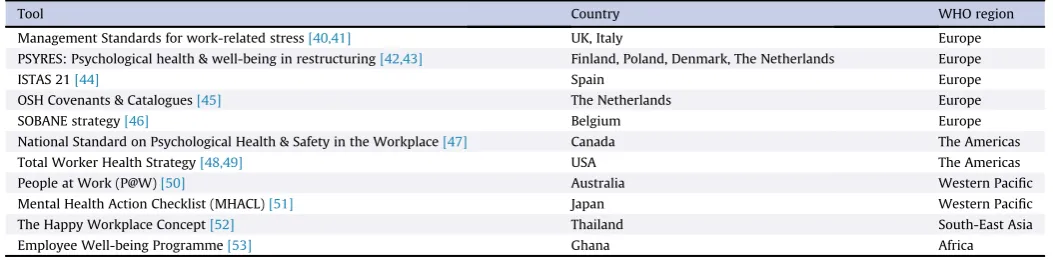
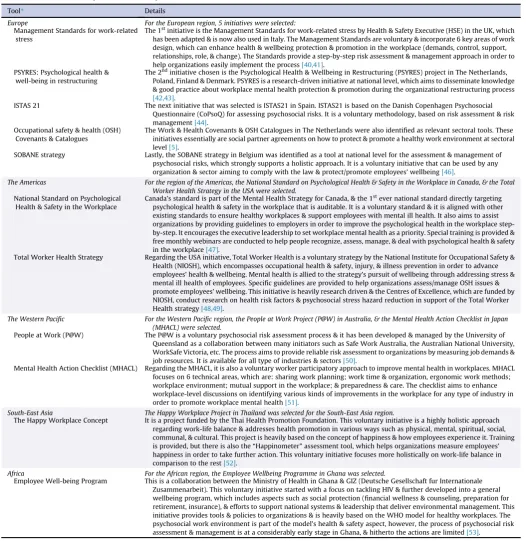
The search strategy included 20 databases, and concluded to a selection of 11 tools.Table 1represents the list of the identified tools per country and WHO region while further details on each initiative are presented inTable 2.
3.2. Interviews
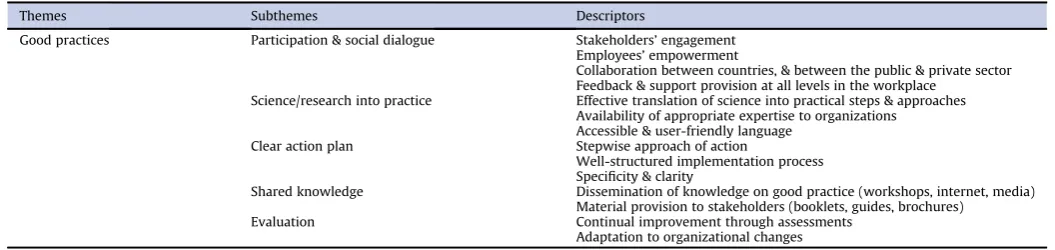
The thematic analysis highlighted four basic themes: (1) good practices for WMHP at national level; (2) responsibility for WMHP; (3) barriers; and (4) potentials for successful implementation. The themes consisting of subthemes and including their descriptors are presented inTables 3e6.
3.2.1. Good practices
The first subtheme, which is about participation and social dialogue for all the stakeholders, was prevalent among all partici-pants. These actions incorporate the full engagement of all,“safety and health [experts], labor [employees], and representatives of la-bor, management of all level... put them all together in the same room and say we are all after the same main point”(M3, USA),“a cross-sectional engagement”(M4, Canada). Employees’ empower-ment has been agreed as a vital eleempower-ment for success,“take their role in the company”(F4, The Netherlands);“top management [has to] give feedback... and [people need] to show empathy to each other” (M1, Japan).
The science/research into practice subtheme was agreed as a matter that raises difficulties, but as the only pathway to successful implementation.“Yes [organizations] may expect your [approach] to be based on a good psychological theory, but it is the application of that theory in the real world... and you have to be careful with terminology as stress is not [easily] recognizable [and understood]” (M1, UK). Correct understanding of science can be a challenge for organizations; misunderstanding leads to “missing information” (M3, Belgium). Scientific knowledge needs to be presented in an apt way without losing value;“have one‘leg’in science/knowledge and the other one in practice... knowledge activism”(M3, Spain).
A clear action plan includes elements such as“a development circle”(M1, UK),“careful planning”(F2, Australia) to avoid wasting money and the need for full awareness of the problem in order to choose actions that“meet the identified needs”(M4, Canada). It is helpful to focus on“a general methodology to be able to meet the majority of population”(M3, Spain), but“being specific”to solu-tions and“never transferring”solutions is dramatically significant (F4, The Netherlands). Tools need to be“tailored by sector”(M3, Italy).
“Continual improvement” and adaptation through evaluation have been outlined as important elements. When“a rational plan” does not work (F4, The Netherlands), adaptation is the way to so-lutions (M3, USA). All of the tools incorporate plans and actions of evaluation aiming at sustainability. Three out of 11 tools are going to be evaluated with all the rest having been already fully or partially evaluated including either formal or informal evaluations.
3.2.2. Responsibility
This theme was supported by three subthemes: current trends, drivers, and impact (Table 4). With respect to current trends, there was an agreement that “the emphasis has changed from organi-zational responsibility to individual responsibility”(M1, UK). The message currently coming out from many governments and orga-nizations is that“individuals have the responsibility for their own mental health and they need to be more resilient” (M3, USA). Moreover, there is also the issue of“MH seen as a peripheral issue” (F3, The Netherlands) for organizations that“do not see why they
should be doing it”(M1, UK) and do not understand the high impact of primary prevention.
Drivers for WMHP mainly included the need of organizations to find ways to comply with the law as part of their social re-sponsibility, but also tackle the persistent numbers of work-related injuries and illness. “Legal obligation... led companies to invest more in the prevention of workers’mental health”(M3, Italy). Or-ganizations will seek tools in order to “meet the needs” for a particular sector rather than doing“philanthropy” (M1, Ghana); “decline in productivity”(M3, Italy) creates a need for actions that will decrease the number of work-related illness and injuries.
The impact of organizational responsibility for WMHP has been stressed as more important concerning prevention and the level of success than individual responsibility; “it is OK to think about health risk assessment and what are the individual challenges”, but the responsibility should“not start from there”(M3, Belgium). The organizational environment will affect “every single employee, whether they know it or not, whether they have a health condition or not, and it is those organizational changes that have the greatest opportunity for primary prevention”(M3, USA).
3.2.3. Barriers
The theme of barriers was based on responses in relation to difficulties in developing and implementing WMHP tools. There-fore, all the answers referring to obstacles, resistance, difficulties, and constraints were coded positive for this theme (Table 5). The subthemes, which support this theme, are: knowledge deficiency; financial constraints; cultural gaps; time pressure; and fear.
Knowledge deficiency was supported by the fact that many middle managers have a lot of responsibilities, but they are not “best qualified to deliver”and this“blocks good practice”(M1, UK) because“low level of awareness of the impact of employees’mental illness is the main barrier”(M3, Italy). Peoplefinish their education, but they“have never heard about OSH prevention”(M3, Belgium). Financial constraints were illustrated through the burden of “upfront investments” (M3, USA), the financial prerequisite of continual improvement and the shift towards constant cost reduction without any added productivity value. There was a consensus on the fact that“insufficient investment”has an impact on processes and makes implementation“less successful”(F4, The Netherlands). In particular, when“there is not much money and the [financial] crisis is present”, organizations will“not put money [on evaluation]”(F2, Finland) and“every time there is afinancial crisis... [WMHP] is the first to be cut, because organizations are not [obliged] to do it”(M1, Ghana).
[image:4.595.30.557.85.215.2]Cultural gaps include barriers such as immature organizational cultures that lack the right mentality and background to engage in WMHP. For example, in some organizations“there is some form of hierarchy in getting things done”(M1, UK), and“workers do not Table 1
Tool per country and World Health Organization (WHO) region
Tool Country WHO region
Management Standards for work-related stress[40,41] UK, Italy Europe
PSYRES: Psychological health & well-being in restructuring[42,43] Finland, Poland, Denmark, The Netherlands Europe
ISTAS 21[44] Spain Europe
OSH Covenants & Catalogues[45] The Netherlands Europe
SOBANE strategy[46] Belgium Europe
National Standard on Psychological Health & Safety in the Workplace[47] Canada The Americas
Total Worker Health Strategy[48,49] USA The Americas
People at Work (P@W)[50] Australia Western Pacific
Mental Health Action Checklist (MHACL)[51] Japan Western Pacific
The Happy Workplace Concept[52] Thailand South-East Asia
Employee Well-being Programme[53] Ghana Africa
talk free... there is an imbalance of power...so tailoristic and authoritarian [organizational culture]”(M3, Spain).
Time pressure and fear were reported to impact on WMHP implementation. With respect to time, benefits for mental health may take years to be seen in an organization and this is very “challenging”for them (M1, Japan) because OSH specialists cannot “solve all the problems in 1 day or 2 days”(M3, Belgium). Changes need time and organizations often want overnight solutions to their
problems. Despite companies’preference for“quickfixes”(M1, UK), successful outcomes come only with consistent “repetition” and work in the long term (F4, The Netherlands).
[image:5.595.41.568.81.623.2]Fear of “unemployment and precariousness” makes people afraid of talking about work and mental health related issues and leads employees to accept bad working conditions and employers not to take care of WMH (M3, Spain).“A lot of people, including employers, are a bit afraid of it [mental illness and its Table 2
Holistic tools relevant to workplace mental health promotion
Tool* Details
Europe For the European region, 5 initiatives were selected:
Management Standards for work-related stress
The 1stinitiative is the Management Standards for work-related stress by Health & Safety Executive (HSE) in the UK, which has been adapted & is now also used in Italy. The Management Standards are voluntary & incorporate 6 key areas of work design, which can enhance health & wellbeing protection & promotion in the workplace (demands, control, support, relationships, role, & change). The Standards provide a step-by-step risk assessment & management approach in order to help organizations easily implement the process[40,41].
PSYRES: Psychological health & well-being in restructuring
The 2ndinitiative chosen is the Psychological Health & Wellbeing in Restructuring (PSYRES) project in The Netherlands, Poland, Finland & Denmark. PSYRES is a research-driven initiative at national level, which aims to disseminate knowledge & good practice about workplace mental health protection & promotion during the organizational restructuring process
[42,43].
ISTAS 21 The next initiative that was selected is ISTAS21 in Spain. ISTAS21 is based on the Danish Copenhagen Psychosocial Questionnaire (CoPsoQ) for assessing psychosocial risks. It is a voluntary methodology, based on risk assessment & risk management[44].
Occupational safety & health (OSH) Covenants & Catalogues
The Work & Health Covenants & OSH Catalogues in The Netherlands were also identified as relevant sectoral tools. These initiatives essentially are social partner agreements on how to protect & promote a healthy work environment at sectoral level[5].
SOBANE strategy Lastly, the SOBANE strategy in Belgium was identified as a tool at national level for the assessment & management of psychosocial risks, which strongly supports a holistic approach. It is a voluntary initiative that can be used by any organization & sector aiming to comply with the law & protect/promote employees’wellbeing[46].
The Americas For the region of the Americas, the National Standard on Psychological Health & Safety in the Workplace in Canada, & the Total Worker Health Strategy in the USA were selected.
National Standard on Psychological Health & Safety in the Workplace
Canada’s standard is part of the Mental Health Strategy for Canada, & the 1stever national standard directly targeting psychological health & safety in the workplace that is auditable. It is a voluntary standard & it is aligned with other existing standards to ensure healthy workplaces & support employees with mental ill health. It also aims to assist organizations by providing guidelines to employers in order to improve the psychological health in the workplace step-by-step. It encourages the executive leadership to set workplace mental health as a priority. Special training is provided & free monthly webinars are conducted to help people recognize, assess, manage, & deal with psychological health & safety in the workplace[47].
Total Worker Health Strategy Regarding the USA initiative, Total Worker Health is a voluntary strategy by the National Institute for Occupational Safety & Health (NIOSH), which encompasses occupational health & safety, injury, & illness prevention in order to advance employees’health & wellbeing. Mental health is allied to the strategy’s pursuit of wellbeing through addressing stress & mental ill health of employees. Specific guidelines are provided to help organizations assess/manage OSH issues & promote employees’wellbeing. This initiative is heavily research driven & the Centres of Excellence, which are funded by NIOSH, conduct research on health risk factors & psychosocial stress hazard reduction in support of the Total Worker Health strategy[48,49].
The Western Pacific For the Western Pacific region, the People at Work Project (P@W) in Australia, & the Mental Health Action Checklist in Japan (MHACL) were selected.
People at Work (P@W) The P@W is a voluntary psychosocial risk assessment process & it has been developed & managed by the University of Queensland as a collaboration between many initiators such as Safe Work Australia, the Australian National University, WorkSafe Victoria, etc. The process aims to provide reliable risk assessment to organizations by measuring job demands & job resources. It is available for all type of industries & sectors[50].
Mental Health Action Checklist (MHACL) Regarding the MHACL, it is also a voluntary worker participatory approach to improve mental health in workplaces. MHACL focuses on 6 technical areas, which are: sharing work planning; work time & organization, ergonomic work methods; workplace environment; mutual support in the workplace; & preparedness & care. The checklist aims to enhance workplace-level discussions on identifying various kinds of improvements in the workplace for any type of industry in order to promote workplace mental health[51].
South-East Asia The Happy Workplace Project in Thailand was selected for the South-East Asia region.
The Happy Workplace Concept It is a project funded by the Thai Health Promotion Foundation. This voluntary initiative is a highly holistic approach regarding work-life balance & addresses health promotion in various ways such as physical, mental, spiritual, social, communal, & cultural. This project is heavily based on the concept of happiness & how employees experience it. Training is provided, but there is also the“Happinometer”assessment tool, which helps organizations measure employees’ happiness in order to take further action. This voluntary initiative focuses more holistically on work-life balance in comparison to the rest[52].
Africa For the African region, the Employee Wellbeing Programme in Ghana was selected.
Employee Well-being Program This is a collaboration between the Ministry of Health in Ghana & GIZ (Deutsche Gesellschaft fur Internationale Zusammenarbeit). This voluntary initiative started with a focus on tackling HIV & further developed into a general wellbeing program, which includes aspects such as social protection (financial wellness & counseling, preparation for retirement, insurance), & efforts to support national systems & leadership that deliver environmental management. This initiative provides tools & policies to organizations & is heavily based on the WHO model for healthy workplaces. The psychosocial work environment is part of the model’s health & safety aspect, however, the process of psychosocial risk assessment & management is at a considerably early stage in Ghana, & hitherto the actions are limited[53].
*For the Eastern Mediterranean WHO region no initiative or tool at national level for Workplace Mental Health Promotion was identified, therefore no further actions could be taken in order to explore any possible development or implementation.
consequences]... that they prefer to get rid of those people instead of doing something to make them better” (F2, The Netherlands). Employers are scared that if they start with risk assessment and management, this might “open a can of worms” (F2, Australia), which will lead to time and money loss.
3.2.4. Potentials for future success
The theme of potentials for future success includes informing policies/legislation, working for better evidence, educating people on psychosocial risk identification, and applying a holistic approach (Table 6).
Policies/legislation have a huge impact on how organizations act towards WMHP and there was a common view that mental health can be protected and promoted only if “policies are informed” (M1, UK). WMH needs to be supported by legislation because or-ganizations, in their majority, take actions due to legal pressures rather than personal choice (M1, Japan) and“it is disappointing that 40e50 years after the good work agenda [in the UK], we are still trying to propagate basic messages to organizations”(M1, UK). It would be very supportive for WMHP initiatives if“the labor in-spection could include psychosocial [risks], not only physical... it could influence people... because [it] has great prestige and power” (F3, Poland). If the labor inspection becomes more active and in-cludes psychosocial risks, WMHP will be easily identified, under-stood, and dealt with.
Constant“monitoring”(F2, Thailand) of the processes is the only way to achieve a better evidence base and convince organizations that there are practical reasons to take preventive actions. There is a need“tofind the link between economic benefit for the company and prevention”(M3, Belgium) and“cost-effectiveness”(M4, Can-ada). If there is clear evidence and understanding about“economic internal investment andfinancial benefits... this will put programs in place” (M3, Belgium). There are “missed opportunities by swinging between the responsibilities of employers and employees rather than working more holistically” (M1, UK). A holistic approach is vital because“when you try tofind the problem, the causes of the psychosocial problems are not often only psychosocial aspects”(M3, Belgium).
Table 5 Barriers theme
Themes Subthemes Descriptors
Barriers Knowledge deficiency Lack of knowledge amongst managers, professionals, workers
Nonscientific approaches Inaccurate use of data Financial constraints Upfront investment
Continual improvement needs investment Cost reduction
Cultural gaps More difficulties for small & medium-sized enterprises
Difficult to communicate mental health issues Mature versus immature cultures
The impact of unwritten rules Time pressure Organizations prefer quickfixes
Results/changes need time Fear Afraid employers
(time & money loss, business failure) Afraid employees
(precariousness, lack of opportunities)
Table 6 Potentials theme
Themes Subthemes Descriptors
Potentials Policies/legislation Inform & update policies on workplace mental health
Need for proper legislation Active labor inspection
Preventive actions are more effective than reactive actions
Better evidence Clear short- & long-term cost-benefit relation Constant monitoring at all levels
Educate people Training for all stakeholders in the workplace Education on psychosocial risk identification National & international dissemination of
good practice
Holistic approach Both organizational culture & community needs to promote mental health Direct & indirect actions
[image:6.595.29.557.84.209.2]Multidisciplinary approach & multilevel integration
Table 3
Good practices theme
Themes Subthemes Descriptors
Good practices Participation & social dialogue Stakeholders’engagement Employees’empowerment
Collaboration between countries, & between the public & private sector Feedback & support provision at all levels in the workplace
Science/research into practice Effective translation of science into practical steps & approaches Availability of appropriate expertise to organizations
Accessible & user-friendly language Clear action plan Stepwise approach of action
Well-structured implementation process Specificity & clarity
Shared knowledge Dissemination of knowledge on good practice (workshops, internet, media) Material provision to stakeholders (booklets, guides, brochures)
[image:6.595.41.554.252.329.2]Evaluation Continual improvement through assessments Adaptation to organizational changes
Table 4
Responsibility for workplace mental health theme
Themes Subthemes Descriptors
Responsibility for workplace mental health Current trends Mental health as a peripheral rather than a central issue Shift from organizational responsibility to individual responsibility Organizational responsibility works better for easily measurable problems
Drivers Legislation
Numbers of work-related injuries & illnesses Impact Organizational responsibility has a bigger effect
Individual responsibility is not enough
4. Discussion
4.1. Whose responsibility?
This paper aimed to shed further light in the area of WMHP by investigating key approaches that have been introduced in several countries to promote mental health in the workplace. On the basis of interviews with experts, it aimed to provide recommendations on key elements of good practice and key challenges that need to be tackled by appropriate policies and stakeholder actions.
Many participants agreed on the fact that there is a mentality across organizations that mental health is a personal problem and individuals have tofind a way out of it. Even if organizations take some actions, they are usually reactive such as counseling and training provision to make individualsstrongerand more resilient. This mentality is held not only by organizations, but also by governments. This creates many challenges for seeing success in the domain of WMHP. However, it was argued that since the impact of poor mental health is already known, governments and organizations would inevitably end up shifting their viewpoints towards prevention. OSH legislation can be a powerful motivator where it exists[4,21]. However, since legal frameworks are lack-ing in many countries, this is not enough [54]. Hard data and evidence of the impact of poor mental health are currently the only overriding reason that triggers organizations to consider their organizational responsibility in this area from the perspec-tive of prevention. There is a need for evidence-based policy making and the promotion of a multilevel intervention frame-work on the basis of a strong evidence base to drive progress in this area[15,54].
4.2. In line with the WHO GPA and MHWfive keys
Regarding the GPA and thefive keys for healthy workplaces, four out of thefive GPA objectives have been discussed through the initiatives (devise and incorporate policies, protect/promote health, provide evidence) and allfive keys of MHW have been covered. The study evaluated how the 11 tools support organiza-tions to accomplish thefive keys of the MWH in order to meet GPA’s objectives. The objectives were met by all initiatives. However, some initiatives illustrated a better and stronger sup-port of the objectives contrary to others. All of them were devel-oped in order to protect and promote employees’health, mental health, and wellbeing. One of the key drivers, apart from compliance with the law, was the goal to eradicate the incidents of work-related injuries and illnesses from both a physical and mental perspective[6,55].
The objectives on devising and incorporating workers’health into other policies (the 1stand the 5thobjective of the GPA), espe-cially for mental health, were covered by thefindings on oppor-tunities for the identified tools. Stakeholder consensus on the need for more effective WMHP policies highlights the importance to inform and reform current policies [15]. There are policies and legislation for OSH prevention, but not all countries have legislation directed to WMHP. It was evident that European countries have more policies for employees’mental health [8,56]. Interestingly, even for the countries with a hitherto strong background in this area, difficulties were reported regarding the implementation of initiatives because organizations are not yet fully aware and educated on psychosocial risk assessment[23].
The GPA objective on the protection and promotion of workers’ health (the 2ndobjective) through primary prevention of occupa-tional hazards, including psychosocial hazards, was supported by thefindings on good WMHP practices, which include employee participation/social dialogue. Engagement of all stakeholders is a
vital part of success, which pertains to the first two keys of the MHW; the first key represents leadership commitment and engagement, the second key represents workers and their repre-sentatives’ involvement. All levels in a working environment include top management, employees, employers, representatives of all stakeholders, OSH specialists, and collaboration between in-dustries, sectors, and countries [3,19,24,25]. In particular, social dialogue and communication between all stakeholders are a sub-stantial basis for effective implementation and improvement in the workplace. Employee empowerment in order to bridge the power gap between employers and employees was reported to be a cen-tral part of success. Charismatic leadership that empowers people though appreciation, showing trust, giving responsibilities, and providing feedback and support is a great strength for organiza-tions and WMHP effectiveness[20,21,57e59].
Business ethics and legality (third key) were supported by or-ganizations that had to comply with the law atfirst and then move on to the next step, which was to find ways to a successful implementation. The fact that psychosocial risks are not easily identified and measured was the main reason why organizations fail to see great results. People need to know what psychosocial risk means in order to deal with it. Lack of awareness and an appropriate policy framework allow organizations to superficially comply with OSH law but not seeing results with respect to mental health[3,26].
All the good practices work in a parallel way with the fourth key for healthy workplaces of the MHW. The initiatives unani-mously incorporate and support the element of systematic, comprehensive process to ensure effectiveness and continual improvement through numerous actions as the only way to suc-cess for WMHP. All of the participants, regardless of the initiative’s current evaluation status, have agreed on the importance of continual improvement through understanding suitable or less suitable practices and sustaining a systematic evaluation process [6,55,60]. Sustainability and integration in a multilevel way implying the application of a holistic approach is in line with the fifth key of the MHW. Multilevel integration represents proposed changes not only through single interventions in the workplace, but a broader approach to changes: integrating an appropriate mentality, with tasks, roles, approaches, and solutions[3,21]. A multidisciplinary holistic approach was identified as a robust so-lution for successful implementation. It has been understood that there are current efforts for a holistic approach and multilevel integration; looking at issues from many perspectives and different viewpoints does help in understanding not only eco-nomic aspects, but also cultural, personal, psychological, health, and productivity aspects and their connection [25,61]. It was common that cultures with a collectivistic mentality, such as Ghana, Japan, and Thailand embraced a community approach, mindfulness, and spirituality more heavily with respect to mental health than individualistic ones, which tend to have a business-oriented understanding. Attention to the values of family, com-munity, and spiritual self was more discernible through collec-tivism [62e66]. However, the implementation of a holistic
approach is still in progress in all countries covered.
4.3. In line with the WHO CMHAP
The third objective prompts mental health promotion through the implementation of multisectoral strategies at national level. All the identified initiatives are multisectoral workplace strategies at na-tional level as pointed by the CMHAP. The fourth objective focuses on strengthening the evidence and research for mental health, which is part of the findings on potentials of this study. This objective aims to the collection and report of mental health in-dicators every 2 years, which could potentially be facilitated by a consistent monitoring process within organizations[6].
Taking a closer look at the initiatives and their link to CMHAP, the Management Standards for work-related stress are based on psychosocial risk assessment to identify the cause and gather evi-dence (4th objective), implement prevention (3rdobjective), and inform/engage stakeholders (1st objective). Psychological Health and Wellbeing in Restructuring (PSYRES) was research driven and aimed to gain insight and identify effective preventive actions for psychological wellbeing during restructuring (4th objective) and inform/engage/empower stakeholders (1st objective). The OSH Covenants/Catalogues are risk management projects to identify causes, gather evidence (4thobjective), implement prevention (3rd objective), and engage all stakeholders in order to improve lead-ership for a healthy workplace (1st objective). ISTAS21 is a psy-chological risk assessment questionnaire aiming to identify risks and prevent (3rdobjective), inform and share evidence (4th objec-tive), and motivate/engage stakeholders (1st objective). SOBANE strategy is an occupational risk management tool including psy-chosocial risks, which aims to identify the problem by using evi-dence (4thobjective), suggest preventive and/or treatment actions (3rd objective), and empower stakeholders in order to improve leadership for WMH (1st objective). The Canadian Standard is a systematic process to create psychologically safe workplaces by identifying and tackling psychosocial hazards (3rdand 4th objec-tives) and supporting the leadership by informing/motivating/ engaging the people involved (1stobjective). Total Worker Health focuses on psychosocial stress hazard reduction approaches (3rd objective), evidence provision (4thobjective), and dissemination of knowledge in order to strengthen awareness and leadership for workplace wellbeing (1st objective). From a similar perspective, People at Work (P@W) and Mental Health Action Checklist (MHACL) work on the basis of psychosocial risk identification and management aiming to share knowledge, inform and engage all stakeholders and leadership (1st, 3rd, and 4thobjectives). The Happy Workplace (met all 3 objectives) and the Employee Wellbeing Program (met 1st and 3rdobjectives) aim to improve employees’ wellbeing through various strategies, but without a clear-cut reference to psychosocial risks. In particular, the Employee Well-being Program is at a very early stage regarding WMHP and psy-chosocial risk management[6].
4.4. Constraints and opportunities
There are some differences in terms of the life cycle of the examined tools. For example, PSYRES, OSH Covenants, and the Management Standards have now stopped the process of continual improvement contrary to Canada’s Standard, SOBANE, P@W, MHACL, Total Worker Health Strategy, Promotion of Wellbeing Program, ISTAS 21, OSH Catalogues and the Happy Workplace Concept. Even though organizations do seek advanced tools and improvement, it has been noted that the economic climate and recessions affect the continuation of actions[67,68].
Knowledge deficiency is a great problem not only because companies cannot identify the reasons behind poor mental health in their work environment, but they also cannot easily transform shared knowledge into effective practice[15,22]. Therefore, there is a great need to act in a two-way direction by educating people
about mental health/psychosocial risks and making science and good practice understandable to the wider audience[22,69]. With respect to cultural gaps, it is difficult to control differences between organizational cultures. Mature larger organizations with better awareness on mental health in the workplace accept and use tools more easily, but it is more difficult to implement them fully. This is in contrast with smaller organizations that are more difficult to penetrate, but easier to integrate fully. The solution is to be as specific as possible based on the given situation and context[70].
Fear was another constraint, especially in countries that are more affected by recessions. Employees are afraid of losing their job and having minimal opportunities, which make them accept any working conditions without any resistance. In this case, employers might choose not to integrate WMHP fully and avoid time and money expenditure, especially if there is no legislation forcing them to explicitly take actions[67]. There is also a gray area where OSH law exists, but evidently mental health is the missing bit. Participants interestingly suggested that this lacuna can be over-come with the use of labor inspection that includes psychosocial risk factors[21,22], although this is far from reality in most coun-tries around the world.
4.5. Limitations and strengths of the study
The main limitation of the study is its selective, qualitative, and interpretative nature of it, which does not allow further general-izations. In addition, lack of tool availability led to an unequal number of experts for each WHO region, which may have affected evaluation due to cultural differences. Nevertheless, the tools were selected based on clear inclusion criteria across WHO regions (with the exception of the Eastern Mediterranean where no suit-able tools were identified). Despite cultural differences, there clearly are similarities as concerns good practices, responsibilities, barriers, and opportunities, which also give credibility to the findings. Lastly, all the participants are highly knowledgeable ex-perts with many years of experience in OSH and mental health in the workplace.
4.6. Conclusion
Thefindings of this study indicate that there is a lack of coor-dinated preventive action for WMHP. There is an urgent need for education, which will enable all stakeholders to understand the impact and cost of poor mental health. Findings suggest that a holistic approach for WMHP combined with informed legislation and active labor inspection is the best plan of action at national level for future success.
Practices, which comply with the WHOfive keys for healthy workplaces, such as engagement of all stakeholders, social dia-logue, proper translation of science into tangible practice, dissemination of good practices, and continual improvement are acknowledged to be effective ways to promote mental health in the workplace. Nonetheless there is a lot of space for improve-ment. One very significant potential for improvement is the ho-listic approach that fully incorporates psychosocial aspects and explores possible psychosocial risks in the workplace. Future research should identify and evaluate such holistic approaches across all WHO regions in order to map available expertise globally.
Conflicts of interest
Acknowledgments
The authors would like to thank Dr Evelyn Kortum and Dr Taghi Yasamy (World Health Organization Headquarters) for their assis-tance and support during this study.
References
[1] World Health Organization, Constitution of the World Health Organizatione
Basic Documents, Forty-fifth edition, Supplement, October 2006 [Internet]. Available from:http://www.who.int/governance/eb/who_constitution_en.pdf.
[2] Prince M, Patel V, Saxena S, Maj M, Maselko J, Phillips MR, Rahman A. No
health without mental health. Lancet 2007;370:859e77.
[3] World Health Organization. Healthy workplaces: a model for action: for
em-ployers, workers, policy-makers and practitioners. Geneva (Switzerland):
World Health Organization; 2010.
[4] World Health Organization. Mental health policies and programmes in the
workplace. Geneva (Switzerland): World Health Organization; 2005.
[5] European Agency for Safety and Health at Work (EU-OSHA). Mental health
promotion in the workplace: a good practice report. Luxemburg (Luxemburg):
EU-OSHA; 2011.
[6] World Health Organization. Comprehensive mental health action plan 2013e
2020. Sixty Sixth World Health assembly. Geneva (Switzerland): World Health
Organization; 2013.
[7] Marmot M, Wilkinson R. Social determinants of health. Oxford (UK): Oxford
University Press; 2009.
[8] Leka S, Cox T. The European Framework for Psychosocial Risk Management.
PRIMA-EF: a resource for employers and worker representatives. Geneva
(Switzerland): World Health Organization; 2008.
[9] Organisation for Economic Co-operation and Development. Average annual hours worked per worker [Internet]. 2012 [cited 2013 Jul 24]. Available from:
http://stats.oecd.org/Index.aspx?DatasetCode¼ANHRS.
[10] World Health Organization. Mental health: strengthening our response. Fact Sheet No. 220. Geneva (Switzerland): World Health Organization [Internet]. Updated August 2014. Available from: http://www.who.int/mediacentre/
factsheets/.
[11] McDaid D, Curran C, Knapp M. Promoting mental well-being in the
work-place: a European policy perspective. Int Rev Psychiatry 2005;17:365e73.
[12] Mykletun A, Harvey SB. Prevention of mental disorders: a new era for
workplace mental health. Occup Environ Med 2012;69:868e9.
[13] Yasamy MT, Dua T, Harper M, Saxena S. Mental health of older adults,
addressing a growing concern. Geneva (Switzerland): World Health
Organi-zation; 2013.
[14] Patel V, Flisher A, Hetrick S, McGorry P. Mental health of young people: a
global public-health challenge. Lancet 2007;369:1302e13.
[15] Langenhan MK, Leka S, Jain A. Psychosocial risks: is risk management strategic
enough in business and policy making? Saf Health Work 2013;4:87e94.
[16] Leka S, Jain A, Iavicoli S, Vartia M, Ertel M. The role of policy for the
man-agement of psychosocial risks at the workplace in the European Union. Saf Sci
2011;49:558e64.
[17] Cox T, Leka S, Ivanov I, Kortum E. Work, employment and mental health in
Europe. Work Stress 2004;18:179e85.
[18] Mills PR, Kessler RC, Cooper J, Sullivan S. Impact of a health promotion
pro-gram on employee health risks and work productivity. Am J Health Promot
2007;22:45e53.
[19] Kirsten W, Karch RC. Global perspectives in workplace health promotion.
Sudbury (MA): Jones & Bartlett Publishers; 2011.
[20] Secker J, Membrey H. Promoting mental health through employment and
developing healthy workplaces: the potential of natural supports at work.
Health Educ Res 2003;18:207e15.
[21] Western Pacific Regional Office (WHO). A training manual for health workers on healthy lifestyle [Internet]. 2009 [cited 2013 Aug 4]. Available from:http:// www.wpro.who.int/philippines/publications/trainers_guide_healthy_
lifestyle/en/index.html.
[22] European Agency for Safety and Health at Work (EU-OSHA). Drivers and
barriers for psychosocial risk management: an analysis of thefindings of the
European survey of enterprises on new and emerging risks (ESENER).
Lux-emburg (LuxLux-emburg): EU-OSHA; 2012.
[23] Leka S, Jain A. Health impact of psychosocial hazards at work: an overview.
Geneva (Switzerland): World Health Organization; 2010.
[24] Grawitch MJ, Trares S, Kohler JM. Healthy workplace practices and employee
outcomes. Int J Stress Manage 2007;14:275e93.
[25] Kelloway EK, Day AL. Building healthy workplaces: what we know so far. Can J
Behav Sci 2005;37:223e35.
[26] Robichaux C, Parsons M. An ethical framework for developing and sustaining
a healthy workplace. Crit Care Nurs Q 2009;32:199e207.
[27] Berkhout F, Hertin J, Gann DM. Learning to adapt: organisational adaptation to
climate change impacts. Clim Change 2006;78:135e56.
[28] Grawitch MJ, Gottschalk M, Munz DC. The path to a healthy workplace: a
critical review linking healthy workplace practices, employee well-being, and
organizational improvements. Consult Psychol J Pract Res 2006;58:129e47.
[29] Leka S, Jain A. Work-related stress: identifying global actions and future
needs. Geneva (Switzerland): International Labour Organization; 2015 in
press.
[30] Goodman LA.“Snowball sampling”. Ann Math Stat 1961;32:148e70.
[31] Bryman A. Social research methods. Oxford (UK): Oxford University Press;
2012.
[32] Levy Y, Ellis TJ. A systems approach to conduct an effective literature review in
support of information systems research. Informing Sci 2006;9:181e212.
[33] The British Psychological Society. Code of ethics and conduct: guidance
published by the ethics committee of the British Psychological Society.
Leicester (UK): British Psychological Society; 2009.
[34] Braun V, Clarke V. Using thematic analysis in psychology. Qual Res Psychol
2006;3:77e101.
[35] Madill A, Jordan A, Shirley C. Objectivity and reliability in qualitative analysis:
realist, contextualist and radical constructionist epistemologies. Br J Psychol
2000;91:1e20.
[36] Boyatzis R. Transforming qualitative information. Cleveland (OH): Sage; 1998.
[37] Mason J. Qualitative researching. London (UK): Sage; 2002.
[38] Saldana J. The coding manual for qualitative researchers. London (UK): Sage;
2009.
[39] Ryan GW, Bernard HR. Techniques to identify themes. Field Meth 2003;15:
85e109.
[40] Kerr R, McHugh M, McCrory M. HSE Management Standards and
stress-related work outcomes. Occup Med 2009;59:574e9.
[41] Health and Safety Executive. Managing the causes of work-related stress: a
step-by-step approach using the Management Standards. London (UK): HSE; 2007.
[42] European Agency for Safety and Health at Work (EU-OSHA). PSYRES: psy-chological health and well-being in restructuring: key effects and mechanisms [Internet]. 2008 [cited 2013 Jul 10]. Available from:https://osha.europa.eu/ sub/newoshera/en/noe-research-programme/project-abstracts/psyres-
psychological-health-and-well-being-in-restructuring-key-effects-and-mechanisms.
[43] Wiezer N, Nielsen K, Pahkin K, Widerszal-Bazyl M, de Jong T,
Mattila-Holappa P, Mockałło Z. Exploring the link between restructuring and employee well-being. Warsaw (Poland): Central Institute for Labour
Protec-tion - NaProtec-tional Research Institute; 2011.
[44] European Agency for Safety and Health at Work (EU-OSHA). ISTAS 21 Method-ology (CoPsoQ) [Internet]. 2002 [cited 2013 June 10]. Available from:https://
osha.europa.eu/data/risk-assessment-links/istas-21-methodology-copsoq.
[45] Bakhuys Roozeboom M, Shire P, Hooftman W, Houtman I, Klein Hesselink J,
Arbobalans. Quality of work, effects and measures in The Netherlands.
Hoofddorp (NL): TNO Work and Employment; 2008.
[46] Malchaire J, Piette A. The SOBANE strategy for the management of risk, as applied
to whole-body or handearm vibration. Ann Occup Hyg 2006;50:411e6.
[47] Mental Health Commission of Canada. The road to psychological safety: legal, scientific and social foundations for a national standard for psychological safety in the workplace [Internet]. 2012 [cited 2013 Aug 7]. Available from:
http://www.mentalhealthcommission.ca/.
[48] Centers for Disease Control & Prevention. NIOSH program portfolio: total worker health [Internet]. 2013 [cited 2013 Jun 12]. Available from:http://
www.cdc.gov/niosh/programs/totalworkerhealth/.
[49] Sauter SL, Murphy LR, Hurrell JJ. Prevention of work-related psychological
disorders: a national strategy proposed by the National Institute for
Occu-pational Safety and Health (NIOSH). American Psychologist 1990;45:1146e58.
[50] Workplace Health and Safety Queensland. People at Work Project [Internet]. 2013 [cited 2013 Aug 7]. Available from:https://www.worksafe.qld.gov.au/
education/articles/people-at-work-project.
[51] Yoshikawa T, Kawakami N, Kogi K, Tsutsumi A, Shimazu M, Nagami M,
Shimazu A. Development of a mental health action checklist for improving
workplace environment as means of job stress prevention. Sangyo Eiseigaku
Zasshi 2007;49:127e42.
[52] Chawsithiwong B. Happy workplace. J Soc Dev 2007;9:61e93.
[53] Deutsche Gesellschaft für Internationale Zusammenarbeit (GIZ). More than
just good business: employee wellbeing programmes in Ghana. Bonn
(Ger-many): GIZ; 2012.
[54] Kortum E, Leka S. Tackling psychosocial risks and work-related stress in
developing countries: the need for a multi-level intervention framework. Int J
Stress Manage 2014;21:7e26.
[55] World Health Organization. Workers’health: global plan of action [Internet]. 2007 [cited 2012 Jul 24]. Available from:http://www.who.int/occupational_
health/publications/global_plan/en/index.html.
[56] European Commission. European pact for mental health and well-being. In
EU-High-Level-Conference “Together for Mental Health and Well-being”.
Brussels; 2008. p. 12e3.
[57] Davydov DM, Stewart R, Ritchie K, Chaudieu I. Resilience and mental health.
Clin Psychol Rev 2010;30:479e95.
[58] Joubert N, Raeburn J. Mental health promotion: people, power and passion. Int
J Mental Health Promot 1998;(Inaugural Issue):15e22.
[59] Liden RC, Wayne SJ, Sparrowe RT. An examination of the mediating role of
psychological empowerment on the relations between the job, interpersonal
relationships, and work outcomes. J Appl Psychol 2000;85:407e16.
[60] Anand G, Ward PT, Tatikonda MV, Schilling DA. Dynamic capabilities through
continuous improvement infrastructure. J Operat Manage 2009;27:444e61.
[61] Sierchio GP. A multidisciplinary approach for improving outcomes. J Infus
[62] Morling B, Lamoreaux M. Measuring culture outside the head: a meta-analysis of individualismdcollectivism in cultural products. Pers Soc Psychol Rev
2008;12:199e221.
[63] Koenig HG. Research on religion, spirituality, and mental health: a review. Can
J Psychiatry 2009;54:283e91.
[64] Seybold KS, Hill PC. The role of religion and spirituality in mental and physical
health. Curr Direct Psychol Sci 2001;10:21e4.
[65] Goleman D. Meditation and consciousness: an Asian approach to mental
health. Am J Psychother 1979;30:41e54.
[66] Grossman P, Niemann L, Schmidt S, Walach H. Mindfulness-based stress
reduction and health benefits: a meta-analysis. J Psychosom Res 2004;57:35e43.
[67] Kortum E. A need to broaden our perspective to address workers’health
effectively in the 21st century. Ind Health 2012;50:71e2.
[68] Landsbergis PA, Grzywacz JG, LaMontagne AD. Work organization, job
inse-curity, and occupational health disparities. Am J Ind Med 2014;57:495e515.
[69] Czabala C, Charzynska K, Mroziak B. Psychosocial interventions in
work-place mental health promotion: an overview. Health Promot Int 2011;26:
70e84.
[70] Wong KY. Critical success factors for implementing knowledge management