C L O U D S T R I F E
marc hulsebosch
An analysis of Cloud-based Shadow IT and a framework for managing its risks and opportunities
Master of Science- Business Information Technology
Faculty of Electrical Engineering, Mathematics and Computer Science University of Twente
Marc Hulsebosch:Cloud Strife,An analysis of Cloud-based Shadow IT and a framework for managing its risks and opportunities, © February 26, 2016
supervisors:
Dr. Klaas Sikkel- University of Twente Dr. ir. Hans Moonen- University of Twente Edwin Sturrus, MSc.- KPMG
S U M M A R Y
This thesis proposes a framework for the management of unauthorized cloud computing usage, based on a risk analysis, a set of possible strategies and concrete measures.
The rise of cloud computing in the consumer domain has raised users’ ex-pectations about the types of services that organizational IT departments deliver and the speed of delivery. Many IT departments are unable to keep up with these expectations. As a result, individual employees and depart-ments choose to bring cloud services into the organization by themselves, circumventing IT. This is called Cloud-Based Shadow IT.
The use of these services may result in various risks for the organization, such as business continuity risks, unauthorized access to sensitive data, non-compliance and adverse effects on financial and operational performance. On the other hand, an employee’s legitimate desire to use these tools to im-prove the quality of their works can lead to various benefits.
No frameworks for the management of the risks and benefits of Cloud-Based Shadow IT previously existed, so this report proposes one.
The proposed framework consists of three steps that organizations should follow.
First: analyze how they are impacted by the aforementioned risks, and how they benefit from the positive effects. They should also consider what causes their employees to adopt Cloud-Based Shadow IT.
Second: choose a strategy. Coming from a state of ignoring unauthorized cloud usage, they can choose to monitor which applications are used, ac-cepting both risks and benefits. Going further, they could use blacklisting or whitelisting to select which applications can and cannot be used, balanc-ing risks and benefits.A final option is to prohibit the use of Cloud-Based Shadow IT completely.
Third, they should choose what measures they take, and how they imple-ment them, in accordance with that strategy. This report introduces mea-sures in five steps: prevention, detection, analysis, response and evaluation, and analyzes how Cloud Access Security Brokers (CASBs) and Identity&Access-Management-as-a-Service (IAMaaS)-solutions can be used in these efforts.
The framework has successfully been validated with experts. Since the frame-work takes a high level perspective of Cloud-Based Shadow IT, the main recommendations are that further research provides additional details about implementation and effectiveness of the proposed measures, that the frame-work is expanded to better cover various organization sizes, industries, ge-ographies, maturity levels and IT governance models.
AC K N O W L E D G M E N T S
This thesis marks the end of my 7.5 years as a student. Fittingly, it also took 7,5 months to write. Even though 7.5 months that is slightly longer than what is is supposed to be, I do believe that it was a smooth ride.
This is primarily thanks to the three people who have guided me: Klaas Sikkel and Hans Moonen on behalf of the University of Twente, and Edwin Sturrus on behalf of KPMG.
I am glad that Klaas and Hans agreed to be my supervisors, even before I knew exactly what I was going to do. I have heard from many other gradu-ates the importance of having supervisors that you can work well with, and who are willing to regularly go through your work both on a high level and with a fine comb. Thank you for that, and for all the previous moments we worked together!
I also grateful that Edwin agreed to be my supervisor at KPMG, where he took the time to discuss my progress at least once a week. Edwin, thank you for both leaving a lot of room for me to figure out where to go, to fail and recover, and for providing professional input in an academic field where business sets the pace.
I also thank Olga Kulikova for reading along several times, for providing a fresh view on the project and for involving me in the discussion on and with CASBs, which was very useful in writing this thesis.
I wrote this thesis as a Graduate Intern at KPMG’s Information Protection Services team. I am grateful to them for the opportunity to do so and for letting me be a part of the team by being part of a project and all of the social activities. I could not have wished for more a team of colleagues that was more passionate about what they do, more professional and capable in how they do it and more fun to work with while they do it.
Ruud Verbij, also part of that team, deserves special mention here for pointing me towards this subject and for quickly arranging meetings with Edwin and others to get me started.
I would like to thank my friends, girlfriend, roommates and family (list is not MECE) for supporting me, for sometimes asking how things were going, and for sometimes not asking how things were going.
Finally, I would like to thank the folks at Overleaf for providing me with the Cloud-based Shadow IT used to write this thesis, André Miede for saving me the work of lay-outing it, and Square Enix for the inspiration for the title and the logo.
Marc Hulsebosch
Amstelveen, February 2016
C O N T E N T S
1 introduction 1
2 background 3
2.1 Problem statement 3
3 research design 5 3.1 Research objective 5 3.2 Research questions 5 3.3 Literature review 6
4 definitions 9
4.1 Definition of Cloud Computing 9 4.2 Definition of Shadow IT 12
4.3 Definition of Cloud-Based Shadow IT 13
5 causes and effects of cloud-based shadow it 15 5.1 Causes 15
5.2 Effects 19
5.3 Chapter Summary 27
6 methods for managing cloud-based shadow it 29 6.1 Prevention 30
6.2 Detection 33 6.3 Analysis 34 6.4 Response 36 6.5 Evaluation 37
6.6 Commercial products 38 6.7 Chapter Summary 41
7 strategies regarding cloud-based shadow it 43 7.1 Ignoring 43
7.2 Monitoring 44 7.3 Blacklisting 46 7.4 Whitelisting 49 7.5 Prohibiting 51 7.6 Chapter Summary 51
8 validation 53
8.1 Interview 1 - CASB Provider 53
8.2 Interview 2 - Professional services firm 54 8.3 Interview 3 - Municipality 55
8.4 Interview 4 - Construction conglomerate 56 8.5 Summary and discussion 58
viii contents
9 conclusion 61
9.1 Causes and Effects 61 9.2 Measures 62
9.3 Strategies 63
9.4 Answering the main research question 63 9.5 Validation 64
10 discussion 65
10.1 Contributions to science 65 10.2 Contributions to practice 65 10.3 Limitations and future work 66 10.4 Personal reflection on the project 67
L I S T O F F I G U R E S
Figure 3.1 Phases, inputs and outputs of this research 7 Figure 4.1 Traditional IT and the three cloud computing
ser-vice models as defined by [46] 11
Figure 5.1 An overview of the categories of causes and effects found as an answer to Knowledge Question 1 15 Figure 6.1 The measures discussed in this chapter 30
Figure 6.2 Shadow IT portfolio plot by Zimmermann et al. [72] 36 Figure 7.1 The five strategies explained in this chapter 43 Figure 7.2 Overview of the framework 44
Figure 9.1 An overview of the categories of causes and effects found as an answer to Knowledge Question 1 62 Figure 9.2 The measures discussed in chapter 6 62 Figure 9.3 The five strategies explained in chapter 7 63 Figure 9.4 Overview of the framework 64
L I S T O F TA B L E S
Table 3.1 Overview of articles found in the various phases of literature research 7
Table 5.1 Overview of causes of Shadow IT as identified in literature and interviews 19
Table 5.2 Overview of negative and positive effects of Shadow IT (SIT) as identified in literature and interviews 26 Table 6.1 Mapping of process steps to other frameworks 29 Table 6.2 Different scenario’s where control is required and
the applicable CASB integration methods. 40 Table 6.3 An overview of how both causes and effects of
Cloud-Based Shadow IT (CBSIT) are impacted by the mea-sures proposed in this chapter 42
AC R O N Y M S
s i t Shadow IT
c b s i t Cloud-Based Shadow IT
b i ta Business-IT Alignment
b y o d Bring-your-own-Device
b y o a Bring-your-own-App
s o x the Sarbanes-Oxley act
v p n Virtual Private Network
p i i Personally Identifiable Information
p c i Payment Card Information
p h i Protected Health Information
d l p Data Leakage Prevention
a p i Application Programming Interface
d n s Domain Name System
i p Internet Protocol
c a s b Cloud Access Security Broker
c d p Cloud Data Protection
c s p Cloud Service Provider
i a m a a s Identity&Access-Management-as-a-Service
s a m l Security Assertion Markup Language
c i s o Chief Information Security Officer
1
I N T R O D U C T I O N
IT departments of large enterprises have long been on the forefront of in-novation, providing the organization’s employees with technology that con-sumers sparsely had access to.
Those roles have reversed: the cutting edge of technological advances is now in the area of consumer technology, and users expect similar easy to use, turnkey solutions to be available whenever they encounter a task their current tool set doesn’t support.
Cloud computing (see section 4 for definitions) is also one of those tech-nologies used by consumers that employees expect to see in their workplace, and that they are quick to introduce if their employer doesn’t [39].
Meanwhile, the trend to buy services outside core competences, instead of providing them in-house, had already led many organizations from in-house maintenance of IT services, via outsourcing to increasingly using cloud com-puting: buying these services from Cloud Service Providers (CSPs). Still, users seem to demand functionality from the cloud that organizations do not yet offer, and thus provide it themselves.
This usage of cloud computing creates a phenomenon called Cloud-Based Shadow IT (CBSIT), where cloud technology is being fielded without the IT department knowing. Although Shadow IT (SIT) has been a concern for two decades [55], CBSITintroduces both specific challenges and opportunities. This thesis looks at the concept ofCBSIT, and how organizations should act on it.
2
B AC K G R O U N D
This section presents high-level background information in order to famil-iarize the reader with the subject matter and provide a line of reasoning towards the choice of the problem that is made explicit in the final section of this chapter. The method used to gather the materials used in writing this chapter is described in section 3.3.
As the introduction states, the rise of CBSITconfronts organizations with new challenges based on the nature of cloud computing.
One of these challenges is the ubiquity: Skyhigh Networks, a provider of tools to manage cloud basedSIT, found that many customers underestimate the number of cloud services in use by a factor of 10, with some firms using over 1.000 services according to scans [56]. One survey states that one in five users surveyed used Dropbox, a cloud storage service, at work [17].
Contrary to many traditionalSITsystems, cloud solutions do not require much setting up. Many of them are free, and paid services are often quickly procured using just a credit card. They do not require specific hard- or soft-ware and often run on various (mobile) operating systems, using the inter-net.
A short literature scan reveals thatCBSITcarries some of the same risks that traditionalSIT brought with it, but also poses new risks as it is based on cloud technology. These new risks require that organizations take new measures to control them.
In many areas, widely accepted frameworks exist to provide organizations with a structured approach to be in control of the risks that they face. Such a framework would function to show the organization’s desired state (i.e. what degree of usage and associated risk do we deem desirable/acceptable?) and that it has taken appropriate measures to match actual usage to that desired state if required.
2.1 problem statement
According to an initial literature search, reading of general publications and discussions with experts, no existing framework as described in the previous paragraphs currently coversCBSIT.
Many frameworks cover one of two topics:
• Traditional shadow IT, covering rogue hardware and software installed on devices without permission from the organization’s IT department
4 background
• Cloud computing, meaning they cover controls for procurement, roll out and management of cloud solutions through the organization’s IT department.
3
R E S E A R C H D E S I G N
This section describes the objective of this research, as well as its division in a design and a knowledge problem. This distinction comes from design science, a research paradigm [68].
3.1 research objective
The objective of this research is to help organizations to manageCBSITby designing a framework that outlines necessary steps to demonstrate control over usage of cloud computing in their organization.
This requires answering a series of knowledge questions. The first aims to get a better overview of the phenomenonCBSIT, while the last three aim to gather more information for the components of the framework.
3.2 research qestions
The main research question below paraphrases the design objective of this research into a research question. Validation of the designed artifact should result in the artifact being the answer to this question.
RQ: What is a framework that helps organizations control Cloud-Based Shadow IT?
In order to complete the design objective that is embedded in the main re-search question, it is necessary to answer three knowledge questions, stated below.
1. What are causes and effects associated with Cloud-Based Shadow IT? 2. What are measures for managing Cloud-Based Shadow IT?
3. What are strategies for managing Cloud-Based Shadow IT and how can they incorporate the measures from Question 2?
These questions are answered by performing both literature research and expert interviews.
The experts interviewed are the following:
• The former Chief Information Security Officer (CISO) for an intergov-ernmental organization [22]
• The formerCISOfor a large Dutch bank [21]
• The Information Security Officer of a professional services firm [31] • A product specialist at the Ministry of Defense [51]
6 research design
The semi-structured interviews were conducted using a short interview pro-tocol, intended to ask open ended questions in order to allow the interview to focus on areas where interviewees wanted to go in-depth.
The interviews were recorded as digital audio files if the interviewees gave consent to do so. The audio files were then partially transcribed where relevant. In the case that the interviewee did not give consent as they felt the interview might cover confidential information, transcription took place during the interview and the interviewee was given the option to review the transcript to ensure it was in accordance with their opinion and did not dis-close confidential information.
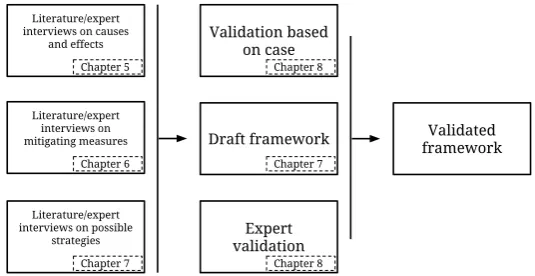
While answering the last research question in chapter 7, the answers are integrated to form the framework that answers the main research question. After the framework is created, an additional round of interviews is con-ducted with experts in order to validate the findings and the framework that was designed. These experts were explained the answers to the knowledge questions and the framework that followed from that.
The experts interviewed are:
• A Director of Sales Engineering at aCASBvendor[18]
• The Information Security Officer of a professional services firm [32] • The CISO of a Dutch municipality [13]
• The interim Information Security Officer of a construction materials conglomerate [30]
During the first two interviews, general feedback on the framework is gathered, both from the perspective of a vendor whose products aim to be a part of resolving the challenges surroundingCBSITand from the perspective of a security professional in an organization that advises clients on this topic.
The last two cases can be used to test whether the framework fits within organizations, by asking them to compare their current and desired efforts with the framework.
Any lessons learned from validation interviews and the cases are then used to improve the framework.
The whole process is summarized in figure 3.1.
3.3 literature review
3.3 literature review 7
Literature/expert interviews on causes
and effects
Literature/expert interviews on
mitigating measures Draft framework
Expert validation
Validated framework Validation based
on case
Literature/expert interviews on possible
strategies Chapter 5
Chapter 6
Chapter 7
Chapter 7 Chapter 8
[image:17.595.129.397.68.206.2]Chapter 8
Figure 3.1: Phases, inputs and outputs of this research
Phase Articles used in research
Initial search 90
Forward and backward searches 54
Other 44
Total 188
Table 3.1: Overview of articles found in the various phases of literature research
In addition to these scientific databases, queries were also performed on the general Google search engine, in order to obtain state of the art work that has not been described in scientific literature yet.
4
D E F I N I T I O N S
In order to understand the research subject at hand and in order to choose an adequate scope, definition were extracted from literature and used in the previous section. The following section provides definitions for the key con-cepts under consideration.
4.1 definition of cloud computing
The definition of cloud computing most often used is the one provided by the American National Institute for Standards and Technology (NIST):
Cloud computing is a model for enabling ubiquitous, convenient, on-demand network access to a shared pool of configurable com-puting resources (e.g., networks, servers, storage, applications, and services) that can be rapidly provisioned and released with minimal management effort or service provider interaction. NIST [46]
NIST proceeds to list five essential characteristics of cloud computing, as well as models of deployment and service models. These are described be-low, starting with the essential characteristics of a cloud computing service:
On-demand self-service
A consumer can unilaterally provision computing capabilities, such as server time and network storage, as needed automat-ically without requiring human interaction with each service provider.
Broad network access
Capabilities are available over the network and accessed through standard mechanisms that promote use by heterogeneous thin or thick client platforms (e.g., mobile phones, tablets, laptops, and workstations).
Resource pooling
The provider’s computing resources are pooled to serve multi-ple consumers using a multi-tenant model, with different phys-ical and virtual resources dynamphys-ically assigned and reassigned according to consumer demand. There is a sense of location in-dependence in that the customer generally has no control or knowledge over the exact location of the provided resources but
10 definitions
may be able to specify location at a higher level of abstraction (e.g., country, state, or data center). Examples of resources in-clude storage, processing, memory, and network bandwidth. Rapid elasticity
Capabilities can be elastically provisioned and released, in some cases automatically, to scale rapidly outward and inward com-mensurate with demand. To the consumer, the capabilities avail-able for provisioning often appear to be unlimited and can be appropriated in any quantity at any time.
Measured service
Cloud systems automatically control and optimize resource use by leveraging a metering capability at some level of abstraction appropriate to the type of service (e.g., storage, processing, band-width, and active user accounts). Resource usage can be moni-tored, controlled, and reported, providing transparency for both the provider and consumer of the utilized service.
The characteristics above describe some of the properties that are essential for a service to be considered a cloud computing service. The precise way in which these properties are implemented varies. NIST therefore provides some service and deployment models which can be used to group cloud ser-vices.
First, there are three service models. A graphical representation can be found in 4.1, and they are explained below:
Infrastructure as a Service
The capability provided to the consumer is to use the provider’s applications running on a cloud infrastructure. The applications are accessible from various client devices through either a thin client interface, such as a web browser (e.g., web-based email), or a program interface. The consumer does not manage or con-trol the underlying cloud infrastructure including network, servers, operating systems, storage, or even individual application capa-bilities, with the possible exception of limited user- specific ap-plication configuration settings.
Platform as a Service
4.1 definition of cloud computing 11 Application Data Runtime Middleware Operating System Virtualization Servers Storage Networking Application Data Runtime Middleware Operating System Virtualization Servers Storage Networking Application Data Runtime Middleware Operating System Virtualization Servers Storage Networking Application Data Runtime Middleware Operating System Virtualization Servers Storage Networking
Managed by CSP Managed by
customer
[image:21.595.129.400.71.254.2]Traditional IaaS PaaS SaaS
Figure 4.1: Traditional IT and the three cloud computing service models as defined by [46]
Software as a Service
The capability provided to the consumer is to provision process-ing, storage, networks, and other fundamental computing re-sources where the consumer is able to deploy and run arbitrary software, which can include operating systems and applications. The consumer does not manage or control the underlying cloud infrastructure but has control over operating systems, storage, and deployed applications; and possibly limited control of select networking components (e.g., host firewalls).
In practice, the distinction is less precise. For example, some CSPsprovide the stack up including an operating system, but none of the parts above.
Public cloud
The cloud infrastructure is provisioned for open use by the gen-eral public. It may be owned, managed, and operated by a busi-ness, academic, or government organization, or some combina-tion of them.It exists on the premises of the cloud provider.
Community cloud
The cloud infrastructure is provisioned for exclusive use by a specific community of consumers from organizations that have shared concerns (e.g., mission, security requirements, policy, and compliance considerations). It may be owned, managed, and op-erated by one or more of the organizations in the community, a third party, or some combination of them, and it may exist on or off premises.
12 definitions
The cloud infrastructure is provisioned for exclusive use by a single organization comprising multiple consumers (e.g., busi-ness units). It may be owned, managed, and operated by the organization, a third party, or some combination of them, and it may exist on or off premises.
In addition, companies can employ multiple cloud services linked together to form a hybrid cloud:
Hybrid cloud
The cloud infrastructure is a composition of two or more dis-tinct cloud infrastructures (private, community, or public) that remain unique entities, but are bound together by standardized or proprietary technology that enables data and application porta-bility (e.g., cloud bursting for load balancing between clouds).
4.2 definition of shadow it
With different authors writing on the subject over the years, several defini-tions of shadow IT exist. One definition is used repeatedly and covers the essence of the subject well:
Shadow IT represents all hardware, software, or any other solu-tions used by employees inside of the organizational ecosystem which have not received any formal IT department approval. Behrens [2], Gyoery et al. [25]
One caveat with the use of this definition is that it speaks of “IT department approval”, while the use of IT in many organizations is also governed by a CISO, who is often in a risk management department. This is especially rele-vant when looking at managing the risks ofCBSIT.
Shadow IT can exist in various forms. Shadow IT in the form of spreadsheets (e.g. Excel), sometimes with macros, has been around since these productiv-ity tools became common in the workplace. Going even further, business units have developed applications and client-server systems to solve their problems[18]. Shadow systems may also consist of off-the-shelf products. Cloud-services fall into this category as well.
4.3 definition of cloud-based shadow it 13
4.3 definition of cloud-based shadow it
By taking the definition of shadow IT with aforementioned modifications and referring to the definition of cloud computing, the following definition of Cloud-Based Shadow IT emerges:
Cloud-Based Shadow IT represents all cloud computing-based services used by employees inside of the organizational ecosys-tem which have not received any formal organizational approval.
5
C A U S E S A N D E F F E C T S O F C L O U D - B A S E D S H A D O W I T
The first knowledge question defined in the research design was KQ1: What are causes and effects associated with Cloud-Based Shadow IT?
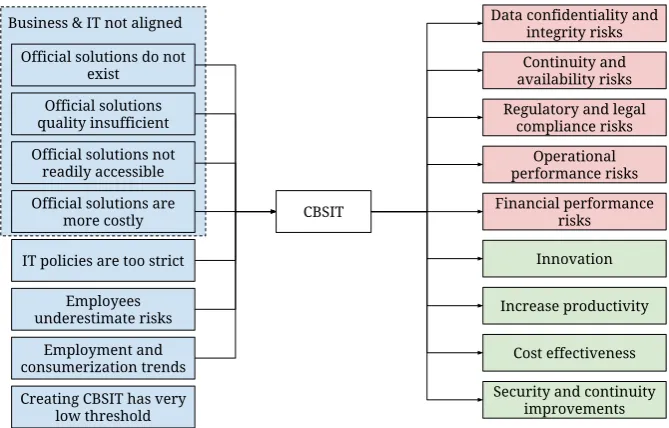
To answer this question, both literature and experts have been consulted. The sections provide an integrated overview of the outcome of these steps, and the final section provides a summary of key findings. As described in the problem statement, the rise ofCBSITintroduces new risks on top of those already posed by traditionalSIT. This section will first explore risks tradition-ally associated with SIT, discussing whether or not they apply to the same extent forCBSIT. It will then continue with an exploration of new risks, spe-cific toCBSIT. An overview of the findings is presented in figure 5.1.
As it turns out, many authors are rather brief or abstract about the causes or effects they state to be associated with shadow IT. In these cases, sources outside the literature found using the method outlined in section 3.3 were searched in order to clarify these phenomena.
5.1 causes
A reading of literature resulted in over thirty phrases that various authors use to identify causes of shadow IT. These are grouped into eight remaining
CBSIT Business & IT not aligned
Official solutions do not exist
Official solutions quality insufficient
Official solutions not readily accessible
Official solutions are more costly
IT policies are too strict
Employees underestimate risks
Employment and consumerization trends
Data confidentiality and integrity risks
Continuity and availability risks
Regulatory and legal compliance risks
Operational performance risks
Financial performance risks
Innovation
Increase productivity
Cost effectiveness
Security and continuity improvements Creating CBSIT has very
[image:25.595.97.432.474.688.2]low threshold
Figure 5.1: An overview of the categories of causes and effects found as an answer to Knowledge Question 1
16 causes and effects of cloud-based shadow it
categories. In many cases, the decision to “go rogue” is the result of a deci-sion that weighs the cost of obtaining the means to do a job through official channels (which may include the official channel having to change what it offers) with the cost of making/buying it unofficially. In other words, trans-action cost theory governs much of the Shadow IT domain [71, 14].
Lack of Business-IT-alignment
Almost all authors identify causes that boil down to employees turning to shadow IT based on the legitimate desire to do their job, and the enterprise not providing them the means to do so, implying that there is a lack of Business-IT Alignment (BITA). Several authors emphasize this classic root cause, which is found in an analysis of a wide variety of problems. King [38] points out a lack of communication between business units and IT depart-ments. Smyth and Freeman [57] find that IT departments are often focused on their internal goals, and have little incentive to focus on requests from other departments. Behrens and Sedera [3] mention that development pro-cesses are often not transparent, leading to unmatched expectations. Even when trying to provide fitting services, IT departments offering technical services often do not fulfill functional requirements from users [57, 25]. This lack of communication leads to several types of mismatches between users and the IT providers in an organization, which in turn lead to a decision whether the cost of solving this alignment problem is lower than the cost to circumvent it. The following sections are in fact instances of this phe-nomenon.
Official solutions do not exist
The first and most intuitive form where a lack of BITA causes shadow IT adoption is when official solutions do not exist in the organization where users adopt shadow IT. For example, an organization may not provide im-age manipulation tools, causing a marketing department to obtain the soft-ware themselves. Other examples would include a sales application that is not available on mobile devices that salespeople carry with them, although it could be argued that this fits in the next category.
Furthermore, when talking to IT, employees who explicitly require the usage of a cloud solution often find that their IT department is unable to support the use of that application in an official capacity, according to Mann et al. [45]. Mann et al. find that IT departments are often unable to accom-modate for the pace at which these services are developed and updated.
Even if the organization has a solution in place that would fulfill the needs of the employee, there is still a chance that employees resort to shadow IT if they don’t know it exists.
Official solutions are of insufficient qality
5.1 causes 17
it because it does not fit with their needs. The system the organization pro-vides may be badly adjusted to business processes as Behrens and Sedera [3] describe their example is a university ERP where looking up information on students required a multitude of steps in several official systems, whereas the shadow system facilitated this in a streamlined way. The system could also be slow or inaccurate or too general: Booz Allen Hamilton [6] gives the example of reports that can’t be sufficiently customized. The opposite of a system that is too general also falls under this category: a virtualization envi-ronment that only allows Linux VM’s while a Windows machine is needed. Again, one could argue that the last example falls under the previous cate-gory, as they are closely related.
Ky [43] argues that the superior usability and convenience that cloud based storage solutions brought in one of his case studies was an impor-tant reason for users to employ these solutions in lieu of official systems.
Official solutions are not readily accessible
Official solutions may also not be readily accessible. This may again seem like a similar problem to the causes mentioned above, but is quite distinct. In these cases a product or service that fulfills the requirements is provided through official channels, but for bureaucratic or practical reasons the access is limited. The resource may actually be limited, without budget for expan-sion, for example if a file server’s disks are full and there is no possibility of adding more. Alternatively, the procedure to obtain resources may be com-plex or take so much time that alternatives are considered.
More even than with traditional shadow IT, cloud-based shadow IT is per-ceived as rapidly and easily deployable [26]. There is often little effort re-quired to deploy a cloud solution, and virtually no time between the pur-chase and activation. The whole process can be done by any employee us-ing a credit card, which circumvents delays through procurement and fi-nance departments[18]. This further increases the perception that services provided by an IT department are too slow.
Official solutions are (perceived to be) more costly
The fact that official solutions, that are otherwise fitting and readily avail-able, are (perceived to be) more costly is a fourth factor [6]. Sometimes this is the result of neglecting the costs of going rogue for other business units, in-cluding sunk costs for purchased infrastructure owned by an IT department. It could also be because solutions sanctioned by IT are subject to stricter re-quirements in terms of confidentiality, integrity and availability. Even after consideration the costs of shadow solutions may still be lower than opting for official solutions, while in other cases the consequences of taking a short-cut may manifest in any of the risks discussed in later sections[18]
expendi-18 causes and effects of cloud-based shadow it
ture [43]. Many services are even offered for free, albeit with limited capacity, capabilities or without a license for commercial use.
Employees underestimate risks
Related to this are the beliefs that employees have about the cost of security and compliance. Bulgurcu et al. [9] found that employees weigh the per-ceived cost of compliance, cost of noncompliance and the benefits of non-compliance (employingSIT). A lack of governance is related to these beliefs [6]: setting and enforcing policies and creating awareness is key in shaping the decisions users make after weighing the security and compliance impacts of their decisions to use shadow IT. Several sources also mention situation where technical (security) policies restricted users’ work processes to the extent where they decided to obtain solutions not governed by these limi-tations [43, 60, 67]. Examples of a security policy is disabling USB storage devices to prevent data leaks. Another example is a policy of restricting the size of email attachments. Without an alternative, such restrictions could lead users to adopt other file sharing solutions (in this case a cloud storage platform) [43]. Haag [26] however, mentions that perceived security risks do not show significant effect in driving users away from cloud-based shadow IT. In addition, many users do not consider cloud solutions insecure, as they expect a level of expertise in securing such solutions from aCSP. In line with that, externalization of IT functions to either Managed Service Providers or Cloud Service providers further increase confidence in the use of systems that are provided by third parties [43].
Creating CBSIT has very low threshold
A prerequisite for the creation of any shadow system is the availability of the means to create a shadow system. These means consist of knowledge, available manpower and financial means. Shadow IT often required consid-erable expertise and upfront investment from a business unit to develop and maintain. Building a shadow system required knowledge of software engi-neering, and in some cases where shadow software was integrated into the organization’s ERP system [2], knowledge of that system was required as well. Depending on the type of system, dedicated (server-)hardware could be required, or licenses need to be bought. Many of these hurdles have been taken away nowadays as cloud services can be purchased with a credit card, significantly lowering the bar[16, 11].
Employment and consumerization trends lower barriers
5.2 effects 19
There are various other factors that authors think contribute to the cre-ation ofCBSIT.
Ky [43] mentions that the usage of “cool” cloud services served as a “fash-ion icon” and were a way to derive status, an observat“fash-ion that King [38] adds to by saying that this “coolness” is partially due to the fact that the services are not sanctioned.
Ky [43] also invokes the concept of network externalities (as used by Shapiro and Varian. [54]), arguing that the incentive to use a shadow so-lution lies in the compatibility with other users who have installed it for personal use. This effect is strengthened by the blurring of the line between private and work life.
Without further explanation, Ky [43] also considers the average age of leadership as a high impact driver of cloud based shadow IT. This could be reasoned to impact many of the drivers mentioned above, and business-IT alignment in general.
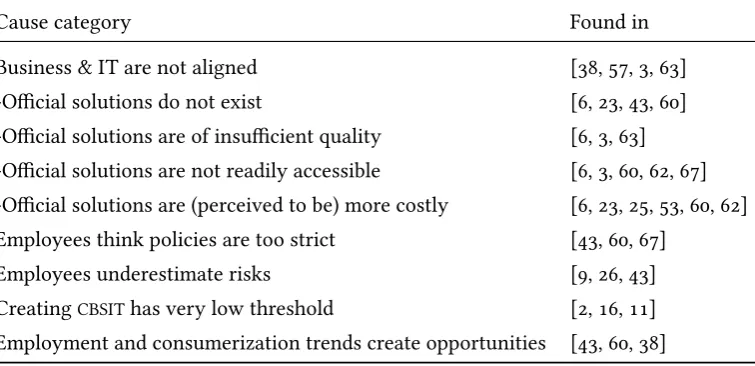
Cause category Found in
Business & IT are not aligned [38, 57, 3, 63] -Official solutions do not exist [6, 23, 43, 60] -Official solutions are of insufficient quality [6, 3, 63] -Official solutions are not readily accessible [6, 3, 60, 62, 67] -Official solutions are (perceived to be) more costly [6, 23, 25, 53, 60, 62] Employees think policies are too strict [43, 60, 67]
Employees underestimate risks [9, 26, 43]
[image:29.595.105.483.295.478.2]CreatingCBSIThas very low threshold [2, 16, 11] Employment and consumerization trends create opportunities [43, 60, 38]
Table 5.1: Overview of causes of Shadow IT as identified in literature and interviews
5.2 effects
As in the previous section, the gathered selection of literature was searched for descriptions of effects of shadow IT. These were then grouped into eight categories of effects described by authors. Six of these categories indicated risks or otherwise adverse effects, while two of the categories indicate posi-tive effects of shadow IT.
5.2.1 Negative effects
Data confidentiality and integrity risks
20 causes and effects of cloud-based shadow it
it was the principal concern regarding shadow IT occurrences in their orga-nizations.
D’Arcy [16] indicates that security risks can be caused by employee de-vices such as smartphones, tablets and storage media physically leaving the organization, contrary to fixed desktop PCs.
If not properly supported by an organizational Bring-your-own-Device (BYOD)-policy (which is the case with shadow IT) and device management, the organization also has no control over software that these devices run. This software may have inadequate security mechanisms, such as personal firewalls, or be improperly configured, e.g. weak passwords and accounts with elevated permissions. The devices may also be infected with malware as a result [60].
Combined with the fact that external networks such as mobile 3G/4G data networks and employees’ home connections are not monitored and fire-walled by corporate IT departments, data leaks over these networks are a risk.
The risks described go much further than devices that employees bring and install software on. If users purchase or develop (client-server) systems, virtualization environments and various other systems, they may not em-ploy the same degree of protection that is incorporated in the enterprise’s systems, such as in-transit and at-rest data encryption, or passwords with sufficient entropy and history requirements.
Another potential security risk mentioned by Stratecast | Frost & Sullivan [60] is the possibility of leaking passwords. A well designed system will have mechanisms such as strong hashing and salting of passwords stored, or con-nect to a system with such facilities (e.g. an enterprise’s Active Directory server) for its authentication. A shadow system may store an independent set of username/ password-combinations which may be identical to the com-bination that users have set up for use in enterprise systems. Compromise of such a system means that enterprise systems are vulnerable to abuse.
Various authors discuss the security risks of individual employees or busi-ness units using cloud based shadow IT. In some cases, the risks they indicate are general to cloud computing projects that badly manage their risks, which is often also the case withCBSIT. For example, Haag [26] mentions the risk of exposing data to a multi-tenant-environment. Stratecast | Frost & Sulli-van [60] finds that 37% of interview IT executives fear encrypted data will be susceptible to breach if placed in a shadow cloud solution, and that they are liable in case this happens. In the same study, an even higher percentage (42%) fears that user names and passwords of their employees are at risk if employees sign up for cloud based services.
5.2 effects 21
Continuity and availability risks
Corporate IT often has stringent continuity-requirements. Specialized hard-ware and softhard-ware are used to prevent outages due to hardhard-ware wear and tear or faults, and products are procured with a guarantee that they will be supported during an expected required life cycle. The markup in costs for these products is often steep, meaning it seems attractive to the creators of a shadow system to forego them altogether.
Although in practice not always complete and up to date, organizations also document various properties of their information systems in order to preserve that information in the case that knowledgeable personnel leaves their organization. Business units setting up shadow systems may not realize the value of such documentation or may not have the resources to set up a complete and up to date documentation of the solution they created. As a consequence, if the maintainer of a shadow system leaves the organization and the system breaks down, any processes or functions that have come to depend on it are also impaired.
Several experts stated in interviews that they were concerned about this effect occurring when an employee uses their personal account at a cloud service to support a process or as the sole storage point of critical data, and this employee leaves the organization. The organization is left with an im-paired ability to support this process or without its critical data[18, 13]
Although, as discussed in a section below, a general characteristic of many cloud services is that their availability is above par, this does not count for all CSPs. Though the cost of outages can be mitigated by agreeing on a Service Level Agreement beforehand, shadow systems may not have been procured under such terms.
In addition to actual outages at theCSPs, as cloud-based shadow services are accessed via the internet, their adoption increases the reliance of employ-ees on the availability of connectivity to that cloud service [60], which may be interrupted by the failure of the employee’s internet connection or any intermediate networks.
Heath [28], Linthicum [44], Chan et al. [11] and several other authors point to the risk of vendor lock-in, if data is not available for download in a standardized format, or services that run on a cloud service cannot be mod-ified to work on a competing platform. In that case, if a vendor terminates the service or employees would like to move to another service for different reasons, they find themselves unable to make that switch. That risk is real: a survey by Stratecast | Frost & Sullivan [60] finds that over 40% of surveyed IT executives fears that data may be lost or deleted by their provider.
Regulatory and legal compliance risks
22 causes and effects of cloud-based shadow it
The regulations that organizations have to comply with differ by the ju-risdiction they are in, and may complement or contradict if organizations operate in various geographies.
American organizations may face federal regulation such as the Sarbanes-Oxley act (SOx) of 2002[1], in addition to any state laws that apply. In Europe, regulation may stem from EU or national levels.
As such, providing a complete overview of infringements to regulations caused bySITgoes beyond the scope of this section. Two high level examples are control over data for financial reporting and requirements for processing Personally Identifiable Information.
SOx[1] requires that information in financial reports is traceable and ver-ifiable, therefore requiring that the organization is in control of the systems that process this information and can ensure its integrity and accuracy. Any SITthat processes data and provide data used in reporting therefore poten-tially leaves the organization non-compliant withSOx.
On the other side of the Atlantic, the EU Data Protection Directive [20] and its intended successor, the General Data Protection Regulation, impose restrictions on the way organizations process information on natural per-sons. For example, it is expected that individuals would have the right to de-mand erasure of all data about them from an organization’s information sys-tems. Without control over which information systems are used to store var-ious types of information, such a request is impossible to fulfill completely, leaving an organization non-compliant with EU law.
A characteristic of many cloud service providers is that they use multi-ple data centers around the world from which they provide their services. Although some are able to guarantee the location where data is stored and processed upon negotiation by the customer, it is possible thatSITmay not be purchased under such conditions. As such, an organization using these ser-vices may be in violation of the EU’s Data Protection Directive [20], which states that certain data is not to leave the EU if the receiving entity is unable to guarantee certain safeguards. Specific to the Netherlands, in effect since January 2016, is the new law governing mandatory reporting on data leaks (“Meldplicht Datalekken”) [40].
Even ifSITdoes not directly cause non-compliance to regulation, the fact that it adds complexity to the IT landscape makes it more difficult to audit an organization’s systems and state that it is in compliance with regulation.
In addition to regulatory compliance, organizations face legal risks, such as being held liable for employees’ use of unlicensed or improperly licensed software. An employee who does not purchase a license for software he or she uses, but instead chooses to rely on an illegally obtained or cracked ver-sion exposes the organization he works for to the risk of litigation. The same goes for employees who, perhaps in good faith, use software whose license grants free use for personal purposes, but requires commercial licenses for commercial use.
5.2 effects 23
the example of an employee using social media using an account that was tied to him as a person. Upon his discharge, obtaining required information from that account proved difficult for the employer.
Another example would be a service that required, in its terms and condi-tions, users to surrender some or all rights to intellectual property and data they process using the service, or to provide a license for the service to use or resell intellectual property.
Operational performance risks
SITmay also hamper the ability of the IT department to supply technology that supports business processes, to operate this technology properly, and may thus hurt the execution of these business processes themselves. There are various reasons for this, having to do with limited insight in the bigger picture due toSITsolving local problems as Fuerstenau and Rothe [23] say, or lacking sufficient quality assurance in setup and changes
Organizations have formalized processes for various reasons. Best prac-tices are implemented to increase productivity in addition to compliance purposes as discussed above.SITthat does not follow these processes may thus hamper both productivity and alignment in processes shared between departments with and without access to the shadow systems. Strong et al. [61] note the rigidity of an ERP system and the problems it causes when em-ployees created workarounds, borrowing parts from different intermediate products to do their job of assembling another product, while keeping track of these parts unofficially. However, at some point such inventories need to be reconciled with the ERP system and mismatches between expected and current inventories do come to light.
Organizations with complex IT landscapes bring order to potential chaos by creating an enterprise architecture, a blue print of the systems, inter-connections and dependencies supporting business functions and processes. Any changes made to the IT landscape can be checked with the enterprise architecture, and measures can be taken to ensure that the change does not have adverse effects on other systems. Shadow systems are not present in an enterprise architecture. This hinders the ability of IT to verify that a change in IT does not adversely affect business processes, as they may be supported bySIToutside their knowledge. It also means that IT is unable to verify that a change in a shadow system is without negative consequences for the rest of the IT landscape. A change in an official application’s authentication mech-anism may lead to a shadow system repeatedly attempting to authenticate itself, in essence performing a Denial-of-Service-attack on the enterprise’s own systems.
24 causes and effects of cloud-based shadow it
personnel is not prepared to provide support in the same way they would for official systems. At the same time, Smyth and Freeman [57] find a lack of support one of the main concerns overSIT, suggesting that organizations have little choice but to provide support wherever possible.
Finally,SITmay act as a barrier to the enhancement of both technology and operations. While official solutions can undergo planned maintenance or upgrades to align them with improved business processes or to increase the performance or security of the systems, the decentralized nature ofSIT makes this more difficult. Raden [53] gives the example of employees us-ing a set of spreadsheets that they email around as an example of SITthat is particularly difficult to upgrade. Changes in official systems may break compatibility with these spreadsheets, and the way they are spread makes it difficult to distribute an updated version. As such, any centrally decided improvements and innovations reach the organization less rapidly, or may altogether be postponed in order to not break compatibility.
Financial performance risks
Several authors discuss the impact thatSITcan have on the financial side of IT operations. Gartner [24] predicted that by now, 35% of IT spending takes place outside control of the IT department. A recent survey by PWC [52] finds an even higher number with up to 47% of IT spending taking place outside the CIO’s control.
Whether this is a problem in itself is up to debate, as King [38] cites research that implies correlation between an organization’s performance in the digital domain, and a greater portion of IT spending taking place throughout the organization, indicating that technology is better interwo-ven in the organization’s culture.
Elemans [19], Fuerstenau and Rothe [23], Gyoery et al. [25], Raden [53] and Symantec [62] mention a loss of synergy or economies of scale due to the repeated implementation ofSITin different business units.
In some cases, these are shadow systems that are redundant to each other, as various departments try to provide systems that fill gaps in the solutions provided by central IT. In other cases the shadow system is redundant to a centrally provided solution.
In both cases, expenditures are higher than necessary. Systems purchased separately do not offer a chance to obtain volume discounts for hardware or software licenses, meaning that more money is spent on assets. Other costs are the redundant work on installing and testing the system, and procuring training for small groups of users. Upon discovery ofSITand integration or elimination of these systems, a reduction in operational expenditure is still possible, but a large part of the capital expenditure is sunk[18]
5.2 effects 25
At the core of many cloud computing solutions is the pay-as-you-go-model. Advantageous in cases where capacity is suddenly needed or where a service is scaled down to reduce its cost, this model also reduces how predictable costs will be if demand cannot fully be predicted. If no agreements are made beforehand about placing a limit on costs incurred, various factors could cause costs to rise.
5.2.2 Positive effects
Increased productivity
While many authors stress the negative impact ofSIT, some shed some light on the positive impact it has. Given that many of the causes identified in the previous section can ultimately be traced back to employees being unable to obtain tools to perform their tasks well enough, an obvious upside ofSITis that in some cases, the productivity of employees rises through a better fit between the task they are performing and the SITsupporting them in per-forming that task[43, 71]. Examples of this include systems for collaboration within the organization (because such tools were unavailable) or between or-ganizations (because employees of both oror-ganizations use the same service in the form ofSIT).
Productivity may also be increased because a shadow system that is be-ing used in lieu of an official system has greater usability. Employees can therefore use time otherwise spent on training or becoming familiar with the official system for productive work [19].
Furthermore, the possibility for employees to determine for a large part which services they use to perform their tasks (e.g.SIT) affects several intrin-sic motivators for employees and increases employee satisfaction [19, 43], thereby leading to increased productivity. Ky [43] and Raden [53] mention employees experiencing trust and autonomy as adding to their productivity, in addition to an increase in technical abilities.
Cost effectiveness
Another driver for creatingSITmentioned in a previous section was an esti-mate by employees that theSITwould cost less to set up and operate than the official alternative. As that section mentions, these estimates often neglect various factors such as sunk costs, quality factors and legal issues. However, even when these factors are considered,SITmay still be more cost effective. As mentioned above, the reduced training time required to operate SIT that users are already familiar with, which is often the case given the trend of consumerization, adds to cost effectiveness.
Innovation
26 causes and effects of cloud-based shadow it
initiatives from the entire organization are recognized [2, 25, 23]. Zejnilovic and Oliveira [70] find that of all innovations submitted by employees, those submitted by employee-users (i.e. those that are in use asSIT) have a signifi-cantly higher chance of getting adopted.
Security and Continuity Improvements
Contrary to the previous section on security effects, several authors and ex-perts note improvements in both security and continuity are possible when employees switch toCBSIT[18].
First of all, cloud based solutions that replace traditional SIT bring the advantage that they are generally managed by a professional staff specialized in providing this service. Their security and continuity measures may well be better than those of an official solution [18]
Many cloud services offer some encryption at rest and in transit, enforce some password policies and have various other security measures imple-mented. In addition, many come with automatic redundancy, backup and revision history facilities, increasing both availability and the chance of re-covering from accidental loss of data.
Even ifSITreplaces an official solution, some organizations may still ben-efit [43]. For some organizations, the advantages outlined above go beyond what their own IT is able to offer.
Based on the above, the Cloud Security Alliance found that nearly 65% of IT leaders now consider cloud services more secure than their on-premise counterparts [15].
The section above, combined with the sections on data security and conti-nuity risks, highlight a split between the security of the services themselves and the security which results from their proper use, as highlighted in the first validation interview.
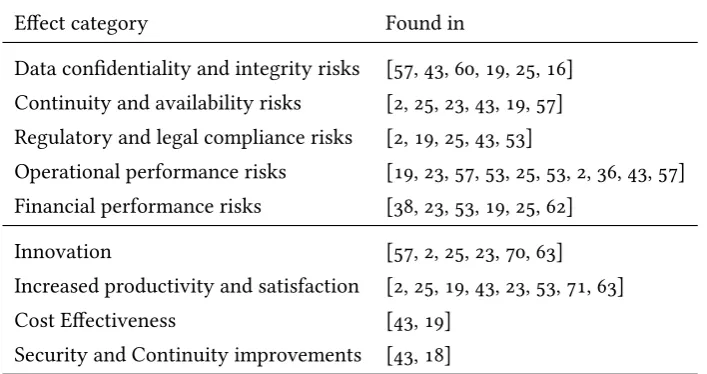
Effect category Found in
Data confidentiality and integrity risks [57, 43, 60, 19, 25, 16] Continuity and availability risks [2, 25, 23, 43, 19, 57] Regulatory and legal compliance risks [2, 19, 25, 43, 53]
Operational performance risks [19, 23, 57, 53, 25, 53, 2, 36, 43, 57] Financial performance risks [38, 23, 53, 19, 25, 62]
Innovation [57, 2, 25, 23, 70, 63]
Increased productivity and satisfaction [2, 25, 19, 43, 23, 53, 71, 63]
Cost Effectiveness [43, 19]
[image:36.595.163.517.477.664.2]Security and Continuity improvements [43, 18]
Table 5.2: Overview of negative and positive effects ofSITas identified in literature
5.3 chapter summary 27
5.3 chapter summary
This chapter has listed a variety of reasons why employees or departments choose to adoptSIT, and the myriad of consequences that this adoption can have. The diversity in cloud services that can be fielded asSITalso makes that reasons to use them as well as their effects are also diverse in nature, and when viewed at large, sometimes contradictory (e.g.CBSITmay cause IT costs to rise or drop, depending on the scenario). This chapter has therefore grouped the causes and effects in categories.
The causal categories show that a mismatch in communication, in under-standing of costs and risks and in the supply-and-demand between business users and IT causes the adoption ofCBSIT, which is aided by the ease by which it is deployed.
The effects differ as well: some are largely based on risks that surround the implementation of any cloud solution, if that implementation is not done properly: risks surrounding compliance, confidentiality and continuity. Other risks are common to all forms of SIT: complex IT landscapes, redundant spending or spending outside IT budgets and availability risks.
6
M E T H O D S F O R M A N AG I N G C L O U D - B A S E D S H A D O W I T
The second knowledge question introduced in chapter 3 investigates what organizations can do to manageCBSIT:
KQ2: What are methods for managing Cloud-Based Shadow IT?
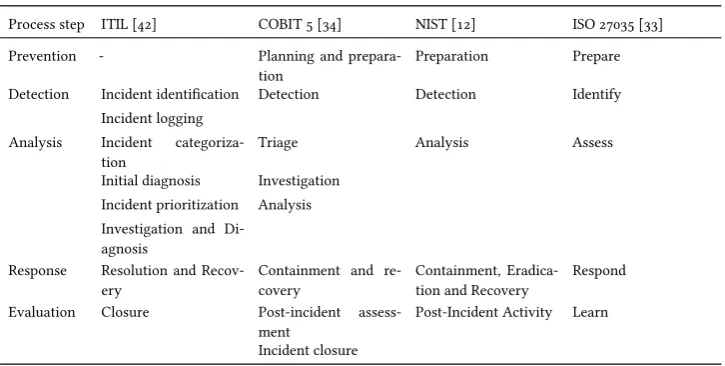
This chapter lists a collection of such measures, which are sorted into five steps of a process. The steps feature a Detection-Analysis-Response-process for dealing with individualCBSIT-services, combined with a prevention and evaluation phase, which aligns with in various works on (security) incident management [66, 35, 37], such as with the ITIL-cycle of incident manage-ment [42] , COBIT 5 [34], NIST 800-61[12] and ISO 27035 [33] as laid out in table 6.1.
1. Prevention - Prevent the creation ofCBSIT.
2. Detection - Identify cloud services for analysis, either because they are in use or because they should otherwise be taken under consideration.
3. Analysis - Analyze what risks and benefits each service offers, and how that compares to the company’s risk appetite.
4. Response - Choose, implement and operate measures to align actual usage with the chosen strategy.
5. Evaluation - On a regular basis, evaluate whether the chosen strategy and set of methods is still appropriate.
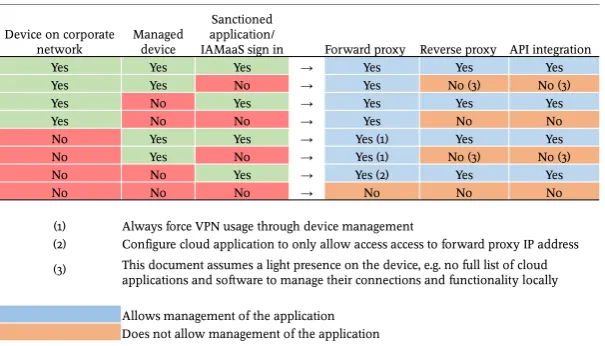
Process step ITIL [42] COBIT 5 [34] NIST [12] ISO 27035 [33]
Prevention - Planning and
prepara-tion Preparation Prepare
Detection Incident identification Detection Detection Identify
Incident logging Analysis Incident
categoriza-tion Triage Analysis Assess
Initial diagnosis Investigation Incident prioritization Analysis Investigation and
Di-agnosis
Response Resolution and
Recov-ery Containment and re-covery Containment, Eradica-tion and Recovery Respond
Evaluation Closure Post-incident
assess-ment Post-Incident Activity Learn
[image:39.595.84.447.522.705.2]Incident closure
Table 6.1: Mapping of process steps to other frameworks
30 methods for managing cloud-based shadow it
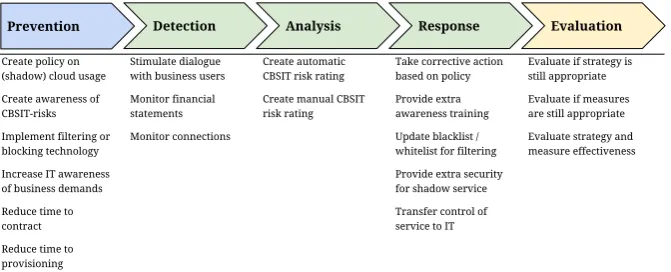
Prevention Detection Analysis Response Evaluation
Implement filtering or blocking technology
Reduce time to provisioning Increase IT awareness of business demands
Reduce time to contract Create awareness of CBSIT-risks Create policy on (shadow) cloud usage
Monitor financial statements Stimulate dialogue with business users
Monitor connections
Create automatic CBSIT risk rating
Create manual CBSIT risk rating
Update blacklist / whitelist for filtering
Provide extra security for shadow service
Transfer control of service to IT Provide extra awareness training Take corrective action based on policy
Evaluate if measures are still appropriate Evaluate if strategy is still appropriate
[image:40.595.165.501.68.204.2]Evaluate strategy and measure effectiveness
Figure 6.1: The measures discussed in this chapter
Figure 6.1 contains the measures explained in this chapter sorted by the two divisions explained above.
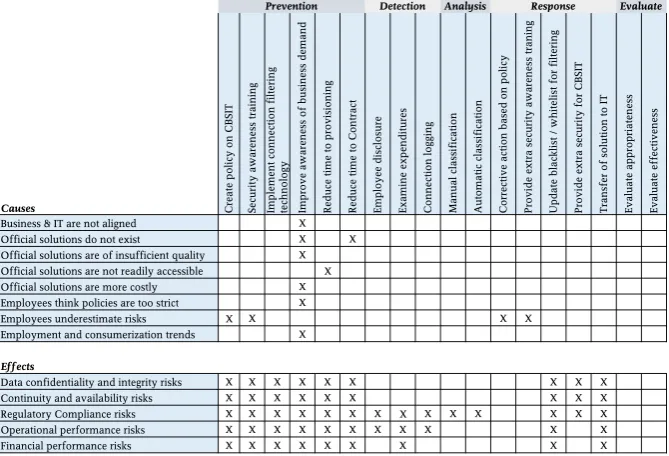
Finally, these measures are taken as the result of a choice to manage risks in a specific way. These risks have been identified in chapter 5, and table 6.3 at the end of this chapter gives an overview of how these measures impact both the risks and causes, while chapter 7 contains specific details per strat-egy, including how each measure is used for specific risks in every strategy.
6.1 prevention
The measures in this section work by reducing the incentive for employees to resort toSIT, or by making it more difficult for them to do so.
6.1.1 Create policy on (shadow) cloud usage
An organization that wants to eliminateCBSIT should start by by putting in place policies outlining the organization’s stance on CBSIT. If applicable, such policies should also state why the organization has taken this stance: which risks is it trying to mitigate, and why? This ties into the next section on creating awareness.
The degree to which organizations are able to impose sanctions upon an employee for violating this policy varies by the jurisdiction it is in, but may include termination, suspension and mandatory attendance of training.
As an alternative to a policy set and enforced without employee involve-ment, organizations may employ a code of conduct, which requires an em-ployee to take note of and consent to rules regulatingCBSIT[58].
6.1 prevention 31
6.1.2 Create awareness of CBSIT-risks
One of the key factors determining whether employees decide to employ a cloud-based shadow service for any given task or type of data, according to both literature and expert interview, is their awareness of the risks it poses [10, CSC 17]
In order to influence their decisions, an organization can employ various measures to improve security awareness for individual employees. Examples include training, exams and certification. In addition to targeting individual employees, the organization can use periodic (i.e. campaigns) or continuous communications to all of its employees explaining their stance on cloud us-age. As explained in the previous section, this communications should be backed up by, and include, official policies and the arguments for them.
Depending on the strategy the organization chooses, training can be aimed at goals other than deterrence as well. Thatte and Grainger [63] suggest the creation of Information Centers, where users ofSITcan request support.
In the case ofCBSIT, such centers could facilitate in selecting aCSP that meets the organization’s criteria in addition to those of the user. It could also assist in safe operation of a cloud service, by assisting the user in setting up secure authentication (see section 6.6.2 and regular backups to prevent data loss at termination.
6.1.3 Implement filtering or blocking technology
In order to maintain control over employees’ usage of cloud services, the organization can take a number of measures to prevent employees from ac-cessing unwanted application functionality. This section explains some of the the methods to do that. Later sections will explain how detection, analy-sis and response to unwanted services may lead to changes in which services employees are prevented from accessing.
Several techniques exist to control employees’ access to services. Simply said; these require filtering network traffic on the corporate network, con-trollingCBSITusage from the device, or both.
The first technique, blocking connections at a gateway or a proprietary DNS service where the address of a cloud service is looked up, has the ad-vantage of requiring no configuration at the individual devices that a user uses while that device is on the corporate network, and therefore configura-tions cannot be undone [49]. Soluconfigura-tions that filter connecconfigura-tions using a proxy might require configuration of this proxy on every device, but by blocking all traffic that does not go through this proxy this solution ensures that, re-gardless of the specific configuration of the endpoint, no connections that are not allowed can be made from the corporate network.
32 methods for managing cloud-based shadow it
alternative. As described in the section on monitoring, these more advanced methods of control require decryption of traffic, and more extensive control of the endpoint [50]
These method of blocking has the disadvantage that it does not work if the device is outside the corporate network and is otherwise connected to the internet. One expert argued that the share of such devices will grow in the next few years as the bandwidth of 3G and 4G services grows exponentially [18]. Implementations of this measure could include configuring devices ex-clusively for internet access through a Virtual Private Network (VPN) or en-forcing the use of a proxy even outside the corporate network, although the advantage of not having to rely on the device’s configuration no longer ap-plies.
Connection blocking can also directly take place at the level of the individ-ual device. Measures such as software firewalls, adding entries to a device’s “Hosts file” or software security policies that forbid browsers to visit certain domains.
The advantage of this measure compared to blocking at a gateway or proxy is that it works even if the device is not routing its internet traffic through the corporate network directly or via aVPN.
The disadvantage is that it relies on the organization’s ability to control the configuration of the device and its willingness to do so, thereby restrict-ing the freedom of its employees to configure their device, which may inhibit productivity.
In addition to blocking certain services’ traffic, any services that require the installation of software on a user’s devices can be blocked. Although the majority of cloud services require no installation at all, or continue to work with limited functionality, services such as Dropbox rely on a local client to provide their core functionality.
Mobile Device Management solutions for mobile phones and tablets allow administrators to block installation of specific apps beforehand, while such measures for laptops and desktops with a different operating system and different application ecosystem generally block software installation as a whole (by not granting users local administrator rights and blocking the execution of unchecked code) or perform regular scans identifying software on a blacklist which is then removed.
6.1.4 Increase IT awareness of business user demands
6.2 detection 33
6.1.5 Reduce time to contract/implementation time for official services
Another driver seen in chapter 5 was the fact that organizations often don’t supply tools of the same functionality and quality that are available as cloud services on the market. Services such as personal cloud storage and collabo-ration tools are examples of such tools according to Ky [43] and interviewed experts.
In order to eliminate this driver, organizations’ IT departments need be able to adjust their service catalog to business demands more rapidly. De-pending on the reason why that is currently not the case, different changes need to be implemented. Examples are: increased staffing, a change in work-ing methodology (from waterfall to incremental delivery) or the implemen-tation of a two-speed architecture where traditional back-end processes are decoupled from more rapidly developed front-end applications[8, 7].
6.1.6 Reduce time to provisioning for official services
As one of the drivers ofCBSITidentified in chapter 5 was the time it took for the IT department to fulfill a request to provide an existing service to a user, reducing that time reduces employees’ need to use CBSIT. This could mean that procedures for obtaining resources are simplified, or that organi-zations need to ensure that they are executed with fewer delays. If waiting occurs due to capacity shortages, addressing those would reduce incentives for employees to resort toCBSIT.
6.2 detection
6.2.1 Stimulate dialogue with business users
One of the most straightforward ways of detecting any form ofSITis simply getting employees to tell the IT department what they are using [29]. Former Chief Information Security Officer for an intergovernmental organization [22] and other interviewed experts argue that in order to achieve a culture where that occurs, it is essential that IT responds to the discovery of SIT in a constructive way. Thus, the user should not be negatively influenced by his disclosure, for example by punishment or the elimination of theSIT he discloses. Thatte and Grainger [63] suggests the creation of information centers, which would advice users on a choice of safe cloud services, an approach that was endorsed in expert interviews[32].
6.2.2 Monitor financial statements
transac-34 methods for managing cloud-based shadow it
tions from CSPswill appear on credit cards issued to employees or depart-ments.
Alternatively, if payments are made through other means than credit cards, these payments can be examined as well as the payment must leave a paper trail. Any unpaid services used go unnoticed by this detection method.
6.2.3 Monitor connections
A very basic measure in order to detect what degree ofCBSITis in use in an organization is analysis of internet traffic. In order to do so, some way of mea-suring the volume and direction of traffic is required. In many organizations, internet traffic is directed via one or more gateway or proxy servers. These servers can be configure to log several data points for each established con-nection, such as the clientś internal network address, the address and port number of the service and the volume of data sent and received.
Automated solutions exist to analyze these log files, and determine whether a given a flow of traffic connects to a cloud service [10, CSC. 7.4]. Somewhat more advanced systems may perform this analysis in real time, allowing it to send alerts and allowing the organization to respond quickly.
Even more advanced systems are capable of providing insight into the con-tents of the communication. As communication to and from cloud services is generally encrypted, this is impossible without additional measures. Some firewalls allow for the inspection of encrypted of traffic in real time, thus allowing it to inspect more precisely what the user is doing. Depending on the jurisdiction that the organization operates in, this may be unlawful. In addition, it requires control over the user’s endpoint as a certificate needs to be installed on the endpoint. The user’s endpoint then encrypts its connec-tion to the firewall/proxy only, after which the latter sets up an encrypted connection to the cloud service. This creates a decrypted view for the fire-wall/proxy, allowing it to filter data directly or offer it for analysis to a third party service [50].
There are also other technologies available, such as configuring devices to use specialized Domain Name System (DNS)-servers that log requests for the Internet Protocol (IP)-address of a cloud service.
6.3 analysis
6.3.1 Create automatic CBSIT risk rating
![Figure 4.1: Traditional IT and the three cloud computing service models as defnedby [46]](https://thumb-us.123doks.com/thumbv2/123dok_us/9781194.479217/21.595.129.400.71.254/figure-traditional-cloud-computing-service-models-defnedby.webp)
![Figure 6.2: Shadow IT portfolio plot by Zimmermann et al. [72]](https://thumb-us.123doks.com/thumbv2/123dok_us/9781194.479217/46.595.210.458.79.270/figure-shadow-portfolio-plot-zimmermann-et-al.webp)