Non-parametric methods applied in the
efficiency analysis of European structural
funding in Romania
Roman, Monica and Gotiu (Lucaciu), Liliana
Bucharest University of Economic Studies, Bucharest University of
Economic Studies
17 March 2017
Online at
https://mpra.ub.uni-muenchen.de/80548/
Non-parametric methods applied in the efficiency analysis of
European structural funding in Romania
1Authors:
Monica Roman, Bucharest University of Economic Studies
Liliana Lucaciu (Gotiu), Bucharest University of Economic Studies
Abstract
One of the most widely used methods in assessing the efficiency of public policies and
programs for a set of units is Data Envelopment Analysis (DEA). DEA is a non-parametric
method which identifies an efficiency frontier on which only the efficient Decision Making
Units (DMUs) are placed, by using linear programming techniques. By applying
non-parametric techniques of frontier estimation, the efficiency of a DMU can be measured by
comparing it with an identified efficiency frontier. In this paper we have used DEA for
evaluating the efficiency of the European structural funds allocated to finance the educational
infrastructure through the Regional Operational Program 2007-2013, implemented in
Romania. The output variables measure the educational performance as well as the school
drop-out rate, while the focal input variable is the value of European funds. Romanian
counties are considered to be the decision making units (DMUs). Our results confirm the deep
disparities existing between Romanian counties concerning the efficient use of European
structural funds.
Keywords: European structural funds, efficiency, Data envelopment analysis, infrastructure,
regions
JEL classification: H83, R58, C61
1
1 Introduction
After becoming a Member State of the European Union, starting with the
programming period of 2007-2013, Romania benefited from structural and investment funds2,
designed to help it cope with the economic challenges and disparities, as well as to take
advantage of the opportunities available in the country. For Romania, the European Union
funds represent financial instruments set up to assist in reducing the regional disparities and
fostering growth through investments in domains such as employment, social inclusion, rural
and urban development or research and innovation. During the programming period
2007-2013, Romania benefited from a budget of 27.5 billion euros, out of which 19.2 billion euros
were for the structural and cohesion funds and 8.3 billion for the Common Agricultural
Policy.
The aim of the paper is to analyse the regional disparities existing between Romanian
counties regarding the efficiency of the European structural funds3 (hereafter SF) allotted for
financing the educational infrastructure. One of the most relevant needs for Romania’s social
development is improving the quality of educational infrastructures and reducing the regional
disparities existing between Romanian regions in this case. The Regional Operational
Programme through the Key Area of Intervention 3.4 „Rehabilitation, modernisation,
development and equipping of pre–university, university education and continuous vocational
training infrastructure” was the programme that addressed the needs for the educational
infrastructure development.
2
Since 2007, the EU Cohesion policy has revolved around three objectives: Convergence (81.7% of the total Cohesion Policy payments), Competitiveness and employment (15.8%) and Territorial cooperation.
3
In this research we have used a non-parametric method widely utilised for evaluating
the efficiency of regional units, namely Data Envelopment Analysis (DEA). The efficiency
was computed in various models, both output and input oriented, using STATA 20.
The contribution of the paper is twofold: the paper approaches the efficiency of using
structural funds in the first Programming period in Romania, being one of the first attempts to
apply DEA methodology in this respect; at the same time, the study is focused on the
counties, at NUTS3 level, and ways to improve regional policies implementation in Romania,
in the second programming period, 2014-2020. The study fills a gap in the literature related to
public programming and planning, provides valuable information for decision makers and
also opens room for further research on this challenging topic.
This paper is structured as follows: The second section presents the Romanian context
related to the existing needs in education, while Section 3 briefly reviews the literature on the
impact of structural funds on economic growth and the economic convergence process,
respectively. Sections 4 and 5 discuss the method applied and subsequently the variables and
model specifications, followed by the presentation of the results in Section 6. Finally, section
7 concludes.
2 The Romanian context: needs in the educational system and policy responses
A basic structure of education levels in Romania includes: kindergarten, primary
school, middle school, high school and higher education and education in Romania is
compulsory for 11 years (from the preparatory school year to the tenth grade). With the
exception of kindergarten and higher education, the private sector has a very low presence in
the Romanian education system. Therefore, the education system is mainly financed from the
state budget; the general government expenditure on education as a share of GDP fell from
sector. This is reflected in low wages, but also in the poor state of the educational equipment,
learning spaces, as well as in the related facilities.
The situation is even more difficult for the schools in disadvantaged communities. In a
report published in 2014, Fartușnic et al. found that the core financial source of these schools
is state funding and their entire annual budget covers only administrative costs and teachers’
salaries. It seems obvious that such institutions have insufficient resources for infrastructural
development.
The access to schooling of children from disadvantaged areas, especially from rural
areas, but also of those from vulnerable social environments is difficult in Romania. In some
cases, school capacity is deficient; there are large distances to the closest school and
inadequate transportation facilities. A large number of education units need rehabilitation
works and equipping with didactic equipment, IT and specific documentation materials.
Fartușnic (2014) noticed that according to the data on early school leaving provided by the
Romanian National Institute for Statistics, the share of early school leavers in rural areas is
three times higher than in urban areas and there are also important differences between
Romanian regions: the highest rates were recorded in the North-East, South-East and South
Muntenia regions, while the lowest were in the Bucharest Ilfov and Western regions.
Under such circumstances, the national strategy in the field made it a priority to set up
and develop the education infrastructure, to increase education accessibility and quality. The
Regional Operational Programme 2007 – 2013 through the Key Area of Intervention 3.4.
“Rehabilitation, modernisation, and development and equipping of pre-university, university
education and continuous vocational training infrastructure” (hereafter KAI 3.4) has the
purpose to address the existing needs. In terms of the activity proposals, the activities that
required special attention referred to “the construction, consolidation, rehabilitation,
equipment with teaching materials, professional training materials, IT equipment and specific
equipment for residential spaces; the rehabilitation, consolidation, modernisation of buildings
and fields on university campuses; the rehabilitation and/or consolidation of buildings located
within the continuous professional formation institutions; and the modernisation of utilities,
including the demand for special facilities for people with disabilities, for all types of
infrastructure”4
In the context of a chronic lack of financial resources invested in education in the past 25
years, the successful implementation of the projects financed through European SF at national
level becomes a top priority. The efficiency of using SF is crucial, since the specific needs are
usually in high numbers and of significant relevance and the final goal is increasing the
quality and performance of the education system in Romania. It is important to mention that
this paper does not provide an impact analysis of SF, but an evaluation of the efficiency of
using SF in achieving the specific objectives.
3 Literature review
Given the relevance and the high interest in the EU Cohesion Policy, the evaluation of the
performances of various financing programs has become a high priority and it involved a
large spectrum of both quantitative and qualitative methods. In their paper (2010) Mohl and
Hagen prove that the econometric evaluation of EU Cohesion Policy is hampered by several
econometric issues, such as reverse causality, measurement error, omitted variables, strict
functional form assumptions and the potential inclusion of inappropriate control variables.
Starting with this finding, we attempted to apply non-parametric methods for evaluating the
performance in using structural funding at regional level in Romania. The existing results on
4
the efficiency of using structural funds for the regional development are relying mainly on
parametric approaches and econometric modelling. The advantages of non-parametric
approaches are less exploited and this paper aims at testing the performance of such
techniques in this field.
DEA approach involves the application of the linear programming technique to trace the
efficiency frontier. It was originally developed to measure the performance of various
non-profit organizations, such as educational and medical institutions, which were highly resistant
to traditional performance measurement techniques due to the complex and often unknown
relations of multiple inputs and outputs and non-comparable factors that had to be taken into
account. In recent years it has been successfully applied in measuring the efficiency of both
for-profit and non-profit organizations, such as the effectiveness of regional development
policies in Northern Greece by Karkazis and Thanassoulis (1998). Coelli, Rao and Battese
(1998) introduce the reader to this literature and describe several applications. DEA was
launched by Charnes et al. (1978) under the assumption that production exhibited constant
returns to scale. Banker et al. extended it to the case where there are variable returns to scale.
Governmental efficiency in general and public policies efficiency became research
subjects of an increasing number of papers. Zhu (2002) provides a series of Data
Envelopment Analysis (DEA) models for efficiency assessment and for decision making
purposes. Rhodes and Southwick (1986) use DEA to analyze and compare private and public
universities in the USA. More recently, Singh (2016) uses DEA for ranking the Indian states
in their efficiency of applying a large welfare scheme for poverty alleviation. Using a sample
of 31, an input and output oriented DEA model was applied, with constant and variable return
to scale proving that 11 units were technically efficient.
There are several applications of the DEA method for Romania; Roman and Suciu (2012)
Nitoi (2008) assesses the efficiency of the Romanian banking system using an input oriented
with variable returns to scale DEA model. DEA has also been used to assess different aspects
of the medical field like hospital efficiency (Nedelea et al., 2010; Mecineanu et al., 2012) or
health systems efficiency (Asandului, Roman, Fatulescu, 2014).
USING a panel of NUTS3 regions, Becker et all (2010) find positive growth effects of
Objective 1 funds, but no employment effects. Puigcerver-Peñalver (2007) finds that
structural funds have positively influenced the growth process at regional level although their
impact has been much stronger during the first Programming period than during the second
one. Rodriguez-Pose and Fratesi (2004) distinguish between various structural funds
expenditure and conclude that only structural fund expenditures for education and investment
have a positive effect in the medium run, whereas expenditures for agriculture do not.
Mohl and Hagen (2010) evaluate the growth effects of European structural funds
payments at regional level. Using a new panel dataset of 124 NUTS regions for the time
period 1995-2005, they found empirical evidence that the effectiveness of structural funds in
promoting growth is strongly dependent on which financing objective is analysed. The
payments of Objective 2 and 3 have a negative effect on GDP.
4 Method and models specifications
First presented in 1978 and based on the paper of Farrell, the first DEA model is
known in the literature as the CCR model, after its authors, Charnes, Cooper and Rhodes. It is
a non-parametric method which identifies an efficiency frontier on which only the efficient
Decision Making Units (DMUs) are placed, by using linear programming techniques. The
method depends on a number of output and input variables that are employed for computing
Since it is of high importance which are the variables selected in the model and how
many these are, a strong experience in the field of application of the method is needed. At the
same time, the number of DMU could also be a challenge for applying the method in public
policy evaluation: for the purpose of the paper, we follow the suggestion of Mohl and Hagen
(2010) who recommend to use regional data that would allow for a more accurate analysis of
the funding’s efficiency and also for maximizing the discrimination existing between various
DMU.
In general there is a trade-off between the number of variables included in the models
and the number of DMU and this issue was studied by various researchers. For instance,
Dyson et al. (1991) recommend a total of two times the product of the number of inputs and
outputs variables. Golany and Roll (1989) recommended that the number of DMU should be
at least twice the number of inputs and outputs considered. On the other hand, Charnes and
Cooper (1991) have suggested that there should be three times as many DMUs as the number
of inputs plus outputs.
Following the rule of thumb suggested by Cooper et al (2007) we estimate that the
minimum number of DMUs required is achieved:
n ≥ max{m * s, 3(m + s)} ,
where n is the number of DMUs, m is the number of inputs and s is the number of outputs. For a model relying on three inputs and three outputs, as in the present research, it would be
recommended that at least 18 DMUs should be included in the estimation of the efficiency
frontier. This condition is satisfied, since there are 31 DMUs involved in the analyzed models.
4.1 Model for an output-oriented specification
The DEA models could be input or output oriented: an input-orientated model looks at the
output-oriented DEA model looks at maximizing the outputs obtained by the DMUs while keeping
the inputs constant.
In the particular case of our research, the linear programming problem to be solved, in the
output oriented and variable-returns to scale hypothesis, is sketched below (Charnes, Cooper
and Rhodes, 1978).
Suppose there are k inputs and m outputs for n DMUs. For the i-th DMU, yi is the column
vector of the inputs and xi is the column vector of the outputs. We can also define X as the
(k×n) input matrix and Y as the (m×n) output matrix. The DEA model is then specified with
the following mathematical programming problem, for a given i-th DMU:
0 1 0 0 1 ,
max
N X x Y y i i (1)In problem (1), is a scalar and 1.
-1 is the proportional increase in outputs that could be achieved by the i-th DMU with the
input quantities held constant.
The measure 1/ is the technical efficiency score and varies between 0 and 1. If it is less than
1, the public intervention is inside the frontier (i.e. it is inefficient), while if it is equal to 1 it implies that the intervention is on the frontier (i.e. it is efficient).
The λ vector is a (n×1) vector of constants that measures the weights used to compute the location of an inefficient DMU if it were to become efficient. The inefficient DMU would be
peers of the inefficient DMU. The peers are other DMUs that are more efficient and therefore
are used as references for the inefficient DMU. N1 is a n-dimensional vector of ones.
Adding the restriction
N1 λ< = 1 in DEA model
the convexity of the frontier is imposed, accounting for variable returns to scale. Dropping
this restriction would amount to admit that returns to scale were constant. The linear
programming problem (1) is solved for each of the n DMUs resulting in n efficiency scores. The scale efficiency could also be computed for the DMUs in the sample. This is the ratio
between the efficiency scores in the CRS and VRS hypotheses and accounts for the increase,
decrease or constant return to scale.
4.2 Model for an input-oriented specification
The specifications of the mathematical programming problem, for a given i-th DMU are
described below, and one problem for each DMU has to be solved:
0 1 N 0 X x 0 Y y min 1 i i , (2)
In the problem above, the inverse of scalar θ ranges between 0 and 1 and is the technical
efficiency score. Like in the previous case, if it is equal to 1, it implies that the DMU is
efficient, while if it is less than 1, the DMU is inefficient. The model specification under the
hypothesis of variable return to scale implies the condition of convexity of the frontier.
In the present research we have applied the DEA input and output oriented models
considering both the constant and variable return to scale and the scale efficiency was also
5 Model specifications and data
The variable of interest in our models is the total value of the projects financing the
educational infrastructure through KAI 4.3 at county level. Out of the total number of projects
contracted, we have selected the projects which had been finalized by April 2014, resulting
131 projects with a total value of 723 million lei. The projects devoted to financing higher
education and research infrastructure were in a small number and therefore were excluded
from the analysis. The data is provided by the Ministry of Regional Development and Public
Administration and it covers the projects financed between 2007 and 2014. Other two inputs
also considered in the efficiency evaluation are: the teacher/student ratio that counts for the
human resources and the number of classrooms/student ratio that counts for fixed capital. The
data provided by the National Institute for Statistics refers to 2014.
The output variables were selected in line with one of the objectives of the KAI 3.4,
that were to increase the educational performance and accessibility. Therefore, the average
pass rates at the National Evaluation and the National Baccalaureate exam were included in
the set of output variables, as proxy for educational performance. These indicators are
reported by the Ministry of National Education at various regional levels, counties included.
The variation of dropout rate was included as the third output, as a measure of the education
accessibility. The variable is reported at county level by National Institute of Statistics. The
output variables refer to 2014 (dropout rate) and 2015 (graduation rates), knowing that it takes
a period of time for a programme to produce effects. As in other studies (Roman and Suciu,
6 Results and discussions
6.1 Data and variables
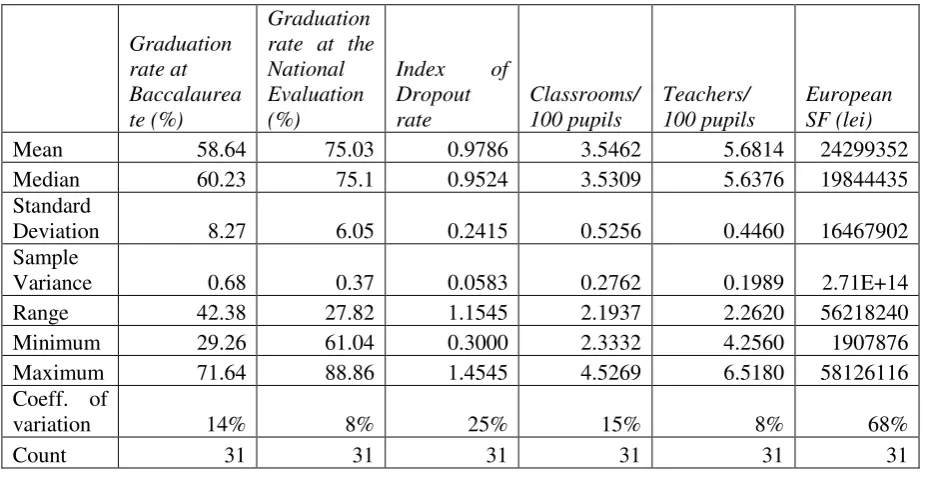
Table 1 summarizes the descriptive statistics for the set of input and output variables.
The two indicators accounting for the performance of the undegraduate education system,
namely the graduation rate at the Baccalaureate exam and the graduation rate at the National
Evaluation, provide a moderate homogeneity. The first one has the minimum value recorded
in Ilfov (29,26%), that is an outlier of the series, while the maximum graduation rate was
registered in Cluj (71,74%). The mean of the sample is 58,64%, in line with the national
average of 59,25%. The graduation rate for the National Evaluation ranges from a minimum
[image:13.595.70.534.410.649.2]score of 61,04% in Olt to 88% in Cluj, with an average of 75%.
Table 1. Descriptive statistics of the selected variables
Graduation rate at Baccalaurea te (%)
Graduation rate at the National Evaluation (%)
Index of
Dropout rate
Classrooms/ 100 pupils
Teachers/ 100 pupils
European SF (lei)
Mean 58.64 75.03 0.9786 3.5462 5.6814 24299352
Median 60.23 75.1 0.9524 3.5309 5.6376 19844435
Standard
Deviation 8.27 6.05 0.2415 0.5256 0.4460 16467902
Sample
Variance 0.68 0.37 0.0583 0.2762 0.1989 2.71E+14
Range 42.38 27.82 1.1545 2.1937 2.2620 56218240
Minimum 29.26 61.04 0.3000 2.3332 4.2560 1907876
Maximum 71.64 88.86 1.4545 4.5269 6.5180 58126116
Coeff. of
variation 14% 8% 25% 15% 8% 68%
Count 31 31 31 31 31 31
The modest performance of the undegraduate education system generated vivid
debates in the Romanian media and also among education decision makers and researchers
that tried to identify the possible causes for the situation, spreading from the poor education
parental involvement, to the shifts in youth behavior and lack of student interest in learning
and preparing for a career.
The variation of the dropout rate has a moderate homogeneity described by a
coefficient of variation of 25% and the mean and median are very close to each other,
pointing out the symmetry of the series. On average, the counties in the sample faced a slow
decrease in the dropout rate, but, at the same time, there are regional differences. The highest
decrease in the dropout rate (by 70%) appears in Hunedoara, while the highest increase (of
38%) is registered in Ilfov. Variables accounting for human and fixed capital are homogenous
and Ilfov is again in the most disadvantageous situation with the minimum values of 2.3
classrooms per 100 pupils and 4.2 teachers per 100 students. The best ranked are Sălaj and
Vâlcea. The values of ESF are by far the most heterogeneous, having a coefficient of variation
of 68%. Maramureş attracted the lowest amount, while Dâmboviţa attracted the highest
amount. The distribution of the European funds across Romanian counties, also presented in
Figure 1, confirms the important differences in attracting European funds for the educational
infrastructure. Although all of the Romanian counties seem to have similar problems related
to the lack of finance for education, many of these were not successful in applying for or
implementing projects for tackling this issue.
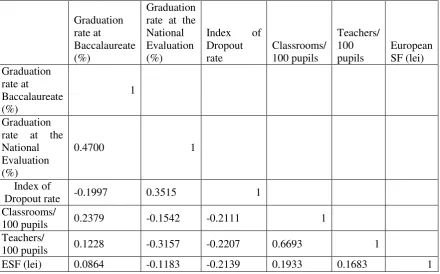
The correlation matrix was computed as a decision instrument in selecting the input and
output variables. If there are strong correlations between these variables, the number of
variables could be reduced by eliminating some of the variables correlated. The values of the
correlation coefficients reported below show that all the variables considered for the analysis
could be included in the DEA models, since the correlation existing between them is modest.
It should be noted that the statistical significance of the Pearson’s correlation coefficients
reported in Table 2 is not of interest for this research, as the statistical inference is not
Figure 1.
Source: authors’ computations, based on data from Ministry for Regional Development and Public Administration, www.inforegio.ro
In order to reduce the heterogeneity in the dataset, the log transformation was applied on the
data. The newly created variable has a coefficient of variation of 5%.
Table 2. Correlation matrix for the input and output variables
Graduation rate at Baccalaureate (%) Graduation rate at the National Evaluation (%)
Index of Dropout rate Classrooms/ 100 pupils Teachers/ 100 pupils European SF (lei) Graduation rate at Baccalaureate (%) 1 Graduation rate at the National Evaluation (%)
0.4700 1
Index of
Dropout rate -0.1997 0.3515 1
Classrooms/
100 pupils 0.2379 -0.1542 -0.2111 1
Teachers/
100 pupils 0.1228 -0.3157 -0.2207 0.6693 1
ESF (lei) 0.0864 -0.1183 -0.2139 0.1933 0.1683 1
0 10000000 20000000 30000000 40000000 50000000 60000000 70000000 MA R A MU R E S S U CE A V A IL F O V T UL CE A V A S L UI MU R S V A L CE A BUZA U S IB IU V R A N CE A DO L J CO V A S N A BA CA U CO N S T A N T A CA R A S S A T U MA R E BI H O R BR A S O V CL UJ BI S T R IT A O L T IA S I G A L A T I S A L A J BR A IL A A R G E S H A R G H IT A N E A M T H UN E DO A R A A R A D DA MB O V IT A
[image:15.595.74.515.487.761.2]6.2 Results of the DEA analysis
Several DEA models, both input and output oriented were applied for better evaluating
the efficiency of European SF invested in education in Romania.
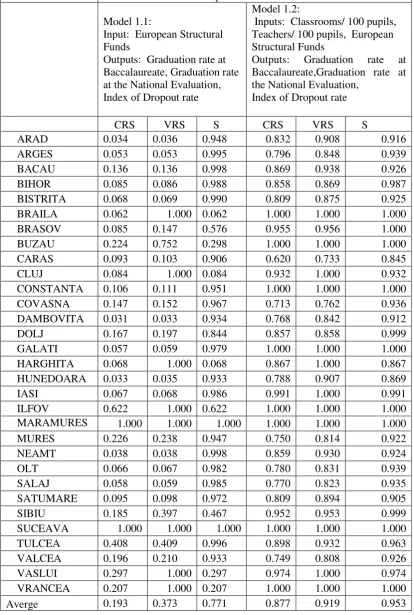
In the first DEA input oriented Model 1.1, we consider the European SF as input variable and the three output variables. There are eight counties on the efficiency frontier,
namely: Brăila, Cluj, Harghita, Ilfov, Maramureş, Suceava, Vaslui and Vrancea (see Table A1
in the Appendix). These counties were less successful in attracting SF, and yet they manage
to generate good education performance. This implies that SF only are not a sufficient
condition for achieving educational performance, and they need to be supported with other
resources. Model 1.2 described below includes all the input and output variables for
generating TE scores, computed in the CRS and VRS versions of DEA.
The average efficiency score under the assumption of constant return to scale is 0.887,
while in the case of variable return to scale the average efficiency is slightly higher, 0.919. In
both cases, the scores distributions are homogeneous. In practice, it is less likely to have
constant return to scale, and therefore in the following table the results from Model 1.2, input
oriented with VRS, are detailed.
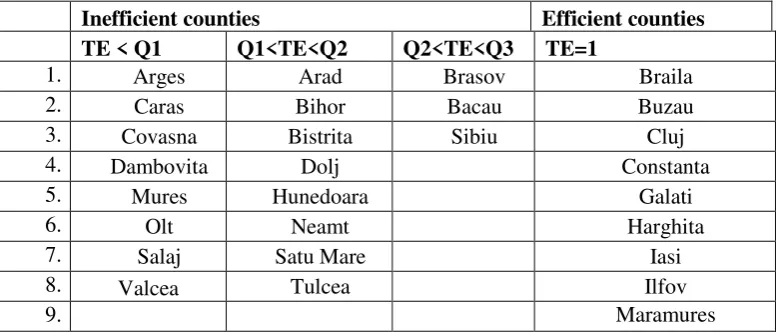
Table 3. Results from the Model 1.2, input oriented with VRS: counties distributed
according to efficiency scores.
Inefficient counties Efficient counties
TE < Q1 Q1<TE<Q2 Q2<TE<Q3 TE=1
1. Arges Arad Brasov Braila
2. Caras Bihor Bacau Buzau
3. Covasna Bistrita Sibiu Cluj
4. Dambovita Dolj Constanta
5. Mures Hunedoara Galati
6. Olt Neamt Harghita
7. Salaj Satu Mare Iasi
8. Valcea Tulcea Ilfov
[image:16.595.104.493.605.772.2]10. Suceava
11. Vaslui
12. Vrancea
The median score is 0.932, slightly higher compared to the average, implying a
dominance of high values which is also reflected by the share of counties situated on the
efficiency frontier.
We consider that the most appropriate model for the current research is the output
oriented one, which assumes maximizing the outputs with the same level of inputs. Keeping
in mind that the expected impact of investing SF in educational infrastructure is improving the
educational performance of students, by increasing the quality of the educational facilities, the
focus of the output oriented model is on the output indicators: the model assumes the
maximization of output variables, achieved with given inputs. Therefore, the most relevant
models seem to be the DEA output oriented models, described in the following part of the
paper. The efficiency scores for the applied DEA models are reported in Appendix.
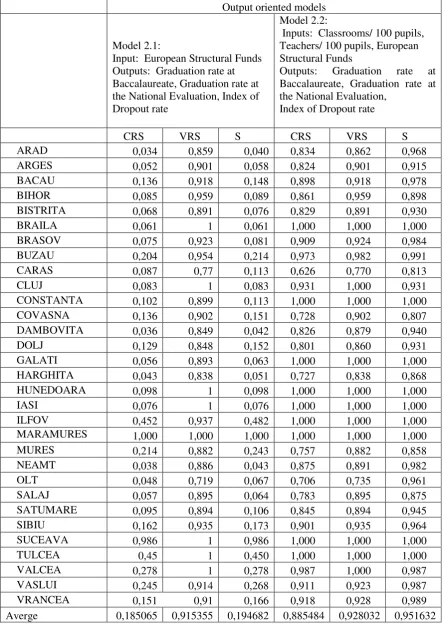
The first output oriented DEA model considers the SF as input variable and the three
output variables. On the efficiency frontier we find almost the same counties as in the input
oriented specification model: Brăila, Cluj, Hunedoara, Iasi, Maramures, Suceava, Tulcea and
Vâlcea (see Table A2 in Appendix). With the exception of Hunedoara County, all the other
counties have registered low levels of SF invested in educational infrastructure, implying that
high levels in the output variables were achieved with fixed, yet low levels SF.
Under these circumstances it is interesting to analyze the counties’ performance when
the set on input variables is increased with human resources and fixed capital. The average
efficiency scores are 0.885 in the CRS version and 0.928 under the VRS assumption. The
extended results after applying the DEA model in the complete model specification,
scores were computed in both the CRS and VRS versions of DEA, in the following table we
[image:18.595.78.519.208.408.2]report the synthesis of the results of the VRS model.
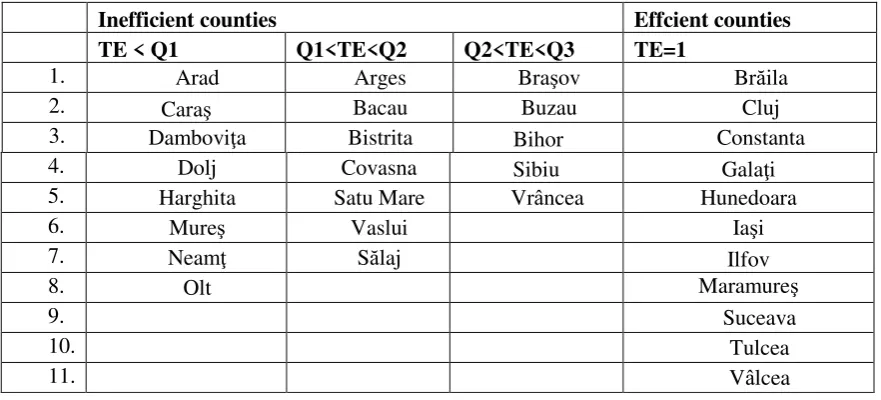
Table 4. Results of Model 2.2, output oriented with VRS: counties distributed according
to efficiency scores.
Inefficient counties Effcient counties
TE < Q1 Q1<TE<Q2 Q2<TE<Q3 TE=1
1. Arad Arges Braşov Brăila
2. Caraş Bacau Buzau Cluj
3. Damboviţa Bistrita Bihor Constanta
4. Dolj Covasna Sibiu Galaţi
5. Harghita Satu Mare Vrâncea Hunedoara
6. Mureş Vaslui Iaşi
7. Neamţ Sălaj Ilfov
8. Olt Maramureş
9. Suceava
10. Tulcea
11. Vâlcea
The results in Table 4 deserve further discussion. The distribution of the counties
seems to be more balanced compared to Model 1.2 and the median score is 0.924, almost
identical with the mean value. In the first quartile there are eight counties that are the least
efficient. These counties have modest education performance, but manage to attract high
amounts of funding for improving their educational infrastructure. Counties such as Arad,
Dâmboviţa or Harghita are among the top recipients of such financial resources, but the
efficiency of using them is relatively low. In the second group, with efficiency scores
ranging between the first and second quartile, there are seven counties, while five counties
have efficiency scores between the second and third quartile. Among these are counties
such as Braşov, Vrâncea, Sibiu, Bihor or Buzau. About one third of the counties in our
sample are efficient: Brăila, Cluj, Constanţa, Galaţi, Hunedoara, Iaşi, Ilfov, Maramureş and
counties like in the previous models. Among these we found counties that have attracted
financial resources above the average and managed to report good educational
performance. These counties are Brăila, Galaţi, Hunedoara and Iaşi. On the efficiency
frontier there are also counties with the lowest values of attracted funds and with low
levels of output indicators, such as Maramureş, Vâlcea, Tulcea, Ilfov. These results
confirm that when combined with human resources and fixed capital, the SF invested
through KAI 4.3 in Romania has led to higher values of output indicators.
The scale efficiency was also considered in the analysis, and scale was computed as
the ratio between efficiency scores produced in the CRS and VRS models. Not
surprisingly, the findings from both CRS and VRS models reflect a decreasing return to
scale for the great majority of the DMUs, with a coefficient of returns to scale lower than
1. This implies that an increase in inputs will generate a smaller increase in outputs.
Finally, five counties that were efficient in both models presented are also scale efficient:
Brăila, Constanţa, Galaţi, Ilfov, Maramureş, and Suceava.
7 Conclusions
In this research, the efficiency in using European structural funds for improving the
educational infrastructure was computed in several DEA models, both output and input
oriented. More than that, in the developed models both CRS and VRS was employed, the
focus being on output oriented model with VRS. The results confirm that there are disparities
among Romanian counties: the counties with a low accession rate to structural funds are the
ones with the lowest efficiency scores: Caraş, Vălcea, Mureş, Dâmboviţa, Sălaj, Olt. On the
other hand, on the efficiency frontier we have found counties with high SF values: Brăila,
The conclusions confirm the efficiency in using European structural funds in a number
of counties that have attracted important amounts of money, but at the same time there are
counties which are far from the efficiency frontier.
It is important to mention that our purpose in not to assess the impacts of the KAI 3.4
and the current research does not have the ambition of providing an impact evaluation, but to
assess the efficiency of using European SF, at county and regional level and to provide a
ranking of Romanian counties. This can be a strong starting point in validating the future
impact evaluations of the programme and also in understanding the regional disparities in
accessing SF for education. The projects implemented in counties with modest technical
efficiency scores could be closer monitored and better supported in achieving their results. In
such cases, the county administration needs to support various projects for generating a
synergetic effect that could contribute to decreasing the regional disparities existing in the
Appendix: Efficiency scores from DEA models Table A1
Input oriented models
Model 1.1:
Input: European Structural Funds
Outputs: Graduation rate at Baccalaureate, Graduation rate at the National Evaluation, Index of Dropout rate
Model 1.2:
Inputs: Classrooms/ 100 pupils, Teachers/ 100 pupils, European Structural Funds
Outputs: Graduation rate at Baccalaureate,Graduation rate at the National Evaluation,
Index of Dropout rate
CRS VRS S CRS VRS S
ARAD 0.034 0.036 0.948 0.832 0.908 0.916
ARGES 0.053 0.053 0.995 0.796 0.848 0.939
BACAU 0.136 0.136 0.998 0.869 0.938 0.926
BIHOR 0.085 0.086 0.988 0.858 0.869 0.987
BISTRITA 0.068 0.069 0.990 0.809 0.875 0.925
BRAILA 0.062 1.000 0.062 1.000 1.000 1.000
BRASOV 0.085 0.147 0.576 0.955 0.956 1.000
BUZAU 0.224 0.752 0.298 1.000 1.000 1.000
CARAS 0.093 0.103 0.906 0.620 0.733 0.845
CLUJ 0.084 1.000 0.084 0.932 1.000 0.932
CONSTANTA 0.106 0.111 0.951 1.000 1.000 1.000
COVASNA 0.147 0.152 0.967 0.713 0.762 0.936
DAMBOVITA 0.031 0.033 0.934 0.768 0.842 0.912
DOLJ 0.167 0.197 0.844 0.857 0.858 0.999
GALATI 0.057 0.059 0.979 1.000 1.000 1.000
HARGHITA 0.068 1.000 0.068 0.867 1.000 0.867
HUNEDOARA 0.033 0.035 0.933 0.788 0.907 0.869
IASI 0.067 0.068 0.986 0.991 1.000 0.991
ILFOV 0.622 1.000 0.622 1.000 1.000 1.000
MARAMURES 1.000 1.000 1.000 1.000 1.000 1.000
MURES 0.226 0.238 0.947 0.750 0.814 0.922
NEAMT 0.038 0.038 0.998 0.859 0.930 0.924
OLT 0.066 0.067 0.982 0.780 0.831 0.939
SALAJ 0.058 0.059 0.985 0.770 0.823 0.935
SATUMARE 0.095 0.098 0.972 0.809 0.894 0.905
SIBIU 0.185 0.397 0.467 0.952 0.953 0.999
SUCEAVA 1.000 1.000 1.000 1.000 1.000 1.000
TULCEA 0.408 0.409 0.996 0.898 0.932 0.963
VALCEA 0.196 0.210 0.933 0.749 0.808 0.926
VASLUI 0.297 1.000 0.297 0.974 1.000 0.974
VRANCEA 0.207 1.000 0.207 1.000 1.000 1.000
Table A2
Output oriented models
Model 2.1:
Input: European Structural Funds Outputs: Graduation rate at Baccalaureate, Graduation rate at the National Evaluation, Index of Dropout rate
Model 2.2:
Inputs: Classrooms/ 100 pupils, Teachers/ 100 pupils, European Structural Funds
Outputs: Graduation rate at Baccalaureate, Graduation rate at the National Evaluation,
Index of Dropout rate
CRS VRS S CRS VRS S
ARAD 0,034 0,859 0,040 0,834 0,862 0,968
ARGES 0,052 0,901 0,058 0,824 0,901 0,915
BACAU 0,136 0,918 0,148 0,898 0,918 0,978
BIHOR 0,085 0,959 0,089 0,861 0,959 0,898
BISTRITA 0,068 0,891 0,076 0,829 0,891 0,930
BRAILA 0,061 1 0,061 1,000 1,000 1,000
BRASOV 0,075 0,923 0,081 0,909 0,924 0,984
BUZAU 0,204 0,954 0,214 0,973 0,982 0,991
CARAS 0,087 0,77 0,113 0,626 0,770 0,813
CLUJ 0,083 1 0,083 0,931 1,000 0,931
CONSTANTA 0,102 0,899 0,113 1,000 1,000 1,000
COVASNA 0,136 0,902 0,151 0,728 0,902 0,807
DAMBOVITA 0,036 0,849 0,042 0,826 0,879 0,940
DOLJ 0,129 0,848 0,152 0,801 0,860 0,931
GALATI 0,056 0,893 0,063 1,000 1,000 1,000
HARGHITA 0,043 0,838 0,051 0,727 0,838 0,868
HUNEDOARA 0,098 1 0,098 1,000 1,000 1,000
IASI 0,076 1 0,076 1,000 1,000 1,000
ILFOV 0,452 0,937 0,482 1,000 1,000 1,000
MARAMURES 1,000 1,000 1,000 1,000 1,000 1,000
MURES 0,214 0,882 0,243 0,757 0,882 0,858
NEAMT 0,038 0,886 0,043 0,875 0,891 0,982
OLT 0,048 0,719 0,067 0,706 0,735 0,961
SALAJ 0,057 0,895 0,064 0,783 0,895 0,875
SATUMARE 0,095 0,894 0,106 0,845 0,894 0,945
SIBIU 0,162 0,935 0,173 0,901 0,935 0,964
SUCEAVA 0,986 1 0,986 1,000 1,000 1,000
TULCEA 0,45 1 0,450 1,000 1,000 1,000
VALCEA 0,278 1 0,278 0,987 1,000 0,987
VASLUI 0,245 0,914 0,268 0,911 0,923 0,987
VRANCEA 0,151 0,91 0,166 0,918 0,928 0,989
Bibliography
Aristovnik, Aleksander, and Alka Obadić. "Measuring relative efficiency of secondary education
in selected EU and OECD countries: the case of Slovenia and Croatia." Technological and Economic Development of Economy 20.3 (2014): 419-433.
Becker, Sascha O., Peter H. Egger, and Maximilian Von Ehrlich. "Going NUTS: The effect of EU Structural Funds on regional performance." Journal of Public Economics 94.9 (2010): 578-590.
Charnes, Abraham, Cooper W. William and E. Rhodes. “Measuring the efficiency of decision making units”, European Journal of Operational. Research 2. (1978). 429-444.
Charnes, Abraham, William W. Cooper, Arie Y. Lewin, Lawrence M. Seiford. Data Envelopment Analysis: Theory, Methodology and Applications, Boston: Kluwer Academic Publishers. 1994.
Coelli, Timothy, Dodla Sai Prasada Rao, George Edward Battese. An introduction to efficiency and productivity analysis, Boston : Kluwer Academic Publishers 1998.
De la Fuente, Angel, and Xavier Vives. "Infrastructure and education as instruments of regional policy: evidence from Spain." Economic policy 10.20 (1995): 11-51.
Dobrescu, Emilian, and Diana-Mihaela Pociovalisteanu. "Regional Development and Socio-Economic Diversity In Romania." Annals-Economy Series 6 (2014): 55-59.
European Commission/EACEA/Eurydice, 2013. Funding of Education in Europe 2000-2012: The Impact of the Economic Crisis. Eurydice Report. Luxembourg: Publications Office of the European Union.
Fartușnic, C. et al Financing pre-university education system based on standards cost. Current evaluation from the equity perspective, Bucharest: Institute of Educational Sciences, UNICEF Romania, (2014).
Gupta, Sanjeev, and Marijn Verhoeven. "The efficiency of government expenditure: experiences from Africa." Journal of policy modeling 23.4 (2001): 433-467.
Hagen, Tobias and Mohl, Philipp. “Econometric evaluation of EU Cohesion Policy: a survey”.
ZEW Discussion Papers, No. 09-052 (2009).
Karkazis, J. and Emmanuel Thanassoulis. “Assessing the Effectiveness of Regional Development Policies in Northern Greece.” Socio-Economical Planning Science 32, no 2. (1998). 123-137.
Mohl, Philipp, and Tobias Hagen. "Do EU structural funds promote regional growth? New evidence from various panel data approaches." Regional Science and Urban Economics 40.5 (2010): 353-365.
Pettas, Nikolaos, and Ioannis Giannikos. "Evaluating the delivery performance of public spending programs from an efficiency perspective." Evaluation and program planning 45 (2014): 140-150.
Pinho, Carlos, Celeste Varum, and Micaela Antunes. "Structural Funds and European Regional Growth: Comparison of Effects among Different Programming Periods." European Planning Studies ahead-of-print (2014): 1-25.
Puigcerver-Peñalver, Mari-Carmen. "The impact of structural funds policy on European regions growth. A theoretical and empirical approach." The European Journal of Comparative Economics 4.2 (2007): 179-208.
Rhodes, E., Southwick, L. Determinants of efficiency in Public and Private Universities. Department of Economics, University of South Carolina. 1986.
Roman, Monica and Christina Suciu. "Analiza eficienţei activităţii de cercetare dezvoltare
inovare prin metoda DEA [The Efficency Analysis Of R&D Activities By Using Dea]," MPRA Paper 44000, 2012. University Library of Munich, Germany.
Singh, Sanjeet. "Evaluation of world’s largest social welfare scheme: An assessment using non -parametric approach." Evaluation and program planning 57 (2016): 16-29.
Stanef, Mihaela Roberta. "Urban and rural educational system disparities in Romania." Theoretical and Applied Economics 18.1 (578) (2013): 121-130.
Traşcă, Daniela Livia, Mirela Ionela Aceleanu, and Daniela Sahlian. "Territorial efficiency of the
cohesion policy in Romania." Theoretical and Applied Economics 18.1 (578) (2013): 103-112.