Proceedings of the 2019 Conference on Empirical Methods in Natural Language Processing
434
Joint Event and Temporal Relation Extraction with Shared
Representations and Structured Prediction
Rujun Han,1,2Qiang Ning,3 Nanyun Peng1,2
1Department of Computer Science, University of Southern California 2Information Sciences Institute, University of Southern California
3Department of Electrical and Computer Engineering, University of Illinois at Urbana-Champaign
[email protected], [email protected], [email protected]
Abstract
We propose a joint event and temporal rela-tion extracrela-tion model with shared representa-tion learning and structured predicrepresenta-tion. The proposed method has two advantages over ex-isting work. First, it improves event represen-tation by allowing the event and relation mod-ules to share the same contextualized embed-dings and neural representation learner. Sec-ond, it avoids error propagation in the conven-tional pipeline systems by leveraging struc-tured inference and learning methods to assign both the event labels and the temporal rela-tion labels jointly. Experiments show that the proposed method can improve both event ex-traction and temporal relation exex-traction over state-of-the-art systems, with the end-to-end
F1improved by 10% and 6.8% on two
bench-mark datasets respectively. 1 Introduction
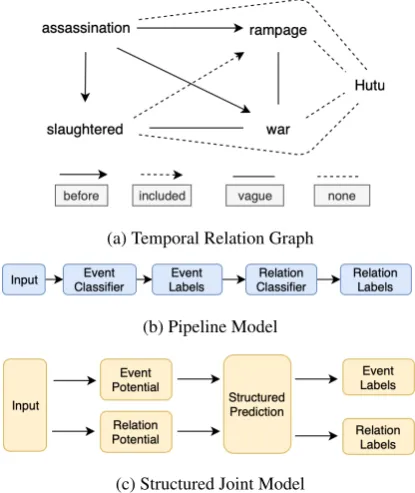
The extraction of temporal relations among events is an important natural language understanding (NLU) task that can benefit many downstream tasks such as question answering, information re-trieval, and narrative generation. The task can be modeled as building a graph for a given text, whose nodes represent events and edges are la-beled with temporal relations correspondingly. Figure 1a illustrates such a graph for the text shown therein. The nodesassassination, slaugh-tered, rampage, war, and Hutu are the candi-date events, and different types of edges spec-ify different temporal relations between them: as-sassination is BEFORErampage, rampage IN-CLUDES slaughtered, and the relation between
slaughteredandwarisVAGUE. Since “Hutu” is actually not an event, a system is expected to an-notate the relations between “Hutu” and all other nodes in the graph asNONE(i.e., no relation).
As far as we know, all existing systems treat this task as a pipeline of two separate subtasks,
(a) Temporal Relation Graph
(b) Pipeline Model
[image:1.595.311.519.270.517.2](c) Structured Joint Model
Figure 1: An illustration of event and relation models in our proposed joint framework. (a) is a (partial) graph of the output of the relation extraction model. “Hutu” is not an event and hence all relations including it should be annotated asNONE. (b) and (c) are comparisons be-tween a pipeline model and our joint model.
i.e., event extraction and temporal relation classi-fication, and they also assume that gold events are given when training the relation classifier ( Ver-hagen et al., 2007, 2010;UzZaman et al., 2013;
ex-tracts both events and temporal relations simulta-neously (see Fig. 1c). The motivation is that if we train the relation classifier with NONE rela-tions between non-events, then it will potentially have the capability of correcting event extraction mistakes. For instance in Fig. 1a, if the relation classifier predictsNONE for (Hutu, war) with a high confidence, then this is a strong signal that can be used by the event classifier to infer that at least one of them is not an event.
Our second contribution is that we improve event representations by sharing the same con-textualized embeddings and neural representation learner between the event extraction and tempo-ral relation extraction modules for the first time. On top of the shared embeddings and neural rep-resentation learner, the proposed model produces a graph-structured output representing all the events and relations in the given sentences.
A valid graph prediction in this context should satisfy two structural constraints. First, the tem-poral relation should always be NONE between two events or between one event and one non-event. Second, for those temporal relations among events, no loops should exist due to the transitive property of time (e.g., if A is beforeB and Bis beforeC, thenAmust be beforeC). The validity of a graph is guaranteed by solving an integer lin-ear programming (ILP) optimization problem with those structural constraints, and our joint model is trained by structural support vector machines (SSVM) in an end-to-end fashion.
Results show that, according to the end-to-end
F1score for temporal relation extraction, the pro-posed method improves CAEVO (Chambers et al.,
2014) by 10% on TB-Dense, and improves Cog-CompTime (Ning et al.,2018c) by 6.8% on MA-TRES. We further show ablation studies to con-firm that the proposed joint model with shared rep-resentations and structured learning is very effec-tive for this task.
2 Related Work
In this section we briefly summarize the existing work on event extraction and temporal relation ex-traction. To the best of our knowledge, there is no prior work on joint event and relation extraction, so we will review jointentity and relation extrac-tion works instead.
Existingevent extractionmethods in the tem-poral relation domain, as in the TempEval3
work-shop (UzZaman et al.,2013), all use conventional machine learning models (logistic regression, SVM, or Max-entropy) with hand-engineered fea-tures (e.g., ClearTK (Bethard, 2013) and Navy-Time (Chambers, 2013)). While other domains have shown progress on event extraction using neural methods (Nguyen and Grishman, 2015;
Nguyen et al., 2016; Feng et al., 2016), recent progress in the temporal relation domain is fo-cused more on the setting where gold events are provided. Therefore, we first show the perfor-mance of a neural event extractor on this task, al-though it is not our main contribution.
Early attempts on temporal relation extrac-tion use local pair-wise classification with hand-engineered features (Mani et al., 2006; Verha-gen et al., 2007; Chambers et al., 2007; Verha-gen and Pustejovsky, 2008). Later efforts, such as ClearTK (Bethard, 2013), UTTime ( Laokul-rat et al., 2013), NavyTime (Chambers, 2013), and CAEVO (Chambers et al., 2014) improve earlier work with better linguistic and syntac-tic rules. Yoshikawa et al. (2009); Ning et al.
(2017); Leeuwenberg and Moens (2017) explore structured learning for this task, and more re-cently, neural methods have also been shown ef-fective (Tourille et al., 2017;Cheng and Miyao,
2017;Meng et al., 2017; Meng and Rumshisky,
2018).
In practice, we need to extract both events and those temporal relations among them from raw text. All the works above treat this as two sub-tasks that are solved in a pipeline. To the best of our knowledge, there has been no existing work on
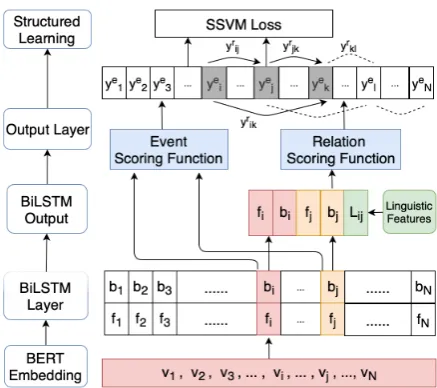
Figure 2: Deep neural network architecture for joint structured learning. Note that on the structured learn-ing layer, grey bars denote tokens belearn-ing predicted as events. Edge types between events follow the same notations as in1a. ye
l = 0 (non-event), so all edges
connecting toye
l areNONE.yei = 1, yej = 1, yek = 1
(events) and hence edges between them are forced to be the same (yr
ij =yrjk =yrik =BEFOREin this
exam-ple) by transitivity. These global assignments are input to compute the SSVM loss.
search. Motivated by these works, we propose an end-to-end trainable neural structured support vector machine (neural SSVM) model to simul-taneously extract events and their relations from text and ensure the global structure via ILP con-straints. Next, we will describe in detail our pro-posed method.
3 Joint Event-Relation Extraction Model In this section we first provide an overview of our neural SSVM model, and then describe each com-ponent in our framework in detail (i.e., the multi-tasking neural scoring module, and how inference and learning are performed). We denote the set of all possible relation labels (including NONE) asR, all event candidates (both events and non-events) asE, and all relation candidates asEE. 3.1 Neural SSVM
Our neural SSVM adapts the SSVM loss as:
L=
l X
n=1
C
Mn
⇥
max
ˆ
yn2Y 0, (y
n,yˆn) + ¯Sn R (1)
+CES¯En ⇤+|| ||2,
whereS¯n
E = S(ˆynE;xn) S(ynE;xn)andS¯Rn =
S(ˆynR;xn) S(ynR;xn); denotes model
param-eters,nindexes instances,Mn=|E|n+|EE|n
de-notes the total number of relations|E|nand events
|EE|n in instance n. yn,yˆn denote the gold and predicted global assignments of events and rela-tions for instancen—each of which consists of ei-ther one hot vector representing true and predicted relation labelsynR,yˆRn 2 {0,1}|EE|, or entity
la-bels yn
E,yˆnE 2 {0,1}|E|. A maximum a posteri-ori probability (MAP) inference is needed to find ˆ
yn, which we formulate as an interger linear
pro-gramming (ILP) problem and describe more de-tails in Section3.3. (yn,yˆn)is a distance
mea-surement between the gold and the predicted as-signments; we simply use the Hamming distance.
CandCEare the hyper-parameters to balance the
losses between event, relation and the regularizer, andS(yn
E;xn), S(ynR;xn) are scoring functions, which we design a multi-tasking neural architec-ture to learn.
The intuition behind the SSVM loss is that it requires the score of gold output structure yn to
be greater than the score of the best output struc-ture under the current model yˆn with a margin
(yn,yˆn)1 or else there will be some loss. The
training objective is to minimize the loss.
The major difference between our neural-SSVM and the traditional neural-SSVM model is the scoring function. Traditional SSVM uses a linear function over hand-crafted features to compute the scores, whereas we propose to use a recurrent neu-ral network to estimate the scoring function and train the entire architecture end-to-end.
3.2 Multi-Tasking Neural Scoring Function
The recurrent neural network (RNN) architecture has been widely adopted by prior temporal extrac-tion work to encode context informaextrac-tion (Tourille et al.,2017;Cheng and Miyao,2017;Meng et al.,
2017). Motivated by these works, we adopt a RNN-based scoring function for both event and relation prediction in order to learn features in a data driven way and capture long-term contexts in the input. In Fig. 2, we skip the input layer for simplicity.2
The bottom layer corresponds to contextualized word representations denoted asvk. We use (i, j)
2 EE to denote a candidate relation andi 2 E to 1Note that if the best prediction is the same as the gold
structure, the margin is zero; there will be no loss.
2Following the convention of event relation prediction
[image:3.595.71.290.63.257.2]indicate a candidate event in the input sentences of length N. We fix word embeddings computed by a pre-trained BERT-base model (Devlin et al.,
2018). They are then fed into a BiLSTM layer to further encode task-specific contextual informa-tion. Both event and relation tasks share this layer. The event scorer is illustrated by the left two branches following the BiLSTM layer. We sim-ply concatenate both forward and backward hid-den vectors to encode the context of each to-ken. As for the relation scorer shown in the right branches, for each pair (i, j) we take the forward and backward hidden vectors corresponding to them,fi, bi, fj, bj, and concatenate them with lin-guistic features as in previous event relation pre-diction research. We denote linguistic features as
Li,j and only use simple features provided in the original datasets: token distance, tense, and polar-ity of events.
Finally, all hidden vectors and linguistic fea-tures are concatenated to form the input to com-pute the probability of being an event or a soft-max distribution over all possible relation labels— which we refer to as the RNN-basedscoring func-tionin the following sections.
3.3 MAP Inference
A MAP inference is needed both during training to obtainyˆn in the loss function (Equation1), as
well as during the test time to get globally coherent assignments. We formulate the inference problem as an ILP problem. The inference framework is es-tablished by constructing a global objective func-tion using scores from local scorers and impos-ing several global constraints: 1) one-label assign-ment, 2) event-relation consistency, and 3) sym-metry and transitivity as inBramsen et al.(2006);
Chambers and Jurafsky(2008);Denis and Muller
(2011);Do et al.(2012);Ning et al.(2017).
3.3.1 Objective Function
The objective function of the global inference is to find the global assignment that has the highest probability under the current model, as specified in Equation2:
ˆ
y= arg max X (i,j)2EE
X
r2R
yi,jr S(yi,jr ,x) (2)
+CEX k2E
X
e2{0,1}
ykeS(yke,x)
s.t.yi,jr , yek2{0,1},
X
r2R
yi,jr = 1,
X
e2{0,1}
yke= 1,
where ye
k is a binary indicator of whether the k -th candidate is an event or not, and yri,j is a
bi-nary indicator specifying whether the global pre-diction of the relation between (i, j) is r 2 R.
S(yke,x),8e 2 {0,1} and S(yri,j,x),8r 2 R
are the scoring functions obtained from the event and relation scoring functions, respectively. The output of the global inference ˆy is a collection of optimal label assignments for all events and relation candidates in a fixed context. CE is a
hyper-parameter controlling weights between re-lation and event. The constraint that follows im-mediately from the objective function is that the global inference should only assign one label for all entities and relations.
3.3.2 Constraints
We introduce several additional constraints to en-sure the resulting optimal output graph forms a valid and plausible event graph.
Event-Relation Consistency. Event and rela-tion predicrela-tion consistency is defined with the fol-lowing property: a pair of input tokens have a positive temporal relation if and only if both to-kens are events. The following global constraints will satisfy this property,
8(i, j)2EE, ePi rPi,j ,ePj ri,jP
andeNi +eNj rNi,j
whereePi denotes an event andeNi denotes a
non-event token. rP
i,j indicates positive relations:
BE-FORE, AFTER, SIMULTANEOUS, INCLUDES,
IS INCLUDED, VAGUE and rNi,j indicate a
neg-ative relation, i.e.,NONE. A formal proof of this property can be found in AppendixA.
Symmetry and Transitivity Constraint. We also explore the symmetry and transitivity con-straints of relations. They are specified as follows:
8(i, j),(j, k)2EE, yi,jr =yrj,i¯ , (symmetry)
yr1i,j+yr2j,k X r32T rans(r1,r2)
yi,kr3 1,(transitivity)
Intuitively, the symmetry constraint forces two pairs of events with flipping orders to have re-versed relations. For example, ifri,j =BEFORE, thenrj,i=AFTER. The transitivity constraint rules that if (i, j), (j, k) and (i, k) pairs exist in the
has to fall into the transitivity set specifyed by (i, j) and (j, k) pairs. The full transitivity table can
be found inNing et al.(2018a).
3.4 Learning
We begin by experimenting with optimizing SSVM loss directly, but model performance de-grades.3 Therefore, we develop a two-state
learn-ing approach which first trains a pipeline version of the joint model without feedback from global constraints. In other words, the local neural scor-ing functions are optimized with cross-entropy loss using gold events and relation candidates that are constructed directly from the outputs of the event model. During the second stage, we switch to the global SSVM loss function in Equation 1
and re-optimize the network to adjust for global properties. We will provide more details in Sec-tion4.
4 Implementation Details
In this section we describe implementation de-tails of the baselines and our four models to build an end-to-end event temporal relation extraction system with an emphasis on the structured joint model. In Section6we will compare and contrast them and show why our proposed structured joint model works the best.
4.1 Baselines
We run two event and relation extraction sys-tems, CAEVO4 (Chambers et al.,2014) and
Cog-CompTime5 (Ning et al., 2018c), on TB-Dense
and MATRES, respectively. These two methods both leverage conventional learning algorithms (i.e., MaxEnt and averaged perceptron, respec-tively) based on manually designed features to ob-tain separate models for events and temporal re-lations, and conduct end-to-end relation extrac-tion as a pipeline. Note Chambers et al. (2014) does not report event and end-to-end temporal re-lation extraction performances, so we calculate the scores per our implementation.
3We leave further investigation for future work. 4https://www.usna.edu/Users/cs/ nchamber/caevo/
5http://cogcomp.org/page/publication_ view/844
4.2 End-to-End Event Temporal Relation Extraction
Single-Task Model. The most basic way to build an end-to-end system is to train separate event detection and relation prediction models with gold labels, as we mentioned in our intro-duction. In other words, the BiLSTM layer is not shared as in Fig. 2. During evaluation and test time, we use the outputs from the event detection model to construct relation candidates and apply the relation prediction model to make the final pre-diction.
Multi-Task Model. This is the same as the single-task model except that the BiLSTM layer is now shared for both event and relation tasks. Note that both single-task and multi-task models are not trained to tackle the NONE relation di-rectly. They both rely on the predictions of the event model to annotate relations as either positive pairs orNONE.
Pipeline Joint Model. This shares the same ar-chitecture as the multi-task model, except that dur-ing traindur-ing, we use the predictions of the event model to construct relation candidates to train the relation model. This strategy will generateNONE
pairs during training if one argument of the rela-tion candidate is not an event. TheseNONEpairs will help the relation model to distinguish nega-tive relations from posinega-tive ones, and thus become more robust to event prediction errors. We train this model with gold events and relation candi-dates during the first several epochs in order to ob-tain a relatively accurate event model and switch to a pipeline version afterwards inspired byMiwa and Bansal(2016).
Structured Joint Model. This is described in detail in Section3. However, we experience diffi-culties in training the model with SSVM loss from scratch. This is due to large amounts of non-event tokens, and the model is not capable of distin-guishing them in the beginning. We thus adopt a two-stage learning procedure where we take the best pipeline joint model and re-optimize it with the SSVM loss.
model where events are first predicted and rela-tions are constructed withpredictedevents. Here, we only leverage an additional hyper-parameter
Tevtto filter out highly unlikely event candidates. Both event and relation labels are assigned simu-taneouslyduring the global inference with ILP, as specified in Section3.3. We also filter out tokens with POS tags that do not appear in the training set as most of the events are either nouns or verbs in TB-Dense, and all events are verbs in MATRES.
Hyper-Parameters. All single-task, multi-task and pipeline joint models are trained by minimiz-ing cross-entropy loss. We observe that model per-formances vary significantly with dropout ratio, hidden layer dimensions of the BiLSTM model and entity weight in the loss function (with re-lation weight fixed at 1.0). We leverage a pre-trained BERT model to compute word embed-ding6and all MLP scoring functions have one
hid-den layer.7 In the SSVM loss function, we fix the
value of C = 1, but fine-tune CE in the objec-tive function in Equation2. Hyper-parameters are chosen using a standard development set for TB-Dense and a random holdout-set based on an 80/20 split of training data for MATRES. To solve ILP in the inference process, we leverage an off-the-shelf solver provided by Gurobi optimizer; i.e. the best solutions from the Gurobi optimizer are in-puts to the global training. The best combination of hyper-parameters can be found in Table9in our appendix.8
5 Experimental Setup
In this section we first provide a brief overview of temporal relation data and describe the specific datasets used in this paper. We also explain the evaluation metrics at the end.
5.1 Temporal Relation Data
Temporal relation corpora such as TimeBank (Pustejovsky et al., 2003) and RED (O’Gorman et al.,2016) facilitate the research in temporal re-lation extraction. The common issue in these cor-pora is missing annotations. Collecting densely
6We use a pre-trained BERT-Base model with
768 hidden size, 12 layers, 12 heads implemented
by https://github.com/huggingface/
pytorch-pretrained-BERT
7LetH, Kdenotes the dimension of (concatenated)
vec-tor from BiLSTM and number of output classes. MLP layer consists of|H|⇤|K|+|K|⇤|K|parameters
8PyTorch code will be made available upon acceptance.
TB-Dense MATRES
# of Documents
Train 22 183
Dev 5
-Test 9 20
# of Pairs
Train 4032 6332
Dev 629
[image:6.595.350.481.59.160.2]-Test 1427 827
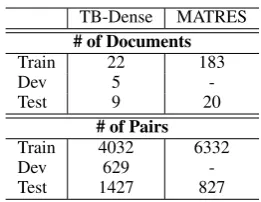
Table 1: Data overview. Note that the numbers reported for MATRES do not include the AQUAINT section.
annotated temporal relation corpora with all events and relations fully annotated is reported to be a challenging task as annotators could easily over-look some facts (Bethard et al., 2007; Cassidy et al., 2014; Chambers et al., 2014; Ning et al.,
2017), which made both modeling and evaluation extremely difficult in previous event temporal re-lation research.
The TB-Dense dataset mitigates this issue by forcing annotators to examine all pairs of events within the same or neighboring sentences, and it has been widely evaluated on this task (Chambers et al.,2014;Ning et al.,2017;Cheng and Miyao,
2017;Meng and Rumshisky,2018). Recent data construction efforts such as MATRES (Ning et al.,
2018a) further enhance the data quality by using a multi-axis annotation scheme and adopting a start-point of events to improve inter-annotator agree-ments. We use TB-Dense and MATRES in our ex-periments and briefly summarize the data statistics in Table1.
5.2 Evaluation Metrics
To be consistent with previous research, we adopt two different evaluation metrics. The first one is the standard micro-average scores. For densely annotated data, the micro-average metric should share the same precision, recall and F1 scores. However, since our joint model includes NONE
pairs, we follow the convention of IE tasks and exclude them from evaluation. The second one is similar except that we exclude both NONE
andVAGUEpairs following (Ning et al., 2018c). Please refer to Figure4in the appendix for a visu-alizations of the two metrics.
6 Results and Analysis
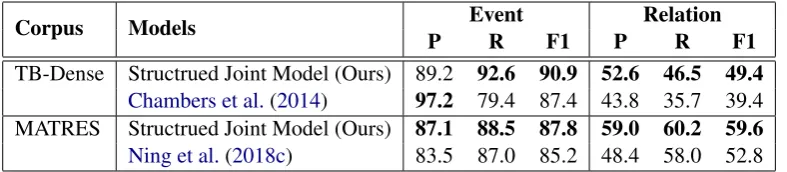
Corpus Models P EventR F1 P RelationR F1
[image:7.595.104.498.62.148.2]TB-Dense Structrued Joint Model (Ours) 89.2 92.6 90.9 52.6 46.5 49.4 Chambers et al.(2014) 97.2 79.4 87.4 43.8 35.7 39.4 MATRES Structrued Joint Model (Ours) 87.1 88.5 87.8 59.0 60.2 59.6 Ning et al.(2018c) 83.5 87.0 85.2 48.4 58.0 52.8
Table 2: Event and Relation Extraction Results on TB-Dense and MATRES
Micro-average TB-Dense MATRES
F1 (%) Event Relation (G) Relation (E) Event Relation (G) Relation (E)
Baselines 87.4† 57.0‡ 39.4† 85.2 65.9 52.8
Single-task 88.6 61.9 44.3 86.9 75.3 57.2
Multi-task 89.2 64.5 48.4 86.4 75.5 58.7
Pipeline Joint 90.3 - 48.5 87.2 - 58.5
Structured Joint 90.9 - 49.4 87.8 - 59.6
Table 3: Further ablation studies on event and relation extractions. Relation (G) denotes train and evaluate using gold events to compose relation candidates, whereas Relation (E) means end-to-end relation extraction. †is the event extraction and pipeline relation extraction F1 scores for CAEVO (Chambers et al.,2014). 57.0‡is the best previously reported micro-average score for temporal relation extraction based on gold events byMeng and Rumshisky(2018). All MATRES baseline results are provided byNing et al.(2018c).
3.5% and 2.6% on event extraction per F1 scores. The best precision score for the TB-Dense dataset is achieved by CAEVO, which indicates that the linguistic rule-based system can make highly pre-cise predictions by being conservative.
Table 3 shows a more detailed analysis, in which we can see that our single-task models with BERT embeddings and a BiLSTM encoder al-ready outperform the baseline systems on end-to-end relation extraction tasks by 4.9% and 4.4% re-spectively. In the following sections we discuss step-by-step improvement by adopting multi-task, pipeline joint, and structured joint models on end-to-end relation extraction, event extraction, and re-lation extraction on gold event pairs.
6.1 End-to-End Relation Extraction
TB-Dense. The improvements over the single-task model per F1 score are 4.1% and 4.2% for the multi-task and pipeline joint model respec-tively. This indicates that the pipeline joint model is helpful only marginally. Table 4 shows that the structured joint model improves both preci-sion and recall scores for BEFORE and AFTER
and achieves the best end-to-end relation extrac-tion performance at 49.4%—which outperforms the baseline system by 10.0% and the single-task model by 5.1%.
MATRES. Compared to the single-task model, the multi-task model improves F1 scores by 1.5%, while the pipeline joint model improves F1 scores by 1.3%—which means that pipeline joint train-ing does not brtrain-ing any gains for MATRES. The structured joint model reaches the best end-to-end F1 score at 59.6%, which outperforms the base-line system by 6.8% and the single-task model by 2.4%. We speculate that the gains come from the joint model’s ability to help deal withNONEpairs, since recall scores for BEFORE and AFTER in-crease by 1.5% and 1.1% respectively (Table10in our appendix).
6.2 Event Extraction
TB-Dense. Our structured joint model out-performs the CAEVO baseline by 3.5% and the single-task model by 1.3%. Improvements on event extraction can be difficult because our single-task model already works quite well with a close-to 89% F1 score, while the inter-annotator agreement for events in TimeBank documents is merely 87% (UzZaman et al.,2013).
CAEVO Pipeline Joint Structure Joint
P R F1 P R F1 P R F1
B 41.4 19.5 26.5 59.0 46.9 52.3 59.8 46.9 52.6
A 42.1 17.5 24.7 69.3 45.3 54.8 71.9 46.7 56.6
I 50.0 3.6 6.7 - - -
-II 38.5 9.4 15.2 - - -
-S 14.3 4.5 6.9 - - -
-V 44.9 59.4 51.1 45.1 55.0 49.5 45.9 55.8 50.4
[image:8.595.73.292.60.157.2]Avg 43.8 35.7 39.4 51.5 45.9 48.5 52.6 46.5 49.4
Table 4: Model performance breakdown for TB-Dense. “-” indicates no predictions were made for that particu-lar label, probably due to the small size of the train-ing sample. BEFORE (B), AFTER(A),INCLUDES (I),
IS INCLUDED(II),SIMULTANEOUS(S),VAGUE(V)
that incorporating relation signals are not partic-ularly helpful for event extraction on MATRES. We speculate that one of the reasons could be the unique event characteristics in MATERS. As we described in Section 5.1, all events in MATRES are verbs. It is possible that a more concentrated single-task model works better when events are homogeneous, whereas a multi-task model is more powerful when we have a mixture of event types, e.g., both verbs and nouns as in TB-Dense.
6.3 Relation Extraction with Gold Events TB-Dense. There is much prior work on rela-tion extracrela-tion based on gold events in TB-Dense.
Meng and Rumshisky (2018) proposed a neural model with global information that achieved the best results as far as we know. The improve-ment of our single-task model over that baseline is mostly attributable to the adoption of BERT em-bedding. We show that sharing the LSTM layer for both events and relations can help further improve performance of the relation classification task by 2.6%. For the joint models, since we do not train them on gold events, the evaluation would be meaningless. We simply skip this evaluation.
MATRES. Both single-task and multi-task models outperform the baseline by nearly 10%, while the improvement of multi-task over single task is marginal. In MATRES, a relation pair is equivalent to a verb pair, and thus the event prediction task probably does not provide much more information for relation extraction.
In Table 4we further show the breakdown per-formances for each positive relation on TB-Dense. The breakdown on MATRES is shown in Table10
in the appendix. BEFORE, AFTER andVAGUE
are the three dominant label classes in TB-Dense. We observe that the linguistic rule-based model, CAEVO, tends to have a more evenly spread-out
Labels TB-Dense MATRES
BEFORE 384 417
AFTER 274 266
INCLUDES 56 –
IS INCLUDED 53 –
SIMULTANEOUS 22 31
VAGUE 638 113
Table 5: Label Size Breakdown in the Test Data
Figure 3: Performances from a single-task relation model under different class weights. Left-axis: over-all model; right-axis: two minority relations.
performance, whereas our neural network-based models are more likely to have concentrated pre-dictions due to the imbalance of the training sam-ple across different label classes.
6.4 Discussion
Label Imbalance. One way to mitigate the label imbalance issue is to increase the sample weights for small classes during model training. We in-vestigate the impact of class weights by refit-ting our single-task model with larger weights on
INCLUDES, IS INCLUDED and VAGUE in the cross-entropy loss.
Figure 3shows that increasing class weights up to 4 times can significantly improve the F1 scores ofINCLUDESandIS INCLUDEDclasses with a decrease less than 2% for the overall F1 score. Performance of INCLUDES and IS INCLUDED
eventually degrades when class weights are too large. These results seem to suggest that more labels are needed in order to improve the perfor-mance on both of these two classes and the overall model. ForSIMULTANEOUS, our model does not make any correct predictions for both TB-DENSE and MATRES by increasing class weight up to 10 times, which implies thatSIMULTANEOUScould be a hard temporal relation to predict in general.
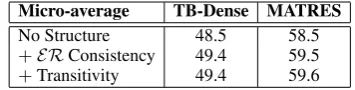
[image:8.595.322.512.163.289.2]consis-Micro-average TB-Dense MATRES
No Structure 48.5 58.5
+ERConsistency 49.4 59.5
[image:9.595.314.517.60.190.2]+Transitivity 49.4 59.6
Table 6: Ablation Study on Global Constraints
tency constraint and the temporal relation tran-sitivity constraint for the structured joint model. As we can see, the event-relation consistency helps improve the F1 scores by 0.9% and 1% for TB-Dense and MATRES, respectively, but the gain by using transitivity is either non-existing or marginal. We hypothesize two potential reasons: 1) We leveraged BERT contextualized embedding as word representation, which could tackle transi-tivity in the input context; 2) NONE pairs could make transitivity rule less useful, as positive pairs can be predicted as NONE and transitivity rule does not apply toNONEpairs.
Error Analysis. By comparing gold and pre-dicted labels for events and temporal relations and examining predicted probabilities for events, we identified three major sources of mistakes made by our structured model, as illustrated in Table7with examples.
Type 1. Both events in Ex 1 are assigned low scores by the event module (<< 0.01). Although the structured joint model is designed to predict events and relations jointly, we leverage the event module to filter out tokens with scores lower than a threshold. Consequently, some true events can be mistakenly predicted as non-events, and the re-lation pairs including them are automatically as-signedNONE.
Type 2. In Ex 2 the event module assigns high scores to tokens happened (0.97) and accord-ing(0.89), but accordingis not an event. When the structured model makes inference jointly, the decision will weigh heavily towards assigning 1
(event) to both tokens. With the event-relation consistency constraint, this pair is highly likely to be predicted as having a positive temporal relation. Nearly all mistakes made in this category follow the same pattern illustrated by this example.
Type 3. The existence of VAGUE makes tem-poral relation prediction challenging as it can be easily confused with other temporal relations, as shown in Ex 3. This challenge is compounded withNONEin our end-to-end extraction task.
Type 1 and Type 2 errors suggest that building a stronger event detection module will be helpful for
Type 1: Event predicted as non-event 189 pairs
Ex 1.What Microsoft gets are developers around the worldworkingon ideas that could potentiallyopen
up Kinect for Windows ...
Type 2:NONEpredicted as true relation 135 pairs
Ex 2.Mr. Netanyahu told Mr. Erdogan that what
happenedon board the Mavi Marmara was “unintentional” ... ,accordingto the statement.
Type 3:VAGUErelation 87 pairs
Ex 3.Microsoftsaidit has identified 3 companies for the China program to run through June. The company
giveseach participating startup $ 20,000 to create ...
Table 7: Error Types Based on MATRES Test Data both event and temporal relation extraction tasks. To improve the performance onVAGUEpairs, we could either build a stronger model that incorpo-rates both contextual information and common-sense knowledge or create datasets with annota-tions that better separateVAGUEfrom other posi-tive temporal relations.
7 Conclusion
In this paper we investigate building an end-to-end event temporal relation extraction system. We pro-pose a novel neural structured prediction model with joint representation learning to make predic-tions on events and relapredic-tions simultaneously; this can avoid error propagation in previous pipeline systems. Experiments and comparative studies on two benchmark datasets show that the proposed model is effective for end-to-end event temporal relation extraction. Specifically, we improve the performances of previously published systems by 10% and 6.8% on the TB-Dense and MATRES datasets, respectively.
Future research can focus on creating more ro-bust structured constraints between events and re-lations, especially considering event types, to im-prove the quality of global assignments using ILP. Since a better event model is generally helpful for relation extraction, another promising direc-tion would be to incorporate multiple datasets to enhance the performance of our event extraction systems.
Acknowledgements
[image:9.595.91.269.62.107.2]References
Steven Bethard. 2013.Cleartk-TimeML: A minimalist approach to TempEval 2013. InSecond Joint Con-ference on Lexical and Computational Semantics (*SEM), Volume 2: Proceedings of the Seventh In-ternational Workshop on Semantic Evaluation (Se-mEval 2013), pages 10–14. Association for Compu-tational Linguistics.
Steven Bethard, James H. Martin, and Sara Klingen-stein. 2007. Timelines from text: Identification of syntactic temporal relations. InProceedings of the International Conference on Semantic Computing, ICSC ’07, pages 11–18, Washington, DC, USA. IEEE Computer Society.
Philip Bramsen, Pawan Deshpande, Yoong Keok Lee, and Regina Barzilay. 2006. Inducing temporal graphs. InEMNLP, Sydney, Australia.
Taylor Cassidy, Bill McDowell, Nathanael Chambers, and Steven Bethard. 2014. An annotation frame-work for dense event ordering. InProceedings of the 52nd Annual Meeting of the Association for Compu-tational Linguistics (Volume 2: Short Papers), pages 501–506. Association for Computational Linguis-tics.
Nate Chambers. 2013. Navytime: Event and time or-dering from raw text. InSecond Joint Conference on Lexical and Computational Semantics (*SEM), Volume 2: Proceedings of the Seventh International Workshop on Semantic Evaluation (SemEval 2013), pages 73–77, Atlanta, Georgia, USA. Association for Computational Linguistics.
Nathanael Chambers, Taylor Cassidy, Bill McDowell, and Steven Bethard. 2014. Dense event ordering with a multi-pass architecture. InACL.
Nathanael Chambers and Dan Jurafsky. 2008. Jointly combining implicit constraints improves temporal ordering. InEMNLP, Honolulu, United States.
Nathanael Chambers, Shan Wang, and Dan Juraf-sky. 2007. Classifying temporal relations between events. InProceedings of the 45th Annual Meeting of the ACL on Interactive Poster and Demonstra-tion Sessions, ACL ’07, pages 173–176, Strouds-burg, PA, USA. Association for Computational Lin-guistics.
Fei Cheng and Yusuke Miyao. 2017. Classifying tem-poral relations by bidirectional LSTM over depen-dency paths. In Proceedings of the 55th Annual Meeting of the Association for Computational Lin-guistics (Volume 2: Short Papers), volume 2, pages 1–6.
Pascal Denis and Philippe Muller. 2011. Predicting globally-coherent temporal structures from texts via endpoint inference and graph decomposition. In IJ-CAI, Barcelone, Spain.
Jacob Devlin, Ming-Wei Chang, Kenton Lee, and Kristina Toutanova. 2018. Bert: Pre-training of deep bidirectional transformers for language understand-ing. InNAACL-HLT.
Quang Xuan Do, Wei Lu, and Dan Roth. 2012. Joint inference for event timeline construction. In EMNLP, Jeju, Korea.
Xiaocheng Feng, Lifu Huang, Duyu Tang, Heng Ji, Bing Qin, and Ting Liu. 2016. A language-independent neural network for event detection. pages 66–71.
Natsuda Laokulrat, Makoto Miwa, Yoshimasa Tsu-ruoka, and Takashi Chikayama. 2013. UTTime: Temporal relation classification using deep syntactic features. InSecond Joint Conference on Lexical and Computational Semantics (*SEM), Volume 2: Pro-ceedings of the Seventh International Workshop on Semantic Evaluation (SemEval 2013), pages 88–92, Atlanta, Georgia, USA. Association for Computa-tional Linguistics.
Artuur Leeuwenberg and Marie-Francine Moens. 2017. Structured learning for temporal relation ex-traction from clinical records. InProceedings of the 15th Conference of the European Chapter of the As-sociation for Computational Linguistics: Volume 1, Long Papers, volume 1, pages 1150–1158.
Qi Li and Heng Ji. 2014. Incremental joint extrac-tion of entity menextrac-tions and relaextrac-tions. In Proceed-ings of the 52nd Annual Meeting of the Association for Computational Linguistics (Volume 1: Long Pa-pers), pages 402–412, Baltimore, Maryland. Asso-ciation for Computational Linguistics.
Inderjeet Mani, Marc Verhagen, Ben Wellner, Chong Min Lee, and James Pustejovsky. 2006. Ma-chine learning of temporal relations. InProceedings of the 21st International Conference on Compu-tational Linguistics and the 44th Annual Meeting of the Association for Computational Linguistics, ACL-44, pages 753–760, Stroudsburg, PA, USA. Association for Computational Linguistics.
Yuanliang Meng and Anna Rumshisky. 2018. Context-Aware neural model for temporal information ex-traction. InProceedings of the 56th Annual Meet-ing of the Association for Computational LMeet-inguistics (Volume 1: Long Papers).
Yuanliang Meng, Anna Rumshisky, and Alexey Ro-manov. 2017. Temporal information extraction for question answering using syntactic dependencies in an lstm-based architecture. In Proceedings of the 2017 Conference on Empirical Methods in Natural Language Processing, pages 887–896.
Germany. Association for Computational Linguis-tics.
Makoto Miwa and Yutaka Sasaki. 2014. Modeling joint entity and relation extraction with table repre-sentation. InProceedings of the 2014 Conference on Empirical Methods in Natural Language Processing (EMNLP), pages 1858–1869, Doha, Qatar. Associa-tion for ComputaAssocia-tional Linguistics.
Thien Huu Nguyen, Kyunghyun Cho, and Ralph Gr-ishman. 2016. Joint event extraction via recurrent neural networks. InProceedings of the 2016 Con-ference of the North American Chapter of the As-sociation for Computational Linguistics: Human Language Technologies, pages 300–309, San Diego, California. Association for Computational Linguis-tics.
Thien Huu Nguyen and Ralph Grishman. 2015. Event detection and domain adaptation with convolutional neural networks. InACL.
Qiang Ning, Zhili Feng, and Dan Roth. 2017. A struc-tured learning approach to temporal relation extrac-tion. InEMNLP.
Qiang Ning, Zhili Feng, Hao Wu, and Dan Roth. 2018a. Joint reasoning for temporal and causal rela-tions. InACL.
Qiang Ning, Hao Wu, and Dan Roth. 2018b. A Multi-Axis annotation scheme for event temporal relations. InACL.
Qiang Ning, Ben Zhou, Zhili Feng, Haoruo Peng, and Dan Roth. 2018c. CogCompTime: A tool for under-standing time in natural language. InEMNLP.
Tim O’Gorman, Kristin Wright-Bettner, and Martha Palmer. 2016.Richer Event Description: Integrating event coreference with temporal, causal and bridg-ing annotation. InProceedings of 2nd Workshop on Computing News Storylines, pages 47–56. Associa-tion for ComputaAssocia-tional Linguistics.
James Pustejovsky, Patrick Hanks, Roser Sauri, An-drew See, Robert Gaizauskas, Andrea Setzer, Dragomir Radev, Beth Sundheim, David Day, and Lisa Ferro. 2003. The TIMEBANK corpus. In Cor-pus linguistics, pages 647–656.
Julien Tourille, Olivier Ferret, Aurelie Neveol, and Xavier Tannier. 2017. Neural architecture for tem-poral relation extraction: a bi-lstm approach for de-tecting narrative containers. In Proceedings of the 55th Annual Meeting of the Association for Compu-tational Linguistics (Volume 2: Short Papers), vol-ume 2, pages 224–230.
Naushad UzZaman, Hector Llorens, Leon Derczyn-ski, James Allen, Marc Verhagen, and James Puste-jovsky. 2013. SemEval-2013 task 1: Tempeval-3: Evaluating time expressions, events, and temporal relations. In Second Joint Conference on Lexical and Computational Semantics (*SEM), Volume 2:
Proceedings of the Seventh International Workshop on Semantic Evaluation (SemEval 2013), pages 1–9. Association for Computational Linguistics.
Marc Verhagen, Robert Gaizauskas, Frank Schilder, Mark Hepple, Graham Katz, and James Pustejovsky. 2007. SemEval-2007 task 15: TempEval temporal relation identification. InProceedings of the 4th In-ternational Workshop on Semantic Evaluations, Se-mEval ’07, pages 75–80, Stroudsburg, PA, USA. As-sociation for Computational Linguistics.
Marc Verhagen and James Pustejovsky. 2008. Tem-poral processing with the TARSQI toolkit. In 22Nd International Conference on on Computa-tional Linguistics: Demonstration Papers, COLING ’08, pages 189–192, Stroudsburg, PA, USA. Associ-ation for ComputAssoci-ational Linguistics.
Marc Verhagen, Roser Saur´ı, Tommaso Caselli, and James Pustejovsky. 2010. SemEval-2010 task 13: Tempeval-2. InProceedings of the 5th International Workshop on Semantic Evaluation, SemEval ’10, pages 57–62, Stroudsburg, PA, USA. Association for Computational Linguistics.
Katsumasa Yoshikawa, Sebastian Riedel, Masayuki Asahara, and Yuji Matsumoto. 2009. Jointly identi-fying temporal relations with Markov logic. In Pro-ceedings of the Joint Conference of the 47th Annual Meeting of the ACL and the 4th International Joint Conference on Natural Language Processing of the AFNLP: Volume 1-Volume 1, pages 405–413. Asso-ciation for Computational Linguistics.