Proceedings of the 2019 Conference on Empirical Methods in Natural Language Processing 997
Cross-Lingual Dependency Parsing Using Code-Mixed TreeBank
Meishan Zhang1 and Yue Zhang2∗ and Guohong Fu3
1. School of New Media and Communication, Tianjin University, China 2. Institute of Advanced Technology, Westlake Institute for Advanced Study
3. Institute of Artificial Intelligence, Soochow University, China
[email protected], [email protected],
Abstract
Treebank translation is a promising method for cross-lingual transfer of syntactic dependency knowledge. The basic idea is to map depen-dency arcs from a source treebank to its tar-get translation according to word alignments. This method, however, can suffer from im-perfect alignment between source and target words. To address this problem, we investigate syntactic transfer by code mixing, translating only confident words in a source treebank. Cross-lingual word embeddings are leveraged for transferring syntactic knowledge to the tar-get from the resulting code-mixed treebank. Experiments on University Dependency Tree-banks show that code-mixed treeTree-banks are more effective than translated treebanks, giv-ing highly competitive performances among cross-lingual parsing methods.
1 Introduction
Treebank translation (Tiedemann et al., 2014;
Tiedemann,2015;Tiedemann and Agi´c,2016) has been considered as a method for cross-lingual syn-tactic transfer. Take dependency grammar for in-stance. Given a source treebank, machine transla-tion is used to find target translatransla-tions of its sen-tences. Then word alignment is used to find mappings between source and target words, so that source syntactic dependencies can be pro-jected to the target translations. Following, a post-processing step is applied by removing unaligned target words, in order to ensure that the result-ing target syntax forms a valid dependency tree, The method has shown promising performance for unsupervised cross-lingual dependency pars-ing among transfer methods (McDonald et al.,
2011;T¨ackstr¨om et al.,2012;Rasooli and Collins,
2015;Guo et al.,2016b).
∗Corresponding author.
we are being accused unfairly here
vi beskylls med or¨att d¨ar
en sv
root
advmod advmod auxpass
aux nsubjpass
vi(we) beskylls(accused) or¨att(unfairly) d¨ar(there)
root
advmod advmod nsubjpass
(a) full-scale translation.
vi(we) being beskylls(accused) or¨att(unfairly) here
sv en sv sv en
root
advmod advmod auxpass
nsubjpass
[image:1.595.312.520.222.422.2](b) this method, partial translation.
Figure 1: An example to illustrate our method, where the source and target languages are English (en) and Swedish (sv), respectively.
lost or mistaken dependency arcs.
We consider a different approach for translation-based syntactic knowledge trans-fer, which aims at making the best use of source syntax with the minimum noise being intro-duced. To this end, we leverage recent advances in cross-lingual word representations, such as cross-lingual word clusters (T¨ackstr¨om et al.,
2012) and cross-lingual word embeddings (Guo et al., 2015), which allow words from different languages to reside within a consistent feature vector space according to structural similarities between words. Thus, they offer a bridge on the lexical level between different languages (Ammar et al.,2016).
A cross-lingual model can be trained by di-rectly using cross-lingual word representations on a source treebank (Guo et al.,2015). Using this method, knowledge transfer can be achieved on the level of token correspondences. We take this approach as a naive baseline. To further introduce structural feature transfer, we transform a source treebank into a code-mixed treebank by consider-ing word alignments between a source sentence and its machine translation. In particular, source words with highly confident target alignments are translated into target words by consulting the ma-chine translation output, so that target word vec-tors can be directly used for learning target syn-tax. In addition, continuous spans of target words of the code-mixed treebank are reordered accord-ing to the translation, so that target grammaticality can be exploited to the maximum potent.
We conduct experiments on Universal Depen-dency Treebanks (v2.0) (McDonald et al., 2013;
Nivre et al.,2016). The results show that a code-mixed treebank can bring significantly better per-formance compared to a fully translated treebank, resulting in averaged improvements of 4.30 points on LAS. The code and related data will be released publicly available under Apache License 2.0.1
2 Related Work
Existing work on cross-lingual transfer can be classified into two categories. The first aims to train a dependency parsing model on source treebanks (McDonald et al., 2011; Guo et al.,
2016a,b), or their adapted versions (Zhao et al.,
2009;Tiedemann et al.,2014;Wang et al.,2017) in the target language. The second category, 1https://github.com/zhangmeishan/CodeMixedTreebank
namely annotation projection, aims to produce a set of large-scale training instances full of auto-matic dependencies by parsing parallel sentences (Hwa et al.,2005;Rasooli and Collins,2015). The two broad methods are orthogonal to each other, and can both make use of the lexicalized depen-dency models trained with cross-lingual word rep-resentations (Rasooli and Collins,2017,2019).
Source Treebank Adaption. There has been much work on unsupervised cross-lingual depen-dency parsing by direct source treebank transfer-ring. Several researchers investigate delexicalized models where only non-lexical features are used in the models (Zeman and Resnik, 2008; Cohen et al.,2011;McDonald et al.,2011;Naseem et al.,
2012;T¨ackstr¨om et al.,2013;Rosa and Zabokrt-sky, 2015). All the features in these models are language independent, and are consistent across languages and treebanks. Thus they can be applied into target languages directly.
Subsequent research proposes to exploit lexi-calized features to enhance the parsing models, by resorting to cross-lingual word representations (T¨ackstr¨om et al., 2012;Guo et al.,2015;Duong et al., 2015b,a; Zhang and Barzilay, 2015; Guo et al., 2016b; Ammar et al., 2016; Wick et al.,
2016; de Lhoneux et al., 2018). Cross-lingual word clusters and cross-lingual word embeddings are two main sources of features for transferring knowledge between source and target language sentences. These studies enable us to train lexi-calized models on code-mixed treebanks as well. Thus here we integrate the cross-lingual word rep-resentations as well, which gives more direct in-teraction between source and target words.
Our work follows another mainstream method of this line of work, namely treebank translation (Tiedemann et al.,2014;Tiedemann,2015; Tiede-mann and Agi´c,2016), which aims to adapt an an-notated source treebank into the target language by machine translation. In addition, the target-side sentences are produced by machine transla-tion. Previous work aims to build a well-formed tree (Tiedemann and Agi´c,2016) from source de-pendencies, solving word alignment conflicts by heuristic rules. In contrast, we use partial transla-tion instead to avoid unnecessary noise.
par-w1
c1 t1 ... cn wn tn e(w1)
e(c1) e(t1) ... e(cn) e(wn) e(tn)
LLL ... LLL
x1 xn
hlstm1 ... hlstmn
BiLSTM×3
hdep1 hhead1 ... hdepn hheadn
s1x∗ ... snx∗
BiAffine
Figure 2: The overall architecture of the BiAffine parser.
ticular, a source parser trained on the source tree-bank is used to parse the source-side sentences of the parallel corpus. The source dependencies are then projected onto the target sentences accord-ing to word alignments. Different strategies can be applied for the dependency projection task (Ma and Xia, 2014; Rasooli and Collins, 2015; Xiao and Guo, 2015; Agi´c et al., 2016; Schlichtkrull and Søgaard,2017). For example, one can project only dependency arcs whose words are aligned to target-side words with high confidence (Lacroix et al.,2016). The resulting treebank can be highly noisy due to the auto-parsed source dependency trees. RecentlyLacroix et al.(2016) andRasooli and Collins (2017) propose to filter the results from the large-scale parallel corpus. Our work is different in that the source dependencies are from gold-standard treebanks.
3 Dependency Parsing
We adopt a state-of-the-art neural BiAffine parser (Dozat and Manning,2016) as the baseline, which has achieved competitive performances for depen-dency parsing. The overall architecture is shown in Figure 2. Given an input sentence w1· · ·wn,
the model finds its embedding representations of each wordx1· · ·xn, where
xi =e(wi)⊕e(ci)⊕e(ti) (1)
Hereci denotes the word cluster ofwi, andti
de-notes the POS tag. We exploit cross-lingual word embeddings, clusters and also universal POS tags, respectively, which are consistent across language and treebanks.
A three-layer deep bidirectional long short term memory (LSTM) neural structure is ap-plied on x1· · ·xn to obtain hidden vectors
hLSTM1 · · ·hLSTMn . For head finding, two
non-linear feed-forward neural layers are used on
hLSTM1 · · ·hLSTMn to obtain hdep1 · · ·hdepn and hhead1 · · ·hheadn . We compute the score for each
de-pendencyixjby:
sixj =BiAffine(h
dep
i ,hheadj ) (2)
The above process is also used for scoring a la-beled dependency ixl j, by extending the 1-dim
vectorsintoLdims, whereLis the total number
of dependency labels.
When all scores are ready, a softmax function is used at each position for all candidate heads and labels, and then the normalized scores are used for decoding and training. For decoding, we ex-ploit the MST algorithm to ensure tree-structural outputs. For training, we accumulate the cross-entropy loss at the word-level by treating the nor-malized scores as prediction probabilities. The reader is referred to Dozat and Manning (2016) for more details.
4 Code-Mixed Treebank Translation
We derive code-mixed trees from source depen-dency trees by partial translation, projecting words and the corresponding dependencies having high-confidence alignments with machine-translated target sentences. Our approach assumes that sen-tence level translations and alignment probabili-ties are available. The motivation is to reduce noise induced by problematic word alignments.
We adopt the word-level alignment strategy, which has been demonstrated as effective as phrase-level alignment yet much simpler ( Tiede-mann et al., 2014; Tiedemann, 2015; Tiede-mann and Agi´c, 2016). Give a source sen-tencee1· · ·en and its target language translation
f1· · ·fm,p(ei|fj)denotes the probability of word
fj being aligned withei (0 ≤i≤nand0< j ≤
m), where e0 denotes a null word, indicating the
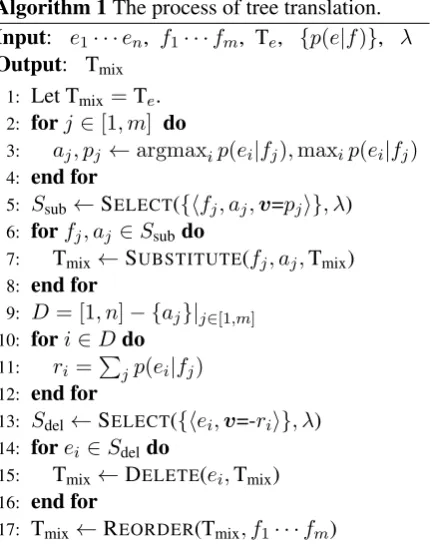
no alignment probability for one target word. The translation process can be conducted by three steps:
(1) word substitution, which incrementally sub-stitutes the source words with the target trans-lations;
[image:3.595.82.277.63.199.2]Algorithm 1The process of tree translation.
Input: e1· · ·en, f1· · ·fm, Te, {p(e|f)}, λ Output: Tmix
1: Let Tmix=Te.
2: forj ∈[1, m] do
3: aj, pj ←argmaxip(ei|fj),maxip(ei|fj)
4: end for
5: Ssub←SELECT({hfj, aj,v=pji}, λ)
6: forfj, aj ∈Ssubdo
7: Tmix←SUBSTITUTE(fj, aj,Tmix) 8: end for
9: D= [1, n]− {aj}|j∈[1,m]
10: fori∈Ddo
11: ri=Pjp(ei|fj)
12: end for
13: Sdel←SELECT({hei,v=-rii}, λ)
14: forei ∈Sdeldo
15: Tmix←DELETE(ei,Tmix) 16: end for
17: Tmix←REORDER(Tmix, f1· · ·fm)
(3) sentence reordering, which reorders the par-tially translated sentence, ensuring local tar-get language word order.
Algorithm 1 shows pseudocode for code-mixing tree translation, where line 1-8 denotes the first step, line 9-16 denotes the second and line 17 de-notes the last step.
There is a hyper-parameter λ to control the
overall ratio of translation. The function SE -LECT(S, λ) is to obtain a subset of S by ratio λ
with top element values as indicated by v inside
S. If λ = 0, it is still the source language
de-pendence tree, since no source word is substituted or deleted. In this condition, our method is equal toGuo et al.(2015) by bridging source and target dependency parsing with universal word represen-tations. Ifλ= 1, the resulting tree is a fully
trans-lated target dependency tree, as all words are target language produced by translation. In this setting, our method is equal toTiedemann and Agi´c(2016) where the only difference the our baseline parsing model. Thus our method can be regarded as a gen-eralization of both source-side training (Guo et al.,
2015) and fully translated target training ( Tiede-mann and Agi´c, 2016) with fine-grained control over translation confidence.
he has meanwhile found ...
han har(has) under(during) tiden (time) hittat ...
nsubj
nsubj
(a) one-to-one.
he has meanwhile found ...
han(he) har (has) under(during) tiden (time) hittat ...
advmod
advmod advmod
[image:4.595.315.518.62.224.2](b) many-to-one.
Figure 3: Examples of word substitution, where the thicker lines indicates more confident alignments.
4.1 Word Substitution
Word substitution is the key step for producing a target treebank. We first obtain the most con-fidently aligned source word eaj for each target
word fj as well as their alignment probability
pj = p(eaj|fj), as shown by line 3 in Algorithm 1. Then we sort the target words by these align-ment probabilities, choosing the topdmλewords
with highest alignment probabilities for substitu-tion. The sorting and choosing is reflected in line line 5 of Algorithm 1. Finally for each chosen word fj and its aligned source wordeaj , we
re-place the source wordeaj byfj, as shown by line
7 in Algorithm1.
One key of the substitution is to maintain the corresponding dependency structures. If eaj and
fj bares a one-one mapping, with no other
tar-get word being aligned with eaj, the source
de-pendencies are kept unchanged, as shown by Fig-ure 3(a). While if two or more words (i.e.,
fj1,· · · , fjk(j1 < · · · < jk)) are aligned toeaj,
we simply link all words to eaj, with the same
dependency label as the original dependency arc. Figure 3(b) illustrates this condition. Both the Swedish words “under” and “tiden” are headed to “hittat” (the Swedish translation of English word “found”) by the dependency label “advmod” in-herited from the source English side . Note that the POS tags of the substituted words are the same as the corresponding source words.
4.2 Word Deletion
[image:4.595.75.292.66.340.2]vi(we) are being beskylls(accused) or¨att(unfairly) here
sv en en sv sv en
root
advmod advmod auxpass
[image:5.595.313.534.61.252.2]aux nsubjpass × × × ×
Figure 4: An example of word deletion.
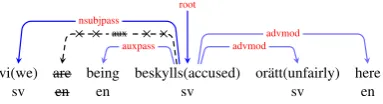
“the”, “are” and “have”. We remove such words to produce dependency trees that are close in syntax to the target language.
In particular, we accumulate the probabilities of
p(ei|fj)for the source wordeiwho has no aligned
target word:
ri = X
j
p(ei|fj) (line 11 in Algorithm1),
where we traverse all target words to sum their alignment probabilities with ei. The value of ri
can be interpreted as the confidence score of re-tention. The words with lower retention scores should be more preferred to be deleted, as these words have lower probabilities aligning with some word of the target language sentence. Concretely, we collect all source words with no aligned target words, computing their retention values, and the selecting a subset of these words with the lowest retention values by the hyper-parameterλ(line 13
in Algorithm1). Finally we delete all the selected words (line 15 in Algorithm1).
Figure 4 shows an example of word deletion. The two words “are” and “being” both have no aligned words in the other side, and meanwhile “are” has a lower retention score compared with “being”.2 Thus the source word “are” is prefer
to be deleted. In most cases, the deleted words are leaf nodes, which can be unattached to the re-sulted dependency tree and deleted them directly. In case of exceptions, we simply reset the corre-sponding heads of its child nodes by the head of
ei (i.e., hei) instead. For example, a dependency
wx
i ei is changed intowxi hei.
4.3 Sentence Reordering
Continuous target spans are reordered to make the final code-mixed sentence contain grammat-ical phrases in the target language. Figure 5(a)
shows one example of full sentence reordering. We can see that the word order by word-level sub-stitutions on the source words is different with the 2Both the two words are only related to the Swedish word “med”, butp(are|med)is slightly lower.
vi(we) kan(can) avsluta(finish) det(it) nu(now)
nu(now) kan(can) vi(we) avsluta(finish) det(it)
root nsubj
aux obj advmod
advmod
aux nsubj obj
root
(a) full sentence
ocks˚a(also) s¨ok(look) upp(up) the familjen(family) Kingston(Kingston)
s¨ok(look) ocks˚a(also) upp(up) the Kingston(Kingston) familjen(family) root
advmod
compound:prt det obj
nmod
root advmod
compound:prt det
nmod
obj
(b) two spans
Figure 5: Two examples of sentence reorder.
order of the machine-translated sentence. Thus we adjust the leaf nodes, letting the word order strictly follow the machine-translated sentence order For example, the word “vi” is moved from the first position into the third position, and similarly the word “mu” is moved from the last position into the first position.
Concretely, we perform the word reorder by the span level, extracting all the continuous spans of target words, because the target language words may be interrupted by source language words. Then we reorder the words in each span accord-ing to their order in the machine translation out-puts. Figure 5(b) shows another example, where there are two spans separated by the English word “the”. Each span is reordered individually. We do not consider the inconsistent orders inter the spans in this work. Note that this step does not change any dependency arc between words.
5 Experiments
We conduct experiments to verify the effective-ness of our proposed models in this section.
5.1 Settings
[image:5.595.86.278.64.116.2]Translate3 is used to translate the sentences in
the English training set into other languages. In order to generate high-quality word-level align-ments, we merge the translated sentence pairs and the parallel data of EuroParl (Koehn,2005) to ob-tain word alignments. We use the fastAlign tool (Dyer et al.,2013) to obtain word alignments.
We use the cross-lingual word embeddings and clusters byGuo et al.(2016b) for the baseline sys-tem. The dimension size of word embeddings is 50 and the word cluster number across of all lan-guages is 256.
For network building and training, we use the same setting as Dozat and Manning (2016), in-cluding the dimensional sizes, the dropout ratio, as well as the parameter optimization method. We assume that no labeled corpus is available for the target language. Thus training is performed for 50 iterations over the whole training data without early-stopping.
To evaluate dependency parsing performances, we adopt UAS and LAS as the major metrics, which indicate the accuracies of unlabeled depen-dencies and labeled dependepen-dencies, respectively. We ignore the punctuation words during evalua-tion following previous work. We run each exper-iment 10 times and report the averaged results.
5.2 Models
We compare performances on the following mod-els:
• Delex(McDonald et al.,2013): The
delexi-calized BiAffine model without cross-lingual word embeddings and clusters.
• Src(Guo et al.,2015): The BiAffine model
trained on the source English treebank only.
• PartProj(Lacroix et al., 2016): The
Bi-Affine model trained on the corpus by pro-jecting only the source dependencies involv-ing high-confidence alignments into target sentences. Note that the baseline only draws the idea from Lacroix et al.(2016), and the two models are significant different in fact.
• Tgt (Tiedemann and Agi´c, 2016): The
Bi-Affine model trained on the fully translated target treebank only.
3https://translate.google.com/ at Oct, 2018
0.0 0.2 0.4 0.6 0.7 0.8 1.0
69 69.5 70 70.5 71 71.5
[image:6.595.314.518.64.158.2].
Figure 6: The LAS relative to the translation ratioλ.
Model UAS LAS
Src 79.52 69.54
Tgt 79.34 69.96
Mix 80.33 71.29
Src + Tgt 80.12 71.16
Src + Mix 80.91 71.73
Table 1: Experiments of corpus mixing.
• Src+Tgt: The BiAffine model trained on
the combination dataset of the source and fully translated target treebanks.
• Mix: The BiAffine model trained on the
code-mixed treebank only.
• Src+Mix: The BiAffine model trained on
the combination dataset of the source and code-mixed treebanks.
The Src and Tgt methods have been discussed
in Section 4. The PartProj model is
an-other way to leverage imperfect word alignments (Lacroix et al., 2016). The training corpus of
PartProjmay be incomplete dependency trees
with a number of words missing heads, because no word is deleted from machine translation out-puts. The POS tags of words inPartProjwith
low-confidence alignments are obtained by a su-pervised POS tagger (Yang et al.,2018) trained on the corresponding universal treebank.
5.3 Development Results
We conduct several developmental experiments on the Swedish dataset to examine important factors to our model.
5.3.1 Influence of The Translation Ratioλ
Our model has an important hyper-parameter λ
to control the percentage of translation. Figure6
[image:6.595.326.508.198.282.2]Model UAS LAS
Mix 80.33 71.29
−Sentence Reordering 79.79 70.47 −Word Deletion 79.82 70.64
[image:7.595.87.275.62.134.2]−Both 79.46 69.59
Table 2: Ablation experiments.
λof 0 gives our baseline by using the source
tree-bank only. As theλgrows, more source words are
translated into the target. We can see that the per-formance improves after translating some source dependencies into the target, demonstrating the ef-fectiveness of syntactic transferring. The perfor-mance reaches the peak when λ = 0.7, but there
is a significant drop when λ grows from 0.8 to 0.9. This can be because the newly added
depen-dency arc projections are mostly noisy. This sharp decrease indicates that noise from low-confidence word alignments can have strong impact on the performance. According to the results, we adopt
λ= 0.7for code-mixed treebanking.
5.3.2 Mixing with Source TreeBank
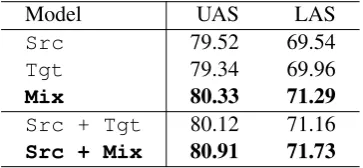
We investigate the effectiveness of the source tree-bank by merging it into the translated treetree-banks. First, we show the model performances of Src, Tgt and Mix, which are trained on the
individ-ual treebanks, respectively. Then we merge the source treebank with the two translated treebanks, and show the results trained on the merging cor-pora. Table 1 shows the results. According to the results, we can find that the source treebank is complementary with the translated treebanks. No-ticeably, althoughSrc + Mixgives the best
per-formance, its improvement overMix is relatively
smaller than that ofSrc + TgtoverTgt. This
is reasonable as the code-mixed treebank contains relatively more source treebank content than the fully translated target treebank.
5.3.3 Ablation Studies
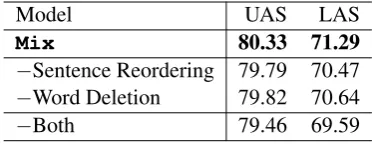
The overall translation is conducted by three steps as mentioned in Section 4, where the first word substitution is compulsory, and the remaining two steps aim to build better mixed dependency trees. Here we conduct ablation studies to test the ef-fectiveness of word deletion and sentence reorder-ing. Table2 shows the experimental results. We can see both steps are important for dependency tree translation. Without word deletion and
sen-tence reordering, themixmodel shows decreases
of 0.82 and 0.65 on LAS, respectively. If both are removed, the performance is only comparable with the baselinesrcmodel (see Table1). 5.4 Final Results
We show the final results of our proposed models in Table3. As shown, the modelTgtgives better
averaged performance compared to Src.
How-ever, its results on French and Italian are slightly worse, which indicates that noise from transla-tion impacts the quality of the projected tree-bank. The model Mix gives much better
perfor-mance compared withSrc, demonstrating the
ef-fectiveness of structural transfer. Mix also
out-performsTgtsignificantly, obtaining average
in-creases of80.93−76.37 = 4.56points on UAS
and72.87−68.28 = 4.59points on LAS,
respec-tively. The best setting is the modelSrc + Mix,
trained on the combined corpus of the source and code-mixed treebanks, which gives better perfor-mance than solely code-mixed treebanks.
By comparing with the delexicalized model
Delex, we can see that lexicalized features are
highly useful for cross-lingual transfer. For the
PartProj model, we conduct preliminary
ex-periments on Swedish to tune the ratio of the pro-jected dependencies. The results show that the dif-ference is very small (δ = 0.24for UAS) between
0.9 to 1.0, and the performance degrades signifi-cantly as the ratio decreases below 0.9. The obser-vation indicates that this method is probably not effective for filtering low-confidence word align-ments. The final results confirm our hypothesis. As shown in Table3, thePartProjmodel gives
only comparable performance withSrc. One
pos-sible reason may be the unremoved target words (if the words are removed, thePartProjmodel
with ratio 1.0 will be identical toTgt), which have
been demonstrated noisy previously (Tiedemann and Agi´c,2016).
5.5 Comparison with Previous Work
We compare our method with previous work in the literature. Table 4 shows the results, where the UAS values are reported. Our model denoted by This refers to the model of Src + Mix.
Lang. UAS LAS UAS LAS UAS LAS UAS LAS UAS LAS UAS LAS UAS LASDelex PartProj Src Tgt Src + Tgt Mix Src + Mix DE 64.10 53.77 69.90 61.28 66.87 57.46 70.84 62.30 72.41 63.74 71.41 63.46 72.78 64.38
ES 71.53 63.33 75.81 66.83 75.63 65.85 76.49 67.39 77.00 67.95 81.18 71.80 81.44 71.66
FR 75.13 67.26 75.54 67.63 78.13 70.63 76.91 69.39 78.75 71.17 83.20 76.32 83.77 76.48
IT 77.71 69.27 77.71 69.27 81.11 72.83 79.30 71.65 81.56 74.09 85.30 77.43 86.13 78.38
PT 74.03 67.70 79.44 71.30 77.37 69.36 78.32 70.67 79.73 71.84 83.54 75.34 84.05 75.89
[image:8.595.72.290.217.392.2]AVG 72.50 64.27 75.68 67.26 75.82 67.23 76.37 68.28 77.89 69.76 80.93 72.87 81.63 73.36
Table 3: Final results.
Model DE ES FR IT PT
TreeBank Transferring
This 72.78 81.44 83.77 86.13 84.05
Guo15 60.35 71.90 72.93 – –
Guo16 65.01 79.00 77.69 78.49 81.86
TA16 75.27 76.85 79.21 – –
Annotation Projection
MX14 74.30 75.53 70.14 77.74 76.65 RC15 79.68 80.86 82.72 83.67 82.07 LA16 75.99 78.94 80.80 79.39 –
TreeBank Transferring + Annotation Projection
RC17 82.1 82.6 83.9 84.4 84.6
Table 4: Comparison with previous work (UAS).
Guo15 (Guo et al., 2015), Guo16 (Guo et al., 2016b) and TA16 (Tiedemann and Agi´c, 2016).
Our model gives the best performance with one exception on the German language. One possible reason may be that TA16 has exploited multiple
sources of treebanks besides English.
The second block shows representative annota-tion projecannota-tion models, including MX14(Ma and Xia, 2014), RC15 (Rasooli and Collins, 2015), LA16. The models of annotation projection can
be complementary with our work, since they build target training corpus from raw parallel texts. The best-performed results of the RC17 model ( Ra-sooli and Collins, 2017) have demonstrated this point, which can be regarded as a combination of the dictionary-based treebank translation4 (Zhao
et al.,2009) andRC15.
5.6 Analysis
We conduct experimental analysis on the Spanish (ES) dataset to show the differences between the models ofSrc,TgtandMix.
4The method has been demonstrated worse thanTA16in
Tiedemann and Agi´c(2016).
NOUN ADP DET VERB ADJ ADV
50 55 60 65 70 75 80 85
[image:8.595.313.520.218.334.2]Src Tgt Mix
Figure 7: Performance relative to POS tags (F-score).
5.6.1 Performance Relative to POS Tags
Figure7 show the F-scores of labeled dependen-cies on different POS tags. We list the six most representative POS tags. TheMixmodel achieves
the best F-scores on 5 of 6 POS tags, with the only exception on tag ADV which has no signifi-cant difference with theTgtmodel. TheMixand Tgtmodels are much better than theSrcmodel
as a whole, especially on the POS tag ADJ where an increase of over 20% has been achieved. In addition, we find that the Src model can
signif-icantly outperform the Tgt model on ADP and
DET. For Spanish, ADP words are typically “de”, “en”, “con” and etc., which behave similarly to the English words such as “’s”, “to” and “of”. The Spanish words of DET include “el”, “la”, “su” and etc., which are similar to the English words such as “the” and “a”. These words are highly ambiguous for automatic word alignment. The results indicate that ourMix model can better handle these word
alignment noise, mitigating their negative influ-ence of treebank translation, while theTgtmodel
suffers from such noise.
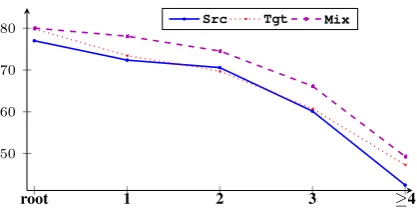
5.6.2 Performance Relative to Arc Distances
root 1 2 3 ≥4
50 60 70
[image:9.595.77.286.59.166.2]80 Src Tgt Mix
Figure 8: Performance relative to arc distances (F-score).
to the results, the Mix model performs the best
over all distances, indicating its effectiveness on treebank transferring. The Tgt model achieves
better performance than theSrcmodel with one
exception on distance 2. We look into the depen-dency patterns of distance 2 arcs further, finding that the dependency arcADPxxx*accounts for over
30%, and it is the major source of errors. The finding is consistent with that on POS tags, denot-ing the effectiveness of the code-mixed treebank in handling noise. In addition, as the distance in-creases the performance drops gradually. The F-score of root dependency is the highest.
6 Conclusion
We proposed a new treebank translation method for unsupervised cross-lingual dependency pars-ing. Unlike previous work, which adopts full-scale translation for source dependency trees, we inves-tigated partial translation instead, producing syn-thetic code-mixed treebanks. The method can bet-ter leverage imperfect word alignments between source and target sentence pairs, translating only high-confidence source sentential words, thus gen-erating dependencies in high-quality. Experimen-tal results on Universal Dependency Treebak v2.0 showed that partial translation is highly effective, and code-mixed treebanks can give significantly better results than full-scale translation.
Our method is complementary with several other methods for cross-lingual transfer, such as annotation projection, and thus can be further in-tegrated with these methods.
Acknowledgments
We thank all anonymous reviewers for their valu-able comments. Several suggestions are not inte-grated in this version, i.e., more experiments on really low-resource languages, and detailed
analy-sis on more languages. We will supplement later on the webpages of the authors. This work is sup-ported by National Natural Science Foundation of China (NSFC) grants 61602160, U1836222 and 61672211.
References
ˇZeljko Agi´c, Anders Johannsen, Barbara Plank, H´ector Mart´ınez Alonso, Natalie Schluter, and An-ders Søgaard. 2016. Multilingual projection for parsing truly low-resource languages.TACL, 4:301–
312.
Waleed Ammar, George Mulcaire, Miguel Ballesteros, Chris Dyer, and Noah A Smith. 2016. Many lan-guages, one parser.TACL, 4:431–444.
Shay B Cohen, Dipanjan Das, and Noah A Smith. 2011. Unsupervised structure prediction with non-parallel multilingual guidance. In Proceedings of the Conference on Empirical Methods in Natural Language Processing, pages 50–61. Association for
Computational Linguistics.
Timothy Dozat and Christopher D Manning. 2016. Deep biaffine attention for neural dependency pars-ing.arXiv preprint arXiv:1611.01734.
Long Duong, Trevor Cohn, Steven Bird, and Paul Cook. 2015a. Cross-lingual transfer for unsuper-vised dependency parsing without parallel data. In
Proceedings of the CONLL, pages 113–122.
Long Duong, Trevor Cohn, Steven Bird, and Paul Cook. 2015b. Low resource dependency parsing: Cross-lingual parameter sharing in a neural network parser. InProceedings of the 53rd ACL, volume 2,
pages 845–850.
Chris Dyer, Victor Chahuneau, and Noah A Smith. 2013. A simple, fast, and effective reparameteriza-tion of ibm model 2. InProceedings of the NAACL,
pages 644–648.
Kuzman Ganchev, Jennifer Gillenwater, and Ben Taskar. 2009. Dependency grammar induction via bitext projection constraints. InProceedings of the Joint Conference of ACL-IJCNLP, pages 369–377.
Jiang Guo, Wanxiang Che, David Yarowsky, Haifeng Wang, and Ting Liu. 2015. Cross-lingual depen-dency parsing based on distributed representations. InProceedings of ACL-IJCNLP, pages 1234–1244.
Jiang Guo, Wanxiang Che, David Yarowsky, Haifeng Wang, and Ting Liu. 2016a. A distributed representation-based framework for cross-lingual transfer parsing. Journal of Artificial Intelligence Research, 55:995–1023.
Jiang Guo, Wanxiang Che, David Yarowsky, Haifeng Wang, and Ting Liu. 2016b. A representation learn-ing framework for multi-source transfer parslearn-ing. In
Rebecca Hwa, Philip Resnik, Amy Weinberg, Clara Cabezas, and Okan Kolak. 2005. Bootstrapping parsers via syntactic projection across parallel texts.
Natural language engineering, 11(3):311–325.
Philipp Koehn. 2005. Europarl: A parallel corpus for statistical machine translation. InMT summit,
vol-ume 5, pages 79–86.
Oph´elie Lacroix, Lauriane Aufrant, Guillaume Wis-niewski, and Franc¸ois Yvon. 2016. Frustratingly easy cross-lingual transfer for transition-based de-pendency parsing. In Proceedings of the NAACL,
pages 1058–1063.
Miryam de Lhoneux, Johannes Bjerva, Isabelle Augen-stein, and Anders Søgaard. 2018. Parameter sharing between dependency parsers for related languages. InProceedings of the EMNLP, pages 4992–4997.
Xuezhe Ma and Fei Xia. 2014. Unsupervised depen-dency parsing with transferring distribution via par-allel guidance and entropy regularization. In Pro-ceedings of ACL, volume 1, pages 1337–1348.
Ryan McDonald, Joakim Nivre, Yvonne Quirmbach-Brundage, Yoav Goldberg, Dipanjan Das, Kuzman Ganchev, Keith Hall, Slav Petrov, Hao Zhang, Oscar T¨ackstr¨om, et al. 2013. Universal dependency an-notation for multilingual parsing. InProceedings of the 51st ACL, volume 2, pages 92–97.
Ryan McDonald, Slav Petrov, and Keith Hall. 2011. Multi-source transfer of delexicalized dependency parsers. In Proceedings of the conference on EMNLP, pages 62–72.
Tahira Naseem, Regina Barzilay, and Amir Globerson. 2012. Selective sharing for multilingual dependency parsing. InProceedings of the 50th ACL, pages 629–
637.
Joakim Nivre, Marie-Catherine De Marneffe, Filip Ginter, Yoav Goldberg, Jan Hajic, Christopher D Manning, Ryan T McDonald, Slav Petrov, Sampo Pyysalo, Natalia Silveira, et al. 2016. Universal de-pendencies v1: A multilingual treebank collection. InLREC.
Mohammad Sadegh Rasooli and Michael Collins. 2015. Density-driven cross-lingual transfer of de-pendency parsers. In Proceedings of the 2015 EMNLP, pages 328–338.
Mohammad Sadegh Rasooli and Michael Collins. 2017. Cross-lingual syntactic transfer with limited resources. TACL, 5:279–293.
Mohammad Sadegh Rasooli and Michael Collins. 2019. Low-resource syntactic transfer with un-supervised source reordering. arXiv preprint arXiv:1903.05683.
Rudolf Rosa and Zdenek Zabokrtsky. 2015. Klcpos3-a language similarity measure for delexicalized parser transfer. InProceedings of the 53rd ACL, volume 2,
pages 243–249.
Michael Schlichtkrull and Anders Søgaard. 2017. Cross-lingual dependency parsing with late decod-ing for truly low-resource languages. In Proceed-ings of the 15th Conference of the EACL, volume 1,
pages 220–229.
Oscar T¨ackstr¨om, Ryan McDonald, and Joakim Nivre. 2013. Target language adaptation of discrimina-tive transfer parsers. InProceedings of the NAACL,
pages 1061–1071.
Oscar T¨ackstr¨om, Ryan McDonald, and Jakob Uszko-reit. 2012. Cross-lingual word clusters for direct transfer of linguistic structure. InProceedings of the NAACL, pages 477–487.
J¨org Tiedemann. 2015. Improving the cross-lingual projection of syntactic dependencies. In Proceed-ings of the 20th NODALIDA, 109, pages 191–199.
Link¨oping University Electronic Press.
J¨org Tiedemann and Zeljko Agi´c. 2016. Synthetic tree-banking for cross-lingual dependency parsing. Jour-nal of Artificial Intelligence Research, 55:209–248.
J¨org Tiedemann, ˇZeljko Agi´c, and Joakim Nivre. 2014. Treebank translation for cross-lingual parser induc-tion. InProceedings of the EMNLP, pages 130–140.
Hongmin Wang, Yue Zhang, GuangYong Leonard Chan, Jie Yang, and Hai Leong Chieu. 2017. Uni-versal dependencies parsing for colloquial singa-porean english. InProceedings of the 55th ACL.
Michael Wick, Pallika Kanani, and Adam Pocock. 2016. Minimally-constrained multilingual embed-dings via artificial code-switching. InAAAI.
Min Xiao and Yuhong Guo. 2015. Annotation projection-based representation learning for cross-lingual dependency parsing. InProceedings of the Nineteenth Conference on Computational Natural Language Learning, pages 73–82.
Jie Yang, Shuailong Liang, and Yue Zhang. 2018. De-sign challenges and misconceptions in neural se-quence labeling. In Proceedings of the 27th Inter-national Conference on Computational Linguistics,
pages 3879–3889.
Daniel Zeman and Philip Resnik. 2008. Cross-language parser adaptation between related lan-guages. InProceedings of the IJCNLP-08 Workshop on NLP for Less Privileged Languages.
Yuan Zhang and Regina Barzilay. 2015. Hierarchical low-rank tensors for multilingual transfer parsing. InProceedings of the 2015 Conference on EMNLP,
pages 1857–1867.
Hai Zhao, Yan Song, Chunyu Kit, and Guodong Zhou. 2009. Cross language dependency parsing using a bilingual lexicon. InProceedings of ACL-IJCNLP,