Parameterized Convolutional Neural Networks for Aspect Level
Sentiment Classification
Binxuan Huang School of Computer Science
Carnegie Mellon University [email protected]
Kathleen M. Carley School of Computer Science Carnegie Mellon University [email protected]
Abstract
We introduce a novel parameterized convo-lutional neural network for aspect level sen-timent classification. Using parameterized filters and parameterized gates, we incorpo-rate aspect information into convolutional neu-ral networks (CNN). Experiments demonstrate that our parameterized filters and parame-terized gates effectively capture the aspect-specific features, and our CNN-based mod-els achieve excellent results on SemEval 2014 datasets.
1 Introduction
Continuous growing of user generated text in so-cial media platforms such as Twitter drives senti-ment classification increasingly popular. The goal of sentiment classification is to detect whether a piece of text expresses a positive, a negative, or a neutral sentiment (Rosenthal et al.,2017). The majority of the literature focuses on general sen-timent analysis (document level), not involving a specific topic or entity. When there are multiple aspects about an entity in a sentence, it is hard to determine the sentiment as a whole.
Differing from general sentiment classifica-tion, aspect level sentiment classification identifies opinions from text about specific entities and their aspects (Pontiki et al.,2015). For example, given a sentence “great food but the service was dreadful”, the sentiment polarity about aspect “food” is pos-itive while the sentiment polarity about “service” is negative. If we ignore the aspect information, it is hard to determine the sentiment for a target aspect, which accounts for a large portion of sen-timent classification error (Jiang et al.,2011).
Recently, machine learning based approaches are becoming popular for this task. Representa-tive approaches in literature include Support Vec-tor Machine (SVM) with manually created fea-tures (Jiang et al.,2011;Wagner et al.,2014) and
neural network based models (Tang et al., 2016;
Wang et al.,2016;Huang et al.,2018). Because of neural networks’ capacity of learning representa-tions from data without feature engineering, they are of growing interest for this natural language processing task. The mainstream neural meth-ods are either based on long short-term memory (Hochreiter and Schmidhuber, 1997) or memory networks (Sukhbaatar et al.,2015). None of them are using convolutional neural networks (CNN), which are good at capturing local patterns.
In the present work, we propose two simple yet effective convolutional neural networks with as-pect information incorporated. The overall archi-tecture differs significantly from previous work. Specifically, we design two novel neural units that take target aspects into account. One is parameter-ized filter, the other is parameterparameter-ized gate. These units both are generated from aspect-specific fea-tures and are further applied on the sentence. Our experiments show that our two model variants work surprisingly well on this type of task.
2 Related Work
Aspect level sentiment classification is a branch of sentiment classification (Pang et al., 2002; Wang and Manning, 2012). It aims at identifying the sentiment polarity of one aspect target in a context sentence.
SVM classifier.
In recent years, aspect level sentiment classifi-cation is dominated by neural network based ap-proaches. The majority of published works rely on the architecture of long short-term memory (LSTM) (Tang et al., 2016). Wang et al. (2016) use an attention vector generated from aspect em-bedding to better capture the important parts in sentences. Tay et al. (2018) introduce a word-aspect fusion operation to learn associative rela-tionships between aspects and sentences. Huang et al. (2018) use an attention-over-attention layer to further improve the performance.
Another type of neural architectures known as memory network (Sukhbaatar et al.,2015) has also been used in this task. Tang et al.(2016) takes an aspect term as a query sent to external memory. Their model consists of multiple computational layers. Each layer is an attention model. One recent work Dyadic MemNN (Tay et al., 2017) places associative layers on top of memory net-works to improve the performance.
The overall architecture in this paper differs sig-nificantly with all these previous works. To the best of our knowledge, this paper is the first at-tempt using convolutional neural networks (Kim,
2014; Huang and Carley, 2017) for aspect level sentiment classification.
3 Parameterized Convolutional Neural Networks
In this section, we introduce our method for as-pect level sentiment classification, which is based on convolutional neural networks. We first de-scribe CNN for general sentiment classification, then we introduce our two model variants Pa-rameterized Filters for Convolutional Neural Net-works (PF-CNN) and Parameterized Gated Con-volutional Neural Networks (PG-CNN).
3.1 Problem Definition
In aspect level sentiment classification, we are given a sentences = [w1, w2, ..., wi, ..., wn]and
an aspect targett = [wi, wi+1, ..., wi+m−1]. The goal is to classify whether the sentiment towards the aspect in the sentence is positive, negative, or neutral.
3.2 Convolutional Neural Networks
We first briefly describe convolutional neural net-works (CNN) for general sentiment classification
(Kim, 2014). Given a sentence s = [w1, w2,
..., wi, ..., wn], letvi ∈Rkbe the word vector for
word wi. A sentence of length n can be
repre-sented as a matrix s = [v1, v2, ..., vn] ∈ Rn×k.
A convolution filter w ∈ Rh×k with width h is applied to the word matrix to get high-level repre-sentative features. Specifically, for a word window
vi:i+h−1 ∈Rh×k, a featureciis generated by
ci=f(wvi:i+h−1+b) (1)
whererepresents element-wise product, b ∈ R
is a bias term and f is a non-linear function. Slid-ing the filter window from the beginnSlid-ing of the word matrix till the end, we get a feature map c∈Rn−h+1.
c= [c1, c2, ..., cn−h+1] (2)
After that, a pooling operation is applied over the feature map to get one single general sentiment feature θg in each map. We use max pooling in
the CNN for sentences.
θg =pooling(c) (3)
We denote this process asθg = CN Ng(s;w, b).
Using d such convolutional filters, we can get a general sentiment feature vectorΘg ∈Rdwithout
information from aspect terms.
3.3 Parameterized Filters
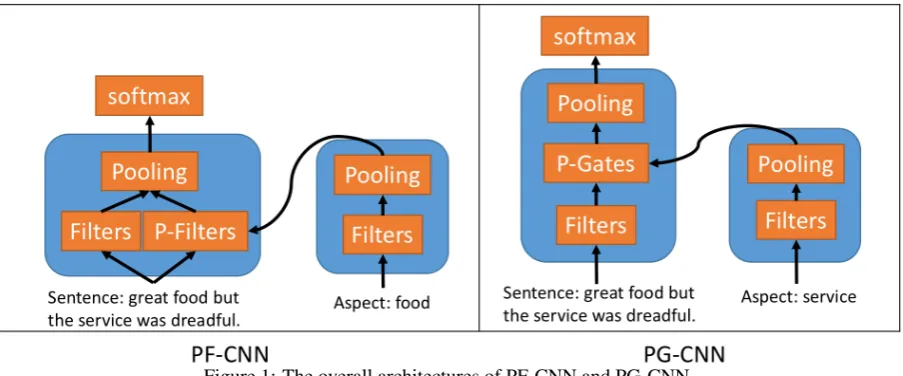
Standard convolutional neural networks do not consider information from aspect terms. Herein, our first model variant overcomes this issue by pa-rameterizing filters using aspect terms. We call it Parameterized Filters for Convolutional Neural Networks (PF-CNN). The overall architecture is shown in the left of Figure1.
Formally, given the aspect term with lengthm,
t= [wi, wi+1, ..., wi+m−1]and the corresponding embedding matrix t = [vi, vi+1, ..., vi+m−1] ∈
Rm×k, we first use another CN N
tto extract one
single featureθtfromt.
θt=CN Nt(t;wt, bt) (4)
where wt ∈ Rht×k, bt are the convolutional
fil-ter, bias term for CN Nt. ht is the width of
fil-ters applied on aspect targets. With hs×ksuch
filters and bias terms, we can get a feature ma-trixΘt ∈ Rhs×k, wherehsis the filter width
ap-plied on sentences. We use average pooling in the
Figure 1: The overall architectures of PF-CNN and PG-CNN.
In the next step,Θtis further used as a
convolu-tional filter applied on the sentence.
θs =CN Ns(s;Θt, bs) (5)
Using such d parameterized filters, we get the aspect-specific featuresΘs ∈Rdwith target term
information. We further concatenate the targeted feature vector with general sentiment features as the final classification featuresΘ = [Θg,Θs].
3.4 Parameterized Gates
The second model variant we designed is called Parameterized Gated Convolutional Neural Net-works (PG-CNN). The overall architecture is shown in the right of Figure1.
Similar with PF-CNN, PG-CNN also utilizes a convolutional neural network to extract featureΘt
from aspect terms, which instead is used as a gate (Dauphin et al.,2017) in the CNN applied on the sentence. The key step of PG-CNN is described in equation (6).
ci = (wvi:i+h−1+b)·σ(Θtvi:i+h−1+b) (6)
Instead of using a non-linear function f in equa-tion (1), we use a gate σ(Θtvi:i+h−1 +b) to control how much information passing to the next layer, where σ(·) is sigmoid function. For each general filter applied on the sentence, one param-eterized gate is generated from the aspect.
After that, we generate the final classification featureΘin the same way as standard CNN.
3.5 Final Classification
We feed the final classification feature into a lin-ear layer to project Θ into the space of targeted classes:
x=Wl·Θ +bl (7)
where Wl and bl are the weight matrix and bias.
Following the linear layer, we use a softmax layer to compute the probability of classc.
P(y=c|x) = Pexp(xc) i∈Cexp(xi)
(8)
3.6 Model training
We train our model to minimize the cross-entropy loss function withL2 regularization:
loss=−X (s,t)
X
c∈C
I(y=c)logP(y=c|s, a) +λ||p||2
whereI(·)is the indicator function andpis the set of all parameters in the convolutional layers and linear layer.
4 Experiments
4.1 Experiments Setting
Dataset
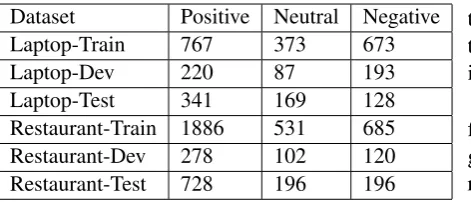
We adopt one widely used dataset from SemEval 2014 Task 4 (Pontiki et al.,2014). It contains two domain-specific datasets for laptops and restau-rants. Each data point is a pair of a sentence and an aspect term. Experienced annotators tagged each pair with sentiment polarity. Following re-cent work (Tay et al., 2018), we take 500 train-ing instances as development set1. Unfortunately, many works have not mentioned the usage of de-velopment set (Wang et al.,2016;Ma et al.,2017).
Hyperparameters and Training
We use rectifier as non-linear function f in the
CN Ng, CN Ntand sigmoid in theCN Ns, filter
window sizes of1,2,3,4 with 100 feature maps
1The splits can be found at
Dataset Positive Neutral Negative
Laptop-Train 767 373 673
Laptop-Dev 220 87 193
Laptop-Test 341 169 128
[image:4.595.73.309.61.162.2]Restaurant-Train 1886 531 685 Restaurant-Dev 278 102 120 Restaurant-Test 728 196 196
Table 1: Statistics of the datasets.
Laptops Restaurants Model 3-way Binary 3-way Binary TD-LSTM 62.38 79.31 69.73 84.41 AT-LSTM 65.83 78.25 74.37 84.74 ATAE-LSTM 60.34 74.20 70.71 84.52 AF-LSTM 68.81 83.58 75.44 87.78 CNN 68.65 85.50 77.95 89.50 PF-CNN 70.06 86.35 79.20 90.15 PG-CNN 69.12 86.14 78.93 90.58
Table 2: Comparisons results with baselines. We use accuracy to measure the performance. Performances of baselines are cited from (Tay et al.,2018).
each, l2 regularization term of 0.001 and mini-batch size of 25. Parameterized filters and gates have the same size and number as normal filters. They are generated uniformly by CNN with win-dow sizes of1,2,3,4, eg. among 100 parameter-ized filters with size 3, 25 of them are generated by aspect CNN with filter size 1, 2, 3, 4 respec-tively. The word embeddings are initialized with 300-dimensional Glove vectors (Pennington et al.,
2014) and are fixed during training. For the out of vocabulary words we initialize them randomly from uniform distributionU(−0.01,0.01). We ap-ply dropout on the final classification features of PG-CNN. The dropout rate is chosen as 0.3.
Training is done through mini-batch stochastic gradient descent with Adam update rule (Kingma and Ba,2015). The initial learning rate is 0.001. If the training loss does not drop after every three epochs, we decrease the learning rate by half. We adopt early stopping based on the validation loss on development sets.
4.2 Results
We use accuracy metric to measure the perfor-mance. To show the effectiveness of our model, we compare it with several baseline methods. We list them as follows:
TD-LSTMuses two LSTM networks to model the preceding and following contexts surrounding
the aspect term. The last hidden states of these two LSTM networks are concatenated for predict-ing the sentiment polarity (Tang et al.,2016).
AT-LSTMcombines the sentence hidden states from a LSTM with the aspect term embedding to generate the attention vector. The final sentence representation is the weighted sum of the hidden states (Wang et al.,2016).
ATAE-LSTMfurther extends AT-LSTM by ap-pending the aspect embedding into each word vec-tor (Wang et al.,2016).
AF-LSTMintroduces a word-aspect fusion at-tention to learn associative relationships between aspect and context words (Tay et al.,2018).
CNN uses the architecture proposed in (Kim,
2014) without explicitly considering aspect. We use filter window sizes of 1,2,3,4 with 100 maps each. Dropout rate is chosen as 0.5. Early stop-ping based on validation accuracy is applied.
Our two models achieve the best performance when compared to these baselines as shown in Table 2, which shows that our proposed neural units effectively captures the aspect-specific fea-tures. Compared to one recently proposed model AF-LSTM, our method achieve 2%-5% improve-ments. Surprisingly, a vanilla CNN works quite well on this problem. It even beats these well-designed LSTM models, which further proves that using CNN-based methods is a direction worth ex-ploring.
4.3 Case Study & Discussion
Compared to a vanilla CNN, our two model vari-ants could successfully distinguish the describing words for corresponding aspect targets. In the sen-tence “the appetizers are ok, but the service is slow”, a vanilla CNN outputs the same negative sentiment label for both aspect terms “appetizers” and “service”, while PF-CNN and PG-CNN suc-cessfully recognize that “slow” is only used for describing “service” and output neutral and neg-ative labels for aspects “appetizers” and “service” respectively. In another example “the staff mem-bers are extremely friendly and even replaced my drink once when i dropped it outside”, our models also find out that positive and neutral sentiment for “staff” and “drink” respectively.
For a sentence containing multiple aspects, we as-sume the majority of the aspect-level sentiment la-bel is the sentence-level sentiment lala-bel. Using this labeling scheme, in the restaurant data, 1034 out of 1117 test points have the same level and aspect-level labels. Thus, a sentence-level classifier with accuracy 75% also classifies 70% aspect-labels correctly. A similar observation was made for the laptop dataset as well. Probably this is the reason why a vanilla CNN has compara-ble performance on these two datasets. For future research, a more balanced dataset would be help-ful to overcome this issue.
5 Conclusion
We propose a novel method for aspect level senti-ment classification. We introduce two novel neu-ral units called parameterized filter and parameter-ized gate to incorporate aspect information into the convolutional neural network architecture. Com-parisons with baseline methods show our model effectively learns the aspect-specific sentiment ex-pressions. Our experiments demonstrate a signif-icant improvement compared to multiple strong neural baselines.
To the best of our knowledge, our model is the first attempt using convolutional neural networks solving this problem. We hope this work could in-spire future research exploring in this direction. It is also interesting to see whether such parameter-ized CNN architecture could benefit other natural language processing tasks involving text pairs like question answering task.
Acknowledgments
We would like to thank the reviewers for their helpful comments that greatly improved the arti-cle. We would also like to thank Sumeet Kumar for his valuable suggestions.
References
Yann N Dauphin, Angela Fan, Michael Auli, and David Grangier. 2017. Language modeling with gated con-volutional networks. InProceedings of the 34th in-ternational conference on machine learning.
Sepp Hochreiter and J¨urgen Schmidhuber. 1997. Long short-term memory. Neural computation, 9(8):1735–1780.
Binxuan Huang and Kathleen M Carley. 2017. On predicting geolocation of tweets using convolutional
neural networks. InInternational Conference on So-cial Computing, Behavioral-Cultural Modeling and Prediction and Behavior Representation in Model-ing and Simulation, pages 281–291. SprModel-inger.
Binxuan Huang, Yanglan Ou, and Kathleen M. Car-ley. 2018. Aspect level sentiment classification with attention-over-attention neural networks. InSocial, Cultural, and Behavioral Modeling, pages 197–206, Cham. Springer International Publishing.
Long Jiang, Mo Yu, Ming Zhou, Xiaohua Liu, and Tiejun Zhao. 2011. Target-dependent twitter senti-ment classification. InProceedings of the 49th An-nual Meeting of the Association for Computational Linguistics: Human Language Technologies-Volume 1, pages 151–160. Association for Computational Linguistics.
Yoon Kim. 2014. Convolutional neural networks for sentence classification. InProceedings of the 2014 Conference on Empirical Methods in Natural Lan-guage Processing (EMNLP), pages 1746–1751. As-sociation for Computational Linguistics.
Diederik Kingma and Jimmy Ba. 2015. Adam: A method for stochastic optimization. In Proceed-ings of the 3rd International Conference on Learn-ing Representations (ICLR).
Dehong Ma, Sujian Li, Xiaodong Zhang, and Houfeng Wang. 2017. Interactive attention networks for aspect-level sentiment classification. In Proceed-ings of the Twenty-Sixth International Joint Con-ference on Artificial Intelligence, IJCAI-17, pages 4068–4074.
Tetsuya Nasukawa and Jeonghee Yi. 2003. Sentiment analysis: Capturing favorability using natural lan-guage processing. InProceedings of the 2nd inter-national conference on Knowledge capture, pages 70–77. ACM.
Bo Pang, Lillian Lee, and Shivakumar Vaithyanathan. 2002. Thumbs up?: sentiment classification using machine learning techniques. InProceedings of the ACL-02 conference on Empirical methods in natural language processing-Volume 10, pages 79–86. As-sociation for Computational Linguistics.
Jeffrey Pennington, Richard Socher, and Christopher Manning. 2014. Glove: Global vectors for word representation. InProceedings of the 2014 confer-ence on empirical methods in natural language pro-cessing (EMNLP), pages 1532–1543.
Maria Pontiki, Dimitris Galanis, Haris Papageorgiou, Suresh Manandhar, and Ion Androutsopoulos. 2015. Semeval-2015 task 12: Aspect based sentiment anal-ysis. InProceedings of the 9th International Work-shop on Semantic Evaluation (SemEval 2015), pages 486–495.
Suresh Manandhar. 2014. Semeval-2014 task 4: As-pect based sentiment analysis. InProceedings of the 8th International Workshop on Semantic Evaluation (SemEval 2014), pages 27–35, Dublin, Ireland. As-sociation for Computational Linguistics and Dublin City University.
Sara Rosenthal, Noura Farra, and Preslav Nakov. 2017. Semeval-2017 task 4: Sentiment analysis in twitter. In Proceedings of the 11th International Workshop on Semantic Evaluation (SemEval-2017), pages 502–518.
Sainbayar Sukhbaatar, Jason Weston, Rob Fergus, et al. 2015. End-to-end memory networks. InAdvances in neural information processing systems, pages 2440–2448.
Duyu Tang, Bing Qin, Xiaocheng Feng, and Ting Liu. 2016. Effective lstms for target-dependent senti-ment classification. In Proceedings of COLING 2016, the 26th International Conference on Compu-tational Linguistics: Technical Papers, pages 3298– 3307.
Duyu Tang, Bing Qin, and Ting Liu. 2016. Aspect level sentiment classification with deep memory net-work. In Proceedings of the 2016 Conference on Empirical Methods in Natural Language Process-ing, pages 214–224.
Yi Tay, Anh Tuan Luu, and Siu Cheung Hui. 2018. Learning to attend via word-aspect associative fu-sion for aspect-based sentiment analysis. InAAAI.
Yi Tay, Luu Anh Tuan, and Siu Cheung Hui. 2017. Dyadic memory networks for aspect-based senti-ment analysis. In Proceedings of the 2017 ACM on Conference on Information and Knowledge Man-agement, pages 107–116. ACM.
Joachim Wagner, Piyush Arora, Santiago Cortes, Utsab Barman, Dasha Bogdanova, Jennifer Foster, and Lamia Tounsi. 2014. Dcu: Aspect-based polarity classification for semeval task 4.
Sida Wang and Christopher D Manning. 2012. Base-lines and bigrams: Simple, good sentiment and topic classification. In Proceedings of the 50th Annual Meeting of the Association for Computational Lin-guistics: Short Papers-Volume 2, pages 90–94. As-sociation for Computational Linguistics.