The Construct Validity and Split-Half Reliability of the Affect Grid in
Experience Sampling: Alexithymia and Fluctuations in Core Affect
Bachelor’s Thesis
Author Tim Tiede
Student Number s1872958 Academic Year 2018/2019
First Supervisor Dr. Matthijs L. Noordzij Second Supervisor Jannis T. Kraiss
Institute University of Twente
Faculty Faculty of Behavioral, Management, and Social Sciences (BMS)
Program Psychology
Abstract
The Construct Validity and Split-Half Reliability of the Affect Grid in Experience Sampling: Alexithymia and Fluctuations in Core Affect
1. Introduction
Around the year 1885, a young researcher by name of Hermann Ebbinghaus began studying memory dynamics in a single-case design: He memorized throughout two one-year periods around 1300 lists of syllables and examined the rate of forgetting and re-learning over time. The procedure he applied was subjected to several means of standardization such as fixed times of the day, constant rates of repetition, and the ideal of a naturalistic setting
(Ebbinghaus, 1885). Because an individual’s memory is ever-changing, the investigation of its dynamics required these special conditions to allow firm conclusions. The same applies to the phenomenon of core affect. Core affect represents a person’s mood, or feeling and is experienced as dynamic, momentary state. Hence, a single measurement only provides little information about variations in core affect. Here, as in the case of Ebbinghaus, special measurement procedures are of importance that allow the assessment of fluctuations.
The experience sampling method (ESM) is a procedure similar to the way Ebbinghaus approached the dynamics of memory. Both share the characteristics of frequent, repeated sampling of the same individual[s], which requires a measure that can be filled in quickly, without much effort and independent of the participants’ location. A measure feasible in this regard is the affect grid. The affect grid is a frequently used measure of core affect that has proven useful to experience sampling research (e.g. Kuppens, Oravecz, and Tuerlinckx (2010); Colomo-Palacios, Casado-Lumbreras, Soto-Acosta, and Garcia-Crespo (2011)). With respect to its psychometric properties, the affect grid has been validated in the assessment of traits, mostly in the context of single use (Killgore, 1998; Russell et al., 1989). However, when it comes to long-term measurement of core affect with the ESM, information on the validity or reliability of the affect grid are nonexistent. This is striking in view of its increasing use in experience sampling.
2. Theoretical Framework Experience sampling
Experience sampling, also referred to as ecological momentary assessment, time budget sampling, or ambulatory assessment, is a sampling procedure with a long history that became increasingly popular during the affective revolution in the 1980s (Schimmack, 2003). Its main purpose is the investigation of dynamic constructs over a potentially long period of time (Csikszentmihalyi, 1992; Palmier-Claus et al., 2011; Trull & Ebner-Priemer, 2013). Whereas a test in common research is conducted only once or a few times, the ESM differs in that it is based on short-interval, repeated testing of the same measure over a potentially long period of time (Ebner-Priemer, Eid, Kleindienst, Stabenow, & Trull, 2009).
This can be advantageous in the measurement of dynamic phenomena, as the used test typically can be filled in quickly and with ease. Therefore, after the briefing no further
supervision is required so that the measurement can be conducted ecologically valid in a naturalistic environment by means of wearables such as smartphones (Palmier-Claus et al., 2011). These characteristics allow an insightful investigation in the fluctuations of dynamic phenomena such as an individual’s core affect (Csikszentmihalyi & Larson, 2014; Ebner-Priemer et al., 2009; Russell, 2003).
Core affect and the Affect Grid
Core affect as introduced by Russell (2003) is a conceptualization of emotion that consists of two distinct dimensions - valence, ranging from pleasure to displeasure, and arousal, ranging from sleepy to activated. These two dimensions combined represent what is
commonly called mood, emotion, feelings or affective state.
A prominent measure of core affect also used in experience sampling is the affect grid, introduced by Russell et al. in 1989 and since then used in varying designs (e.g.
Ebner-Priemer et al. (2015)). It is a single-item measure consisting of the dimensions compromised in core affect, valance, located along the horizontal axis, and arousal, along the vertical axis. The present study’s affect grid is depicted in Figure 1. The affect grid has been validated in use for single assessment of facial expressions or emotion-related words and exhibited
DynAffect
The DynAffect is an explanatory model introduced by Kuppens et al. (2010) that describes the dynamics of valence and arousal based on three propositions: Every individual has a characteristic, and fairly stable 1. affective home base, 2. individual core affect
variability, and 3. attractor strength (Ebner-Priemer et al., 2015; Kuppens et al., 2010). The
affective home base is a person’s affective comfort zone, the area in which the core affect is in average located. (Kuppens et al., 2010). Core affect variability refers to the individuals’ typical range of core affect-fluctuation around the affective home base, whereas the regulatory processes that, with individual pace, redirect the core affect towards the home base are called attractor strength. Conceptually, these are represented in an individual’s core affect mean score (home base), standard deviation or variance (core affect variability), and pace of change, represented through the mean squared successive difference [MSSD] (attractor strength) (Ebner-Priemer et al., 2015; Kuppens et al., 2010).
Validation of a measure
Commonly in scientific practice, to accept the outcomes of a measure as
representative it must be validated with regard to its content, the criteria, and the construct, overall referred to as validity.
case is not verifiable (Russell et al., 1989). Criterion validity refers to the correspondence of the measure’s outcome with the situation at a specific time- either the present state, called concurrent validity, or a future situation, called predictive validity (Dooley, 2009). Finally, construct validity is the extent to which a test measures what it is supposed to measure
(Cronbach & Meehl, 1955). The validation of the construct is achieved by correlating a measure’s outcome with other constructs that are known to be related (Dooley, 2009). This is also a common way of validity assessment in experience sampling and hence in line with the purpose of the present study (Csikszentmihalyi & Larson, 2014; Palmier-Claus et al., 2011). However, in contrast to the validation of the affect grid in the past, experience sampling creates the opportunity to validate the affect grid with respect to its long term-characteristics, in other words when measuring the fluctuation of core affect over time (Palmier-Claus et al., 2011; Russell et al., 1989). A construct known to be related to long term-fluctuations in emotional experience is alexithymia, which therefore will be the means for the investigation of the affect grid’s construct validity in the present study.
Alexithymia
Alexithymia is a personality construct characterized by difficulties to perceive and describe own and others’ emotional states (Taylor, Ryan, & Bagby, 1985; Versluis et al., 2018). Moreover, alexithymic individuals have difficulties in attending to and distinguishing own emotions (Lane, Sechrest, Riedel, Shapiro, & Kaszniak, 2000; Lane et al., 1996;
Thompson, Dizén, & Berenbaum, 2009). This appears to be especially relevant when reporting own emotions over a longer period of time, as it is to expect that individuals with difficulties in distinguishing emotional states exhibit less variability in their reported emotional experience. Additionally, as emotion recognition should be slower when being inattentive, a slower change in reported emotions is expected.
Reliability. Next to validity, the second factor relevant to the adequacy of a measure is reliability. A reliable measure produces close-to identical results in the same measurement situations (Dooley, 2009). Reliability is commonly separated into parallel test-, interrater-reliability, and internal consistency (Dooley, 2009; Field, 2014).
Test-retest reliability indicates whether a measure produces stable results when being conducted at different points in time, whereas parallel test-reliability looks at the
between the raters in the assessment of the materials (Dooley, 2009). Interrater and test-retest reliability are inapplicable when measuring core affect with the ESM, as here (1). a personal state is assessed, wherefore no rater but the individuals themselves must ‘rate’, and (2.) changes are expected, so that a second measurement only will most likely show different results. Finally, internal consistency refers to the reliability of the test-items within the measure, examining whether the results of different parts of the measure are indicating the same outcome (Dooley, 2009). Two indices of internal consistency are ‘Lambda 2’ and ‘Cronbach’s alpha’, which, however, are inapplicable to single-item measures such as the affect grid, as they require tests with a number of different items (Cronbach, 1951; Dooley, 2009; Russell et al., 1989).
In a basic form, internal consistency tested for by either splitting the results in half and comparing them (split-half reliability), or by comparing the results of all even with all odd-numbered items of a measure (odd-even reliability) (Dooley, 2009). Split-half reliability is the recommended manner to test for reliability in experience sampling as it gives insight into stable patterns throughout the scorings (Csikszentmihalyi & Larson, 2014; Palmier-Claus et al., 2011). The assumption to find stable patterns in core affect might seem counterintuitive considering that the ESM is usually applied to dynamic constructs, however, past research in experience sampling found individuals to exhibit relative stability in their everyday emotional experience (Csikszentmihalyi & Larson, 2014). In line with this reasoning, Kuppens et al. (2010) introduced an explanatory model that specifies these individual characteristics with regard to core affect under the name DynAffect.
The present study
The affect grid is a measure that becomes a increasingly popular instrument for ESM. However, to this point in time, no information exists on its psychometric properties in this context. Building on the DynAffect and the characteristics of alexithymia, this study aims to validate the affect grid under the conditions of the experience sampling method. Split-half reliability will be investigated with regards to the within-person mean score (home base), standard deviation (core affect variability) and MSSD (attractor strength). To assess construct validity, the characteristic variability and MSSD in core affect will be correlated to the
H1: The affect grid exhibits adequate split-half reliability with regard to the within participant mean scores
H2: The affect grid exhibits adequate split-half reliability with respect to the within participant standard deviation
H3: The affect grid exhibits adequate split-half reliability concerning the within participant mean squared successive difference (MSSD).
H4: The participants’ scores on the subscales of the TAS-20 are negatively correlated
with the standard deviation of their ratings on the affect grid.
H5: The participants’ scores on the subscales of the TAS-20 are negatively correlated
with the mean successive difference of their ratings on the affect grid
3. Method
Design
The present correlational study involved the experience sampling method (ESM) in a one-group repeated measures design to test for the within-participant fluctuation of core affect over a period of one week. All participants filled in 3 questionnaires at the beginning of the study followed by 42 core affect measures (six times a day, over a period of seven days). The data was gathered by means of a mobile application developed by the University of Twente, called TiiM (The incredible intervention Machine). The study was approved in May 2019 by the ethics committee of the University of Twente, with data collection taken place in May and April of the same year.
Participants
For the purpose of this study, 52 participants were recruited by means of convenience sampling. Most participants were befriended students of the researchers, studying at German universities. Due to technical issues with the app, 7 participants (13.47%) had to be excluded from the analyses. Of the remaining 45 participants, 43 were German. Overall, 29 participants (64.40%) were female and 16 (35.60%) male, with age ranging from 18 to 52 (mean age of 22.76; SD= 6.17).
willingness to install the app TiiM and to spend the respective time to repeatedly fill in the measures.
Materials and Measures
TiiM. TiiM (The incredible intervention Machine) is a free application available for IOS and Android that has been developed by the BMS-lab of the University of Twente. This app was the means of administration of the questionnaires and the affect grids and the platform within which the researchers created the study. All measures, their sequence and their timing in the way they would later appear on the smartphone of the participants were set-up through TiiM.
Demographic Data. At the beginning of the study, the participants were asked through the app to provide information on age, nationality, and gender.
The Toronto Alexithymia Scale (TAS). To measure for alexithymia, two of the three subscales of the Toronto Alexithymia Scale (TAS-20) were administered; difficulties in identifying feelings (DIF), consisting of 7 items (e.g. ‘I am often confused about what emotion I am feeling’) and the subscale difficulties in describing feelings (DDF), consisting of 5 items (e.g. ‘It is difficult for me to find the right words for my feelings’) (Bagby, Parker, & Taylor, 1994; Taylor et al., 1985) [For a complete overview of the items see Appendix B]. In
accordance with the original measure, the 12 items were answered on a 5-point Likert scale, ranging from 1 = strongly disagree to 5 = strongly agree. By reason of insufficient reliability the author omitted the third subscale of the TAS-20, externally oriented thinking (EOT) in this study (Kooiman, Spinhoven, & W Trijsburg, 2003).
.78 for both subscales combined, .70 for DIF and .81 for DDF. Lambda 2 was satisfactory with .82 for both subscales combined, with .74 for the DIF and .82 for DDF.
The Affect Grid. To measure the participants’ core affect, the test that has been used
Psychometric Properties of the affect grid. The affect grid has been found to exhibit adequate psychometric properties; Construct validity has been found to be moderate to high. Both, Killgore (1998) and Russell et al. (1989) found adequate to high convergent validity (.74 to .94 for valence and .63 to .92 for arousal) as well as high construct validity, supporting the orthogonality of arousal and valence (see Russell (2003)). With regard to its reliability, Russell et al. 1989 reported high split-half reliability when being tested for emotion-related terms in multiple studies (.98 for valence and .97 for arousal; n=25). Furthermore, the affect grid has been successfully used to validate affective characteristics of Borderline Personality Disorder (BPD) and individuals in general, as expressed in the DynAffect (Ebner-Priemer et al., 2015; Ebner-Priemer et al., 2009; Kuppens et al., 2010). However, no information exists with regard to the reliability of long-term assessments of personal affective states
Procedure
Preparation. In alignment with recommendations by Conner and Lehman (2012), the researchers ran several pilot tests that they completed themselves after having received ethical approval by the University’s ethics committee.
The study consisted of a one-week data collection with the ESM that took place by means of TiiM. In this time period, every participant was instructed to fill in 42 affect grids preceded by three questionnaires. Due to technical issues, one passage had to be re-launched, however, without affecting the data. All students read through an opening statement before the start of the data collection and received detailed instructions via mail after they created an account for the study (for the instructions, see Appendix A). To create an account, the
participants had to follow a link provided by the researchers that required to fill in an email address and to choose a custom password. By doing so, the participants gained access to the free app ‘TiiM’.
When the researchers had assigned the participants to the study, the measurement started the next day. It began with three questionnaires that preceded the repeated
the notification ‘Hey! Please take a moment to set a mark’, would appear and the test would remain available in the app for another 60 minutes before finally disappearing. After the 42nd affect grid had been filled in on the seventh day of measurement, the participant would not receive any further tests or notifications via the app, and the participation ended. Overall, besides the request to fill in as many tests as possible and to do so as quickly as possible after they were made available, the participants were not restricted in the context in which they would fill in the affect grids.
Data Analysis
In alignment with past research on and with the affect grid, the scores for the two dimensions arousal and valence were analyzed separately (Russell et al., 1989; Russell & Gobet, 2012).
For the final analyses, of the participants who did not experience technical issues, (N=45), 26 participants were excluded by reason of too little data points. The remaining 19 participants had response rates of at least 65% (28 responses), which is in rough alignment with Palmier-Claus et al. (2011), who recommended a minimum of 20 valid responses. To improve the representativeness of the mean values, the author decided for a slightly higher number.
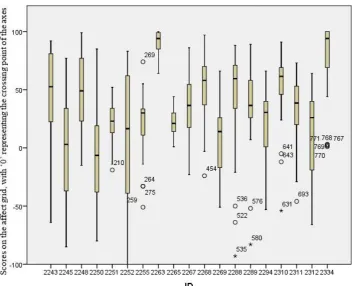
Before the analyses, a normal distribution test was performed. Graphical analyses by means of Q-Q-plots and dot-histograms for both dimensions, arousal and valence, indicated normally distributed sample scores for both dimensions (see Figures 7-9 in Appendix).
Split-half-reliability. To examine the reliability of the affect grid, split-half reliability of the (1) within-participant mean scores, (2) standard deviations, and (3) mean successive
differences was calculated by means of a correlational analysis. The obtained data points were split into half at the 21st administered affect grid, irrespective of the number of responses a participant gave. In other words, the datapoints were split with regard to the responses obtained in the first 3,5 days and the second 3,5 days, and not based on the actual number of obtained responses, as this would disregard an equal time frame of the responses given.
Based on previous research in experience sampling, the author rated split half reliability correlations of .50 to .70 as moderate to high and correlations above .70 to .90 as high to very high (Csikszentmihalyi & Larson, 2014).
Validity. With regard to the relation of alexithymia and core affect, a correlational
with recommendations by Kuppens et al. (2010), core affect variability was represented by the within-participant standard deviation of the scorings per dimensions.
Furthermore, to investigate the relation of attractor strength and alexithymia, the author conducted a correlational analysis with the scores on the TAS-20 and the mean squared successive difference scores (MSSD) per participant.
Results Descriptive Statistics
Reliability
Overall, all tested split-half correlations were significant. The within-participant mean scores of the first and second half were highly correlated for both valence (r=.803, N=19; p<0.01) and arousal (r=.730, N=19; p<0.01) respectively. Furthermore, the within-participant
standard deviations of the halves were moderately correlated in case of valence with a value of .658, (p<0.01), and highly correlated for arousal with .746, (p < .01). Finally, the analysis of the mean successive difference scores of the responses on the first and second 21
administered affect grids revealed a moderate correlation for valence (r=.672, N=19; p<0.01) as well as in case for arousal (r=.686, N=19; p<0.01).
Construct Validity
The results of the correlational analyses of the TAS-20 (sub-)scales with the within-participant standard deviations and mean squared successive differences of arousal and variance and is shown in Table 1. No significant or high negative correlation was found between within-participant standard deviation for valence and the scores on the TAS-20 in any case. However, a moderate negative correlation was observed between within-participant standard deviation of arousal and the subscale difficulties in describing feelings (DDF) (r=-.476, N=19; p<0.05). The same pattern emerged for the within-participant MSSD of valence, that exhibited low and insignificant correlations with all tested scales of the TAS-20.
[image:15.595.74.532.612.738.2]Furthermore, the MSSD of arousal again showed a negative, moderate correlation with the subscale DDF (r=-.475, N=19; p<0.05).
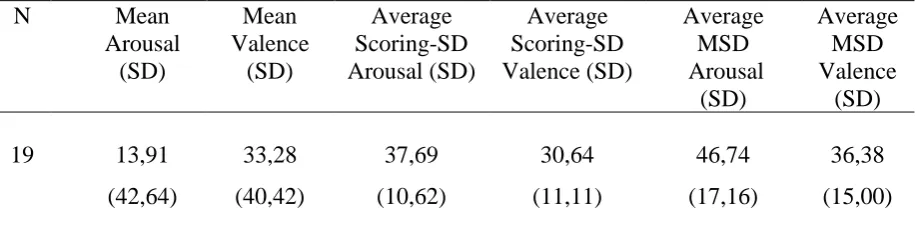
Table 1
Means with standard deviations for valence and arousal and average within-participant standard deviation for the scorings of each dimension.
Note. In the present table the mean successive difference scores (MSD), which is the square root of the mean squared successive difference (MSSD), is included to allow a better comparison of the values, as the MSD has the same measurement unit as the coordinates of the affect grid.
N Mean Arousal (SD) Mean Valence (SD) Average Scoring-SD Arousal (SD) Average Scoring-SD Valence (SD) Average MSD Arousal (SD) Average MSD Valence (SD)
19 13,91
Discussion
The purpose of the present study was to validate the affect grid in the context of
experience sampling, more precisely with regard to split-half reliability and construct validity. On the question of reliability, the author found moderate to high spit-half reliability in all tested facets, with values in alignment with split-half reliability of other measures in experience sampling (Csikszentmihalyi & Larson, 2014). More precisely, the participants’ individual mean score, standard deviation, and mean squared successive difference in core affect all exhibited adequate stability throughout the testing period. With respect to construct validity, the findings demonstrated a negative correlation of variability and pace of change in arousal with the TAS-20 subscale difficulties in describing feelings (DDF). This is in
correspondence with the negative relationship of alexithymia and emotional variability that has been hypothesized in the present study and indicated in the past (e.g. Thompson et al. (2009)). However, contrary to the author’s expectations, this study did not find a significant negative correlation of variability or pace of change in valence with scores on the TAS-20, independent of subscale. Likely explanations for and implications of these findings for experience sampling and the construct alexithymia will be discussed subsequently.
With values for split-half reliability ranging between .65 and .80, the affect grid exhibits good reliability compared to other measures in experience sampling, typically obtaining correlation coefficients of .55 to .93 (Csikszentmihalyi & Larson, 2014). In view of the increasing amount of experience sampling research involving the affect grid and the ongoing interest in affective states, this finding is of considerable significance (Ebner-Priemer et al., 2009; Kuppens et al., 2010; Russell & Gobet, 2012; Schimmack, 2003). Not only provide these findings a valid ground for conclusions made in past experience sampling studies involving the affect gird, they also open the door for future research on core affect involving the ESM. With increasing interest in implications of emotional experience on
Furthermore, in consequence of the adequate reliability found, the present study also provides support for the long-term stability of the three dimensions incorporated in the DynAffect. In the present study the affective home base was represented in the
within-participant mean score, core affect variability in the within-within-participant standard deviation, and the attractor strength in the within-participant MSSD. As aforementioned, for valence and arousal all tested parameters turned out to be considerably stable throughout the testing period. Conclusively, these findings support the belief of relative stability of the DynAffect dimensions.
Finally, the reported negative relation between variability in arousal and alexithymia is consistent with the conceptualization of alexithymia, which includes having difficulties in distinguishing feelings (Bagby et al., 1994; Boden & Berenbaum, 2011). Furthermore, the impaired ability in recognizing (new) emotions, as reported by Lane et al. (2000); Lane et al. (1996) is reflected in the negative correlation of alexithymia with the pace of change in reported arousal. On the one hand, these findings are in line with the hypotheses and provide support for the construct validity of the affect grid in the present study. On the other hand, the expected relationship between alexithymia and core affect was only found with respect to arousal, not to valence. However, considering that valence and arousal are distinct
favor of the representativeness of the present findings. Taken together, these studies provide support for the reported results and the construct validity of the affect grid.
Limitations
With regard to limitations of the present study, there are two factors that could have had an influence on the data. The first concerns the sequence of the affect grid’s administration; the study was programmed to administer the affect grid every two hours, and, if not filled in immediately, to remain available for 90 minutes. However, few participants reported that the previous affect grid remained available if it had not been filled in, even after the subsequent measurement was appearing. To the author’s knowledge this was the case only for a few participants, however, it appears likely that retrospective answering of multiple responses could have reduced the variability in scoring, as the responses were given at the same time.
Another confounding factor that could have affected the scorings are external events. Of course, this is the case for any experience sampling research, however, in view of the rather ‘short’ sampling period of one week, an external event could have affected the participant over a considerable part of the testing period. In retrospection the author would therefore recommend including a question item such as ‘During the testing period, did an event take place that strongly affected you in your mood in any way? If yes, 1. On which day? 2. Around which time? 3. How long did you feel affected by it? 4. How did the event make you feel? (more pleasant; less pleasant; more aroused; less aroused). Of course, these items cannot be thought to reliably explain detected irregularities in the responses, however, they could allow some insight into reasons for potential irregularities in the data.
On a more general level, also with regard to the conclusions about validity and reliability, caution is advised. Due to the little research conducted on the role of valence and arousal in alexithymia the question of construct validity of the affect grid based on the reported results can be answered on a preliminary basis only. Future correlational ESM-research involving constructs with better validated relations to core affect (e.g. the PANAS by Watson, Clark, and Tellegen (1988)) would allow further conclusions with regard to the affect grid’s construct validity.
Implications and suggestions for future research.
has received little attention from varying fields of research and lacks a comprehensive picture. A meta-study gathering the findings with respect to a distinct role of valence and arousal to alexithymia could be informative. Alternatively, based on the outcome of the present study the affect grid seems to be a suitable instrument to investigate this distinction further and cross-validate the outcome, e.g. by simultaneous use of a skin conductance measure to investigate arousal.
With respect to practical implications, this study could prove useful especially to the clinical practice. As Derks, Westerhof, Bohlmeijer, (2017) pointed out, one focus of psychotherapeutic treatments is to increase the emotional awareness of patients. The affect grid as long-term measure could contribute to the observation of treatment effects on emotional awareness by investigating enduring changes in core effect variability. Also, concluded in the same study, alexithymia and, closely connected, emotional awareness have been found to be related to borderline personality pathology (BPP). However, these findings have been based on mono-self reports (Derks et al., 2017). With the affect grid a tool is available that allows to investigate these past findings by means of experience sampling. In this regard, as a rather ventured suggestion, it furthermore seems possible that using the affect grid over a longer period of time could by itself contribute to an increase in emotional
awareness, as the patient is habituated to attend to the own emotions more frequently. Effects of a decrease in scoring variance over time have been reported by Csikszentmihalyi and Larson, (2014) but could be due to a multitude of reasons. On these grounds, by investigating changes in emotional variability when using the affect grid over a long period of time, in combination with a measure of emotional awareness, not only treatment effects could be observed, but also changes in variability not stemming from the actual treatment.
Conclusion
Taken together, the present study found the affect grid to exhibit adequate split-half reliability in all tested facets. With respect to the question of construct validity, correlations in the expected directions were found, however, only in one of the two facets, namely arousal. In light of research that provides evidence for a connection of alexithymia to arousal, but not valence, these findings speak in favor of adequate construct validity of the affect grid in the present study. Nevertheless, additional validation appears necessary to confirm this
References
Bagby, R. M., Parker, J. D. A., & Taylor, G. J. (1994). The twenty-item Toronto Alexithymia Scale-I. Item selection and cross-validation of the factor structure. Journal of
Psychosomatic Research, 38(1), 23-32.
doi:https://doi.org/10.1016/0022-3999(94)90005-1
Boden, M. T., & Berenbaum, H. (2011). What you are feeling and why: Two distinct types of emotional clarity. Personality and Individual Differences, 51(5), 652-656.
doi:https://doi.org/10.1016/j.paid.2011.06.009
Colomo-Palacios, R., Casado-Lumbreras, C., Soto-Acosta, P., & Garcia-Crespo, A. (2011). Using the affect grid to measure emotions in software requirements engineering. Journal of Universal Computer Science, 17(9), 1281-1298.
doi:10.3217/jucs-017-09-1281
Conner, T., & Lehman, B. (2012). Getting started: Launching a study in daily life. In M. R. Mehl & T. S. Conner (Eds.), Handbook of research methods for studying daily life (pp. 89-107). New York: New York: Guilford Press.
Cranford, J. A., Shrout, P. E., Iida, M., Rafaeli, E., Yip, T., & Bolger, N. (2006). A procedure for evaluating sensitivity to within-person change: Can mood measures in diary studies detect change reliably? Personality and Social Psychology, 32(7), 917-929. doi:10.1177/0146167206287721
Cronbach, L. (1951). Coefficient alpha and the internal structure of tests. Psychometrika, 16(3), 297-334. doi:10.1007/BF02310555
Cronbach, L., & Meehl, P. E. (1955). Construct validity in psychological tests. Psychological Bulletin, 52(4), 281-302.
Csikszentmihalyi, M. (1992). The experience of psychopathology: Investigating mental disorders in their natural settings (M. W. d. Vries Ed.). Cambridge: Cambridge
University Press.
Csikszentmihalyi, M., & Larson, R. (2014). Validity and reliability of the
experience-sampling method. In M. Csikszentmihalyi (Ed.), Flow and the Foundations of Positive Psychology: The collected works of Mihaly Csikszentmihalyi (pp. 35-54). Dordrecht:
Springer Netherlands.
Derks, Y. P. M. J., Westerhof, G. J., & Bohlmeijer, E. T. (2017). A meta-analysis on the association between emotional awareness and borderline personality pathology. Journal of personality disorders, 30(3), 362-384.
https://doi.org/10.1521/pedi_2016_30_257
Dooley, D. (2009). Social Research Methods (4th ed.). New Jersey: Pearson Education Limited.
Ebbinghaus, H. (1885). Memory: A contribution to experimental psychology. New York: Dover.
Ebner-Priemer, U., Houben, M., Santangelo, P., Kleindienst, N., Tuerlinckx, F., Oravecz, Z., . . . Kuppens, P. (2015). Unraveling affective dysregulation in borderline personality disorder: A theoretical model and empirical evidence. J Abnorm Psychol, 124. doi:10.1037/abn0000021
Ebner-Priemer, U. W., Eid, M., Kleindienst, N., Stabenow, S., & Trull, T. J. (2009). Analytic strategies for understanding affective (in)stability and other dynamic processes in psychopathology. Journal of Abnormal Psychology, 118(1), 195-202.
doi:10.1037/a0014868
Field, A. (2014). Discovering statistics using IBM SPSS statistics (4 ed.). London: SAGE Publications Ltd.
Heinzel, A., Schäfer, R., Müller, H.-W., Schieffer, A., Ingenhag, A., Northoff, G., . . . Hautzel, H. (2010). Differential modulation of valence and arousal in high-alexithymic and low-high-alexithymic individuals. NeuroReport, 21, 998-1002. doi:10.1097/WNR.0b013e32833f38e0
Hoey, M. (2012). Lexical priming. In A New Theory of Words and Language. London: Routledge.
Killgore, W. D. S. (1998). The affect grid: A moderately valid, nonspecific measure of pleasure and arousal. Psychological Reports, 83(2), 639-642.
doi:10.2466/pr0.1998.83.2.639
Kooiman, C., Spinhoven, P., & W Trijsburg, R. (2003). The assessment of alexithymia: a critical review of the literature and a psychometric study of the Toronto Alexithymia Scale-20. Journal of Psychosomatic Research, 53, 1083-1090.
Kuppens, P., Oravecz, Z., & Tuerlinckx, F. (2010). Feelings change: Accounting for
Lane, R., Sechrest, L., Riedel, R., Shapiro, D., & Kaszniak, A. (2000). Pervasive emotion recognition deficit common to alexithymia and the repressive coping style.
Psychosomatic Medicine, 62, 492-501. doi:10.1097/00006842-200007000-00007
Lane, R. D., Lee, S., Reidel, R., Weldon, V., Kaszniak, A., & Schwartz, G. E. (1996). Impaired verbal and nonverbal emotion recognition in alexithymia. Psychosomatic Medicine, 58(3), 203-210.
Leising, D., Grande, T., & Faber, R. (2009). The Toronto Alexithymia Scale (TAS-20): A measure of general psychological distress. Journal of Research in Personality, 43(4), 707-710. doi:https://doi.org/10.1016/j.jrp.2009.03.009
Luminet, O., Rime, B., Bagby, R. M., & Taylor, G. J. (2004). A multimodal investigation of emotional responding in alexithymia. Cognition & Emotion, 18(6), 741-766.
doi:10.1080/02699930341000275
Palmier-Claus, J., Myin-Germeys, I., Barkus, E., Bentley, L., Udachina, A., Delespaul, P., . . . Dunn, G. (2011). Experience sampling research in individuals with mental illness: Reflections and guidance. Acta psychiatrica Scandinavica, 123, 12-20.
doi:10.1111/j.1600-0447.2010.01596.x
Panayiotou, G., & Constantinou, E. (2017). Emotion dysregulation in alexithymia: Startle reactivity to fearful affective imagery and its relation to heart rate variability. Psychophysiology, 54(9), 1323-1334. doi:10.1111/psyp.12887
Parker, J., Taylor, G., & Bagby, R. (2003). The 20-Item Toronto Alexithymia Scale: III. Reliability and factorial validity in a community population. Journal of Psychosomatic Research, 55, 269-275. doi:10.1016/S0022-3999(02)00578-0
Parker, J. D. A., Michael Bagby, R., Taylor, G. J., Endler, N. S., & Schmitz, P. (1993). Factorial validity of the 20-item toronto alexithymia scale. European Journal of Personality, 7(4), 221-232. doi:10.1002/per.2410070403
Peasley-Miklus, C. E., Panayiotou, G., & Vrana, S. R. (2016). Alexithymia predicts arousal-based processing deficits and discordance between emotion response systems during emotional imagery. Emotion, 16(2), 164-174. doi:10.1037/emo0000086
Russell, J. A. (2003). Core affect and the psychological construction of emotion. Psychological Review, 110, 145-172. doi:10.1037//0033-295X.110.1.145
Russell, Y. I., & Gobet, F. (2012). Sinuosity and the affect grid: A method for adjusting repeated mood scores. Perceptual and Motor Skills, 114(1), 125-136.
doi:10.2466/03.28.PMS.114.1.125-136
Schimmack, U. (2003). Affect measurement in experience sampling research. Journal of Happiness Studies, 4(1), 79-106. doi:10.1023/a:1023661322862
Soo Seo, S., Chung, U.-S., Deog Rim, H., & Jeong, S. (2009). Reliability and validity of the 20-Item Toronto Alexithymia Scale in korean adolescents. Psychiatry investigation, 6, 173-179. doi:10.4306/pi.2009.6.3.173
Stone, L. A., & Nielson, K. A. (2001). Intact physiological response to arousal with impaired emotional recognition in alexithymia. Psychotherapy and Psychosomatics, 70(2), 92-102. doi:10.1159/000056232
Taylor, G. J., Ryan, D., & Bagby, R. M. (1985). Toward the development of a new self-report alexithymia scale. Psychotherapy and Psychosomatics, 44(4), 191-199.
doi:10.1159/000287912
Thompson, R. J., Dizén, M., & Berenbaum, H. (2009). The unique relations between emotional awareness and facets of affective instability. Journal of Research in Personality, 43(5), 875-879. doi:https://doi.org/10.1016/j.jrp.2009.07.006
Trull, T. J., & Ebner-Priemer, U. (2013). Ambulatory assessment. Annual review of clinical psychology, 9, 151-176. doi:10.1146/annurev-clinpsy-050212-185510
Versluis, A., Verkuil, B., Lane, R. D., Hagemann, D., Thayer, J. F., & Brosschot, J. F. (2018). Ecological momentary assessment of emotional awareness: Preliminary evaluation of psychometric properties. Current Psychology. doi:10.1007/s12144-018-0074-6 Watson, D., Clark, L. A., & Tellegen, A. (1988). Development and validation of brief
measures of positive and negative affect: the PANAS scales. Journal of Personality and Social Psychology, 54(6), 1063-1070
Appendix
A. Instructions sent to the participants by mail after being assigned to the study
Hey [account name]!
Thank you for taking part in our study.
of this study.
In general, this study serves the investigation of changes in core affect over time.
Core affect represents what is commonly called mood or feelings, and consists of two dimensions- valence and arousal.
Valence represents how pleasant you feel at the moment and ranges from unpleasant to pleasant.
Arousal represents how activated you feel at the moment and ranges from sleepy to activated.
These two dimensions are represented in the Affect Grid, the test you will fill in repeatedly in the course of this study.
The Affect Grid is a coordinate system with valence represented on the x-axis (horizontal) and arousal on the y-axis (vertical).
You can refer to the point where both axes cross as 'neutral state of feelings'. By setting a mark somewhere in this coordinate system you indicate how you feel- both pleasant/unpleasant and sleepy/activated in one mark!
(this means, that if you feel very active and pleasant you set a mark far to the right upper corner,
if you feel pleasant but rather sleepy/inactive you set it far to the right but in the lower corner)
(please read the information above carefully- understanding this is necessary to successfully fill in the affect grid!)
(you can also make a screenshot of this description in case you want to read it at a later point again)
Your task is to set a mark in the coordinate system every two hours between 10:00 and 20:00 o'clock (six times per day) for 7 days.
You do not have to keep track of the time yourself, the app will send you a notification every two hours within this time frame to fill in the Affect Grid.
(therefore please allow the app to send you notifications!)
If you are not able to fill in the grid right away, you can do so a few minutes later, but please try to do so in time.
To start the study, please download the app TiiM - The incredible intervention machine and log in with the credentials you chose.
You will start by answering three questionnaires and then the study will begin- We hope you are as excited about this study as we are!
Best,
[researchers]
PS: In case of any open questions, issues, or critique please do not hesitate to contact
[Names and corresponding mail addresses of the researchers]
B. TAS-20 with the two subscales administered
I. Difficulties Identifying Feelings
1. I am often confused about what emotion 1 am feeling.
2. I have physical sensations that even doctors don’t understand. 3. When I am upset I don’t know if I am sad, frightened, or angry. 4. I am often puzzled by sensations in my body.
5. I have feelings that 1 can’t quite identify. 6. I don’t know what’s going on inside me. 7. I often don’t know why I am angry.
II. Difficulties Describing Feelings
1. It is difficult for me to find the right words for my feelings. 2. I am able to describe my feelings easily.
3. I find it hard to describe how I feel about people. 4. People tell me to describe my feelings more.
C. Additional graphics and Tables
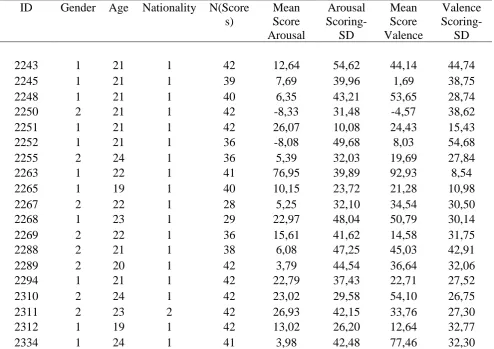
Table 2
Gender, age, nationality, number of given responses, mean scores and standard deviations of the participants’ scorings on arousal and valence.
Note. Gender (1=female, 2=male), nationality (1= German, 2= other)
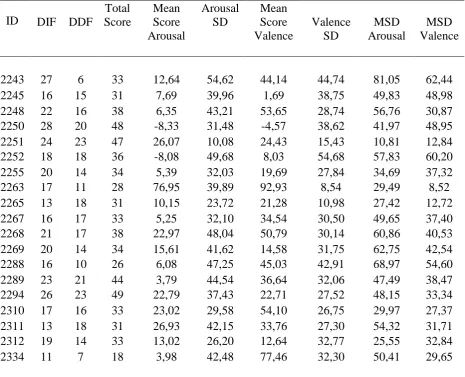
ID DIF DDF
Total Score Mean Score Arousal Arousal SD Mean Score Valence Valence SD MSD Arousal MSD Valence
2243 27 6 33 12,64 54,62 44,14 44,74 81,05 62,44
2245 16 15 31 7,69 39,96 1,69 38,75 49,83 48,98
2248 22 16 38 6,35 43,21 53,65 28,74 56,76 30,87
2250 28 20 48 -8,33 31,48 -4,57 38,62 41,97 48,95
2251 24 23 47 26,07 10,08 24,43 15,43 10,81 12,84
2252 18 18 36 -8,08 49,68 8,03 54,68 57,83 60,20
2255 20 14 34 5,39 32,03 19,69 27,84 34,69 37,32
2263 17 11 28 76,95 39,89 92,93 8,54 29,49 8,52
2265 13 18 31 10,15 23,72 21,28 10,98 27,42 12,72
2267 16 17 33 5,25 32,10 34,54 30,50 49,65 37,40
2268 21 17 38 22,97 48,04 50,79 30,14 60,86 40,53
2269 20 14 34 15,61 41,62 14,58 31,75 62,75 42,54
2288 16 10 26 6,08 47,25 45,03 42,91 68,97 54,60
2289 23 21 44 3,79 44,54 36,64 32,06 47,49 38,47
2294 26 23 49 22,79 37,43 22,71 27,52 48,15 33,34
2310 17 16 33 23,02 29,58 54,10 26,75 29,97 27,37
2311 13 18 31 26,93 42,15 33,76 27,30 54,32 31,71
2312 19 14 33 13,02 26,20 12,64 32,77 25,55 32,84
Table 3
Means, standard deviations (SD), and mean successive difference scores (MSD) with scores in the two used subscales of the TAS-20 and the respective total score.
Note. In the present table the mean successive difference scores (MSD), which is the square root of the mean squared successive difference (MSSD), is included to allow a better comparison of the values, as the MSD has the same measurement unit as the coordinates of the affect grid.
ID Gender Age Nationality N(Score s)
Mean Score Arousal
Arousal
Scoring-SD
Mean Score Valence
Valence
Scoring-SD
2243 1 21 1 42 12,64 54,62 44,14 44,74
2245 1 21 1 39 7,69 39,96 1,69 38,75
2248 1 21 1 40 6,35 43,21 53,65 28,74
2250 2 21 1 42 -8,33 31,48 -4,57 38,62
2251 1 21 1 42 26,07 10,08 24,43 15,43
2252 1 21 1 36 -8,08 49,68 8,03 54,68
2255 2 24 1 36 5,39 32,03 19,69 27,84
2263 1 22 1 41 76,95 39,89 92,93 8,54
2265 1 19 1 40 10,15 23,72 21,28 10,98
2267 2 22 1 28 5,25 32,10 34,54 30,50
2268 1 23 1 29 22,97 48,04 50,79 30,14
2269 2 22 1 36 15,61 41,62 14,58 31,75
2288 2 21 1 38 6,08 47,25 45,03 42,91
2289 2 20 1 42 3,79 44,54 36,64 32,06
2294 1 21 1 42 22,79 37,43 22,71 27,52
2310 2 24 1 42 23,02 29,58 54,10 26,75
2311 2 23 2 42 26,93 42,15 33,76 27,30
2312 1 19 1 42 13,02 26,20 12,64 32,77
Participant means of Valence and Arousal Scorings
ACKNOWLEDGEMENTS