warwick.ac.uk/lib-publications
Original citation:Brendel, Johannes C., Gody, Guillaume and Perrier, Sébastien. (2016) Efficient click-addition sequence for polymer–polymer couplings. Polymer Chemistry, 7 (35). pp. 5536-5543.
Permanent WRAP URL:
http://wrap.warwick.ac.uk/83844
Copyright and reuse:
The Warwick Research Archive Portal (WRAP) makes this work of researchers of the University of Warwick available open access under the following conditions. Copyright © and all moral rights to the version of the paper presented here belong to the individual author(s) and/or other copyright owners. To the extent reasonable and practicable the material made available in WRAP has been checked for eligibility before being made available.
Copies of full items can be used for personal research or study, educational, or not-for-profit purposes without prior permission or charge. Provided that the authors, title and full bibliographic details are credited, a hyperlink and/or URL is given for the original metadata page and the content is not changed in any way.
Publisher statement:
First published by Royal Society of Chemistry 2016 http://dx.doi.org/10.1039/C6PY00954A
A note on versions:
The version presented here may differ from the published version or, version of record, if you wish to cite this item you are advised to consult the publisher’s version. Please see the ‘permanent WRAP url’ above for details on accessing the published version and note that access may require a subscription.
Efficient click-addition sequence for polymer-polymer couplings
Johannes C. Brendel,a,b
Guillaume Godya
and Sébastien Perrier*a,b
a
Department of Chemistry, University of Warwick, Gibbet Hill Road, Coventry CV4 7AL,
United Kingdom.
b
Faculty of Pharmacy and Pharmaceutical Sciences, Monash University, 381 Royal Parade,
Parkville, VIC 3052, Australia.
KEYWORDS: RAFT polymerization, SPAAC, isocyanate, addition reactions, multiblock
copolymer
Abstract
Controlled radical polymerization methods and click chemistry form a versatile toolbox for
creating complex polymer architectures. However, the incompatibility between the functional
groups required for click reactions and the reaction conditions of radical polymerization
techniques often limits application. Here, we demonstrate how combining two complementary
click reactions in a sequence circumvents compatibility issues. We employ isocyanate-amine
addition on a polymer obtained by RAFT without purification, thus allowing us to work at
exact equimolarity. The addition of commercially available amine-functional azido or strained
alkyne compounds, yields orthogonally modified polymers, which can be coupled together in
a subsequent strain promoted cycloaddition (SPAAC). The efficiency of this reaction sequence
is demonstrated with different acrylate, methacrylate, and acrylamide polymers giving block
copolymers in high yield. The resulting diblock copolymers remain active towards RAFT
polymerization, thus allowing access to multiblock structures by simple chain extension. The
orthogonality of the isocyanate-amine reaction, SPAAC and RAFT polymerization (both in
terms of monomer and chain end groups) is a key advantage and offers access to functional
and challenging polymer architectures without the need for stringent reaction conditions or
Introduction
The last 20 years have dramatically changed the field of polymer synthesis, with the
development of new synthetic methodologies enabling the production of a wealth of new
materials with potential applications in engineering and life sciences. In particular, controlled
radical polymerization techniques attracted considerable attention due to their extensive control
of the polymer architecture without requiring stringent reaction conditions.1-4
Nevertheless,
access to certain structures remains challenging and requires alternative chemistry, for example
in the synthesis of comb-like polymers, block copolymers with crystalline domains or the
combination of vinyl ether based monomers with methacrylates.5-7
a polymer-polymer coupling reaction, since the exact number of polymeric chain end groups present in the reaction cannot be calculated due to the molar mass distribution of the polymeric reagents. Recently, we showed that RAFT polymerization combined with the addition of an amine to a tertiary isocyanate chain end group, fulfils all criteria of a polymer click reaction and can easily be performed at equimolarity, as the number of end-groups is determined by the initial quantity of chain transfer agent (CTA) and no purification is required prior to the coupling.25
Here, we demonstrate that this approach can be further expanded using a second, fully orthogonal click reaction – the strain promoted azide-alkyne cycloaddition (SPAAC) – to become a versatile and convenient tool for linking a variety of different polymers. SPAAC has so far been scarcely recognized in polymer chemistry, but it has attracted considerable attention in biomedicine and pharmacology for labelling or conjugation.26, 27 This reactions proceeds without the need of catalysts or elevated temperatures to achieve high conversion and tolerates many functional groups as it can even be used for in vivo labelling.28 However, the high reactivity of the strained alkyne towards radicals and the potential side reactions of azides with acrylate based monomers have limited the application of SPAAC in radical polymerization.19, 29 These limitations can be overcome by combining SPAAC with our isocyanate chemistry, in order to introduce the strained alkyne and azide moiety in a post-polymerization step, using commercially available, amine-functionalized compounds (Figure 1).
Figure 1. Schematic reaction procedure starting with 1-azido-2-methyl-1-oxopropan-2-yl butyl carbonotrithioate (BIAzTC) which undergoes a Curtius rearrangement in the first polymerizations (with monomers M1 or M2) to provide the isocyanate end-group. The azide and alkyne (BCN-NH2
shown as example) are introduced via amine-isocyanate click to the individual polymers, which are subsequently combined for the formation of the block copolymer. To prove the orthogonality of the
reactions to the CTA, the active chain ends are extended with a third monomer (M3).
Results and discussion
We used 1-azido-2-methyl-1-oxopropan-2-yl butyl carbonotrithioate (BIAzTC) to prepare a
variety of isocyanate functionalized polymers including hydrophobic poly(n-butyl acrylate)
(pBA) and poly (methyl methacrylate) (pMMA), hydrophilic poly(4-acryloylmorpholine)
(pNAM), and a sterically hindered poly(poly(ethylene glycol) methyl ether acrylate) (pPEGA)
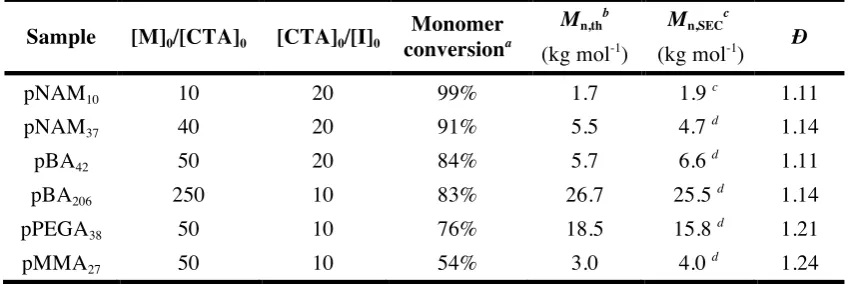
Table 1. Polymerization conditions and results for the isocyanate precursor polymers used for coupling.
Sample [M]0/[CTA]0 [CTA]0/[I]0
Monomer conversiona
Mn,thb Mn,SECc
Ð
(kg mol-1) (kg mol-1)
pNAM10 10 20 99% 1.7 1.9 c 1.11
pNAM37 40 20 91% 5.5 4.7 d 1.14
pBA42 50 20 84% 5.7 6.6 d 1.11
pBA206 250 10 83% 26.7 25.5 d 1.14
pPEGA38 50 10 76% 18.5 15.8 d 1.21
pMMA27 50 10 54% 3.0 4.0 d 1.24
a
Determined by 1
H NMR; b
Calculated from [M]0/[CTA]0 and conversion; c
Determined by SEC using Chloroform (2% Triethylamine) as eluent, calibrated with pMMA standards. d Determined by SEC using DMF (0.1% LiBr) as eluent, calibrated with pMMA standards.
To introduce the orthogonal functionalities BCN-NH2 (obtained from Aldrich, purity > 95%)
or DBCO-NH2 (Jena Biosciences, purity > 95%) and azidopropylamine (Alfa Aesar, >98%), each bearing a primary amine group, the polymers, still in their original solution for
polymerization, were reacted with exactly 1 equivalent (to CTA end group) of the respective
compound. Remarkably, no extra precautions were made for avoiding water or oxygen, as
standard solvents were used and solutions were not degassed. Furthermore, the NMR samples
demonstrate that in all cases, except pNAM10 (99% conversion), unconsumed monomers were still present (SI, Figure S1-S6).
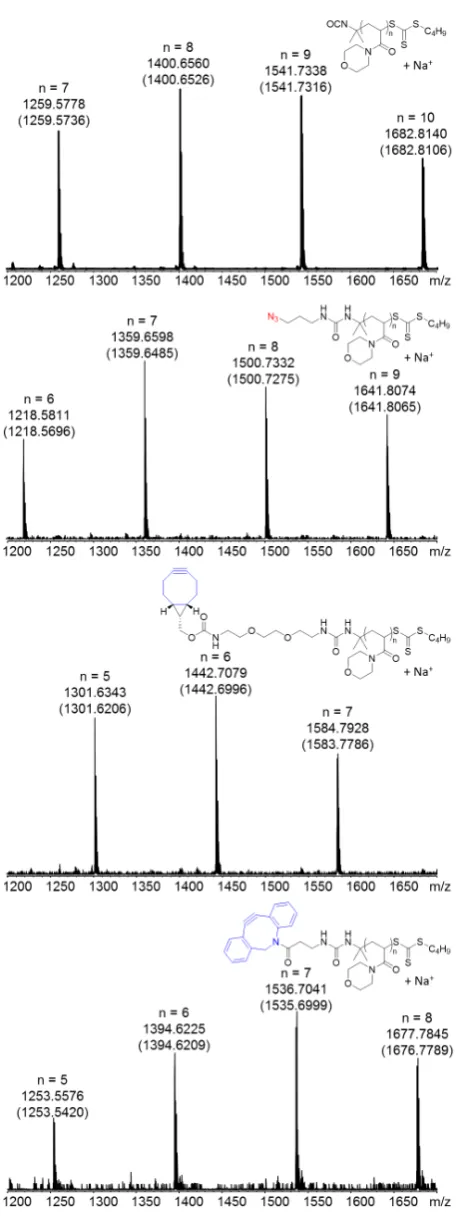
Figure 2 illustrates the high yield of the reaction by determining the degree of functionalization
of pNAM10 by Electron Spray Ionisation-Time of Flight (ESI-ToF) measurements (Figure 2, full spectra in SI Figure S7-S10). NMR spectra of the products after reaction with the respective
amines were also recorded (Figure S11-S12), but the overlap of signals with the polymer
backbone or solvents prevents accurate quantification of the modification efficiency. In
addition to ESI-ToF and NMR, we monitored the reaction with IR which showed a complete
disappearance of the characteristic signal for the isocyanate at 2250 cm-1
Figure 2. Electron spray ionisation-time of flight (ESI-ToF) measurements of the initial isocyanate modified polymer (pNAM10-NCO) (a), after addition of 1 eq. of azidopropylamine (b), after addition
of 1 eq. of BCN-NH2 (c), and after addition of 1 eq. of DBCO-NH2 (d). The calculated theoretical
No side reactions were observed in the ESI-ToF or NMR spectra, proving the absence of any
undesired side reactions of either the strained alkynes or the azides with the isocyanate groups,
the CTA or the remaining monomer; a key requirement for efficient coupling of the polymer
chains. Subsequently we combined the obtained polymers bearing orthogonal functionalities
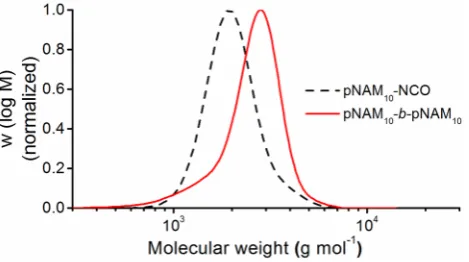
and tested the efficiency of the SPAAC. The reaction was examined for its conversion by size
exclusion chromatography (SEC) as previously reported (Figure 3).25
The respective number
distribution plot is given in the SI (Figure S15). The tailing towards lower molecular weights
is partially due to difficulties to correct the baseline being close to the lower limit of the
[image:8.595.182.417.269.400.2]separation range of the SEC.
Figure 3. Normalized SEC traces (SEC: CHCl3) of the initial polymer pNAM10-NCO (dashed black
line) and the polymer linked (red line) via SPAAC after modifying equal amounts of the precursor with 1 eq. of azidopropylamine or BCN-NH2, respectively. The respective number distribution plot is
given in the SI (Figure S15).
The SEC trace shifted towards higher molecular weight indicating that the polymers were
coupled. Furthermore, comparison of the IR-spectra of the starting material and the coupling
reaction after 4h revealed a complete disappearance of the azide signal at 2095 cm-1
indicating
a high coupling efficiency (Figure S14). Encouraged by this result we applied the procedure to
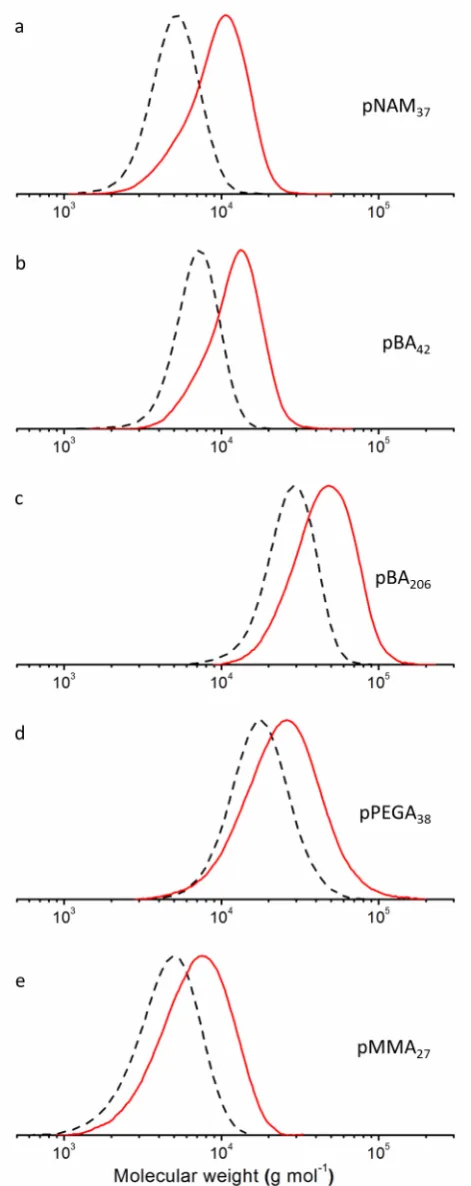
higher molecular weight pNAM and other types of polymers. The corresponding SEC traces
Figure 4. Normalized SEC traces of the initial precursors (dashed line) and the homocoupling (solid line) of pNAM37-NCO (a), pBA42-NCO (b), pBA207-NCO (c), pPEGA38-NCO (d), and pMMA27-NCO
According to the SEC traces, the homocoupling between the same polymers in all cases gave
a significant shift of towards higher molecular weight and mostly monomodal distributions.
Except for the sterically demanding pPEGA, a coupling efficiency of more than 90% was
obtained for all different types of polymer (see SI for details of the calculation, Figures
S21-S25, Table S1). Interestingly, increasing the degree of polymerization for pBA from 42 to 206
(5.7 kg/mol to 26.7 kg/mol) had no negative effect on coupling efficiency. These results clearly
demonstrate the high efficiency of each step in this click addition sequence. As we did not
observe any traces of side reactions we attribute any residual polymer to unavoidable dead
chains from the RAFT polymerization, limitations in reaching a quantitative conversion in each
step, or slight deviations in weighing the compounds precisely. It has to be kept in mind that a
deviation of only 1% in the first step may cause a reduction of the efficiency of 5% in the final
coupling step. Furthermore, the conversion to number distribution and the final deconvolution
has limitations which may compound these errors. Nevertheless, such high efficiencies can
only be reached if both reactions proceed to nearly quantitative conversion, and the results
prove that this happens almost independently of the type of polymer and within a total time of
less than 10 h.
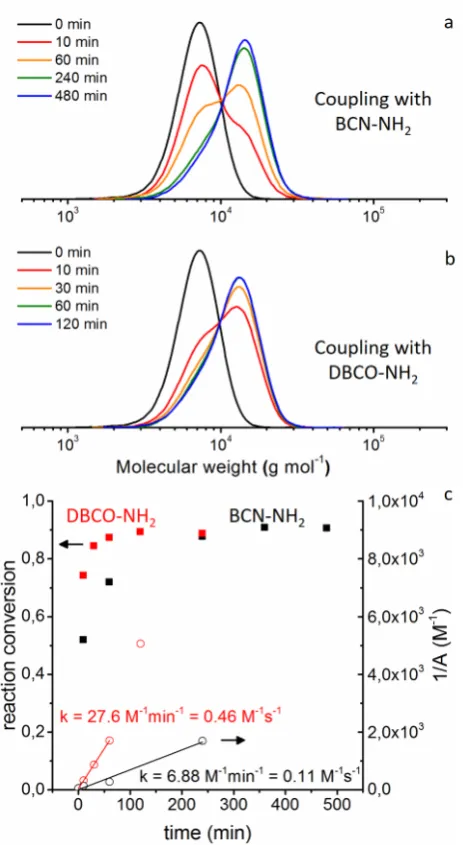
A more detailed analysis of the reaction kinetics was undertaken, taking pBA42 as an example. For both strained alkynes, BCN-NH2 and DBCO-NH2, SEC samples of the click reaction with
Figure 5. SEC traces of the samples taken from the reaction of pBA42-BCN (a) and pBA42-DBCO (b)
with pBA42-N3. After deconvolution of the number distribution the calculated conversion (filled
squares) and respective inverse concentrations (1/A, empty circles) of the reagents (red: DBCO-NH2,
black: BCN-NH2) were plotted versus time (c). From the slope of the linear fits in the kinetics plot
(1/A vs time) the rate constant k was calculated.
Both reactions reached high conversion (> 90%), however, the reaction with DBCO proceeded
much faster reaching a remarkable 74% after only 10 min and with almost maximum
conversion achieved in 1 h. The reaction of the BCN-NH2 modified polymer is considerably slower and reaches the maximum conversion after only 6 h. Based on the calculated conversion
us to estimate approximate rate constants (k) of 0.46 M-1 s-1
and 0.11 M-1 s-1
for DBCO and BCN,
respectively. Despite the attached polymer chain, the apparent reaction rate of pBA-DBCO
with the azide modified polymer is comparable to the reaction rate of the respective small
molecules.32
For BCN, rate constants of 0.29 M-1 s-1
and 0.19 M-1 s-1
(endo and exo form) were
reported for reactions in water/acetonitrile mixtures.30
These values are slightly higher than the
observed rates, but expected due to the constraints of the bulky polymer chain. Despite this
difference in reaction rates, it is noteworthy to mention that the strained precursor BCN-NH2 proved considerably more stable than DBCO, when stored in solution (Figure S26-S27, SI).
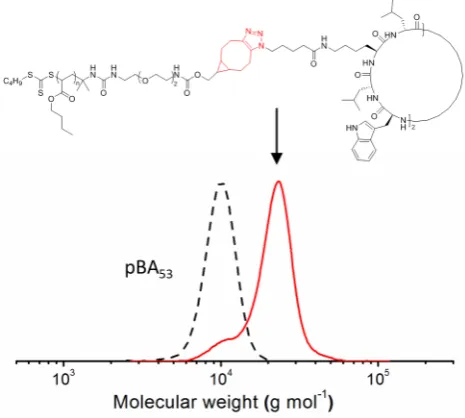
To demonstrate the reactivity and orthogonality of the presented procedure, we attached
BCN-NH2 modified polymer chains to a diazido functionalized cyclic peptide (Figure 6). As previously reported, these materials form large tubular assemblies, which requires stringent
optimization of reaction conditions to guarantee high yields in modification, especially with
[image:12.595.180.413.364.573.2]polymer chains.33
Figure 6. Normalized SEC traces of pBA53-NCO and the cyclic peptide conjugate obtained after
coupling to polymer chains via SPAAC.
Other reactions often require either an excess of polymer, high temperatures (100°C) or
reaction times of up to 5 days to reach high conversions.34, 35
The presented approach yields a
coupling efficiency of more than 90% within 48 h, while no trace of a side reaction was
A key advantage of the presented approach is the ability to combine various different RAFT
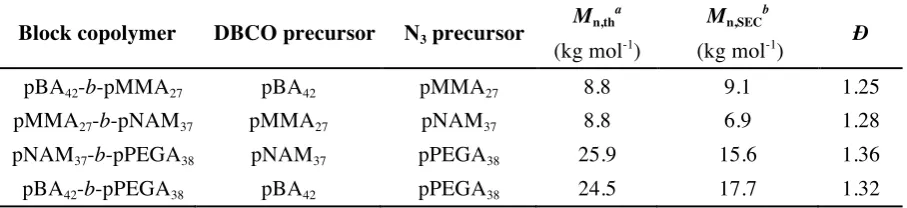
[image:13.595.72.526.165.269.2]polymers, while preserving the CTA chain end. Table 2 summarizes several, exemplarily combinations of polymers using the click sequence.
Table 2. Summary of the coupling reactions combining different types of polymers.
Block copolymer DBCO precursor N3 precursor
Mn,tha Mn,SECb
Ð
(kg mol-1) (kg mol-1)
pBA42-b-pMMA27 pBA42 pMMA27 8.8 9.1 1.25
pMMA27-b-pNAM37 pMMA27 pNAM37 8.8 6.9 1.28
pNAM37-b-pPEGA38 pNAM37 pPEGA38 25.9 15.6 1.36
pBA42-b-pPEGA38 pBA42 pPEGA38 24.5 17.7 1.32
a Determined form the theoretical M
n of the individual polymers and the molecular weight of the linkers;.
b Determined by SEC using DMF (0.1% LiBr) as eluent, calibrated with pMMA standards.
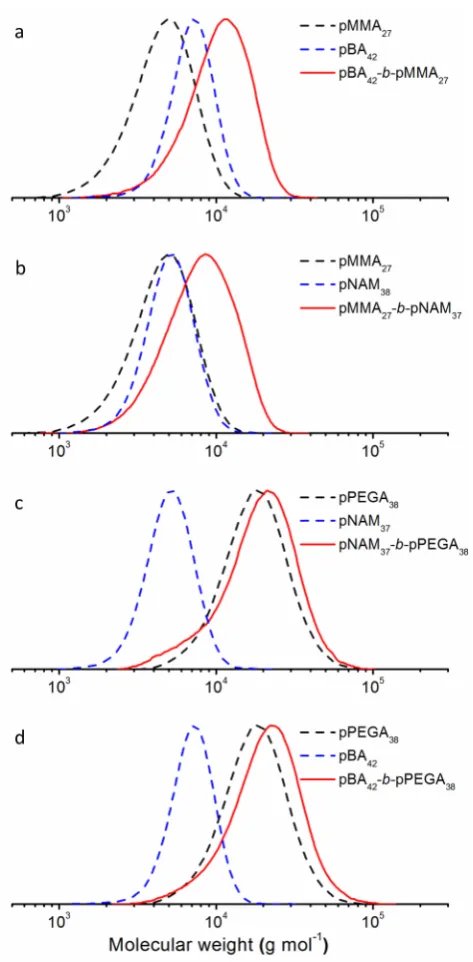
In all cases block copolymers with monomodal distributions were obtained. The SEC traces
Figure 7. Normalized SEC traces of pBA-b-pMMA, pMMA-b-pNAM, pNAM-b-pPEGA, and pBA -b-pPEGA (solid lines). For comparison the traces of the respective isocyanate precursors are included
(dashed lines).
No side reactions or limitations were observed in these reactions, despite the different character
of the polymers and the presence of monomer in solution. A critical point in this context is the
retention of the CTA end groups. These groups are known to be hydrolytically unstable,
especially in presence of amines or thiols. In order to prove the preservation of the CTA end
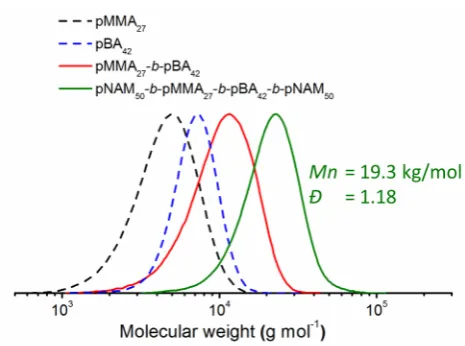
groups, we tried to chain extend the block copolymer pBA-b-pMMA using
Figure 8. Normalized SEC traces of the block copolymer pBA-b-pMMA obtained by the click sequence and the resulting tetrablock after chain extension with NAM.
A clear shift of the SEC trace is observed, demonstrating the successful chain extension of the
block copolymer pBA-b-pMMA. No significant tailing or residual polymer is visible in the
SEC trace as would be expected from a partial cleavage of the CTA. We therefore assume that
both CTA end groups are present and active after the click addition sequence, providing the
ability to create asymmetric tetrablock copolymers with the sequence pNAM-b-pBA
-b-pMMA-b-pNAM. Such a combination of acrylates, methacrylates and acrylamides is very
challenging and hardly possible using common RAFT chain extension due to the difference in
reactivity of methacrylates versus acrylates and acrylamides.
Conclusions
This study demonstrates the potential of combining efficient click reactions to effectively link
various polymers created by the RAFT process. While the isocyanate chemistry has previously
been shown to be an excellent tool and a robust click reaction for coupling polymers, the
introduction of strained alkynes or azides bearing an amine group facilitates the creation of a
variety of reactive polymers which can be combined to create well-defined block copolymers.
Key elements, which guarantee the efficiency of this reaction sequence, are the pure addition
character of all reactions and true orthogonality of the applied chemistry. Not only are there no
major side reactions observable between the isocyanate-amine click and the SPAAC, but also
no interaction with the CTA chain end and the residual vinyl groups of the monomer could be
detected. In particular the latter provides the ability to work at exact equimolarity in the
sequence is the speed of reaction for each step. The isocyanate-amine click reaches full
conversion within an hour, and the additional SPAAC also proceeds to high conversion in less
than an hour, especially for the highly reactive DBCO. However, this increased reactivity
comes at the cost of reagent stability. The BCN derivative requires longer, but still reasonable
reaction times (< 6 h), yet it remains active even after storage in solution for several months.
The tolerance to the CTA end group further allows the subsequent chain extension of the
bifunctional, but asymmetrical block copolymer obtained by the click sequence. This procedure
enables the formation of well-defined multiblocks combining methacrylates as central elements
with pendant acrylate or acrylamide polymer chains, which is not possible using sequential
controlled radical polymerization. In summary, this combination of controlled radical
polymerization and click chemistry is a powerful and versatile tool to create functional and
demanding polymer architectures. In addition, the effective introduction of strained alkynes to
polymer chains, which are well-known for their bioorthogonality, may be useful for
conjugation of proteins or other targets not only in reaction vessels, but also in vitro or even in
vivo.
Experimental
Materials
All monomers, deuterated solvents for NMR and aluminum oxide were purchased from Sigma-Aldrich. If applicable, stabilizers were removed by passing the monomers through a short aluminum oxide column. Dimethyl 2,2'-azobis(2-methylpropionate) (V-601) was purchased from Wako Specialty Chemicals. All solvents were bought from commercial sources and used as received. The acyl azide chain transfer agent was synthesized according to previously published procedures.36
Characterization
NMR spectra were recorded on Bruker DPX-300, DPX-400 and HD-500 instruments. Mass spectrometry measurements were performed on a Bruker MicroToF for ESI ToF. Size exclusion chromatography (SEC) measurements were performed on an Agilent PL50 equipped
with 2 Agilent Polargel Medium Columns eluting with dimethylformamide containing 0.1 M
LiBr as an additive at 50°C. The flow rate was 1 mL/min and detection was achieved using
simultaneous refractive index (RI) and UV (λ = 280 nm) detectors. As alternative an Agilent
1260 GPC-MDS fitted with differential refractive index (DRI), light scattering (LS), and
1 × PLgel 5 mm guard column (50 × 7.5 mm) was used with the mobile phase being chloroform
with 2% triethylamine at a flow rate of 1.0 mL/min. All molecular weights were calculated
relative to narrow PMMA standards and every sample was passed through 0.45 µm PTFE filter
before analysis. Attenuated Total Reflection Fourier Transform Infrared (ATR-FTIR) spectra
were recorded using a Bruker Alpha-E FTIR spectrometer fitted with a zinc-selenide crystal in
the region between 4000 and 400 cm-1
. The resolution was set-up at 4 cm-1
, the scan speed at
0.5 cm·s-1 with 64 scans performed per sample.
Synthesis
Polymerizations
Typical protocol: chain transfer agent (CTA), monomer, initiator (V601) and DMF were introduced into a vial equipped with a magnetic stirrer and sealed with a rubber septum. The solution was degassed with constant stream of nitrogen for 10 min, the flask was then put in a thermostated oil bath set at 65°C. The polymerizations were stopped by cooling the flask and opening it to air. Conditions specific to each polymerization are detailed in Table 1. Conversions were determined by 1H-NMR by comparison of the integration of the vinyl protons corresponding to the remaining monomer with the integration of polymer side chains signals. The final concentration (in mg/g solution) of CTA was determined gravimetrically weighing the empty vial with stirrer and subtracting this weight from the final mass of the vial with solution.
Modification with strained alkyne or azide
Exactly weighed aliquots of the polymerization solution (100-200 mg) were taken and either
exactly one equivalent (stock solutions in DMF) of BCN (c = 33 mg/g), DBCO (c = 25 mg/g)
or azidopropylamine (c = 10 mg/g) was added. The resulting mixture was agitated for 4 h at
room temperature on a shaker to complete the amine-isocyanate addition.
Polymer-polymer coupling with strained promoted alkyne-azide cycloaddition
The alkyne or azide modified polymer precursors, respectively, were prepared as stated above,
however to ensure equimolarity in the final polymer-polymer coupling reaction, the amount of
initial polymerization solution was carefully weighed to ensure that equal number of
end-groups were present in each reaction vessel. After modification the solutions were combined
and stirred for 2 h (DBCO) or 8 h (BCN), respectively. For kinetic measurements, samples
conversion was determined by deconvolution of the SEC traces and comparison of the
respective areas under the fitted curves.
Chain extension of linked polymers
The previously obtained pBA-b-pMMA was precipitated in a water/methanol mixture (1/1) to
remove any residual monomer and dried in vacuum. The resulting block copolymer (0.0434 g,
5 x 10⁻⁶
mol, 1 eq.) was dissolved in dioxane (0.2 ml), and NAM (0.035 mg, 2.5 x 10⁻⁴
mol, 50
eq.) and V601 (1.14 x 10⁻⁴
g, 5 x 10⁻⁷
mol, 0.1 eq.) were added. After degassing for 10 min with
constant stream of nitrogen, the polymerization was started by immersing the solution into a
preheated oil bath at 65°C. The polymerization was stopped by cooling the flask and opening it to air. The chain extension was examined by SEC calibrated with PMMA standards: Mn = 19.3 kg/mol, Ð = 1.18.
Polymer-cyclic peptide coupling with strain promoted alkyne-azide cycloaddition
The cyclic peptide was prepared according to previously published procedures.33, 35 For the
coupling reaction 0.099 g (3.67 x 10⁻⁶
mol, 2 eq.) of the reaction solution containing the
previously BCN-modified pBA (c = 3.71 x 10⁻⁵
mol/g) were added to 2.4 x 10⁻³
g of cyclic
peptide (1.84 x 10⁻⁶
mol, 1 eq.) previously dissolved in 0.25 mL N-methylpyrolidone. The
mixture was agitated for 7 days and samples taken at different time points were analysed by
SEC. The final conversion was calculated from the deconvolution of the traces.
Associated content
Electronic supplementary information.
Acknowledgements
The Royal Society Wolfson Merit Award (WM130055; SP) and the Monash-Warwick Alliance
(JB; SP) are acknowledged for financial support. Further, JB thanks the German Science
Foundation (DFG) for granting a full postdoctoral fellowship (BR 4905/1-1). S. Larnaudie and
References
1. G. Moad, E. Rizzardo and S. H. Thang, Polymer, 2008, 49, 1079-1131.
2. W. A. Braunecker and K. Matyjaszewski, Prog. Polym. Sci., 2007, 32, 93-146.
3. A. Anastasaki, V. Nikolaou, G. Nurumbetov, P. Wilson, K. Kempe, J. F. Quinn, T. P. Davis, M. R. Whittaker and D. M. Haddleton, Chem. Rev., 2015, DOI: 10.1021/acs.chemrev.5b00191.
4. J. Chiefari, Y. K. Chong, F. Ercole, J. Krstina, J. Jeffery, T. P. T. Le, R. T. A. Mayadunne, G. F. Meijs, C. L. Moad, G. Moad, E. Rizzardo and S. H. Thang, Macromolecules, 1998, 31, 5559-5562.
5. Z. Zheng, J. Ling and A. H. E. Müller, Macromol. Rapid Commun., 2014, 35, 234-241. 6. M. Hufnagel, M. Fischer, T. Thurn-Albrecht and M. Thelakkat, Polym. Chem., 2015,
6, 813-826.
7. J. Gardiner, I. Martinez-Botella, J. Tsanaktsidis and G. Moad, Polym. Chem., 2016, 7, 481-492.
8. U. Mansfeld, C. Pietsch, R. Hoogenboom, C. R. Becer and U. S. Schubert, Polym. Chem., 2010, 1, 1560-1598.
9. A. S. Goldmann, M. Glassner, A. J. Inglis and C. Barner-Kowollik, Macromol. Rapid Commun., 2013, 34, 810-849.
10. C. Barner-Kowollik, F. E. Du Prez, P. Espeel, C. J. Hawker, T. Junkers, H. Schlaad and W. Van Camp, Angew. Chem., Int. Ed., 2011, 50, 60-62.
11. C. E. Hoyle and C. N. Bowman, Angew. Chem., Int. Ed., 2010, 49, 1540-1573. 12. M. A. Tasdelen, Polym. Chem., 2011, 2, 2133-2145.
13. V. V. Rostovtsev, L. G. Green, V. V. Fokin and K. B. Sharpless, Angew. Chem., Int. Ed., 2002, 41, 2596-2599.
14. D. Konkolewicz, M. J. Monteiro and S. b. Perrier, Macromolecules, 2011, 44, 7067-7087.
15. B. S. Sumerlin and A. P. Vogt, Macromolecules, 2010, 43, 1-13.
16. J. C. Brendel, F. Liu, A. S. Lang, T. P. Russell and M. Thelakkat, ACS Nano, 2013, 7, 6069-6078.
17. W. Xi, T. F. Scott, C. J. Kloxin and C. N. Bowman, Adv. Funct. Mater., 2014, 24, 2572-2590.
18. S. P. S. Koo, M. M. Stamenović, R. A. Prasath, A. J. Inglis, F. E. Du Prez, C. Barner-Kowollik, W. Van Camp and T. Junkers, J. Polym. Sci., Part A: Polym. Chem., 2010,
48, 1699-1713.
19. V. Ladmiral, T. M. Legge, Y. Zhao and S. Perrier, Macromolecules, 2008, 41, 6728-6732.
20. P. Espeel and F. E. Du Prez, Macromolecules, 2015, 48, 2-14.
21. G. Delaittre, N. K. Guimard and C. Barner-Kowollik, Acc. Chem. Res., 2015, 48, 1296-1307.
22. A. J. Inglis, S. Sinnwell, M. H. Stenzel and C. Barner-Kowollik, Angew. Chem., Int. Ed., 2009, 48, 2411-2414.
23. S. Billiet, K. De Bruycker, F. Driessen, H. Goossens, V. Van Speybroeck, J. M. Winne and F. E. Du Prez, Nat Chem, 2014, 6, 815-821.
24. M. Dietrich, G. Delaittre, J. P. Blinco, A. J. Inglis, M. Bruns and C. Barner-Kowollik, Adv. Funct. Mater., 2012, 22, 304-312.
25. G. Gody, D. A. Roberts, T. Maschmeyer and S. Perrier, J. Am. Chem. Soc., 2016, DOI: 10.1021/jacs.5b11831.
27. J. C. M. van Hest and F. L. van Delft, ChemBioChem, 2011, 12, 1309-1312. 28. E. M. Sletten and C. R. Bertozzi, Acc. Chem. Res., 2011, 44, 666-676.
29. X. Yang, S. Wang, Y. Yan, Y. Wu, K. Zhang and Y. Chen, Polymer, 2014, 55, 1128-1135.
30. J. Dommerholt, S. Schmidt, R. Temming, L. J. A. Hendriks, F. P. J. T. Rutjes, J. C. M. van Hest, D. J. Lefeber, P. Friedl and F. L. van Delft, Angew. Chem., Int. Ed., 2010, 49, 9422-9425.
31. M. F. Debets, S. S. van Berkel, S. Schoffelen, F. P. J. T. Rutjes, J. C. M. van Hest and F. L. van Delft, Chem. Commun., 2010, 46, 97-99.
32. M. King and A. Wagner, Bioconjug. Chem., 2014, 25, 825-839.
33. S. C. Larnaudie, J. C. Brendel, K. A. Jolliffe and S. Perrier, J. Polym. Sci., Part A: Polym. Chem., 2016, 54, 1003-1011.
34. C. K. Poon, R. Chapman, K. A. Jolliffe and S. Perrier, Polym. Chem., 2012, 3, 1820-1826.
35. S. Dehn, R. Chapman, K. A. Jolliffe and S. Perrier, Polym. Rev., 2011, 51, 214-234. 36. G. Gody, C. Rossner, J. Moraes, P. Vana, T. Maschmeyer and S. Perrier, J. Am. Chem.