ORIGINAL RESEARCH
Apparent Diffusion Coefficients for Differentiation
of Cerebellar Tumors in Children
Z. Rumboldt D.L.A. Camacho D. Lake C.T. Welsh M. Castillo
BACKGROUND AND PURPOSE: Diffusion-weighted imaging (DWI) and apparent diffusion coefficient (ADC) maps provide information at MR imaging that may reflect cell attenuation and integrity. We hypothesized that cerebellar tumors in children can be differentiated by their ADC values.
METHODS: Brain MR imaging studies that included ADC maps were retrospectively reviewed in 32 patients with histologically proved cerebellar neoplasm. There were 17 juvenile pilocytic astrocytomas (JPA), 8 medulloblastomas, 5 ependymomas, and 2 rhabdoid (atypical teratoid/rhabdoid tumor [AT/RT]) tumors. Absolute ADC values of contrast-enhancing solid tumor regions and ADC ratios (ADC of solid tumor to ADC of normal-appearing white matter) were compared with the histologic diagnosis. ADC values and ratios of JPAs, medulloblastomas, and ependymomas were compared by using a 2-tailed ttest and one-way analysis of variance (ANOVA).
RESULTS: ADC values were significantly higher in pilocytic astrocytomas (1.65⫾0.27) (mean⫾SD) than in ependymomas (1.10⫾0.11) (P⫽.0003) and medulloblastomas (0.66⫾0.15) (P⬍.0001). Ependymomas demonstrated significantly higher ADC values than medulloblastomas (P⫽.0005). The observed differences were statistically significant on ANOVA (P ⬍ .001). ADC ratios were also significantly different among these 3 tumor types. AT/RT ADC values were similar to medulloblastoma. The range of ADC values and ratios within JPAs and ependymomas did not overlap with that of medulloblastomas.
CONCLUSION:Assessment of ADC values of enhancing solid tumor is a simple and reliable technique for preoperative differentiation of cerebellar tumors in pediatric patients. Our cutoff values of⬎1.4⫻ 103mm2/s for JPA and⬍0.9⫻103mm2/s for medulloblastoma were 100% specific.
A
lthough MR imaging is essential for diagnosis and evalu-ation of brain tumors, it offers limited informevalu-ation re-garding tumor type and grade and is frequently far from being a definite diagnostic test, which is a role reserved for histology. Accurate preoperative diagnosis is an important goal in pedi-atric patients with cerebellar neoplasms, because the most common tumors in this location and age group, juvenile pilo-cytic astrocytoma (JPA) and medulloblastoma, may dictate the need for different surgical approaches and have signifi-cantly different natural histories and outcomes.1Diffusion MR imaging is a technique in which dedicated phase-defocusing and -refocusing gradients allow evaluation of microscopic water diffusion within tissues, where calcu-lated apparent diffusion coefficient (ADC) maps represent an absolute measure of average diffusion for each voxel.2 Diffu-sion-weighted imaging (DWI) and ADC maps are useful in evaluation of acute infarcts and a number of different brain lesions.2-5ADC values in brain tumors seem to be primarily based on tumor cellularity and nuclear area,6-9and a correla-tion between ADC values and tumor grade also seems to be present, though the reported studies have demonstrated con-flicting results.5-16Significant differences in cellularity of pe-diatric cerebellar neoplasms, particularly between JPAs and medulloblastomas, indicate that these lesions could poten-tially be distinguished by their ADC values.8,17
The goal of our retrospective study was to establish the ADC values of different pediatric cerebellar tumors with the
hypothesis that these ADC values and ratios allow for differ-entiation of specific tumor types.
Methods
Retrospective review of patient records with histologically proved neoplasm in an electronic data base and PACS was performed in 2 institutions. Histologic diagnosis and MR imaging studies were eval-uated for all pediatric patients with cerebellar neoplasm. Histologic diagnosis was provided by analysis of postoperative specimens.
Thirty-two patients in whom ADC maps were obtained in addi-tion to convenaddi-tional MR imaging were identified and included in the study. There were 18 male patients and 16 female patients, with a mean age of 9 years (range, 6 weeks to 23 years). Histologic examina-tion revealed 17 (53.1%) patients with JPA, 8 (25%) with medullo-blastoma, 5 (15.6%) with ependymoma, and 2 (6.3%) with rhabdoid tumor (atypical teratoid/rhabdoid tumor [AT/RT]). In all but 2 pa-tients, the initial presentation MR imaging study was used for analy-sis; in these 2 patients, postoperative MR imaging showing residual tumor was used.
Conventional MR imaging was performed on 1.5T MR units with a protocol that included sagittal noncontrast T1-weighted, axial fast spin-echo T2-weighted, axial fluid-attenuated inversion recovery (FLAIR), as well as postcontrast enhanced axial, coronal, and sagittal T1-weighted images. Diffusion-weighted images were acquired (be-fore administration of contrast material) by using b values of 0, 500, and 1000 s/mm2applied in theZ,Y, andXdirections. Processing of ADC maps was performed automatically on the MR scanners.
For each patient the enhancing solid portion of the lesion was identified on postcontrast T1-weighted images and matching ADC maps. Regions of interest (ROIs) of 50 –100 mm2were accordingly manually positioned at the PACS workstations (AGFA Impax 4.1, Mortsel, Belgium) and all values were automatically calculated and expressed in 10⫺3mm2/s. The persons placing the ROIs were blinded Received July 26, 2005; accepted after revision October 17.
From the Departments of Radiology (Z.R., D.L.) and Pathology and Laboratory Medicine (C.T.W.), Medical University of South Carolina, Charleston, SC; and Department of Radi-ology (D.L.A.C., M.C.), University of North Carolina, Chapel Hill, NC.
to the tumor histology. The first region of interest was placed over homogenous enhancing regions in the central portion of tumors. Two additional ROIs were placed on homogenous enhancing areas on different sections, or, if the tumor was present on fewer than 3 sections, these ROIs were positioned so that overlapping with the first ROI was avoided. A total of 3 lesion ROIs were obtained and averaged to serve as the ADC tumor average value. Control ADC values were obtained by placing ROIs in the normal-appearing cerebellum, as well as bilateral centrum semiovale (3-region-of-interest method). The control ADC values in the normal brain were compared among pa-tients with different tumors. The ADC values of each tumor type were compared with their respective control ADC values. The ratio of the average tumor ADC to the average control ADC of the normal-ap-pearing cerebellum, contralateral and ipsilateral supratentorial brain ROI was then computed (ADC ratio). In addition, the ratio of a single ROI (the first measurement) of solid enhancing tumor to normal-appearing cerebellum was also performed (1-region-of-interest method) to determine whether the 3-region-of-interest and 1-region-of-interest methods yielded similar results.
Comparison of obtained normal brain and tumor ADC values was done by using a 2-tailed pairedttest, whereas comparison of ADC values and ratios among groups was performed with a 2-tailed un-pairedttest. One-way analysis of variance (ANOVA) was also per-formed, including the Tukey honestly significant difference test and the Duncan method for pairwise multiple comparison procedures.
The observed differences were considered statistically significant ifP was less than .05. Because of the small number, the AT/RT tumor group was excluded from statistical analysis.
After obtaining the above information, a first-year radiology res-ident, who was informed that JPAs should be bright and medulloblas-tomas dark, reviewed isolated ADC maps belonging to all patients with these 2 tumors and tried to correctly identify them based on this single criterion. The obtained sensitivity, specificity, and accuracy were calculated.
Results
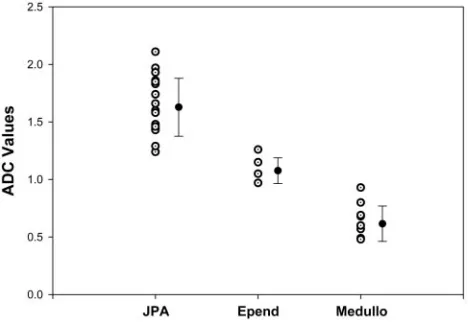
[image:2.585.56.534.59.405.2]The results are summarized in Tables 1 and 2 and in Fig 1. Normal brain ADC values among patients with JPAs, medul-loblastomas, and ependymomas were not significantly differ-ent (P⫽.75–.87). There was no significant difference in all ADC tumor values obtained with 3-region-of-interest com-pared with 1-region-of-interest methods (P⫽.524). In pa-tients with JPA, the average normal brain versus tumor ADC value was significantly different (P⬍.0001). In patients with medulloblastoma and ependymoma, this difference was also statistically significant (P⫽.015 andP⫽.0066, respectively). JPA and medulloblastoma could be differentiated by using both absolute values and ratios (Table 2, Figs 1–5). The JPA group showed significantly higher ADC values based on 3 measurements (P⬍.0001) and with the single measurement
Table 1. Data and ratios of apparent diffusion coefficient (ADC) values with 1-ROI and 3-ROI methods
Patient No.
Age/Sex Tumor Histology ADC Tumor ADC Tumor Average Ratio 1-ROI method Ratio 3-ROI method
1/14 y/M JPA 1.45 1.44 2.02 1.93
2/7 y/M JPA 1.28 1.24 1.76 1.65
3/20 mo/M JPA 1.64 1.66 2.18 1.90
4/11 y/M JPA 1.44 1.45 2.02 1.97
5/15 y/M JPA 1.65 1.83 2.43 2.48
6/15 y/F JPA 2.01 1.97 2.93 2.70
7/6 y/F JPA 1.39 1.29 1.94 1.67
8/6 y/M JPA 1.89 1.86 2.72 2.50
9/3 y/M JPA 1.44 1.48 1.62 1.77
10/21 y/M JPA 1.38 1.43 1.66 1.70
11/4 y/F JPA 1.60 1.85 2.47 2.50
12/7 y/M JPA 1.62 1.60 1.84 1.90
13/6 y/M JPA 1.73 1.74 2.01 2.12
14/4 y/F JPA 1.54 1.58 2.26 2.16
15/15 y/F JPA 2.09 1.93 2.99 2.76
16/7 y/M JPA 1.49 1.46 1.84 1.87
17/2 y/F JPA 2.05 2.11 2.30 2.21
18/8 y/M Ependymoma 1.08 0.97 1.28 1.15
19/16 y/M Ependymoma 1.11 1.05 1.39 1.31
20/4 y/F Ependymoma 1.24 1.15 1.39 1.44
21/5 y/F Ependymoma 1.07 1.05 1.43 1.42
22/22 y/F Ependymoma 1.29 1.26 1.85 1.63
23/16 y/M Medulloblastoma 0.69 0.68 1.00 0.91
24/3 y/M Medulloblastoma 0.90 0.93 1.07 1.10
25/22 y/F Medulloblastoma 0.48 0.49 0.71 0.71
26/23 y/F Medulloblastoma 0.54 0.48 0.71 0.66
27/7 y/F Medulloblastoma 0.74 0.69 1.02 0.91
28/11 y/M Medulloblastoma 0.61 0.57 0.77 0.74
29/2 y/F Medulloblastoma 0.58 0.60 0.79 0.82
30/6 wk/M Medulloblastoma 0.80 0.80 0.84 0.84
31/13 mo/F AT/RT 0.60 0.63 0.69 0.74
32/15 mo/M AT/RT 0.55 0.56 0.69 0.64
Note:—1-ROI method indicates the approach wherein a single region of interest of solid enhancing tumor to normal-appearing cerebellum was performed; 3-ROI method, approach used
by placing additional regions of interest in the tumor and bilateral centrum semiovale. ADC values are expressed in 10⫺3
mm2
/s. JPA indicates juvenile pilocytic astrocytoma; AT/RT, atypical teratoid/rhabdoid tumor.
PEDIATRICS
ORIGINAL
technique (P⬍.0001), as well as significantly higher ADC ratio values with both the 3-region-of-interest (P⬍.0001) and 1-region-of-interest (P⬍ .0001) techniques. There was no overlap in individual tumor ADC values or ratios between JPA and medulloblastoma or AT/RT (Tables 1 and 2 and Fig 1). JPA also demonstrated higher diffusion compared with ependymoma (Table 2 and Figs 1, 2, 4 and 7) and the observed difference was statistically significant for 3-region-of-interest (P⫽.0002) and 1-region-of-interest (P⫽.0006) ADC mea-surements, as well as for ADC ratios obtained with 3-region-of-interest (P ⫽ .0004) or 1-region-of-interest (P ⫽ .018) techniques.
The ADC values of ependymoma were higher than of me-dulloblastoma (Table 2, Figs 1, 3, 5, and 7), and this was sta-tistically significant for both 3-region-of-interest (P⫽.0002) and 1-region-of-interest (P⬍.0001) measurements, as well as for 3-region-of-interest (P⬍.0001) and 1-region-of-interest (P⫽.0001) ADC ratio techniques. There was no overlap in individual tumor ADC values or ratios between ependymoma and medulloblastoma or AT/RT (Tables 1 and 2 and Fig 1). The values obtained for AT/RT were within the range of me-dulloblastoma group with any of the performed measure-ments (Table 1, Figs 3, 5, and 6).
Source of variation between groups of average tumor ADC values for JPA, medulloblastoma, and ependymoma was also statistically significant with one-way ANOVA atP⬍.001 level. Pairwise comparison between any of these groups was also statistically significant atP⬍.01 level with the Tukey honestly
significant difference test and atP⬍.05 with the Duncan method.
On subjective evaluation of the images, JPAs were very hy-perintense, ependymomas were isointense to slightly hyperin-tense, and medulloblastomas and AT/RTs predominantly hy-pointense compared with brain parenchyma on ADC maps (Figs 2–7). The first-year radiology resident evaluating iso-lated ADC maps of 17 JPAs and 8 medulloblastomas was able to correctly identify the tumor type in all cases, yielding sensi-tivity, specificity, and accuracy of 100%.
Discussion
MR diffusion imaging has been widely used to study cerebral infarction, multiple sclerosis, tumors, abscesses, and other in-tracranial diseases and has become an indispensable part of many brain MR imaging protocols, for adult and pediatric patients alike.18It is a reliable technique for detection of acute infarcts, as well as for distinction between arachnoid cysts and epidermoids, and between brain tumors and abscesses.2-16 Arachnoid cysts demonstrate free diffusion of water similar to that of CSF, whereas epidermoids show slower diffusion, pre-sumably as a result of the more complex internal structure.3,4 The ADC values of abscess fluid are markedly lower than those of necrotic or cystic portions of tumor, which is considered to be a consequence of restricted water mobility within purulent fluid related to its high cellularity and viscosity.3,4Diffusion MR imaging is also helpful for distinguishing primary central nervous system lymphoma and toxoplasmosis in patients in-fected with human immunodeficiency virus.19
Although a negative correlation between glioma grade and ADC values has been established,11,14,16,17generalized applica-tion of ADC values for differentiaapplica-tion of brain tumor types and grades has been found inaccurate.7ADC also does not seem helpful in distinguishing tumor tissue from peritumoral edema.20On the other hand, the ADC has been reported reli-able for distinction of specific tumor types, such as dysem-bryoplastic neuroepithelial tumors,15and helpful in charac-terizing some pediatric brain tumors.8,21 In addition, pretreatment diffusion values also seem to be predictive of tumor response to radiation therapy22and valuable for differ-entiation of radiation-induced brain injury from tumor recurrence.23,24
None of the prior reports specifically evaluated ADC values of cerebellar tumors in pediatric population—the studies in-cluded all intracranial tumors, and only one of them was lim-ited to children.8Either the values for all primitive neuroecto-dermal tumors (PNETs), JPAs, and ependymomas arising in
Fig 1.Scatter diagram of average ADC tumor values for all pilocytic astrocytomas (JPA),
[image:3.585.53.533.69.164.2]ependymomas (Epend) and medulloblastomas (Medullo) (open circles) along with their respective mean (full circles) and standard deviation (bars) values. ADC values are expressed in 10⫺3mm2/s.
Table 2. Summary of apparent diffusion coefficient (ADC) values of tumors, ADC ratios of tumors to normal-appearing brain, and ADC values of normal-appearing brain parenchyma for juvenile pilocytic astrocytomas (JPA), ependymomas, and medulloblastomas
JPA Ependymoma Medulloblastoma
Tumor ADC range (1-ROI and 3-ROI) (⫻10⫺3mm2/s) 1.24–2.09 0.97–1.29 0.48–0.93
Mean tumor ADC value (3-ROI) (⫻10⫺3mm2/s) (⫾SD) 1.65⫾0.27 1.10⫾0.11 0.66⫾0.15
Tumor ADC ratio range 1.62–2.99 1.15–1.85 0.66–1.10
(1-ROI and 3-ROI)
Mean tumor ADC ratio (3-ROI) (⫾SD) 2.11⫾0.36 1.39⫾0.18 0.84⫾0.14
Mean tumor ADC ratio (1-ROI) (⫾SD) 2.18⫾0.42 1.47⫾0.22 0.86⫾0.15
Normal brain ADC (3-ROI) (⫾SD) 0.78⫾0.07 0.79⫾0.04 0.78⫾0.08
Age range (Mean Age) 20 mo⫺21 y (8.5 y) 4 y⫺22 y (11 y) 6 wk–23 y (10.5 y)
Note:—1-ROI method indicates the approach wherein a single region of interest of solid enhancing tumor to normal-appearing cerebellum was performed; 3-ROI method, approach used
[image:3.585.54.288.192.356.2]any intracranial location and in any age group were combined together,15or the goal of the study was to investigate possible correlation between cellular attenuation and nuclear area with ADC values.8Direct comparison of different histologic types of pediatric cerebellar tumors has not yet been performed.
The ADC values of different tumor types obtained in our study are comparable with those reported in the literature8,15 (Table 3). At least some of the discrepancies in the ADC values among the studies are probably due to different designs: Ya-masaki et al15included patients of all age groups, whereas both Gauvain et al8and Yamasaki et al15evaluated all intracranial tumors, infratentorial and supratentorial (Table 3).
It has been established that ADC values of normal develop-ing brain decrease with increasdevelop-ing age.25-27The absolute ADC value, rather than ADC ratio, may therefore be the preferred method of differentiating pediatric brain tumors because dif-fusion properties of brain change with age, in addition to white matter anisotropy and partial volume averaging effects, which also affect the ADC ratio measurements. However, ADC ratios have been used in previously reported studies,2-24 and we wanted to test these ratios because they correspond to qualitative estimate of relative tumor intensity on visual in-spection. If the tumor type could be determined based on qualitative subjective evaluation of ADC maps, without mea-surements, the method would be more practical and easier to implement in clinical practice.
In our study, JPA and medulloblastoma could be differen-tiated on the basis of ADC values and ADC ratios in all
pa-tients, and there was no overlap in obtained measurements between these 2 tumor types. As an illustration, 2 of the JPAs demonstrated very heterogenous strong contrast enhance-ment and were adherent to the brain stem; however, their very high ADC values and ratios were characteristic of JPA (Fig 2). ADC values and ratios also clearly distinguished medulloblas-toma from ependymoma in all patients, again without any overlap. This finding is similar to that in a recent study by Yamasaki et al15who found that ADC values were retrospec-tively 100% accurate in differentiation between ependymo-mas and PNETs.
The ADC values of JPAs were also higher from ependymo-mas in our study, and this difference was statistically signifi-cant (P⫽.0002 andP⫽.0006, for 1-region-of-interest and 3-region-of-interest methods, respectively), though there was a slight overlap in measurements, which corresponds to re-sults reported by Yamasaki et al.15Medulloblastomas and AT/ RTs may be indistinguishable by their diffusion characteristics on MR imaging.
These findings in JPAs and medulloblastomas are probably secondary to the low cellularity and relatively small nuclear area typically seen in the former tumor types in contradistinc-tion to the densely packed cells and large nuclei characteristic for the latter.8,28-30Kotsenas et al17described a case of a me-dulloblastoma that was very hyperintense on DWI and theo-rized that the attenuated cellularity of the tumor resulted in this increased signal intensity and was due to relatively re-stricted diffusion. A number of studies have since reported that increasing cellularity leads to increased signal intensity on DWI and consequently hypointensity on ADC maps.6-9,13
The high cellularity of medulloblastoma is a well-known histologic feature of these tumors.28,29Medulloblastoma char-acteristically shows patternless sheets of small cells with small areas of necrosis. The cells, though small, actually vary in size and shape (Fig 3D). Histologic variants of medulloblastoma
Fig 2.Eleven-year-old boy with cerebellar juvenile pilocytic astrocytoma (JPA) (patient 4).
A,Axial T2-weighted image at the level of middle cerebellar peduncles shows slightly heterogeneous, predominantly hyperintense midline mass without significant surrounding edema. There is associated effacement of the fourth ventricle.
B,Contrast-enhanced T1-weighted image at same levels asAdemonstrates strong, slightly heterogeneous enhancement of the tumor.
C,Apparent diffusion coefficient (ADC) map corresponding toAandBreveals that lesion is very hyperintense compared with normal brain parenchyma, representing increased diffu-sion of water.
[image:4.585.59.487.39.387.2]include the nodular/desmoplastic pattern, a large cell/anaplas-tic category, and tumors with additional differentiation (neu-ronal, glial, striated muscle, or melanin-producing cells). Des-moplastic/nodular medulloblastomas have prominent nodules that are paler than the surrounding tumor on histo-logic sections due to more stroma and fewer nuclei. These
areas, however, remain more densely cellular than the most cellular areas in a typical pilocytic tumor. In one of our pa-tients (patient 25), histologic examination revealed a desmo-plastic subtype of medulloblastoma (Fig 5), which was not different from those with the large-cell subtype by conven-tional MR imaging or ADC values. Although medulloblasto-mas are typically of low signal intensity on T2-weighted im-ages, in some of our patients, they were predominantly T2 hyperintense and yet they could easily be recognized by ADC values and ratios (Fig 3).
AT/RT tumors have a population of rhabdoid cells and
Fig 3.Sixteen-year-old boy with cerebellar medulloblastoma (patient 23).
A,Axial T2-weighted image at level of medulla oblongata shows heterogeneous mass in left paramedian location that is predominantly hyperintense. There is surrounding edema and compression of fourth ventricle.
B,Contrast-enhanced T1-weighted image corresponding toAdemonstrates avid, slightly heterogeneous, enhancement of tumor.
C,ADC map corresponding toAandBreveals that mass is hypointense to normal cerebellar parenchyma, consistent with decreased diffusion. Hyperintense ring surrounding tumor (arrowhead) represents increased diffusion of vasogenic edema.
D, Photomicrograph shows densely packed nuclei in medulloblastoma with scattered apoptosis and mitoses (arrows). Some nuclei show prominent nucleoli (arrowheads) (hematoxylin-eosin stain, 40⫻).
Fig 4.Fifteen-year-old girl with cerebellar JPA (patient 5). ADC map in axial plane at level
of middle cerebellar peduncles shows well defined, oval mass in right paramedian location with increased diffusion.
Fig 5.22-year-old woman with desmoplastic cerebellar medulloblastoma (patient 25). Axial
[image:5.585.55.514.39.413.2] [image:5.585.338.496.506.694.2] [image:5.585.92.246.508.694.2]often additional variable amounts of other elements, such as neuroectodermal, epithelial, or mesenchymal histology. Rhabdoid cells have an eccentric round-to-oval nucleus with cytoplasmic eosinophilia that varies from granular to charac-teristic dense pink bodies (Fig 6D). The cells may vary in size from small to enormous. Hemorrhage and necrosis are com-mon; mitoses are abundant. On ultrastructural studies, the dense pink inclusions are whorled bundles of intermediate filaments.29The tumors are always quite cellular, on the order of the other neoplasm most often in the differential diagnosis (ie, medulloblastoma). Intracranially, these rare tumors usu-ally occur in the cerebellum and are typicusu-ally of heterogenous appearance on MR imaging.30ADC value of AT/RT tumor has been previously reported in only 1 case,8and was very similar to the 2 cases in our study (Table 3).
Low water diffusion observed in pilocytic astrocytomas probably reflects the low cellularity appearance of these tu-mors on histologic examination.29,31Pilocytic astrocytomas in the posterior fossa have a classic “biphasic pattern,” with al-ternating loose (vacuolated) and denser areas. Even the denser areas, however, are not particularly cellular, especially com-pared with medulloblastoma. In pilocytic astrocytomas, there are frequently microcysts in addition to the macrocysts seen on imaging studies (Fig 2D). The “piloid” cells for which the tumor is named have oval nuclei and long bipolar processes. Rosenthal fibers (Fig 2D), though not pathognomonic of pi-locytic astrocytoma, are characteristic. They are generally
found in the more cellular areas of the tumor. Oligodendro-glial-appearing areas are common in cerebellar tumors. Ne-crosis and vascular changes typical for higher grade fibrillary astrocytomas can be seen but do not change their classifica-tion, grade, or prognosis.
Ependymomas are well circumscribed, moderately cellular tumors. The typical cellularity in posterior fossa ependymo-mas therefore is somewhere between that of astrocytoependymo-mas and medulloblastomas. The characteristic histology shows perivascu-lar pseudorosettes (cleared areas and radially arranged cells around blood vessels) (Fig 7D) and occasionally ependymal ro-settes (cleared spaces and radially arranged cells around a lumen that is not vascular). Several variants exist that are uncommon, one of which is more cellular. As ependymomas progress in ma-lignancy, they also increase in cellularity, but anaplastic ependy-momas are also less common than the more benign variants.29
Gauvain et al8used diffusion tensor imaging, which re-quires additional postprocessing steps, to examine pediatric tumor cellularity and nuclear-to-cytoplasmic ratio and found that it may be predictive of tumor classification and may en-hance the diagnostic process of pediatric brain malignancies. Moreno-Torres et al32recently used taurine detection by sin-gle-voxel proton MR spectroscopy. In all 6 patients with me-dulloblastoma, they demonstrated prominent taurine peaks that were absent in the other 7 patients with cerebellar astro-cytoma. Although this demonstrates accuracy similar to that of our method, it again involves additional imaging and post-processing. In our study, we sought to focus on pediatric cer-ebellar tumors and simplify the evaluation. Our method of analysis can be performed on routinely obtained ADC maps at a PACS station with only a single ROI measurement, without any additional imaging or postprocessing. Our goal of simple
Fig 6.15-month-old boy with atypical teratoid/rhabdoid tumor (AT/RT) (Patient 32).
A, Axial T2-weighted image at level of middle cerebellar peduncles shows a large heterogeneous mass of predominantly low to isointense signal intensity that is almost completely effacing the fourth ventricle. The temporal horns of the lateral ventricles are dilated with signs of transependymal CSF flow (arrowheads), consistent with obstructive hydrocephalus.
B,Contrast-enhanced T1-weighted image with fat saturation corresponding toAshows heterogeneous enhancement of the tumor. A nonenhancing cystic area (arrow) is also seen that is likely to correspond to trapped CSF adjacent to the tumor.
C,ADC at a similar level as A and B reveals that the lesion is of lower diffusion than the normal brain parenchyma. The lateral cystic area shows diffusion properties of CSF.
[image:6.585.60.470.39.399.2]differentiation between the tumors was manifest by compar-ing the 3-region-of-interest versus the 1-region-of-interest methods. Although the 3-region-of-interest method initially seemed more robust, after careful analysis, the 1-region-of-interest method provided similar results in all patients and further streamlined the analysis.
When ADCs between tumor types were compared for cre-ation of cutoffs, a value of⬎1.40⫻10⫺3mm2/s was 100% specific for JPA, whereas measurements⬍0.90⫻10⫺3mm2/s were 100% specific for medulloblastoma and AT/RT. Most of ependymomas fall between 1.00 and 1.30⫻10⫺3mm2/s. On subjective visual inspection, this translates into prominent hy-perintensity of JPAs, mild hyhy-perintensity relative to adjacent
brain of ependymomas, and hypointensity to isointensity of medulloblastomas and AT/RTs on ADC images. To determine whether our method was truly simple and robust, ADC images of JPAs and medulloblastomas were shown to a first-year ra-diology resident unaware of the histologic diagnoses who was informed only that medulloblastomas should be dark and JPAs bright. After we ensured that the resident was analyzing the solid enhancing portion of the tumor, he was able to cor-rectly differentiate medulloblastoma from JPA in all patients, indicating that correct distinction of these 2 tumor types is possible by visual inspection only, without additional mea-surements and even with limited experience.
Limitations of our study include a relatively small number of patients and the limited sample of pathology encountered. A further limitation is the retrospective nature of the analysis. Other less common primary neoplasms occurring in this lo-cation were not addressed in our study but deserve further evaluation, particularly in older age groups.
Although ADC values and ratios are not widely reliable in predicting the histology of all brain tumors, we have found that focused application to pediatric patients with posterior fossa tumors is fruitful. ADC values and ratios could prove reliable for distinction of other intracranial tumors, if used in a selective manner to answer specific questions, combined with patient’s age, tumor location, and other imaging findings. Isolated analysis of diffusion properties does not provide uni-versally reliable identification of different brain tumor types and grade; however, this may not be clinically relevant, be-cause diagnosis is never based on a single sequence but rather on careful analysis of entire brain MR imaging study. For ex-ample, in addition to JPAs, hemangioblastomas and schwan-nomas are other posterior fossa tumors that have been found to have similar high ADC values.15,33These 3 neoplasms may therefore not be distinguished solely on the basis of their dif-fusion properties; however, extra-axial location of
schwanno-Fig 7.Sixteen-year-old boy with ependymoma (patient 19).
A,Axial T2-weighted image at level of middle cerebellar peduncles shows a very hetero-geneous abnormality (arrows) within the fourth ventricle.
B,Corresponding contrast-enhanced T1-weighted image demonstrates enhancement of the solid portion of this mass (arrows).
C,ADC map at a level similar to that ofAandBshows that diffusion within the solid portion of the tumor (arrows) is slightly higher compared with normal cerebellum.
[image:7.585.45.537.36.429.2]D,Photomicrograph of ependymoma shows moderate cellularity with perivascular pseudo-rosettes (arrows) (hematoxylin-eosin stain, 10⫻).
Table 3. Summary of apparent diffusion coefficient (ADC) values obtained in 3 studies that evaluated pilocytic astrocytoma (PA), ependymoma, medulloblastoma, and atypical teratoid rhabdoid tumor (AT/RT)
Range of tumor ADC values (⫻10⫺3mm2/s)
Gauvain et al 20018
Yamsaki et al 200515*
Present Study
PA 1.13–1.54† 1.30–1.92† 1.24–2.09
Ependymoma 0 1.05–1.33 0.97–1.29
Medulloblastoma 0.54–0.58 0.68–0.99‡ 0.48–0.93
AT/RT 0.60§ 0 0.55–0.63
*Data for all age groups.
†Data for all intracranial tumors, infratentorial and supratentorial.
[image:7.585.53.286.471.537.2]mas and presence of prominent flow voids within hemangio-blastomas should allow for correct diagnosis in most cases.
Based on our results, we suggest that ADC values may play a potentially important role in the presurgical management of children with posterior fossa tumors. It may be proposed that if high ADC values are present, a patient may go directly to surgery without additional imaging, given that pilocytic astro-cytomas are unlikely to metastasize. Low ADC values on the other hand suggest that the tumor is either a medulloblastoma or a rhabdoid tumor, and imaging of the spine is warranted to exclude metastases and appropriately stage the patient.
Conclusion
ADC values and ratios are simple and readily available tech-niques for evaluation of pediatric cerebellar neoplasms that may accurately differentiate the 2 most common tumors, JPA and medulloblastoma. Proposed cutoff values of⬎1.4⫻10⫺3 mm2/s for JPA and⬍0.9⫻10⫺3mm2/s for medulloblastoma seem to reliably provide the diagnosis, which may affect fur-ther diagnostic studies, treatment plan, and prognosis. Ependymomas are also significantly different from other tu-mor types, and in most of cases show ADC values 1.00 –1.30⫻ 10⫺3mm2/s.
References
1. Becker L.Pathology of pediatric brain tumors.Neuroimaging Clin N Am1999; 9:671–90
2. Rowley HA, Grant PE, Roberts TPL.Diffusion MR imaging.Neuroimaging Clin N Am1999;9:343– 61
3. Schaefer PW, Grant PE, Gonzalez RG.Diffusion-weighted MR imaging of the brain.Radiology2000;217:331– 45
4. Castillo M, Mukherji SK.Diffusion-weighted imaging in the evaluation of intracranial lesions.Semin Ultrasound CT MR2000;21:405–16
5. Stadnik TW, Chaskis C, Michotte A, et al.Diffusion-weighted MR imaging of intracerebral masses: comparison with conventional MR imaging and histo-logic findings.AJNR Am J Neuroradiol2001;22:969 –76
6. Sugahara T, Korogi Y, Kochi M, et al.Usefulness of diffusion-weighted MRI with echo-planar technique in the evaluation of cellularity of gliomas.J Magn Reson Imaging1999;9:53– 60
7. Gupta RK, Cloughesy TF, Sinha U, et al.Relationships between choline mag-netic resonance spectroscopy, apparent diffusion coefficient and quantitative histopathology in human glioma.J Neurooncol2000;50:215–26
8. Gauvain KM, McKinstry RC, Mukherjee P, et al.Evaluating pediatric brain tumor cellularity with diffusion-tensor imaging.AJR Am J Roentgenol2001; 177:449 –54
9. Guo AC, Cummings TJ, Dash RC, et al. Lymphomas and high-grade astrocytomas: comparison of water diffusibility and histologic characteris-tics.Radiology2002;224:177– 83
10. Tien RD, Felsberg GJ, Friedman H, et al.MR imaging of high-grade cerebral gliomas: value of diffusion-weighted echoplanar pulse sequences.AJR Am J Roentgenol1994;162:671–77
11. Kono K, Inoue Y, Nakayama K, et al.The role of diffusion-weighted imaging in patients with brain tumors.AJNR Am J Neuroradiol2001;22:1081– 88
12. Castillo M, Smith JK, Kwock L, et al.Apparent diffusion coefficients in the evaluation of high-grade cerebral gliomas.AJNR Am J Neuroradiol2001;22: 60 – 64
13. Filippi CG, Edgar MA, Ulug AM, et al.Appearance of meningiomas on diffu-sion-weighted images: correlating diffusion constants with histopathologic findings.AJNR Am J Neuroradiol2001;22:65–72
14. Bulakbasi N, Guvenc I, Onguru O, et al.The added value of the apparent dif-fusion coefficient calculation to magnetic resonance imaging in the differen-tiation and grading of malignant brain tumors.J Comput Assist Tomogr2004; 28:735– 46
15. Yamasaki F, Kurisu K, Satoh K, et al.Apparent diffusion coefficient of human brain tumors at MR imaging.Radiology2005;235:985–91
16. Calvar JA, Meli FJ, Romero C, et al.Characterization of brain tumors by MRS, DWI and Ki-67 labeling index.J Neurooncol2005;72:273– 80
17. Kotsenas AL, Roth TC, Manness WK, et al.Abnormal diffusion-weighted MRI in medulloblastoma: does it reflect small cell histology?Pediatr Radiol1999; 29:524 –26
18. Grant PE, Matsuda KM.Application of new MR techniques in pediatric pa-tients.Magn Reson Imaging Clin N Am2003;11:493–522
19. Camacho DLA, Smith JK, Castillo M.Differentiation of toxoplasmosis and lymphoma in AIDS patients by using apparent diffusion coefficients.AJNR Am J Neuroradiol2003;24:633–37
20. Pauleit D, Langen KJ, Floeth F, et al.Can the apparent diffusion coefficient be used as a noninvasive parameter to distinguish tumor tissue from peritu-moral tissue in cerebral gliomas?J Magn Reson Imaging2004;20:758 – 64 21. Tzika AA, Zarifi MK, Goumnerova L, et al.Neuroimaging in pediatric brain
tumors: Gd-DTPA-enhanced, hemodynamic, and diffusion MR imaging compared with MR spectroscopic imaging.AJNR Am J Neuroradiol2002;23: 322–33
22. Mardor Y, Roth Y, Ochershvilli A, et al.Pretreatment prediction of brain tu-mors’ response to radiation therapy using high b-value diffusion-weighted MRI.Neoplasia2004;6:136 – 42
23. Hein PA, Eskey CJ, Dunn JF, et al.Diffusion-weighted imaging in the fol-low-up of treated high-grade gliomas: tumor recurrence versus radiation in-jury.AJNR Am J Neuroradiol2004;25:201– 09
24. Asao C, Korogi Y, Kitajima M, et al.Diffusion-weighted imaging of radiation-induced brain injury for differentiation from tumor recurrence.AJNR Am J Neuroradiol2005;26:1455– 60
25. Morriss MC, Zimmerman RA, Bilaniuk LT, et al.Changes in brain water dif-fusion during childhood.Neuroradiology1999;41:929 –34
26. Sener RN.Diffusion MRI apparent diffusion coefficient (ADC) values in the normal brain and a classification of brain disorders based on ADC values.
Comput Med Imaging Graph2001;25:299 –326
27. Lovblad KO, Schneider J, Ruoss K, et al.Isotropic apparent diffusion coeffi-cient mapping of postnatal cerebral development.Neuroradiology2003;45: 400 – 03
28. Ellison D.Classifying the medulloblastoma: insights from morphology and molecular genetics.Neuropathol Appl Neurobiol2002;28:257– 82
29. Kleihues P, Louis DN, Scheithauer BW, et al.The WHO classification of tumors of the nervous system.J Neuropathol Exp Neurol2002;61:215–25
30. Cheng YC, Lirng JF, Chang FC, et al.Neuroradiological findings in atypical teratoid/rhabdoid tumor of the central nervous system.Acta Radiol2005;46: 89 –96
31. Perry A.Pathology of low-grade gliomas: an update of emerging concepts.
Neuro-oncol2003;5:168 –78
32. Moreno-Torres A, Martinez-Perez I, Baquero M, et al.Taurine detection by proton magnetic resonance spectroscopy in medulloblastoma: contribution to noninvasive differential diagnosis with cerebellar astrocytoma. Neurosur-gery2004;55:824 –29