
doi:10.4236/ica.2011.24041 Published Online November 2011 (http://www.SciRP.org/journal/ica)
An Adaptive Fuzzy Controller for Trajectory Tracking of
Robot Manipulator
Amol A. Khalate, Gopinathan Leena, Goshaidas Ray
Department of Electrical Engineering, Indian Institute of Technology, Kharagpur, India E-mail: [email protected]
Received June 24, 2011; revised July 15, 2011; accepted August 20, 2011
Abstract
In this paper, an adaptive fuzzy control algorithm is proposed for trajectory tracking of an n-DOF robot ma-nipulator subjected to parametric uncertainty and it is advantageous compared to the conventional nonlinear saturation controller. The asymptotic stability of the proposed controller has been derived based on Lyapunaov energy function. The design procedure is straightforward due to its simple fuzzy rules and con-trol strategies. The simulation results show that the present concon-trol strategy effectively reduces the concon-trol effort with negligible chattering in control torque signals in comparison to the existing nonlinear saturation controller.
Keywords: Parametric Uncertainty, Lyapunov’s Stability, Adaptive Control, Fuzzy Control, Robotic
Manipulator
1. Introduction
The mathematical model of a dynamic robot manipulator involves highly nonlinearities, strong coupling and un-certain system dynamics [1-4]. To overcome this prob-lem, various adaptive control strategies have been adopted for such uncertain systems including SISO and MIMO systems with guaranteed performance. The pa-rametric uncertainty mainly occurs in robotic manipula-tor due to the variation in payloads and mass of links. Many efforts have been made in developing control scheme to achieve precise tracking controller of a robot manipulator in presence of parametric uncertainty. The adaptive control and nonlinear saturation control are the two major approaches in dealing the parametric uncer-tainty of a robot manipulator [5,6].
Fuzzy control has shown a great potential since it is able to handle uncertainty using the programming capa-bility of human control behavior. Many results have been published in area of design and stability of fuzzy control systems [3,7,8]. Efforts have been made to improve tracking performance of fuzzy controllers with adaptive algorithms, which are well known as adaptive fuzzy ap-proach [9]. A vast amount of research work on adaptive fuzzy control of nonlinear dynamic systems can be found in [10] and references cited therein.
In this paper, the possibility of replacing the additional
control law given in [2] by an equivalent control law based on fuzzy-logic approach has been explored. Sub-sequently, an equivalent adaptive fuzzy controller is proposed to design a robust control law for trajectory tracking of a two-link robot manipulator with reduced control effort as well as reduced chattering in control force. Initially fuzzy controller is designed from a simple fuzzy IF-THEN rule and then an adaptive control law is adopted to update the parameters of the fuzzy controller during the adaptation procedure. Now, this adaptive fuzzy controller along with simple PD control term is used to construct the final control torque for tracking control of robot manipulators joints.
2. Dynamic Model and Robust Control
Design
The dynamic equation of n-DOF robot manipulator is governed by [11]
,
with n, nM q qC q q q g q q (1)
where M q
is n n inertia matrix, the vector
,q q C q represents centrifugal and coriolis forces, and
g q is the vector of gravitational forces and the matrix
,q M
q 2
q q,N q C is skew-symmetric. The
, ,
,
M q qC q q g q Y q q q (2)
where is a constant p-dimensional parameter vector and is an matrix of known functions of the generalized coordinates and their higher derivatives.
Y np
It is assumed that there exists an unknown bound on parametric uncertainty such that
0
(3)
For any specific trajectory, are the desired positions, velocities, accelerations whereas the position and velocity errors are defined as d, d
, ,
d d d
q q q
q q q q q q .
The adaptive algorithm [1] is very useful for dealing the parametric uncertainties involve in a robot manipulator. The reference velocity and acceleration of the following quantities are defined as
,
r d r d
q q q q q q (4)
and reference velocity error is given as
r
q q q q
(5)
The nominal control law is given as
0 0 0 0
0
, , , ,
r r
r r
M q q C q q q g q K
Y q q q q K
(6)
where 0 represents fixed robot parameter, these
pa-rameters are not updated or changed with time. The gain matrices K and are positive definite diagonal
ma-trices.
Now, we define the control torque in terms of nominal control vector 0 as
0
0
, , , , , ,
r r r r
Y q q q q u
Y q q q q u K
(7) where is an additional control input that will be de-signed to achieve robustness to parametric uncertainty represented by
u
. Substituting the control law (7) into
(1) and after simplification we have,
,
, , ,r r
M q C q q K Y q q q q u (8)
3. Simple Fuzzy Logic Control
In [2], the additional input is defined as
if
if
T
T T
T
T
Y
Y Y
u
Y
Y
(9)
where 0 and the upper uncertainty bound is defined as
1 2 2 0
1
p i i
(10) The parameter indicates the measure of uncer-tainty that may leads to a higher controller gain. To overcome this problem different weights or gains can be assigned to each component of and it is assumed there exists an upper bound on each parametric uncer-tainty as
u t
, 1, 2, , .
i i i
p (11)
The control law (9) can be modified following the dis-cussion in [2] as
if
; 1, 2, , if
i
i i i
i i
i
i i i
i
u i
p. (12)
where i denotes the element of the vector th
i YT ,
i
is th element of
i and is element of
(see (9)). i
u ith u
It can be seen if i is chosen very small then the nonlinear saturation control (12) will act as an ON-OFF controller. It is possible to avoid hard switching and also to achieve a better performance if we grade i in num-ber of linguistic terms.
Therefore, we need to construct additional control in-put with the help of “r” numbers of IF-THEN fuzzy rules to achieve robustness against the parametric uncer-tainty. The jth rule is given as:
u
Rule j: IF i is
j i
M THEN is ui
j i
(13) where, i and
j i
M ,i1, 2, , , 1, 2, , p j r are the
premise variables and the fuzzy terms, respectively; r is the number of IF-THEN rule; j
i
is the singleton fuzzy inference. The crisp value of i can be obtained after weighted average deffuzzification,
u
1
r
j j T
i i i i i i
j
u w W i
(14)and
1
j i
k i i M j
i i r
i M k
w
;
1
1, 0 1
r
j j
i i i i
j
w w
for all j
1 , ,2 r Ti i i i i
W w w w , 1 , ,2 r T. i i i i
where j i
M
fuzzy set j i
M witht ij i.
4. Design of Adaptive Fuzzy Controller
In this section, we have proposed an adaptive fuzzy logic controller as an additional control input to achieve ro-bustness against the parametric uncertainty. We have summarized the results of proposed work in following theorem.
Theorem: Let the ith element of the additional control input be defined as
Ti i oi
u Wi W
(15) where, i i i is adaptive and is fuzzy compensation (14) for
T
W
T oi i
T
iWi
i
with an adaptive law
as
i iWi
(16) and the gain matrix K in (8) is chosen such that
max
K I, (17)
where
max
2
max ,
if
if
i T
i i oi i
i i
T
i i oi i
i i
W
W
(18)
Then for the trajectory tracking error of a robot ma-nipulator is uniformly ultimately bounded along the tra-jectory i.e. the tracking errors and its derivatives converge to zero with application of additional control law (15) in presence of parametric uncertainities.
q q
u t
Proof: Let us assume that, the parameter vector oi is selected in an adaptive way so that is the adaptive compensation for
T oi oiWi
i
.
Let us choose Lyapunov function as
1
1 1
,
2 2
p
T T
i
i
V M q
i i
(19)
The time derivative of V along the trajectories is
1
1 2
p
T T
i i
V M q M q
T
i
(20)
Using the property T
2
, M q C q q 0
, we have
1
p
T T T
i i i
V K Y u
(21)
Note that 1 2 p , 1 2 p
T
Y
1 1
p p
T T
i i i i
i i
V K u
i
(22)
We know that i i 0i i, and i can be negative also so (23) reduces to
1
p
T T
i i i i i
i
V K u
(23)
Substituting the adaptive fuzzy control from (15)
1
T p
T T T
i i i i oi i i i
i
V K
W W
(24)
1
T p
T T T
i i oi i i i i i i
i
V K
W W
(25)
Using the adaptive law (16)
1
T p
T T T
i i oi i i i i ii
i
V K
W
(26)
1p
T T
i i oi i
i
V K W
(27)There exists a small positive scalar i0 satisfying
following inequality [12],
1, 2, , .
T
i oiWi i i
p (28)
Similarly, with i0 we can write,
2
1, 2, , . T
i oi i i i
i
W i
p (29)
Substituting (29) in (27),
2
1
p T
i i
V K
(30)
Using max for i with
, , ,max the above Equation (30) can be written as
max i
i 1, 2 p
max
maxT T T
V K I K I
From (17), KmaxI0, hence and the
closed-loop system is asymptotically stable and the posi-tion and velocity tracking errors and converge to zero. Moreover, from (29) one can get (18). □
0 V
q q
The design procedure of adaptive fuzzy controller for robot manipulator can be summarized in following steps:
,
(21) can be written as
Step 1: Obtain the parameter vector , according to fuzzy IF-THEN Rules.
, 1, 2, ,6 i i
Step 2: Using the adaptive law (16) obtain
to compute optimal parameter vector
, 1, 2, ,6
i i
0 i
Step 3: Compute the additional control input (15),
,
i i
Ti i o
. 1, 2, ,6 i
i i
u W i1, 2,
i
, ,6.
Step 4: Obtain from (18) and get max max
ifor i1, 2, , p.
Step 5: Choose the gain matrix K such that
max
K I , , ,r r
Y q q q q .
Step 6: Obtain the final control torque according to (7)
0 u
K
2 2
1 2 1 1
1 2
1
m l I l 2 1 1 3 2 5 2 m l m l m l , m m
1, 2
l l , c c l l
.
5. Description of Two-Ink Robot
Manipulator
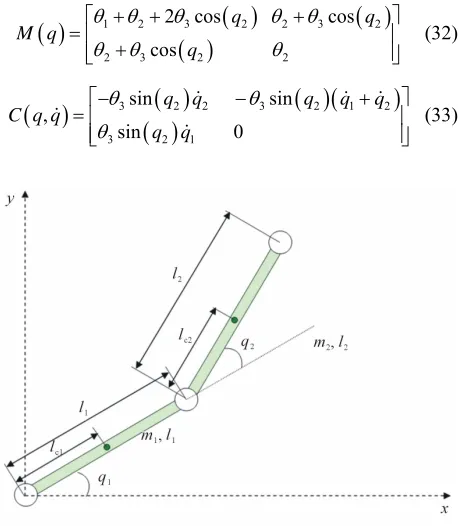
In order to show effectiveness of the proposed controller, computer simulations have been performed with the two-link planar manipulator model [11]. Figure 1 shows this two link planar manipulator with the following parameterizations are considered as
2
2 2 2
4 1 1
6 2 2
c c c c c m l I m l m l (31)
where 1 2 the masses of links 1 and 2 respectively, are the lengths of link 1 and 2 respectively and
1 2 are the lengths where the masses of link 1 and 2
are assumed to be concentrated respectively. Using the above parameters, the matrices M q
, andthe vectors C q q
,
g q , in (1) are given as
M q
,sin C q q
2 2 3
22
cos
q q
1 2 3
2 3 2
2 cos cos q
3 2 2
3 2 1
sin 0 q q q q (32)
3sin q2 q1 q2
(33)
Figure 1. Two-link planar robot.
4 5 1 6 1 2
6 1 2
cos cos
cos
g q g q q
g q
g q q
(34)
, ,
; 6Y q q q
(35) where the component yij of Y q q q
, ,
are given as
q q
r
g q q
11 1 12 1 2
13 2 1 2
2
2 2 1 2 14 1
15 1 16 1 2
21
cos 2
sin 2 cos cos cos 0
y q y q q
y q q q
q q q q y g q
y g q y g q q
y
122 1 2
2
23 2 1 2 24
25 26 1 2
cos sin 0
0 cos
y q q
y q q q q y
y y g
(36)
The each component of in (7) is given
as
, , ,r r
Y q q q q
11 1 12 1 2
13 2 1 2
2 2 2 1 2 14 1
15 1 16 1 2
21
cos 2
sin 2 cos cos cos 0
r r
r r
r r
y q y q q
y q q q
q q q q q y g q
y g q y g q q
y
22 1 2
23 2 1 2 1 1 24
25 26 1 2
cos sin 0
0 cos
r r
r r
y q q
y q q q q q y
y y (37) The unloaded manipulator parameters used in simula-tion are given in Table 1. Using the values from Table 1 in (31) we can get i as shown in Table 2.
We assume that due to unknown load carried by the robot as part of second link, the parameters , c2
and 2
m l
2
I will change to m2 m2 , lc2 lc2 and
2 2
I I , respectively. We will design an adaptive
con-troller that will ensure the asymptotic stability in pres-ence of parameter uncertainties in the intervals
2 2 2
15 0 10; 0 0.5; 0
12
c
m l I
. (38)
The nominal parameter vector 0 is shown in Table 3, is obtained after choosing the mean value for the range of possible i. The uncertainty bound for each parame-ter i is shown in Table 4. The design steps of the proposed adaptive fuzzy controller are discussed below:
5.1. Controller Design
Step 1: The parameter vector , is the fuzzy controller consequent can be obtained according to fuzzy IF-THEN rules (13). Each premises variable i
, 1, 2, ,6
i i
is
[image:4.595.308.544.71.443.2] [image:4.595.58.287.442.705.2]Table 1. Parameters of the unloaded arm.
1
m m2 l1 l2 lc1 lc2 I1 I2
10 5 1 1 0.5 0.5 10/12 5/12
Table 2. θi for the unloaded arm.
1
2 3 4 5 6
8.33 1.67 2.5 5 5 2.5
Table 3. Nominal parameter vector θ0.
01
02 03 04 05 06
13.33 8.96 8.75 5 10 8.75
Table 4. Uncertainty bounds ρi.
1
2 3 4 5 6
5 6.25 6.25 0 5 6.25
and PB. Therefore, it requires five rules to describe for each . These fuzzy IF-THEN rules are as follows
,
i
u i1, 2, ,6
1) IF i is NB THEN ui is NB; 2) IF i is NS THEN i is NS; 3) IF
u
i
is Z THEN is Z; ui
4) IF i is PS THEN ui is PS; 5) IF i is PB THEN ui is PB.
These fuzzy rules are generated using the control structure (12) of [2]. The membership functions for input and output variables are shown in Figure 2.
Table 5 shows the parameters of membership func-tions for input variables and Table 6 shows the parame-ters of membership functions for output variables. Note that there is no uncertainty in parameter 4, i.e. 40.
Therefore, the component u4 of is zero.
,6
u
Step 2: i are computed using the
adaptive law (16). Now we can get the optimal parameter
vector as .
, i 1, 2,
,
i i i
0 i
Step 3: The additional control input is obtained based on adaptive fuzzy control law (15), ,
.
1, 2, ,6
Ti i oi
u Wi 1, 2, ,6
i
Step 4: Now we will compute i using (18) and maximum value of it chosen as max max
i .Step 5: The gain matrix is now updated so as to meet the stability condition (17)
K
max
K I .
Step 6: The final control torque is obtained according to (6) Y q q q q
, , , r r
0u
KFigure 2. Membership functions for input and output vari-ables.
Table 5. Parameters of membership functions for input variable.
1
i
a ai2 ai3 ai4 ai5
1
−0.040 −0.020 0.000 0.020 0.040
2
−0.200 −0.100 0.000 0.100 0.200
3
−0.150 −0.075 0.000 0.075 0.150
5
−0.200 −0.100 0.000 0.100 0.200
6
−0.400 −0.200 0.000 0.200 0.400
Table 6. Parameters of membership functions for output variable.
1
i
b bi2 bi3 bi4 bi5
1
u −5.000 −2.500 0.000 2.500 5.000
2
u −7.290 −3.645 0.000 3.645 7.290
3
u −6.250 −3.125 0.000 3.125 6.250
5
u −5.000 −2.500 0.000 2.500 5.000
6
u −6.250 −3.125 0.000 3.125 6.250
5.2. Simulation Results
Desired trajectories for both the joints are given as
1 cos , sin
d d
q at q a
at (39)
. Note that the proposed control algorithm updates the gain K of PD
0 1 2 3 4 -150
0 150 300
5 (f)
Time (sec)
0 1 2 3 4 5
-300 0 300 600
0 1 2 3 4
-50 5 10 15
5
Nm
Nm
X1
0
- 3
(e) (d) (c)
0 1 2 3 4 5
0 5 10
X1
0
- 3
0 1 2 3 4 5
0 1 2
(b)
0 1 2 3 4
0 1 2
5 (a)
[image:6.595.63.284.76.322.2]
Figure 3. System response based on [2] using controller (12) with ε = 0.1.
0 1 2 3 4 5
0 10 20
30 (f)
0 1 2 3 4 5
-75 0 75 150
Nm
(e)
0 1 2 3 4
-150 0 150 300
5 (d)
Nm
0 1 2 3 4 5
-50 5 10 15
X1
0
- 3
0 1 2 3 4 5
-4 -2 0 2
X1
0
- 3
0 1 2 3 4 5
0 1 2
(c) (b)
0 1 2 3 4
0 1 2
5
0 1 2 3 4 5
0 10 20 30
(h) (g) (a)
[image:6.595.313.533.78.322.2]Time (sec)
Figure 4. System response based on proposed adaptive fuzzy controller (15) (manipulator is unloaded).
0 1 2 3 4 5
-150 0 150 300
Time (sec) (f)
0 1 2 3 4 5
-300 0 300 600
(e)
0 1 2 3 4 5
-50 5 10 15
(d) (c)
0 1 2 3 4 5
0 5 10
0 1 2 3 4 5
0 1 2
X1
0
- 3
X1
0
- 3
(b) (a)
0 1 2 3 4 5
0 1 2
[image:6.595.66.283.364.694.2]
Figure 5. System response based on [2] using controller (12) with ε = 0.1 (Manipulator is loaded at time 2 sec).
0 1 2 3 4 5
0 10 20 30
(h) (g)
Time (sec)
0 1 2 3 4 5
0 10 20
30 (f)
0 1 2 3 4 5
-750 75 150
X1
0
- 3
Nm
(e)
0 1 2 3 4 5
-1500 150 300
Nm
(d)
0 1 2 3 4 5
-50 5 10 15
X10
- 3
(c)
0 1 2 3 4 5
-4 -2 0 2
0 1 2 3 4 5
0 1 2
(b) (a)
0 1 2 3 4 5
0 1 2
[image:6.595.312.532.365.693.2]
trol scheme is effective in reducing chattering in torque control signal and simultaneously control effort is less in comparison to the results in [2].
the system response of a two-link robot manipulator based on nonlinear saturation controller [2] and proposed adap-tive fuzzy controller (15) for two cases while the robot manipulator is (i) unloaded (ii) loaded. Results are pre-sented in the following sequences in the figures: joint positions (joint-1 ( 1), joint-2 ( 2)), tracking errors ( 1
and 2), and input torques ( 1
q q q
q and 2) respectively. It
may be mentioned that the robot manipulator is loaded at time 2 sec. i.e. the second link lifts some mass due to which the parameter of the robot changes as given in (38).
7. References
[1] J. J. E. Slotine and W. Li, “On the Adaptive Control of Robotic Manipulators,” International Journal of Robotics Research, Vol. 6, No. 3, 1987, pp. 49-59.
doi:10.1177/027836498700600303
[2] M. W. Spong, “On the Robust Control of Robot Manipu-lators,” IEEE Transactions on Automatic Control, Vol.
37, No. 11, 1992, pp. 1782-1786. doi:10.1109/9.173151 The results of the proposed adaptive fuzzy controller
are compared with that of [2] (see (12)) where fixed PD controller gains are considered as and
. In both the methods, it is observed that the tracking error responses remain almost the same or-der and insensitive irrespective of the payload variation. Further it has been observed through simulation studies that the proposed technique effectively alleviates or re-duces the chattering effect in control signals. A signifi-cant chattering in the control signal is noticed while a robot arm takes a sharp turn under loaded condition. Simulation result shows that the proposed controller ef-fectively reduces the magnitude of input torque or in other words effectively reduces the control effort com-pared to the method discussed in [2]. It may be further observed from the figures ((see Figures 4(g)-(h) and Figures 6(g)-(h)) how the diagonal elements of gain matrix
diag 75 50
K [3] A. B. Sharkawy, M. M. Othman and A. M. A. Khalil, “A Robust Fuzzy Tracking Control Scheme for Robotic
Ma-nipulators with Experimental Verification,” Intelligent Con- trol and Automation, Vol. 2, No. 2, 2011, pp. 100-111.
doi:10.4236/ica.2011.22012
diag 40 15
K(K11,K22) of PD controller are updated adap-
tively.
[4] M. Galicki, “An Adaptive Regulator of Robotic Manipu-lators in the Task Space,” IEEE Transactions on Auto-matic Control, Vol. 53, No. 4, 2008, pp. 1058-1062.
doi:10.1109/TAC.2008.921022
[5] M. W. Spong, S. Hutchinson and M. Vidyasagar, “Robot Modeling and Control,” John Wiley & Sons Inc., New York, 2006.
[6] C. C. Cheah, C. Liu and J. J. E. Soltine, “Adaptive Track-ing Control for Robots with Unknown Kinematics and Dynamic Uncertainty,” International Journal of Robotics Research, Vol. 25, No. 3, 2006, pp. 283-296.
doi:10.1177/0278364906063830
[7] T. H. S. Li and Y. C. Huang, “MIMO Adaptive Fuzzy Terminal Sliding-Mode Controller for Robotic Manipu-lators,” Information Sciences, Vol. 180, No. 23, 2010, pp.
4641-4660. doi:10.1016/j.ins.2010.08.009
6. Conclusions
[8] Z. Bingul and O. karahan, “A Fuzzy Logic Controller Tuned with PSO for 2 DOF Robot Trajectory Control,”
Expert Systems with Applications, Vol. 38, No. 1, 2011,
pp. 1017-1031. doi:10.1016/j.eswa.2010.07.131 In this paper, an adaptive fuzzy control law is proposed
for trajectory tracking of robot manipulator with a view to reduce the chattering effect in torque control signal. The advantages of fuzzy and adaptive control strategies are combined and subsequently the stability condition of robot manipulator is derived based on Lyapunov theorem. The implementation of proposed controller is very straightforward due to the use of simple fuzzy rules and control strategies. The gain of PD term is updated with time and hence proposed adaptive control scheme removes the disadvantage of using fixed large gain val-ues in [2]. Simulation results show that the present con-
K
[9] L.-X. Wang, “Stable Adaptive Fuzzy Control of Nonlin-ear Systems,” IEEE Transactions on Fuzzy Systems, Vol.
1, No. 2, 1993, pp. 146-155.
[10] G. Feng, “A Survey on Analysis and Design of Model- Based Fuzzy Control Systems,” IEEE Transactions on Fuzzy Systems, Vol. 14, No. 5, 2006, pp. 676-697.
[11] M. W. Spong and M. Vidyasagar, “Robot Dynamics and Control,” Wiely, New York, 1989.
![Figure 3. System response based on [2] using controller (12) with ε = 0.1.](https://thumb-us.123doks.com/thumbv2/123dok_us/9221161.409188/6.595.66.283.364.694/figure-response-based-using-controller-e.webp)
