Cochrane
Database of Systematic Reviews
Macrolide antibiotics for bronchiectasis (Review)
Kelly C, Chalmers JD, Crossingham I, Relph N, Felix LM, Evans DJ, Milan SJ, Spencer S
Kelly C, Chalmers JD, Crossingham I, Relph N, Felix LM, Evans DJ, Milan SJ, Spencer S. Macrolide antibiotics for bronchiectasis.
Cochrane Database of Systematic Reviews2018, Issue 3. Art. No.: CD012406. DOI: 10.1002/14651858.CD012406.pub2.
www.cochranelibrary.com
Macrolide antibiotics for bronchiectasis (Review)
T A B L E O F C O N T E N T S
1 HEADER . . . .
1
ABSTRACT . . . .
2
PLAIN LANGUAGE SUMMARY . . . .
4
SUMMARY OF FINDINGS FOR THE MAIN COMPARISON . . . .
7
BACKGROUND . . . .
8
OBJECTIVES . . . .
8 METHODS . . . .
11 RESULTS . . . .
Figure 1. . . 12
Figure 2. . . 13
Figure 3. . . 16
Figure 4. . . 17
Figure 5. . . 19
24 ADDITIONAL SUMMARY OF FINDINGS . . . . 31 DISCUSSION . . . . 33 AUTHORS’ CONCLUSIONS . . . . 33 ACKNOWLEDGEMENTS . . . . 34 REFERENCES . . . . 38 CHARACTERISTICS OF STUDIES . . . . 73 DATA AND ANALYSES . . . . Analysis 1.1. Comparison 1 Macrolide versus placebo: adults, Outcome 1≥1 exacerbation. . . 75
Analysis 1.2. Comparison 1 Macrolide versus placebo: adults, Outcome 2 Hospitalisation: all-cause. . . 76
Analysis 1.3. Comparison 1 Macrolide versus placebo: adults, Outcome 3 Serious adverse events. . . 77
Analysis 1.4. Comparison 1 Macrolide versus placebo: adults, Outcome 4 Sputum weight (g): endpoint. . . 78
Analysis 1.5. Comparison 1 Macrolide versus placebo: adults, Outcome 5 FEV1 (% predicted): endpoint. . . 78
Analysis 1.6. Comparison 1 Macrolide versus placebo: adults, Outcome 6 FEV1 (% predicted): change (post bronchodilator). . . 79
Analysis 1.7. Comparison 1 Macrolide versus placebo: adults, Outcome 7 FEV1 (L): endpoint. . . 79
Analysis 1.8. Comparison 1 Macrolide versus placebo: adults, Outcome 8 FEV1 (L): change. . . 80
Analysis 1.9. Comparison 1 Macrolide versus placebo: adults, Outcome 9 FVC (% predicted): endpoint. . . 81
Analysis 1.10. Comparison 1 Macrolide versus placebo: adults, Outcome 10 FVC (L): endpoint. . . 81
Analysis 1.11. Comparison 1 Macrolide versus placebo: adults, Outcome 11 FVC (L): change. . . 82
Analysis 1.12. Comparison 1 Macrolide versus placebo: adults, Outcome 12 FEV1/FVC: endpoint. . . 83
Analysis 1.13. Comparison 1 Macrolide versus placebo: adults, Outcome 13 Adverse events. . . 83
Analysis 1.14. Comparison 1 Macrolide versus placebo: adults, Outcome 14 Azithromycin-resistant bacteria (any). . 85
Analysis 1.15. Comparison 1 Macrolide versus placebo: adults, Outcome 15 6-Minute walk test: change. . . 85
Analysis 1.16. Comparison 1 Macrolide versus placebo: adults, Outcome 16 Quality of life: endpoint. . . 86
Analysis 1.17. Comparison 1 Macrolide versus placebo: adults, Outcome 17 Quality of life: change. . . 87
Analysis 2.1. Comparison 2 Macrolide versus no intervention: adults, Outcome 1≥1 exacerbation. . . 88
Analysis 2.2. Comparison 2 Macrolide versus no intervention: adults, Outcome 2 QoL SGRQ: endpoint total score. 88 Analysis 3.1. Comparison 3 Macrolide versus placebo: children, Outcome 1≥1 exacerbation. . . 89
Analysis 3.2. Comparison 3 Macrolide versus placebo: children, Outcome 2 Hospitalisation: all-cause. . . 89
Analysis 3.3. Comparison 3 Macrolide versus placebo: children, Outcome 3 Serious adverse events. . . 90
Analysis 3.4. Comparison 3 Macrolide versus placebo: children, Outcome 4 Sputum purulence score: endpoint. . . 90
Analysis 3.5. Comparison 3 Macrolide versus placebo: children, Outcome 5 FEV1 (% predicted): endpoint. . . . 91
Analysis 3.6. Comparison 3 Macrolide versus placebo: children, Outcome 6 Adverse events. . . 92
Analysis 3.7. Comparison 3 Macrolide versus placebo: children, Outcome 7 Azithromycin-resistant bacteria (any). . 92
Analysis 3.8. Comparison 3 Macrolide versus placebo: children, Outcome 8 Azithromycin-resistant Streptococcus pneumoniae. . . 93
Analysis 3.9. Comparison 3 Macrolide versus placebo: children, Outcome 9 Azithromycin-resistant Staphylococcus aureus. . . 93
i Macrolide antibiotics for bronchiectasis (Review)
93 ADDITIONAL TABLES . . . .
95
APPENDICES . . . .
97
CONTRIBUTIONS OF AUTHORS . . . .
97 DECLARATIONS OF INTEREST . . . .
97 SOURCES OF SUPPORT . . . .
98
DIFFERENCES BETWEEN PROTOCOL AND REVIEW . . . .
ii Macrolide antibiotics for bronchiectasis (Review)
[Intervention Review]
Macrolide antibiotics for bronchiectasis
Carol Kelly1,2, James D Chalmers3, Iain Crossingham4, Nicola Relph1,2, Lambert M Felix5, David J Evans6, Stephen J Milan7, Sally
Spencer1,2
1Faculty of Health and Social Care, Edge Hill University, Ormskirk, UK.2Postgraduate Medical Institute, Edge Hill University,
Ormskirk, UK.3University of Dundee, Ninewells Hospital and Medical School, Dundee, UK.4East Lancashire Hospitals NHS
Trust, Blackburn, UK.5Nuffield Department of Orthopaedics, Rheumatology and Musculoskeletal Sciences (NDORMS), University
of Oxford, Oxford, UK.6Thoracic Medicine, Hemel Hempstead Hospital, Hemel Hempstead, UK.7Medical School, Lancaster
University, Lancaster, UK
Contact address: Sally Spencer, Postgraduate Medical Institute, Edge Hill University, Ormskirk, [email protected].
Editorial group:Cochrane Airways Group.
Publication status and date:New, published in Issue 3, 2018.
Citation:Kelly C, Chalmers JD, Crossingham I, Relph N, Felix LM, Evans DJ, Milan SJ, Spencer S. Macrolide antibiotics for bronchiec-tasis.Cochrane Database of Systematic Reviews2018, Issue 3. Art. No.: CD012406. DOI: 10.1002/14651858.CD012406.pub2.
Copyright © 2018 The Cochrane Collaboration. Published by John Wiley & Sons, Ltd.
A B S T R A C T
Background
Bronchiectasis is a chronic respiratory disease characterised by abnormal and irreversible dilatation and distortion of the smaller airways. Bacterial colonisation of the damaged airways leads to chronic cough and sputum production, often with breathlessness and further structural damage to the airways. Long-term macrolide antibiotic therapy may suppress bacterial infection and reduce inflammation, leading to fewer exacerbations, fewer symptoms, improved lung function, and improved quality of life. Further evidence is required on the efficacy of macrolides in terms of specific bacterial eradication and the extent of antibiotic resistance.
Objectives
To determine the impact of macrolide antibiotics in the treatment of adults and children with bronchiectasis.
Search methods
We identified trials from the Cochrane Airways Trials Register, which contains studies identified through multiple electronic searches and handsearches of other sources. We also searched trial registries and reference lists of primary studies. We conducted all searches on 18 January 2018.
Selection criteria
We included randomised controlled trials (RCTs) of at least four weeks’ duration that compared macrolide antibiotics with placebo or no intervention for the long-term management of stable bronchiectasis in adults or children with a diagnosis of bronchiectasis by bronchography, plain film chest radiograph, or high-resolution computed tomography. We excluded studies in which participants had received continuous or high-dose antibiotics immediately before enrolment or before a diagnosis of cystic fibrosis, sarcoidosis, or allergic bronchopulmonary aspergillosis. Our primary outcomes were exacerbation, hospitalisation, and serious adverse events.
Data collection and analysis
Two review authors independently screened the titles and abstracts of 103 records. We independently screened the full text of 40 study reports and included 15 trials from 30 reports. Two review authors independently extracted outcome data and assessed risk of bias for each study.We analysed dichotomous data as odds ratios (ORs) and continuous data as mean differences (MDs) or standardised mean differences (SMDs). We used standard methodological procedures as expected by Cochrane.
1 Macrolide antibiotics for bronchiectasis (Review)
Main results
We included 14 parallel-group RCTs and one cross-over RCT with interventions lasting from 8 weeks to 24 months. Of 11 adult studies with 690 participants, six used azithromycin, four roxithromycin, and one erythromycin. Four studies with 190 children used either azithromycin, clarithromycin, erythromycin, or roxithromycin.
We included nine adult studies in our comparison between macrolides and placebo and two in our comparison with no intervention. We included one study with children in our comparison between macrolides and placebo and one in our comparison with no intervention.
In adults, macrolides reduced exacerbation frequency to a greater extent than placebo (OR 0.34, 95% confidence interval (CI) 0.22 to 0.54; 341 participants; three studies; I2= 65%; moderate-quality evidence). This translates to a number needed to treat for an additional
beneficial outcome of 4 (95% CI 3 to 8). Data show no differences in exacerbation frequency between use of macrolides (OR 0.31, 95% CI 0.08 to 1.15; 43 participants; one study; moderate-quality evidence) and no intervention. Macrolides were also associated with a significantly better quality of life compared with placebo (MD -8.90, 95% CI -13.13 to -4.67; 68 participants; one study; moderate-quality evidence). We found no evidence of a reduction in hospitalisations (OR 0.56, 95% CI 0.19 to 1.62; 151 participants; two studies; I2= 0%; low-quality evidence), in the number of participants with serious adverse events, including pneumonia, respiratory
and non-respiratory infections, haemoptysis, and gastroenteritis (OR 0.49, 95% CI 0.20 to 1.23; 326 participants; three studies; I2
= 0%; low-quality evidence), or in the number experiencing adverse events (OR 0.83, 95% CI 0.51 to 1.35; 435 participants; five studies; I2= 28%) in adults with macrolides compared with placebo.
In children, there were no differences in exacerbation frequency (OR 0.40, 95% CI 0.11 to 1.41; 89 children; one study; low-quality evidence); hospitalisations (OR 0.28, 95% CI 0.07 to 1.11; 89 children; one study; low-quality evidence), serious adverse events, defined within the study as exacerbations of bronchiectasis or investigations related to bronchiectasis (OR 0.43, 95% CI 0.17 to 1.05; 89 children; one study; low-quality evidence), or adverse events (OR 0.78, 95% CI 0.33 to 1.83; 89 children; one study), in those receiving macrolides compared to placebo. The same study reported an increase in macrolide-resistant bacteria (OR 7.13, 95% CI 2.13 to 23.79; 89 children; one study), an increase in resistance toStreptococcus pneumoniae(OR 13.20, 95% CI 1.61 to 108.19; 89 children; one study), and an increase in resistance toStaphylococcus aureus(OR 4.16, 95% CI 1.06 to 16.32; 89 children; one study) with macrolides compared with placebo. Quality of life was not reported in the studies with children.
Authors’ conclusions
Long-term macrolide therapy may reduce the frequency of exacerbations and improve quality of life, although supporting evidence is derived mainly from studies of azithromycin, rather than other macrolides, and predominantly among adults rather than children. However, macrolides should be used with caution, as limited data indicate an associated increase in microbial resistance. Macrolides are associated with increased risk of cardiovascular death and other serious adverse events in other populations, and available data cannot exclude a similar risk among patients with bronchiectasis.
P L A I N L A N G U A G E S U M M A R Y
Macrolide antibiotics for bronchiectasis
Background to the question
Bronchiectasis is a long-term respiratory condition. The airways in the lungs are damaged, and people are prone to infection. Symptoms are chronic cough and the production of sputum (coughed-up material (phlegm) from the lower airways). Moreover, bronchiectasis is associated with a mortality rate more than twice that of the general population.
Long-term antibiotic therapy with macrolides (such as azithromycin, roxithromycin, erythromycin, and clarithromycin) may reduce the cycle of reinfection, reduce symptoms, and improve quality of life. We wanted to do this review to look at the evidence on use of macrolides in people with bronchiectasis. This review is intended to help people such as guideline producers, doctors, and patients make decisions about whether to use or recommend macrolides.
Study characteristics
We found 15 studies that compared macrolides with placebo (a substance or treatment with no benefit) or no intervention. Eleven studies involved 690 adults (aged 18 years and older) and four studies involved 190 children. Among adults, six used azithromycin, four roxithromycin, and one erythromycin. The four studies with children used azithromycin, clarithromycin, erythromycin, or roxithromycin. This review is current to January 2018.
2 Macrolide antibiotics for bronchiectasis (Review)
Main results
The studies on azithromycin reported improved quality of life in adults. We do not have sufficient evidence from other macrolides to make a robust judgement on their use, and we similarly have insufficient evidence from children to draw clear conclusions.
Although we found only a few trials, they do show a possible increase in antibiotic resistance. Antibiotic resistance is seen when an antibiotic becomes less effective at killing the bacteria causing the chest infection.
We know that macrolides are associated with higher risk of cardiovascular death and other serious adverse events when they are used to treat other conditions. The data in our review suggest it is possible that people with bronchiectasis are at risk for these adverse effects when taking macrolides.
Quality of the evidence
Generally the limited number of studies evaluating macrolides and the variation among them indicate that we cannot be sure of the overall effect of their use in bronchiectasis. Further high-quality studies are needed to examine the role of long-term macrolide antibiotics in the treatment of adults and children with bronchiectasis.
3 Macrolide antibiotics for bronchiectasis (Review)
S U M M A R Y O F F I N D I N G S F O R T H E M A I N C O M P A R I S O N [Explanation]
M acrolides compared with placebo for adults with bronchiectasis
Patient or population:adults with bronchiectasis
Setting:outpatient clinics in Australia, Azerbaijan, M alaysia, Netherlands, New Zealand, and Thailand Intervention:m acrolides
Comparison:placebo
Outcomes Anticipated absolute effects* (95% CI) Relative effect
(95% CI)
No. of participants (studies)
Quality of the evidence (GRADE)
Comments
Risk with placebo Risk with macrolides
≥1 exacerbation
Follow-up: range 24
weeks to 52 weeks
714 per 1000 459 per 1000
(355 to 574)
OR 0.34 (0.22 to 0.54)
341 (3 RCTs)
⊕⊕⊕
M ODERATEa
2 studies azithrom y-cin (1750 m g/ week f or 52 weeks; 1500 m g/ week f or 6 m onths) 1 study erythrom ycin (3500 m g/ week f or 48 weeks)
Hospitalisation: all
cause
Follow-up: range 12
weeks to 52 weeks
133 per 1000 79 per 1000
(28 to 200)
OR 0.56 (0.19 to 1.62)
151 (2 RCTs)
⊕⊕
LOWb,c
2 studies azithrom ycin (1000 m g/ week f or 12 weeks; 1750 m g/ week f or 52 weeks)
Serious adverse events
Follow-up: range 24
weeks to 48 weeks
86 per 1000 44 per 1000
(18 to 104)
OR 0.49 (0.20 to 1.23)
326 (3 RCTs)
⊕⊕
LOWb,d
All-cause m ortality
Follow-up: range 8
weeks to 52 weeks
0 per 1000 0 per 1000
(0 to 0)
not estim able 540
(7 RCTs)
⊕⊕
Lowe,f
4 studies azithrom ycin (1000 to 1750 m g/ week f or 12 to 52 weeks) 2 studies roxithrom ycin (2100 m g/ week f or 8 to 12 weeks)
1 study erythrom ycin (3500 m g/ week f or 48 weeks)
Quality of lif e: endpoint assessed with SGRQ Scale f rom 0 to 100 Follow-up: 12 weeks
M ean SGRQ score at
endpoint in placebo
groups was 39.1 points
M D 8.90 lower (13.13 lower to 4.67 lower)
- 68
(1 RCTs)
⊕⊕⊕ M oderateb
1 study azithrom ycin (1000 m g/ week f or 12 weeks)
Quality of lif e: change assessed with SGRQ Scale f rom 0 to 100
Follow-up: range 8
weeks to 48 weeks
M ean change in SGRQ score ranged f rom -1.3 to -8.9 points.
M D 2.86 lower (5.67 lower to 0.04 lower)
- 305
(4 RCTs)
⊕⊕
LOWg,h
1 study azithrom ycin (1500 m g/ week f or 6 m onths)
1 study erythrom ycin (3500 m g/ week f or 48 weeks)
2 studies roxithrom ycin (2100 m g/ week f or 12 weeks; 2100 m g/ week f or 8 weeks)
*The risk in the intervention group(and its 95% conf idence interval) is based on the assum ed risk in the com parison group and therelative effectof the intervention (and its 95% CI).
CI: conf idence interval; OR: odds ratio; RCT: random ised controlled trial; RR: risk ratio; SGRQ: St. George’s Respiratory Questionnaire
GRADE Working Group grades of evidence.
High quality:We are very conf ident that the true ef f ect lies close to that of the estim ate of the ef f ect.
M oderate quality:We are m oderately conf ident in the ef f ect estim ate: The true ef f ect is likely to be close to the estim ate of the ef f ect, but there is a possibility that it is substantially dif f erent.
Low quality:Our conf idence in the ef f ect estim ate is lim ited: The true ef f ect m ay be substantially dif f erent f rom the estim ate of the ef f ect.
Very low quality:We have very little conf idence in the ef f ect estim ate: The true ef f ect is likely to be substantially dif f erent f rom the estim ate of ef f ect
aEf f ect observed only with azithrom ycin (one point deducted in relation to design and im plem entation of available studies
suggesting likelihood of bias).
bUnclear allocation concealm ent and baseline im balances on Lourdesam y (one point deducted in relation to design and
im plem entation of available studies suggesting likelihood of bias).
cTwo sm all studies and wide conf idence interval (one point deducted f or im precision).
dWide conf idence interval (one point deducted f or im precision).
eIn three of the seven studies, study m ethods were not clearly reported (one point deducted in relation to design and
im plem entation of available studies suggesting likelihood of bias).
fA total of 28 participants across f our studies were lost to f ollow-up with no f urther details available and unclear details
of withdrawals in one study (one point deducted in relation to design and im plem entation of available studies suggesting likelihood of bias).
gRandom isation, blinding, and other study m ethods unclear in two studies (Asintam ; J uthong) (one point deducted in relation
to design and im plem entation of available studies suggesting likelihood of bias).
hWide conf idence interval and m ean dif f erence does not exceed the threshold f or clinical signif icance (one point deducted
f or im precision).
B A C K G R O U N D
Description of the condition
Bronchiectasis is a chronic respiratory disease characterised by ab-normal and irreversible dilatation and distortion of the airways (Pasteur 2010). Bacterial colonisation of the damaged airways leads to chronic cough and sputum production, often with breath-lessness and further structural damage to the airways. Diagnosis is made by computed tomography (CT) scanning of the chest when appropriate clinical symptoms are identified (Chang 2010), but asymptomatic radiological evidence of bronchiectasis may be noted (Kwak 2010).
Bronchiectasis has many causes, generally involving major or re-peated insults to the lungs. Severe infections including pneumonia, tuberculosis, and pertussis may cause bronchiectasis, particularly if they occur during childhood while the lungs are still developing. Connective tissue disorders and defects in the immune system are other common causes of bronchiectasis, but many cases are idio-pathic. Cystic fibrosis leads to severe, progressive bronchiectasis and usually is considered a separate entity from ’non-cystic fibrosis’ bronchiectasis. This review will exclude bronchiectasis secondary to cystic fibrosis.
Prevalence estimates are unclear owing to variable diagnostic strategies (Weycker 2005), a well as higher prevalence rates in developing countries (Habesoglu 2011), but the global disease burden is increasing, with mortality rising by 3% per year be-tween 2001 and 2007, in England and in Wales (Roberts 2010), and hospitalisations by 3% per year in the United States (Seitz 2010). Prevalence is higher in women and those over 60 years of age (Roberts 2010;Seitz 2012). However, prevalence rates may be increasing more rapidly than was previously estimated, with 67 cases per 100,000 general population reported in Germany (Ringshausen 2015), and with UK prevalence rising from 350.5 to 566.1 in women and from 301.2 to 485.5 in men, affecting around 262,900 adults (Quint 2016). Similarly, UK incidence rates increased by 63% over nine years to 2013, rising from 21.2 to 35.2 in women and 8.2 to 26.9 in men, per 100,000 person-years (Quint 2016). In paediatric populations, younger children and more frequent exacerbations are associated with worse quality of life (Kapur 2012). A higher prevalence of bronchiectasis has been reported among indigenous children in Australia (15:1000) and Alaska (16:1000) (Chang 2002). Incidence rates of 3.7 per 10,000 per year in children under 15 years of age have been reported in New Zealand (Twiss 2005). This equates to a prevalence of 1: 3000 children overall and 1:625 children of Pacific Island descent (Twiss 2005). However, these increases may be due to improved diagnosis resulting from easier access to high-quality CT scanners, rather than reflecting a true rise in prevalence (Goeminne 2016). Estimated European mortality rates are 0.3 per 100,000 general population in EU countries (ranging from 0.01 in Germany to 1.18 in the UK) and 0.2 per 100,000 in non-EU countries (ranging
from 0.01 in Azerbaijan to 0.67 in Kyrgyzstan), based on data to 2009 (European Lung White Book 2013). Recent age-adjusted mortality rates in the UK are estimated to be 2.26 times higher in women and 2.14 times higher in men compared with the wider population (Quint 2016). This information is based on estimated mortality rates for bronchiectasis of 1437.7 per 100,000 and for the general population of 635.9 per 100,000 (Quint 2016).
Description of the intervention
Chronic airway infection with pathogens such as Pseudomonas aeruginosaandHaemophilus influenzaeand neutrophil-mediated airway inflammation are key drivers of disease progression and poor outcomes in bronchiectasis (Chalmers 2012;Chalmers 2014;
Finch 2015). Long-term antibiotic therapy therefore is often pre-scribed with the intention of suppressing bacterial load and reduc-ing airway inflammation (Chalmers 2012). This in turn aims to reduce exacerbations, improve symptoms, and improve quality of life (Haworth 2014). Prolonged antibiotic treatment can be ad-ministered in the form of oral or inhaled antibiotics. Inhaled an-tibiotics offer the advantage of delivering a higher dose of the drug directly to the site of bronchiectasis infection, with less potential for collateral damage and resistance; however, they are often time consuming to administer (Brodt 2014). Oral antibiotics by con-trast are typically cheaper and easier to administer than inhaled antibiotics.
Oral antibiotics may be given at lower doses than those used to treat acute infection, with the aims of reducing adverse effects and promoting compliance (Haworth 2014). Macrolide antibiotics are antibacterial agents with anti-inflammatory and immunomodu-latory properties (Haworth 2014). Long-acting macrolide antibi-otics such as azithromycin can be given intermittently rather than requiring daily dosing. Penicillins, tetracyclines, and macrolides have all been tested as prolonged therapy in bronchiectasis (Pasteur 2010). National guidelines for bronchiectasis, such as those pro-vided by the British Thoracic Society, suggest that use of long-term antibiotic treatment should be considered for patients with three or more exacerbations per year (Pasteur 2010).
Long-term use of macrolides in bronchiectasis is supported by their ease of administration, their effectiveness in cystic fibrosis and other neutrophilic lung diseases, and their reported anti-inflam-matory properties (Saiman 2003). Balanced against these traits is the potential for macrolides to induce antibiotic resistance and pro-duce antibiotic-related adverse effects, hearing impairment, and cardiotoxicity (Serisier 2013a).
How the intervention might work
Exacerbations, symptoms, and quality of life are directly linked to bacterial infection and airway inflammation in bronchiectasis (Chalmers 2012;Chalmers 2014). Macrolides are given as both
7 Macrolide antibiotics for bronchiectasis (Review)
antibacterial and anti-inflammatory drugs, although it is unclear which of these properties is primarily responsible for the clini-cal effect observed in cystic fibrosis or bronchiectasis. Macrolides bind reversibly to the 50s ribosomal subunit, preventing bacterial protein synthesis (Haworth 2014). They therefore have broad ac-tivity against Gram-positive organisms such as staphylococci and streptococci and exhibit a degree of activity against Gram-negative organisms such asHaemophilusbacteria.It is interesting to note that macrolides show no bacteriocidal activity againstP aeruginosa
but may modify virulence by interfering with quorum sensing and virulence factors (Kohler 2010).
The anti-inflammatory effects of macrolides have been known for decades and are classically demonstrated in their effectiveness against diffuse panbronchiolitis (Amsden 2005). Macrolides con-tain a macrocytic lactone ring that is thought to be responsible for most anti-inflammatory effects (Haworth 2014). Macrolides are classified according to the number of lactone rings as 14-, 15-, and 16-member ring macrolides. Macrolides confer potentially beneficial effects at every level of the ’vicious cycle’ of bronchiecta-sis. They reduce the secretion of pro-inflammatory cytokines from epithelial cells, inhibit leucocyte recruitment to the airway, inhibit neutrophil activation, and reduce oxidative stress (Zarogoulidis 2012).
Thus potential benefits of macrolides include suppression of bac-terial infection, leading to reduced exacerbations, reduced cough and sputum production, and improved lung function and quality of life.
Why it is important to do this review
Bronchiectasis is associated with a mortality rate more than twice that of the general population - 2.26 times higher in women and 2.14 times higher in men (Quint 2016). Data on the economic burden of bronchiectasis are few; however a 2001 US study re-ported 2.0 more days in hospital, 6.1 more outpatient appoint-ments, and 27.2 more days of antibiotic treatment (Weycker 2005). It is estimated that additional annual costs associated with bronchiectasis ranged from USD 5681 to USD 7827 during the period between 2001 and 2009 (Joish 2013;Seitz 2010;Weycker 2005).
Frequent exacerbations lead to impaired quality of life and pro-gressive lung damage with permanent loss of lung function (Martínez-García 2007). Therefore, drug interventions that are effective in reducing the frequency of exacerbations should offer both short-term and long-term benefit for patients with bronchiec-tasis. A Cochrane Review of short-term antibiotics provided little evidence on which to base a recommendation, with one small trial showing evidence of global improvement and pathogen eradica-tion in sputum (Wurzel 2011). Another Cochrane Review of long-term antibiotic therapy included 18 trials of moderate quality and provided evidence of reduced exacerbation frequency and hospi-talisation but increased drug resistance (Hnin 2015). Neither of
these Cochrane Reviews examined effects by class of antibiotics, and neither specifically created subgroups by macrolide therapy. A Cochrane Overview concluded that further evidence is required on the efficacy of antibiotics in terms of eradication of specific bac-terial colonisation and the extent of antibiotic resistance (Welsh 2015). Recent recommendations from the European Task Force on Bronchiectasis further reinforced the importance of this ques-tion by identifying research on macrolide therapy as one of the key priorities in bronchiectasis (Aliberti 2016). Macrolides may po-tentially reduce exacerbations of bronchiectasis. Given their draw-backs, particularly cardiac toxicity as described byRay 2012and the potential for selecting antibiotic-resistant organisms as dis-cussed byLeclercq 2002, robust evidence on the effectiveness of macrolides is needed if they are to be used with confidence for this indication.
This review is being conducted alongside two other, closely related reviews: “Dual antibiotics for bronchiectasis” and“Head to head trials of antibiotics for bronchiectasis”.
O B J E C T I V E S
To determine the impact of macrolide antibiotics in the treatment of adults and children with bronchiectasis.
M E T H O D S
Criteria for considering studies for this review
Types of studies
We included randomised controlled trials (RCTs) of at least four weeks’ duration. We included cross-over studies but used only data from the first pre-cross-over phase to eliminate potentially irre-versible carry-over effects (e.g. antibiotic resistance). We included studies reported as full text, those published as abstract only, and unpublished data.
Types of participants
We included adults and children with a diagnosis of bronchiectasis by bronchography, plain film chest radiography, or high-resolution computed tomography who reported daily sputum expectoration for at least three months. We did not exclude participants whose condition was diagnosed by radiography alone. When a study cluded participants with different respiratory conditions, we in-cluded the study only if investigators performed a separate sub-group analysis for participants with bronchiectasis. We excluded studies if participants had been receiving continuous or high-dose
8 Macrolide antibiotics for bronchiectasis (Review)
antibiotics immediately before enrolment, or if they had received a diagnosis of cystic fibrosis, sarcoidosis, or allergic bronchopul-monary aspergillosis. We defined children as individuals from six months to 18 years of age.
Types of interventions
We included studies comparing macrolide antibiotics with placebo, no intervention, or non-macrolide antibiotics for long-term management of stable bronchiectasis and reporting these different comparisons separately. We excluded studies looking at short-term macrolides for management (as opposed to prevention) of exacerbations of bronchiectasis.
Types of outcome measures
We used exacerbation and hospitalisation rates as reported by study authors. We collected outcome data at a range of follow-up points that best reflected available evidence from included studies (e.g. end of study, end of follow-up, change from baseline).
Primary outcomes
1. Exacerbations (defined by study authors’ criteria) 2. Hospitalisation (defined by study authors’ criteria) 3. Serious adverse events defined byHansen 2015, as follows: adverse events that result in death or life-threatening events, requirement for hospitalisation or prolongation of existing hospitalisation, persistent or significant disability, or congenital anomalies; or events that are considered medically important
Secondary outcomes
1. Sputum volume and purulence
2. Measures of lung function (e.g. forced expiratory volume in one second (FEV1))
3. Systemic markers of infection (C-reactive protein (CRP)) 4. Adverse events (e.g. cardiac arrhythmias, gastrointestinal symptoms, hearing impairment)
5. Mortality (with this review indicating whether defined as all-cause or bronchiectasis-related in individual studies)
6. Emergence of resistance to antibiotics
7. Exercise capacity (e.g. the Six-Minute Walk Distance test (6MWD))
8. Health-related quality of life (e.g. St. George’s Respiratory Questionnaire (SGRQ))
Reporting in the study one or more of the outcomes listed here was not an inclusion criterion for this review.
Search methods for identification of studies
Electronic searches
We identified studies from the Cochrane Airways Trials Register, which is maintained by the Information Specialist for the Group. The Cochrane Airways Trials Register contains studies identified from the following sources.
1. Monthly searches of the Cochrane Central Register of Controlled Trials (CENTRAL), through the Cochrane Register of Studies Online (crso.cochrane.org).
2. Weekly searches of MEDLINE Ovid SP 1946 to date. 3. Weekly searches of Embase Ovid SP 1974 to date. 4. Monthly searches of PsycINFO Ovid SP 1967 to date. 5. Monthly searches of Cumulative Index to Nursing and Allied Health Literature (CINAHL) EBSCO 1937 to date.
6. Monthly searches of Allied and Complementary Medicine (AMED) EBSCO.
7. Handsearches of the proceedings of major respiratory conferences.
Studies contained in the Cochrane Airways Trials Register are iden-tified through search strategies based on the scope of Cochrane Airways. We have provided details of these strategies, as well as a list of handsearched conference proceedings, inAppendix 1. See
Appendix 2for search terms used to identify studies for this review. We also conducted a search of the US National Insti-tutes of Health Ongoing Trials Register, ClinicalTrials.gov (
www.clinicaltrials.gov), and the World Health Organization International Clinical Trials Registry Platform (apps.who.int/ trialsearch).
We searched all databases from their inception to January 2018 and imposed no restrictions on language of publication.
Searching other resources
We checked the reference lists of all primary studies and review articles for additional references and searched relevant manufac-turers’ websites for study information. We searched PubMed (
www.ncbi.nlm.nih.gov/pubmed) for errata or retractions from in-cluded studies published in full text and reported within the re-view the date this was done.
Data collection and analysis
Selection of studies
Two review authors (DE and LF) independently screened titles and abstracts for inclusion of all potential studies identified as a result of the search and coded them as ’retrieve’ (eligible or poten-tially eligible/unclear) or ’do not retrieve’. We retrieved full-text study reports/publications, and two review authors (CK and LF) independently screened the full texts, identified studies for inclu-sion, and identified and recorded reasons for exclusion of ineligible studies. We encountered no disagreements, so the need to consult a third review author (SS or SJM) did not arise. We identified and
9 Macrolide antibiotics for bronchiectasis (Review)
excluded duplicates and collated multiple reports of the same trial, so that each trial rather than each report was the unit of interest in the review. We recorded the selection process in detail in the PRISMA flow diagram and theCharacteristics of excluded studies
table (Moher 2009).
Data extraction and management
We used a data collection form that was piloted on at least one study in the review to extract study characteristics and outcome data. One review author (LF) extracted the following characteris-tics from included studies.
1. Methods: study design, total duration, details of ’run-in’ period, number of centres and their locations, settings, withdrawals, and dates the study was carried out.
2. Participants: number, mean age and range, gender, bronchiectasis severity, diagnostic criteria, baseline lung function, smoking history, inclusion and exclusion criteria.
3. Interventions and comparisons: intervention, comparison, concomitant medications, and excluded medications.
4. Outcomes: primary and secondary outcomes reported and follow-up time points.
5. Notes: funding source and notable conflicts of interest of study authors.
Two review authors (LF and NR) independently extracted out-come data from the included studies. When investigators did not report outcome data in a usable way, we noted this in the
Characteristics of included studies table. We resolved disagree-ments by reaching consensus or by involving a third review author (SS or SJM). One review author (LF) transferred data into the Re-view Manager 5 file (RevMan 2014), and a second review author (SS) verified and validated the information. One review author (CK) spot-checked study characteristics for accuracy against the trial reports.
Assessment of risk of bias in included studies
Two review authors (NR and LF) independently assessed the risk of bias for each study, using the criteria outlined in theCochrane Handbook for Systematic Reviews of Interventions(Higgins 2011), according to the domains below. We resolved disagreements by discussion or by consultation with another review author (SS or SJM).
1. Random sequence generation. 2. Allocation concealment.
3. Blinding of participants and personnel. 4. Blinding of outcome assessment. 5. Incomplete outcome data. 6. Selective outcome reporting. 7. Other bias.
We graded each potential source of bias as bringing high, low, or unclear risk, provided a quote from the study report, and recorded our judgement in the ’Risk of bias’ table. We summarised risk of
bias judgements across different studies for each of the domains listed and reported these in a ’Risk of bias summary table’ and a ’Risk of bias graph’. We considered blinding separately for differ-ent key outcomes when necessary (e.g. for unblinded outcome as-sessment, risk of bias for all-cause mortality may be very different than for a patient-reported pain scale). When information on risk of bias was related to unpublished data or correspondence with a study author, we noted this in the ’Risk of bias’ table.
When considering treatment effects, we took into account the risk of bias for studies that contributed to that outcome.
Assessment of bias in conducting the systematic review
We conducted the review according to the previously published protocol and have reported deviations from it in theDifferences between protocol and reviewsection.
Measures of treatment effect
We analysed dichotomous data as odds ratios (ORs) and contin-uous data as mean differences (MDs) or standardised mean dif-ferences (SMDs). We analysed hospitalisation and exacerbation rates as rate ratios when possible. We entered data as a scale with a consistent direction of effect. We undertook meta-analyses only when these were meaningful (i.e. when treatments, participants, and the underlying clinical question were similar enough for pool-ing to make sense). We narratively described skewed data reported as medians and interquartile ranges, as well as data not suitable for meta-analysis (e.g. data from mixed methods regression). Our review did not include trials with multiple intervention arms, but if future updates of the review should identify this type of trial, we will include only the intervention arms relevant to this review. When we combined two comparisons (e.g. drug A vs placebo and drug B vs placebo) in the same meta-analysis, we halved the con-trol group to avoid double-counting.
Unit of analysis issues
The study participant was the unit of analysis in all included stud-ies. For exacerbation and admission rates, we focused on the num-ber of events experienced by the participant during the trial. For cross-over trials, we used only data from the first pre-cross-over phase to minimise potential bias from carry-over effects.
Dealing with missing data
We contacted investigators or study sponsors to verify key study characteristics and to obtain missing numerical outcome data when possible (e.g. only abstract available). When this was not possible and we thought that missing data might introduce seri-ous bias, we explored the impact of including such studies in the overall assessment of results by performing a sensitivity analysis.
10 Macrolide antibiotics for bronchiectasis (Review)
Assessment of heterogeneity
We used the I2statistic to measure heterogeneity among the
stud-ies in each analysis. When we identified substantial heterogeneity (> 50%), we reported this in the text and explored possible causes by conducting prespecified subgroup analyses (e.g. adults vs chil-dren).
Assessment of reporting biases
We were not able to pool more than 10 studies for any compari-son; therefore, we were unable to explore small-study effects and publication biases by using a funnel plot.
Data synthesis
We included outcomes in meta-analyses when we considered study designs, interventions, and outcomes as sufficiently similar. When we identified substantial heterogeneity (> 50%), we reported out-comes in the text, revealing the direction and size of the effect, along with the strength of the evidence (risk of bias). Antibiotic studies varied by population, design, and outcomes. However, we identified few studies for each comparison, and estimates from a random-effects model therefore may have been unreliable, we used a fixed-effect model, reported data with 95% confidence in-tervals (CIs), and evaluated the impact of model choice by per-forming a sensitivity analysis, when appropriate. We synthesised and reported dichotomous and continuous data separately for each outcome (e.g. exacerbation/no exacerbation or exacerbation dura-tion), and when study authors reported both end-of-study point estimates and change from baseline scores, we analysed these sep-arately.
’Summary of findings’ tables
We created ’Summary of findings’ tables by using the following primary and secondary outcomes: exacerbations, hospitalisations, serious adverse events, deaths, and quality of life. We used the five GRADE considerations (study limitations, consistency of effect, imprecision, indirectness, and publication bias) to assess the qual-ity of evidence from studies contributing data to meta-analyses for these outcomes. We used methods and recommendations as described in Section 8.5 and Chapter 12 of theCochrane Hand-book for Systematic Reviews of Interventions(Higgins 2011), and we
used GRADEproGDT software (GRADEproGDT). We justified
all decisions to downgrade or upgrade the quality of evidence
pro-vided by studies by using footnotes and adding comments to aid understanding when necessary.
Subgroup analysis and investigation of heterogeneity
We planned to carry out the following subgroup analyses, although data were insufficient for comparisons of all subgroups. However, we chose to present the data for different macrolides as subgroups for all outcomes.
1. Macrolides versus other classes of long-term antibiotics. 2. Types of macrolides.
3. Dose and frequency. 4. Duration.
We planned to use the following outcomes in conducting subgroup analyses.
1. Exacerbations. 2. Hospitalisations. 3. Serious adverse events.
We used the formal test for subgroup interactions provided in Review Manager 5 (RevMan 2014).
Sensitivity analysis
We evaluated effects of methodological study quality by removing studies at high or unclear risk of bias for the domains of random sequence generation and allocation concealment.
R E S U L T S
Description of studies
Results of the search
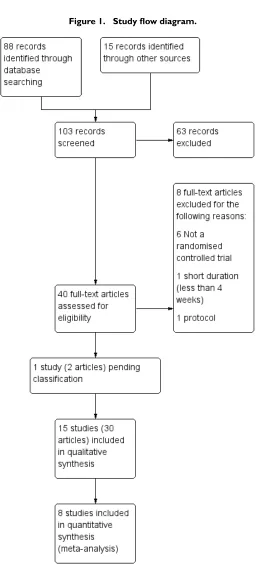
A systematic search, conducted on 18 January 2018, identified 103 unique records of potentially relevant trials. Of these, we considered 63 records irrelevant following inspection of their titles and abstracts. We obtained and read full texts for the remaining 40 records and formally excluded eight records (documented in
Excluded studies). We contacted the authors of one study (two records) awaiting classification (seeStudies awaiting classification). A total of 15 trials, with 30 records, met our inclusion criteria for studies of macrolides for bronchiectasis. We have summarised the selection process in the study flow diagram (Figure 1).
11 Macrolide antibiotics for bronchiectasis (Review)
Figure 1. Study flow diagram.
12 Macrolide antibiotics for bronchiectasis (Review)
[image:15.595.179.441.66.643.2]Included studies
In 11 trials (Altenburg 2013;Asintam 2012;Cymbala 2005;Diego 2013; Juthong 2011;Liu 2012; Liu 2014; Lourdesamy 2014;
Sadigov 2013;Serisier 2013;Wong 2012), study participants were adults, and in the remaining four trials (Koh 1997; Masekela 2013;Valery 2013;Yalcin 2006), participants were children. See
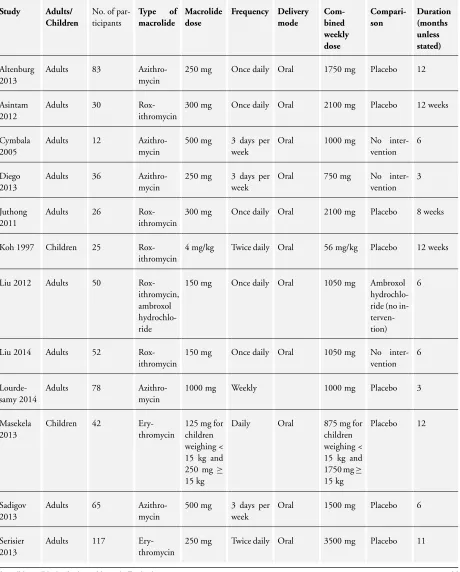
Characteristics of included studiesfor further details. SeeTable 1
for an overview of study characteristics.
Methods
Fourteen of the 15 included studies were parallel-group RCTs, and the remaining study was an RCT with a cross-over design (Cymbala 2005). Nine trials were double-blind, five were open-label, and one did not report information on study blinding. The
intervention duration ranged from eight weeks inJuthong 2011
to 24 months inValery 2013. The percentage of participants who withdrew after randomisation ranged from 0 inJuthong 2011and
Yalcin 2006to 27% inMasekela 2013, with an average withdrawal proportion of 8.7% across all included studies.
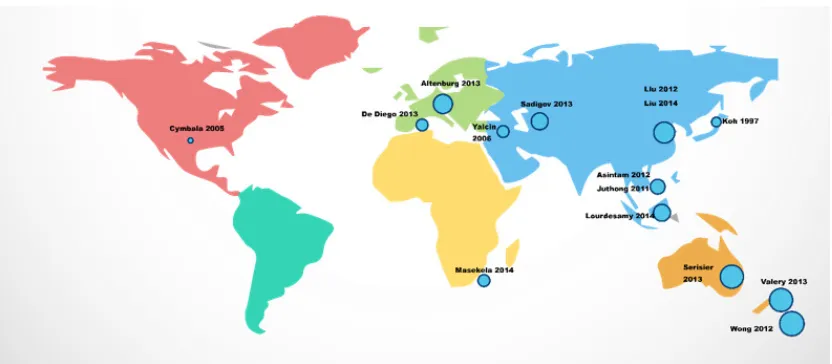
Seven trials were conducted in Asia (Asintam 2012;Juthong 2011;
Koh 1997;Liu 2012;Liu 2014;Lourdesamy 2014;Sadigov 2013); three in Australia/New Zealand (Serisier 2013;Valery 2013;Wong 2012); three in Europe (Altenburg 2013; Diego 2013;Yalcin 2006); one in South Africa (Masekela 2013); and one in the USA (Cymbala 2005). Please seeFigure 2for the global distribution of trials. The oldest study concluded in 1996 (Koh 1997), and the most recent in 2013 (Lourdesamy 2014). Three studies recruited participants through multiple centres (Altenburg 2013; Valery 2013;Wong 2012); the remainder were conducted at single centres (Figure 2).
Figure 2. Global distribution of studies.
Six trials used intention-to-treat analyses (Altenburg 2013;
Juthong 2011; Serisier 2013; Valery 2013; Wong 2012;Yalcin 2006), and seven trials included in analyses only participants who completed the study (Cymbala 2005;Diego 2013;Koh 1997;Liu 2012;Liu 2014;Lourdesamy 2014;Masekela 2013); the analyses performed in two studies were unclear (Asintam 2012;Sadigov 2013). Nine studies reported power calculations for sample size es-timation (Altenburg 2013;Asintam 2012;Cymbala 2005;Diego 2013; Lourdesamy 2014;Masekela 2013; Serisier 2013;Valery 2013;Wong 2012), and all six remaining studies reported
statisti-cally significant results (Juthong 2011;Koh 1997;Liu 2012;Liu 2014;Sadigov 2013;Yalcin 2006).
Note:We could not include results fromCymbala 2005in the review, as data from the pre-cross-over phase alone were not available owing to ineffective randomisation procedures. SeeCharacteristics of included studiesand the associated risk of bias table for additional details.
Participants
We chose to present separately data from adults and children and
13 Macrolide antibiotics for bronchiectasis (Review)
[image:16.595.100.516.326.508.2]data on different macrolides.
Adults
Eleven studies included a total of 690 adults aged 18 years and older, with a diagnosis of bronchiectasis confirmed by high-res-olution computed tomography (HRCT). Three studies specified the following numbers of exacerbations in the preceding year as screening criteria: at least three (Altenburg 2013); two (Serisier 2013); and one (Wong 2012). The number of randomised partic-ipants in each study ranged from 12 inCymbala 2005to 141 in
Wong 2012, with a mean age range of 48 years inLiu 2012to 70.8 years inCymbala 2005, although one study did not report this information (Sadigov 2013). Data on gender were missing for 81 randomised participants: Three trials reported gender distribution only for those who completed the study (Cymbala 2005;Diego 2013;Liu 2014), and one did not report gender (Sadigov 2013). Of 601 participants for whom data were available, 373 were fe-male and 236 were fe-male, with the percentage of fe-male participants
ranging from 23% inAsintam 2012to 54% inJuthong 2011,
across individual studies.
Three studies reported baseline disease severity in terms of Bhalla score: 9.5 (Liu 2014), 12.5 (Asintam 2012), and 26.5 (Diego 2013). Seven studies reported baseline FEV1% predicted ranging
from moderate impairment at 57% of predicted (Diego 2013), to mild impairment at 80.7% of predicted (Altenburg 2013), and two further studies reported baseline FEV1as 1.08 L inLourdesamy
2014and 1.42 L inJuthong 2011. The remaining two studies did not report baseline lung function (Liu 2012;Sadigov 2013). Seven studies reported smoking status, with the proportion of current smokers ranging from none inAsintam 2012andSerisier 2013
to 28% inLourdesamy 2014;one study reported 66% current or ex-smokers (Cymbala 2005), and four studies did not report this information (Diego 2013;Liu 2012;Sadigov 2013;Wong 2012).
Children
Four studies included a total of 190 randomised children, consist-ing of 81 girls and 98 boys (gender of participants lost to follow-up was not reported inMasekela 2013), younger than 18 years of age (Koh 1997; Masekela 2013;Valery 2013; Yalcin 2006). Four studies reported a diagnosis of bronchiectasis by HRCT, and
Valery 2013included children with chronic suppurative lung dis-ease, thus meeting clinical criteria when HRCT was not available. Sample sizes ranged from 25 inKoh 1997to 89 children inValery 2013, with mean age ranging from four years inValery 2013to 13 years inKoh 1997. Participants inValery 2013were indigenous children from Australia and New Zealand. Children inMasekela 2013had confirmed HIV infection, were receiving highly active antiretroviral therapy (HAART), and had undergone a sweat test to rule out cystic fibrosis. Children inKoh 1997had increased airway responsiveness, confirmed by a metacholine challenge test.
Valery 2013specified at least one exacerbation in the preceding year as one of its inclusion criteria.
Three studies reported baseline FEV1 % predicted as follows:
54.8% (Masekela 2013), 76.5% (Yalcin 2006), and 83% (Koh 1997).Valery 2013did not report lung function.
Interventions
Adults
The 11 adult studies evaluated three types of oral macrolides. Six studies used azithromycin with doses ranging from 750 to 1750 mg per week for a period of 12 to 52 weeks, four studies used roxithromycin with doses ranging from 1050 to 2100 mg per week for 8 to 24 weeks, and one study used erythromycin at a dose of 3500 mg per week for 48 weeks. Seven studies compared the intervention with placebo (Altenburg 2013;Asintam 2012;
Juthong 2011;Lourdesamy 2014;Sadigov 2013;Serisier 2013;
Wong 2012), three studies compared the intervention with no intervention (Cymbala 2005;Diego 2013;Liu 2014), and one study compared the intervention plus an antimucolytic with the antimucolytic alone (Liu 2012). We have summarised inTable 1
further details of interventions provided in individual studies.
Note:For all outcomes fromDiego 2013, we have included only the mean change score, pending clarification by study authors of reported standard deviations. Therefore, we have included these data in the text narratively.
Outcomes
One study reported all of our prespecified outcomes (Altenburg 2013).
Seven adult studies reported the frequency of exacerbations (Altenburg 2013;Asintam 2012;Diego 2013;Liu 2014;Sadigov 2013;Serisier 2013;Wong 2012), and three reported the time to first exacerbation (Altenburg 2013;Sadigov 2013;Wong 2012). Two children’s studies reported the frequency of exacerbations (Masekela 2013; Valery 2013), and one also reported the time to first exacerbation and the duration of the exacerbation (Valery 2013).
Two adult studies reported hospitalisations (Altenburg 2013;
Lourdesamy 2014), as did one paediatric study (Valery 2013). All three adult studies reported serious adverse events (Lourdesamy 2014;Serisier 2013;Wong 2012), as did one study in which the participants were children (Valery 2013).
Five of the adult studies reported sputum volume (Asintam 2012;
Cymbala 2005;Diego 2013;Lourdesamy 2014;Serisier 2013), as did two paediatric studies (Koh 1997;Yalcin 2006). Data from
Cymbala 2005were not usable (see note above).
Nine adult studies reported lung function, measured as FEV1or
forced vital capacity (FVC), or both (Altenburg 2013;Asintam 2012;Cymbala 2005;Diego 2013;Juthong 2011; Lourdesamy
14 Macrolide antibiotics for bronchiectasis (Review)
2014;Sadigov 2013;Serisier 2013;Wong 2012), as did all four paediatric studies (Koh 1997;Masekela 2013;Valery 2013;Yalcin 2006). Data fromCymbala 2005were not usable (see note above). Two adult studies reported FEV1before and after bronchodilation
(Diego 2013;Wong 2012), and one also reported FVC before and after bronchodilation (Wong 2012). The remaining studies did not specify whether lung function was measured before or after bronchodilation.
Three adult studies reported systemic markers such as C-reactive protein (Altenburg 2013;Masekela 2013;Serisier 2013). Five adult studies reported adverse events (Altenburg 2013;
Juthong 2011;Lourdesamy 2014;Serisier 2013;Wong 2012), as did two studies with children (Liu 2014;Valery 2013).
All 15 studies directly reported or inferred all-cause mortality due to completion of the study period by all participants (Altenburg 2013;Asintam 2012;Cymbala 2005;Diego 2013;Juthong 2011;
Koh 1997;Liu 2012; Liu 2014;Lourdesamy 2014; Masekela 2013; Sadigov 2013; Serisier 2013; Valery 2013;Wong 2012;
Yalcin 2006).
Four adult studies reported the emergence of resistance to antibi-otics (Altenburg 2013;Juthong 2011;Serisier 2013;Wong 2012), as did one study that included children (Valery 2013).
Two adult studies reported exercise capacity as measured by the 6MWD test (Serisier 2013;Wong 2012).
Nine adult studies reported health-related quality of life using SGRQ (Altenburg 2013; Asintam 2012;Diego 2013; Juthong 2011;Liu 2012;Liu 2014;Lourdesamy 2014;Serisier 2013;Wong 2012).
Note: Eight studies reported a formal sample size calculation (Altenburg 2013; Asintam 2012; Cymbala 2005;Diego 2013;
Lourdesamy 2014;Serisier 2013;Valery 2013;Wong 2012), but two of these studies did not recruit the target number of par-ticipants (Asintam 2012; Cymbala 2005). Six studies provided details of online trial registration (Altenburg 2013;Diego 2013;
Lourdesamy 2014;Serisier 2013;Valery 2013;Wong 2012). Eight
studies included conflict of interest statements (Altenburg 2013;
Cymbala 2005; Juthong 2011; Liu 2014; Lourdesamy 2014;
Serisier 2013;Valery 2013;Wong 2012). Nine studies explicitly stated funding sources for the study (Altenburg 2013;Cymbala 2005;Diego 2013;Juthong 2011;Liu 2014;Lourdesamy 2014;
Serisier 2013;Valery 2013;Wong 2012), but only six studies re-ported the role of funding sources in the trial (Altenburg 2013;
Cymbala 2005; Lourdesamy 2014;Serisier 2013;Valery 2013;
Wong 2012).
Subgroup analysis
One study with children conducted several post hoc subgroup analyses based on intervention compliance, intervention duration, bronchiectasis diagnosis, frequency of exacerbations at baseline, and positive bacterial infection at the beginning of the trial (Valery 2013).
Excluded studies
We excluded eight studies from this review. Six of these were not RCTs (Kudo 1988;Min 1988;Ming 2005;Rikitomi 1988;Saito 1988;Unoura 1986), one study was of less than four weeks’ du-ration and therefore did not meet our inclusion criteria (Tagaya 2002), and one study served as the protocol for a trial (Chang 2013). Please seeCharacteristics of excluded studiesfor additional details.
Risk of bias in included studies
Full details of the risk of bias judgements can be found in the ’Risk of bias’ section at the end of eachCharacteristics of included studiestable.Figure 3andFigure 4also provide a summary of the risk of bias in all included studies. Two independent review authors (LF and NR) independently assessed the risk of bias for each of the included studies and reached agreement.
15 Macrolide antibiotics for bronchiectasis (Review)
Figure 3. Risk of bias graph: review authors’ judgements about each risk of bias item presented as percentages across all included studies.
16 Macrolide antibiotics for bronchiectasis (Review)
[image:19.595.101.516.114.290.2]Figure 4. Risk of bias summary: review authors’ judgements about each risk of bias item for each included study.
17 Macrolide antibiotics for bronchiectasis (Review)
[image:20.595.198.417.107.639.2]Allocation
Review authors considered the methods used to generate randomi-sation sequences as low risk in six studies (Altenburg 2013;Liu 2012;Lourdesamy 2014;Serisier 2013;Valery 2013;Wong 2012).
Lourdesamy 2014andValery 2013randomised participants using computer-generated random numbers in a 1:1 ratio, andValery 2013also reported using a block design.Altenburg 2013described an independently performed computer-generated random alloca-tion sequence that used a permuted block size of 10.Serisier 2013
also used a computer-generated random allocation sequence but with block sizes of 2, 4, and 8, and stratified patients by baseline sputumPseudomonas.Wong 2012used a similar sequence gener-ation with block size of 6 and stratified participants by centre.Liu 2012randomised participants by using random number tables. The remaining nine studies provided unclear details regarding gen-eration of the randomisation sequence (Asintam 2012;Cymbala 2005;Diego 2013;Juthong 2011;Koh 1997;Liu 2014;Masekela 2013;Sadigov 2013;Yalcin 2006).
We judged allocation concealment as having low risk of bias in four studies (Altenburg 2013;Serisier 2013;Valery 2013;Wong 2012), and we assigned unclear risk in 11 studies (Asintam 2012;Cymbala 2005;Diego 2013;Juthong 2011;Koh 1997;Liu 2012;Liu 2014;
Lourdesamy 2014;Masekela 2013;Sadigov 2013;Yalcin 2006).
Altenburg 2013assigned identification codes with double-blind allocation to treatment groups. Valery 2013 used sequentially numbered, double-sealed, opaque envelopes to conceal group al-location.Serisier 2013used an independent trial pharmacist to dispense blinded study drug according to the randomisation se-quence.Wong 2012randomly assigned participants to groups us-ing a study-independent statistician. Studies considered at unclear risk of allocation concealment bias did not provide adequate de-tails of study methods to inform a clear judgement.
Blinding
We judged performance of the trial to be at low risk of bias in six studies (Altenburg 2013; Juthong 2011; Lourdesamy 2014;
Serisier 2013; Valery 2013; Wong 2012). Juthong 2011 and
Altenburg 2013reported identical tablets in both groups.Juthong 2011, Lourdesamy 2014,Serisier 2013, Valery 2013, andWong 2012stated that study personnel (patients, supervisors, staff, re-searchers, investigators) were blinded to treatment allocation at all times. We judged three studies as having high risk of performance bias, as they were open-label trials (Diego 2013;Liu 2012;Liu 2014). Investigators reported methods in the remaining studies in insufficient detail to permit a clear judgement of performance bias (Asintam 2012;Cymbala 2005;Koh 1997;Masekela 2013;
Sadigov 2013;Yalcin 2006).
Six studies clearly stated blinding of outcome assessments (de-tection bias); we therefore judged these studies to be low risk of bias (Altenburg 2013;Liu 2012;Lourdesamy 2014;Serisier 2013;
Valery 2013;Wong 2012). However, the remaining nine studies did not report methods in sufficient detail to inform a clear judge-ment of the risk of detection bias (Asintam 2012;Cymbala 2005;
Diego 2013;Juthong 2011;Koh 1997;Liu 2014;Masekela 2013;
Sadigov 2013;Yalcin 2006).
Incomplete outcome data
We judged incomplete outcome data (attrition bias) to introduce low risk of bias in nine studies (Altenburg 2013;Juthong 2011;
Koh 1997; Liu 2014; Lourdesamy 2014;Serisier 2013; Valery 2013;Wong 2012;Yalcin 2006). Four studies reported no drop-outs (Altenburg 2013;Juthong 2011;Serisier 2013;Yalcin 2006). Five studies clearly reported attrition rates and reasons for with-drawal (Koh 1997; Liu 2014; Lourdesamy 2014;Valery 2013;
Wong 2012). We judged the remaining six studies to have un-clear risk of attrition bias owing to insufficient reporting (Asintam 2012;Cymbala 2005; Diego 2013;Liu 2012; Masekela 2013;
Sadigov 2013).
Selective reporting
We judged six of the included studies to have low risk of re-porting bias (selective rere-porting) (Altenburg 2013;Diego 2013;
Lourdesamy 2014;Serisier 2013;Valery 2013;Wong 2012), as the study protocols were available, and all outcomes of interest had been reported in the prespecified way. We judged the risk of reporting bias as unclear in nine studies (Asintam 2012;Cymbala 2005;Juthong 2011;Koh 1997;Liu 2012;Liu 2014;Masekela 2013;Sadigov 2013;Yalcin 2006), as a full trial protocol was not available.
Other potential sources of bias
We did not identify any other potential sources of bias in five studies (Altenburg 2013;Diego 2013;Serisier 2013;Valery 2013;
Wong 2012), but we could not adequately assess this in seven other included studies (Asintam 2012;Juthong 2011;Koh 1997;
Liu 2012;Liu 2014;Masekela 2013;Sadigov 2013). We judged three studies to have high risk of other potential sources of bias (Cymbala 2005; Lourdesamy 2014; Yalcin 2006). Group allo-cation was ineffective in the pre-cross-over phase of Cymbala 2005, with eight of 11 participants receiving the intervention. In
Lourdesamy 2014, baseline sputum volume (primary outcome) was significantly higher in the intervention arm compared with
18 Macrolide antibiotics for bronchiectasis (Review)
the placebo group. Similarly, inYalcin 2006, baseline cytokine as-say levels were again significantly higher in the intervention group compared with the placebo group.
Effects of interventions
See:Summary of findings for the main comparisonMacrolides compared with placebo for adults with bronchiectasis;Summary of findings 2 Macrolides compared with no intervention for adults with bronchiectasis;Summary of findings 3Macrolides compared with placebo for children with bronchiectasis;
Summary of findings 4 Macrolides compared with no
intervention for children with bronchiectasis
Macrolide versus placebo: adults
Primary outcomes
Exacerbations
Two adult studies of azithromycin -Altenburg 2013andWong 2012- and one adult study of erythromycin -Serisier 2013- with a total of 341 participants were included in a meta-analysis. Results show that macrolides reduced the frequency of exacerbations to a greater extent than placebo (OR 0.34, 95% CI 0.22 to 0.54; I2
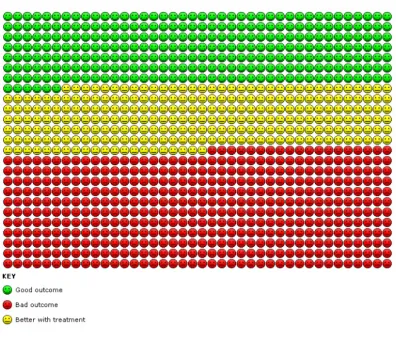
= 65%;Analysis 1.1; moderate-quality evidence). This translates to 714 per 1000 in the placebo group experiencing one or more exacerbation compared with 459 per 1000 in the macrolide group (95% CI 355 to 574) or a number needed to treat for an additional beneficial outcome (NNTB) of 4 (95% CI 3 to 8) (Figure 5).
Figure 5. Analysis 1.1. Cates plot showing the absolute reduction in numbers of participants experiencing one or more exacerbations in adults treated with macrolides compared with placebo (OR 0.34, 95% CI 0.22 to
0.54). 714 people per 1000 in the placebo group experienced one or more exacerbations compared with 459 (95% CI 355 to 574) per 1000 in the macrolide group.
19 Macrolide antibiotics for bronchiectasis (Review)
[image:22.595.108.504.335.679.2]As heterogeneity was substantial, we tested the impact of a ran-dom-effects model on the pooled effect size, which remained un-changed (OR 0.34, 95% CI 0.15 to 0.75). However, we noted significant differences between azithromycin and erythromycin subgroups (test for subgroup differences: Chi2= 5.63, df = 1 (P
= 0.02), I2 = 82.2%) and beneficial effects related to the two
azithromycin studies (OR 0.23, 95% CI 0.13 to 0.40; I2= 0%)
(Altenburg 2013;Wong 2012). Data show no differences between groups in the erythromycin study (OR 0.74, 95% CI 0.34 to 1.63). Two further studies did not report exacerbations in suffi-cient detail for inclusion in meta-analyses. In one study of azithro-mycin (1500 mg/week for six months) involving 65 adults, trial authors reported that the intervention “significantly decreased the rate of event-based exacerbations and significantly increased the time to the first event-based exacerbation compared to placebo”, but no further details were available (Sadigov 2013). In another study of roxithromycin involving 30 adults, two participants in the intervention group and one participant in the control group developed an exacerbation but researchers reported no further de-tails (Asintam 2012).
Three adult studies reported significantly reduced incidence rate ratios in the intervention group as follows: 0.48 fewer exacerba-tions per year (95% CI 0.65 to 0.26) (Altenburg 2013); 0.57 fewer exacerbations per year (95% CI 0.77 to 0.42) (Serisier 2013); and 0.38 fewer exacerbations per year (95% CI 0.54 to 0.25) (Wong 2012).
One adult study reported time to first exacerbation following a post hoc analysis, with a hazard ratio of 0.29 (95% CI 0.16 to 0.51) favouring azithromycin (Altenburg 2013).
Hospitalisations
We included in a meta-analysis two studies of azithromycin involv-ing 151 adults (Altenburg 2013;Lourdesamy 2014); results show no evidence of a reduction in hospitalisations in the azithromycin group compared with the placebo group (OR 0.56, 95% CI 0.19 to 1.62; I2= 0%;Analysis 1.2; low-quality evidence), although these results should be interpreted with caution owing to the low event rate.
Serious adverse events
Meta-analysis included two studies of azithromycin involving 209 adults (Lourdesamy 2014; Wong 2012), along with one study of erythromycin with 117 adults (Serisier 2013). Serious adverse events included pneumonia, respiratory and non-respiratory in-fections, haemoptysis, gastroenteritis, hernia, congestive heart fail-ure, stroke, and skin carcinoma. Results show no difference in the numbers of participants with serious adverse events between study groups (OR 0.49, 95% CI 0.20 to 1.23; I2= 0%;Analysis
1.3; low-quality evidence) and no evidence of subgroup differ-ences between azithromycin and erythromycin (test for subgroup
differences: Chi2= 0.48, df = 2 (P = 0.79), I2= 0%), although
re-sults should be interpreted with caution owing to low event rates. Removing the study with unclear risk of bias for allocation con-cealment -Lourdesamy 2014- from the meta-analysis had little impact on the pooled treatment effect (OR 0.39, 95% CI 0.12 to 1.23; I2= 0%).
Secondary outcomes
Sputum volume and purulence
One study of azithromycin (1000 mg/week for 12 weeks) with 78 adults reported no difference in sputum volume between study groups (MD 3.70, 95% CI -5.78 to 13.18;Analysis 1.4) (Lourdesamy 2014). One study of erythromycin (3500 mg/week for 48 weeks) with 117 adults reported a significant reduction in the change from baseline in 24-hour sputum weight, favouring the intervention (median change -4.4 grams, interquartile ratio (IQR) -7.8 to -1; P = 0.01) (Serisier 2013). One study of roxithromycin (2100 mg/week for 12 weeks) with 30 adults reported no improve-ment in sputum volume in either study group but provided no further details (Asintam 2012).
Measures of lung function
Forced expiratory volume in one second (FEV1)
Seven adult studies reported FEV1as litres, percent of predicted, or
both (Altenburg 2013;Asintam 2012;Juthong 2011;Lourdesamy 2014;Sadigov 2013; Serisier 2013;Wong 2012). One trial of azithromycin (1000 mg/week for 12 weeks) with 78 participants showed no evidence of benefit in FEV1% predicted from the
inter-vention at the end of the study (MD 2.98, 95% CI -6.15 to 12.11;
Analysis 1.5) (Lourdesamy 2014). One trial of azithromycin (1750 mg/week for 52 weeks)with 83 participants reported an increase of 1.03% in FEV1% predicted in the intervention group every
three months compared with a decrease of 0.10% in the placebo group (P = 0.047) (Altenburg 2013). One trial of erythromycin (3500 mg/week for 48 weeks) with 117 participants reported a significant difference in FEV1%predicted change from baseline
between groups, favouring macrolides (MD 2.40, 95% CI 0.34 to 4.46;Analysis 1.6) (Serisier 2013). One study of azithromycin (1500 mg/week for 6 months) with 65 participants reported signif-icant improvements in prebronchodilator and postbronchodilator FEV1but provided no further details (Sadigov 2013). One study
20 Macrolide antibiotics for bronchiectasis (Review)