The prevalence of renal anaemia in new dialysis patients
before and after routine eGFR reporting: A single centre
experience
*
Senyo K. Tagboto, Liz Cropper
University Hospital of North Staffordshire, Stoke-on-Trent, UK Email: [email protected], [email protected]
Received 20 November 2011; revised 30 January 2012; accepted 20 February 2012
ABSTRACT
Background: In March 2006, evidence-based guide- lines for the management of chronic kidney disease (CKD) in adults in the UK were publishedincluding the recommendation that kidney function should be assessed by formula-based estimation of glomerular filtration rate (eGFR), using the 4-variable modifica- tion of diet in renal disease (MDRD) equation. The purpose of this study was to evaluate whether or not improved assessment of renal function by eGFR re- porting followed by an intensive local education pro- gramme and local protocols affected the prevalence of renal anaemia at the time of starting dialysis for the first time. Methods: To do this, we collected data on haemoglobin levels in people starting renal replace- ment therapy (RRT) for the first time, during the 12 months immediately preceding eGFR reporting. We collected data for a further 12 months after eGFR was introduced; starting 6 months after the official date of introduction. Results: The proportion of peo- ple with Haemoglobin (Hb) levels ≥ 11 g/dl increased from 25.4% in the pre-eGFR era to 41.1% in the post eGFR era. In addition, average Hb levels were better in the post eGFR era (9.89 vs. 10.2 g/dl) although this did not reach statistically significance. In general, in the post eGFR era, people known to the renal services for less than 1 month prior to starting RRT had the worst Hb levels (8.7 g/dl). Hb levels were higher ac- cording to time of referral prior to RRT with peak Hb levels in people referred 6 - 9 months (11.5 g/dl) beforehand. Conclusions: It has been suggested that estimated GFR reporting may be associated with ear- lier recognition of kidney disease. This may have contributed to the increase in the proportion of peo- ple with optimal haemoglobin (≥11 g/dl) levels prior to starting renal replacement therapy. However a
large number still start renal replacement therapy with severe anaemia. The increase in Hb levels in the post eGFR era could also result from better anaemia care which could be an effect of other guideline im- plementation.
Keywords:Anaemia; Estimated Glomerular Filtration Rate; Haemodialysis; Peritoneal Dialysis; MDRD Equation
1. BACKGROUND
Measurements of the rate at which solutes in blood are filtered by the kidneys {glomerular filtration rate (GFR)} are the ideal method of evaluating renal function. These typically involve artificially injecting solutes such as inulin or the radioisotope chromium51 chelated with ethylenediaminetetraacetic acid (EDTA) and measuring the rate of filtration of these solutes. The manner in which endogenously produced solutes are removed by the kidney including creatinine and cystatin C may also be used to estimate GFR [1].
However these techniques are cumbersome and im- practical in routine clinical practice. This has led to the proliferation of a number of mathematical formulas aimed at estimating this (eGFR) [2]. These are usually based on serum creatinine level, age, sex, and race. In children, these formulas tend to be based on height, length, weight and serum creatinine levels [3,4].
The most widely used method for adults is the 4- variable modification of diet in renal disease (MDRD) equation, as it has proved robust and accurate [5].
In March 2006, evidence-based guidelines for the management of chronic kidney disease (CKD) in adults in the UK were published. These guidelines included the recommendation that kidney function in patients with CKD should be assessed by formula-based estimation of glomerular filtration rate (eGFR), using the MDRD equationand that all clinical biochemistry laboratories in
*Competing interests: The authors declare that they have no competing
the country should report estimates of eGFR alongside measurements of serum creatinine [6].
At the same time, the classification of CKD into 5 stages based on the proposal by the US/DOQI groupwas adopted in the UK. These classified CKD based on the severity of renal dysfunction as follows: (CKD stage 1, GFR > 90 ml/min/1.73m2; CKD stage 2, GFR 60 - 89 ml/min/1.73m2; CKD stage 3, GFR 30 - 59 ml/min/ 1.73m2; CKD stage 4, GFR 15 - 29 ml/min/1.73m2; CKD stage 5, GFR < 15 ml/min/1.73m2 or dialysis). These stages represent kidney disease with normal, mild, mod- erate, severe kidney dysfunction or kidney failure/dialy- sis respectively [7].
In the United Kingdom, a quality and outcomes framework has been introduced into primary care to sys- tematically incentivize process measures such as com- puterization and chronic disease management by estab- lishing practice-based disease registers. With respect to CKD, general practitioners (GPs) were required to have a register of patients with CKD stages 3 - 5 and focus care towards limiting the progression of kidney disease in these patients based on local research findings and the wider international consensus. This has resulted in a paradigm shift from kidney disease being viewed as a secondary care condition to being a primary care priority. Kidney disease is now recognized as a public health problem in the United Kingdom and has become a prior- ity area under the National Health Service [8].
The nephrology department at the University Hospital of North Staffordshire covers a population of 1.2 million people living in Staffordshire and parts of Shropshire and Cheshire. The department deals with 367 GP practices each with 1 - 17 GPs. We worked with the clinical bio- chemistry department to introduce eGFR reporting lo- cally from the beginning of September 2006. This was preceded by a local conference at the end of August 2006 where the concepts were explained to GPs. Over the next 6 months, there were several additional educational ac- tivities for GPs and practice nurses. We used a combina- tion of locally organised seminars, practice based lec- tures, interactive small-group workshops and information brochures. Local protocols for CKD management were introduced including improving contact with GPs by e-mail or telephone as a means of improving service de- livery. Finally, we encouraged GPs to consider referring CKD patients with an eGFR of less than 30 mls/min to the service unless multiple co morbidities made it un- likely that those patients would benefit from dialysis.
The purpose of this study was to evaluate whether or not improved assessment of renal function by eGFR re- porting followed by an intensive local education pro- gramme and local protocols affected the prevalence of renal anaemia at the time of starting dialysis for the first time.
2. METHODS
Data on people starting renal replacement therapy is rou- tinely collected and stored on our database (Cyber Ren®) for audit purposes.
We retrieved this data retrospectively, as part of our ongoing audit, on all patients starting renal replacement therapy (RRT) for the first time during the 12 months immediately preceding eGFR reporting (1st September 2005 to 31st August 2006), and for a further 12 months after the introduction of eGFR reporting. We excluded the immediate 6 months post-reporting during time which local protocols, experience and expertise were being developed (i.e. 1st March 2007 to 28th February
2008). This data was thoroughly checked for accuracy. This research did not involve experimental research per
se.
This included information on modality type including haemodialysis (HD), peritoneal dialysis (PD) and trans- plantation. Patients starting RRT elsewhere prior to transfer to our unit (including pre-emptive transplanta- tion which is carried out elsewhere with patients trans- ferred back after 10 days) were excluded. We collected demographic and the most recent laboratory data just prior to starting RRT (On the same day in most cases, but up to 3 weeks prior).
We also collected data on when patients were first seen by the renal services and the time between this and their first dialysis treatment. For the purposes of this pa- per we consider people starting dialysis within 3 months of being known to the renal services as starting dialysis without enough time for adequate preparation.
3. RESULTS
In the year prior to eGFR reporting, our Unit started 79 patients on RRT. An additional 13 people were started on RRT elsewhere and transferred into the programme. In the year starting 6 months after initial routine eGFR re- porting, we started a total of 92 patients on RRT and a further 19 patients were started elsewhere and subse- quently transferred to us. Pre-dialysis Hb levels were not available in 2 of the 92 patients.
Because of the difficulty getting reliable laboratory data on patients started on treatment elsewhere, further analysis was limited to people started on RRT locally in the year prior to eGFR reporting (n = 79) and in the year afterwards following the 6 months watershed period (n = 92).
change the proportion of people starting dialysis without adequate preparation.
Excluding the 2 patients without Hb data, the average starting Hb levels in the post eGFR era was slightly higher than in the pre eGFR period, (10.2 ± 1.86 g/dl vs. 9.89 ± 2.26 g/dl), the difference did not however reach statistical significance (p = 0.25).
Hb levels were compared in patients who were known to the renal service for less than 3 months prior to start- ing dialysis in the pre-eGFR vs. post eGFR era (Hb lev- els 9.24 ± 1.92 g/dl vs. 9.12 ± 1.59 g/dl, p = 0.78). Simi- lar comparisons were made for patients who had been adequately prepared prior to starting dialysis in the pre- eGFR compared to the post eGFR era (Hb levels 10.2 ± 1.92 g/dl vs. 11.0 ± 1.71 g/dl, p = 0.066).
Hb levels in patients who had been adequately pre- pared prior to starting dialysis was better in both the pre-eGFR era (Hb levels 10.2 g/dl vs. 9.24 g/dl, p < 0.05) and the post eGFR era (Hb levels 11.0 g/dl vs. 9.12 g/dl, p < 0.001) where the results were highly significant. Fur- thermore, out of the total population started on dialysis, the proportion of patients with Haemoglobin (Hb) levels
≥ 11g/dl which was our minimum target Hb [4,5] in- creased from 25.4% to 41.1% (Table 1) in the post eGFR era.
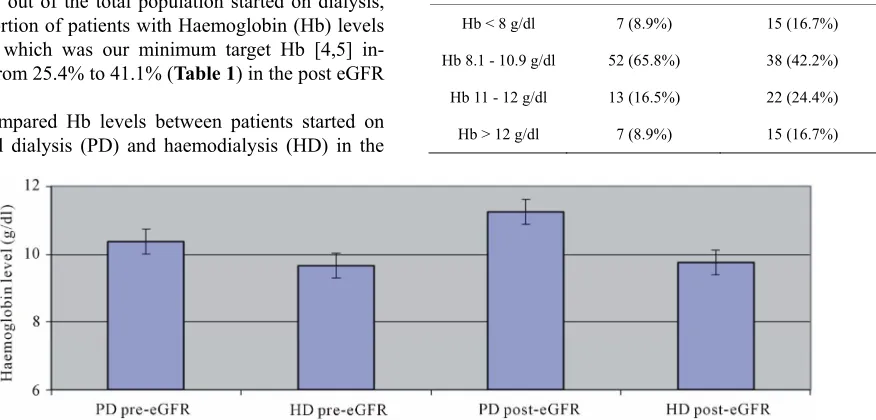
We compared Hb levels between patients started on peritoneal dialysis (PD) and haemodialysis (HD) in the
pre and post-eGFR era (Figure 1). Hb levels were con- sistently better in patients started on PD than on HD in both the pre (10.4 g/dl vs. 9.7 g/dl, PD vs. HD, p = 0.14) and post (11.3 g/dl vs. 9.8 g/dl, PD vs. HD, p = 0.004). The difference between Hb levels in people started on PD and HD however only reached statistical significance in the post-eGFR period.
Average Hb levels over the 2 year period were similar between male and female patients and between younger and older patients (≥ or <70 yrs) in both pre and post eGFR periods (data not shown).
[image:3.595.95.533.331.541.2]Hb levels and time of referral to the renal services in the post eGFR period was examined in some detail (Figure 2). People known to the renal service for less than 1 month had the lowest Hb levels (8.7 g/dl). Mean
Table 1. A comparison of haemoglobin levels at the time of starting initial renal replacement therapy in the period immedi- ately before and after routine eGFR reporting.
Pre-eGFR (n = 79) Post-eGFR (n = 90)
Hb < 8 g/dl 7 (8.9%) 15 (16.7%)
Hb 8.1 - 10.9 g/dl 52 (65.8%) 38 (42.2%)
Hb 11 - 12 g/dl 13 (16.5%) 22 (24.4%)
[image:3.595.95.504.578.706.2]Hb > 12 g/dl 7 (8.9%) 15 (16.7%)
Figure 1. Haemoglobin levels just prior to initiating first haemodialysis or peritoneal dialysis treatments in pa-tients with end stage kidney disease before and after routine eGFR reporting.
Hb levels then gradually increased depending on time of referral, reaching a peak of 11.5 g/dl in people referred >6 - 9 months prior to therapy. There was no statistical difference between initial Hb in people referred between >6 - 9 months and longer (p = 0.23).
4. DISCUSSION
It is now widely accepted that serum creatinine does not accurately reflect renal excretory function and leads to a low awareness of people with chronic kidney disease [9].
The 4-variable MDRD eGFR gives a more reliable and practical estimate of renal function. The introduction of routine eGFR reporting in England alongside serum creatinine levels raises the possibility of earlier identifi- cation of people with kidney disease, with the potential for improvements in outcome [10]. Jain et al., 2009 and
Noble et al., 2008, have shown that routine reporting of
eGFR is associated with increased nephrology consults, predominantly in older and diabetic patients with stage 3 CKD. Richards et al., 2008, demonstrated a 7-fold month
on month rise in nephrology referrals following institu- tion of eGFR reporting which was only reversed by the introduction of a referral management service.
However, it is not clear whether this improved as- sessment of renal function and earlier recognition of people with kidney disease and the development of guidelines for the identification, management and refer- ral of CKD in adults translates into practical improve- ments in disease management or outcomes.
This study attempted to partially address this question by investigating Hb levels at the time of starting RRT for the first time and comparing Hb values in the era before and after eGFR reporting started.
Anaemia is a common consequence of advanced kid- ney disease and is the result of decreased renal erythro- poietin production, impaired iron utilization and iron deficiency. Iron supplementation and treatment with erythropoietin are used to optimise Hb levels to a target level of between 11 - 12 g/dl in people with renal anae- mia [11,12].
Furthermore, anaemia has a significant impact on the quality of life of patients and warrants early recognition and treatment [13].
Our data shows that in both the pre and post eGFR era, approximately a third of people start RRT less than 3 months after initial contact with the renal services. We consider this to be probably inadequate time to permit optimal preparation for RRT.
For the purposes of this paper, we considered people known to the renal service for more than 3 months prior to starting RRT as probably having enough time for ade- quate preparation. We considered that a key assessment of the impact of eGFR reporting would be if Hb levels in
these patients starting renal replacement therapy im- proved during after eGFR reporting started.
The average Hb levels in people starting dialysis for the first time was slightly better in the post eGFR period (9.89 vs. 10.2 g/dl) although this did not reach statistical significance. This was largely driven by an improvement in Hb levels on people started on dialysis for the first time who were known to the renal services for at least 3 months prior (10.2 vs. 11 g/dl) where the difference just missed reaching statistical significance (p = 0.066).
Hb levels in people started on PD were superior to HD. Probably reflecting the fact that these people had typi- cally been seen by the renal services for much longer than people starting on HD initially (sometimes for sev- eral years prior). While this difference missed statistical significance in the pre eGFR era (p = 0.14), the differ- ences were highly significant in the post eGFR era (p = 0.004).
In both the pre and post eGFR periods, Hb levels were significantly better in people who had been in contact with the renal services for at least 3 months. The level of significance just attained statistical significance in the pre eGFR era (p < 0.05) and was highly significant in the post eGFR era (p < 0.001).
Perhaps the single biggest change seen in the post- eGFR period, was in the proportion of people starting dialysis for the first time with an Hb level greater than 11 g/dl. This increased by an additional 15% (from 25.4% to 41.1%).
however an increased risk of strokes [17]. This has raised significant questions about the appropriateness of initia- tion of erythropoiesis-stimulating agents (ESAs) in pre- dialysis patients although it is widely accepted that se- vere anaemia is undesirable in patients with renal dis- ease.
5. CONCLUSIONS
Our results suggest that there was a small trend towards an improvement in Hb levels on starting RRT for the first time in the post eGFR period compared to the pre eGFR period, although these differences did not reach statistical significance. Hb levels in people known to the renal ser- vices for at least 3 months prior to first RRT generally were generally higher. The proportion of people with Hb levels greater than 11g/dl increased substantially in the post-eGFR period.
Surprisingly the routine reporting of eGFR has so far not made a difference to the proportion of people starting RRT following late referral to the renal service. It re- mains to be seen whether or not this pattern will improve with time.
6. AUTHORS CONTRIBUTIONS
ST conceived of the study and performed the statistical analysis. Both ST and LC were involved in collecting data, checking for accuracy and in drafting the manuscript. All authors read and approved the final manuscript.
REFERENCES
[1] Stevens, L.A., Padala, S. and Levey, A.S. (2010) Ad- vances in glomerular filtration rate-estimating equations. Current Opinion in Nephrology and Hypertension, 19, 298- 307. doi:10.1097/MNH.0b013e32833893e2
[2] Stevens, L.A., Zhang, Y. and Schmid, C.H. (2008) Eva- luating the performance of equations for estimating glo- merular filtration rate. Journal of Nephrology, 21, 797- 807.
[3] Schwartz, G.J., Haycock, G.B., Edelmann, C.M. and Spitzer, A. (1976) A simple estimate of glomerular fil- tration rate in children derived from body length and plasma creatinine. Pediatrics, 58, 259-263.
[4] Brion, L.P., Fleischman, A.R., McCarton, C. and Schwar- tz, G.J. (1986) A simple estimate of glomerular filtration rate in low birth weight infants during the first year of life: Noninvasive assessment of body composition and growth. Journal of Pediatics, 109, 698-707.
doi:10.1016/S0022-3476(86)80245-1
[5] Levey, A.S., Greene, T., Kusek, J.W. and Beck, G.J. (2000) A simplified equation to predict glomerular filtra- tion rate from serum creatinine. Journal of the American Society Nephrology, 11, 155A.
[6] Royal College of Physicians of London (2006) Chronic kidney disease in adults: UK guidelines for identification,
management and referral. Royal College of Physicians, London.
[7] National Kidney Foundation (2006) K/DOQI clinical practice guidelines for chronic kidney disease: Evaluation, classification, and stratification. American Journal of Kid- ney Diseases, 39, A1.
doi:10.1016/S0272-6386(02)70054-1
[8] Stevens, P.E. and O’Donoghue, D.J. (2009) The UK model for system redesign and chronic kidney disease services. Seminars in Nephrology, 29, 475-482.
doi:10.1016/j.semnephrol.2009.06.004
[9] Ferris, M., Shoham, D.A., Pierre-Louis, M., Mandhelker, L., Detwiler, R.K. and Kshirsagar, A.V. (2009) High pre- valence of unlabeled chronic kidney disease among inpa- tients at a tertiary-care hospital. The American Journal of the Medical Sciences, 337, 93-97.
doi:10.1097/MAJ.0b013e318181288e
[10] Lamb, E.J. (2008) United Kingdom guidelines for chro- nic kidney disease. Scandinavian Journal of Clinical and Laboratory Investigation, 241, 16-22.
doi:10.1080/00365510802144920
[11] Tagboto, S., Cropper, L., Mostafa, S., Turner J. and Pugh-Clark, K. (2008) Intravenous iron in chronic kidney disease: Haemoglobin change shortly after treatment of patients not on dialysis or erythropoietin. Journal of Renal Care, 34, 112-115.
doi:10.1111/j.1755-6686.2008.00026.x
[12] Tagboto, S., Cropper, L., Turner, J. and Pugh-Clark, K. (2009) The efficacy of a single dose of intravenous ferric carboxymaltose (ferinject) on anaemia in a pre-dialysis population of chronic kidney disease patients. Journal of Renal Care, 35, 18-22.
doi:10.1111/j.1755-6686.2009.00075.x
[13] Stevens, P.E., O’Donoghue, D.J. and Lameire, N.R. (2003) Anaemia in patients with diabetes: Unrecognised, undetected and untreated? Current Medical Research and Opinion, 19, 395-401. doi:10.1185/030079903125002036 [14] Singh, A.K., Szczech, L., Tang, K.L., Barnhart, H., Sapp,
S., Wolfson, M., Reddan, D., CHOIR Investigators (2006) Correction of anemia with epoetin alfa in chronic kidney disease. New England Journal of Medicine, 355, 2085- 2098. doi:10.1056/NEJMoa065485
[15] Inrig, J.K., Barnhart, H.X., Reddan, D., Patel, U.D., Sapp, S., Califf, R.M., Singh, A.K. and Szczech, L.A. (2012) Effect of hemoglobin target on progression of kidney disease: A secondary analysis of the CHOIR (Correction of hemoglobin and outcomes in renal insufficiency) trial. American Journal of Kidney Diseases.
[16] Drüeke, T.B., Locatelli, F., Clyne, N., Eckardt, K.U., Macdougall, I.C., Tsakiris, D., Burger, H.U., Scherhag, A., CREATE Investigators (2006) Normalization of hemo- globin level in patients with chronic kidney disease and anemia. New England Journal of Medicine, 355, 2071- 2084. doi:10.1056/NEJMoa062276
tors (2009) A trial of darbepoetin alfa in type 2 diabetes and chronic kidney disease. New England Journal of Me-