Appl. Sci.2019, 9, x; doi: FOR PEER REVIEW www.mdpi.com/journal/applsci Article
Phase Noise Cancellation in Coherent
Communication Systems Using a Radio Frequency
Pilot Tone
Tianhua Xu 1,2,*, Cenqin Jin 1, Shuqing Zhang 3,*, Gunnar Jacobsen 4,5, Sergei Popov 5,
Mark Leeson 1 and Tiegen Liu 6
1 School of Engineering, University of Warwick, Coventry CV4 7AL, UK
2 Optical Networks Group, University College London, London WC1E 7JE, UK
3 Department of Optical Engineering, Harbin Institute of Technology, Harbin 150001, China
4 NETLAB, RISE Research Institutes of Sweden, SE-16440 Stockholm, Sweden
5 Optics and Photonics Group, KTH Royal Institute of Technology, SE-16440 Stockholm, Sweden
6 Key Laboratory of Opto-Electronic Information Technology (MoE), School of Precision Instruments and Opto-Electronics Engineering, Tianjin University, Tianjin 300072, China; [email protected]
* Correspondence: [email protected] (T.X.); [email protected] (S.Z.) Received: 26 September 2019; Accepted: 3 November 2019; Published: date (Invited Paper)
Featured Application: This work is performed for the compensation of the laser phase noise (LPN) and the equalization enhanced phase noise (EEPN) in high-capacity, long-haul, coherent optical fiber networks.
Abstract: Long-haul optical fiber communication employing digital signal processing (DSP)-based dispersion compensation can be distorted by the phenomenon of equalization-enhanced phase noise (EEPN), due to the reciprocities between the dispersion compensation unit and the local oscillator (LO) laser phase noise (LPN). The impact of EEPN scales increases with the increase of the fiber dispersion, laser linewidths, symbol rates, signal bandwidths, and the order of modulation formats. In this work, the phase noise cancellation (PNC) employing a radio frequency (RF) pilot tone in coherent optical transmission systems has been investigated. A 28-Gsym/s QPSK optical transmission system with a significant EEPN has been implemented, where the carrier phase recovery (CPR) was realized using the one-tap normalized least-mean-square (NLMS) estimation and the differential phase detection (DPD), respectively. It is shown that the RF pilot tone can entirely eliminate the LPN and efficiently suppress the EEPN when it is applied prior to the CPR.
Keywords: coherent optical fiber communication; laser phase noise (LPN); carrier phase recovery (CPR); phase noise cancellation (PNC); equalization enhanced phase noise (EEPN); radio frequency (RF) pilot tone
1. Introduction
systems, where the enhancement effect of fiber dispersion on the LPN was neglected [10,11]. Actually, due to the interplay between the electronic dispersion compensation (EDC) module and the LPN from the local oscillator (LO), a phenomenon of equalization enhanced phase noise (EEPN) is induced and plays a significant role in the carrier phase recovery (CPR) in high-capacity optical communication systems [10–16]. However, so far, no DSP-based CPR has been developed to effectively compensate for EEPN [16–18]. Therefore, it will be of great significance to study the suppression of LPN and EEPN using an RF pilot tone scheme.
In this work, the performance of an orthogonally polarized RF pilot tone scheme is investigated for eliminating both the LPN and the EEPN in long-haul optical transmission systems. A 28-Gsym/s quadrature phase shift keying (QPSK) system is numerically implemented, where the CPR is realized using a one-tap normalized least mean square (NLMS) estimation and a differential phase detection (DPD) scheme, respectively [19–21]. The results show that the LPN can be fully removed and the EEPN can also be effectively suppressed, when the RF pilot tone scheme is applied prior to the CPR.
2. EEPN in Optical Communication Systems
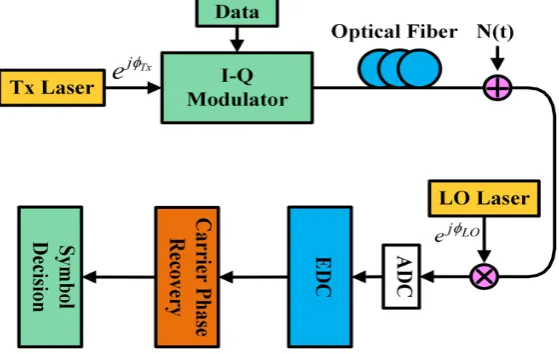
Figure 1 describes the block diagram of a long-haul, coherent optical communication system with EDC and CPR. The LPN from the transmitter (Tx) laser passes through the optical fiber and the dispersion compensation unit, and thus the net CD experienced by the Tx LPN approaches zero. By contrast, the LO LPN goes only through the dispersion compensation unit. Consequently, the LO LPN interplays with the dispersion compensation component in EDC and the interactions will degrade the performance of the optical communication system. This effect is called EEPN [10–13].
Figure 1. Block diagram of coherent transmission system and equalization-enhanced phase noise (EEPN). ϕTx: Tx laser phase noise (LPN), ϕLO: LO LPN, ADCs: analogue-to-digital converters.
The variance of the EEPN distortion will increase with fiber dispersion, local oscillator laser linewidth, and signal symbol rate. The noise variance of EEPN can be written as follows [10,19]:
, (1)
where λ is the central wavelength of the optical carrier, c is the speed of the light in vacuum, L is the length, D is the CD coefficient of the fiber, TS is the symbol period of the signal, and ΔfLO is the 3-dB linewidth of the LO laser.
It is noted that the EEPN evaluation in Equation (1) only works for the static time-domain and frequency-domain EDCs, which involve no phase noise compensation functions [22,23].
σEEPN
2 =πλ2
2c ⋅
[image:2.595.159.439.376.553.2]3. CPR Using One-Tap NLMS
A one-tap NLMS filter could be effectively applied in the CPR [20], and its tap weight w(k) is expressed using the following equations:
, (2)
, (3)
where x(k) is the input signal, k is the symbol index, d(k) is the desired symbol, e(k) is the error between the output and the desired symbols, and µ represents a parameter of the step size.
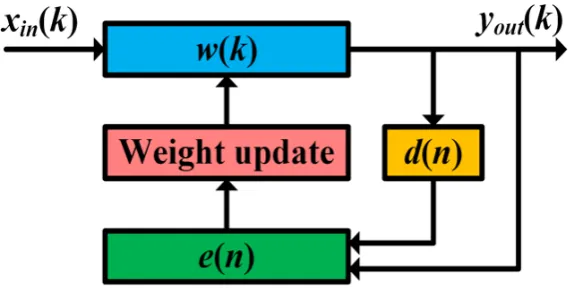
[image:3.595.156.443.284.428.2]The schematic of the NLMS CPR is illustrated in Figure 2, which can actually be implemented in a feed-forward structure and can be realized in parallel in the field programmable gate array (FPGA) circuits for a real-time operation [4].
Figure 2. Block diagram of the one-tap normalized least-mean-square (NLMS) carrier phase recovery (CPR).
Similar to the definition of the Tx and the LO, a concept of effective linewidth ΔfEff is employed here to describe the total phase noise in coherent transmission systems considering EEPN [17,19]:
(4)
(5)
(6)
where and are the LPN variance of the Tx and LO lasers, respectively, and ΔfTx is the 3-dB linewidth of the Tx laser.
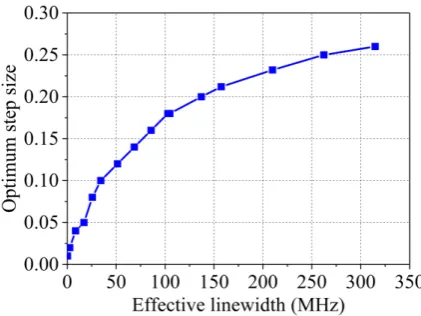
It has been established that the step size µ can be optimized to enhance the performance of NLMS CPR [19]. Therefore, it is significant to find the optimal step size for NLMS CPR, when the EEPN is considered in coherent optical communication systems. Figure 3 shows the optimal step size parameter for various effective linewidths in the 28-Gsym/s QPSK system, applicable to the time-domain and the frequency-time-domain static dispersion equalizations [22,23]. In all numerical simulations in this paper, the NLMS algorithm is operated with its corresponding optimal value of the step size.
w k
( )
+1 =w k( )
+ µx k
( )
2x*
( )
k e k( )
( ) ( ) ( ) ( )
= - × e k d k w k x k2 2 2
2
Tx LO EEPN Eff
S
f
T
s s s
p
+ +
D »
S Tx Tx = pDf ×T
s2 2
S LO LO = pDf ×T
s2 2
2 Tx
s
2LO
Figure 3. The optimal step size parameter in the NLMS CPR for various effective linewidths.
4. Differential Carrier Phase Recovery
[image:4.595.194.405.436.544.2]Differential phase detection (DPD) can also be employed for recovering the carrier phase in coherent communication systems. In the DPD scheme, signal data are encoded in and extracted from the phase differences between consecutive transmitted signal symbols [21]. For instance, the phase information of the k-th symbol can be extracted according to the phase difference between the k-th and the (k +1)-th symbols. Therefore, the CPR error is determined by the phase fluctuation between the k-th and the (k +1)-th symbols within a symbol period [19]. It is noted that DPD does not require additional computations such as the n-power, the averaging, and the phase unwrapping, compared to other CPR methods [20,24–26]. Therefore, it can be easily implemented in DSP hardware for a real-time operation. The block diagram of DPD CPR is provided in Figure 4.
Figure 4. Schematic of the differential phase detection.
5. Transmission Setup with RF Pilot Tone Scheme
Figure 5. High-speed coherent communication system with an orthogonally-polarized RF pilot tone.
6. Results and Analyses
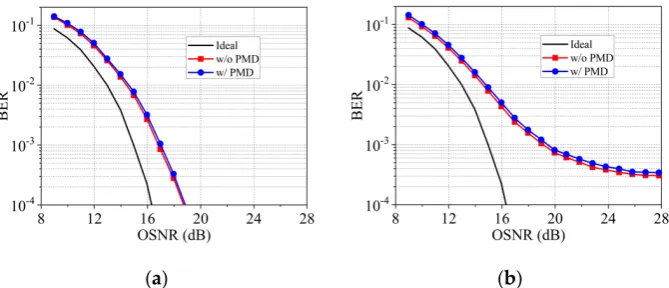
Figure 6 shows the results of PNC using the RF pilot tone in a 2000 km coherent communication system, where the CPR is realized using the NLMS algorithm. In Figure 6a, the effective linewidth is 170 MHz and there is no EEPN, since the linewidth of the transmitter laser is 170 MHz and the linewidth of the LO laser is 0 Hz. It is found that both the Tx and the LO LPN can be entirely suppressed. In Figure 6b, the linewidths of both the Tx and the LO lasers are 5 MHz. According to Equations (1) and (4), the EEPN is quite significant in such a case, and the effective linewidth is the same (170 MHz) as that in Figure 6a. It is found in Figure 6b that the BER performance improves considerably (around half an order of magnitude in the BER floor, from 8 × 10⁻⁴ to 3 × 10⁻⁴) using the RF pilot tone, compared to the case of NLMS CPR only. The results in Figure 6a,b demonstrate the efficiency of the RF pilot tone in compensating for both LPN and EEPN. It can be found that the use of RF pilot tone can entirely mitigate the LPN from both the Tx and the LO lasers. However, it cannot fully compensate for the EEPN in optical fiber transmission systems since the EEPN actually represents a complicated integration of the phase, the amplitude, and the time jitter noise [10,12,16,29].
[image:5.595.136.462.496.637.2](a) (b)
Figure 6. Phase noise cancellation (PNC) results of the 2000 km coherent transmission system (the one-tap NLMS CPR). Ideal: linewidth of both Tx and LO lasers is 0 Hz. w/o: without, w/: with. (a) Transmitter: 170 MHz, local oscillator: 0 Hz; (b) Transmitter = local oscillator: 5 MHz.
Similar to Figure 6b, a considerable improvement of BER performance is also achieved with half an order of magnitude in the BER floor (from 6.5 × 10⁻⁴ to 1.5 × 10⁻⁴), when the RF pilot tone scheme is applied prior to the DPD.
[image:6.595.140.461.130.266.2](a) (b)
Figure 7. PNC results of the 2000 km coherent transmission system (DPD CPR). Ideal: linewidth of both Tx and LO lasers are 0 Hz. (a) Transmitter: 170 MHz, local oscillator: 0 Hz; (b) Transmitter = local oscillator: 5 MHz.
7. Discussions
It has to be clarified that the use of the RF pilot tone for the PNC in this work has occupied one polarization state in the fiber, since here we aim to investigate and discuss the efficiency of the use of an RF pilot tone for PNC in a simplified transceiver structure. In fact, the RF pilot tone can also be transmitted using the same polarization state as the optical data signals, which requires a more complicated implementation to perform the generation and recovery of the RF pilot tone [7,30,31]. In such systems, a pilot-carrier vector modulation (PCVM) scheme has been applied, where the transverse magnetic (TM) component is loaded with the signal data in X-polarization and the transverse electric (TE) component is employed to carry both the signal data in Y-polarization and the RF pilot tone [7]. It was reported that the PNC in such PCVM transmission schemes can also provide a good performance for an effective linewidth of up to 30 MHz [7,31]. The performance comparison between such PCVM transmission scheme and our proposed RF pilot tone-PNC scheme will be investigated in future work. In addition, for orthogonal frequency division multiplexing (OFDM) optical transmission systems it will be straightforward to employ one subcarrier as the RF pilot tone within the OFDM spectrum to remove the influence of laser phase noise and EEPN [32].
(a) (b)
Figure 8. PNC performance of the 2000 km coherent transmission systems with and without PMD, when the NLMS-CPR is applied. Ideal: linewidth of both Tx and LO lasers are 0 Hz. (a) Transmitter: 170 MHz, local oscillator: 0 Hz; (b) Transmitter = local oscillator: 5 MHz.
8. Conclusions
In this work, an orthogonally polarized RF pilot tone is investigated to suppress the LPN and EEPN in long-haul coherent optical fiber communication systems. A 28-Gsym/s QPSK optical transmission system is numerically implemented, where the CPR is performed using the one-tap NLMS and DPD methods, respectively. Our results demonstrate that the LPN in the communication system can be completely eliminated and the EEPN can also be effectively suppressed, when the RF pilot tone scheme is applied prior to the CPR.
Author Contributions: Theoretical analyses and numerical simulations were implemented by T.X. The paper was mainly written by T.X. C.J. wrote some parts and edited the manuscript. S.Z. and M.L. made modifications. All authors reviewed and discussed the paper.
Funding: This work is in parts supported by the EU H2020 RISE Grant DAWN4IoE (778305) and the UK EPSRC Program Grant TRANSNET (EP/R035342/1).
Conflicts of Interest: The authors declare no conflict of interest.
References
1. Kaminow, I.; Li, T.; Willner, A. E. Optical fiber telecommunications VIA: Components and subsystems, 6th ed.; Academic Press Publisher: Oxford, UK, 2013.
2. Ip, E.; Lau, A.P.T.; Barros, D.J.F.; Kahn, J.M. Coherent detection in optical fiber systems. Opt. Express2008,
16, 753–791.
3. Winzer, P.J.; Essiambre, R.J. Advanced modulation formats for high-capacity optical transport networks. J.
Lightwave Technol. 2006, 24, 4711–4728.
4. Savory, S.J. Digital coherent optical receivers: Algorithms and subsystems. IEEE J. Sel. Top. Quantum Electron. 2010, 16, 1164–1179.
5. Zhao, J.; Liu, Y.; Xu, T. Advanced DSP for coherent optical fiber communication. App. Sci. 2019, 9, 4192. 6. Mori, Y.; Zhang, C.; Igarashi, K.; Katoh, K.; Kikuchi, K. Unrepeated 200 km transmission of 40-Gbit/s
16-QAM signals using digital coherent receiver. Opt. Express2009, 17, 1435–1441.
7. Nakamura, M.; Kamio, Y.; Miyazaki, T. Pilot-carrier based linewidth-tolerant 8PSK self-homodyne using
only one modulator. In Proceedings of the 33rd European Conference and Exhibition of Optical Communication, Berlin, Germany, 16–20 September 2007.
8. Cai, Y.; Gao, X.; Ling, Y.; Xu, B.; Qiu, K. RF pilot tone phase noise cancellation based on DD-MZM SSB
modulation for optical heterodyne RoF link. Opt. Commun. 2020, 454, 124502.
9. Jacobsen, G.; Xu, T.; Popov, S.; Li, J.; Friberg, A.T.; Zhang, Y. Receiver implemented RF pilot tone phase noise mitigation in coherent optical nPSK and nQAM systems. Opt. Express2011, 19, 14487–14494.
10. Shieh, W.; Ho, K.P. Equalization-enhanced phase noise for coherent detection systems using electronic
11. Xie, C. Local oscillator phase noise induced penalties in optical coherent detection systems using electronic chromatic dispersion compensation. In Proceedings of the 2009 Conference on Optical Fiber Communication-Incudes post deadline papers, San Diego, CA, USA, 29 May 2009.
12. Lau, A.P.T.; Shen, T.S.R.; Shieh, W.; Ho, K.P. Equalization-enhanced phase noise for 100Gb/s transmission and beyond with coherent detection. Opt. Express2010, 18, 17239–17251.
13. Xu, T.; Liga, G.; Lavery, D.; Thomsen, B.C.; Savory, S.J.; Killey, R.I.; Bayvel, P. Equalization enhanced phase noise in Nyquist-spaced superchannel transmission systems using multi-channel digital back-propagation.
Sci. Rep.2015, 5. doi:10.1038/srep13990
14. Zhuge, Q.; Xu, X.; El-Sahn, Z.A.; Mousa-Pasandi, M.E.; Morsy-Osman, M.; Chagnon, M.; Qiu, M.; Plant,
D.V. Experimental investigation of the equalization-enhanced phase noise in long haul 56 Gbaud DP-QPSK systems. Opt. Express2012, 20, 13841–13846.
15. Fatadin, I.; Savory, S.J. Impact of phase to amplitude noise conversion in coherent optical systems with digital dispersion compensation. Opt. Express2010, 18, 16273–16278.
16. Kakkar, A.; Navarro, J.R.; Schatz, R.; Louchet, H.; Pang, X.; Ozolins, O.; Jacobsen, G.; Popov, S. Comprehensive study of equalization-enhanced phase noise in coherent optical systems. J. Lightwave Technol. 2015, 33, 4834–4841.
17. Xu, T.; Jacobsen, G.; Popov, S.; Li, J.; Friberg, A.T.; Zhang, Y. Carrier phase estimation methods in coherent optical transmission systems influenced by equalization enhanced phase noise. Opt. Commun. 2013, 293, 54–60.
18. Colavolpe, G.; Foggi, T.; Forestieri, E.; Secondini, M. Impact of phase noise and compensation techniques in coherent optical systems. J. Lightwave Technol. 2011, 29, 2790–2800.
19. Xu, T.; Jacobsen, G.; Popov, S.; Li, J.; Friberg, A.T.; Zhang, Y. Analytical estimation of phase noise influence in coherent transmission system with digital dispersion equalization. Opt. Express2011, 19, 7756–7768. 20. Xu, T.; Jacobsen, G.; Popov, S.; Li, J.; Wang, K.; Friberg, A.T. Normalized LMS digital filter for chromatic
dispersion equalization in 112-Gbit/s PDM-QPSK coherent optical transmission system. Opt. Commun.
2010, 283, 963–967.
21. Fatadin, I.; Ives, D.; Savory, S. J. Differential carrier phase recovery for QPSK optical coherent systems with integrated tunable lasers. Opt. Express2013, 21, 10166–10171.
22. Savory, S.J. Digital filters for coherent optical receivers. Opt. Express2008, 16, 804–817.
23. Kudo, R.; Kobayashi, T.; Ishihara, K.; Takatori, Y.; Sano, A.; Miyamoto, Y. Coherent optical single carrier transmission using overlap frequency domain equalization for long-haul optical systems. J. Lightwave Technol. 2009, 27, 3721–3728.
24. Jacobsen, G.; Xu, T.; Popov, S.; Sergeyev, S. Study of EEPN mitigation using modified RF pilot and Viterbi-Viterbi based phase noise compensation. Opt. Express2013, 21, 12351–12362.
25. Ly-Gagnon, D.S.; Tsukamoto, S.; Katoh, K.; Kikuchi, K. Coherent detection of optical quadrature
phase-shift keying signals with carrier phase estimation. J. LightwaveTechnol. 2006, 24, 12–21.
26. Viterbi, A.J.; Viterbi, A.M. Nonlinear estimation of PSK-modulated carrier phase with application to burst digital transmission. IEEETrans. Inf. Theory1983, 29, 543–551.
27. Liga, G.; Xu, T.; Alvarado, A.; Killey, R.I.; Bayvel, P. On the performance of multichannel digital backpropagation in high-capacity long-haul optical transmission. Opt. Express2014, 22, 30053–30062.
28. Maher, R.; Xu, T.; Galdion, L.; Sato, M. Spectrally shaped DP-16QAM super-channel transmission with
multi-channel digital back propagation. Sci. Rep. 2015, 5, 08214.
29. Ho, K.P.; Lau, A.P.T.; Shieh, W. Equalization-enhanced phase noise induced timing jitter. Opt. Lett. 2011,
36, 585–587.
30. Nakamura, M.; Kamio, Y.; Miyazaki, T. Linewidth-tolerant real-time 40-Gbit⁄s 16-QAM self-homodyne detection using a pilot carrier and ISI suppression based on electronic digital processing. Opt. Lett. 2010,
35, 13–15.
31. Nakamura, M.; Kamio, Y.; Miyazaki, T. Linewidth-tolerant real-time 10-Gbit⁄s 16-QAM transmission using
a pilot-carrier based phase-noise cancelling technique. Opt. Express2008, 16, 10611–10616.
32. Randel, S.; Adhikari, S.; Jansen, S.L. Analysis of RF-pilot-based phase noise compensation for coherent optical OFDM systems. IEEE Photon. Technol. Lett.2010, 22, 1288–1290.
33. Ip, E.; Kahn, J.M. Digital equalization of chromatic dispersion and polarization mode dispersion. J.
34. Liga, G.; Czegledi, C.B.; Xu, T.; Agrell, E.; Killey, R.I.; Bayvel, P. Ultra-wideband nonlinearity compensation performance in the presence of PMD. In Proceedings of the 42nd European Conference on Optical
Communication, Dusseldorf, Germany,5 December 2016.