0
Towards a Vegan Jurisprudence:
The Need for a Reorientation of Human Rights
Jeanette Karen Rowley LLM, BA Hons, PG Cert. Ed. FHEA
A thesis submitted to Lancaster University for the degree of PhD
1
Abstract
The objective of this thesis is to develop a new way of thinking about the theory and practice of human rights to accommodate the demands of vegans for basic moral rights for nonhuman animals. The work firstly outlines the ways in which the claims of vegans, under the right to freedom of thought and conscience, are largely unsupported by existing human rights because they are typically outweighed by the wider interests of the majority. Drawing on the work of Emmanuel Levinas, the thesis considers arguments that ground the nature of vegan claims in the ethics of alterity. It specifically utilises the argument that the basis of human rights recognises ethical responsibility to the precarious, mortal other.
Upendra Baxi cautiously supports the application of Levinas’ philosophy to the ethics of law, and there is a slowly growing body of literature in this regard. This thesis is the first human rights work to show that Levinas’ ethics of alterity can also be applied to nonhuman others, and that human rights arguments can include claims that the avoidable suffering of nonhuman animals is a human rights wrong.
2
‘So strong is man’s aversion to all killing …’
Leo Tolstoy, ‘Introduction’ in Howard Williams, The Ethics of Diet: An Anthology of Vegetarian Thought
3
Declaration
1. I declare that the work contained herein has been entirely composed by me and is the product of my own intellectual effort. In addition, I confirm that no part of this thesis has been submitted for any other degree or professional qualification.
2. Extracts from parts of this thesis have already been published:
Jeanette Rowley, Human Rights are Animal Rights: The Implications of Ethical Veganism for Human Rights published in Critical Perspectives on Veganism edited by Jodey Castricano and Rasmus R. Simonsen, 2016, The Palgrave Macmillan Animal Ethics Series reproduced with permission of Springer Nature, Springer International Publishing AG Switzerland.
4
Acknowledgements
I would firstly like to thank Lancaster University and the Law School for giving me the opportunity to undertake research on this topic. I have benefitted from its well-thought-out research training and assessment process and financial support to present at conferences in Toulouse and Australia. I am especially grateful to my supervisors, Professor Steven Wheatley and Dr Bela Bonita Chatterjee, for their enduring professional approach, for their enthusiastic support and for providing the nurturing environment needed for the thesis to be progressed and completed.
I would also like to acknowledge the following: Dr Kevin Watson, whose exceptional support at the beginning of my thinking on this subject contributed to the positive employment conditions in which I could consider taking on a demanding, long-term research project; Anu from Switzerland who liaised with and arranged our presentation to Heiner Bielefeldt at the United Nations in Geneva; and all the vegans who have written to me with their accounts of negative experiences at work or as consumers expressing their support for the project. I am grateful for the support of The Vegan Society and the members of its Academic Research Committee. I am continually inspired by the work and support of newfound colleagues, many of whom – including Petr, Greg, Ralf and Barbara – have become new collaborators and friends. I am especially grateful to the team at the German VEBU for their collaboration to host symposiums on Veganism and Law. I acknowledge the attendees and inspiring speakers: Ralf, Till, Camille, Sissi, Barbara, Eberhart, Felix, Thomas, Helena, Aro and others – many of whom travelled some distance to participate.
During the last six years, a number of other people have been more important than they realise. The Lancaster Academic Reading Group members – Mark, Dr Richard Twine, Emma, Pete and Jess – have been truly inspirational with their keenness and critical comments on our monthly readings. I couldn’t have presented in Australia without the help and support of Michael Green, Jackie, Simon, Paula, Ian, Sheena and Steve (or without the flexibility of their families).
More recently, I have been motivated by the support of Associate Professor Jodey Castricano and Rasmus R Simonsen PhD, who invited me to write a chapter for their new publication. Barbara Gardner of Catholic Concern for Animals has also been generously complimentary and has asked to publish a presentation I gave to the UK All-Party Parliamentary Group on Vegetarianism and Veganism. I am especially delighted, honoured and humbled to be in receipt of motivational compliments from the founder of the concept of ‘speciesism’, Dr Richard D Ryder.
As with any long-term project, a commitment to developing and writing this thesis has meant that other people are subject to my ordering of conflicting priorities. I am eternally grateful for the amazing support and understanding of my family. As I usually explain to students, life does not stop when you study. There have been various events, weddings, babies born and hospitalisations that I may have attended with pen, pad and books or articles to read. For this, though you totally understand, I apologise and sincerely hope that it will not be in vain in our combined efforts to speak truth to power and find the way to liberate a compassionate humanity and nonhuman others from enduring constraints.
I want to say a huge thank you to Loukas for unwavering support: for the visits, food, walks, drinks and chats – but most of all for a limitless sense of humour on the difficult philosophy and especially for when I took reading material everywhere ‘just in case’.
5
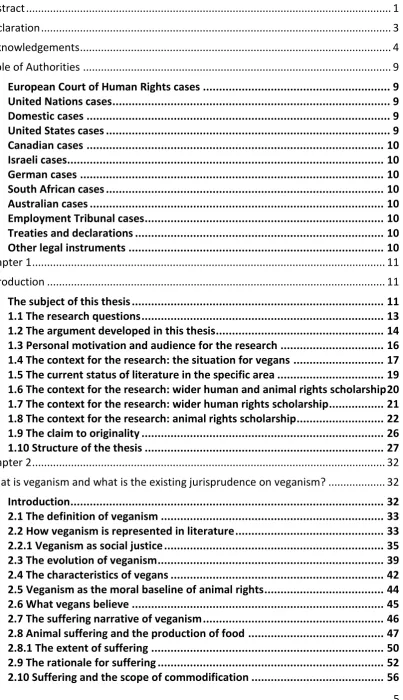
Contents
Abstract ... 1
Declaration ... 3
[image:6.595.124.528.85.786.2]Acknowledgements ... 4
Table of Authorities ... 9
European Court of Human Rights cases ... 9
United Nations cases ... 9
Domestic cases ... 9
United States cases ... 9
Canadian cases ... 10
Israeli cases... 10
German cases ... 10
South African cases ... 10
Australian cases ... 10
Employment Tribunal cases ... 10
Treaties and declarations ... 10
Other legal instruments ... 10
Chapter 1 ... 11
Introduction ... 11
The subject of this thesis ... 11
1.1 The research questions ... 13
1.2 The argument developed in this thesis ... 14
1.3 Personal motivation and audience for the research ... 16
1.4 The context for the research: the situation for vegans ... 17
1.5 The current status of literature in the specific area ... 19
1.6 The context for the research: wider human and animal rights scholarship 20 1.7 The context for the research: wider human rights scholarship ... 21
1.8 The context for the research: animal rights scholarship ... 22
1.9 The claim to originality ... 26
1.10 Structure of the thesis ... 27
Chapter 2 ... 32
What is veganism and what is the existing jurisprudence on veganism? ... 32
Introduction ... 32
2.1 The definition of veganism ... 33
2.2 How veganism is represented in literature ... 33
2.2.1 Veganism as social justice ... 35
2.3 The evolution of veganism ... 39
2.4 The characteristics of vegans ... 42
2.5 Veganism as the moral baseline of animal rights ... 44
2.6 What vegans believe ... 45
2.7 The suffering narrative of veganism ... 46
2.8 Animal suffering and the production of food ... 47
2.8.1 The extent of suffering ... 50
2.9 The rationale for suffering ... 52
6
2.11 Intersecting human and nonhuman suffering ... 58
2.12 The scope of mutual suffering ... 61
2.13 The human desire to address mutual suffering ... 64
2.14 The context for the claims of vegans ... 67
2.15 Veganism at the European Court of Human Rights: H v UK ... 70
2.16 Conclusion ... 72
Chapter 3 ... 75
To what extent does the existing human rights jurisprudence on veganism confirm the centrality of individual (human) self-determination in the idea of human rights? ... 75
Introduction ... 75
3.1 Background ... 75
3.2 The problem of human rights ... 77
3.3 The idea of human autonomy in the groundwork of rights ... 80
3.4 The emergence of individualised human rights ... 82
3.5 The implications of autonomy for human rights ... 86
3.6 Human rights, dignity and personhood ... 88
3.7 How autonomy grounds the paramount right to freedom of individual conscience ... 91
3.8 The scope of community and autonomy in human rights: the development of the Universal Declaration of Human Rights ... 94
3.9 The Articles of the Universal Declaration of Human Rights ... 97
3.9.1 The centrality of autonomy in international human rights ... 101
3.10 The European Convention on Human Rights ... 105
3.11 The definition of freedom of conscience ... 108
3.12 Protection for freedom of conscience ... 110
3.13 Compassionate responsibility, personal disadvantage and the limits of the right to freedom of conscience ... 112
3.14 Conclusion ... 114
Chapter 4 ... 116
Can human rights be grounded by ethical responsibility to suffering? ... 116
Introduction ... 116
4.1 Argument so far ... 117
4.2 Background ... 118
4.3 Levinas’ philosophy on the ethics of alterity ... 119
4.4 A brief note about reading Levinas ... 122
4.5 The essence of the ethics of alterity ... 124
4.6 The ethics of alterity and the essence of humanity... 125
4.7 The ethics of alterity and human identity ... 126
4.8 The face and the production of ethics ... 127
4.9 The infinity of ethical responsibility ... 131
4.10 Levinas’ thoughts on human rights ... 131
4.11 Responsibility in the face of difference ... 134
4.12 The application of the ethics of alterity in protest scholarship ... 135
4.13 Upendra Baxi ... 136
7
4.15 William Paul Simmons ... 146
4.16 Analysis of protest scholarship... 151
4.16.1 The significance of compassionate responsibility ... 154
4.17 Conclusion ... 158
Chapter 5 ... 161
Do the ethics of alterity concern nonhuman animals?... 161
Introduction ... 161
5.1 Background ... 161
5.2 Things do not have face ... 165
5.3 Levinas responds to the face of the nonhuman other ... 167
5.4 Levinas’ denial of a nonhuman face ... 169
5.5 Levinas’ incomplete philosophy ... 171
5.6 Inconsistencies in Levinas’ logic ... 174
5.7 Derrida’s response to the status of animals in Levinas’ ethics of alterity . 178 5.8 Derrida: the face and suffering ... 181
5.9 Derrida and signification ... 184
5.10 The basis for ethics ... 187
5.11 Conclusion ... 190
Chapter 6 ... 195
What are the implications of including nonhumans in an ethics of alterity for the practice of human rights? ... 195
Introduction ... 195
6.1 The abstract development of a rights enterprise that includes nonhumans ... 196
6.1.2 Nonhuman alterity in the abstract development of an ethics of alterity for human rights ... 199
6.1.3 Nonhuman otherness in the abstract development of an ethics of alterity for human rights ... 201
6.1.4A priori responsibility to nonhumans in the abstract development of an ethics of alterity for human rights ... 202
6.1.5 Infinity of responsibility for nonhumans in the abstract development of an ethics of alterity for human rights ... 204
6.1.5.1 Duty and limiting infinite duty to nonhumans ... 208
6.2 The moral standing of nonhumans in a human rights informed by the ethics of alterity ... 212
6.2.1 A nonhuman entitlement to life and liberty ... 214
6.2.2 A nonhuman entitlement to self-defined identity ... 216
6.2.3 A nonhuman entitlement to care and assistance ... 217
6.3 A practical example ... 218
6.4 A reconceptualisation of freedom of conscience ... 221
6.5 Article 9 litigation and adjudication ... 223
6.6 Conclusion... 225
Chapter 7 ... 228
Conclusion ... 228
8
7.2 Implementing the ethics of alterity ... 237
7.3 Adjudication and the recognition of alterity ... 237
7.4 The existing possibility of alterity in human rights ... 239
7.5 Adjudication and the recognition of otherness ... 240
7.6 Adjudication and a priori responsibility to nonhumans ... 241
7.7 Adjudication and infinity of ethical responsibility to nonhumans ... 242
7.8 Implications for nonhumans ... 245
7.9 Implications for vegans ... 246
7.10 Recognising the complexities of Levinas’ philosophy ... 247
7.11 Developing a vegan jurisprudence of human rights ... 249
9
Table of Authorities
European Court of Human Rights cases
Bladet Tromsø And Stensaas v Norway App no 21980/93 (ECtHR, 20 May 1999) C v UK (1983) DR 142
Campbell and Cossans v UK (1982) Series A no 48 Golder v UK (1975) Series A no 18
Friend, The Countryside Alliance And Others v UKApp no 16072/06 and 27809/08 (ECtHR, 4 November 2009)
H v UK (1993) 16 EHRR (Commission Decision) Handyside v UK (1976) Series A no 24
Hashman and HarrupvUKApp no 25594/94 (ECtHR, 25 November 1999) Herrmann v GermanyApp no 9300/07 (ECtHR, 26 June 2012)
Jakóbski v PolandApp no 18429/06 (ECtHR, 7 December 2010)
National Union of Belgium Police v Belgium App no 4464/70 (ECtHR, 27 October 1975)
Rukavina v CroatiaApp no 770/12 (ECtHR, 6 January 2015) Soering v UK (1989) 11 EHRR 439
Stibbe v Austria App no 26188/08 (ECtHR, 4 May 2008)
Vartic v Romania (no 2) App no 14150/08 (ECtHR, 17 March 2014)
Verein GegenTierfabriken Schweiz (Vgt) vSwitzerlandApp no 32772/02 (ECtHR, 30 June 2009)
United Nations cases
Angela Poma Poma v Peru Comm no 1457/2006 UN Doc CCPR/C/95/D/1457/2006, 27 March 2009
Chief Bernard Ominayak and the Lubicon Lake Band v Canada Comm no 167/1984 UN Doc CCPR/C/38/D/167/1984, 10 May 1990
Kitok v Sweden Comm no 197/1985 UN Doc CCPR/C/33/D/197/1985, 10 August 1988 Länsman et al v Finland (no 1) Comm no 511/1992 UN Doc CCPR/C/52/D/511/1992, 8 November 1994
Länsman et al v Finland (no 2) Comm no 671/1995 UN Doc CCPR/C/58/D/671/1995, 22 November 1996
Länsman et al v Finland (no 3) Comm no 1023/2001 UN Doc CCPR/C/83/D/1023/2001, 15 April 2005
Domestic cases
F v F (Welfare of Children: Immunisation) [2013] EWHC 2683 (Fam) S (CHILDREN) [2012] EWCA Civ 210
BC v EF (Parental Responsibility: Immunisation) [2016] EWFC 69 (05 December 2016)
United States cases
10
Canadian cases
H (Re) 2011 CanLII 63119 (ON CCB) Melville v Muller 2006 BCSC 895 (CanLII)
WCAT-2012-02217 (Re) 2012 CanLII 54414 (BC WCAT)
Israeli cases
Academic Center of Law and Business v Minister of Finance HCJ 2605/05 Let the Animals Live v Hamat GaderLCA 1684/96
German cases
Life Imprisonment Case (1977) 45BVerfGE 187 Ger, fed, Const. Ct.
South African cases
Smit NO and Others v King Goodwill Zwelithini Kabhekuzulu and Others (10237/2009) [2009] ZAKZPHC 75 (4 December 2009)
Australian cases
Genna & Dennis [2010] Fam CA 1161 (30 November 2010)
Employment Tribunal cases
Alexander v Farmtastic Valley Ltd and Others [2011] 2513832/10 (ET) Hashman v Milton Park Dorset Limited [2011] EqLR 426 (ET)
Treaties and declarations
Convention for the Protection of Human Rights and Fundamental Freedoms (European Convention on Human Rights, as amended) (ECHR) Article 9 Convention for the Protection of Human Rights and Fundamental Freedoms (European Convention on Human Rights, as amended) (ECHR) Article 10 Convention for the Protection of Human Rights and Fundamental Freedoms (European Convention on Human Rights, as amended) (ECHR) Protocol 1 Convention for the Protection of Human Rights and Fundamental Freedoms (European Convention on Human Rights, as amended) (ECHR) Protocol 14
Declaration on the Elimination of all Forms of Intolerance and Discrimination Based on Religion or Belief, UNGA Res 36/55 (25 November 1981)
International Covenant on Economic, Social and Cultural Rights (adopted on 16 December 1966, entered into force on 3 January 1976) 993 UNTS 3 (CESCR) International Covenant on Civil and Political Rights (adopted 16 December 1966, entered into force 23 March 1976) 999 UNTS 171 (ICCPR)
Treaty of Amsterdam Amending the Treaty on European Union (Amsterdam Treaty) Universal Declaration of Human Rights (adopted 10 December 1948 UNGA Res 217 A) (III) (UDHR)
Vienna Convention on the Law of Treaties (adopted 23 May 1969) 1155 UNTS 331
Other legal instruments
Animal Welfare Amendment Act (No 2) 2015 (NZ)
11
Chapter 1
Introduction
The subject of this thesis
The subject of this thesis is the relationship of veganism to human rights. Veganism is unique in that whilst other disadvantaged groups – for example, women, religious minorities or disabled people – make human rights claims for themselves, the claims of vegans represent, first and foremost, the moral standing of nonhuman animals.1 In the dominance of a culture that is based on the consumption of other animals, vegans experience unfair treatment and discrimination in personal, social and employment contexts. Some of these experiences motivate human rights claims under the right to freedom of conscience: for example, by a vegan in public authority employment who is required to wear uniform items that are made from the skin or hair of nonhuman animals. In such circumstances, vegans experience coercion and feel required to assimilate into a way of life that is not aligned with their ethical orientation.
Veganism has no official definition for the purposes of law. The definition promoted by The Vegan Society2 states that it is:
[a] philosophy and way of living which seeks to exclude—as far as is possible and practicable—all forms of exploitation of, and cruelty to, animals for food, clothing or any other
1
In recognition of a well-established observation that prejudice against nonhuman animals is reinforced by language, this thesis will support expressions such as ‘nonhuman animal(s)’, ‘nonhuman(s)’ and ‘other-than-human animal(s)’ but may sometimes use ‘animal(s)’ interchangeably with these terms.
2
12 purpose; and by extension, promotes the development and
use of animal-free alternatives for the benefit of humans, animals and the environment. In dietary terms it denotes the practice of dispensing with all products derived wholly or partly from animals.3
This thesis asks whether there is an ethical theory that – when applied to the human rights system of the European Court of Human Rights (‘the Court’ or ‘the ECtHR’) – supports the claims of vegans. This focus on the ECtHR relates to the inadmissibility of a case brought by a vegan in 19914 and the statement of the ECtHR’s Commission (as it was prior to the 1998 ECtHR restructure) in that case which indicated that the vegan convictions regarding animal products are within the scope of Article 9 of the European Convention on Human Rights (‘the Convention’).5
What is problematic about this case is the acknowledgement that nonhumans have sufficient moral standing to validate the human rights claims of vegans but that rights are exclusively human and deny that nonhumans have any basic rights. This thesis frames this problem in terms of a tension in human rights between the prioritisation of individual human reason and the mission of human rights to acknowledge and deal with suffering. In this regard, it foregrounds the ethics of human rights.
The ECtHR is the judicial body that hears cases about alleged violations of the Convention. It builds upon the human rights work of the United Nations (UN) and
3
The Vegan Society, ‘Definition of veganism’ <www.vegansociety.com/go-vegan/definition-veganism> accessed 5 May 2016.
4
H v UK (1993) 16 EHRR.
5
13 gives effect to some human rights provisions that are contained in the Universal Declaration of Human Rights (‘the UDHR’ or ‘the Declaration’).6 This is a regional, international human rights treaty that is ratified by the member states of the Council of Europe.
The Convention lists the basic rights and fundamental freedoms of every person. It is a ‘living instrument’ that evolves through the addition of new Protocols which extend and further clarify existing provisions. Its terms also evolve and are clarified through the judgments of the Court. Given this evolutionary potential, this thesis examines whether there is a way to reconceptualise the idea of basic rights to better accommodate veganism.
1.1 The research questions
The human rights claims of vegans are raised as a matter of freedom of conscience but are claims that represent the moral imperative to attend to nonhuman animal suffering. As such, the primary research question of this thesis concerns the ethical orientation of the human right to freedom of conscience. It seeks to ascertain if there is a way to accommodate veganism by thinking about this right differently. The thesis responds to the primary question through four subsidiary questions. Firstly, what is the essence of veganism and what are the human rights claims of vegans? Secondly, what are the normative legal values and principles that determine the relationship between current human rights and veganism? Thirdly, is there an ethical theory that has utility for the claims of vegans? And finally, what is the essence of such a theory, how might it have utility for vegans and how might it be applied to human rights to support the claims of vegans? The argument
6
14 developed from an exploration of these questions will now be explained.
1.2 The argument developed in this thesis
The argument developed in the thesis is presented in four stages. The first stage argues that veganism is an ethical commitment to the moral standing of animals and that it represents a moral imperative to attend to their suffering. Observing that other animals suffer, vegans aim to live their lives without harming animals or consuming products derived from their living or dead bodies. Veganism can, thus, be regarded as an uncompromising response to suffering and a manifestation of ethical responsibility to the moral standing of nonhuman others that re-presents their authenticity. On this view, the human rights claims of vegans emerge from the inclusion of other animals in the moral community. The claims of vegans are grounded by responsibility and, first and foremost, present the suffering of other animals as a matter of justice. As such, the claims of vegans are uniquely claims for others rather than for themselves.
15 differently than as matters concerning disadvantage in relation to personal and private conscience. In this regard, the stage identifies the need to explore an inclusive philosophy that can ground the existence of fundamental rights for a community of individuals that suffer.
The third stage explains that Emmanuel Levinas’ ethics of alterity constitute a theory of asymmetrical ethical responsibility that supports the claims of vegans. It observes that asymmetrical ethical compassion is intrinsic to a humanity that is bound in community through an innate regard for suffering others. Developing existing discourse on the utility of Levinas’ philosophy for human rights, the stage applies the principles of Levinas’ philosophy to nonhuman animals on the basis that they are legitimate, suffering others who demand an ethical response and to whom the human subject responds. The stage identifies that Levinas’ ethics of alterity offer a stronger level of protection for nonhuman animals than is explicated in current animal rights literature.
The fourth stage argues that Levinas’ ethics of alterity, when applied to animals and human rights, have utility for the claims of vegans. On this view, nonhumans have five basic rights which can be viewed in three groups: the right to life and liberty, the right to self-defined identity and the right to support and assistance. These basic rights of nonhumans ground the claims of vegans; claims judged not on the basis of the right to freedom of personal and private conscience but as the expression of a moral imperative to respond to nonhuman suffering as a matter of ethical justice.
16 capable of explaining and underpinning the moral and legal standing of animals. This conclusion has significant implications for Article 9 jurisprudence. Rather than framing Article 9 as a provision that supports veganism as a matter of personal and private conscience, this conclusion allows a response to Article 9 that recognises the claims of vegans in the context of an existing empirical ethical regard for other animals and their suffering. It rejects the idea that the claims of vegans are matters that belong in the domain of personal and private conscience and allows Article 9 to become the vehicle through which the moral imperative to attend to the suffering of nonhumans is transported into human rights. It is a response to Article 9 that recognises nonhuman suffering to be a fundamental matter of ethical responsibility to a humanity that is first and foremost ethically responsive to the suffering of others.
1.3 Personal motivation and audience for the research
The personal motivation for this research stems from a longstanding interest in the relationship between human society and the status of nonhuman animals. A specific interest in the human rights claims of vegans was fuelled in 2010 by the observation of a tension in the UK concerning the status of veganism as a qualifying belief under Article 9 of the Convention and the role of the UK Equality and Human Rights Commission.7
The Equality and Human Rights Commission has a statutory duty to oversee human rights and monitor equality initiatives and had made it clear in its Draft Code of Practice for Employers, that veganism comes within the scope of the protected
7
Jamieson Alastair, ‘Vegans should be protected from discrimination, says equality watchdog: Vegans and atheists should have the same protection against discrimination as religious groups according to guidance on new equality laws proposed by Harriet Harman’ The Telegraph (2010)
17 characteristic ‘Religion and Belief’.8 In the Draft Code of Practice it gave example scenarios featuring vegan employees. These examples sought to explain to employers the steps that could be taken to accommodate the needs of vegans. These useful examples were removed from its final published Code of Practice on the basis that they were not ‘realistic’ and that different examples would better ‘reflect the principles in relevant case law’.9 It was felt that the removal of the examples was contrary to the principle of inclusion, because it meant that the legal status of veganism was relegated in the dissemination of important information, and that vegans were denied a point of reference to support their requests for accommodation of needs.
The research is likely to be of interest to vegans and animal rights activists because it opens up new ways to debate the relationship between humans and other animals, to articulate claims and to develop political campaigns. It will also be of interest: to human rights scholars who are interested in the ontology or ethical orientation of human rights or the construction of a moral foundation for human rights; to those interested in exploring the philosophy of Emmanuel Levinas; and to those interested in the debate on human/nonhuman rights.
1.4 The context for the research: the situation for vegans
There are varied responses to veganism in case law and by public authorities. In addition to being regarded as within the scope of the Convention, veganism has
8
Equality and Human Rights Commission, ‘Employment Statutory Code of Practice (Draft for Consultation)’ (Equality and Human Rights Commission 2009) 32, 252, accessed June 2010. The website of the Equality and Human Rights Commission (https://www.equalityhumanrights.com/en) no longer carries a copy of this document. An online copy can be viewed at
<https://www.elaweb.org.uk/sites/default/files/docs/Draft%20Employment%20Code%20of%20Practice%201109 798532.pdf> accessed 12 October 2017.
9
Equality and Human Rights Commission, ‘Employment: Statutory Code of Practice’
18 been referred to, in a UK court, as a component of a broader positive philosophy within which to raise children.10 In the UK, vegan children have nevertheless been required by law to receive vaccinations made using substances derived from nonhumans.11 In Rukavina v Croatia,12 the court heard that a multidisciplinary team of experts had been brought in to respond to the applicant’s allegations that his ex-wife was putting the heath of his daughter at risk by ‘keeping her on a vegan diet’.13 The specialist team was composed of a psychologist, a psychiatrist, a paediatrician and a social worker. It reported to the court that the child was healthy but that her mother’s insistence on a vegan diet put her at risk regarding her ‘normal psychophysical development’.14 There was no discussion about the ethical orientation of the specialists. Similarly, in Genna & Dennis, the Family Court of Australia was required to assist disputing parents and employed the services of a dietician as the final arbiter of what the child should eat when in the father’s care. Again, there was no discussion as to the dietician’s ethical orientation.15
In France, the judiciary authorised the removal of a child from vegan parents on the grounds that the child was in danger.16 In other jurisdictions too, the word ‘vegan’ is conflated with child abuse.17 Generally, in health care, veganism has been
10
See comments in S (CHILDREN) [2012] EWCA Civ 210. This case concerned vegan children taken into foster care due to the volatile relationship of the parents. The alternative lifestyle and loving environment in which the children were raised was acknowledged as very positive for them.
11
F v F (Welfare of Children: Immunisation) [2013] EWHC 2683 (Fam). The court declares the MMR vaccination should be given to vegan children of divorcing parents and warns that an order will be issued if they cannot agree. See also a similar case: BC v EF (Parental Responsibility: Immunisation) [2016] EWFC 69 (05 December 2016). In this case the extensive research undertaken by the mother and presented to the court was remarkable but the court declared that the vaccine was in the best interests of the child and that the mother’s view was not balanced.
12
Rukavina v Croatia App no 770/12 (ECtHR, 6 January 2015). The father cited the mother’s preference of a vegan diet for their young daughter as emotional abuse.
13
Rukavina v Croatia App no 770/12 (ECtHR, 6 January 2015), point 56.
14
Rukavina v Croatia App no 770/12 (ECtHR, 6 January 2015), point 28.
15
Genna & Dennis [2010] Fam CA 1161 (30 November 2010).
16
The Connexion, ‘Vegan mother has baby taken away’ (The Connexion, 8 Jan 2014)
https://www.connexionfrance.com/Archive/Vegan-mother-has-baby-taken-away accessed 28 June 2016.
17
19 problematised as an extreme diet or a manifestation of psychological disorder.18 In Switzerland, a soldier was not allowed to join the army on the grounds that his veganism was an unsuitable ethical orientation.19 A vegan in the United States of America (US) felt obliged to define her ethical orientation as Hindu in order to receive an alternative medical test in place of a standard type that used derivatives of cows’ blood.20
A high-profile case in the UK was the case of Joe Hashman, whose employment was unlawfully terminated on the basis of his commitment, as a vegan, to actively oppose fox-hunting. Southampton Employment Tribunal Centre held that his belief in the sanctity of life and anti-fox-hunting was within the scope of protection.21 Similarly, a belief in vegetarianism as a manifestation of a perceived relationship with nonhumans has also been accepted as coming within the scope of equality law.22
1.5 The current status of literature in the specific area
In 2003, Sara Soifer identified that veganism created an ‘emerging and difficult dilemma’ for law. Since the outset, six years ago, of research for the present thesis, interest in the idea that veganism presents to law an intersection of human
18
WCAT-2012-02217 (Re), 2012 CanLII 54414 (BC WCAT) (Canadian Workers Compensation Appeal Tribunal). The case was brought to determine compensation for food supplements following injury sustained in the workplace. See also H (Re) 2011 CanLII 63119 (ON CCB). This case concerned the legal capacity of a 15-year-old girl and medical intervention.
19
Christopher Harres, ‘Vegan Soldier Rejected by Swiss Army for Failing to Wear Leather Boots’ (International Business Times, 26 January 2016) <http://www.ibtimes.com/vegan-soldier-rejected-swiss-army-refusing-wear-leather-boots-2280206> accessed 20 July 2016.
20
Sarah Soifer, ‘Vegan Discrimination: An Emerging and Difficult Dilemma’ (2003) Loyola of Los Angeles Law Review 1709. See also Friedman v Southern California Permanente Medical Group 102 Cal, App 4th 39, 125 Cal Rptr 2d 663 (2002), in which an offer of employment was withdrawn when the applicant refused to be vaccinated against mumps. The Californian Supreme Court confirmed the decision of the lower court that veganism was not within the scope of protective regulations.
21
Hashman v Milton Park Dorset Limited [2011] EqLR 426 (ET) See also Wardrop Murray, ‘Foxhunting Views Placed On Par With Religion After Landmark Legal Ruling’ (The Telegraph, 9 March 2011)
<http://www.telegraph.co.uk/news/uknews/law-and-order/8368934/Foxhunting-views-placed-on-par-with-religion-after-landmark-legal-ruling.html> accessed 20 July 2016.
22
20 and nonhuman moral standing has grown within the academy. In 2015, a request was received for written material – on the relationship of veganism to human rights – for a proposed edited collection of critical perspectives on veganism. This was published in 2016.23 Also in 2016, Ralph Müller-Amenitsch published Vegan im Recht
(Vegan Rights) in Germany,24 and in 2017, Carlo Prisco published The Right to Vegetarianism, in which he makes a connection between the ways law is developing in response to a historical ethical regard for nonhumans and a growing demand to eat a vegan diet.25 Though Prisco’s approach is entirely different from the one taken in this thesis, in that he emphasises more comprehensively the historical human interest in animals’ wellbeing and the development of a moral imperative not to eat them, he independently observes the way in which positive law for vegans gives expression to the moral standing of other animals, their exclusion from basic moral rights and how these circumstances challenge the orthodoxy of human rights. These scholarly contributions indicate the development of new ways of articulating the moral and legal standing of other animals. Importantly, they bring new insights to debates about the legitimacy and validity of exclusive human rights in the context of a moral imperative to consider the suffering and exclusion of nonhuman animals.
1.6 The context for the research: wider human and animal rights scholarship
Some human rights scholars – for example, Costas Douzinas, Connor Gearty and Michael Hass – have recognised the importance of dealing with animals within
23
Jeanette Rowley, ‘Human Rights are Animal Rights’ in Jodey Castricano and Rasmus R Simonsen (eds), Critical Perspectives on Veganism (Palgrave Macmillan 2016).
24
Ralf Müller-Amenitsch, Vegan im Recht (Ventil 2016) ISBN 9783955750657.
25
21 the context of human rights.26 Gearty argues that an ethically minded public requires the idea of human rights to be revisited because it identifies naturally with nonhuman animal suffering. For Gearty, ‘[t]he raw fact of an animal suffering should be enough in itself to engender strong feeling of solidarity and underpin joint campaigns…’.27
The argument for an integrated debate concerning nonhuman and human rights issues resonates with some animal rights scholars, such as Kelly Oliver, Alasdair Cochrane and Anne Peters.28 Though there are a number of positions and approaches in this combined scholarship, it is fair to say that it is predominantly anthropocentric in nature and relies on nonhuman sentience as the ground for inclusion. None of the existing literature deals with the human rights claims of vegans or their presentation of suffering, and none of it considers potential implications. This thesis considers the human rights claims of vegans for the moral standing of nonhumans, in recognition of an ethical interface between human and animal rights debates.
1.7 The context for the research: wider human rights scholarship
Upendra Baxi has no doubt that the target of human rights is suffering. In assessing the ethics of human rights, Baxi, Costas Douzinas, William Paul Simmons and Joseph Indaimo express the utility of the philosophy of Emmanuel Levinas’ ethics
26
Costas Douzinas, The End of Human Rights: Critical Legal Thought at the Turn of the Century (Hart Publishing 2000); Conor Gearty, The Hamlyn Lectures: Can Human Rights Survive? (Cambridge University Press 2006); Michael Hass, International Human Rights: A Comprehensive Introduction (2nd edn, Routledge 2014).
27
Gearty (2006) 154.
28
22 of alterity.29 Though these scholars believe that Levinas’ philosophy pertains to inclusion on the basis that human rights are first and foremost a recognition of others, none develop a discussion as to whether Levinas’ theory can be applied to nonhuman animals as legitimate others and what implications this may have for the human rights claims of vegans. This research goes beyond two current thresholds in existing literature: it challenges the anthropocentric assumptions of current human rights, and it offers a new way to speak of nonhuman animal rights. It also contributes to the debate on the validity of rights in general. By examining the inclusive potential of Levinas’ philosophy, it first develops the existing idea that human rights theory recognises duty to the other. It then argues that nonhumans are legitimate others and that the claims of vegans present ethical claims for the other.
1.8 The context for the research: animal rights scholarship
Given that this thesis identifies ethical responsibility to nonhumans as the grounds for the human rights claims of vegans, it is worth introducing the various strands of animal rights theory and explaining why it does not ground the argument for a reorientation of human rights on sentience.
An attempt to bridge the gap between human rights and animal rights was recently undertaken by Alasdair Cochrane.30 He argues for a reorientation from human rights to sentient rights on the basis that suffering is the universal principle to ground protective rights. This reliance on primacy of the sentiency of animals is historically relevant and typical of other literature that advocates for the moral and
29
Upendra Baxi, The Future of Human Rights (3rd ed, 2nd impression, Oxford University Press 2009b); Costas Douzinas, The End of Human Rights (2000); William Paul Simmons, Human Rights Law and the Marginalised Other
(Cambridge University Press 2014); J A Indaimo, The Self, Ethics and Human Rights: Lacan, Levinas & Alterity
(Routledge 2015).
30
23 legal standing of nonhumans.
This thesis does not ground its argument in the well-established idea that sentiency should ground protective rights. One reason for this is that the concept of sentiency is subject to the parameters of anthropocentric human reason that deny absolute moral standing for animals. For example, the supremacy of human reason in Peter Singer’s utilitarian and Tom Regan’s inherent value approach to animal rights ultimately fails nonhumans.31 Though both of these thinkers recognise the significance of animal suffering and the socio-political conditions that sully the moral standing of nonhumans, both ultimately retain the view that nonhumans can be considered less important than humans. They claim that since humans have observable complex cognitive abilities – for example, language abilities, memory, and a perception of desires, goals or the future – it is possible to identify and implement human superiority: Singer on utilitarian grounds and Regan on the grounds that it is not possible to give an explanation of the inherent value of nonhumans. For Singer, human interests will always outweigh those of nonhumans, and for Regan, inherent value is related to being a ‘subject of a life’, defined as any normally developing mammal aged one year or more.32 In the absence of an articulation of the philosophical grounds for the significance humans give to sentient others, both authors retain the notion of arbitrary human privilege.
Mark Rowlands and Alasdair Cochrane argue that animals have interests and consciousness but do not explain the ethical pre-conditions that confirm their
31
Peter Singer, Animal Liberation (1st paperback edn, Thorsons 1983); Tom Regan, The Case for Animal Rights (2nd edn, Routledge 1988).
32
24 absolute moral standing.33 Consequently, the moral and legal standing of animals always succumbs to human privilege on the grounds that meeting the interests of humans will always be a priority. This discourse is problematic for establishing the rights of animals. Robert Garner, for example, has suggested that it may be permissible to experiment on animals.34 He puts forward the argument that as long as an animal’s interests are met and no pain or suffering is endured, it may be acceptable to conduct experiments or perform amputations on animals in the interests of human advantage and progress. As such, arguments put forward for animal rights on the basis that sentient animals are in possession of consciousness or interests do not guarantee their protection and are thus inadequate to ground the claims of vegans.
A similar problem arises when ascribing a moral status to animals using Martha Nussbaum’s capabilities approach.35 This approach involves attributing a hierarchy of importance and significance to nonhuman life and the retention of the resource status of nonhumans. The idea that a normative code of conduct can be developed from the recognition of sentiency is thus subject to an anthropocentric categorisation of nonhumans that does them a disservice.
A different problem emerges in the recent ‘political turn’ in animal rights. This body of theory recognises the emphasis on nonhuman interests and sentiency in
33
Mark Rowlands, Animal Like Us (Verso 2002); Mark Rowlands, ‘Making Light of the Ethical? The Ethics and Politics of Animal Rights’ (Penultimate Version. To appear in Andrew Woodhall and Gabriel Garmendia da Trindade (eds), Ethical and Political Approaches to Nonhuman Animal Issues: Towards an Undivided Future
(Palgrave Macmillan)). This version available at
<https://www.academia.edu/24880242/Making_Light_of_the_Ethical_The_Ethics_and_Politics_of_Animal_Right s> accessed 4 July 2016; Alasdair Cochrane, ‘Do Animals Have an Interest in Liberty?’ (2009) 57(3) Political Studies 660.
34
Robert Garner, ‘Abolitionism: Anatomy of an Ideology’ Conference Presentation (International Animal Rights Conference, Luxembourg, 13-16 September 2012).
35
25 traditional animal rights theory and promotes a notion of selfhood rather than personhood as the grounds for establishing inviolable basic rights. On these grounds, the uniqueness and subjectivity of others is acknowledged, but positive obligations and rights remain grounded in the idea that the self is paramount.
On the notion of respect for selfhood, Sue Donaldson and Will Kymlicka explain a model for practical justice based on a notion of animal citizenship in which nonhuman animals are co-opted into organised human society.36 Domestic animals become equal (to human) citizens, wild animals have their own territories over which they are sovereign and liminal animals (those who chose to live at the margins of human society without interaction) also have basic rights. Citizenship is built upon the basic premise of human moral sentiments and pro-social dispositions and intends to offer nonhumans an immediate and practical (rather than theoretical) solution to their oppression. But this political turn in animal rights thinking retains and promotes the primacy of an autonomous self as the basis for rights. In so doing, it cannot guarantee that self-seeking human beings will endeavour to extend ethical regard for all nonhuman others in all situations and circumstances. Hence what is needed is an explanation for why, in the first instance, this body of theory recognises the subjectivity of nonhuman others. Without this, there is every possibility that even this very well-thought-out approach to the inclusion of nonhumans in human justice will give way to anthropocentric hierarchy and prejudice.
Prioritisation and relegation of sentient beings is also a problem for the application of vulnerability theory to animals. This approach, built upon the ideas of Martha Fineman, grounds rights for animals in vulnerability and dependence but
36
26 does not specify the moral grounds for the basic rights of animals, apart from by expressing their vulnerability.37
These historical and contemporary accounts of animal rights seek to accommodate the moral standing of nonhumans in a human system of justice. They fail, however, to identify robust ethical grounds for basic rights that would generate absolute pre-conditions for the treatment of nonhumans. As such, current animal rights theories fail to provide a suitable philosophical basis to support the human rights claims of vegans. What these theories have in common is that they implicitly observe, but fail to explore, the fact that humanity is, first and foremost, responsive to nonhumans. It is this responsiveness that is paramount to this thesis. Its originality is that it explains a philosophical theory that both supports the moral standing of other animals and explains their basic rights and the absolute pre-conditions for their inclusion into a human system of justice. It then offers a reconceptualisation of human rights to support the claims of vegans.
1.9 The claim to originality
This thesis makes an original contribution to human rights discourse by applying the ethics of alterity to nonhumans and considering their implications for animals, humans and human rights. Existing postmodern, realist, deconstructionist and posthuman human rights literature identifies the elimination of suffering as the mission of human rights. In this regard, it promotes the utility of Levinas’ ethics of alterity, but it does not consider the exclusion of nonhumans or the impact of veganism in human rights. The thesis applies the established principle insights of
37
27 Levinas’ ethics of alterity to nonhumans to explain that their precarious mortality, understood through a concept of ethical responsibility to suffering, grounds their moral and legal standing. The moral standing of nonhumans is then used, for the first time, to reconceptualise the claims of vegans as ethical responsibility under Article 9 of the Convention.
Importantly, the thesis argues that ethical responsibility in the face of suffering is an inherent concern of humanity, that it is central to the claims of vegans, that their claims are limited in exclusionary human rights and that Levinas’ philosophy on the ethics of alterity has utility for the claims of vegans because it can be applied to nonhuman animals to promote their moral and legal standing.
Thus, to ground the moral and legal standing of nonhumans, the thesis looks beyond the sentiency of animals by applying the principles of Levinas’ ethics of alterity. In so doing, it resolves the struggle in animal rights theory by identifying the grounds on which nonhumans have moral standing: that they qualify as unique others who express their authentic presence to human subjects for a response. In this light, the thesis presents veganism as a non-reductive and non-oppressive response to their precarious existence and suffering. It argues that to accommodate the claims of vegans, the right to freedom of conscience can be reconceptualised as the presentation of an ethical response to the precarious existence of animals and their basic rights. The thesis concludes that Levinas’ ethics of alterity have transformative, inclusive potential for the evolution of human rights.
1.10 Structure of the thesis
28 In so doing, it explores the nature of veganism, the human rights claims of vegans, the normative principles and values intrinsic to the relationship of current human rights to veganism, whether there is an alternative philosophical model for human rights that can deal more favourably with the claims of vegans, what this philosophy entails, and what broad implications such a model may have. The thesis addresses these questions in a logical progression of chapters. Following this step-by-step approach, it culminates in the affirmative stance that Levinas’ ethical theory has utility for the claims of vegans. The thesis then outlines the implications for the moral standing of animals and vegans and for the existing orientation of human rights.
Chapter 2 examines the nature of veganism, what vegans believe, and the human rights claims of vegans.From an examination of a broad range of literature, it explains that veganism is the practical, lived expression of indistinguishable human and nonhuman moral standing. It is observed as a culture that responds to ethical responsibility to nonhuman others. As such, veganism is a term that expresses the moral imperative to attend to nonhuman suffering.The chapter then conceptualises the human rights claims of vegans as claims that present the moral imperative to attend to suffering nonhuman animals.These claims are directed at state authorities and address a reviled requirement to assimilate into a dominant culture of animal consumption, to which veganism is opposed. From an assessment of existing case law, it concludes that the claims of vegans are assessed as matters of personal and private conscience, rather than on the presentation of ethical responsibility to suffering.
29 human rights are a result of a concern with suffering, they have been built upon a branch of moral philosophy that explains human nature in terms of individual autonomous rational agency. The chapter observes that on these grounds, nonhumans are denied basic rights and that the vegan presentation of ethical responsibility is subject to an orthodoxy of individual human autonomy that does not recognise or promote the need to deal with suffering or the widely accepted moral standing of other animals.
On the basis of the argument that the orthodoxy of autonomy is problematic for the claims of vegans, the chapter recommends consideration of an alternative philosophy. This philosophy is Levinas’ ethics of alterity. It defines human nature as essentially and universally compassionate and innately responsible to others in recognition of a universally shared perception of the negative forces of mortality.
30 the world and obligates a subject to support another.
Chapter 4 goes on to explain that the fundamental ideas in the ethics of alterity are critical because the Levinasian other has moral standing as the other to whom the subject is obliged to respond. The other presents themselves in a ‘saying’ without a ‘said’: ‘It is me in my world. Here I am, how will you respond?’. It is in this context that the human rights claims of vegans can be reconceptualised as ethical claims of conscience that cannot be subject to speciesist notions of human supremacy that permit and validate legal concepts that moderate duty. These concepts – such as the primacy of individual conscience concerning duties to nonhumans, priority of human personal disadvantage, and legitimate aim and proportionality – when considered through the lens of the ethics of alterity only serve an oppressive totality that subjugates nonhuman others.
31 responsibility. Such a responsibility requires the acknowledgment and recognition of nonhuman uniqueness, a prohibition on killing and intentional harm, the recognition of a duty to permit individual experience of life, and the acknowledgement that responsibility espouses a duty to assist nonhuman others in face-to-face relationships. The chapter concludes that the extension of moral community to nonhumans has specific advantages for the claims of vegans.
Chapter 6 discusses the implications emerging from the argument that the ethics of alterity concern asymmetrical ethical duties to nonhumans. With a particular focus on the European system of human rights, it firstly outlines, in abstract, how a reoriented framework for human rights might be conceptualised. It then explains the basic moral and legal entitlements of nonhumans.
32
Chapter 2
What is veganism and what is the existing jurisprudence on veganism?
Introduction
The primary objective of this chapter is to define veganism, identify the claims vegans make and explain existing jurisprudence on veganism. It examines what veganism is, what vegans believe, how veganism is represented in literature, how vegans frame their arguments in terms of human rights and how vegan claims have been dealt with in court. The purpose of addressing these questions is to understand vegans, their concerns and the grounds for their human rights claims. To provide responses to the questions raised, a range of secondary literature is reviewed and assessed.
The structure of this chapter firstly gives a definition of veganism and examines veganism in the academy. It then explains the evolution of veganism, identifies the characteristics of vegans and explores their convictions regarding nonhuman animal suffering, before examining the human rights claims of vegans in the context of their concerns for suffering nonhuman animals.
33
2.1 The definition of veganism
Veganism has no deity and no official definition for the purposes of law.38 The definition promoted by The Vegan Society emphasises that veganism is a response to the exploitation and cruelty inflicted on other animals.39 It builds on the original ideas about what veganism meant to early advocates. In the 1940s, veganism was defined more specifically as ‘[t]he principle of the emancipation of animals from exploitation by man’, which meant ‘to seek an end to the use of animals by man for food, commodities, work, hunting, vivisection, and by all other uses involving exploitation of animal life by man’.40 The current broad definition of veganism suggests that it is a philosophy that deals with intersecting issues. Suggesting a relationship between these broad issues locates veganism as a critical perspective on the status of nonhuman animals and social justice. The definition denounces the exploitation of nonhumans and, at the same time, relates exploitation to human wellbeing and the health of the natural environment. That the exploitation of animals is related to human health and issues concerning the environment is given credence in wider literature. In these critiques on ethics and social justice, veganism is promoted as conceptually and strategically important.
2.2 How veganism is represented in literature
In recent years, academic interest in the culture of veganism has become
38
There is an ongoing attempt to secure Europe-wide rules on food labelling that take into account the needs of the vegan community. In the UK, the Food Standards Agency recommends that veganism should be taken into account for food labelling purposes. It advises that ‘[t]he term ‘vegan’ should not be applied to foods that are, or are made from or with the aid of, animals or animal products (including products from living animals)’. It also recommends notifying consumers about possible cross-contamination: ‘Manufacturers, retailers and caterers should be able to demonstrate that foods presented as ‘vegetarian’ or ‘vegan’ have not been contaminated with non-vegetarian or non-vegan foods during storage, preparation, cooking or display’.
39
Current definition available at The Vegan Society, ‘Definition of veganism’ <www.vegansociety.com/go-vegan/definition-veganism> accessed 5 May 2016.
40
34 more visible and is gaining traction.41 This academic interest in veganism is related to the expansion of topics under the umbrella term ‘Animal Ethics’ and developments in Animal and Critical Animal Studies.42 In 2016, vegan scholars at Oxford University held the first ‘Towards a Vegan Theory’ conference, which posed questions about vegan identity, culture, politics and coherence, the way veganism challenges the animal/human binary and how veganism challenges current theoretical practices.43 The Oxford conference description illustrates the contemporary self-reflexive evaluation of veganism and neatly summarises the trajectory of the academic production of knowledge emerging from the broad topics being addressed by a growing vegan community.
The dietary element of veganism is supported by a range of sources. The British Dietetic Association and the American Dietetic Association show support for the diet of vegans and also refer, in their literature, to the serious disadvantages of eating meat.44 In addition, the many problems resulting from farming other animals and the cost to the environment and human health are noted by many authors and incorporated into official reports published by the UN. They are,
41
Veganism as a subject of academic interest at Portsmouth University, for example. There is also historical and sustained interest in the sciences on the implications of the dietary aspects of veganism. See, for example, early work by F R Ellis and T A B Sanders, ‘Angina and Vegan Diet’ (June 1977) 93, (6) American Heart Journal 803.
42
For example, the Palgrave Macmillan Animal Ethics Series has recently extended its range with the publication of Critical Perspectives on Veganism. See Jodey Castricano and Rasmus R Simonsen (eds), Critical Perspectives on Veganism (Palgrave Macmillan 2016).
43
Towards a Vegan Theory: An Interdisciplinary Humanities Conference (CFP description posted by Louise Squires 4th December 2015)
<http://asle.org.uk/cfp-towards-a-vegan-theory-university-of-oxford-may-2016-call-deadline-14-feb-2016/> accessed 27 May 2016. NB This link appears to be no longer available. An alternative website that explains the conference is Torch: The Oxford Research Centre in the Humanities
<http://torch.ox.ac.uk/towards-vegan-theory> accessed 29 June 2017.
44
35 therefore, well-established.45 Some authors conclude that veganism is the only sensible, viable option for human health and for the preservation of human societies.46
This growth of interest in veganism has motivated a body of critical discourse that includes the idea that veganism is a form of ethical, human identity that challenges current anthropocentric dominance. Philosopher Matthew Calarco has described veganism as moral indistinction because, in his view, veganism is a way of life through which moral responsibility to both human and nonhuman animals is enacted in practice.47 Sociologist Bob Torres describes veganism as the ‘daily lived expression of ethical commitment and of protest’ because it responds to intersecting oppressions that are maintained in the interests of a capitalist economy that exploits entrenched prejudice against nonhumans.48 Adopting a cultural movement perspective, Breeze Harper argues that ‘[v]eganism is not just about the abstinence of animal consumption; it is about the ongoing struggle to produce socio-spatial epistemologies of consumption that lead to cultural and spatial change’.49 These views conceptualise veganism as educational and a matter concerning social justice.50
2.2.1 Veganism as social justice
45
See, for example, Professor Richard Lacey, Unfit for Human Consumption: Food in Crisis: The Consequences of Putting Profit Before Safety (Souvenir Press 1991); Peter Singer and Jim Mason, The Ethics of What We Eat: Why Our Food Choices Matter (Rodale Inc 2006); and United Nations Food and Agriculture Organisation, ‘Livestock's Long Shadow – Environmental Issues and Options’(United Nations FAO Corporate Document Repository 2006).
46
Jon Wynne-Tyson, Food For a Future (Davis-Poynter Ltd 1975); Erik Marcus, Meat Market (Brio Press 2005) and Michael Klaper, ‘Plant-only medicine man’ (Vegsource.com 2010 video clip)
<www.vegsource.com/news/2011/09/dr-klaper----plant-only-medicine-man-video.html > accessed 13 May 2016.
47
Matthew Calarco, ‘We Are Made Of Meat: Interview With Matthew Calarco’ (Interviewer Caffo L 2013) 1 (2) Relations: Beyond Anthropocentrism <www.ledonline.it/index.php/Relations/issue/view/3> accessed 18 September 2015.
48
Bob Torres, Making A Killing: The Political Economy of Animal Rights (AK Press 2007) 134.
49
Amie B Harper, ‘Race as a ‘Feeble Matter’ in Veganism: Interrogating Whiteness, Geopolitical Privilege, and Consumption Philosophy of ‘Cruelty-Free’ Products’ (2010) 8(3) Journal for Critical Animal Studies 5.
50
36 Veganism remains grounded in the moral standing of nonhumans but has also evolved to become conceptually and strategically important in the expression of broader social injustice. The sentient status of nonhumans is registered as relevant to the foundations of justice, and progress is argued to rely on exposing the relationship between animal suffering and the imposition of arbitrary power and oppression – and on recognising the broad social ramifications of this relationship. Veganism is cited in the disciplines of ethics, philosophy, health, feminism, environmental studies, intersectional theory and queer studies as having social and political significance.51 It is argued by human rights Professor Gary Francione as being the ‘moral baseline’52 of the movement for animal rights because it ‘represents a rejection of the commodity status of nonhumans and recognition of their inherent value’.53 It has been cited, since at least the mid-1970s, as a positive response to intersecting oppressions of capitalism,54 and is relevant in longstanding philosophical comment on the wrong of eating other beings.55
Veganism is also represented in feminist thinking on social justice.56 The ground-breaking work of Carol J Adams in 1990 analysed the relationship between meat-eating and patriarchy,57 and in her thesis, five years later, Adams comments that ‘the vegan diet is becoming increasingly popular because of the intersection of
51
These streams of thought were certainly indicated in vegan literature by 1991. See Kathleen Jannaway, ‘Abundant Living in the Coming Age of the Tree’ (Movement for Compassionate Living, 1991)
<www.mclveganway.org.uk/Publications/Abundant_Living.pdf> accessed 6 May 2016.
52
Gary Francione, Animals as Persons: Essays on the Abolition of Animal Exploitation (Columbia University Press 2008) 234.
53
Francione (2008) 109.
54
For example, Jon Wynne-Tyson (1975).
55
Prisco (2017).
56
A range of insights are available in Carol J Adams and Lori Gruen (eds), Ecofeminism: Feminist Interactions with Other Animals & the Earth (Bloomsbury 2014).
57
37 health and ethics…’.58 Marti Kheel also argued during this time that the oppressive pressure to comply with the norm of meat-eating is managed and maintained by force in patriarchal society.59 By 2008, the ecofeminist branch of feminist discourse had established that veganism was most relevant to an examination of the root causes of social problems. In the context of theory on the patriarchal marginalisation of veganism, Kheel queries the tendency within our culture to ask: ‘Why are you vegan?’ rather than: ‘Why do you eat other animals?’.60
The historical ecofeminist search for an explanation of female oppression in patriarchy includes the idea that a naturally compassionate human identity is subjugated under patriarchal rationalism and its creation of dualisms. For at least three decades, feminists have argued that care and compassion for others is intrinsic to human nature but is denied in a patriarchal distinction between reason and emotion. The feminist objection to rationalism inspired Val Plumwood’s attempt to articulate a notion of human identity that was on a continuum with nature. It led her to suggest the naturalness of compassion as a manifestation of identifying with others at the level of responsibility.61 This idea remains significant in current ecofeminist theory. Recently, Deane Curtin has argued that compassion grows out of insight into the connectedness of self and others, including nonhuman animals.62 She argues that we could not be human, social or moral, without the basic ability to
58
Carol J Adams, Neither Man nor Beast: Feminism and the Defence of Animals (The Continuum Publishing Company 1995) 219, n20.
59
Marti Kheel, ‘From Heroic to Holistic Ethics: The Ecofeminist Challenge’ in Gretta Gaard (ed), Ecofeminism: Women, Animals, Nature (Temple University Press 1993).
60
Marti Kheel, ‘Toppling Patriarchy With a Fork – The Radical Potential of Veganism, Lecture by Marti Kheel; Part 2 - Why Aren’t More People Vegan?’([video clip] Internet Archive Community Video website 2008b)
<www.archive.org/details/toppling_patriarchy_part_2_of_8> accessed 16 January 2012.
61
Val Plumwood, ‘Nature, Self, and Gender: Feminism, Environmental Philosophy, and the Critique of Rationalism’ in Robert Elliot (ed), Environmental Ethics (Oxford University Press 1995).
62