NAACL-HLT 2012 Workshop on Predicting and Improving Text Readability for target reader populations (PITR 2012)., pages 17–24,
Offline Sentence Processing Measures for testing Readability with Users
Advaith Siddharthan Napoleon Katsos
Department of Computing Science Department of Theoretical and Applied Linguistics University of Aberdeen University of Cambridge
[email protected] [email protected]
Abstract
While there has been much work on compu-tational models to predict readability based on the lexical, syntactic and discourse prop-erties of a text, there are also interesting open questions about how computer generated text should be evaluated with target populations. In this paper, we compare two offline methods for evaluating sentence quality, magnitude es-timation of acceptability judgements and sen-tence recall. These methods differ in the ex-tent to which they can differentiate between surface level fluency and deeper comprehen-sion issues. We find, most importantly, that the two correlate. Magnitude estimation can be run on the web without supervision, and the results can be analysed automatically. The sentence recall methodology is more resource intensive, but allows us to tease apart the flu-ency and comprehension issues that arise.
1 Introduction
In Natural Language Generation, recent approaches to evaluation tend to consider either “naturalness” or “usefulness”. Following evaluation methodologies commonly used for machine translation and sum-marisation, there have been attempts to measure nat-uralness in NLG by comparison to human generated gold standards. This has particularly been the case in evaluating referring expressions, where the gen-erated expression can be treated as a set of attributes and compared with human generated expressions (Gatt et al., 2009; Viethen and Dale, 2006), but there have also been attempts at evaluating sentences this way. For instance, Langkilde-Geary (2002) gener-ate sentences from a parsed analysis of an existing
sentence, and evaluate by comparison to the origi-nal. However, this approach has been criticised at many levels (see for example, Gatt et al. (2009) or Sripada et al. (2003)); for instance, because there are many good ways to realise a sentence, because typi-cal NLG tasks do not come with reference sentences, and because fluency judgements in the monolingual case are more subtle than for machine translation.
Readability metrics, by comparison, do not rely on reference texts, and try to model the linguistic quality of a text based on features derived from the text. This body of work ranges from the Flesch Met-ric (Flesch, 1951), which is based on average word and sentence length, to more systematic evaluations of various lexical, syntactic and discourse charac-teristics of a text (cf. Pitler et al. (2010), who as-sess readability of textual summaries). Some re-searchers have also suggested measuring edit dis-tance by using a human to revise a system generated text and quantifying the revisions made (Sripada et al., 2003). This does away with the need for ref-erence texts and is quite suited to expert domains such as medicine or weather forecasting, where a do-main expert can easily correct system output. Anal-ysis of these corrections can provide feedback on problematic content and style. We have previously evaluated text reformulation applications by asking readers which version they prefer (Siddharthan et al., 2011), or through the use of Likert scales (Lik-ert, 1932) for measuring meaning preservation and grammaticality (Siddharthan, 2006). However, none of these approaches tell us very much about the com-prehensibility of a text for an end reader.
To address this, there has been recent interest in task based evaluations. Task based evaluations di-rectly evaluate generated utterances for their utility
to the hearer. However, while for some generation areas like reference (Gatt et al., 2009), the real world evaluation task is obvious, it is less so for other gen-eration tasks such as surface realisation or text-to-text regeneration or paraphrase. We are thus keen to investigate psycholinguistic methods for investi-gating sentence processing as an alternative to task based evaluations.
In the psycholinguistics literature, various offline and online techniques have been used to investigate sentence processing by readers. Online techniques (eye-tracking (Duchowski, 2007), neurophysiologi-cal (Friederici, 1995), etc.) offer many advantages in studying how readers process a sentence. But as these are difficult to set up and also resource in-tensive, we would prefer to evaluate NLG using of-fline techniques. Some ofof-fline techniques, such as Cloze tests (Taylor, 1953) or question answering, re-quire careful preparation of material (choice of texts and questions, and for Cloze, the words to leave out). Other methods, such as magnitude estima-tion and sentence recall (cf. Sec 3 for details), are more straightforward to implement. In this paper, we investigate magnitude estimation of acceptabil-ity judgements and delayed sentence recall in the context of an experiment investigating generation choices when realising causal relations. Our goal is to study how useful these methods are for evaluat-ing surface level fluency and deeper comprehensibil-ity. We are interested in whether they can distinguish between similar sentences, and whether they can be used to test hypotheses regarding the effect of com-mon generation decisions such as information order and choice of discourse marker. We briefly discuss the data in Section 2, before describing our experi-ments (Sections 3.1 and 3.2). We finish with a dis-cussion of their suitability for more general evalua-tion of NLG with target readers.
2 Data
We use a dataset created to explore generation choices in the context of expressing causal re-lations; specifically, the choice of periphrastic causative (Wolff et al., 2005) and information order. The dataset considers four periphrastic causatives (henceforth referred to as discourse markers): “be-cause”, “because of”, the verb “cause” and the noun
“cause” with different lexico-syntactic properties. We present an example from this dataset below (cf. Siddharthan and Katsos (2010) for details):
(1) a. Fructose-induced hypertension is caused byincreased salt absorption by the intestine and kidney.[b caused-by a]
b. Increased salt absorption by the intestine and kidneycausesfructose-induced hyper-tension.[a caused b]
c. Fructose-induced hypertension occurs be-cause ofincreased salt absorption by the in-testine and kidney.[b because-of a]
d. Because ofincreased salt absorption by the intestine and kidney, fructose-induced hy-pertension occurs.[because-of ab]
e. Fructose-induced hypertension occurs be-causethere is increased salt absorption by the intestine and kidney.[b because a]
f. Because there is increased salt absorp-tion by the intestine and kidney, fructose-induced hypertension occurs.[because ab]
g. Increased salt absorption by the intestine and kidney is thecause offructose-induced hypertension.[a cause-of b]
h. Thecause offructose-induced hypertension is increased salt absorption by the intestine and kidney.[cause-of ba]
In this notation, “a” represents the cause,“b” rep-resents the effect and the remaining string indi-cates the discourse marker; their ordering reflects the information order in the sentence, for exam-ple, “a cause-of b” indicates a cause-effect informa-tion order using “cause of” as the discourse marker. The dataset consists of 144 sentences extracted from corpora (18 sentences in each condition (discourse marker + information order), reformulated manually to generated the other seven conditions, resulting in 1152 sentences in total.
Clearly, different formulations have different lev-els of fluency. In this paper we explore what two of-fline sentence processing measures can tell us about their acceptability and ease of comprehension.
3 Method
3.1 Magnitude estimation of acceptability
the reformulations are, strictly speaking, grammati-cal according to the authors’ judgement. We are test-ing violations of acceptability, rather than grammat-icality per se. This mirrors the case of NLG, where a grammar is often used for surface realisation, en-suring grammaticality.
Acceptability is a measure which reflects both ease of comprehension and surface well-formedness. We later compare this experiment with a more qualitative comprehension experiment based on sentence recall (cf. Section 3.2). Rather than giving participants a fixed scale, we used the magnitude estimation paradigm, which is more suitable to capture robust or subtle differences between the relative strength of acceptability or grammaticality violations (see, for example, Bard et al. (1996); Cowart (1997); Keller (2000)). One advantage of magnitude estimation is that the researcher does not make any assumptions about the number of linguistic distinctions allowed. Each participant makes as many distinctions as they feel comfortable. Participants were given the following instructions (omitting those that relate to the web interface):
1. Judge acceptability of construction, not of meaning;
2. There is no limit to the set of numbers you can use, but they must all be positive - the lowest score you can assign is 0. In other words, make as many distinctions as you feel comfortable;
3. Always score the new sentence relative to the score you gave the modulus sentence, which you will see on the top of the screen;
4. Acceptability is a continuum, do not just make yes/no judgements on grammaticality;
5. Try not to use a fixed scale, such as 1–5, which you might have used for other linguistic tasks previously.
Design: The propositional content of 144 sen-tences was presented in eight conditions. Eight par-ticipant groups (A–H) consisting of 6 people each were presented with exactly one of the eight formu-lations of each of 144 different sentences, as per a Latin square design. This experimental design al-lows all statistical comparisons between the eight
types of causal formulations and the three genres to be within-participant. The participants were Uni-versity of Cambridge students (all native English speakers). Participants were asked to score how ac-ceptable a modulus sentence was, using any positive number. They were then asked to score other sen-tences relative to this modulus, so that higher scores were assigned to more acceptable sentences. Scores were normalised to allow comparison across partic-ipants, following standard practice in the literature, by using the z-score: For each participant, each sen-tence score was normalised so that the mean score is 0 and the standard deviation is 1 (zih= xihσ−hµh), wherezihis participanth’s z-score for the sentence i when participant h gave a magnitude estimation score ofxihto that sentence. µhis the mean andσh the standard deviation of the set of magnitude esti-mation scores for userh.
3.2 Sentence Recall
Acceptability ratings are regarded as a useful mea-sure because they combine surface judgements of grammaticality with deeper judgements about how easy a sentence is to understand. However, one might want to know whether an inappropriate for-mulation can cause a breakdown in comprehension of the content of a sentence, which would go beyond the (perhaps) non-detrimental effect of a form that is dispreferred at the surface level. To try and learn more about this, we conducted a second behavioural experiment using a sentence recall methodology. As these experiments are harder to conduct and have to be supervised in a lab (to ensure that participants have similar conditions of attention and motivation, and to prevent “cheating” using cut-and-paste or note taking techniques), we selected a subset of 32 pairs of items from the previous experiment. Each pair consisted of two formulations of the same sen-tence. The pairs were selected in a manner that ex-hibited a variation in the within-pair difference of acceptability. In other words, we wanted to explore whether two formulations of a sentences with sim-ilar acceptability ratings were recalled equally well and whether two formulations of a sentence with dif-ferent acceptability ratings were recalled difdif-ferently.
partici-pants from those in the acceptability experiment in Section 3.1, but were also all native speakers). We created four groups A–D, each with eight partici-pants. Each Group saw 16 sentences in exactly one of the two formulation types, such that groups A–B formed one Latin square and C–D formed another Latin square. These 16 sentences were interleaved with 9 filler sentences that did not express causal-ity. For each item, a participant was first shown a sentence on the screen at the rate of 0.5 seconds per word. Then, the sentence was removed from the screen, and the participant was asked to do two arith-metic tasks (addition and subtraction of numbers be-tween 10 and 99). The purpose of these tasks was to add a load between target sentence and recall so that the recall of the target sentence could not rely on internal rehearsal of the sentence. Instead, research suggests that in such conditions recall is heavily de-pendent on whether the content and form was ac-tually comprehended (Lombardi and Potter, 1992; Potter and Lombardi, 1990). Participants then typed what they recalled of the sentence into a box on the screen.
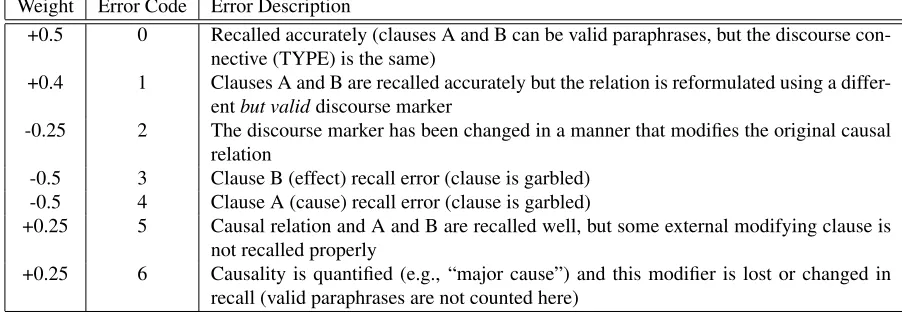
We manually coded the recalled sentences for six error types (1–6) or perfect recall (0) as shown in Table 1. Further, we scored the sentences based on our judgements of how bad each error-type was. The table also shows the weight for each error type. For any recalled sentences, only one of (0,1,5,6) is coded, i.e., these codes are mutually exclusive, but if none of the positive scores (0,1,5,6) have been coded, any combination of error types (2,3,4) can be coded for the same sentence.
4 Results
4.1 Correlation between the two methods
The correlation between the differences in accept-ability (using average z-scores for each formula-tion from the magnitude estimaformula-tion experiment) and recall scores (scored as described above) for the 32 pairs of sentences was found to be significant (Spearman’s rho=.43; p=.01). A manual inspec-tion of the data showed up one major issue regard-ing the methodologies: our participants appear to penalise perceived ungrammaticalities in short sen-tences quite harshly when rating acceptability, but they have no trouble recalling such sentences
ac-curately. For example, sentence a. in Example 2 below had an average acceptability score of 1.41, while sentence b. only scored .13, but both sentences were recalled perfectly by all participants in the re-call study:
(2) a. It is hard to imagine that it was the cause of much sadness.
b. It is hard to imagine that because of it there was much sadness.
Indeed the sentence recall test failed to discrimi-nate at all for sentences under 14 words in length. When we removed pairs with sentences under 14 words (there were eight such pairs), the correlation between the differences in magest and recall scores for the 24 remaining pairs of sentences was even stronger (Spearman’s rho=.64; p<.001).
Summary: The two methodologies give very dif-ferent results for short sentences. This is because comprehension is rarely an issue for short sentences, while surface level disfluencies are more jarring to participants in such short sentences. For longer sen-tences, the two methods correlate strongly; for such sentences, magnitude estimations of acceptability better reflect ease of comprehension. In retrospect, this suggests that the design of an appropriate load (we used two arithmetic sums) is an important con-sideration that can affect the usefulness of recall measures. One could argue that acceptability is a more useful metric for evaluating NLG as it com-bines surface level fluency judgements with ease of comprehension issues. In Siddharthan and Katsos (2010), we described how this data could be used to train an NLG component to select the most accept-able formulation of a sentence expressing a causal relation. We now enumerate other characteristics of magnitude estimation of acceptability that make them useful for evaluating sentences. Then, in Sec-tion 4.3, we discuss what further informaSec-tion can be gleaned from sentence recall studies.
4.2 Results of magnitude estimation study
Distinguishing between sentences: We found
Weight Error Code Error Description
+0.5 0 Recalled accurately (clauses A and B can be valid paraphrases, but the discourse con-nective (TYPE) is the same)
+0.4 1 Clauses A and B are recalled accurately but the relation is reformulated using a differ-entbut validdiscourse marker
-0.25 2 The discourse marker has been changed in a manner that modifies the original causal relation
-0.5 3 Clause B (effect) recall error (clause is garbled) -0.5 4 Clause A (cause) recall error (clause is garbled)
+0.25 5 Causal relation and A and B are recalled well, but some external modifying clause is not recalled properly
[image:5.612.79.530.69.227.2]+0.25 6 Causality is quantified (e.g., “major cause”) and this modifier is lost or changed in recall (valid paraphrases are not counted here)
Table 1: Weighting function for error types.
144 sentences (n=1–8). We see that the best formu-lation averages .89, the second best .57 and the worst formulation -.90. Note that it is not always the same formulation types that are deemed acceptable – if we always select the most preferred type (a caused b) for each of the 144 sentences, the average accept-ability is only .12.
n = 1 2 3 4 5 6 7 8
Av. Z = .89 .57 .33 .13 -.12 -.33 -.58 -.90
Table 2: Average acceptability for thenthbest
formula-tion of each of the 144 sentences.
Testing hypotheses: In addition to distinguishing between different formulations of a sentence, vary-ing generation choices systematically allows us to test any hypotheses we might have about their ef-fect on acceptability. Indeed, hypothesis testing was an important consideration in the design of this ex-periment. For instance, various studies (Clark and Clark, 1968; Katz and Brent, 1968; Irwin, 1980) suggest that for older school children, college stu-dents and adults, comprehension is better for the cause-effect presentation, both when the relation is implicit (no discourse marker) and explicit (with a discourse marker). We can then test specific predic-tions about which formulapredic-tions are likely to be more acceptable.
H1 We expect the cause-effect information order to be deemed more acceptable than the corre-sponding effect-cause information order.
H2 As all four discourse markers are commonly used in language, we do not expect any par-ticular marker to be globally preferred to the others.
We ran a 4 (discourse marker) x 2 (information or-der) repeated measures ANOVA. We found a main effect of information order (F1(1, 49) = 5.19, p = .017) and discourse marker (F1(3, 147) = 3.48, p = .027). Further, we found a strong interaction be-tween information order and formulation type, F1(3, 147) = 19.17, p<.001. We now discuss what these results mean.
Understanding generation decisions: The main
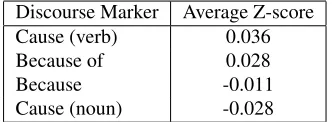
effect of discourse marker was not predicted (Hy-pothesis H2). We could try and explain this em-pirically. For instance, in the BNC “because” as a conjunction occurs 741 times per million words, while “cause” as a verb occurs 180 times per mil-lion words, “because of” 140 per milmil-lion words and “cause” as a noun 86 per million words. We might expect the more common markers to be judged more acceptable. However, there was no significant corre-lation between participants’ preference for discourse marker and the BNC corpus frequencies of the mark-ers (Spearman’s rho=0.4, p>0.75). This suggests that corpus frequencies need not be a reliable indica-tor of reader preferences, at least for discourse con-nectives. The mean z-scores for the four discourse markers are presented in Table 3
Discourse Marker Average Z-score Cause (verb) 0.036 Because of 0.028
Because -0.011
[image:6.612.103.269.66.127.2]Cause (noun) -0.028
Table 3: Av. z-scores for the four discourse markers
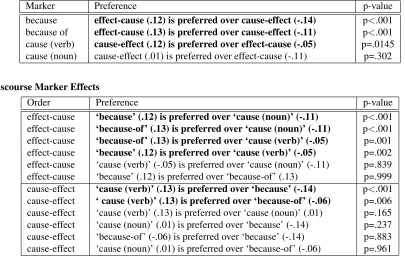
effects are listed in Table 4. There is a significant preference for using “because” and “because of” in the effect-cause order (infix) over the cause-effect order (prefix) and for using “cause” as a verb in the cause-effect order (active voice) over the effect-cause order (passive voice). Thus, hypothesis H1 is not valid for “because” and “because of”, where the canonical infix order is preferred, and though there are numerical preferences for the cause-effect order for “cause” as a noun we found support for hypothesis H1 to be significant only for “cause” as a verb. Table 4 also tells us that if the formulation is in cause-effect order, there is a preference for “cause” as a verb over “because” and “because of”. On the other hand, if the formulation is in the reverse effect-cause order, there is a preference for “beeffect-cause” or “because of” over “cause” as a verb or as a noun.
Summary: This evaluation provides us with some insights into how generation decisions interact, which can be used prescriptively to, for example, se-lect a discourse marker, given a required information order.
4.3 Results of sentence recall study
While magnitude estimation assessments of accept-ability can be used to test some hypotheses about the effect of generation decisions, it cannot really tease apart cases where there are surface level disfluencies from those that result in a breakdown in comprehen-sion. To test such hypotheses, we use the sentence recall study.
Testing hypotheses: Previous research (e.g., En-gelkamp and Rummer (2002)) suggests that recall for the second clause is worse when clauses are combined through coordination (such as “therefore” or “and”) than through subordination such as “be-cause”. The explanation is that subordination bet-ter unifies the two clauses in immediate memory. We would expect this unification to be even greater
when the cause and effect are arguments to a verb. Thus, compared to “because”, we would expect re-call of the second clause to be higher for “cause” as a verb or a noun, due to the tighter syntactic binding to the discourse marker (object of a verb). Likewise, compared to “cause”, we would expect to see more recall errors for the second clause when using “be-cause” as a conjunction. Our hypotheses are listed below:
H3 For “cause” as a verb or a noun, there will be fewer recall errors in “a” and “b” compared to “because” or “because of”, because of the tighter syntactic binding.
H4 For “because” as a conjunction, there will be more recall errors in the second clause than in the first clause; i.e., for “b because a”, clause “a” will have more recall errors than “b” and for “because ab”, clause “a” will have fewer recall errors than “b”.
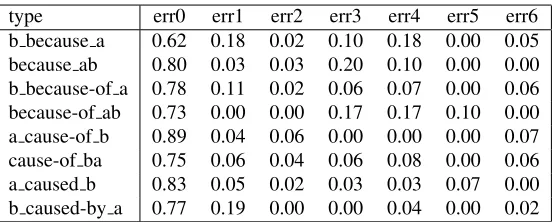
Table 5 shows the average incidence of each error type per sentences in that formulation (cf. Table 1). Note that the totals per row might add up to slightly more than 1 because multiple errors can be coded for the same sentence.
Table 5 shows that “because” and “because of” constructs result in more type 3 and 4 recall errors in clauses “a” and/or “b” compared with “cause” as either a noun or a verb. This difference is significant (z-test; p<.001), thus supporting hypothesis H3.
Further, for “because”, the recall errors for the first clause are significantly fewer than for the sec-ond clause (z-test; p<.01), thus supporting hypoth-esis H4. In contrast, for the cases with “cause” as a verb or noun, both A and B are arguments to a verb (either “cause” or a copula), and the tighter syntactic binding helps unify them in immediate memory, re-sulting in fewer recall errors that are also distributed more evenly between the first and the second argu-ment to the verb.
(a) Ordering Effects
Marker Preference p-value
because effect-cause (.12) is preferred over cause-effect (-.14) p<.001 because of effect-cause (.13) is preferred over cause-effect (-.11) p<.001 cause (verb) cause-effect (.12) is preferred over effect-cause (-.05) p=.0145 cause (noun) cause-effect (.01) is preferred over effect-cause (-.11) p=.302
(b) Discourse Marker Effects
Order Preference p-value
[image:7.612.96.501.80.341.2]effect-cause ‘because’ (.12) is preferred over ‘cause (noun)’ (-.11) p<.001 effect-cause ‘because-of’ (.13) is preferred over ‘cause (noun)’ (-.11) p<.001 effect-cause ‘because-of’ (.13) is preferred over ‘cause (verb)’ (-.05) p=.001 effect-cause ‘because’ (.12) is preferred over ‘cause (verb)’ (-.05) p=.002 effect-cause ‘cause (verb)’ (-.05) is preferred over ‘cause (noun)’ (-.11) p=.839 effect-cause ‘because’ (.12) is preferred over ‘because-of’ (.13) p=.999 cause-effect ‘cause (verb)’ (.13) is preferred over ‘because’ (-.14) p<.001 cause-effect ‘ cause (verb)’ (.13) is preferred over ‘because-of’ (-.06) p=.006 cause-effect ‘cause (verb)’ (.13) is preferred over ‘cause (noun)’ (.01) p=.165 cause-effect ‘cause (noun)’ (.01) is preferred over ‘because’ (-.14) p=.237 cause-effect ‘because-of’ (-.06) is preferred over ‘because’ (-.14) p=.883 cause-effect ‘cause (noun)’ (.01) is preferred over ‘because-of’ (-.06) p=.961
Table 4: Interaction effects between information order and discourse marker (mean z-scores in parentheses; significant effects in bold face).
reasonable conclusion, given that all our participants are university students.
Summary: Overall we conclude that sentence re-call studies provide insights into the nature of the comprehension problems encountered, and they cor-roborate acceptability ratings in general, and partic-ularly so for longer sentences.
5 Conclusions
In this paper, we have tried to separate out surface form aspects of acceptability from breakdowns in comprehension, using two offline psycholinguistic methods.
We believe that sentence recall methodologies can substitute for task based evaluations and highlight breakdowns in comprehension at the sentence level. However, like most task based evaluations, recall ex-periments are time consuming as they need to be conducted in a supervised setting. Additionally, they require manual annotation of error types, though perhaps this could be automated.
Acceptability ratings on the other hand are easy to acquire. Based on our experiments, we believe that
acceptability ratings are reliable indicators of com-prehension for longer sentences and, particularly for shorter sentences, combine surface form judgements with ease of comprehension in a manner that is very relevant for evaluating sentence generation or regen-eration, including simplification.
Both methods are considerably easier to set up and interpret than online methods such as self paced reading, eye tracking or neurophysiological meth-ods.
Acknowledgements
This work was supported by the Economic and So-cial Research Council (Grant Number RES-000-22-3272).
References
E.G. Bard, D. Robertson, and A. Sorace. 1996. Magni-tude estimation for linguistic acceptability. Language, 72(1):32–68.
type err0 err1 err2 err3 err4 err5 err6 b because a 0.62 0.18 0.02 0.10 0.18 0.00 0.05 because ab 0.80 0.03 0.03 0.20 0.10 0.00 0.00 b because-of a 0.78 0.11 0.02 0.06 0.07 0.00 0.06 because-of ab 0.73 0.00 0.00 0.17 0.17 0.10 0.00 a cause-of b 0.89 0.04 0.06 0.00 0.00 0.00 0.07 cause-of ba 0.75 0.06 0.04 0.06 0.08 0.00 0.06 a caused b 0.83 0.05 0.02 0.03 0.03 0.07 0.00 b caused-by a 0.77 0.19 0.00 0.00 0.04 0.00 0.02
Table 5: Table of recall errors per type.
W. Cowart. 1997. Experimental Syntax: applying objec-tive methods to sentence judgement. Thousand Oaks, CA: Sage Publications.
A.T. Duchowski. 2007. Eye tracking methodology: The-ory and practice. Springer-Verlag New York Inc. J. Engelkamp and R. Rummer. 2002.
Subordinat-ing conjunctions as devices for unifySubordinat-ing sentences in memory. European Journal of Cognitive Psychology, 14(3):353–369.
Rudolf Flesch. 1951. How to test readability. Harper and Brothers, New York.
A.D. Friederici. 1995. The time course of syntactic ac-tivation during language processing: A model based on neuropsychological and neurophysiological data. Brain and language, 50(3):259–281.
A. Gatt, A. Belz, and E. Kow. 2009. The tuna-reg chal-lenge 2009: Overview and evaluation results. In Pro-ceedings of the 12th European workshop on natural language generation, pages 174–182. Association for Computational Linguistics.
J.W. Irwin. 1980. The effects of explicitness and clause order on the comprehension of reversible causal re-lationships. Reading Research Quarterly, 15(4):477– 488.
E.W. Katz and S.B. Brent. 1968. Understanding connec-tives. Journal of Verbal Learning & Verbal Behavior. F. Keller, S. Gunasekharan, N. Mayo, and M. Corley.
2009. Timing accuracy of web experiments: A case study using the WebExp software package. Behavior Research Methods, 41(1):1.
Frank Keller. 2000.Gradience in Grammar: Experimen-tal and Computational Aspects of Degrees of Gram-maticality. Ph.D. thesis, University of Edinburgh. I. Langkilde-Geary. 2002. An empirical verification of
coverage and correctness for a general-purpose sen-tence generator. In Proceedings of the 12th Interna-tional Natural Language Generation Workshop, pages 17–24. Citeseer.
R. Likert. 1932. A technique for the measurement of attitudes. Archives of psychology.
L. Lombardi and M.C. Potter. 1992. The regeneration of syntax in short term memory* 1. Journal of Memory and Language, 31(6):713–733.
E. Pitler, A. Louis, and A. Nenkova. 2010. Automatic evaluation of linguistic quality in multi-document summarization. In Proceedings of the 48th Annual Meeting of the Association for Computational Linguis-tics, pages 544–554. Association for Computational Linguistics.
M.C. Potter and L. Lombardi. 1990. Regeneration in the short-term recall of sentences* 1. Journal of Memory and Language, 29(6):633–654.
Advaith Siddharthan and Napoleon Katsos. 2010. Refor-mulating discourse connectives for non-expert readers. In Proceedings of the 11th Annual Conference of the North American Chapter of the Association for Com-putational Linguistics (NAACL-HLT 2010), Los Ange-les, CA.
A. Siddharthan, A. Nenkova, and K. McKeown. 2011. Information status distinctions and referring expres-sions: An empirical study of references to peo-ple in news summaries. Computational Linguistics, 37(4):811–842.
Advaith Siddharthan. 2006. Syntactic simplification and text cohesion. Research on Language and Computa-tion, 4(1):77–109.
S. Sripada, E. Reiter, and I. Davy. 2003. SumTime-Mousam: Configurable marine weather forecast gen-erator.Expert Update, 6(3):4–10.
W.L. Taylor. 1953. ” cloze procedure”: a new tool for measuring readability. Journalism Quarterly; Jour-nalism Quarterly.
Jette Viethen and Robert Dale. 2006. Algorithms for generating referring expressions: do they do what peo-ple do? In Proceedings of the Fourth International Natural Language Generation Conference, pages 63– 70.