Adaptive Chinese Word Segmentation with
Online Passive-Aggressive Algorithm
Wenjun Gao
School of Computer Science Fudan University
Shanghai, China [email protected]
Xipeng Qiu
School of Computer Science Fudan University
Shanghai, China [email protected]
Xuanjing Huang School of Computer Science
Fudan University Shanghai, China [email protected]
Abstract
In this paper, we describe our system1 for CIPS-SIGHAN-2010 bake-off task of Chinese word segmentation, which fo-cused on the cross-domain performance of Chinese word segmentation algorithms. We use the online passive-aggressive al-gorithm with domain invariant informa-tion for cross-domain Chinese word seg-mentation.
1 Introduction
In recent years, Chinese word segmentation (CWS) has undergone great development (Xue, 2003; Peng et al., 2004). The popular method is to regard word segmentation as a sequence label-ing problems. The goal of sequence labellabel-ing is to assign labels to all elements of a sequence.
Due to the exponential size of the output space, sequence labeling problems tend to be more challenging than the conventional classifi-cation problems. Many algorithms have been proposed and the progress has been encourag-ing, such as SVMstruct (Tsochantaridis et al., 2004), conditional random fields (CRF) (Lafferty et al., 2001), maximum margin Markov networks (M3N) (Taskar et al., 2003) and so on. After years of intensive researches, Chinese word segmenta-tion achieves a quite high precision. However, the performance of segmentation is not so satisfying for out-of-domain text.
There are two domains in domain adaption problem, a source domain and a target domain. When we use the machine learning methods for
1
Available at http://code.google.com/p/ fudannlp/
Chinese word segmentation, we assume that train-ing and test data are drawn from the same distri-bution. This assumption underlies both theoreti-cal analysis and experimental evaluations of learn-ing algorithms. However, the assumption does not hold for domain adaptation(Ben-David et al., 2007; Blitzer et al., 2006). The challenge is the difference of distribution between the source and target domains.
In this paper, we use online margin max-imization algorithm and domain invariant fea-tures for domain adaptive CWS. The online learn-ing algorithm is Passive-Aggressive (PA) algo-rithm(Crammer et al., 2006), which passively ac-cepts a solution whose loss is zero, while it ag-gressively forces the new prototype vector to stay as close as possible to the one previously learned. The rest of the paper is organized as follows. Section 2 introduces the related works. Then we describe our algorithm in section 3 and 4. The feature templates are described in section 5. Sec-tion 6 gives the experimental analysis. SecSec-tion 7 concludes the paper.
2 Related Works
There are several approaches to deal with the do-main adaption problem.
The first approach is to use semi-supervised learning (Zhu, 2005).
The second approach is to incorporate super-vised learning with domain invariant information. The third approach is to improve the present model with a few labeled domain data.
intrinsic geometry of inputs revealed by unlabeled data points and we derive a maximum-margin for-mulation of semi-supervised learning for struc-tured variables.
Self-training (Zhu, 2005) is also a popular tech-nology. In self-training a classifier is first trained with the small amount of labeled data. The clas-sifier is then used to classify the unlabeled data. Typically the most confident unlabeled points, to-gether with their predicted labels, are added to the training set. The classifier is re-trained and the procedure repeated. Note the classifier uses its own predictions to teach itself. Yarowsky (1995) uses self-training for word sense disambiguation, e.g. deciding whether the word plant means a liv-ing organism or a factory in a given context.
Zhao and Kit (2008) integrated unsupervised segmentation and CRF learning for Chinese word segmentation and named entity recognition. They found word accessory variance (Feng et al., 2004) is useful to CWS.
3 Online Passive-Aggressive Algorithm Sequence labeling, the task of assigning labels y = y1, . . . , yL to an input sequence x = x1, . . . , xL.
Give a sample (x,y), we define the feature is
Φ(x,y). Thus, we can labelxwith a score func-tion,
ˆ
y= arg max
z F(w,Φ(x,z)), (1)
wherewis the parameter of functionF(·). The score function of our algorithm is linear function.
Given an example (x,y), yˆ is denoted as the incorrect label with the highest score,
ˆ
y= arg max z̸=y w
TΦ(x,z). (2)
Themarginγ(w; (x,y))is defined as
γ(w; (x,y)) =wTΦ(x,y)−wTΦ(x,yˆ). (3)
Thus, we calculate thehinge loss.
ℓ(w; (x,y) =
{
0, γ(w; (x,y))>1 1−γ(w; (x,y)), otherwise
(4)
We use the online PA learning algorithm to learn the weights of features. In roundt, we find new weight vectorwt+1by
wt+1= arg min w∈Rn
1
2||w−wt||
2+C ·ξ,
s.t.ℓ(w; (xt,yt))<=ξandξ >= 0 (5)
where C is a positive parameter which controls the influence of the slack term on the objective function.
The algorithms goal is to achieve a margin at least 1 as often as possible, thus the Hamming loss is also reduced indirectly. On rounds where the algorithm attains a margin less than 1 it suffers an instantaneous loss.
We abbreviate ℓ(wt; (x, y)) to ℓt. If ℓt = 0
then wt itself satisfies the constraint in Eq. (5) and is clearly the optimal solution. We therefore concentrate on the case whereℓt>0.
First, we define the Lagrangian of the optimiza-tion problem in Eq. (5) to be
L(w, ξ, α, β) = 1
2||w−wt||
2+C ·ξ
+α(ℓt−ξ)−βξ
s.t.α >= 0, β >= 0. (6)
whereα, βis a Lagrange multiplier.
Setting the partial derivatives ofLwith respect to the elements ofξto zero gives
α+β =C. (7)
The gradient ofwshould be zero,
w −wt −α(Φ(x,y) −Φ(x,yˆ)) = 0, (8)
we get
w = wt + α(Φ(x,y) − Φ(x,yˆ)). (9)
Substitute Eq. (7) and Eq. (9) to dual objective function Eq. (6), we get
L(α) =−1
2||α(Φ(x,y)−Φ(x,yˆ))|| 2
Differentiate withα, and set it to zero, we get
α||Φ(x,y)−Φ(x,yˆ)||2
+wtT (Φ(x,y)−Φ(x,yˆ))−1 = 0. (11)
So,
¯
α = 1−wt
T (Φ(x,y)−Φ(x,yˆ))
||Φ(x,y)−Φ(x,yˆ)||2 . (12)
Fromα+β =C, we know thatα <C, so
¯
α∗ = min(C,α¯). (13)
Finally, we get update strategy,
wt+1=wt+ ¯α∗(Φ(x,y)−Φ(x,yˆ)). (14)
Our final algorithm is shown in Algorithm 1. In order to avoiding overfitting, the averaging tech-nology is employed.
input : training data set:
(xn,yn), n= 1,· · ·, N, and parameters:C, K
output:w
Initialize:cw←0,;
fork= 0· · ·K−1do
w0 ←0;
fort= 0· · ·T−1do
receive an example(xt,yt); predict:
ˆ
yt= arg max
z̸=yt
⟨wt,Φ(xt,z)⟩;
calculateℓ(w; (x,y)); updatewt+1with Eq.(14); end
cw=cw+wT ;
end
w=cw/K;
Algorithm 1: Labelwise Margin Maxi-mization Algorithm
4 Inference
The PA algorithm is used to learn the weights of features in training procedure. In inference pro-cedure, we use Viterbi algorithm to calculate the maximum score label.
Letω(n) be the best score of the partial label sequence ending withyn. The idea of the Viterbi algorithm is to use dynamic programming to com-puteω(n):
ω(n) = max
n−1 (
ω(n−1) +wTϕ(x, yn, yn−1) )
(15)
+wtϕ(x, yn)
Using this recursive definition, we can evalu-ateω(N)for allyN, whereN is the input length. This results in the identification of the best label sequence.
The computational cost of the Viterbi algorithm isO(N L2), whereLis the number of labels.
5 Feature Templates
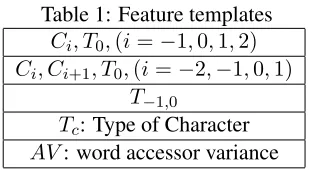
All feature templates used in this paper are shown in Table 1.Crepresents a Chinese character while the subscript ofCindicates its position in the sen-tence relative to the current character, whose sub-script is0. T represents the character-based tag: “B”, “B2”, “B3”, “M”, “E” and “S”, which repre-sent the beginning, second, third, middle, end or single character of a word respectively.
The type of character includes: digital, letter, punctuation and other.
We also use the word accessor variance for do-main adaption. Word accessor variance (AV) was proposed by (Feng et al., 2004) and was used to evaluate how independently a string is used, and thus how likely it is that the string can be a word. The accessor variety of a stringsof more than one character is defined as
AV(s) = min{Lav(s), Rav(s)} (16)
Table 1: Feature templates Ci, T0,(i=−1,0,1,2)
Ci, Ci+1, T0,(i=−2,−1,0,1)
T−1,0
Tc: Type of Character AV: word accessor variance
6 CIPS-SIGHAN-2010 Bakeoff
CIPS-SIGHAN-2010 bake-off task of Chinese word segmentation focused on the cross-domain performance of Chinese word segmentation algo-rithms. There are two subtasks for this evaluation: (1) Word Segmentation for Simplified Chinese Text;
(2) Word Segmentation for Traditional Chinese Text.
The test corpus of each subtask covers four do-mains: literature, computer science, medicine and finance.
We participate in closed training evaluation of both subtasks.
Firstly, we calculate the word accessor variance AVL(s)of the continuous string s from labeled corpus. Here, we set the largest length of string sto be4.
Secondly, we train our model with feature tem-ples andAVL(s).
Thirdly, when we process the different domain unlabeled corpus, we recalculate the word ac-cessory varianceAVU(s)from the corresponding corpus.
Fourthly, we segment the domain corpus with new word accessory varianceAVU(s) instead of AVL(s).
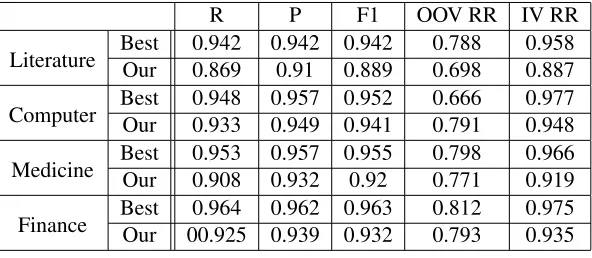
The results are shown in Table 2 and 3. The results show our method has a poor performance in OOV ( Out-Of-Vocabulary) word.
The running environment is shown in Table 4.
Table 4: Experimental environment
OS Win 2003
CPU Intel Xeon 2.0G
Memory 4G
We set the max iterative number is20. Our run-ning time is shown in Table 5. “s” represents
sec-ond, “chars” is the number of Chinese character, and “MB” is the megabyte. In practice, we found the system can achieve the same performance af-ter7loops. Therefore, we just need less half the time in Table 5 actually.
7 Conclusion
In this paper, we describe our system in CIPS-SIGHAN-2010 bake-off task of Chinese word segmentation. Although our method just achieve a consequence of being average and not outstand-ing, it has an advantage of faster training than other batch learning algorithm, such as CRF and M3N.
In the future, we wish to improve our method in the following aspects. Firstly, we will investi-gate more effective domain invariant feature rep-resentation. Secondly, we will integrate our algo-rithm with self-training and other semi-supervised learning methods.
Acknowledgments
This work was (partially) funded by 863 Pro-gram (No. 2009AA01A346), 973 ProPro-gram (No. 2010CB327906), and Shanghai Science and Tech-nology Development Funds (No. 08511500302).
References
Altun, Y., D. McAllester, and M. Belkin. 2006. Max-imum margin semi-supervised learning for
struc-tured variables. Advances in neural information
processing systems, 18:33.
Ben-David, S., J. Blitzer, K. Crammer, and F. Pereira. 2007. Analysis of representations for domain
adap-tation. Advances in Neural Information Processing
Systems, 19:137.
Blitzer, J., R. McDonald, and F. Pereira. 2006.
Domain adaptation with structural correspondence
learning. InProceedings of the 2006 Conference on
Empirical Methods in Natural Language
Process-ing, pages 120–128. Association for Computational
Linguistics.
Crammer, Koby, Ofer Dekel, Joseph Keshet, Shai Shalev-Shwartz, and Yoram Singer. 2006. Online
passive-aggressive algorithms. Journal of Machine
[image:4.612.106.257.633.687.2]Table 2: Evaluation results on simplified corpus
R P F1 OOV RR IV RR
Best 0.945 0.946 0.946 0.816 0.954 Literature Our 0.915 0.925 0.92 0.577 0.94
Best 0.953 0.95 0.951 0.827 0.975 Computer Our 0.934 0.919 0.926 0.739 0.969
Best 0.942 0.936 0.939 0.75 0.965 Medicine Our 0.927 0.924 0.925 0.714 0.953
[image:5.612.149.445.248.377.2]Best 0.959 0.96 0.959 0.827 0.972 Finance Our 0.94 0.942 0.941 0.719 0.961
Table 3: Evaluation results on traditional corpus
R P F1 OOV RR IV RR
Best 0.942 0.942 0.942 0.788 0.958 Literature Our 0.869 0.91 0.889 0.698 0.887
Best 0.948 0.957 0.952 0.666 0.977 Computer Our 0.933 0.949 0.941 0.791 0.948
Best 0.953 0.957 0.955 0.798 0.966 Medicine Our 0.908 0.932 0.92 0.771 0.919
Best 0.964 0.962 0.963 0.812 0.975 Finance Our 00.925 0.939 0.932 0.793 0.935
Table 5: Execution time of training and test phase.
Task A B C D
Training Simp 817.2s 795.6s 774.0s 792.0s Trad 903.6s 889.2s 885.6s 874.8s Test 20327 chars/s, or 17.97 s/MB
Feng, H., K. Chen, X. Deng, and W. Zheng. 2004. Ac-cessor variety criteria for chinese word extraction.
Computational Linguistics, 30(1):75–93.
Lafferty, John D., Andrew McCallum, and Fernando C. N. Pereira. 2001. Conditional random fields: Probabilistic models for segmenting and labeling
sequence data. In ICML ’01: Proceedings of the
Eighteenth International Conference on Machine Learning.
Peng, F., F. Feng, and A. McCallum. 2004. Chinese segmentation and new word detection using condi-tional random fields. Proceedings of the 20th inter-national conference on Computational Linguistics.
Taskar, Ben, Carlos Guestrin, and Daphne Koller.
2003. Max-margin markov networks. In
Proceed-ings of Neural Information Processing Systems.
Tsochantaridis, I., T. Hofmann, T. Joachims, and Y Al-tun. 2004. Support vector machine learning for
in-terdependent and structured output spaces. In
Pro-ceedings of the International Conference on Ma-chine Learning(ICML).
Xue, N. 2003. Chinese word segmentation as
charac-ter tagging.Computational Linguistics and Chinese
Language Processing, 8(1):29–48.
Yarowsky, D. 1995. Unsupervised word sense
disam-biguation rivaling supervised methods. In
Proceed-ings of the 33rd annual meeting on Association for Computational Linguistics, pages 189–196. Associ-ation for ComputAssoci-ational Linguistics.
Zhao, H. and C. Kit. 2008. Unsupervised segmenta-tion helps supervised learning of character tagging for word segmentation and named entity
recogni-tion. InThe Sixth SIGHAN Workshop on Chinese
Language Processing, pages 106–111. Citeseer.
Zhu, Xiaojin. 2005. Semi-supervised learning
literature survey. Technical Report 1530,