Improving Chinese Word Segmentation and POS Tagging
with Semi-supervised Methods Using Large Auto-Analyzed Data
Yiou Wang†, Jun’ichi Kazama†, Yoshimasa Tsuruoka‡†, Wenliang Chen§†, Yujie Zhang∗†, Kentaro Torisawa†
†National Institute of Information and Communications Technology (NICT), Japan ‡School of Information Science, JAIST, Japan;∗Beijing Jiaotong University, China
§Human Language Technology, Institute for Infocomm Research, Singapore
{wangyiou, kazama, torisawa}@nict.go.jp; [email protected] [email protected];[email protected]
Abstract
This paper presents a simple yet effective semi-supervised method to improve Chi-nese word segmentation and POS tagging. We introduce novel features derived from large auto-analyzed data to enhance a sim-ple pipelined system. The auto-analyzed data are generated from unlabeled data by using a baseline system. We evaluate the usefulness of our approach in a series of experiments on Penn Chinese Treebanks and show that the new features provide substantial performance gains in all exper-iments. Furthermore, the results of our proposed method are superior to the best reported results in the literature.
1 Introduction
In Chinese, most language processing starts from word segmentation and part-of-speech (POS) tag-ging. These two steps tokenize a sequence of char-acters without delimiters into words and predict a syntactic label (POS tag) for each segmented word. They are considered indispensable steps for higher-level NLP tasks such as parsing and infor-mation extraction. Although the performance of Chinese word segmentation and POS tagging has been greatly improved over the past years, the task is still challenging.
To improve the accuracy of NLP systems, one of the current trends is semi-supervised learning, which utilizes large unlabeled data in supervised learning. Several studies have demonstrated that the use of unlabeled data can improve the perfor-mance of NLP tasks, such as text chunking (Ando and Zhang, 2005), POS tagging and named entity recognition (Suzuki and Isozaki, 2008), and pars-ing (Suzuki et al., 2009; Chen et al., 2009; Koo et al., 2008). Therefore, it is attractive to con-sider adopting semi-supervised learning in Chi-nese word segmentation and POS tagging tasks.
In this paper, we present an approach to improve the performance of both segmentation and POS tagging by incorporating large unlabeled data. We first preprocess unlabeled data with our baseline models. We then extract various items of dictio-nary information from the auto-analyzed data. Fi-nally, we generate new features that incorporate the extracted information for both word segmenta-tion and POS tagging. We also perform word clus-tering on the auto-segmented data and use word clusters as features in POS tagging. In addition, we introduce lexicon features by using a cross-validation technique.
The use of sub-structures from the auto-annotated data has been presented previously (No-ord, 2007; Chen et al., 2008; Chen et al., 2009). Chen et al. (2009) extracted different types of sub-trees from the auto-parsed data and used them as new features in standard learning methods. They showed this simple method greatly improves the accuracy of dependency parsing. The idea of combining word clusters with discriminative learning has been previously reported in the con-text of named entity recognition (Miller et al., 2004; Kazama and Torisawa, 2008) and depen-dency parsing (Koo et al., 2008). We adapt and extend these techniques to Chinese word segmen-tation and POS tagging, and demonstrate their ef-fectiveness in this task.
One of our criteria in this study was to achieve high accuracy with simple and easy-to-implement techniques. To meet this, the whole system is a pipeline with a character-based CRF for word seg-mentation and a word-based CRF for POS tag-ging. The information of unlabeled data is incor-porated as additional new features without chang-ing the learnchang-ing algorithm.
To demonstrate the effectiveness of our ap-proach, we conduct segmentation and POS tag-ging experiments on three versions of Penn Chi-nese Treebank, including the newly released CTB
Word Length 1 2 3 4 5 6 7 or more
Tags S BE BB2E BB2B3E BB2B3M E BB2B3M M E BB2B3M...M E
Table 1: Word representation with a 6-tag tagset :S, B, B2, B3, M, E
Type Feature Description
Character Unigram c−1,c0,c1 Previous, current and next character
Nearing Character Bigram (c−1c0), (c0c1) Previous (next) character and current character Jump Character Bigram c−1c1 Previous character and next character
Punctuation IsPu(c0) Current character is punctuation
Character Type K(c−2)K(c−1)K(c0)K(c1)K(c2) Types of character: date, numeral, alphabet, Chinese
Table 2: Feature templates for word segmentation
version 7.0. We show that our semi-supervised ap-proach yields improvements for all the test collec-tions and achieves better results than the best re-ported results in the literature.
2 Segmentation and POS tagging Models We implement our approach using sequential tag-ging models. Following the previous work (Zhao et al., 2006; Zhao et al., 2010), we employ the linear chain CRFs (Lafferty et al., 2001) as our learning model. Specifically, we use its CRF++ (version 0.54) implementation by Taku Kudo.1
2.1 Baseline Segmentation Model
We employ character-based sequence labeling for word segmentation. In addition to its simplicity, the advantage of a character-based model is its robustness to the unknown word problem (Xue, 2003). In a character-based Chinese word seg-mentation task, a character in a given sequence is labeled by a tag that stands for its position in the word that the character belongs to. Zhao et al. (2006) reported that a 6-tag tagset shown in Ta-ble 1 is the best choice among the tagsets tested for Chinese word segmentation under the CRF frame-work. Therefore we also use this 6-tag tagset.
The basic types of features of our word segmen-tation model are listed in Table 2. These basic feature templates are based on Zhao et al. (2006; 2010) and Low et al. (2005).
2.2 Baseline POS Tagging Model
Since we employ a pipelined method, the POS tag-ging can be performed as a word labeling task, where the input is a sequence of segmented words. We use a CRF here as well. The feature set of our baseline POS tagger, is listed in Table 3. These are adopted from Wu et al. (2008).
1Available from http://crfpp.sourceforge.net/
3 Our New Features
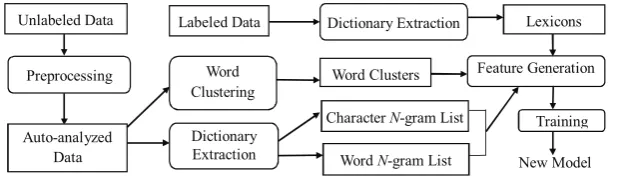
In this section, we describe our approach of ef-fectively integrating useful information from un-labeled (and un-labeled) data into the above baseline models through features. We preprocess unlabeled data with our baseline models and obtain word-segmented sentences with POS tags, and gener-ate new features from the auto-analyzed data. Al-though the focus of the paper is semi-supervised learning, we also extract a lexicon from the train-ing corpus and use it to generate features. Figure 1 shows an overview of our approach. The rest of this section describes our features in detail.
3.1 New features for Word Segmentation 3.1.1 Semi-supervisedn-gram features
In this section, we describe our approach of ex-tracting character-level n-gram lists and generat-ingn-gram features from unlabeled data. We fol-lowed the method of Chen et al. (2009), and mod-ified the method for word segmentation and POS tagging. First, we preprocess unlabeled data using the baseline segmenter and obtain auto-segmented data. We then extract charactern-gram lists from auto-segmented sentences. Finally, we generaten -gram features for word segmentation.
By using the baseline segmenter, each character
ci in the unlabeled data is labeled with a tag ti.
In other words, the output of auto-segmentation is a sequence {(ci, ti)}Li=1. Let g be a charac-tern-gram (e.g., uni-gramci, bi-gramcici+1,
tri-gram ci−1cici+1 and so on)2, and seg be a seg-mentation profile for n-gram g observed at each
position. The segmentation profile can be tag
ti or the combination of tags. Take a bi-gram
for example, seg may be ti or titi+1. Then,
2Note that there are several alternative ways for extracting
n-grams at positioni, for exampleci−1ci for a bi-gram. In
Feature Type Context Position Description Word Unigram w−2,w−1,w0,w1,w2 Word unigram Nearing Word Bigram (w−2w−1),(w−1w0),(w1w0),(w1w2) Word bigram
Jump Word Bigram (w−1,w1) Previous word and next word
First Character F c(w0) First character of current word
Last Character Lc(w0) Last character of current word
Length Len(w0) Length of current word
Table 3: Feature templates for POS tagging
Unlabeled Data
Preprocessing
Auto-analyzed Data
Dictionary Extraction
Character N-gram List
Word N-gram List Word
Clustering
Word Clusters Feature Generation
Training
New Model Dictionary Extraction
Labeled Data Lexicons
Figure 1: Overview of the proposed approach
we can extract a list of{(g, seg, f(g, seg))}from the auto-segmented data. Here, f(g, seg) is the
frequency of the cases where n-gram g is
seg-mented with the segmentation profileseg. Then,
following Chen et al. (2009), we group entries in this list into three sets: high-frequency (HF), middle-frequency (MF), and low-frequency (LF). The sets are defined as follows: if(g, seg)is one
of the top 5% most frequent entries, it is labeled as HF; if it is between top 5% and 20%, it is la-beled as MF, otherwise it is lala-beled as LF. Fi-nally the list can be transformed as a n-gram list
Lng = {(g, seg, F L(g, seg))}, with F L(g, seg)
being the frequency label determined as above. We attempted to encode the information of the above n-gram list into a new type of features, called n-gram features. We tried several feature representations and generation methods and found that the feature derived from the bi-gram list with
seg=ti was most effective.
We generate the feature for the current character
c0as follows. We retrieve a set of entries, whoseg part matches the bi-gramc0c1, fromLng. Let this
set be Lm. From an entry inLm, we generate a
feature string represented by (a)seg−F L(g, seg)
Then, we concatenate the feature strings of all the entries inLmas onen-gram feature. If there is
no entry inLm, the feature representation is "ND".
For example, consider that Lm is {
(幸(Xing)/福(Fu), B, HF), (幸(Xing)/福(Fu), B2, MF), (幸(Xing)/福(Fu), E, LF)} and we are processing ckck+1 = "幸(Xing)/福(Fu)";
conse-quently, then-gram feature ofckis represented as
"B-HF|B2-MF|E-LF". Note that the concatena-tion is in lexicographic order of the feature strings for standardization.
3.1.2 Lexicon features
Although a character-based model is simple and robust to unknown words, a limitation is its in-ability to consider word-level information. If a se-quence of characters matches a word in an existing dictionary, it may be a clue that the character se-quence should be segmented as one word. Several studies showed that using a dictionary brings im-provement for Chinese word segmentation (Low et al., 2005; Zhao et al., 2010). For a corpus-based word segmenter, a manually annotated corpus is essential. Thus we can easily compile a lexicon from a training corpus. We refer to the features related to this lexicon as lexicon features.
of cross-validation.
• Divide the training corpus into ten
equal-sized sets, as in the data preparation for 10-fold cross-validation.
• For each set, we compile a lexicon using the
remaining nine sets and use this lexicon to generate features for this set.
• For the development and test sets, we collect a lexicon using the entire training corpus and use it for feature generation.
Because the lexicon is extracted from other sets, the weights for this feature will not be overesti-mated by the learning algorithm. This kind of cross-validation-like techniques are used in stud-ies such as Collins (2002) and Martins et al. (2008) to avoid over-fitting to the training data. Our method can be considered as its application to lex-icon extraction.
Using the extracted lexicon, we generate lexi-con features as follows. If a character sequence starting with character c0 matches some words in the lexicon, we greedily choose the longest such matching word w. Letting LEN(w) be
the length (the number of characters) of w, we
add the following feature for each characterck in
c0, c1, ..., cLEN(w):
(b)P(ck)/LEN(w)-P OSs(w)
Here, P(ck) is the position number (i.e.,k) of
the characterckinwandP OSs(w)represents the
POS tags of w in the lexicon. After generating these features, we increment the current position by LEN(w). If there is no matching word, we
proceed to the next character. That is, the forward maximum matching is used.
For example, consider that the current character sequence c0c1= "幸(Xing)/福(Fu)" was matched with a lexicon entry (幸福(XingFu), JJ-NN-VA), the feature for c0 "幸(Xing)" is "1/2-JJ-NN-VA" and the feature forc1"福(Fu)" is "2/2-JJ-NN-VA". Several feature representations have been at-tempted: (i) using only position information, (ii) representing the position information in a 6-tag or 4-tag tagset, or (iii) representing only one POS tag with the highest frequency. Development exper-iments showed that the current encoding is more effective than others in word segmentation tasks.
Note that our lexicon feature uses POS tag in-formation for word segmentation. The fact that this feature is very effective as reported in Section
4.3 is interesting, since this can be considered as "loose" information feedback from the later pro-cess. Although we need a POS tagged corpus even for segmentation, this will not be a big problem since we usually perform POS tagging as well in many applications.
3.2 New Features for POS Tagging
We generaten-gram and lexicon features for POS tagging as well. In addition, the features that in-corporate word clusters derived from a large auto-analyzed corpus (referred to as cluster features) are introduced.
3.2.1 Semi-supervisedn-gram features
We preprocess auto-segmented data using the baseline POS tagger and can generate word-level n-gram listsLwg ={w, pos, F L(w, pos)}. Here,
w is a word n-gram and pos is the POS tagging
profile of the word n-gram. Different from seg-mentation, features generated from the word uni-gram list yielded the best results.
A feature of this type for the current wordw0 is generated as follows. We retrieve a set of en-tries, whosewpart matches the uni-gramw0, from Lwg. Let this set be Lm. In the error analysis,
we found that some words were associated with several odd POS tags in the uni-gram list. For in-stance, in addition to (研究(YanJiu), NN, HF) and (研究(YanJiu), VV, HF), (研究(YanJiu), VA, LF) and (研究(YanJiu), CD, LF) may appear as entries in the word unigram list, due to mis-tagging by the baseline POS-tagger. Therefore we further impose a restriction based on the frequency as follows: if the number of entries with aHF label≥ thresh-old, only the entries withHF will be selected, and
if the sum of entries with aHF orM F label ≥
threshold, the entries with eitherHF orM F will
be selected, otherwise, all of the entries inLmwill
be selected. Here the threshold is set to 2 based on the development experiments. Let these selected entries beLs. From an entry inLs, we generate a
feature string represented by (c)pos−F L(w, pos).
Then, we concatenate the feature strings of all entries in Ls as one n-gram feature. As for the
previous instance, the feature for "研究(YanJiu)" is encoded as "N N-HF|V V-HF".
3.2.2 Semi-supervised cluster features
Data set CTB chapter IDs
Dev 41-80,203-233,301-325,400-409,591,613-617,643-673,1022-1035,1120-1129,2110-2159,2270- 2294,2510-2569,2760-2799,3040-3109,4040-4059,4084-4085,4090,4096,4106-4108,4113-4115,4121,4128,4132,4135,4158-4162,4169,4189,4196,4236-4261,4322,4335-4336,4407-4411
Test 1-40,144-174,271-300,410-428,592,900-931,1009-1020,1036,1044,1060-1061,1072,1118-1119,1132,1141-
1142,1148,2000-2010,2160-2220,2295-2330,2570-2640,2800-2845,3110-3145,4030-4039,4060- 4070,4086-4087,4091,4097,4109-4112,4118-4120,4127,4133-4134,4136-4139,4163-4168,4188,4197-4235,4321,4334,4337,4400-4406
Table 4: Dev-set and test-set of CTB7 data split
Total Dev-LDC Test-LDC Dev Test
NS 107,14 561 981 2,084 2,028
NM 8,420 682 917 1,618 1,646
BN 10,079 836 898 2,067 2,038
BC 12,049 0 0 2,367 2,382
NW 10,181 0 0 2,000 2,086
Table 5: Statistics of each genre of CTB7 split (Dev(Test)-LDC are sets of LDC split)
by using the prefixes of the Brown cluster hierar-chy at various lengths3. After experimenting with
many different feature configurations, we eventu-ally settled on the following features:
(d) full string prefixes forw−1,w0,w1 6-bit string prefixes forw−1,w0,w1
The clusters are best exploited when "anchored" to words or parts of speech (Koo et al., 2008). We found it useful to make the above features in Bi-gram template, in CRF++ with the first charac-ter "B". With this template, a combination of the current output tag and the previous output tag (bi-gram) is automatically generated. In this case, the combination of the current POS tag and the previ-ous POS tag output is automatically generated.
3.2.3 Lexicon features
We use the same lexicon extracted for word seg-mentation for POS tagging. We add the following feature for the current wordw0:
(e)P OSs(w0)
Here, P OSs(w0) are all possible POS tags of
the current wordw0 in the lexicon. We also tried to use different lexicons, as well as representing the feature with only one POS tag with the high-est frequency. However, the experimental results were not better than those by using the above sim-ple method.
3We used the word clustering tool, available from
http://www.cs.berkeley.edu/˜pliang/software/brown-cluster-1.2.zip, to produce word clusters.
4 Experiments
We conducted word segmentation and POS tag-ging experiments on Penn Chinese Treebanks incorporating up to 200-million-word unlabeled data.
4.1 Data Set
To compare with previous studies, we selected the widely used CTB5 (LDC2005T01), and defined the training, development and test sets according to Kruengkrai (2009a). In order to increase the reliability of our findings, we also used CTB6 (LDC2007T36) and CTB7 (LDC2010T07), which are larger than CTB5. For CTB6, we used the same data split as recommended in the CTB6 doc-ument4. Because CTB7 includes data from
var-ious sources and varvar-ious genres, we made a new data split according to the following criteria:
• Put the test set and the development set data described in CTB7 documents5into each data set. • Put the test set and the development set data of CTB5 into each set.
•Put all double checked files into the test-set.6 •Keep the data of different genres and sources
in balance.
•Increase the size of the development and test
sets to make the evaluation more reliable.7
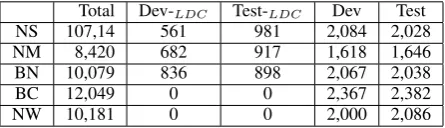
The test set and development set of the CTB7 data split used in this paper are detailed in Ta-ble 4, and we used the rest as the training set. Table 5 provides the detailed statistics of each genre: NS (Newswire), NM (News magazine), BN (Broadcast news), BC (Broadcast conversation), NW (Newsgroups weblogs). Table 6 provides the statistics of our experimental settings on the tree-banks. The out-of-vocabulary (OOV) is defined as
4list-of-files.pdf
5This is the same as the CTB6 data split.
6In CTB7, sentences checked twice are marked, and they
are expected to have higher annotation quality.
7CTB5 and CTB6 data splits include small development
# of sent.
training # of sent.dev OOV rate(word) dev OOV rate(word& tag) dev # of sent.test OOV rate(word) test OOV rate(word& tag) test
CTB5 18,089 350 0.0811 0.0877 348 0.0347 0.0420
CTB6 23,420 2,079 0.0545 0.0635 2,796 0.0557 0.0636
CTB7 31,131 10,136 0.0549 0.0634 10,180 0.0521 0.0608
Table 6: Statistics of CTB5, CTB6 and CTB7 data splits
CTB5 CTB6 CTB7
method R P F1 R P F1 R P F1
Baseline 0.9791 0.9715 0.9753 0.9504 0.9521 0.9513 0.9503 0.9492 0.9498 +(a)n-gram 0.9830 0.9766 0.9798 0.9567 0.9568 0.9567 0.9562 0.9546 0.9554 +(b) lexicon 0.9809 0.9743 0.9776 0.9545 0.9555 0.9550 0.9548 0.9535 0.9542 +(a)+(b) 0.9845 0.9777 0.9811 0.9575 0.9583 0.9579 0.9576 0.9554 0.9565
Table 7: Results of word segmentation
POS tag method CTB5 CTB6 CTB7
Baseline 0.9318 0.8999 0.8937
+(c)n-gram 0.9333 0.9014 0.8958 +(d) cluster 0.9350 0.9026 0.8959 +(e) lexicon 0.9346 0.9015 0.8959 +(c)+(d)+(e) 0.9359 0.9048 0.8985
Table 8: F1 results of segmentation and POS tag-ging (baseline model for word segmentation)
the words in the test set that are not in the training set (Sproat and Emerson, 2003). The development sets were used to obtain the optimal values of tun-able parameters and feature configurations.
The unlabeled data for our experiments were taken from the XIN_CMN portion of Chinese Gi-gaword Version 2.0 (LDC2009T14), which has ap-proximately 311 million words. Some of CTB data and Chinese Gigaword data are from the same source: Xinhua newswire between 1994 and 1998. In order to avoid overlap between the CTB data and the unlabeled data, we used only the articles published in 1991- 1993 and 1999-2004 as unla-beled data, with 204 million words.8 Note that
we only used one million words from this data for word clustering, because the clustering process is time-consuming and the amount is enough to show the impact of cluster feature.
4.2 Parameter Tuning
CRF++ has four major tunable parameters to con-trol the training condition:a, the regularization al-gorithm; c, the balance between over-fitting and under-fitting; f, the cut-off threshold for the fea-ture frequencies; and p, the number of threads. We used a= CRF-L2 (Gaussian regularization)
8This may be a too strict setting, but we wanted to test our
approach in the fairest way.
POS tag method CTB5 CTB6 CTB7 Baseline 0.9362 0.9061 0.8996 +(c)n-gram 0.9382 0.9078 0.9017 +(d) cluster 0.9403 0.9089 0.9020 +(e) lexicon 0.9399 0.9081 0.9019 +(c)+(d)+(e) 0.9418 0.9112 0.9046
Table 9: F1 results of segmentation and POS tag-ging (our best model for word segmentation)
andf = 1. We setp to 12 for all experiments to
speed up the training. For the baseline segmenta-tion model, we variedcin the range of [1.0, 5.0] and found that settingc= 4.0 yielded the best per-formance on the development set of CTB7. For our approach, we variedcin the range of [0.3, 5.0] and found that settingc= 1.0 yielded the best per-formance. For the POS tagging model,cwas set to 4.0 in all of the methods . For the clustering tool,
c(the number of clusters) was set to 1000.
4.3 Experimental Results
We evaluated both word segmentation (Seg) and joint word segmentation and POS tagging (Seg &Tag). We used recall (R), precision (P) and F1 as evaluation metrics.
The experimental results of word segmentation on CTB5, CTB6 and CTB7 test sets are shown in Table 7, where (a) refers to then-gram feature gen-erated from the unlabeled data and (b) refers to the lexicon feature. The results show that then-gram feature was very effective in all experiments and that the combination of (a) and (b) can provide fur-ther improvement.
segmenta-CTB5 CTB6 CTB7
Method Seg Seg&Tag Seg Seg&Tag Seg Seg&Tag
Ours 0.9628 0.9316 0.9619 0.9138 0.9536 0.9027
Baseline 0.9493 0.8934 0.9564 0.9052 0.9493 0.8934
K 09b 0.9628 0.9291 0.9577 0.9063 0.9547 0.8989
K 09a 0.9642 0.9288 0.9574 0.9061 0.9533 0.8984
Table 12:F1Results comparison on development set
Method Seg Seg&Tag
Ours 0.9811 0.9418
Baseline 0.9753 0.9318
Z&C 10 0.9778 0.9367
K 09a 0.9787 0.9367
K 09b 0.9798 0.9400
Jiang 08a 0.9785 0.9341
Jiang 08b 0.9774 0.9337
N&U 07 0.9796 0.9338
Table 10: Comparison with previous studies on CTB5
CTB6 CTB7
Methods Seg Seg&Tag Seg Seg&Tag Ours 0.9579 0.9112 0.9565 0.9046 Baseline 0.9513 0.8999 0.9498 0.8937 K 09a 0.9550 0.9050 0.9540 0.8986 K 09b 0.9551 0.9053 0.9546 0.8990
Table 11: Comparison with previous studies on CTB6 and CTB7
tion model and Table 9 shows the results when we used our best segmentation model (i.e., (a)+(b)). The results show that the cluster features were the most effective ones and that a combination of three types of features achieves the best performance. This suggests that these features are relatively in-dependent in feature characteristics.
The results of our best system are compared with the previous methods in the next section.
4.4 Comparative Results
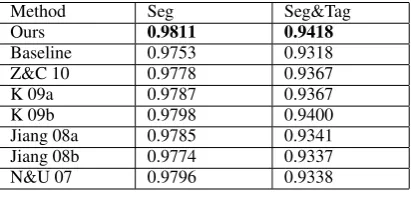
In this section, we compare our approach with the best previous approaches reported in the lit-erature. The performance scores of previous stud-ies are directly taken from their papers, except for N&U 07 (Nakagawa and Uchimoto, 2007), which is taken from Kruengkrai et al. (2009b). Z&C 10 refers to Zhang and Clark (2010). Two methods in Kruengkrai et al. (2009a; 2009b) are referred to as K 09a and K 09b. Jiang 08a and Jiang 08b refer to Jiang et al. (2008a; 2008b). Table 10 compares
F1results on CTB5.0. The best score in each col-umn is in boldface. The results of our approach are superior to those of previous studies for both
p-value
Models CTB5 CTB6 CTB7
Ours vs. K 09b(Seg) 0.8054 5.0e-08 ≈0.0 Ours vs. K 09b(Seg&Tag) 0.7060 1.6e-14 ≈0.0 Ours vs. Base(Seg) 4.0e-06 1.8e-11 ≈0.0 Ours vs. Base(Seg&Tag) 2.1e-06 ≈0.0 ≈0.0
Table 13: Results of McNemar’s test.
Seg and Seg&Tag.
We also conducted experiments using the sys-tem implemented by Kruengkrai for comparison on CTB6 and CTB7 with two methods (K 09a and K 09b) and theF1results are shown in Table 11.
For reference, the results of the development set are also shown in Table 12. Although the Seg per-formances of CTB5 and CTB7 are lower than K 09a and K 09b , Seg&Tag achieves the best per-formance on all development sets.
4.5 Statistical Significance Tests
We evaluated statistical significance using McNe-mar’s test9. With McNemar’ test, we compared
the correctness of the labeling decisions of the two models. The null hypothesis is that the disagree-ments (correct vs. incorrect) are due to chance. For Seg, a word in the system output is considered correct if the word boundary is correctly identi-fied. For Seg &Tag, a word is considered correct only when both the word boundary and its POS tag are correctly identified. Table 13 summarizes the results on test sets. These tests suggest that al-though the difference from K 09b for CTB5 data is not statistically significant, all other differences are clearly statistically significant (p <10−5).
4.6 Comparison with Self-Training
An alternative method of incorporating unlabeled data is self-training, so we also compared our results to the self-training method. Because no existing research was found concerning the self-training method on word segmentation and POS
9We used the version with Yates’ correction, using
Sentences added SegmentationF1 0(Baseline) 0.9498
5k 0.9493
10k 0.9492
30k 0.9482
150k 0.9469
300k 0.9469
600k 0.9468
Table 14: Comparison with self-training (Seg)
sentences added POS taggingF1 0(Baseline) 0.8937
5k 0.8926
10k 0.8922
30k 0.8911
50k 0.8908
Table 15: Comparison with self-training (POS)
tagging for Chinese, we tested the simplest self-training here. We analyzed the unlabeled data with the baseline models, added the newly auto-labeled data to the training corpus, and trained a new model. Since the manually labeled data should be considered more important than the un-labeled data (McClosky et al., 2006), we also ad-justed the weight of the labeled data to the integer in the range of [1,5] in experiments. The results of all the experiments were not positive – we were not able to obtain any improvement over the base-line models in either word segmentation or POS tagging. Due to space limitation, we only include the results with the labeled data weight = 1. Other weights did not change the conclusion here. Ta-ble 14 shows theF1 results on segmentation with different sizes of the additional data on the CTB7 test set. Table 15 shows theF1results on segmen-tation and POS tagging. The segmensegmen-tation by the baseline model was used for all of the POS tagging experiments here.
5 Related Work
Our approach is to incorporate large unlabeled data in Chinese word segmentation and POS tag-ging.
For research using large unlabeled data, Suzuki and Isozaki (2008) and Suzuki et al. (2009) proposed semi-supervised learning algorithms on giga-word-scale unlabeled data and showed per-formance improvement in POS tagging, syntac-tic chunking, and named entity recognition. In-stead of using specialized semi-supervised learn-ing algorithms, Chen et al. (2009) used features
based on sub-structures in auto-parsed data and demonstrated the effectiveness of these features. Koo et al. (2008) presented the use of cluster fea-tures. The advantage of the methods by Chen et al. (2009) and Koo et al. (2008) is their sim-plicity and flexibility. Our research applied these techniques to word segmentation and POS tagging rather than dependency parsing.
Yu et al. (2007) proposed a character-based joint method for word segmentation and POS tagging, in which they introduced an unsupervised method for unknown word learning. However, they only learned the unknown words from the test set. Zhao and Kit (2007; 2008) proposed an approach using unsupervised segmentation criteria as features for Chinese word segmentation. However, their fea-tures were only accumulated from the training and test data. Our approach differs in that we used features generated from large unlabeled data and provided richer information, which may be unseen from the training corpus.
Kruengkrai et al. (2009a; 2009b) presented a discriminative word-character hybrid model for joint Chinese word segmentation and POS tagging and achieved the state-of-the-art accuracy for the CTB test sets. Instead of using the hybrid model, we used conceptually simpler pipelined models built with standard CRF tools. Compared with their method, our approach achieved higher per-formance with the help of unlabeled data.
6 Conclusion
In this paper, we presented a simple yet effec-tive semi-supervised approach to pipelined Chi-nese segmentation and POS tagging. Through a series of experiments, we demonstrated that our approach provides substantial improvement over the best previously reported methods as well as the baseline methods.
References
Andr F. T.Martins, Dipanjan Das, Noah A. Smith, and Eric P. Xing 2008. Stacking Dependency Parsers. In Proceedings of EMNLP-2008, pages 513-521.
Canasai Kruengkrai, Kiyotaka Uchimoto, Jun’ichi Kazama, Yiou Wang, Kentaro Torisawa, and Hitoshi Isahara 2009. An Error-Driven Word-Character Hybird Model for Joint Chinese Word Segmentation
and POS Tagging. In Proceedings of
Canasai Kruengkrai Kiyotaka Uchimoto, Jun’ichi Kazama, Yiou Wang, Kentaro Torisawa, and Hi-toshi Isahara 2009. Joint Chinese Word Segmenta-tion and POS Tagging Using an Error-Driven
Word-Character Hybrid Model. IEICE transactions on
in-formation and systems 92(12), pages 2298-2305.
David McClosky, Eugene Charniak, and Mark Johnson 2006. Effective self-training for parsing. In Pro-ceedings of the Human Language Technology Con-ference of the NAACL-2006, pages 152-159.
Gertjan van Noord 2007. Using Self-trained Ailexical
Preferences to Improve Disambiguation Accuracy.
In Proceedings of IWPT-07, pages 1-10
Hai Zhao, Chang-Ning Huang, Mu Li, and Bao-Liang Lu 2006. Effective Tag Set Selection in Chinese Word Segmentation via Conditional Random Field
Modeling. In Proceedings of the 20th Pacific Asia
Conference on Language, Information and Compu-tation.pages 87-94.
Hai Zhao, Chang-Ning Huang, Mu Li, and Bao-Liang Lu 2010. A Unified Character-Based Tagging
Framework for Chinese Word Segmentation. ACM
Transactions on Asian Language Information Pro-cessing, 9(2), Article 5.
Hai Zhao and Chunyu Kit 2008.Exploiting Unlabeled Text with Different Unsupervised Segmentation
Cri-teria for Chinese Word Segmentation. Research in
Computing Science, Vol. 33, pages 93-104.
Hai Zhao and Chunyu Kit 2007. Incorporating Global Information into Supervised Learning for Chinese
Word Segmentation. In Proceedings of
PACLING-2007, pages 66-74.
Jin Kiat Low, Hwee Tou Ng and Wenyuan Guo 2005. A Maximum Entropy Approach to Chinese
Word Segmentation. In Proceedings of the 4th
SIGHAN Workshop on Chinese Language Process-ing (SIGHAN05), pages 161-164.
John Lafferty, Andrew McCallum, and JFernando Pereira 2001. Conditional Random Fields: Prob-abilistic Models for Segmenting and Labeling
Se-quence Data. In Proceedings of ICML01, pages
282-289.
Jun’ichi Kazama and Kentaro Torisawa 2008. In-ducing Gazetteers for Named Entity Recognition by Large-scale Clustering of Dependency Relations. In Proceedings of ACL-2008, pages 665-673.
Jun Suzuki and Hideki Isozaki 2008. Semi-Supervised Sequential Labeling and Segmentation using
Giga-word Scale Unlabeled Data. In Proceedings of
ACL-08: HLT, pages 407-415.
Jun Suzuki, Hideki Isozaki, Xavier Carreras, and Michael Collins 2009. An Empirical Study of Semi-supervised Structured Conditional Models for
De-pendency Parsing. In Proceedings of EMNLP-2009,
pages 551-560.
Kun Yu, Sadao Kurohashi, Hao Liu 2007. Character-based Chinese Word Segmentation and Pos-tagging
with Unsupervised Unknown Word Learning. In
Proceedings of NLP-2007, pages 823-826.
Michael Collins 2002. Ranking Algorithms for Named-entity Extraction: Boosting and the Voted
Perceptron. In Proceedings of ACL-2002, pages
489-496
Nianwen Xue 2003. Chinese Word Segmentation as
Character Tagging. Computational Linguistics and
Chinese Language Processing 8(1), pages 29-48 Richard Sproat and Thomas Emerson 2003. The First
International Chinese Word Segmentation Bakeoff.
In Proceedings of the 2nd SIGHAN Workshop on Chinese Language Processing, pages, 133-143. Rie Kubota Ando and Tong Zhang 2005. A
Frame-work for Learning Predictive Structures from
Multi-ple Tasks and Unlabeled Data. Journal of Machine
Learning Research, 6, pages 1817-1853
Scott Miller, Jethran Guinness, and Alex Zamanian 2004. Name Tagging with Word Clusters and
Dis-criminative Training. In Proceedings of HLT-2004,
pages 337-342
Terry Koo, Xavier Carreras and Michael Collins 2008.
Simple Semi-supervised Dependency Parsing. In
Proceedings of ACL-2008, pages 595-603
Tetsuji Nakagawa and Kiyotaka Uchimoto 2007. Hy-brid Approach to Word Segmentation and Pos Tag-ging. In Proceedings of ACL Demo and Poster Ses-sions, pages 217-220
Wenbin Jiang, Liang Huang, Qun Liu, and Yajuan Lu. 2008. A Cascaded Linear Model for Joint Chinese
Word Segmentation and Part-of-Speech Tagging. In
Proceedings of ACL-2008, pages 897-904
Wenbin Jiang, Haitao Mi and Qun Liu 2008. Word Lattice Reranking for Chinese Word Segmentation
and Part-of-Speech Tagging. In Proceedings of
COLING-2008, pages 385-392
Wenliang Chen, Daisuke Kawahara, Kiyotaka Uchi-moto, Yujie Zhang, and Hitoshi Isahara 2008. De-pendency Parsing with Short DeDe-pendency Relations
in Unlabeled Data. In Proceedings of IJCNLP-2008
Wenliang Chen, Jun’ichi Kazama, Kiyotaka Uchimoto, and Kentaro Torisawa 2009. Improving Depen-dency Parsing with Subtrees from auto-Parsed Data. In Proceedings of EMNLP-2009, pages 570–579, Yu-Chieh Wu Jie-Chi Yang and Yue-Shi Lee 2008.
Description of the NCU Chinese Word Segmenta-tion and Part-of-Speech Tagging for SIGHAN
Bake-off 2008. In Proceedings of the SIGHAN Workshop
on Chinese Language Processing, pages 161-166. Yue Zhang and Stephen Clark 2010. A Fast Decoder
for Joint Word Segmentation and POS-Tagging
Us-ing a SUs-ingle Discriminative Model. In Proceedings