doi:10.4236/ijcns.2010.36069 Published Online June 2010 (http://www.SciRP.org/journal/ijcns/).
An Empirical Examination of Routing Protocols in
Mobile Ad Hoc Networks
Kuncha Sahadevaiah1, Oruganti Bala Venkata Ramanaiah2 1
Department of Computer Science & Engineering, University College of Engineering, Jawaharlal Nehru Technological University, Kakinada, India
2
Department of Computer Science & Engineering, University College of Engineering, Jawaharlal Nehru Technological University, Hyderabad, India
E-mail:{ksd1868, obvramanaiah} @gmail.com
Received March 26, 2010; revised April 28, 2010; accepted May 29, 2010
Abstract
A Mobile Ad hoc NETwork (MANET) is a self-organizing, temporary, infrastructure-free, multi-hop, dy-namic topology wireless network that contains collection of cooperative autonomous freely roaming mobile nodes. The nodes communicate with each other by wireless radio links with no human intervention. Each mobile node functions as a specialized router to forward information to other mobile nodes. In order to pro-vide efficient end-to-end communication with the network of nodes, a routing protocol is used to discover the optimal routes between the nodes. The routing protocols meant for wired networks can not be used for MANETs because of the mobility of nodes. Routing in ad hoc networks is nontrivial due to highly dynamic nature of the nodes. Various routing protocols have been proposed and widely evaluated for efficient routing of packets. This research paper presents an overview on classification of wide range of routing protocols for mobile ad hoc wireless networks proposed in the literature and shows the performance evaluation of the routing protocols: DSDV, AODV, FSR, LAR, OLSR, STAR and ZRP using the network simulator QualNet 4.0 to determine which protocols may perform best in large networks. To judge the merit of a routing proto-col, one needs performance metrics (throughput, end-to-end delay, jitter, packet delivery ratio, routing over-head) with which to measure its suitability and performance. Our simulation experiments show that the LAR protocol achieves relatively good performance compared to other routing protocols.
Keywords: Mobile Ad Hoc Networks, Routing Protocols, LAR, QualNet 4.0, Performance Metrics, Simulations, Performance Evaluation
1. Introduction
The advent of ubiquitous computing and the proliferation of portable computing devices have raised the impor-tance of mobile and wireless networking. Wireless net-working is an emerging technology that allows users to access information and services electronically, regardless of their geographic position. Ad hoc is a Latin word, which means “for this purpose only”. The term “ad hoc” tends to imply “can take different forms” and “can be mobile, stand alone, or networked” [1]. Ad hoc networks have the ability to form “on the fly” and dynamically handle the joining or leaving of nodes in the network. Mobile nodes are autonomous units that are capable of roaming independently. Typical mobile ad hoc wireless nodes are Laptops, Personal Digital Assistants, Pocket PCs, Cellular Phones, Internet Mobile Phones, Palmtops
or any other mobile wireless devices. All of these have the capability and need to exchange information over a wireless medium in a network. Mobile ad hoc wireless devices are typically lightweight and battery operated.
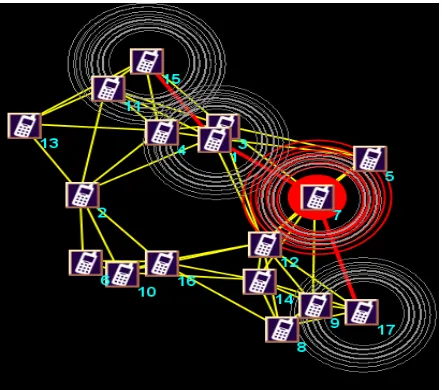
Figure 1. Communication scenario in MANET.
In addition, each node in a mobile ad hoc network is ca-pable of moving independently and forwarding packets to other nodes.
The important characteristics of ad hoc wireless net-works [2] are: dynamic topologies, low bandwidth, lim-ited battery power, decentralized control, weak physical protection, etc. Dynamic Topologies: The nodes in ad hoc wireless networks are free to move independently in any direction. The network topology changes randomly at unpredictable times and primarily consists of bidirec-tional links. Low Bandwidth: These networks have lower capacity and shorter transmission range than fixed infra-structure networks. The throughput of wireless commu-nication is lesser than wired commucommu-nication because of the effect of the multiple access, fading, noise, and inter-ference conditions. Limited Battery Power: The nodes or hosts operate on small batteries and other exhaustible means of energy. So, energy conservation is the most im-portant design optimization criteria. Decentralized Con-trol: Due to unreliable links, the working of ad hoc wire-less network depends upon cooperation of participating nodes. Thus, implementation of any protocol that in-volves a centralized authority or administrator becomes difficult. Weak Physical Protection: Nodes in ad hoc wire-less networks are usually compact, soft, and hand-held in nature. Today, portable devices like mobile phones or personal digital assistants (PDAs) are getting smaller and smaller. They could get damaged or lost or stolen easily and misused by an adversary.
The domain of applications for ad hoc wireless net-works is diverse, ranging from small, static netnet-works that are constrained by power sources, to large-scale, mobile, highly dynamic networks [2,4]. Such networks are fre-quently viewed as a key communications technology en- abler for network-centric warfare and military tactical operations-for fast establishment of military
communica-tions and troop deployments in hostile and/or unknown environments, disaster relief operations-for communica-tion in environments where the existing infrastructure is destroyed, search and rescue operations and emergency situations-for communication in areas with no wireless infrastructure support, law enforcement-for secure and fast communication during law enforcement operations, commercial use-for enabling communications in exhibi-tions, conferences & large gatherings, intelligent trans-portation systems and fault-tolerant mobile sensor grids. Most of these applications demand a secure and reliable communication.
2. Routing in Mobile Ad Hoc Networks
Mobile hoc network (MANET) is built on the fly where a number of mobile nodes work in cooperation without the engagement of any centralized access point or any fixed infrastructure. The nodes in the network are free to move independently in any direction. Node mobility causes route changes. The nodes themselves are respon- sible for dynamically discovering other nodes to commu- nicate. When a node wants to communicate with a node outside its transmission range, a multi-hop routing strat-egy is used which involves some intermediate nodes. The network’s wireless topology changes frequently and ran-domly at unpredictable times. Every node in ad hoc wire-less network acts as a router that discovers and maintains routes in the network. Hence, the primary challenge is to establish a correct and efficient route between a pair of nodes and to ensure the correct and timely delivery of packets. Route construction should be done with a mini-mum of overhead and bandwidth consumption. Various protocols-proactive, reactive and hybrid-have been pro-posed and widely evaluated for efficient routing of pack-ets in the literature [3].
Routing protocols [5] often are very vulnerable to node misbehavior. A node dropping all the packets is con- sidered as malicious node or selfish nodes. A malicious node misbehaves because it intends to damage network functioning. A selfish node does so because it wants to save battery life for its own communication by simply not participating in the routing protocol or by not exe-cuting the packet forwarding. A malicious node could falsely advertise very attractive routes and thereby con-vince other nodes to route their messages via that mali-cious node.
3. Routing Protocols in Mobile Ad Hoc
Networks
protocol for MANET should be distributed in manner in order to increase its reliability, the routing protocol sh- ould assume routes as unidirectional links, the routing protocol should be power-efficient, the routing protocol should consider its security, and a routing protocol should be aware of Quality of Service (QoS). Based on the method of delivery of data packets from the source to destination, classification of the MANET routing proto-cols could be done as unicast, multicast or geocast rout-ing protocols [6].
Unicast Routing Protocols: The routing protocols that consider sending information packets to a single destina-tion from a single source.
Multicast Routing Protocols: Multicast is the delivery of information to a group of destinations simultaneously. Multicast routing protocols for MANET use both multi-cast and unimulti-cast for data transmission. Multimulti-cast routing protocols for MANET can be classified again into two categories: tree-based and mesh-based multicast routing protocols. Mesh-based routing protocols use several routes
to reach a destination while the tree-based protocols
[image:3.595.67.276.438.696.2]maintain only one path. Tree-based protocols ensure less end-to-end delay in comparison with the mesh-based protocols.
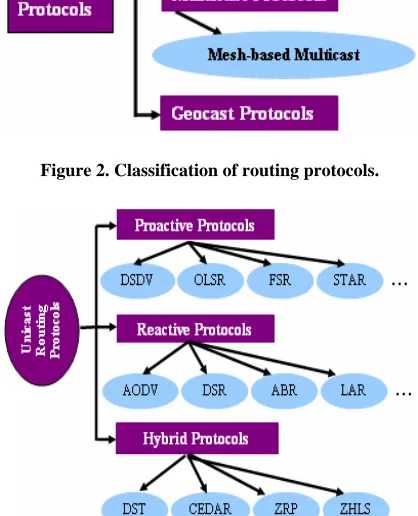
Figure 2. Classification of routing protocols.
Figure 3. Classification of unicast routing protocols.
Geocast Routing Protocols: The routing protocols aim to send messages to some or all of the wireless nodes within a particular geographic region. Often the nodes know their exact physical positions in a network, and these protocols use that information for transmitting packets from the source to the destination(s).
Ad hoc wireless network unicast routing protocols can be further classified into three major categories based on the routing information update mechanism: proactive or table driven, reactive or on-demand, and hybrid routing protocols.
3.1. Proactive Routing Protocols
In proactive routing protocols, also known as table-
driven routing protocols, each node maintains one or
more tables that contain consistent and up-to-date routing information to every other node in the network. The rout-ing information is usually kept in a number of different tables. Proactive protocols continuously learn the global topology of the network by exchanging topological
in-formation among the network nodes. When the network
topology changes, the nodes propagate update messages and the topology change information is distributed across the network. If the network topology changes too fre-quently, the cost of maintaining the network might be very high. Each node continuously evaluates routes to all reachable nodes. The overhead to maintain up-to-date network topology information is high.
Some of these protocols are: Destination Sequenced Distance Vector routing protocol (DSDV), Optimized Link State Routing protocol (OLSR), Fisheye State Routing protocol (FSR), Source Tree Adaptive Routing protocol (STAR), Wireless Routing Protocol (WRP), Global State Routing (GSR), Cluster-head Gateway Switch Routing protocol (CGSR), Hierarchical State Routing protocol (HSR).
3.1.1.DestinationSequencedDistance VectorRouting Protocol(DSDV)
is used.
Every node periodically exchange routing table up-dates to its immediate neighbors. The route upup-dates can be either time-driven or event-driven. Two types of route update packets: full dump and incremental packets are used. The full dump packet carries all the available rout-ing information, i.e., the entire routing table to the
neighbors and the incremental packet carries only the
information changed since the last full dump. For updat-ing the routupdat-ing information in a node, the update packet
with the highest sequence number is used. The
incre-mental update messages are sent more frequently than the full dump packets. The protocol will not scale in large network since a large portion of the network band-width is used in the updating procedures.
3.1.2.OptimizedLinkStateRouting Protocol(OLSR) The Optimized Link State Routing (OLSR) [11] is a proactive unicast optimized version of a pure link state routing protocol that employs an efficient link state packet forwarding mechanism called multipoint relaying. This protocol performs hop-by-hop routing; that is, each node in the network uses its most recent information to route a packet. The routing optimization is done mainly in two ways. Firstly, OLSR reduces the size of the con-trol packets for a particular node during each route up-date by declaring only a subset of links with the node’s neighbors who are its multipoint relay selectors, instead of all links in the network. Any node which is not in the set can read and process each packet but do not retrans-mit. Secondly, it minimizes flooding of the control traffic by using only the selected nodes, called multipoint relays to disseminate information in the network. To select the multipoint relaying, each node periodically broadcasts a list of its one hop neighbors using hello messages. From the list of nodes in the hello messages, each node selects a subset of one hop neighbors, which covers all of its two hop neighbors. It provides optimal routes to every desti-nation in terms of number of hops, which are immedi-ately available when needed. As only multipoint relays of a node can retransmit its broadcast messages, this protocol significantly reduces the number of retransmis-sions in a flooding or broadcast procedure.
Therefore, the protocol works based on the mecha-nisms of: neighbors-sensing based on periodic exchange of hello messages, efficient flooding of control traffic using the concept of multipoint relays, and computation of an optimal route using the shortest-path algorithm. This protocol does not notify the source immediately after detecting a broken link and source node comes to know that route is broken when the intermediate node broad-casts its next packet. The proposed protocol is best suit-able for large and dense ad hoc networks.
3.1.3.FisheyeStateRoutingProtocol(FSR)
The Fisheye State Routing (FSR) [12] is a proactive
uni-cast routing protocol based on link state routing algo-rithm with effectively reduced overhead to maintain network topology information. The novelty of FSR is that it uses a special structure of the network called the “fisheye”. FSR maintains the accurate distance and path quality information about the immediate neighboring nodes and progressively reduces detail as the distance increases. In link state routing algorithm, used for wired networks, link state updates are generated and flooded through the network whenever a node detects a topology change. However, in FSR nodes exchange link state in-formation periodically only with the neighboring nodes to maintain up-to-date full topology information of the network. To reduce the size of link state update messages, FSR uses different update periods for different entries in the routing table. Link state updates corresponding to the nodes within a smaller scope are propagated with higher frequency.
The FSR protocol is an improvement of Global State Routing (GSR). The large size of update messages in GSR wastes a considerable amount of network band-width. In FSR, each update message does not contain information about all nodes. Instead, it reduces the size of the update messages by exchanging information about closer nodes more frequently than it does about farther nodes, which lie outside the fisheye scope. The scope is defined in terms of the nodes that can be reached in a certain number of hops. So, each node gets accurate in-formation about neighbors and accuracy of inin-formation decreases as the distance from node increases.
The advantage of FSR is that even though a node does not have accurate information about a destination, as the packet moves closer to the destination, more correct in-formation about the route to the destination becomes
available. FSR exhibits a better scalability concerning
the network size compared to others as the overhead is controlled in this scheme.
routing approach (LORA) to exchange routing informa-tion. However, this protocol may have significant mem-ory and processing overheads in large and highly mobile networks, because each node is required to maintain a partial topology graph of the network (it is determined from the source tree reported by its neighbors), which changes frequently as the neighbors keep reporting dif-ferent source trees.
3.2. Reactive Routing Protocols
In reactive routing protocols, also known as on-demand routing protocols, a node creates a route in an on-demand fashion, i.e. it computes a route only when needed. When a source wants to send packets to a destination, it invokes the route discovery mechanisms to find the path to the destination. Route discovery usually occurs by flooding a route request packet throughout the network. Route reply is sent back if the destination itself or node with route to the destination is reached. The discovery procedure ter-minates either when a route has been found or no route available after examination for all route permutations. Re-active routing does not maintain global topological infor-mation and, therefore, substantially reduces energy con-sumption. Some of these protocols are: Ad hoc On-De-mand Distance Vector routing protocol (AODV), Dy-namic Source Routing protocol (DSR), Associativity Based Routing protocol (ABR), Location Aided Routing protocol (LAR), Light-weight Mobile Routing protocol (LMR), Temporally Ordered Routing Algorithm (TORA), Ant-colony-based Routing Algorithm (ARA), Cluster- based Routing Protocol (CBRP).
3.2.1.AdHocOn-DemandDistanceVectorRouting Protocol(AODV)
The Ad hoc On-Demand Distance Vector (AODV) [14] routing protocol is a reactive unicast routing protocol. The protocol constructs efficient route on demand with minimal control overhead and minimal route acquisition latency. AODV is essentially a combination of both DSR and DSDV algorithms and it borrows the basic on de-mand mechanism of route discovery and route mainte-nance from DSR, plus the use of hop-by-hop routing se-quence numbers from DSDV. The destination sese-quence number can be used to ensure loop-free and to identify which route with the greatest sequence number is newer one.
AODV has bidirectional route from source to destina-tion. To find a path from source to destination, the source broadcasts a route request packet. The neighbors in turn broadcast the packet to their neighbors till it reaches an intermediate node that has recent route information about the destination or till it reaches the destination. A node discards a route request packet that it has already seen. The route request packet uses sequence numbers to en-sure that the routes are loop free. When a node forwards
a route request packet to its neighbors, it also records in its tables the node from which the first copy of the re-quest came. This information is used to construct the reverse path for the route reply packet. AODV uses only symmetric links because the route reply packet follows the reverse path of route request packet. As the route reply packet traverses back to the source, the nodes along the path enter the forward route into their tables. For route maintenance, when a source node moves, it can reinitiate route discovery to the destination. If one of the intermediate nodes moves, then the moved nodes neighbor realizes the link failure and sends a link failure notifica-tion to its upstream neighbors and so on till it reaches the source upon which the source can reinitiate route dis-covery if needed.
The difference between DSR and AODV is that in DSR, each packet carries full routing information, whereas in AODV, the packets carry the destination address. This means that AODV has potentially less routing overheads than DSR. The other difference is that the route replies in DSR carry the address of every node along the route, whereas in AODV, the route replies only carry the desti-nation IP address and the sequence number.
The advantage of AODV is that it is adaptable to highly dynamic networks. However, node may experience large delays during route construction, and link failure may initiate another route discovery, which introduces extra delays and consumes more bandwidth as the size of the network increases.
3.2.2. Location Aided Routing Protocol (LAR) The Location Aided Routing (LAR) [15] protocol is a reactive unicast routing scheme. In this, a source node estimates the current location range of the destination based on information of the last reported location and the mobility pattern of the destination. In this, an expected zone is defined as a region that is expected to hold the current location of the destination node. During route discovery procedure, the route request flooding is limited to a request zone, which contains the expected zone and location of the sender node. LAR decreases overhead of the route discovery by using the location information. It limits the search to a smaller request zone, causing sig-nificant reduction of the number of routing messages.
the destination, since the route request packets travel away from the source and towards the destination.
The disadvantage of LAR protocol is that each node is required to carry a GPS. Another disadvantage is, espe-cially for the first method, that protocols may behave similar to flooding protocols (e.g., DSR and AODV) in highly mobile networks.
3.3. Hybrid Routing Protocols
In hybrid routing protocols, some of the characteristics of proactive protocols and some of the characteristics of
reactive protocols are combined into one to get better
solution for mobile ad hoc networks. These protocols exploit the hierarchical network architecture and allow the nodes with close proximity to work together to form some sort of backbone, thus increasing scalability and reducing route discovery. Nodes within a particular geo-graphical region are said to be within the routing zone of the given node. For routing within this zone, a table-driven approach is used. For nodes that are located be-yond this zone, an on demand approach is used.
Some of the hybrid routing protocols are: Distributed Spanning Tree based Routing Protocol (DST), Core- Extraction Distributed Ad Hoc Routing protocol (CE-DAR), Zone Routing Protocol (ZRP), Zone-based Hier-archical Link State Routing Protocol (ZHLS), Distrib-uted Dynamic Routing protocol (DDR), Scalable Loca-tion Update Routing Protocol (SLURP), Hybrid Ad hoc Routing Protocol (HARP).
3.3.1. Zone Routing Protocol (ZRP)
The Zone Routing Protocol (ZRP) [16] is a hybrid rout-ing protocol, where the network is divided into routrout-ing zones according to the distances between nodes and the routing zone defines a range (in hops) that each node is required to maintain network connectivity proactively. In this, proactive routing approach-Intra Zone Routing Pro-tocol (IARP) is used inside routing zones and reactive routing approach-Inter Zone Routing Protocol (IERP) is used between routing zones. Therefore, for nodes within
the routing zone, routes are immediately available. For nodes that lie outside the routing zone, routes are deter-mined on-demand (i.e. reactively), and it can use any on-demand routing protocol to determine a route to the required destination. Route creation is done using a query-reply mechanism. During the forwarding of the query packet, a node identifies whether it is coming from its neighbor or not. If yes, then it marks all of its known neighboring nodes in its same zone as covered. A cov-ered node is a node which belongs to the routing zone of a node that has received a route query. The query is thus relayed till it reaches the destination. The destination in turn sends back a reply message via the reverse path and creates the route.
ZRP is suitable for the networks with large span and diverse mobility patterns. The advantage of this protocol is that it has significantly reduced the amount of commu-nication overhead when compared to pure proactive pro-tocols. It also has reduced the delays associated with pure reactive protocols such as DSR, by allowing routes to be discovered faster. This is because, to determine a route to a node outside the routing zone, the routing only has to travel to a node which lies on the boundaries (edge of the routing zone) of the required destination. Since the boundary node would proactively maintain routes to the destination (i.e. the boundary nodes can complete the route from the source to the destination by sending a reply back to the source with the required routing address).
The disadvantage of ZRP is that for large values of routing zone, the protocol can behave like a pure proac-tive protocol, while for small values it behaves like a reactive protocol.
4. Overall Comparison of All Unicast
Routing Protocols
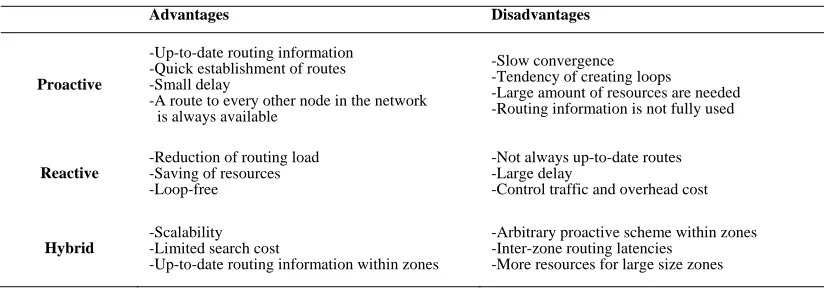
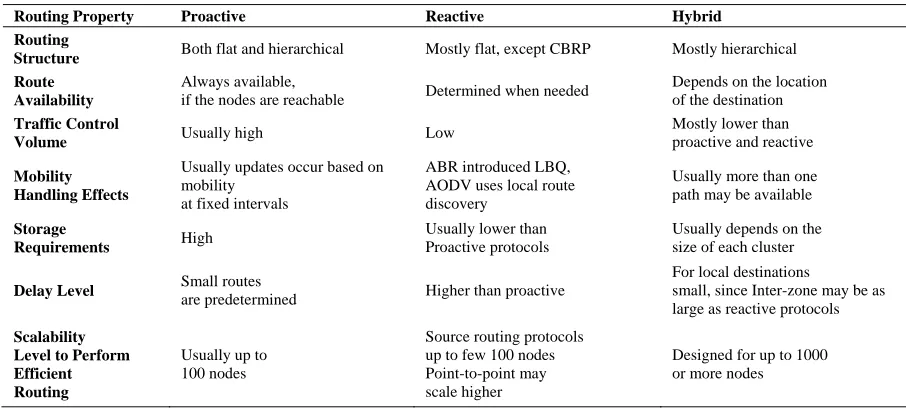
[image:6.595.91.503.565.709.2]Advantages and disadvantages of proactive, reactive and hybrid approaches are shown in Table 1 and overall comparison of all unicast routing protocols are shown in Table 2.
Table 1. Advantages and disadvantages of proactive, reactive and hybrid routing protocols.
Advantages Disadvantages
Proactive
-Up-to-date routing information -Quick establishment of routes -Small delay
-A route to every other node in the network is always available
-Slow convergence -Tendency of creating loops
-Large amount of resources are needed -Routing information is not fully used
Reactive
-Reduction of routing load -Saving of resources -Loop-free
-Not always up-to-date routes -Large delay
-Control traffic and overhead cost
Hybrid
-Scalability -Limited search cost
-Up-to-date routing information within zones
-Arbitrary proactive scheme within zones -Inter-zone routing latencies
Table 2. Overall comparison of all unicast routing categories [20].
Routing Property Proactive Reactive Hybrid
Routing
Structure Both flat and hierarchical Mostly flat, except CBRP Mostly hierarchical Route
Availability
Always available,
if the nodes are reachable Determined when needed
Depends on the location of the destination Traffic Control
Volume Usually high Low
Mostly lower than proactive and reactive
Mobility Handling Effects
Usually updates occur based on mobility
at fixed intervals
ABR introduced LBQ, AODV uses local route discovery
Usually more than one path may be available
Storage
Requirements High
Usually lower than Proactive protocols
Usually depends on the size of each cluster
Delay Level Small routes
are predetermined Higher than proactive
For local destinations
small, since Inter-zone may be as large as reactive protocols
Scalability Level to Perform Efficient Routing
Usually up to 100 nodes
Source routing protocols up to few 100 nodes Point-to-point may scale higher
Designed for up to 1000 or more nodes
5. Performance Evaluation and Analysis
5.1. Simulation Model
The simulations were performed using the network simu-lator QualNet 4.0 which is a discrete event simulator developed by Scalable Networks. It is extremely scalable accommodating high fidelity models of networks. QualNet makes good use of computational resources and models large-scale networks with heavy traffic and mobility in reasonable simulation times.
The study has been done to compare the efficiency of the various categories of routing protocols: DSDV, AODV, FSR, LAR, OLSR, STAR, and ZRP. The overall goal of our simulation study is to analyze the behavior and performance of the protocols under a range of vari-ous scenarios. Simulations have been run using a mobile ad hoc networks composed of 10, 15, 25, 50 and 75 nodes moving over a rectangular 1500 m × 1500 m space and operating over 30 seconds of simulation time. All nodes move according to the random way point mobility model. The traffic sources in our simulation are constant bit rate (CBR) traffic. Each traffic source originates 512 bytes data packets. The simulation parameters are shown in Table 3.
Table 3. Simulation parameters.
Parameter Value Number of nodes 10, 15, 25, 50, 75
Number of traffic sources 3
Simulation Time 30 Seconds
Traffic Type CBR
Packet Size 512 bytes
Topology Size 1500m × 1500m
Mobility Pattern Random way point
5.2. Simulation Metrics
The metrics that are used to evaluate the performance of the routing protocols are: throughput, average end-to-end delay, average jitter, total packets received, packet deliv-ery ratio and routing overhead.
Throughput is the average rate of successful message/ packets delivery over a communication channel. i.e. Thr- oughput is the measure of how fast we can actually send the packets through network. The throughput is usually measured in bits per second (bit/s or bps), and sometimes in data packets per second or data packets per time slot.
Average end-to-end delay is the delay experienced by a packet from the time it was sent by a source till the time it was received successfully at the destination. i.e., the end-to-end delay is the time a data packet is received by the destination minus the time the data packet is gen-erated by the source. Average end-to-end delay includes all possible delays caused by buffering during route dis-covery latency, queuing at the interface queue, retrans-mission delays at the MAC, and propagation and transfer times of data packets.
Average jitter measures the packet delay variation. It is calculated as the average of the difference of the inter arrival time between subsequently received packets.
Total packets received is the number of packets re-ceived by the TCP sink at the final destination and the number of packets generated by the traffic sources.
[image:7.595.61.284.618.717.2]5.3. Simulation Scenarios
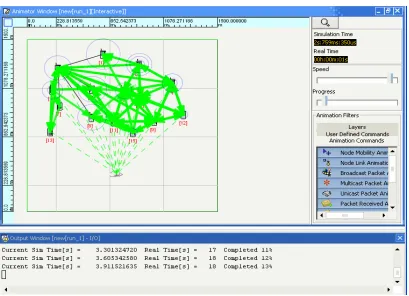
Figure 4. Designer window scenario for 15 nodes.
[image:8.595.94.503.392.688.2]Table 4.Metric values for 15 nodes.
Protocols/
Parameters DSDV AODV FSR LAR OLSR STAR ZRP
Throughput(104) 5.85 5.85 4.0 6.1 5.7 3.65 4.85
End-To-End Delay - - 1.17 3.25 0.08 0.4 1.56
Average Jitter - - 3.48 2.5 0.5 0.4 4.68
Total Packets
Received (102) 3.35 3.35 1.9 3.22 2.97 1.83 2.56
Table 5. Metric values for 25 nodes.
Protocols/
Parameters DSDV AODV FSR LAR OLSR STAR ZRP
Throughput(105) 0.99 1.01 0.63 0.98 0.94 0.51 0.48
End-To-End Delay - - 2.8 11.6 0.1 0.6 3.8
Average Jitter 0.1 - 1.2 11.7 0.6 0.6 3.5
Total Packets
Received (102) 5.6 5.7 2.8 5.4 4.8 2.7 2.4
Table 6. Metric values for 50 nodes.
Protocols/
Parameters DSDV AODV FSR LAR OLSR STAR ZRP
Throughput(105) 2 0.07 1.24 1.17 0.98 1.96 0.75
End-To-End Delay - - 7.5 46 0.75 31 40.8
Average Jitter - - 20.75 21.3 0.5 36.75 32.5
Total Packets
[image:9.595.107.490.64.722.2]Re-ceived(103) 1.16 1.16 0.53 1.13 0.08 0.61 0.41
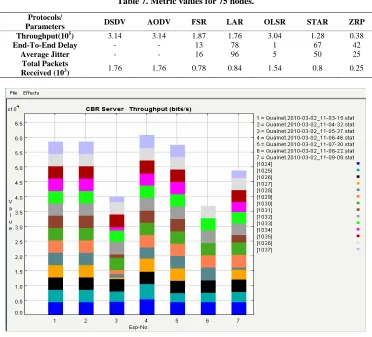
Table 7. Metric values for 75 nodes.
Protocols/
Parameters DSDV AODV FSR LAR OLSR STAR ZRP
Throughput(105) 3.14 3.14 1.87 1.76 3.04 1.28 0.38
End-To-End Delay - - 13 78 1 67 42
Average Jitter - - 16 96 5 50 25
Total Packets
Received (103) 1.76 1.76 0.78 0.84 1.54 0.8 0.25
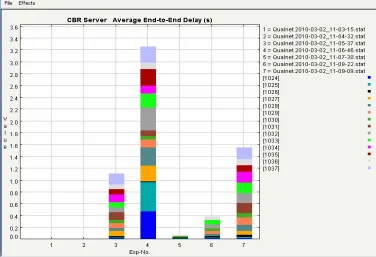
[image:9.595.112.484.362.699.2]Figure 7. Multi experimental comparison chart (15 nodes) for the metric: Average end-to-end delay.
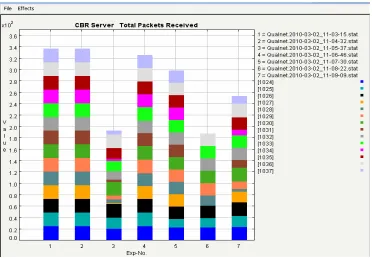
[image:10.595.109.488.401.666.2]Figure 9. Multi experimental comparison chart (15 nodes) for the metric: Total packets received.
5.4. Simulation Results and Analysis
The simulation study has been done using the network simulator QualNet 4.0 for performance comparison of the protocols: DSDV, AODV, FSR, LAR, OLSR, STAR and ZRP. The all seven routing protocols result in impro- vements of the performance metrics that include through-put, jitter, end-to-end delay and total packets received.
It was observed from the simulation that DSDV and AODV gives nearly same and maximum throughput in small sized networks. Throughput of FSR, LAR, OLSR, and STAR is increasing as the network size is increasing, but OLSR performs well in large sized networks. Throu- ghput of ZRP is well and it is nearer for small and large networks, but for large sized networks it is decreasing. For end-to-end delay and average jitter, the performance of DSDV and AODV is better than FSR, LAR, OLSR, STAR and ZRP in case of small sized networks. In me-dium and large sized networks, the end-to-end delay and average jitter of AODV and DSDV protocols are same.
The improvements shown in LAR are gradually in-creasing than others. Hence, it can be concluded that LAR is the best among the studied routing protocols.
6. Conclusions
In this article, the classifications of routing protocols for ad hoc wireless networks were discussed. In proactive protocols, each node maintains network connectivity and up-to-date routing information to all the nodes in the network. In reactive protocols, a node finds the route to a
destination when it desires to send packets to the destina-tion. In hybrid routing protocols, some of the characteris-tics of proactive and some of the characterischaracteris-tics of reac-tive are combined, by maintaining intra-zone information proactively and inter-zone information reactively, into one to get better solution for mobile ad hoc networks.
Generally speaking, reactive protocols require fewer amounts of memory, processing power, and energy than that of the proactive protocols. The mobility and traffic pattern of the network must play the key role for choos-ing an appropriate routchoos-ing strategy for a particular net-work. It is quite natural that one particular solution can-not be applied for all sorts of situations and, even if ap-plied, might not be optimal in all cases. Often it is more appropriate to apply a hybrid protocol rather than a strictly proactive or reactive protocol as hybrid protocols often possess the advantages of both types of protocols.
proto-col where the route is in each packet. DSR had higher routing overhead as compared to AODV. ZHLS and SLURP are highly adaptable to changing topology, since only the node ID and zone ID of the destination is re-quired for routing to occur. They do not use a clus-ter-head to coordinate data transmission, which means that a single point of failure and performance bottlenecks can be avoided. The ZRP routing protocol is designed to in-crease the scalability of mobile ad hoc networks. The advantage of this protocol is that it maintains strong net-work connectivity (proactively) within the routing zones while determining remote route (outside the routing zone) quicker than flooding.
The simulation study has been done using the network simulator QualNet 4.0 for performance comparison of the protocols: DSDV, AODV, FSR, LAR, OLSR, STAR and ZRP. The improvements shown in LAR are gradu-ally increasing than others. Hence, it can be concluded that LAR is the best among the studied routing protocols.
7
. References
[1] C. K. Tok, “Ad Hoc Mobile Wireless Networks: Proto-cols and Systems,” Pearson Education, Boston, 2002, pp. 28-30.
[2] X. Cheng, X. Huang and D. Z. Du, “Ad Hoc Wireless Networking,” Kluwer Academic Publishers, Boston, 2006, pp. 319-364.
[3] C. S. R. Murthy and B. S Manoj, “Ad Hoc Wireless Networks: Architectures and Protocols,” Pearson Educa-tion, Boston, 2006.
[4] P. Mohaptra and S. V. Krishnamurthy, “Ad Hoc Net-works: Technologies and Protocols,” Springer Interna-tional Edition, New Delhi, 2005.
[5] F. Anjum and P. Mouchtaris, “Security for Wireless Ad hoc Networks,” John Wiley & Sons, Chichester, 2007.
[6] S. Misra, I. Woungang and S. C. Misra, “Guide to Wire-less Ad Hoc Networks,” Springer, Berlin, 2009, pp. 59- 96.
[7] S. Basagni, M. Conti, S. Giordono and I. Stojmenovic, “Mobile Ad Hoc Networks,” John Wiley & Sons, Chich-ester, 2003.
[8] C. E. Perkins, “Ad Hoc Networks,” Addition Wesley, 2001.
[9] C. E. Perkins and P. Bhagwat, “Highly Dynamic Destina-tion Sequenced Distance Vector Routing (DSDV) for Mobile Computers,” ACM Computer Communication Review, Special Interest Group on Data Communication
(ACM SIGCOMM’94), Vol. 24, No. 4, 1994, pp. 234- 244.
[10] E. M. Royer and C. K. Toh, “A Review of Current Rout-ing Protocols for Ad Hoc Mobile Wireless Networks,”
IEEE Personal Communications, Vol. 6, No. 2, 1999, pp. 46-55.
[11] P. Jacquet, P. Muhlethaler, T. Clausen, A. Laouiti, A. Qayyum and L. Viennot, “Optimized Link State Routing Protocol for Ad Hoc Networks,” IEEE International Multi Topic Conference (IEEE INMIC), Islamabad, 2001, pp. 62-68.
[12] M. Gerla, X. Hong and G. Pei, “Fisheye State Routing (FSR) Protocol for Ad Hoc Networks,” 2002. http://tools. ietf.org/html/draft-ietf-manet-fsr-03
[13] J. J. Garcia-Luna-Aceves and M. Spohn, “Source-Tree Routing in Wireless Networks,” Proceedings of the Sev-enth Annual International Conference on Network Pro-tocols, Toronto, October 1999, p. 273.
[14] C. E. Perkins, E. M. Belding-Royer and S. R. Das, “Ad hoc On-Demand Distance Vector (AODV) Routing,” 2002. http://tools.ietf.org/html/draft-ietf-manet-aodv-11
[15] Y. B. Ko and N. H. Vaidya, “Location-Aided Routing (LAR) in Mobile Ad Hoc Networks,” Wireless Networks, Kluwer Academic Publishers, Vol. 6, No. 4, 2000, pp. 307-321.
[16] Z. J. Hass, M. R. Pearlman and P. Samar, “Zone Routing Protocol for Ad Hoc Networks,” 2002. http://www.ietf. org/proceedings/55/I-D/draft-ietf-manet-zone-zrp-04.txt
[17] M. Abolhasan, T. Wysocki and E. Dutkiewicz, “A Re-view of Routing Protocols for Mobile Ad Hoc Networks,”
Ad Hoc Networks, Vol. 2, No. 2, 2004, pp. 1-22. [18] A. C. Sun, “Design and Implementation of Fisheye
Rout-ing Protocol for Mobile Ad Hoc Networks,” Massachu-setts Institute of Technology, 2000.
[19] M. Mauve, J. Widmer and H. Hartenstein, “A Survey on Position Based Routing in Mobile Ad hoc Networks,”
IEEE Network, Vol. 15, No. 6, 2001, pp. 30-39.