N
-Phenylmorpholine-4-carboxamide
Shuang-Ming Meng, Ke-Wei Wang, Hai Xie, Yue-Qin Fan and Yong Guo*
College of Chemistry and Chemical Engineering, Shanxi Datong University, Datong 037009, People’s Republic of China
Correspondence e-mail: [email protected]
Received 7 December 2010; accepted 13 December 2010
Key indicators: single-crystal X-ray study;T= 293 K; mean(C–C) = 0.002 A˚;
Rfactor = 0.040;wRfactor = 0.105; data-to-parameter ratio = 14.8.
In the title compound, C11H14N2O2, the urea-type NC ON
moiety [planar to within 0.0002 (13) A˚ ] is inclined to the phenyl ring by 42.88 (8) A˚ , and the morpholine ring has a chair conformation. In the crystal, intermolecular N—H O hydrogen bonds link the molecules into infinite chains in [001].
Related literature
For amides as functional groups in biologically relevant mol-ecules, see: Allen et al.(2010). For the synthesis of this and similar compounds, see: Montalbettiet al.(2005).
Experimental
Crystal data
C11H14N2O2
Mr= 206.24 Monoclinic,P21=c
a= 8.0907 (10) A˚
b= 15.754 (2) A˚
c= 8.4529 (11) A˚
= 104.205 (2)
V= 1044.5 (2) A˚3
Z= 4
MoKradiation
= 0.09 mm1
T= 293 K
0.290.210.19 mm
Data collection
Bruker SMART APEX CCD diffractometer
Absorption correction: multi-scan (SADABS; Bruker, 2001)
Tmin= 0.976,Tmax= 0.981
5309 measured reflections 2056 independent reflections 1633 reflections withI> 2(I)
Rint= 0.016
Refinement
R[F2> 2(F2)] = 0.040
wR(F2) = 0.105
S= 1.04 2056 reflections 139 parameters
H atoms treated by a mixture of independent and constrained refinement
max= 0.13 e A˚ 3
min=0.18 e A˚ 3
Table 1
Hydrogen-bond geometry (A˚ ,).
D—H A D—H H A D A D—H A
N1—H1N O1i
0.844 (17) 2.130 (18) 2.9543 (16) 165.3 (16)
Symmetry code: (i)x;yþ1 2;z
1 2.
Data collection:SMART(Bruker, 2007); cell refinement:SAINT
(Bruker, 2007); data reduction:SAINT; program(s) used to solve structure:SHELXS97(Sheldrick, 2008); program(s) used to refine structure: SHELXL97 (Sheldrick, 2008); molecular graphics:
SHELXTL-Plus(Sheldrick, 2008); software used to prepare material for publication:SHELXL97.
We thank the Natural Science Foundation of Shanxi (No. 2010011018) for support.
Supplementary data and figures for this paper are available from the IUCr electronic archives (Reference: SU2236).
References
Allen, C. L., Burel, C. & Williams, J. M. J. (2010).Tetrahedron Lett.20, 2724– 2726.
Bruker (2001).SADABS. Bruker AXS Inc., Madison, Wisconsin, USA. Bruker (2007).SMARTandSAINT. Bruker AXS Inc., Madison, Wisconsin,
USA.
Montalbetti, C. & Falque, V. (2005).Tetrahedron Lett.61, 10827–10852. Sheldrick, G. M. (2008).Acta Cryst.A64, 112–122.
Acta Crystallographica Section E
Structure Reports
Online
supporting information
Acta Cryst. (2011). E67, o225 [https://doi.org/10.1107/S1600536810052207]
N
-Phenylmorpholine-4-carboxamide
Shuang-Ming Meng, Ke-Wei Wang, Hai Xie, Yue-Qin Fan and Yong Guo
S1. Comment
Amides are one of the most important and prolific functional groups found in biologically relevant molecules (Allen et
al., 2010), which lead to the synthesis of N-phenylmorpholine-4-carboxamide. In this study, this new acetamide
derivative was prepared and its structure is presented herein.
In the title compound all the bond lengths and angles are within normal ranges. The molecule of the title compound is
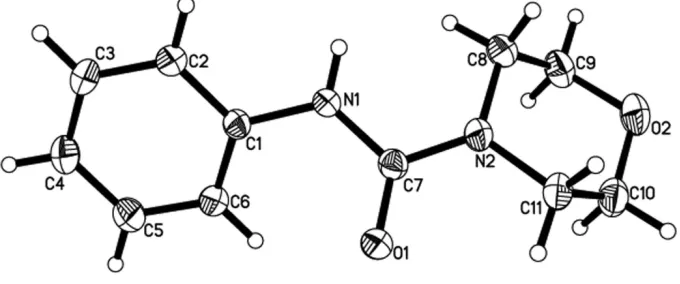
markedly non-planar (Fig. 1). The urea-type moiety [atoms N1,C7,O1,N2 - planar to within 0.0002 (13) Å] is inclined to
the phenyl ring by 42.88 (8) Å. The morpholine ring has a chair conformation.
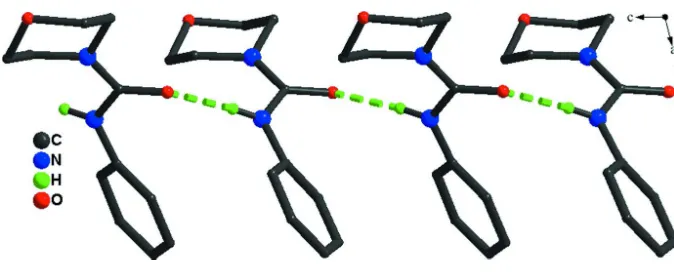
In the crystal, intermolecular N—H···O hydrogen bonds link the molecules into infinite one-dimensional chains
propagagting in [001] (see Fig. 2 and Table 1).
S2. Experimental
The title compound was synthesized according to the literature procedure (Montalbetti et al., 2005). To a solution of
iso-cyanatobenzene (1.19 g, 10 mmol) and morpholine (0.87 ml, 10 mmol) in CH2Cl2 (25 ml) was added triethylamine (1.20
ml, 10 mmol) in one portion. The reaction mixture was stirred at room temperature for 3 h, and then poured into
ice-water (100 ml) under stirring. The combined organic phase was washed with ice-water (3 × 20 ml), dried over MgSO4, and
filtered. Colourless single crystals were obtained by slow evaporation of the filtrate at room temperature.
S3. Refinement
The NH H-atom was located in a difference Fourier map and was refined with Uiso(H) = 1.2Ueq(N). The C-bound H-atoms
[image:2.610.136.476.513.655.2]were positioned geometrically and refined as riding: C—H = 0.93 Å (CH) and 0.97 Å (CH2) with Uiso(H) = 1.2Ueq(C).
Figure 1
Figure 2
View along the b-axis of the one-dimensional polymeric chain of the title compound formed by hydrogen bonding (green
dashed lines). H-atoms not involved in hydrogen bonding have been omitted for clarity.
N-Phenylmorpholine-4-carboxamide
Crystal data
C11H14N2O2 Mr = 206.24 Monoclinic, P21/c
Hall symbol: -P 2ybc
a = 8.0907 (10) Å
b = 15.754 (2) Å
c = 8.4529 (11) Å
β = 104.205 (2)°
V = 1044.5 (2) Å3 Z = 4
F(000) = 440
Dx = 1.312 Mg m−3
Mo Kα radiation, λ = 0.71073 Å Cell parameters from 5309 reflections
θ = 2.6–26.1°
µ = 0.09 mm−1 T = 293 K Block, colourless 0.29 × 0.21 × 0.19 mm
Data collection
Bruker SMART APEX CCD diffractometer
Radiation source: fine-focus sealed tube Graphite monochromator
ω scans
Absorption correction: multi-scan (SADABS; Bruker, 2001)
Tmin = 0.976, Tmax = 0.981
5309 measured reflections 2056 independent reflections 1633 reflections with I > 2σ(I)
Rint = 0.016
θmax = 26.1°, θmin = 2.6° h = −8→9
k = −12→19
l = −10→9
Refinement
Refinement on F2
Least-squares matrix: full
R[F2 > 2σ(F2)] = 0.040 wR(F2) = 0.105 S = 1.04 2056 reflections 139 parameters 0 restraints
Primary atom site location: structure-invariant direct methods
Secondary atom site location: difference Fourier map
Hydrogen site location: inferred from neighbouring sites
H atoms treated by a mixture of independent and constrained refinement
w = 1/[σ2(F
o2) + (0.051P)2 + 0.1766P]
where P = (Fo2 + 2Fc2)/3
(Δ/σ)max < 0.001
Δρmax = 0.13 e Å−3
Special details
Geometry. All e.s.d.'s (except the e.s.d. in the dihedral angle between two l.s. planes) are estimated using the full covariance matrix. The cell e.s.d.'s are taken into account individually in the estimation of e.s.d.'s in distances, angles and torsion angles; correlations between e.s.d.'s in cell parameters are only used when they are defined by crystal symmetry. An approximate (isotropic) treatment of cell e.s.d.'s is used for estimating e.s.d.'s involving l.s. planes.
Refinement. Refinement of F2 against ALL reflections. The weighted R-factor wR and goodness of fit S are based on F2,
conventional R-factors R are based on F, with F set to zero for negative F2. The threshold expression of F2 > σ(F2) is used
only for calculating R-factors(gt) etc. and is not relevant to the choice of reflections for refinement. R-factors based on F2
are statistically about twice as large as those based on F, and R- factors based on ALL data will be even larger.
Fractional atomic coordinates and isotropic or equivalent isotropic displacement parameters (Å2)
x y z Uiso*/Ueq
C1 0.32831 (18) 0.27851 (9) 0.53510 (15) 0.0363 (3)
C6 0.21670 (19) 0.23577 (9) 0.60820 (17) 0.0423 (4)
H006 0.2379 0.1796 0.6410 0.051*
C2 0.2934 (2) 0.36162 (9) 0.48415 (18) 0.0446 (4)
H007 0.3679 0.3909 0.4358 0.054*
C7 0.56729 (17) 0.17667 (8) 0.59477 (16) 0.0354 (3)
C11 0.79490 (19) 0.07168 (10) 0.61799 (19) 0.0466 (4)
H00A 0.7747 0.0651 0.7258 0.056*
H00B 0.9098 0.0932 0.6306 0.056*
C5 0.0740 (2) 0.27684 (11) 0.6320 (2) 0.0533 (4)
H010 0.0011 0.2486 0.6838 0.064*
C9 0.6653 (2) 0.04917 (11) 0.2800 (2) 0.0532 (4)
H01A 0.5540 0.0256 0.2783 0.064*
H01B 0.6755 0.0528 0.1683 0.064*
C8 0.6786 (2) 0.13675 (10) 0.35298 (18) 0.0515 (4)
H01C 0.7849 0.1629 0.3450 0.062*
H01D 0.5854 0.1716 0.2929 0.062*
C10 0.7776 (2) −0.01294 (10) 0.5331 (2) 0.0535 (4)
H01E 0.8650 −0.0511 0.5929 0.064*
H01F 0.6674 −0.0373 0.5327 0.064*
C4 0.0387 (2) 0.35911 (12) 0.5799 (2) 0.0633 (5)
H014 −0.0584 0.3862 0.5951 0.076*
C3 0.1479 (2) 0.40080 (11) 0.5054 (2) 0.0587 (5)
H015 0.1236 0.4561 0.4687 0.070*
N2 0.67253 (16) 0.13193 (8) 0.52338 (14) 0.0450 (3)
O1 0.55772 (13) 0.16176 (6) 0.73527 (11) 0.0438 (3)
O2 0.79327 (14) −0.00542 (7) 0.36958 (15) 0.0565 (3)
N1 0.47270 (16) 0.23906 (8) 0.50123 (15) 0.0425 (3)
H1N 0.505 (2) 0.2590 (11) 0.421 (2) 0.051*
Atomic displacement parameters (Å2)
U11 U22 U33 U12 U13 U23
C1 0.0432 (8) 0.0365 (7) 0.0307 (6) 0.0074 (6) 0.0117 (6) −0.0014 (5)
C6 0.0503 (9) 0.0360 (7) 0.0430 (8) 0.0046 (6) 0.0162 (7) 0.0020 (6)
C7 0.0396 (7) 0.0314 (7) 0.0375 (7) 0.0000 (6) 0.0135 (6) −0.0023 (6)
C11 0.0415 (8) 0.0472 (9) 0.0516 (9) 0.0114 (7) 0.0123 (7) 0.0019 (7)
C5 0.0504 (9) 0.0546 (10) 0.0616 (10) 0.0050 (8) 0.0265 (8) 0.0052 (8)
C9 0.0503 (9) 0.0595 (10) 0.0538 (9) 0.0068 (8) 0.0202 (7) −0.0086 (8)
C8 0.0658 (11) 0.0506 (9) 0.0463 (8) 0.0153 (8) 0.0293 (8) 0.0033 (7)
C10 0.0486 (9) 0.0437 (9) 0.0701 (11) 0.0086 (7) 0.0185 (8) 0.0023 (8)
C4 0.0603 (11) 0.0606 (11) 0.0781 (12) 0.0253 (9) 0.0347 (9) 0.0106 (9)
C3 0.0698 (11) 0.0421 (9) 0.0711 (11) 0.0222 (8) 0.0306 (9) 0.0134 (8)
N2 0.0531 (8) 0.0446 (7) 0.0417 (7) 0.0159 (6) 0.0199 (6) 0.0024 (5)
O1 0.0544 (6) 0.0438 (6) 0.0369 (5) 0.0098 (5) 0.0182 (5) 0.0034 (4)
O2 0.0538 (7) 0.0500 (7) 0.0693 (8) 0.0108 (5) 0.0220 (6) −0.0118 (6)
N1 0.0525 (8) 0.0407 (7) 0.0411 (7) 0.0138 (6) 0.0245 (6) 0.0091 (5)
Geometric parameters (Å, º)
C1—C2 1.386 (2) C5—H010 0.9300
C1—C6 1.387 (2) C9—O2 1.414 (2)
C1—N1 1.4132 (18) C9—C8 1.504 (2)
C6—C5 1.380 (2) C9—H01A 0.9700
C6—H006 0.9300 C9—H01B 0.9700
C2—C3 1.379 (2) C8—N2 1.4553 (18)
C2—H007 0.9300 C8—H01C 0.9700
C7—O1 1.2315 (16) C8—H01D 0.9700
C7—N2 1.3559 (18) C10—O2 1.424 (2)
C7—N1 1.3711 (18) C10—H01E 0.9700
C11—N2 1.4601 (18) C10—H01F 0.9700
C11—C10 1.504 (2) C4—C3 1.372 (2)
C11—H00A 0.9700 C4—H014 0.9300
C11—H00B 0.9700 C3—H015 0.9300
C5—C4 1.376 (2) N1—H1N 0.844 (17)
C2—C1—C6 119.46 (13) H01A—C9—H01B 108.0
C2—C1—N1 117.91 (13) N2—C8—C9 109.95 (13)
C6—C1—N1 122.52 (12) N2—C8—H01C 109.7
C5—C6—C1 119.76 (14) C9—C8—H01C 109.7
C5—C6—H006 120.1 N2—C8—H01D 109.7
C1—C6—H006 120.1 C9—C8—H01D 109.7
C3—C2—C1 119.86 (15) H01C—C8—H01D 108.2
C3—C2—H007 120.1 O2—C10—C11 111.67 (13)
C1—C2—H007 120.1 O2—C10—H01E 109.3
O1—C7—N2 121.67 (13) C11—C10—H01E 109.3
O1—C7—N1 122.31 (12) O2—C10—H01F 109.3
N2—C7—N1 116.02 (12) C11—C10—H01F 109.3
N2—C11—C10 110.11 (13) H01E—C10—H01F 107.9
N2—C11—H00A 109.6 C3—C4—C5 119.41 (15)
C10—C11—H00A 109.6 C3—C4—H014 120.3
N2—C11—H00B 109.6 C5—C4—H014 120.3
H00A—C11—H00B 108.2 C4—C3—H015 119.6
C4—C5—C6 120.69 (15) C2—C3—H015 119.6
C4—C5—H010 119.7 C7—N2—C8 126.22 (12)
C6—C5—H010 119.7 C7—N2—C11 120.64 (12)
O2—C9—C8 111.64 (14) C8—N2—C11 113.14 (12)
O2—C9—H01A 109.3 C9—O2—C10 110.01 (11)
C8—C9—H01A 109.3 C7—N1—C1 124.79 (12)
O2—C9—H01B 109.3 C7—N1—H1N 119.4 (12)
C8—C9—H01B 109.3 C1—N1—H1N 115.7 (12)
C2—C1—C6—C5 −1.2 (2) O1—C7—N2—C11 −8.0 (2)
N1—C1—C6—C5 −177.35 (13) N1—C7—N2—C11 172.05 (13)
C6—C1—C2—C3 −0.5 (2) C9—C8—N2—C7 −128.09 (16)
N1—C1—C2—C3 175.89 (14) C9—C8—N2—C11 51.77 (18)
C1—C6—C5—C4 1.8 (2) C10—C11—N2—C7 128.49 (15)
O2—C9—C8—N2 −55.97 (18) C10—C11—N2—C8 −51.38 (18)
N2—C11—C10—O2 54.81 (17) C8—C9—O2—C10 60.27 (17)
C6—C5—C4—C3 −0.8 (3) C11—C10—O2—C9 −59.74 (17)
C5—C4—C3—C2 −0.9 (3) O1—C7—N1—C1 −16.0 (2)
C1—C2—C3—C4 1.5 (3) N2—C7—N1—C1 163.93 (13)
O1—C7—N2—C8 171.82 (14) C2—C1—N1—C7 150.53 (14)
N1—C7—N2—C8 −8.1 (2) C6—C1—N1—C7 −33.2 (2)
Hydrogen-bond geometry (Å, º)
D—H···A D—H H···A D···A D—H···A
N1—H1N···O1i 0.844 (17) 2.130 (18) 2.9543 (16) 165.3 (16)